Baltimore People’s Proposals for Covid-19

Photo: Baltimore Sun

Statement from the Baltimore People’s Power Assembly.

As health care workers and advocates and as community, civil rights and union organizers we call on City and State officials to begin preparations to protect the people of Baltimore especially those most vulnerable for a Covid-19 outbreak in our community.

We believe there are special considerations to be addressed in Baltimore.   For instance, most of our population are low wage workers living paycheck to paycheck; close to 25% live below the poverty line; and a large number of people regardless of age have chronic illnesses such as diabetes, hypertension, heart disease that put them at greater risk for death.  

Concerns for the elderly and the poor, the homeless, prisoners and our immigrant population need to be addressed sooner rather than later.

These considerations are not only critical for Baltimore but for workers and the poor across the State of Maryland. As such, we are disseminating this to the Governor, State and Senate Delegates also.

We therefore request a meeting with the Baltimore City Health Department — and other political officials and leaders so that we can jointly address our specific concerns and our proposals.

Concrete proposals and questions: 

  • Full paid sick and childcare leave to all impacted workers for the duration of the time that workers are forced to be off their jobs.  This includes workers who are sick or quarantined and also school workers including teacher support staff, custodial workers, etc. It includes parents who are forced to stay home with children.
  • No reprisals or job losses for workers who are sick, quarantined or taking care of school children or family members.
  • Halt evictions and foreclosures for those who are sick, quarantined or cannot work due to the crisis.
  • Develop a plan on how food can be distributed and delivered to vulnerable families and individuals who cannot stockpile supplies.
  • A large number of school children in Baltimore City depend on school provided lunches.
  • Implement a plan in each school to deliver lunches to children in the advent of  school closing. Include teachers, their union, and parents in this plan.
  • Provide a phone hotline staffed by medical professionals so that those who do not have primary doctors or nurses can get clear health instructions  so that testing and other home services can be coordinated.
  • Provide free broadband internet service through Comcast so that all city residents including students without service can be connected for emergency communication and school work. 
  • Develop a free app that can be downloaded to phones and computers so that alerts can be sent out to dispel rumors and deliver people oriented preventative health education. 
  • Make sure everyone is fully covered for all medical treatment including testing and suspend debt in the advent of a major crisis.  
  • Protect all health care and frontline workers; consult with union representatives from the National Nurses United, 1199 Healthcare Workers Union, United Food and Commercial Workers and with workers directly.  Make sure that there is adequate personal protective equipment for all frontline workers.
  • Develop and distribute an app for all willing and able health care providers, nurses, doctors, EMS from the broader community so that they may be called up to act as frontline teams if needed.  
  • Make special provisions now for undocumented and immigrant families who may be fearful in reporting illness due to fear of deportation.  This includes suspending all deportations and consulting with the immigrant community.
  • Make sure that plans are being made to specifically service the homeless both in shelters and in the street.
  • Address the rights of those who are incarcerated, especially those in city jail, to make sure that loved ones who are locked up are not forgotten and at risk.
  • What is being done by the Mass Transit Administration to ensure commuters and bus riders are as safe as possible i.e. frequently cleaning? 
  • We ask that the city and state government dispel racism and racist stereotypes that have been promulgated during this pandemic and that accurate medical information be made widespread to the public now rather than later through TV and radio ads.  It is critical that no community is targeted or blamed.

The people of Baltimore and the many organizations that they belong to are a tremendous resource that can be drawn on in a time of crisis.  

The city and state government has the power to declare a State of Emergency to provide for the people and take action to promote not only people’s health and safety, but to protect people from evictions, job and wage losses, and much more. 

Addressing these proposals protects the health of the entire population.  Unless low wage workers, the poor and those most vulnerable are insured that they will not be stigmatized or suffer great losses, they will be less able and willing to self-quarantine.  Unless we involve frontline health care workers and community organizers in being part of the solution, we will be hampered in fighting an epidemic.

Baltimore People’s Power Assembly

Strugglelalucha256


Covid-19 in Baltimore: ‘This is a people’s issue’

Over a dozen community organizers and health care workers met to raise concerns over the city’s response to Covid-19. Members of the Peoples Power Assembly (PPA) and National Nurses United (NNU) called upon city officials, the Baltimore City Health Department and city residents to work together to protect the community’s most vulnerable people.

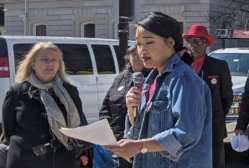
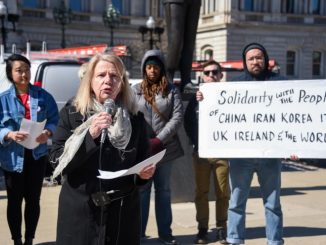
Standing in front of Baltimore City Hall, Sharon Black of the PPA read a list of demands. They included paid sick and childcare leave for all low-wage workers impacted by the illness. That means no reprisals or job loss for workers who are sick, quarantined or taking care of school children or family members. The activists also called for the city to halt evictions and foreclosures for those who are sick, quarantined or cannot work due to the crisis, and for free meal distributions to students in case any Baltimore City schools are forced to close.

‘Patients should not be afraid to seek care’

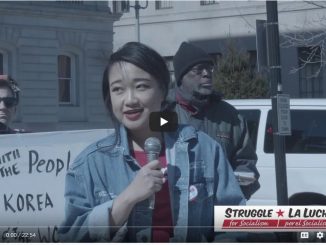
After the demands were read, Jennie Lu of NNU spoke to the importance of nurses having a constant voice in running hospitals and health care — not just during times of crisis. She pointed out that an “abysmal” 29 percent of nurses nationwide said that their employers had a plan to deal with Covid-19. “If nurses aren’t protected, then nobody is protected.”

The NNU also demanded Johns Hopkins cease suing patients for medical debt, which deters people from seeking care in the first place. When people can’t get treatment, they remain sick and have a higher chance of passing on illness. As Lu pointed out, medical debt hurts everyone, not just the poor.

Longtime Baltimore Civil Rights leader Marvin “Doc” Cheatham responded to the City Health Department’s recommendations for prevention: “We don’t need you to tell us what needs to be done. We need you to come work with us.” Cheatham also stressed the importance of neighbors banding together, not wasting time waiting for officials to respond.

Bonnie “Raven” Lane also gave practical demands to help address the concerns of Baltimore’s homeless people. She called on city officials and shelters to provide public washing stations and increase sanitation of public spaces, like busses and public parks.

Solidarity with the people of the world

Black, Indigenous and Latinx communities are even more endangered by this pandemic because of poverty and racist policies. This results in lower rates of health insurance coverage and less access to medical care. As the capitalist health care system fails us, Cuba offers to send doctors to the most vulnerable communities around the world. In Baltimore, labor unions, community organizations, activist groups and socialists are taking the lead in making progressive demands of city and state officials, while directly organizing the people to defend themselves from a crisis sparked by Covid-19 and a failing market. 

Strugglelalucha256


A people’s response to Covid-19

We place no confidence in the anti-science, climate-change deniers of the Trump administration, the pathetically inadequate for-profit U.S. health care system, or Big Pharma and Wall Street to address the Covid-19 (novel coronavirus) crisis. The truth is that only a socialized health care system that provides equal access and quality care for all, regardless of ability to pay or immigration status, can address this situation, which is causing fear and anxiety for millions of people. 

The Affordable Care Act of 2010 actually imposes financial penalties on those unable to afford health insurance; an estimated 27 million people still have no coverage. That’s not counting the millions more undocumented workers, and those whose coverage is so minimal as to be useless. The infrastructure required to contain and treat outbreaks such as Covid-19 exists in countries like China and Cuba, but is sorely lacking in the United States, the richest country in the world, where the disparity of rich and poor is also greatest.

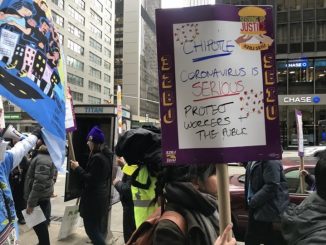
In New York, workers at Chipotle restaurants have held picket lines and walkouts to protest the company’s refusal to honor sick days. In Ohio, police in riot gear attacked University of Dayton students with tear gas and pepper balls on March 11, when they protested being abruptly evicted from student housing as the college shut down. Housing activists in Boston rallied on March 12 to demand a moratorium on evictions.

In Baltimore, community organizations led by the Peoples Power Assembly held a news conference and rally on March 7 to outline a people’s response to the Covid-19 crisis and demand action from city officials to protect the poorest and most vulnerable. Two days later in New Orleans, activists from the Hospitality Workers Alliance disrupted a mayoral press event, demanding that workers be provided with paid sick leave, health insurance and free testing for the virus.

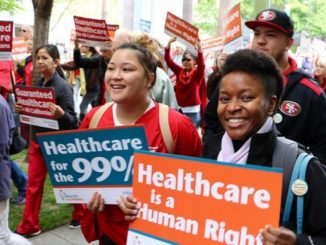
In Chicago, Augusta, Ga., and several California cities, National Nurses United held rallies at hospitals on March 11 to protest new CDC recommendations rolling back protections for health workers and patients.

Given the potentially life-or-death consequences, it’s no wonder that workers, students and communities are starting to take action across the country. What is urgently needed is to unite these local initiatives into a broad national movement whose demands address all the urgent needs of the workers and oppressed.

Can’t wait for November elections to respond

For an effective response to Covid-19 to succeed, it must involve the leadership of health care workers and members of the affected communities at all levels. The response to the Covid-19 crisis cannot wait for the outcome of the November elections.

As workers, organized and unorganized, unemployed and underemployed, Black, Latinx, Asian, Arab, Indigenous and white, undocumented people, women, LGBTQ2S people, students and youth, prisoners, homeless and disabled people, we must apply all forms of pressure to force the government to take the necessary measures for control and treatment of Covid-19, while ensuring that anti-Asian racism, xenophobia and other forms of discrimination against our communities or attacks on other countries are not substitued for real solutions. 

If the government fails to respond, what can be done? We must be prepared to take direct action to protect our class and communities, including taking over health care and other facilities in cooperation with health care workers and their unions, requisitioning medications and supplies, distributing food stores, and imposing a moratorium on rent and layoffs.

We must demand that all candidates for the U.S. presidency and other elected offices, as well as current elected officials, take a clear position. In particular, Bernie Sanders, who advocates Medicare for all, and the Sanders 2020 campaign, which has the most progressive stance on health care of all the Democratic and Republican campaigns, should be encouraged to participate on this question. 

  • We will not allow local, state or national “emergency declarations” to be used as an excuse for repression: for banning protests and strikes; nor for increasing the police occupation of Black and Brown communities; for jailing or deporting immigrants; or for the deployment of the National Guard or other military forces to prevent “looting,” that is, the liberation of the necessities of life and health from profiteers.
  • We demand that the U.S. government institute cooperation and assistance to other countries fighting the spread of Covid-19. We have seen how the Trump administration used the outbreak in Wuhan to score political points against China while sitting on its hands and doing nothing to assist in stopping the spread of the virus either here or abroad. This is unacceptable. The Covid-19 crisis is an international crisis and solving it requires international cooperation. 
  • Iran is suffering a severe outbreak and its efforts are being hampered by U.S.-imposed economic sanctions. All U.S. sanctions and blockades against other countries must be ended, including against Cuba, whose exemplary health care system and popular mobilizations in response to natural disasters are recognized as some of the best in the world.
  • In December 2019, the U.S. Congress, including most representatives and senators of both the Republican and Democratic parties, voted to give President Trump a $130-billion budget increase for the Pentagon. We demand that this money be rerouted from the bloated U.S. war machine to the international effort to stop the Covid-19 crisis and to create the infrastructure to deal with future pandemics. The many university research and development programs that operate in cooperation with the U.S. military industry should be repurposed for prevention and treatment of Covid-19, to save lives now and to improve the response to outbreaks in the future. 
  • Before President Trump silenced health officials and abruptly subordinated them to Vice President Mike Pence on Feb. 26, the Centers for Disease Control issued some advice to the public concerning Covid-19. One was for people to stock up on at least 2 to 3 weeks’ worth of nonperishable food items in case of a Covid-19 outbreak. But how many of us can afford to do that? More than three-quarters of U.S. workers live paycheck to paycheck, while a significant share of U.S. households would not be able to pay for an unexpected $400 emergency. Outrageously, this “advice” was given as the Agriculture Department is poised to deny SNAP benefits (food stamps) to 700,000 people beginning in April and to decrease the benefits of millions more. The USDA rule changes must be suspended. Nationwide, about 20 percent of the population suffers hunger or is in imminent danger of going hungry. The government must provide adequate food to the entire population, regardless of ability to pay.
  • Another piece of CDC advice was for workers to be prepared to stay home from work or telecommute. But how many workers really have that option? Millions do not even have access to paid sick leave. As a recent article by the Economic Policy Institute states, “The CDC recommendations all seem well and good but how does someone with no paid sick days or insurance cope?” The Homeland Security Act gives the president the right to declare a “major disaster,” and allows the president to provide unemployment benefits to anyone who becomes unemployed because of it, including anyone unpaid because of sick leave. Declaring a disaster allows the president to tap the Disaster Relief Fund, which contains billions of dollars.
  • For Covid-19 to be contained and treated, people must be able to seek out and access health care and other resources. How can migrant workers and refugees do so when they are threatened with arrest and deportation by U.S. Immigration and Customs Enforcement and Border Patrol agents? There must be an immediate, unconditional end to deportations. The tens of thousands of refugees caged by the U.S. across the country must be released and provided with adequate housing, health care and other necessary resources to live a healthy life. So too must the ever-growing population of homeless people, including families, and those housed in substandard, overcrowded and unsafe conditions. There must be a nationwide moratorium on evictions starting immediately. This would not bring down the economy. In fact, it would be a boost to the economy in general.
  • What about the prisons? The U.S. has by far the largest prison population on earth, with some of the worst conditions, particularly when it comes to health care. Communities disproportionately affected by mass incarceration and the prisoners themselves must be put in charge of determining the necessary measures to adequately protect them.
  • According to Wall Street and the corporate media, the dramatic drop in the stock market was caused by fear of Covid-19. But the profit system has been teetering on the edge of a recession for at least a year. Mass layoffs or wage cuts cannot be allowed to take place by blaming the virus. The government must institute an immediate moratorium on layoffs and wage cuts. 

These are just some examples of the measures that are required. Others will surely be raised and must also be addressed. Labor unions, community organizations, activist groups and socialists should take the lead in organizing people in every workplace, school and neighborhood to fight for these demands. 

On March 11, the city of San Francisco and the state of Washington banned “large gatherings,” while Washington, D.C., recommended cancelling or postponing any events of 1,000 people or more. The town of New Rochelle, a suburb of New York City, has been put under a containment zone for 14 days by New York Gov. Andrew Cuomo, who deployed the National Guard there.

Of course, many organizations, both mainstream and in the progressive movement, have postponed public events and closed event spaces to help contain the spread of the coronavirus. This is laudable. But the time may come soon when the risks of not taking action are greater than the risks of mass gatherings. And even after the current crisis is passed, workers and communities will likely have to fight to maintain and regain their right to protest, strike and organize.

The money, people-power and technology exist to respond to the threat of the Covid-19 outbreak and future dangers to the health and well-being of the people. But those resources must be taken over and mobilized by the people and for the people, not for the interests of the profit-hungry 1% who have shown time and again that they don’t care if we live or die.

Strugglelalucha256


Cuba: Better than ‘not all bad’

March 10 was election day in Michigan. One of the major issues brought forward in the Sanders campaign among many important ones like eliminating cash bail and racist mass incarceration, is Medicare for All. 

Sanders has been vilified for daring to say that Cuba is “not all bad.” The return to Cold War stereotypes about socialism and communism is a relic that has lost its punch with the younger folk. 

As we experience the chaos reigning across the U.S. as the capitalist economic system and neoliberal government structures deal with the Covid-19 virus epidemic, let’s reflect on how Cuba’s medical system might handle this differently.

First, of course, health care is a human right in Cuba. Everyone is covered for everything up to and including heart transplants. The U.S. blockade has made it difficult or impossible to get some equipment, replacement parts, medicine and more, but everyone is covered.

This is the aspect that compares with Medicare for All. The health care systems in all imperialist and former colonizer countries reportedly have this universal health coverage — with the lone exception being the United States.

Cuba better than ‘not all bad’

But Cuba also has family doctors who live in the neighborhood — every neighborhood, urban and rural. They know the health challenges faced by the human beings in their community. They are the first line in preventing sickness, together with the Committees in Defense of the Revolution block organizations.

Why does Cuba have fewer infant and maternal deaths than in the U.S. per capita? The key is prevention before cure.

If we had Cuban-style health care, our local doctors and nurses would be knocking on doors in New York, Washington, Maryland, California and other centers of the outbreak to test and interview everyone. Are you sick?

A general announcement in the U.S. has now declared that everyone over age 60 should stay indoors. But what if they work? Need to use a bus or subway for transportation? Who will tell their employer? Will they be paid even if they have no sick time? Will their job and income be there when the threat passes? How will they get food? In the U.S., the only safety net is the one we create for ourselves with our families and neighbors, our union and co-workers. But that isn’t enough.

What should you do if you are feeling sick? We are told “call your doctor,” but don’t go there. Most people don’t have a doctor, just an urgent care clinic run by a variety of drug stores or other companies or their health plan center. Visiting these centers potentially brings more people into contact with the virus, increasing the epidemic. How many places do you call before you get the contact number you need? How do you do this if you are sick and scared that a potentially deadly virus is attacking your body? 

This kind of question and insecurity do not stress the lives of Cubans because the responsibility to deal with social crises is not left to each individual to navigate. Solidarity and unity are their key to a life better in many ways than that in the U.S., although with fewer material things.

An ounce of prevention

An ounce of prevention is worth more than a pound of cure, except in the capitalist system, where the pound of cure rakes in megaprofits from Big Pharma and the corporate medical industry.

Cuba’s lower infant and maternal mortality and life expectancy equal to or better than that of the U.S. highlights the human improvement due to prevention-focused health care. And at a fraction of the cost spent in the U.S., where the cost is more than $10,000 per capita.

Medicare for All and a prevention focused health system is not the end of the story. Cuban Foreign Minister Bruno Rodríguez Parilla called for international solidarity to defeat Covid-19. The foreign minister’s tweet reported by Cuba News Agency “expressed the need to strengthen cooperation among the world’s nations, as well as the need to see health as a human right for all and not as a business in the hands of a few.”

The article pointed out that “Cuba has already defined strategies to contain the risk of entry and spread of the virus in the country.” But also, according to the press conference statement, “Dr. Manuel Romero Placeres, director of the Pedro Kouri Institute of Tropical Medicine (IPK) in Havana, warned that Covid-19 is one of the most virulent coronaviruses and is genotypically stronger, and if protective measures are not taken properly, the consequences of the epidemic could be disastrous.”

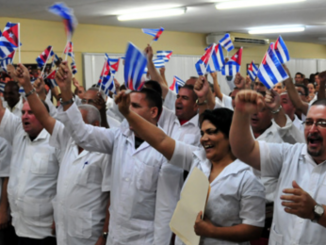
On a March 9 television program explaining Cuba’s special health preparations, Cuban Prime Minister Manuel Marrero Cruz reiterated that Cuba is standing beside the Chinese government and people, mentioning [Cuba’s] modest contribution in providing Interferon Alpha 2b, with proven results.”

In addition to following health procedures, U.S. residents must uplift the call to end economic warfare against Cuba, Venezuela, Iran, Zimbabwe and all other countries blockaded by U.S. imperialism. Medical and pharmaceutical research on a vaccine will benefit from open collaboration. China recognized this by internationally sharing the entire genome sequence for public health authorities, laboratories and researchers.

According to Dr. Trevor Bedford, quoted on Seattle’s Fred Hutchinson Cancer Research Center website, Basically, a week after registering that there’s this new thing, the amazing scientists in China have a genome for the novel virus that had never been seen before. … That first genome has been amazing for people developing rapid tests to be able to actually confirm cases.”

Strugglelalucha256


Health not profits! Italian union calls 32-hour strike amidst pandemic

Readers in the U.S. may be under the impression that everyone in Italy is shut up in their homes since the government declared a state of emergency over the spread of the Covid-19 coronavirus. But millions of nonessential workers are still being forced to report to work by the Conte regime and the bosses. Here’s an example of how workers are fighting back.

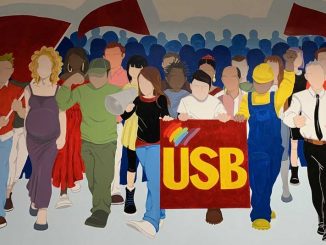
The Basic Union Syndicate (Unione Sindacale Di Base – USB) of Italy has called a 32-hour strike in nonessential industrial sectors, calling for a halt to factory production and a guarantee of workers’ health and wages.

The World Health Organization has declared a state of global pandemic; however, as the situation in our country grows more serious every day, the government of Prime Minister Giuseppe Conte has bowed again to Confindustria [General Confederation of Italian Industry], which insists on imposing the opening of all sectors, including nonessential ones.

Scrolling through the Prime Ministerial Decree of March 11, it turns out that industries, banks, call centers, TLC, commerce, logistics companies and most public offices will remain open. That is, millions of workers will continue to be forced to go to work while there is an epidemic going on.

In most cases, workers are not provided with the minimum tools for personal protection, and few companies sanitize their workplaces.

In the Decree of March 11, there are bland provisions, “smartworking” is unusable by those in production, and the invitation to close only departments unessential for production is provocative, as are many of the measures borne by workers, such as the use of holidays.

To deal with this emergency, drastic measures are required that are necessary for workers to safeguard health and wages. Therefore, we call for:

  • A temporary halt to all industrial activities except those strictly connected to the fight against the pandemic; 
  • Activation of social safety nets, including full wages; 
  • The adoption, and control by the relevant bodies, of all necessary measures corresponding to the levels of risk linked to specific work situations.

The USB has repeatedly urged the government, without receiving any response, and as we go back to forcefully ask for a meeting at Palazzo Chigi [the prime minister’s residence], we reiterate the workers’ right to strike to defend their safety, wages and general well-being.

The USB therefore calls for a first 32-hour general strike package of nonessential industrial sectors for each shift from March 12th. This package is renewable and can be increased beyond 32 hours at the local and company level.

Rome, March 12, 2020

Translated for Struggle-La Lucha by Greg Butterfield

Source: Contropiano

Strugglelalucha256


Coronavirus alert: NYers rally vs. U.S. sanctions which escalate global health crisis

On Wed., March 11, human rights groups gathered in front of the Trump building on Wall Street and charged Pres. Trump and Big Pharma with a criminal policy that threatens the world. This as a coalition of over 1,000 organizations and activists plan to hold “International Days of Action against Sanctions and Economic War” from March 13-15 to raise awareness about the enormous impact that sanctions imposed by the U.S. and its junior partners have on more than 39 countries ––1/3 of the world’s population.

Representatives of the International Action Center, December 12th Movement, Veterans for Peace, Nodutdol, Casa de las Americas, the International League of Peoples’ Struggle and additional organizations held a press conference to discuss the impact of U.S. sanctions on global health care and the battle against the coronavirus, and the March 13-15 Days of Action.

“U.S. sanctions particularly target health care, depriving millions of people of access to medicine and medical supplies,” said Amadi Ajamu, activist and December 12th Movement member. “According to reports by the Center for Economic and Policy Research and Korea Peace Now, sanctions are responsible for the deaths of 40,000 people in Venezuela over two years, and 4,000 people in North Korea in 2018, primarily due to lack of access to medicine. In Zimbabwe, Western sanctions handicapped the countries response to cholera outbreaks and last year’s devastation from Cyclone Idai. As the coronavirus continues to spread worldwide, the impact of U.S. sanctions on access to healthcare threatens to thwart attempts to contain the disease.”

Amadi concluded: “U.S. sanctions have severely hampered Iran’s efforts to respond to the coronavirus and accelerated it’s spread by limiting access to medical supplies, test kits and information about the virus. ”

[The March 14 NYC rally for the International Days of Action against Sanctions and Economic War has been postponed to a future date, yet to be determined.]

Source: Amsterdam News

Strugglelalucha256


STOCKS AND VIRUSES. Don’t let Wall Street panic get in the way of a much-needed coronavirus response

Holy cow! The Wall Street rollercoaster ride has taken a big plunge. By March 2, Wall Street stockholders had lost $4.6 trillion since the Feb. 19 market high. The percentage drop is changing too frequently to keep up.

The media call it the Covid-19 induced stock market crash.

But how could that be?

Humanly, the COVID-19 coronavirus can be devastating, more devastating in the United States than in other industrialized countries because there is no universal health care system.

Economically, the impact of a pandemic will only be a temporary slowdown. There is a fall in production as workers take time off sick. School closures increase the reduction in labor supply, as workers are forced to take time off to care for children. 

According to a study published in Health Economics, the fall in production is generally short term and is usually restored when workers come back and work overtime. 

The Wall Street bankers wouldn’t panic over reports of a pandemic. The COVID-19 coronavirus has caused an economic slowdown, mainly in China. China’s remarkable response fighting the coronavirus appears to have contained the spread of the virus. 

Oil overproduction crisis

The March 9 stock market nosedive partly reflected the price war in the crude oil markets.

“Oil prices fell through the floor in early trading Monday, tanking as much as 30 percent after Saudi Arabia slashed its crude prices for buyers,” CNBC reported.

“‘This has turned into a scorched Earth approach by Saudi Arabia, in particular, to deal with the problem of chronic overproduction,’ John Kilduff, founding partner of Again Capital, told CNBC.” The overproduction crisis has plagued Big Oil since at least 2018 and is not related to the drop in demand during the coronavirus epidemic. 

The virus-related drop in demand, however, is not a permanent condition and the industry normally has no trouble adjusting to known falls or rises in demand. 

The continuing fall of the stock market reflects the general instability in the capitalist mode of production for profit. The economy was already slowing, contracting. Capitalist economies periodically fall into crises of overproduction. Capitalists call it a profit crisis as the produced commodities cannot be sold at profit. The crisis triggers a major economic downturn, a full-on recession or even depression. 

As Axios reported on the day after a 7 percent stock market fall, “while the [COVID-19] outbreak itself is unlikely to drive an economic collapse, the U.S. has been something of a ticking time bomb for some time.

  • Growth has declined over the last two years despite higher government spending and a $23.4 trillion national debt.
  • While the labor market has boomed, many of the jobs added have been hourly service-industry positions that offer limited scope for savings or health insurance.
  • 44 percent of all U.S. workers earn barely enough to live on, a Brookings Institution study found in January.”

Bernie Sanders and Big Pharma

Business Insider reported on Feb. 26 that some on Wall Street are saying that the Bernie Sanders win in Nevada triggered the stock market fall.

“‘If this stock market reversal is due exclusively to the virus, then why is United Healthcare down far more than [the S&P 500]?’ Jeff Gundlach asked CNBC’s Scott Wapner in an email. ‘Why is health care as a sector broadly not outperforming?’ Answer to these questions: The market is digesting a better than 50 percent chance of Bernie getting the nomination.’”

The pharmaceutical-health care industry is maybe the most profitable in the U.S. The pharmaceutical companies have the highest profit margins in health care and some of the highest profit margins for any industry.

Health care is an industry, not a service. And its primary purpose is to produce a profit. Capitalism has predominated over health care in this country, maybe more than anywhere else on the planet. The insurance giants have blocked universal health care for more than a century.

More than a hundred years ago, in the 1912 elections, former President Theodore Roosevelt ran as the Progressive Party presidential candidate on a platform that included support for national health insurance. Roosevelt came in second in the popular vote, behind Democrat Woodrow Wilson but ahead of Republican Howard Taft. Socialist candidate Eugene Debs, who won 6 percent of the popular vote that year, also supported universal national health insurance. The country has suffered without it.

U.S. public health care is not only by far the worst system among rich countries, it is much worse than that of many middle-income or poorer countries when it comes to confronting a fast-moving epidemic. And it is by far the most expensive per capita with poorer outcomes than countries with national health care systems, including economically blockaded Cuba. 

Distributing a vaccine is not that difficult — World Health Organization workers managed it with smallpox even in the poorest regions of the world in the 1970s. Mobilizing medical professionals to administer in-home COVID-19 testing nationally or a hotline to effectively direct individuals who feel unwell are possible. But how can that be done with a health care system geared to price-gouge sick people out of as much money as possible?

Of course, Medicare for All would fix some of the worst abuses being seen in the U.S. health care system. And everyone knows it. Bernie Sanders, calling his platform democratic socialist, is campaigning for Medicare for All, as well as ending student debt, stopping deportations and a $15 minimum wage. But it’s not the politician and his promises that Wall Street heard, it’s the movement behind the campaign. Millions came out to vote, seen by many as a vote for socialism, a vote that says we can’t continue in the old way. It’s time for a change. That change zeroes in on Big Pharma and corporate health care profiteers.

Trump’s response

CNBC reported March 8 that “as confirmed cases of the coronavirus continue to rise, President Donald Trump has quickly embraced the pharmaceutical industry.” The solution, Trump says, will come from Big Pharma.

The Trump administration has decided to make the workers pay the cost of the coronavirus epidemic. The capitalist solution! It’s something like his Afghanistan policy, where Trump wants to privatize the war, that is, to turn it over to for-profit contractors like Erik Prince, making a deal with the Taliban that allows the U.S. to withdraw troops, but leave contractors in place.

The Trump administration has already made deep cuts in the funding of the Centers for Disease Control and Prevention. The CDC is the leading national public health institute of the United States. It should be at the head of any national response to an epidemic. Trump not only cut its budget, he has put a toadstool politician, Mike Pence, in charge of the response to COVID-19 and has overridden several CDC recommendations for responding to the coronavirus. The CDC has been practically pushed out.

Meanwhile, workers are being made to bear all the costs of the epidemic: health care costs, lost work days, even loss of jobs. Most are not paid enough to be able to take on the extra expense of the high-cost U.S. health care system. This, by the way, can only increase the spread of the virus and make the illness worse.

What’s needed

The U.S. needs to make tests available and free for all. It must also deliver the necessary health care free of charge. That means everyone, including the jobless, prisoners and immigrants, no matter what status. 

With a U.S. administration noted for crudely inflaming racism and anti-foreign bigotry, solidarity must triumph over any demonization of the sick or scapegoating of China or Asian people in general.

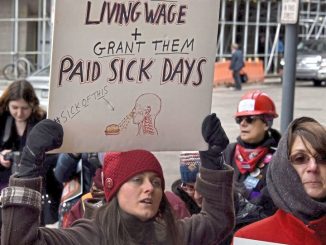
There needs to be full pay for sick leave, with complete job protection.

People must make a living wage to be able to meet the requirements of a health emergency.

The fight for free universal health care and a living wage has become even more urgent as the novel coronavirus COVID-19 sweeps through our cities. It’s a movement whose time has come.


Strugglelalucha256


Baltimore Peoples Proposals for COVID-19

Strugglelalucha256


A people’s response to COVID-19

We place no confidence in the anti-science, climate-change deniers of the Trump administration, the pathetically inadequate for-profit U.S. health care system, or Big Pharma and Wall Street to address the COVID-19 (novel coronavirus) crisis. The truth is that only a socialized health care system that provides equal access and quality care for all, regardless of ability to pay or immigration status, can address this situation, which is causing fear and anxiety for millions of people. 

The Affordable Care Act of 2010 actually imposes financial penalties on those unable to afford health insurance; an estimated 27 million people still have no coverage. That’s not counting the millions more undocumented workers, and those whose coverage is so minimal as to be useless. The infrastructure required to contain and treat outbreaks such as COVID-19 exists in countries like China and Cuba, but is sorely lacking in the United States, the richest country in the world, where the disparity of rich and poor is also greatest.

Can’t wait for November elections to respond

For an effective response to COVID-19 to succeed, it must involve the leadership of health care workers and members of the affected communities at all levels. The response to the COVID-19 crisis cannot wait for the outcome of the November elections.

As workers, organized and unorganized, unemployed and underemployed, Black, Latinx, Asian, Arab, Indigenous and white, undocumented people, women, LGBTQ2S people, students and youth, prisoners, homeless and disabled people, we must apply all forms of pressure to force the government to take the necessary measures for control and treatment of COVID-19, while ensuring that anti-Asian racism, xenophobia and other forms of discrimination against our communities or attacks on other countries are not substitued for real solutions. 

If the government fails to respond, what can be done? We must be prepared to take direct action to protect our class and communities, including taking over health care and other facilities in cooperation with health care workers and their unions, requisitioning medications and supplies, distributing food stores, and imposing a moratorium on rent and layoffs.

We must demand that all candidates for the U.S. presidency and other elected offices, as well as current elected officials, take a clear position. In particular, Bernie Sanders, who advocates Medicare for all, and the Sanders 2020 campaign, which has the most progressive stance on health care of all the Democratic and Republican campaigns, should be encouraged to participate and provide leadership on this question. 

  • We will not allow local, state or national “emergency declarations” to be used as an excuse for repression: for banning protests and strikes; nor for increasing the police occupation of Black and Brown communities; for jailing or deporting immigrants; or for the deployment of the National Guard or other military forces to prevent “looting,” that is, the liberation of the necessities of life and health from profiteers.
  • We demand that the U.S. government institute cooperation and assistance to other countries fighting the spread of COVID-19. We have seen how the Trump administration used the outbreak in Wuhan to score political points against China while sitting on its hands and doing nothing to assist in stopping the spread of the virus either here or abroad. This is unacceptable. The COVID-19 crisis is an international crisis and solving it requires international cooperation. 
  • Iran is suffering a severe outbreak and its efforts are being hampered by U.S.-imposed economic sanctions. All U.S. sanctions and blockades against other countries must be ended, including against Cuba, whose exemplary health care system and popular mobilizations in response to natural disasters are recognized as some of the best in the world.
  • In December 2019, the U.S. Congress, including most representatives and senators of both the Republican and Democratic parties, voted to give President Trump a $130-billion budget increase for the Pentagon. We demand that this money be rerouted from the bloated U.S. war machine to the international effort to stop the COVID-19 crisis and to create the infrastructure to deal with future pandemics. The many university research and development programs that operate in cooperation with the U.S. military industry should be repurposed for prevention and treatment of COVID-19, to save lives now and to improve the response to outbreaks in the future. 
  • Before President Trump silenced health officials and abruptly subordinated them to Vice President Mike Pence on Feb. 26, the Centers for Disease Control issued some advice to the public concerning COVID-19. One was for people to stock up on at least 2 to 3 weeks’ worth of nonperishable food items in case of a COVID-19 outbreak. But how many of us can afford to do that? More than three-quarters of U.S. workers live paycheck to paycheck, while a significant share of U.S. households would not be able to pay for an unexpected $400 emergency. Outrageously, this “advice” was given as the Agriculture Department is poised to deny SNAP benefits (food stamps) to 700,000 people beginning in April and decrease the benefits of millions more. The USDA rule changes must be suspended. Nationwide, about 20 percent of the population suffers hunger or is in imminent danger of going hungry. The government must provide adequate food to the entire population, regardless of ability to pay.
  • Another piece of CDC advice was for workers to be prepared to stay home from work or telecommute. But how many workers really have that option? Millions do not even have access to paid sick leave. As a recent article by the Economic Policy Institute states, “The CDC recommendations all seem well and good but how does someone with no paid sick days or insurance cope?” The Homeland Security Act gives the president the right to declare a “major disaster,” and allows the president to provide unemployment benefits to anyone who becomes unemployed because of it, including anyone unpaid because of sick leave. Declaring a disaster allows the president to tap the Disaster Relief Fund, which contains billions of dollars.
  • For COVID-19 to be contained and treated, people must be able to seek out and access health care and other resources. How can migrant workers and refugees do so when they are threatened with arrest and deportation by ICE and Border Patrol agents? There must be an immediate, unconditional end to deportations. The tens of thousands of refugees caged by the U.S. across the country must be released and provided with adequate housing, health care and other necessary resources to live a healthy life. So too must the ever-growing population of homeless people, including families, and those housed in substandard, overcrowded and unsafe conditions. There must be a nationwide moratorium on evictions starting immediately. This would not bring down the economy. In fact, it would be a boost to the economy in general.
  • What about the prisons? The U.S. has by far the largest prison population on earth, with some of the worst conditions, particularly when it comes to health care. Communities disproportionately affected by mass incarceration and the prisoners themselves must be put in charge of determining the necessary measures to adequately protect them.
  • According to Wall Street and the corporate media, the dramatic drop in the stock market in late February was caused by fear of COVID-19. But the profit system has been teetering on the edge of a recession for at least a year. Mass layoffs or wage cuts cannot be allowed to take place by blaming the virus. The government must institute an immediate moratorium on layoffs and wage cuts. 

These are just some examples of the measures that are required. Others will surely be raised and must also be addressed. Labor unions, community organizations, activist groups and socialists should take the lead in organizing people in every workplace, school and neighborhood to fight for these demands. 

The money, people-power and technology exist to respond to the threat of the COVID-19 outbreak and future dangers to the health and well-being of the people. But those resources must be taken over and mobilized by the people and for the people, not for the interests of the profit-hungry 1% who have shown time and again that they don’t care if we live or die.

Strugglelalucha256


China buys time for world but Trump, Wall Street can’t cope with COVID-19 crisis

The White House held a rare press conference Feb. 26, trying to calm financial markets after fear of a COVID-19 outbreak caused the largest stock market tumble in years. President Donald Trump painted a rosy picture of the situation in the U.S., contradicting the national health officials who were lined up alongside him. 

Wall Street markets — already jittery over the looming capitalist crisis of overproduction — lost $3 trillion immediately following an announcement by the U.S. Centers for Disease Control (CDC) declaring a national health emergency. Investors are terrorized by the prospect of an epidemic, not for humane reasons, but because of its potential impact on profits.

Trump didn’t mention at the press conference that, in 2018, his administration disbanded a global health security team whose job it had been to implement a national biodefense strategy, or that he cut the budget for global health by 20 percent.

Nor did he mention that Vice President Mike Pence, whom Trump appointed to head his “task force” on COVID-19, blocked life-saving measures to stop the spread of HIV during his tenure as Indiana governor.

As China has been battling the disease, epidemiologists and scientists repeatedly warned that all countries should prepare for an outbreak. The number of new COVID-19 cases has slowed in China, but the virus has now reached 44 other countries, and the World Health Organization (WHO) reported Feb. 26 that the number of new cases outside China had exceeded the number in China for the first time.

Western politicians’ and media’s slander of China and articles of gloom and doom have fed racist, anti-Asian violence in places where infections have occurred or been feared, from the San Fernando Valley in California to New York City, from Manchester, England, to Italy, France and Australia.

China’s campaign to control the virus has been at great cost: medical staff risking and losing their lives but bravely carrying on, public transportation shut down, millions of people confined to their apartments, workplaces halted and an economic loss of $196 billion in January.

But there was no hesitation. The Chinese people knew what had to be done. Their historic actions were enabled by a planned, centralized social system put in place by the 1949 revolution, and by unity in the face of the crisis. 

China’s war against the virus is looking more successful every day, as the daily count of new cases has slowed. The sacrifices made by the Chinese people have bought time for the rest of the world.

U.S. health care system unprepared

WHO Director General Tedros Adhanom Ghebreyesus has expressed numerous times that his biggest concern has been the spread of the virus to countries that are less capable of controlling it than China is. 

One might have interpreted his remarks to refer to impoverished countries with capitalist economies so drained by imperialist exploitation — their health care systems battered and weakened by budget cuts imposed by the International Monetary Fund. Of course, the danger is great in impoverished countries. 

But as William Haseltine pointed out in a Feb. 24 L.A. Times Op Ed, the U.S. has shown itself to be in a health care crisis with every influenza outbreak: “Just two years ago … patients seeking treatment … found themselves in war zones. Hospitals turned away ambulances, imported nurses from elsewhere and erected parking lot tents when they ran out of beds. Surgeries had to be canceled and hospitals ran out of supplies.”

The fatalities from COVID-19 are roughly 2 percent, or 2,000 out of 100,000 infections. That is far less than those of the outbreaks of related infections like SARS (Severe Acute Respiratory Syndrome) and MERS (Middle Eastern Respiratory Syndrome) earlier in this century that took the lives of 25 percent and 34 percent of those infected, respectively. But it’s more than the annual outbreaks of influenza that take the lives of 14 out of 1,000 infected patients. 

Had China not moved so boldly, the worldwide death toll could have been catastrophic. Nearly 90 percent of COVID-19 cases result only in mild symptoms. Ironically, that coupled with the fact that human to human transmission of the disease can happen almost immediately after the infection, makes the disease extremely difficult to contain, because many people think they have a cold and continue with normal work and social interaction. 

All of this points to the enormous challenge that the Chinese people have faced and validates their plan to make containment the first order of business.

China prioritizes virus containment

In addition to a strategy of keeping workplaces closed and a quarantine that at its peak affected 100 million people to varying degrees, drones sprayed disinfectant on the streets of Wuhan and broadcast messages encouraging people to stay indoors. Food was delivered to people’s doorsteps.

Although Western media accused the Chinese government of not being transparent in its efforts to combat the virus, this video posted on YouTube is an example of the material released to explain the crisis in scientific terms, the timeline of events, and offer guidelines to help curb the outbreak. 

Interviews with quarantined people and medical staff show what a hard time it has been for the Chinese people, but also the confidence that they have in the Chinese Communist Party leadership. 

The People’s Liberation Army staffed a newly built hospital — one of two new hospitals built for COVID-19 patients in record time. International help was solicited by the Chinese leadership, including a delegation of scientists from the World Health Organization, and medications to help with treatment were sought and received from other countries. 

Notably, revolutionary Cuba, one of the world’s pioneers of biotechnological medicine despite the brutal U.S. economic blockade, has provided a medicine with antiviral properties that is being used in treatment.

Strugglelalucha256
https://www.struggle-la-lucha.org/covid-19/page/8/