Biden escalates ‘forever war’ in Somalia

Biden has authorized the redeployment of hundreds of troops in Somalia, thus reversing Trump’s December 2020 decision. The U.S. plans to establish a “persistent military presence” there. This new development is not very surprising, and in fact Washington had never quite left the country but has always maintained at least an advisory presence.

The U.S. has had an “invisible” presence in Africa for a while, encompassing a whole range of covert and clandestine operations – this includes the Horn of Africa, where Somalia is located. Washington has been militarily involved in the country since the early 1990s, as part of a humanitarian intervention in the context of civil war. By the early 2000s, violent fundamentalist Islamic groups started to grow in power and numbers, including the al-Shabaab, which started an insurgency in 2006-7.

At the end of his presidential term, former United States President Donald Trump had removed most troops from this African country, redeploying them to nearby states, so as to offer remote assistance to the Somali authorities against the al-Shabaab rebels. Recent U.S. intelligence reports claim that since the troops left, this group has grown stronger.

In July 2021 the Biden administration carried its first airstrike on Somali soil against al Shabaab combatants, shortly after withdrawing troops from Afghanistan. This took place without White House’s approval and was justified by the Pentagon by invoking the 2001 “Authorization for the Use of Military Force”, even thought this pertains to the terrorist groups that attacked the World Trade Center towers twenty years ago. In a context of growing mobilization in both houses to reclaim oversight of the very war powers the Presidency and the Pentagon have accumulated since the 911 attacks in 2001, even top Democrats (from Biden’s own party) warned  that such actions were a “dangerous precedent”. Even so, other such strikes followed – there was a major one in February 2022, for example. Voices within the Pentagon had been defending the redeployment of troops in Somalia since early 2021. It has finally happened.

One of recently elected Somali President Hassan Sheikh Mohamud’s first actions was to issue a statement thanking President Biden for the redeployment and describing Washington as a “reliable partner” in the country’s anti-terrorism efforts. However several sectors of the country’s society dispute this description.

According to an Amnesty International April 2020 report, by the year 2020 the U.S. Africa Command (AFRICOM) had already conducted hundreds of air strikes over a decade, with zero acountability for the deaths of civilians, who were routinely labeled as “terrorists”, and with no compensation of any kind to the families.

According to former Senior Director for Counterterrorism at the National Security Council (in the U.S.) Luke Hartig, it is simply not clear how Biden’s escalation of Washington’s “forever war” in Somalia even fits into the United States larger counterterrorism strategy, and this is so because the White House so far has not released its own National Strategy for Counterterrorism. As a result of this lack of transparency, nobody really knows what the strategy is and one can only speculate.

It is widely known, for example, that U.S. oil companies, such as Coastline Exploration Ltd, have interests in the country. Already in 1993, a Los Angeles Times article stated that  “nearly two-thirds of Somalia was allocated to the U.S. oil giants Conoco, Amoco, Chevron, and Phillips”.

When discussing Somalia, not so much is talked, though, about U.S.-China geopolitical competition in the region. Already in January 2021 the FPRI website published a piece by former U.S. Ambassador to Somalia Stephen M. Schwartz arguing that the withdrawal of troops could “open the door” to a “greater role for the People’s Republic of China” on the continent. Moreover, he argued that Somalia is “more” than just al-Shabaab. Chinese presence in Africa is of course a great concern for Washington.

More recently, in a March 18, 2002 article, former Pentagon official Michael Rubin criticized Biden’s “neglect” of Africa in general and of Somalia and its neighboring region, arguing that it was about time Washington provided “democratic, pro-Taiwan Somaliland” with the means to “defend itself against a Chinese-backed regime”. The Republic of Somaliland is a de facto state internationally considered to be part of Somalia, which lies  on the southern coast of the Gulf of Aden, a very strategic area, for a number of reasons, and is bordered by Djibouti, where China has its only overseas military base.

There is no indication so far the current administration will pursue any such policy pertaining to Somaliland especifically. In any case, for Washington, its activities in Somalia and in the larger Horn of Africa region are in now way merely about classic counter-terrorism operations. It is also about a kind of great power competition with Beijing.

While carrying on such a geopolitical dispute, the very legality of the U.S. military actions has been disputed, and Washington’s terrible record of human rights infringement in the region has been largely forgotten, while Biden’s presidency still hypocritically pursues the narrative of a moral leadership regarding human democracy and the rule of law.

Uriel Araujo is aresearcher with a focus on international and ethnic conflicts.

Source: InfoBrics
Strugglelalucha256


Is this the end of the French project in Africa’s Sahel?

On May 15, 2022, the military junta in Mali announced that it would no longer be part of the G5 Sahel platform. The G5 Sahel was created in Nouakchott, Mauritania, in 2014, and brought together the governments of Burkina Faso, Chad, Mali, Mauritania and Niger to collaborate over the deteriorating security situation in the Sahel belt—the region just below the Sahara desert in Africa—and to increase trade among these countries. Behind the scenes, it was clear that the formation of the G5 Sahel was encouraged by the French government, and that, despite all the talk of trade, the real focus of the group was going to be security.

In early 2017, under French pressure, these G5 Sahel countries created the G5 Sahel Joint Force (FC-G5S), a military alliance to combat the security threat posed by the aftermath of the Algerian civil war (1991-2002) and the detritus of NATO’s 2011 war in Libya. The G5 Sahel Joint Force received the backing of the United Nations Security Council to conduct military operations in the region.

Mali’s military spokesperson Colonel Abdoulaye Maïga said on May 15 that his government had sent a letter on April 22 to General Mahamat Idriss Déby Itno—President of Chad’s transitional military council and the outgoing president of the G5 Sahel—informing him of Mali’s decision; the lack of movement in holding the conference of the G5 Sahel heads of state, which was supposed to take place in Mali in February, and handing over the rotating presidency of the FC-G5S to the country, forced Mali to take the action of leaving both the FC-G5S and the G5 Sahel platform, Colonel Maïga said on national television.

The departure of Mali was inevitable. The country has been torn apart by austerity policies pushed by the International Monetary Fund (IMF) and by conflicts that run along the length of this country of more than 20 million people. Two coups d’état in 2020 and 2021 in Mali were followed up with the promise of elections, which do not seem to be on the horizon. Regional bodies, such as the Economic Community of West African States (ECOWAS), have also imposed tough sanctions against Mali, which has only exacerbated the economic problems already being faced by the Malian people. The G5 Sahel defense ministers last met in November 2021, and the G5 Sahel member countries’ heads of state meeting in February 2022 was postponed. Mali was meant to take over the rotating presidency of G5 Sahel, but the other states who are part of the platform were not keen on this transfer (Chad has continued with the presidency).

Extra-regional power

The statement by Mali’s military blamed the institutional drift in the G5 Sahel on the “maneuvers of an extra-regional state desperately aiming to isolate Mali.” This “extra-regional state” is France, which Mali says has tried to “instrumentalize” the G5 Sahel for French objectives.

The five members of G5 Sahel are all former French colonies, who ejected the French through anti-colonial struggles and attempted to build their own sovereign states. These countries suffered assassinations (such as that of Burkina Faso’s former leader Thomas Sankara in 1987), dealt with IMF austerity programs (such as the measures taken against the government of Mali’s former President Alpha Oumar Konaré from 1996 to 1999), and faced the reassertion of French power (such as when France backed Chad’s Marshall Idriss Déby against Hissène Habré in 1990). After the French-initiated NATO war against Libya in 2011, and the destabilization it wrought, France intervened militarily in Mali through Operation Barkhane, and then—along with the United States military—it intervened across the Sahel as part of the G5 Sahel platform.

Since the reentry of the French military in the region, it has driven an agenda that seems to be more about catering to Europe’s needs than those of the Sahel region. The main argument made for the French (and U.S.) intervention in the Sahel is that they want to partner with the militaries of the region to combat terrorism. It is true that there has been a rise in militancy—some of it rooted in the expansion of Al Qaeda and the Islamic State activities in the Sahel. Conversations with officials in the Sahel states, however, reveal that they do not believe that countering terrorism is the main issue for French pressure on their governments. They believe, although they are wary of going on the record, that the Europeans are worried more about the issue of migration than that of terrorism. Rather than allow migrants—many from West Africa and West Asia—to reach the Libyan coast and make an attempt to cross the Mediterranean Sea, they want to build a perimeter in the Sahel to limit the migrant movement beyond that; France has, in other words, moved the southern border of Europe from north of the Mediterranean to south of the Sahara.

Poorest place on Earth

“We live in one of the poorest places on earth,” former Malian President Amadou Toumani Touré told me before he died in 2020. About 80 percent of the people of the Sahel live on less than $1.90 a day, and the population growth in this region is expected to rise from 90 million in 2017 to 240 million by 2050. The Sahel belt owes a vast debt to the wealthy bondholders in the North Atlantic states, who are not prepared for debt forgiveness. At the seventh summit of the G5 Sahel in February 2021, the heads of state called for a “deep restructuring of the debt of the G5 Sahel countries.” But the response they received from the IMF was deafening.

Part of the budgetary problem is the demands made on these states by France to increase their military spending against any increase in their spending for humanitarian relief and development. The G5 Sahel countries spend between 17 percent and 30 percent of their budgets on their militaries. Three of the five Sahel countries have increased their military spending astronomically over the past decade, according to the Stockholm International Peace Research Institute: Burkina Faso by 238 percent, Mali by 339 percent, and Niger by 288 percent. The arms trade is suffocating these countries. With the potential entry of NATO into the region, this illusionary form of treating the Sahel’s problems as security problems will only persist. Even for the United Nations, the questions of development in the area have become an afterthought to the main focus on war.

Lack of support for the civilian governments to deal with the real problems in the region has led to military coups in three of the five countries: Burkina Faso, Chad and Mali. The military junta in Mali ejected the French military from Mali’s territory on May 2, a week before it left G5 Sahel. Indications of disquiet regarding French policies swirl around the region. Will Mali’s example be followed by any of the other countries who are part of the G5 Sahel group, and will France’s real project in the Sahel—to limit migration of people from the Global South to Europe—eventually collapse with Mali’s exit from the G5 Sahel?

This article was produced by Globetrotter. Vijay Prashad is an Indian historian, editor and journalist. He is a writing fellow and chief correspondent at Globetrotter. He is an editor of LeftWord Books and the director of Tricontinental: Institute for Social Research. He is a senior non-resident fellow at Chongyang Institute for Financial Studies, Renmin University of China. He has written more than 20 books, including The Darker Nations and The Poorer Nations. His latest book is Washington Bullets, with an introduction by Evo Morales Ayma.

Strugglelalucha256


Why ‘Bolivia is the center of the world’ for people’s movements

Humanity finds itself at a crucial moment. It’s not only war and climate change that threaten life on our planet. Ideologies and some people do too.

We know that money and the production of wealth and well-being have created an ever greater and more profound gap between people, neighborhoods, cities and countries—a gap that has been exacerbated by the pandemic.

So, I’d like us (my fellow Bolivians and Indigenous peoples) to stop thinking of ourselves as the poor periphery of a process of globalization that has been unequal, colonial and racist.

In Bolivia, since the beginning of this century, we have battled some of the most important and decisive questions for the future of the human race: water, our sacred coca leaf, the goods we have which we can share thanks to the generosity of the Pachamama and, of course, the right to make decisions collectively about our lives.

Each battle, each sacrifice made, from places like El Alto and Cochabamba, has repeatedly confronted us with the owners of power and money.

At the core of each one of our struggles is our overriding need to stay alive, to finally construct a world fit for all of us to live with dignity.

Not tomorrow, today. Bolivia is the center of the world, as is North Dakota or Chiapas, or the poor neighborhoods of Caracas.

Yes, we are poor and far from the powerful centers of economic and political decision-making. But at the same time, we live in the center of the most important battles—battles fought from our smallest trenches, communities, neighborhoods, cities, jungles and forests.

What I’m describing to you isn’t merely a simple change in discourse. We want to think about ourselves differently, because if we do that at the core of the true struggle for survival, we can look at the world and at our sisters and our brothers with new eyes. If we are condemned to be at the margins, we will not get far.

It is by constructing in this way, from the hundreds and thousands of centers in which life is defined, that we fight for what is most essential: water, food, shelter, education and dignity—perhaps from this we can construct a new horizon. Weaving together our needs, our achievements, and even our errors, it’s possible to dismantle centuries of colonialism, the brutal pillaging of our territories, and the forced subjugation of our people.

In Bolivia, we have had to draw on our millennia-old Aymara and Quechua traditions and knowledge, for example, peoples who define much of what this country is. But it’s not only Indigenous peoples who have fought against imperialism, nor is it the obligation of one people to be the vanguard or the moral reserve for the human race.

We are what we are. We know, among ourselves, what our grandparents passed down to us. For that reason, from our lived experience, I invite you to begin this journey, firstly by reestablishing what is important so that we can begin to view ourselves like the people in the streets of Cochabamba were viewed after the Water Wars, knowing that it is possible and that there is another life waiting beyond the barricades, beyond the strikes and the roadblocks, and that is our common heritage.

This also happened to us in October 2003, when El Alto (near the capital city of La Paz) was converted, for a few moments, into the center of the world. With sticks and with stones, with their will, the Aymara rejected the selling off of our riches—a death prescribed by a corrupt and foolish president.

There, in this burning epicenter, everything that matters was at stake. The centers of power and global decision-making were our periphery. Without a doubt, I do not think we are the periphery. This mini-census is not intended to be paralyzing. Quite the opposite.

As a Bolivian, as an Aymara, as someone who has lived within one of the most decisive battles to change everything, I know that we can’t ignore the daily catastrophe we saw in Sri Lanka, in the boats filled with refugees in the Mediterranean, in that wall that separates North America from the rest of the Americas, in the Aboriginal territories of Australia, or in the famine experienced by the girls and boys in La Guajira in Colombia.

To be able to view the immensity of our horizon, to be able to daydream when we look upon the Andean Altiplano and its peaks, perhaps we should give ourselves a different perspective, a new center.

In Bolivia, like in so many other places, what’s at stake is not a set of goods or a piece of land, not even a government. We have fought to defend life itself, to nourish it, and to watch it grow with dignity. We do not know of anything more important to do in these difficult times.

We are the center of the world.

Adapted from Rogelio Mayta’s speech to the Progressive International’s Summit at the End of the World on May 12, 2022.

This article was produced by Globetrotter. Rogelio Mayta is the foreign minister for the Plurinational State of Bolivia.

Strugglelalucha256


Mali’s military ejects France but faces serious challenges

On May 2, 2022, a statement was made by Mali’s military spokesperson Colonel Abdoulaye Maïga on the country’s national television, where he said that Mali was ending the defense accords it had with France, effectively making the presence of French troops in Mali illegal. The statement was written by the military leadership of the country, which has been in power since May 2021.

Colonel Maïga said that there were three reasons why Mali’s military had taken this dramatic decision. The first was that they were reacting to France’s “unilateral attitude,” reflected in the way France’s military operated in Mali and in the June 2021 decision by French President Emmanuel Macron to withdraw French forces from the country “without consulting Mali.” France’s military forces moved to nearby Niger thereafter and continued to fly French military planes over Malian airspace. These violations of Malian airspace “despite the establishment of a temporary no-fly zone by the Malian military authorities” constituted the second reason for the new declaration, according to the statement. Thirdly, Mali’s military had asked the French in December 2021 to revise the France-Mali Defense Cooperation treaty. Apparently, France’s answer to relatively minor revisions from Mali on April 29 displeased the military, which then issued its statement a few days later.

‘Neither Peace, Nor Security, Nor Reconciliation’

Over the past few years, French forces in Mali have earned a reputation for ruthless use of aerial power that has resulted in countless civilian casualties. A dramatic incident took place on January 3, 2021, in the village of Bounti in the central Mopti region of Mali, not far from Burkina Faso. A French drone strike killed 19 civilians who were part of a wedding party. France’s Defense Minister Florence Parly said, “The French armed forces targeted a terrorist group, which had been formally identified as such.” However, an investigation by the United Nations mission in Mali (the United Nations Multidimensional Integrated Stabilization Mission in Mali, or MINUSMA) found that the French drone fired at a marriage celebration attended by about 100 people (which might have included five armed persons).

Two months later, on March 5, 2021, in the village of Talataye, east of Bounti, a French airstrike killed three teenage children and injured two others, who were all out hunting birds. The father of the three deceased children—Adamou Ag Hamadou, a shepherd—said that the children had taken their cattle to drink water and then had gone off to hunt birds with their two hunting rifles. “When I arrived at the scene of the airstrike,” Ag Hamadou remembered, “there were other people from this [hunting] camp. From 1 p.m. until 6 p.m., we were able to collect the pieces of their bodies that we buried.”

These are some of the most dramatic incidents. Others litter the debate over the French military intervention in Mali, but few of these stories make it beyond the country’s borders. There are several reasons for the global indifference to these civilian deaths, one of them being that these atrocities perpetrated by Western states during their interventions in Africa do not elicit outrage from the international press, and another is that the French have consistently denied even well-proven incidents of what should be considered war crimes.

For example, on June 8, 2019, French soldiers fired at a car in Razelma, outside Timbuktu, killing three civilians (one of them a young child). The French military made a bizarre statement about the killing. On the one hand, the French said that the killing was “unintentional.” But then, on the other hand, the French authorities said that the car was suspicious because the car did not stop despite warning shots being fired at it. Eyewitnesses said that the driver of the car was helping a family move to Agaghayassane and that they were not linked to any terrorist group. Ahmad Ag Handoune, who is a relative of those killed in this attack and who drove up to the site after the incident, said that the French soldiers “took gasoline and then poured it on the vehicle to set everything on fire so that nothing was identifiable.”

Protests against the French military presence have been taking place for over a year, and it is plausible to say that the May 2021 military coup, which installed the present military leadership of the country to power, was partly due to both the failure of the French intervention in Mali to bring about stability and its excesses. Colonel Assimi Goïta, who leads the military junta, said that the agreement with the French “brought neither peace, nor security, nor reconciliation” and that the population aspires “to stop the flow of Malian blood.”

No Way Forward

On the day that the Malians said that the presence of French troops on their soil was illegal with the ending of the defense accords, United Nations Secretary-General António Guterres paid a visit to neighboring Niger. When France’s army withdrew from Mali, they relocated to Niger, whose president, Mohamed Bazoum, tweeted his welcome to these troops. Guterres, standing beside Bazoum, said that terrorism is “not just a regional or African issue, but one that threatens the whole world.”

No one denies the fact that the chaos in the Sahel region of Africa was deepened by the 2011 NATO war against Libya. Mali’s earlier challenges—including a decades-long Tuareg insurgency and conflicts between Fulani herders and Dogon farmers—were now convulsed by the entry of arms and men from Libya and Algeria. Three jihadi groups appeared in the country as if from nowhere—Al Qaeda in the Islamic Maghreb, Movement for the Unification of Jihad in the African West, and Ansar Dine. They used the older tensions to seize northern Mali in 2012 and declared the state of Azawad. French military intervention followed in January 2013.

Iyad Ag Ghali, a Tuareg leader from Kidal, fought in Libya and Mali. In the early 2000s, Ag Ghali set up the Alliance for Democracy and Change, which advocated for Tuareg rights. “Soft-spoken and reserved,” said a 2007 U.S. Embassy cable about him. “Ag Ghali showed nothing of the cold-blooded warrior persona created by the Malian press.” After a brief stint as a diplomat to Saudi Arabia, Ag Ghali returned to Mali, befriended Amadou Koufa, the leader of the Macina Liberation Front, and drifted into the world of Sahelian jihad. In a famous 2017 audio message, Amadou Koufa said, “The day that France started the war against us, no Fulani or anyone else was practicing jihad.” That kind of warfare was a product of NATO’s war on Libya and the arrival of Al Qaeda, and later ISIS, to seek local franchise with local grievances to nurture their ambitions.

Conflicts in Mali, as the former President Alpha Oumar Konaré said over a decade ago, are inflamed due to the suffocation of the country’s economy. Neither did the country receive any debt relief nor infrastructure support from the West or international organizations. This landlocked state of more than 20 million people imports 70 percent of its food, the prices for which have skyrocketed in recent weeks, and could further worsen food insecurity in Mali. Part of the instability of the post-NATO war has been the military coups in Mali, Guinea and Burkina Faso. Mali faces harsh sanctions from the Economic Community of West African States (ECOWAS), sanctions that will only deepen the crisis and provoke greater conflict north of Mali’s capital, Bamako.

Anti-French sentiment is not the whole story in Mali. What France and other global leaders need to recognize is that there are many larger questions at the root of the issues Malians face—questions around their livelihood and their dignity, which need to be answered to secure a better future for the country.

This article was produced by Globetrotter. Vijay Prashad is an Indian historian, editor and journalist. He is a writing fellow and chief correspondent at Globetrotter. He is the chief editor of LeftWord Books and the director of Tricontinental: Institute for Social Research. He is a senior non-resident fellow at Chongyang Institute for Financial Studies, Renmin University of China. He has written more than 20 books, including The Darker Nations and The Poorer Nations. His latest book is Washington Bullets, with an introduction by Evo Morales Ayma.

Strugglelalucha256


Why Latin America needs a new world order

The world wants to see an end to the conflict in Ukraine. The NATO countries, however, want to prolong the conflict by increasing arms shipments to Ukraine and by declaring that they want to “weaken Russia.” The United States had already allocated $13.6 billion to arm Ukraine. Biden has just requested $33 billion more. By comparison, it would require $45 billion per year to end world hunger by 2030.

Even if negotiations take place and the war ends, an actual peaceful solution will not likely be possible. Nothing leads us to believe that geopolitical tensions will decrease, since behind the conflict around Ukraine is an attempt by the West to halt the development of China, to break its links with Russia, and to end China’s strategic partnerships with the Global South.

In March, commanders of the U.S. Africa Command (General Stephen J. Townsend) and Southern Command (General Laura Richardson) warned the U.S. Senate about the perceived dangers of increased Chinese and Russian influence in Africa as well as Latin America and the Caribbean. The generals recommended that the United States weaken the influence of Moscow and Beijing in these regions. This policy is part of the 2018 national security doctrine of the United States, which frames China and Russia as its “central challenges.”

No Cold War

Latin America does not want a new cold war. The region has already suffered from decades of military rule and austerity politics justified based on the so-called “communist threat.” Tens of thousands of people lost their lives and many tens of thousands more were imprisoned, tortured, and exiled only because they wanted to create sovereign countries and decent societies. This violence was a product of the U.S.-imposed cold war on Latin America.

Latin America wants peace. Peace can only be built on regional unity, a process that began 20 years ago after a cycle of popular uprisings, driven by the tsunami of neoliberal austerity, led to the election of progressive governments: Venezuela (1999), Brazil (2002), Argentina (2003), Uruguay (2005), Bolivia (2005), Ecuador (2007), and Paraguay (2008). These countries, joined by Cuba and Nicaragua, created a set of regional organizations: the Bolivarian Alliance for the Peoples of Our America–Peoples’ Trade Treaty (ALBA-TCP) in 2004, the Union of South American Nations (UNASUR) in 2008, and the Community of Latin American and Caribbean States (CELAC) in 2011. These platforms were intended to increase regional trade and political integration. Their gains were met with increased aggression from Washington, which sought to undermine the process by attempting to overthrow the governments in many of the member countries and by dividing the regional blocs to suit Washington’s interests.

Brazil

Because of its size and its political relevance, Brazil was a key player in these early organizations. In 2009, Brazil joined with Russia, India, China, and South Africa to form BRICS, a new alliance with the goal to rearrange the power relations of global trade and politics.

Brazil’s role did not please the White House, which—avoiding the crudeness of a military coup—staged a successful operation, in alliance with sectors of the Brazilian elite, that used the Brazilian legislature, judiciary system, and media to overthrow the government of President Dilma Rousseff in 2016 and to cause the arrest of President Lula in 2018 (who was then leading the polls in the presidential election). Both were accused of a corruption scheme involving the Brazilian state oil company, and an investigation by Brazil’s judiciary known as Operation Car Wash ensued. The participation of both the U.S. Department of Justice and the FBI in that investigation was revealed following a massive leak of the Telegram chats of Operation Car Wash’s lead prosecutor. However, before the U.S. interference was uncovered, the removal of Lula and Dilma from politics brought the right wing back to power in Brasília; Brazil no longer played a leading role in either the regional or the global projects that could weaken U.S. power. Brazil abandoned UNASUR and CELAC, and remains in BRICS only formally—as is also the case with India—weakening the perspective of strategic alliances of the Global South.

Turning tide

In recent years, Latin America has experienced a new wave of progressive governments. The idea of regional integration has returned to the table. After four years without a summit meeting, CELAC reconvened in September 2021 under the leadership of Mexican President Andrés Manuel López Obrador and Argentine President Alberto Fernández. Should Gustavo Petro win the Colombian presidential election in May 2022, and Lula win his campaign for reelection to Brazil’s presidency in October 2022, for the first time in decades, the four largest economies in Latin America (Brazil, Mexico, Argentina, and Colombia) would be governed by the center-left, notably supporters of Latin American and Caribbean integration. Lula has said that if he wins the presidency, Brazil will return to CELAC and will resume an active stance in BRICS.

The Global South might be prepared to reemerge by the end of the year and create space for itself within the world order. Evidence for this is in the lack of unanimity that greeted NATO’s attempt to create the largest coalition to sanction Russia. This NATO project has aroused a backlash around the Global South. Even governments that condemn the war (such as Argentina, Brazil, India, and South Africa) do not agree with NATO’s unilateral sanction policy and prefer to support negotiations for a peaceful solution. The idea of resuming a movement of the nonaligned — inspired by the initiative launched at the conference held in Bandung, Indonesia, in 1955 — has found resonance in numerous circles.

Their intention is correct. They seek to de-escalate global political tensions, which are a threat to the sovereignty of countries and tend to negatively impact the global economy. The spirit of nonconfrontation, and peace, of the Bandung Conference is urgent today.

But the Non-Aligned Movement emerged as a refusal by Third World countries to choose a side in the polarization between the United States and USSR during the Cold War. They were fighting for their sovereignty and the right to have relations with the countries of both systems, without their foreign policy being decided in Washington or Moscow.

This is not the current scenario. Only the Washington-Brussels axis (and allies) demand alignment with their so-called “rules-based international order.” Those who do not align suffer from sanctions applied against dozens of countries (devastating entire economies, such as those of Venezuela and Cuba), illegal confiscation of hundreds of billions of dollars in assets (as in the cases of Venezuela, Iran, Afghanistan, and Russia), invasions and interference resulting in genocidal wars (as in Iraq, Syria, Libya, and Afghanistan), and outside support for “color revolutions” (from Ukraine in 2014 to Brazil in 2016). The demand for alignment comes only from the West, not from China or Russia.

Humanity faces urgent challenges, such as inequality, hunger, the climate crisis, and the threat of new pandemics. To overcome them, regional alliances in the Global South must be able to institute a new multipolarity in global politics. But the usual suspects may have other plans for humanity.

This article was produced by the Morning Star and Globetrotter. Marco Fernandes is a researcher at Tricontinental: Institute for Social Research (a pillar of the International Peoples’ Assembly). He is a member of the No Cold War campaign and is a co-founder and co-editor of News on China (Dongsheng). He lives in Shanghai.

Strugglelalucha256


Elon Musk, super pig

The U.S. Supreme Court wants to abolish reproductive rights and return to the days of coat hangers. Elon Musk―the world’s richest man―wants to turn back the clock for all poor and working people.

The 12,000 employees at Musk’s Tesla plant in Fremont, California, work 12-hour days in a racist, sexist, homophobic and transphobic hellhole. Black workers refer to it as the “plantation.”

They’re called “monkeys” by supervisors. Foremen sexually harass women workers. Those that complain often get fired. 

Musk advised workers who were discriminated against to “be thick-skinned and accept [an] apology.” Black employees were often assigned to the worst part of the factory. 

Tesla’s management allows graffiti including swastikas, the n-word and “KKK” to remain on walls for days. You can be sure that if any worker wrote “union” on a wall, it would be immediately taken down. 

The Fremont plant was a former GM-Toyota joint venture that closed in 2004. The workers were represented by the United Auto Workers.

Elon Musk hates unions and uses dirty tricks to keep the UAW out.

The National Labor Relations Board cited Musk for threatening workers with the loss of their benefits if they voted for a union.

Racist workers are allowed to flaunt their confederate flag tattoos. This is what Musk means when he says he wants to restore “free speech” to Twitter.

Rocket boy Elon took over the social media platform with $44 billion in largely borrowed money. Larry Ellison, the Trump-loving former CEO of Oracle software, kicked in a billion. 

Boston-based Fidelity Investments provided $316 million. This may not seem much compared to its $4.5 trillion in assets under management, but it’s politically significant. 

Fidelity is 49% owned by Abigail Johnson and her family, all of whom are Mayflower descendants. It shows that New England’s “old money” is just as bigoted as newer capitalists in Trump’s circle.

Why not? Johnson’s ancestors―the Pilgrims―conducted genocidal wars against the Wampanoags and other Indigenous nations to steal their land.

Elon Musk’s Boer ancestors stole African land. The Bantustans in apartheid South Africa were modeled on Indian reservations in the United States.

‘We can coup whoever we want!’

Last year, Time magazine named Elon Musk as its “man of the year.” In 1938 Time gave the award to Adolf Hitler. He sent union supporters to concentration camps. 

Musk hasn’t been able to do that yet. In the meantime, he supports the neo-Nazis in Ukraine fighting against the people of Donbass and their Russian allies.

Musk was thrilled with the 2019 coup in Bolivia that overthrew a democratic, Indigenous-led government. He tweeted, “We will coup whoever we want! Deal with it.”

The Bolivarian people dealt with the coup plotters a year later when they restored the Movement Toward Socialism government. Not incidentally, the Plurinational State of Bolivia has some of the largest reserves of lithium in the world, which is vital for the batteries in Musk’s electric cars. 

Virtually all the capitalist media fawns over Musk, who has been anointed a humanitarian for providing satellite services to the Kiev regime. 

According to commentator Yasha Levin, most of this was actually subsidized by the U.S. government. Musk is a big military contractor, with the Pentagon being a sugar daddy for Musk’s Space-X rocket company.

Musk’s biological daddy is a millionaire who owned an African emerald mine. He made his fortune because of the apartheid system that enslaved Black people.

Bringing back 12-hour work day

Two hundred years ago British textile employees worked 12-hour days. Elon Musk wants to make that the working standard today.

It took the labor movement over 50 years to win an eight-hour work day and a two-day weekend for most U.S. workers. The Haymarket martyrs ― labor leaders George Engel, Adolph Fischer, Albert Parsons and August Spies ― were hanged in 1887 for demanding an eight-hour work day.

It was to abolish an 84-hour work week that 365,000 steel workers went on strike in 1919. Employees at the now-closed Sparrows Point steel mill outside Baltimore worked 12 hours every day except July 4th and Christmas.

Strikers, led by future communist leader William Z. Foster, shut down most of the steel industry. The entire capitalist class and its newspapers united to smash the strike. Today, almost all of the corporate media want you to support a war against Russia.

Cops beat up strikers while U.S. Army troops were sent to Gary, Indiana, to defeat the strike. After months of these assaults the strike was called-off in January 1920.

Yet this struggle was not in vain. Hatred towards the 12-hour work day deepened. By 1923, U.S. Steel―then the world’s largest corporation―threw in the towel and instituted an eight-hour work day. (“Steelworkers in America, the Nonunion Era,” by David Brody.)

Almost a century later, Elon Musk sends rockets into outer space and wants to go to Mars. Meanwhile, this pig with his $200 billion stash makes 12,000 Tesla employees in Fremont work a 72-hour week.

That’s six days of 12-hour days. Tesla workers often work weeks straight without a day off.

These horrible conditions libel the memory of the Serbian electrical genius Nikola Tesla. He had at one time been a member of the Socialist Labor Party in the United States.

These conditions will also impel Tesla workers to struggle. Henry Ford was forced to sign a union contract. So will Elon Musk.

Strugglelalucha256


Victory to the South Korean workers’ struggle!

Statement from the John Parker for U.S. Senate Campaign

The history of labor in the U.S. is similar to the history of labor in South Korea in terms of how the capitalist ruling class always attempts to undermine the effective organization of workers. And they have two similar strategies: one is to deny any labor rights or rights to organize unions, and the other is to create phony unions and union leaders picked by the ruling class to weaken organized labor.

In both cases, eventually the rank-and-file workers are successful in making their demands – the demands of organized labor, the unemployed and poor, and even non-unionized workers – heard.

The history of the South Korean and U.S. labor movement is one of workers combating the sabotage of capitalist governments whose definition of economic success is contingent upon taking increasingly more from the workers, through longer work hours, wage cuts, austerity taking our social services, and especially now – global inflation that acts as a wage cut, exacerbated by the U.S.-led NATO proxy war in Ukraine threatening World War III.

As workers in the U.S. fight to make their unions fight, the Korean Confederation of Trade Unions (KCTU), which emerged as the answer to phony unions; which pushed greater unity amongst all workers – no matter their industry; and which bridged the international connections with workers abroad, remains a powerful example that cannot be stopped.

The answer to attacks on our unions and workers is to fight even harder and make our unions fight harder. The answer to the offshoring of jobs and decentralization and greater privatization is to build greater unity amongst all workers and build international solidarity.

And, like in the U.S., the pandemic has been bad for South Korean workers, but very good for private companies that employ them. Delivery workers in S. Korea – working 84 hours a week and dying as a result – see their employers making an 11% increase in profit due to the pandemic.

We face similar conditions, and although our labor organization pales in comparison to that of the militancy of the South Korean workers, we are learning and changing and our most oppressed workers are rising up in the Amazon shops from Alabama to New York, where the first Amazon union was established.

But there is also a weight around all of us, which holds us back. That is the shared condition of privatized production. The change to our conditions is limited as long as we do not control our workplaces, factories and other forces of production. We must be the ones making the decisions of what gets produced, how it gets produced, and most importantly, how the wealth we create as workers is shared equitably in society. 

So as we fight to build strength through international solidarity, let’s keep our eyes on the prize:  a society where working and poor people decide the issues of economics, health care, wages and the elimination of war and poverty.

Strugglelalucha256


Philippines community rallies to demand fair elections

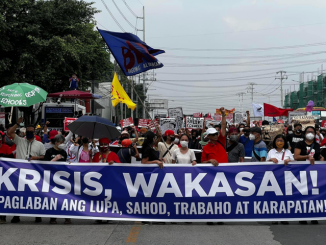
On April 23, nearly 200 members of the Philippines community from up and down the east coast came to Washington, D.C., to demand clean and fair elections from U.S.-backed dictator Rodrigo Duterte. They held a spirited rally at Dupont Circle, then marched to the Philippine Embassy. The voting in the Philippines will take place on May 9. Many Filipino overseas voters placed their absentee ballots in the box set aside for voting on the embassy grounds.

Strugglelalucha256


Happy Birthday Zimbabwe!

Sista’s Place in the Bedford-Stuyvesant neighborhood of Brooklyn, New York, was filled on April 18 to celebrate the 42nd anniversary of Zimbabwe’s independence. The event, which included representatives from Zimbabwe’s mission to the United Nations, was organized by the December 12th Movement.

The people of Zimbabwe fought long and hard for freedom from racist white colonial rule. It was an armed struggle that won Zimbabwe’s independence on April 18, 1980.

More than 70,000 Africans gave their lives for independence, while the U.S. Senate voted to give financial aid to the racist regime by subsidizing chrome imports.

President Emmerson Dambudzo Mnangagwa of Zimbabwe was sentenced to hang when he was a teenager. Fortunately he was reprieved but his companion freedom fighter was executed.

Since 2000, Zimbabwe has been under cruel sanctions from the United States and the European Union for taking back the land from white settlers and returning it to Africans. That’s what should have happened in the U.S. following the Civil War.

The U.S. sanctions are hurting the people of Zimbabwe. Yet Zimbabwe’s people and their Zimbabwe African National Union―Patriotic Front government have pushed forward. The country has the highest literacy rate in Africa.

Africans built Great Zimbabwe

Kingston Ziyera from the Zimbabwe Mission to the U.N. helped set the militant tone of the meeting. He spoke of Zimbabwe’s accomplishments in many economic areas.

A good example is bottled oxygen, which is used in hospitals and welding. Hundreds of patients tragically died in India when hospitals there ran out of oxygen at the height of the COVID-19 surge. Zimbabwe is now producing all the oxygen it needs and has started to export the commodity.

Comrade Ziyera expressed Zimbabwe’s solidarity with Palestine. Thousands of former white settlers from Zimbabwe are now in the apartheid state occupying Palestine.

Omowale Clay spoke for the December 12th Movement. D12 has championed Zimbabwe for decades.

Field Marshall Coltrane Chimurenga, a D12 leader who passed away in 2019, is buried in the Harare Provincial Heroes’ Acre. He was given a 21-gun salute by the Zimbabwean military.

Clay said Zimbabwe has become a beacon for Africa. He emphasized the struggle of the Palestinian people. “Unity is our greatest weapon,” exclaimed Omowale Clay.

Colette Pean from D12 spoke about a tour that’s being organized later this year to go to Zimbabwe. Pean described how beautiful the African country is.

A top attraction is Great Zimbabwe, one of the largest stone fortresses in the world. Pean told how British colonialists were so embarrassed by this African feat of engineering that they claimed it was really built by Phoenicians! (It wasn’t built by UFOs either.)

Colette Pean described how healthcare workers and all of Zimbabwe’s people fought back more successfully against COVID-19 than did the United States government. Zimbabwe closed its borders and took other measures against the pandemic weeks before the U.S. did.

Compare Zimbabwe with Pennsylvania, a state with at least 17 billionaires. While Pennsylvania has 13 million people, Zimbabwe has around 15 million people.

As of April 19, some 5,464 people have died in Zimbabwe from the coronavirus. In Pennsylvania, 44,539 people died from COVID ― over eight times as many. 

Jihad from Al-Awda, the Palestine Right to Return Coalition, read a moving solidarity statement that was greeted warmly by the audience. There’s solidarity with Palestine throughout Africa.

While the sanctions against Zimbabwe have hurt the country, so will the sanctions against the Russian Federation hurt the people of Zimbabwe. That’s because Zimbabwe imports much of its fertilizer from Russia.

Despite these difficulties, Zimbabwe will never surrender. Long live Zimbabwe!

Strugglelalucha256


Facebook censorship of Filipino revolutionary forces is the handiwork of the U.S. imperialists

STATEMENT from CPP.ph

Marco Valbuena | Chief Information Officer | Communist Party of the Philippines
April 10, 2022

(1) Over the past two weeks, Facebook deleted several accounts, groups and pages maintained by various revolutionary outfits in the Philippines, including those of the CPP’s information arm, and those belonging to different units of the New People’s Army (NPA). These account served as a means for of reaching out to the public, sharing information, and expressing views on important issues the Filipino people are facing.

This is not the first time that Facebook censored the revolutionary forces in the Philippines on its platform. In 2017, the PRWC Facebook Page, which had more than 10,000 followers was shut down by Facebook without warning or explanation. Since then, it has repeatedly taken down accounts and pages maintained by the CPP and other Filipino revolutionary forces. Last February, it permanently removed the account of Prof. Jose Ma. Sison, which for many years was used to promote Ka Joma’s academic work and views on Philippine issues.

These accounts censored by Facebook have consistently provided information about the human rights situation in the Philippines, especially in rural areas where reporters of major media organizations do not have access to or which have been subjected to news blackouts by the AFP. On several occasions, these accounts carried content which exposed the involvement and culpability of units of the Armed Forces of the Philippines (AFP) and Philippine National Police (PNP) in extrajudicial killings and massacres, as well as unlawful arrests, abductions, torture and other abuses perpetrated by state armed forces in the course of the Duterte regime’s counterinsurgency operations.

Information posted by these accounts also exposed foreign and local mining companies and big infrastructure projects which brought destruction to the environment and to people’s lives. These accounts have carried information that challenged the views promoted by state agencies especially regarding the current armed conflict, and explain the social, political and economic reasons why people take up arms in the struggle for democracy and freedom.

By taking down the accounts of revolutionary forces in the Philippines who are waging a struggle for national liberation, Facebook has effectively censored information that for years has challenged the dominant narrative being promoted and peddled by the reactionary government and the AFP. In doing so, it denies a large segment of the Filipino public, who rely on Facebook for information, a critical or alternative view that is essential for democratic life and action. Information on Facebook about the civil war in the country will now be monopolized by the AFP and the NTF-Elcac which long have been discredited sources of lies and disinformation.

(2) The banning of the CPP and NPA on Facebook is just one of the most recent evidence of the company’s exercise of arbitrary powers to censor information that are anti-imperialist and anti-fascist on the social networking platform. It has trampled on the right to free expression on the pretext of fighting “terrorism,” “hate speech,” “fake news” and “misinformation.” Facebook foists its “community standards,” an opaque set of rules, mainly against those groups who oppose the narrative promoted by the U.S. government. There are no legal or bureaucratic procedure that govern Facebook’s decisions to take down accounts and pages.

Facebook’s policy is firmly linked with the policies U.S. imperialism through its partnership with the Atlantic Council, a Washington-based agency that is known to be a NATO lobby group. According to Facebook, the Atlantic Council, specifically its Digital Forensic Research Lab, helps it “weed out fake news” from its platform.

The Atlantic Council is a veritable bulwark of U.S. ultra-conservatives and war hawks. It counts among its directors retired U.S. military officers (such as Wesley Clark and David Petraeus), at least seven former top officers of the U.S. CIA (including Robert Gates, Leon Panetta and Stephen Kappes) and known former U.S. ultra-conservative and war-mongering officials (Condoleezza Rice, Henry Kissinger and James Baker). The Atlantic Council receives funding from the U.S. State Department, ultra-wealthy corporate donors, defense contractors, major oil companies, and NATO governments.

The Atlantic Council promotes U.S. global economic interests, propping up dictatorships, anti-communism, U.S. military and political interventions, and “regime change” against governments that assert national sovereignty against U.S. hegemonism. It has openly supported subversive activities of the Venezuelan pro-U.S. opposition and destabilization of the Maduro government, and has advocated the arming of fundamentalist groups in Syria. It has promoted U.S. war provocations against Russia in Ukraine and for extending military support to the neo-Nazi Ukrainian government.

Facebook is strewn with spies. Officers heading its Security Policy, Security Communications, Cyber Espionage Investigations, Influence Operations Product Policy Manager, Threat Intelligence Analyst are all once connected with the National Security Agency, the CIA, the FBI or intelligence agencies of other governments.

With the Atlantic Council as partner and former CIA spies as employees, Facebook’s “community standards,” “fight against fake news” and “ban on hate speech” are all worthless and hypocritical declarations that only serve to conceal its pro-U.S., ultra-conservative, anti-progressive and counterrevolutionary agenda. This has been repeatedly demonstrated over the past few years.

Last March, despite having included the Azov Battalion in its list of “violent organizations”, Facebook recently announced that it will allow praise for the neo-Nazi Russophobe armed group that is known to have been involved in attacks, rape and torture against civilian Russian population in Ukraine. In addition, it will allow for content calling for “death” against Russia’s leaders and military forces.

Last year, Facebook censored content posted by Palestinians surrounding the violent attempts of the Israeli state to drive them away from their homes in Sheikh Jarrah, a neighborhood in East Jerusalem. The ban was made upon the request of the Israeli government. At the same time, Facebook is known to be liberal in allowing content promoting violence against Palestinians.

In 2020, after the Iranian general Qassem Soleimani was assassinated on orders of U.S. President Trump, Facebook banned all positive references to the general to support the U.S. government’s narrative that the general was a “terrorist” and suppress the voices of Iranians who widely consider Soleimani positively. Last year, Facebook allowed content that featured calls of “death to Khamenei” in specific reference to Iran’s supreme leader Ali Hosseini Khamenei.

At the height of the elections in Nicaragua last year, Facebook deleted the accounts of top news outlets, journalists and activists, all of which were supportive of the Sandinista government. Facebook claimed these accounts were “bots” engaged in “inauthentic behavior” in what was described as an “appalling interference” by Facebook on the elections of a sovereign country.

In the Philippines, while Facebook bans the NPA for having “a violent mission,” it continues to allow content consistently promoted by the AFP and its units, by the NTF-Elcac and its network of trolls that engage in red-tagging against human rights defenders and legal democratic parties and organizations, and foment hate, and encourage and applaud violent death against activists and revolutionaries.

(3) Facebook is one of the biggest monopoly companies in the market of social networking. Its mother company, Meta, has a $1 trillion market capitalization, and also owns Instagram, WhatsApp, Messenger and other platforms. Facebook, together with other monopoly internet companies such as Google, Apple, Amazon and others have been widely denounced for its monopoly business practices to kill or gobble up smaller companies.

Facebook employs close to 19,000 workers, mostly contractual project-based employees. It produces applications for massive data mining of private information shared by its 2.85 billion active users, which it then sells to advertisers.

With its capital and global infrastructure, Facebook wields strong monopoly power in terms of controlling the flow of news and information. It has reshaped the world of news media. In the U.S., more than 1/3 of Americans get their news from Facebook. In the Philippines, it is reported that more than 80% of Filipinos use Facebook, with many accessing the internet through Facebook Basics (free access to Facebook paid by the company). Around 25% of Filipinos rely on Facebook as news source.

Facebook is also denounced for engaging in mind manipulation. It has worked with “consultancy groups” as the Cambridge Analytica to conduct political, social, cultural and psychological surveys in order to determine methods to manipulate and influence the views of its users, and give it the means to intervene in the elections of countries and influence its voters. It has been reported that Cambridge Analytica worked with the campaign of Rodrigo Duterte in 2016. Moneyed politicians and big companies use Facebook and its analytics (data) to deploy bot accounts and trolls that daily hammer users’ minds to shape by information tailored to fit their cultural, ideological and psychological makeup.

Although its service is in the nature of a conveyor of information among its users, and from news producers to subscribers, Facebook has wielded its vast monopoly power to influence and shape the flow of information in line with its commercial and political interests, which are subsumed to the interests of U.S. imperialism and its global hegemonism, military interventionism and policy of war.

(4) As a social networking platform, Facebook is ironically anti-social and anti-democratic, having assumed powers to determine what information should be suppressed and what should be promoted. It has abused its power of “moderation” using its so-called “community guidelines” as vague pretext. By determining what its users could read, Facebook has assumed the role of global dictator in the realm of news and information.

Facebook has been compared to a devious newspaper delivery driver, who along the route stops to read the news, disagrees with how the news is written, and decides not to deliver the papers to its readers.

Facebook is using its monopoly position to carry out what it calls “content moderation,” which essentially, is determining which news organizations and information are “trustworthy,” which to defame as “serving foreign interference,” or which would be deranked and deprived of readers using its “algorithms.” It is basically an instrument of global U.S. psyops to shape the opinion and worldview of people around the world.

(5) Facebook users should be made critically aware of the fact that the information that they are being fed by the social media monopoly giant are filtered and selected in partnership with pro-war and pro-interventionist U.S. policy makers to serve the interests and policies of U.S. imperialism.

People should denounce Facebook for being the omni-censor that suppresses their right to freely express their opinion and share information, and thus uphold their democratic right to choose what beliefs they will adhere to.

There are democratic sectors demanding that Facebook and other monopoly internet companies be dismantled and turned into non-profit organizations, where content moderation will be placed under transparent community control.

In analyzing or understanding one issue or another, we advise people to exert more effort to seek information from sources outside Facebook, and, thus, demand free access to these sources (free internet).

Of course, the internet is dominated by western media sources that are also under the sway of Washington-based policy makers. They have all the resources and infrastructure to dominate the global information environment in line with the interests of the U.S..

However, the internet also provides the means for the broad masses of the people and their organizations to promote their own ideas and views by maintaining their own websites, email lists, chat groups, and other means of information exchange. But the more that these are put to effective use for revolutionary propaganda and education, the more certain that these will also be met with anti-democratic suppression, through DDoS attacks, malware and other means. We will, however, never allow ourselves to be silenced. Persistence is the key.

Strugglelalucha256
https://www.struggle-la-lucha.org/around-the-world/page/44/