Philippines administration displays hypocrisy on political prisoners

Earlier this month, newly elected Philippines president and neo-fascist demagogue Ferdinand “Bongbong” Marcos Jr. visited Singapore, a fellow country-member of the Association of Southeast Asian Nations (ASEAN). It is important to note that ASEAN was founded to suppress Communist movements that spread throughout the continent, including China, Vietnam, and Korea. 

At this recent meeting, Marcos and the president of Singapore explicitly denounced the government of Myanmar and demanded that Myanmar release all political prisoners.  Marcos’ office released a statement after the meeting in Singapore, “The leaders expressed support for ASEAN’s active role in assisting in Myanmar to overcome the crisis and to return to the path of democratization.” 

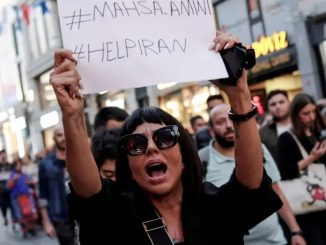
The military junta in Myanmar has been charged with human rights violations against its political opponents. However, this description fits another government – that of President “BongBong” Marcos. 

Since 2016, the Philippines has suffered neo-fascist rule. First at the hands of U.S.-backed dictator Rodrigo Duterte and now by his successor, Bongbong Marcos, who took office in June. The individual office holder has changed, but the political reality remains the same. 

The political prisoner crisis in the Philippines has exploded in the past six years. There is a severe and disturbing irony in BongBong Marcos lecturing any country about their treatment of political prisoners when his fascist government is one of the most notorious for using prison and torture to subdue progressive and revolutionary political forces. 

The Duterte regime took hundreds of political prisoners while it was in power. The recorded number is likely far less than the actual. Further, this number does not include the thousands that Duterte’s troops murdered in furtherance of the misnamed “war on terror.” 

Bongbong Marcos has some nerve chastising anyone about political prisoners, especially considering his vice president is Sarah Duterte, the daughter of Rodrigo Duterte. This Marcos regime will simply continue the work of Duterte and Ferdinand Marcos before that. 

Down with fascism in the Philippines! Release all political prisoners now! 

Strugglelalucha256


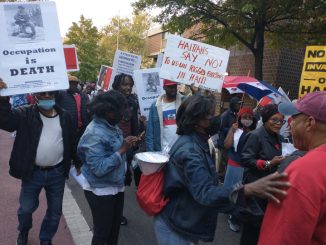
Four straight years of nonstop street protest in Haiti

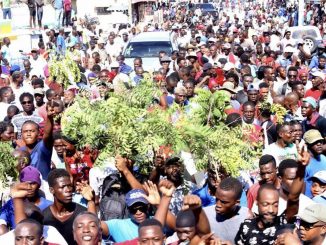
A cycle of protests began in Haiti in July 2018, and—despite the pandemic—has carried on since then. The core reason for the protest in 2018 was that in March of that year the government of Venezuela—due to the illegal sanctions imposed by the United States—could no longer ship discounted oil to Haiti through the PetroCaribe scheme. Fuel prices soared by up to 50 percent. On August 14, 2018, filmmaker Gilbert Mirambeau Jr. tweeted a photograph of himself blindfolded and holding a sign that read, “Kot Kòb Petwo Karibe a???” (Where did the PetroCaribe money go?). He reflected the popular sentiment in the country that the money from the scheme had been looted by the Haitian elite, whose grip on the country had been secured by two coups d’état against the democratically elected President Jean-Bertrand Aristide (once in 1991 and again in 2004). Rising oil prices made life unlivable for the vast majority of the people, whose protests created a crisis of political legitimacy for the Haitian elite.

In recent weeks, the streets of Haiti have once again been occupied by large marches and roadblocks, with the mood on edge. Banks and nongovernmental organizations (NGOs) — including Catholic charities — faced the wrath of the protesters, who painted “Down with [the] USA” on buildings that they ransacked and burned. The Creole word dechoukaj or uprooting—that was first used in the democracy movements in 1986 — has come to define these protests. The government has blamed the violence on gangs such as G9 led by the former Haitian police officer Jimmy “Babekyou” (Barbecue) Chérizier. These gangs are indeed part of the protest movement, but they do not define it.

The government of Haiti—led by acting President Ariel Henry—decided to raise fuel prices during this crisis, which provoked a protest from the transport unions. Jacques Anderson Desroches, president of the Fós Sendikal pou Sove Ayiti, told the Haitian Times, “If the state does not resolve to put an end to the liberalization of the oil market in favor of the oil companies and take control of it,” nothing good will come of it. “[O]therwise,” he said, “all the measures taken by Ariel Henry will be cosmetic measures.” On September 26, trade union associations called for a strike, which paralyzed the country, including the capital of Haiti, Port-au-Prince.

The United Nations (UN) evacuated its nonessential staff from the country. UN Special Representative Helen La Lime told the UN Security Council that Haiti was paralyzed by “[a]n economic crisis, a gang crisis, and a political crisis” that have “converged into a humanitarian catastrophe.” Legitimacy for the United Nations in Haiti is limited, given the sexual abuse scandals that have wracked the UN peacekeeping missions in Haiti, and the political mandate of the United Nations that Haitian people see as oriented to protecting the corrupt elite that does the bidding of the West.

The current President Ariel Henry was installed to his post by the “Core Group” (made up of six countries, this group is led by the United States, the European Union, the UN, and the Organization of American States). Henry became the president after the still-unsolved murder of the unpopular President Jovenel Moïse (thus far, the only clarity is that Moïse was killed by Colombian mercenaries and Haitian Americans). The UN’s La Lime told the Security Council in February that the “national investigation into his [Moïse’s] murder has stalled, a situation that fuels rumors and exacerbates both suspicion and mistrust within the country.”

Haiti’s crises

An understanding of the current cycle of protests is not possible without looking clearly at four developments in Haiti’s recent past. First, the destabilization of the country after the second coup against Aristide in 2004, which took place right after the catastrophic earthquake of 2010, led to the dismantling of the Haitian state. The Core Group of countries took advantage of these serious problems in Haiti to import onto the island a wide range of Western NGOs, which seemed to substitute for the Haitian state. The NGOs soon provided 80 percent of the public services. They “frittered” considerable amounts of the relief and aid money that had come into the country after the earthquake. Weakened state institutions have meant that the government has few tools to deal with this unresolved crisis.

Second, the illegal U.S. sanctions imposed on Venezuela crushed the PetroCaribe scheme, which had provided Haiti with concessionary oil sales and $2 billion in profits between 2008 and 2016 that was meant for the Haitian state but vanished into the bank accounts of the elite.

Third, in 2009, the Haitian parliament tried to increase minimum wages on the island to $5 per day, but the U.S. government intervened on behalf of major textile and apparel companies to block the bill. David Lindwall, former U.S. deputy chief of mission in Port-au-Prince, said that the Haitian attempt to raise the minimum wage “did not take economic reality into account” but was merely an attempt to appease “the unemployed and underpaid masses.” The bill was defeated due to U.S. government pressure. These “unemployed and underpaid masses” are now on the streets being characterized as “gangs” by the Core Group.

Fourth, the acting President Ariel Henry likes to say that he is a neurosurgeon and not a career politician. However, in the summer of 2000, Henry was part of the group that created the Convergence Démocratique (CD), set up to call for the overthrow of the democratically elected government of Aristide. The CD was set up in Haiti by the International Republican Institute, a political arm of the U.S. Republican Party, and by the U.S. government’s National Endowment for Democracy. Henry’s call for calm on September 19, 2022, resulted in the setting up of more barricades and in the intensification of the protest movement. His ear is bent more to Washington than to Petit-Goâve, a town on the northern coast that is the epicenter of the rebellion.

Waves of invasions

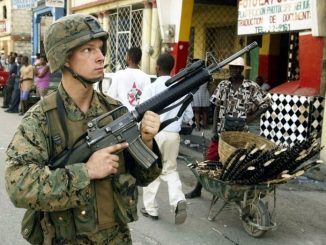
At the UN, Haiti’s Foreign Minister Jean Victor Geneus said, “[T]his dilemma can only be solved with the effective support of our partners.” To many close observers of the situation unfolding in Haiti, the phrase “effective support” sounds like another military intervention by the Western powers. Indeed, the Washington Post editorial called for “muscular action by outside actors.” Ever since the Haitian Revolution, which ended in 1804, Haiti has faced waves of invasions (including a long U.S. occupation from 1915 to 1930 and a U.S.-backed dictatorship from 1957 to 1986). These invasions have prevented the island nation from securing its sovereignty and have prevented its people from building dignified lives. Another invasion, whether by U.S. troops or the United Nations peacekeeping forces, will only deepen the crisis.

At the United Nations General Assembly session on September 21, U.S. President Joe Biden said that his government continues “to stand with our neighbor in Haiti.” What this means is best understood in a new Amnesty International report that documents the racist abuse faced by Haitian asylum seekers in the United States. The United States and the Core Group might stand with people like Ariel Henry, but they do not seem to stand with the Haitian people, including those who have fled to the United States.

Options for the Haitian people will come from the entry of trade unions into the protest wave. Whether the unions and the community organizations—including student groups that have reemerged as key actors in the country — will be able to drive a dynamic change out of the anger being witnessed on the streets remains to be seen.


This article was produced by Globetrotter. Vijay Prashad is an Indian historian, editor, and journalist. He is a writing fellow and chief correspondent at Globetrotter. He is an editor of LeftWord Books and the director of Tricontinental: Institute for Social Research. He is a senior non-resident fellow at Chongyang Institute for Financial Studies, Renmin University of China. He has written more than 20 books, including The Darker Nations and The Poorer Nations. His latest books are Struggle Makes Us Human: Learning from Movements for Socialism and (with Noam Chomsky) The Withdrawal: Iraq, Libya, Afghanistan, and the Fragility of U.S. Power.

Strugglelalucha256


Jean-Luc Godard, revolutionary filmmaker

We are saddened to receive the news of the death of the pioneering filmmaker, critic, and political activist Jean-Luc Godard on Sept. 13. 

His films broke ground as part of the French New Wave. Most importantly, Godard was interested in left politics and made films with revolutionary politics, together with a group of like-minded filmmakers. He became interested in Maoism as he was becoming radicalized during the 1960s, and made several films on that subject, including “La Chinoise.”

In 1970, Godard was invited to make a film about the Palestinian revolution against the zionist Israeli state. He visited Palestinian refugee camps in Jordan to collect footage. 

Later that year, the Jordanian royal army murdered most of the Palestinian refugees in those camps, in the massacre known as “Black September.” By the time the film was in the editing stage, most of the people on film were killed. 

It is said that Godard was devastated and had a breakdown after these tragic events and was unable to finish the film. Later, the footage was used in the film “Ici et ailleurs” (“Here and Elsewhere”), completed in collaboration with Anne-Marie Miéville in 1975.  

There’s a lot that can be said about Godard’s contributions to the world of independent cinema. However, we take this time to celebrate his contribution to revolutionary ideals in cinema. He was unapologetically anti-imperialist and defended the Palestinian revolution with mind and body.

The writer is a filmmaker and Amazon worker.

Strugglelalucha256


After Queen’s death, victims of British imperialism share why ‘we will not mourn’

As millions of Britons and admirers the world over mourned Queen Elizabeth II’s death Thursday, others—especially in nations formerly colonized by the British Empire—voiced reminders of the “horrendous cruelties” perpetrated against them during the monarch’s reign.

“We do not mourn the death of Elizabeth, because to us her death is a reminder of a very tragic period in this country and Africa’s history,” declared Julius Malema, head of the left-wing Economic Freedom Fighters party in South Africa.

“Elizabeth ascended to the throne in 1952, reigning for 70 years as a head of an institution built up, sustained, and living off a brutal legacy of dehumanization of millions of people across the world,” he continued.

“During her 70-year reign as queen, she never once acknowledged the atrocities that her family inflicted on native people that Britain invaded across the world,” Malema noted. “She willingly benefited from the wealth that was attained from the exploitation and murder of millions of people across the world.”

“The British royal family stands on the shoulders of millions of slaves who were shipped away from the continent to serve the interests of racist white capital accumulation, at the center of which lies the British royal family,” Malema added.

Larry Madowo, a CNN International correspondent from Kenya, said during a Thursday broadcast that “the fairytale is that Queen Elizabeth went up the treetops here in Kenya a princess and came down a queen because it’s when she was here in Kenya that she learned that her dad had died and she was to be the queen.”

“But that also was the start of the eight years after that, that the… British colonial government cracked down brutally on the Mau Mau rebellion against the colonial administration,” he continued. “They herded more than a million people into concentration camps, where they were tortured and dehumanized.”

In addition to rampant torture—including the systemic castration of suspected rebels and sympathizers, often with pliers—British forces and their local allies massacred unarmed civilians, disappeared their children, sadistically raped women, and clubbed prisoners to death.

“And so,” added Madowo, “across the African continent, there have been people who are saying, ‘I will not mourn for Queen Elizabeth, because my ancestors suffered great atrocities under her people that she never fully acknowledged that.”

Indeed, instead of apologizing for its crimes and compensating its victims, the British government launched Operation Legacy, a massive effort to erase evidence of colonial crimes during the period of rapid decolonization in the 1950s-’70s.

“If the queen had apologized for slavery, colonialism, and neocolonialism and urged the Crown to offer reparations for the millions of lives taken in her/their names, then perhaps I would do the human thing and feel bad,” tweeted Cornell University professor Mũkoma wa Ngũgĩ. “As a Kenyan, I feel nothing. This theater is absurd.”

Aldani Marki, an activist with the Organization of Solidarity with the Yemeni Struggle, asserted that “Queen Elizabeth is a colonizer and has blood on her hands.”

“In 1963 the Yemeni people rebelled against British colonialism. In turn the Queen ordered her troops to violently suppress any and all dissent as fiercely as possible,” he tweeted. “The main punitive measure of Queen Elizabeth’s Aden colony was forced deportations of native Yemenis into Yemen’s desert heartland.”

https://twitter.com/Aldanimarki/status/1567861794605043712

“This is Queen Elizabeth’s legacy,” Marki continued. “A legacy of colonial violence and plunder. A legacy of racial segregation and institutionalized racism.”

“The queen’s England is today waging another war against Yemen together with the U.S., Saudi Arabia, and the UAE,” he added.

Melissa Murray, a Jamaican-American professor at New York University School of Law, said that the queen’s death “will accelerate debates about colonialism, reparations, and the future of the Commonwealth” as “the residue of colonialism shadows day-to-day life in Jamaica and other parts of the Caribbean.”

Numerous observers noted how the British Empire plundered around $45 trillion from India over two centuries of colonialism that resulted in millions of deaths, and how the Kohinoor—one of the largest cut diamonds in the world, with an estimated value of $200 million—was stolen from India to be set in the queen mother’s crown.

“Why are Indians mourning the death of Queen Elizabeth II?” asked Indian economist Manisha Kadyan on Twitter. “Her legacy is colonialism, slavery, racism, loot, and plundering. Despite having chances, she never apologized for [the] bloody history of her family. She reduced everything to a ‘difficult past episode’ on her visit to India. Evil.”

An Indian historian tweeted, “there are only 22 countries that Britain never invaded throughout history.”

“British ships transported a total of three million Africans to the New World as slaves,” he wrote. “An empire that brought misery and famine to Asia and Africa. No tears for the queen. No tears for the British monarchy.”

Negative reaction to the queen’s passing was not limited to the Global South. Despite the historic reconciliation between Ireland and Britain this century, there were celebrations in Dublin—as a crowd singing “Lizzie’s in a Box” at a Celtic FC football match attests—and among the Irish diaspora.

“I’m Irish,” tweeted MSNBC contributor Katelyn Burns, “hating the queen is a family matter.”

Welsh leftists got in on the action too. The Welsh Underground Network tweeted a litany of reasons why “we will not mourn.”

“We will not mourn for royals who oversaw the protection of known child molesters in the family,” the group said.

“We will not mourn for royals who oversaw the active destruction of the Welsh language, and the Welsh culture,” the separatists added.

Summing up the sentiments of many denizens of the Global South and decolonization defenders worldwide, Assal Rad, research director at the National Iranian American Council, tweeted, “If you have more sympathy for colonizers and oppressors than the people they oppress, you may need to evaluate your priorities.”

Source: Common Dreams

Strugglelalucha256


The bewildering vote in Chile that rejected a new constitution

On September 4, 2022, more than 13 million Chileans—out of a voting-eligible population of approximately 15 million—voted on a proposal to introduce a new constitution in the country. As early as March, polls began to suggest that the constitution would not be able to pass. However, polls had hinted for months at a narrowing of the lead for the rejection camp, and so proponents of the new constitution remained hopeful that their campaign would in the end successfully convince the public to set aside the 1980 constitution placed upon the country by the military dictatorship led by General Augusto Pinochet. The date for the election, September 4, commemorated the day that Salvador Allende won the presidency in 1970. On that date, those who wanted a new constitution suggested that the ghost of Pinochet—who overthrew Allende in a violent coup in 1973—would be exorcized. As it happened, Pinochet’s constitution remains in place with more than 61 percent of voters rejecting the new constitution and only 38 percent of voters approving it.

The day before the election, in the municipality of Recoleta (a part of Chile’s capital city of Santiago), Mayor Daniel Jadue led a massive rally in support of passing the new constitution. Tens of thousands of people gathered in this largely working-class area with the hope, as Jadue put it, of leaving behind the “constitution of abuses.” It, however, was not to be. Even in Recoleta, where Jadue is a popular mayor, the constitution was defeated. The new constitution received 23,000 more votes than Jadue had received in the last election—a sign that the number of voters on the left had increased—but the vote to reject the constitution was larger, which meant that new voters made a greater impact on the overall result.

On September 7, Jadue told us that he was feeling “calm,” that it was a significant advance that nearly 5 million Chileans voted for the constitution and that “for the first time we have a constitutional project that is written and can be transformed into a much more concrete political program.” There is “no definitive victory and no definitive defeat,” Jadue told us. People voted not only on the constitution but also on the terrible economic situation (inflation in Chile is more than 14.1 percent) and the government’s management of it. Just as the 2020 plebiscite to draft a new constitution was a punishment for former President Sebastián Piñera, this was a punishment for the Boric government’s inability to address the problems of the people. Jadue’s “calm” stems from his confidence that if the left goes to the people with a program of action and is able to address the people’s needs, then the 5 million who voted for the constitution will find their numbers significantly increased.

Within hours of the final vote being announced, analysts from all sides tried to come to terms with what was a great defeat for the government. Francisca Fernández Droguett, a member of the Movement for Water and Territories, wrote in an article for El Ciudadano that the answer to the defeat lay in the decision by the government to make this election mandatory. “Compulsory voting put us face to face with a sector of society that we were unaware of in terms of its tendencies, not only its political tendencies but also its values.” This is precisely what happened in Recoleta. She pointed out that there was a general sentiment among the political class that those who had historically voted would—because of their general orientation toward the state—have a viewpoint that was closer to forms of progressivism. That has proven not to be the case. The campaign for the constitution did not highlight the economic issues that are important to the people who live at the rough end of social inequality. In fact, the reaction to the loss—blaming the poor (rotear, is the disparaging word) for the loss—was a reflection of the narrow-minded politics that was visible during the campaign for the new constitution.

Droguett’s point about compulsory voting is shared across the political spectrum. Until 2012, voting in Chile was compulsory, but registration for the electoral roll was voluntary; then, in 2012, with the passing of an election law reform, registration was made automatic but voting was voluntary. For such a consequential election, the government decided to make the entire voting process mandatory for all Chileans over 18 years old who were eligible to vote, with the imposition of considerable fines for those who would not vote. As it turned out, 85.81 percent of those on the electoral rolls voted, which is far more than the 55.65 percent of voters who voted in the second record turnout in Chile during the presidential election in 2021.

A comparison between the second round of voting during the presidential election of 2021 and the recent vote on the constitution is instructive. In December 2021, Chile’s President Gabriel Boric—leading the center-left Apruebo Dignidad coalition—won 4.6 million votes. Apruebo Dignidad campaigned for the constitution and won 4.8 million votes. That is, the Apruebo Dignidad vote in December 2021 and the vote for the new constitution was about the same. Boric’s opponent—José Antonio Kast—who openly praised Pinochet—won 3.65 million votes. Kast campaigned against the new constitution and was defeated by 7.88 million voters. That is, the votes against the constitution were twice more than the votes that Kast was able to garner. This figure does not register, as Jadue told us, as a shift to the right in Chile, but rather is an absolute rejection of the entire political system, including the constitutional convention.

One of the least remarked upon elements of political life in Chile—as is in other parts of Latin America—is the rapid growth of evangelical (notably Pentecostal) churches. About 20 percent of Chile’s population identifies as evangelical. In 2021, Kast went to the thanksgiving service of an evangelical congregation, the only representative invited to such an event. Forced to vote in the polls by the new mandatory system, a large section of evangelical voters rejected the proposal for a new constitution because of its liberal social agenda. Jadue told us that the evangelical community failed to recognize that the new constitution gave evangelicals “equal treatment with the Roman Catholic Church because it ensured freedom of worship.”

Those who were not in favor of the constitution began to campaign against its liberal agenda right after the constituent assembly was empaneled. While those who were in favor of the new constitution waited for it to be drafted, and they refrained from campaigning in the regions where the evangelical churches held sway and where opposition to the constitution was clear. The constitution was rejected as an expression of the growing discontent among Chileans regarding the general direction of social liberalism that was assumed by many—including the leadership of Frente Amplio—to be the inevitable progression in the country’s politics. The distance between the evangelicals and the center-left is evident not only in Chile—where the results are on display now—but also in Brazil, which faces a consequential presidential election in October.

Meanwhile, two days after the election, school children took to the streets. The text they circulated for their protest bristles with poetry: “in the face of people without memory, students make history with organization and struggle.” This entire cycle of the new constitution and the center-left Boric government began in 2011-2013, when Boric and many of his cabinet members were in college and when they began their political careers. The high school students—who faced the brutal police and now answer to Boric—want to open a new road. They were dismayed by an election that wanted to determine their future, but in which they could not participate due to their age.

This article was produced by Globetrotter.

Taroa Zúñiga Silva is a writing fellow and the Spanish media coordinator for Globetrotter. She is the co-editor with Giordana García Sojo of Venezuela, Vórtice de la Guerra del Siglo XXI (2020). She is a member of the coordinating committee of Argos: International Observatory on Migration and Human Rights and is a member of the Mecha Cooperativa, a project of the Ejército Comunicacional de Liberación.

Vijay Prashad is an Indian historian, editor and journalist. He is a writing fellow and chief correspondent at Globetrotter. He is an editor of LeftWord Books and the director of Tricontinental: Institute for Social Research. He is a senior non-resident fellow at Chongyang Institute for Financial Studies, Renmin University of China. He has written more than 20 books, including The Darker Nations and The Poorer Nations. His latest books are Struggle Makes Us Human: Learning from Movements for Socialism and (with Noam Chomsky) The Withdrawal: Iraq, Libya, Afghanistan, and the Fragility of U.S. Power.

Strugglelalucha256


Silencing the lambs: How propaganda works

In the 1970s, I met one of Hitler’s leading propagandists, Leni Riefenstahl, whose epic films glorified the Nazis. We happened to be staying at the same lodge in Kenya, where she was on a photography assignment, having escaped the fate of other friends of the Fuhrer.

She told me that the “patriotic messages” of her films were dependent not on “orders from above” but on what she called the “submissive void” of the German public.

Did that include the liberal, educated bourgeoisie? I asked. “Yes, especially them,” she said.

I think of this as I look around at the propaganda now consuming Western societies.

Of course, we are very different from Germany in the 1930s. We live in information societies. We are globalists. We have never been more aware, more in touch, better connected.

Are we? Or do we live in a Media Society where brainwashing is insidious and relentless, and perception is filtered according to the needs and lies of state and corporate power?

The United States dominates the Western world’s media. All but one of the top ten media companies are based in North America. The internet and social media—Google, Twitter, Facebook—are mostly American-owned and controlled.

In my lifetime, the United States has overthrown or attempted to overthrow more than 50 governments, mostly democracies. It has interfered in democratic elections in 30 countries. It has dropped bombs on the people of 30 countries, most of them poor and defenseless. It has attempted to murder the leaders of 50 countries. It has fought to suppress liberation movements in 20 countries.

The extent and scale of this carnage is largely unreported, unrecognized; and those responsible continue to dominate Anglo-American political life.

In the years before he died in 2008, the playwright Harold Pinter made two extraordinary speeches, which broke a silence.

“US foreign policy,” he said, is “best defined as follows: kiss my arse or I’ll kick your head in. It is as simple and as crude as that. What is interesting about it is that it’s so incredibly successful. It possesses the structures of disinformation, use of rhetoric, distortion of language, which are very persuasive, but are actually a pack of lies. It is very successful propaganda. They have the money, they have the technology, they have all the means to get away with it, and they do.”

In accepting the Nobel Prize for Literature, Pinter said this: “The crimes of the United States have been systematic, constant, vicious, remorseless, but very few people have actually talked about them. You have to hand it to America. It has exercised a quite clinical manipulation of power worldwide while masquerading as a force for universal good. It’s a brilliant, even witty, highly successful act of hypnosis.”

Pinter was a friend of mine and possibly the last great political sage—that is, before dissenting politics were gentrified. I asked him if the “hypnosis” he referred to was the “submissive void” described by Leni Riefenstahl.

“It’s the same,” he replied. “It means the brainwashing is so thorough we are programmed to swallow a pack of lies. If we don’t recognise propaganda, we may accept it as normal and believe it. That’s the submissive void.”

In our systems of corporate democracy, war is an economic necessity, the perfect marriage of public subsidy and private profit: socialism for the rich, capitalism for the poor. The day after 9/11 the stock prices of the war industry soared. More bloodshed was coming, which is great for business.

Today, the most profitable wars have their own brand. They are called “forever wars”: Afghanistan, Palestine, Iraq, Libya, Yemen and now Ukraine. All are based on a pack of lies.

Iraq is the most infamous, with its weapons of mass destruction that didn’t exist. Nato’s destruction of Libya in 2011 was justified by a massacre in Benghazi that didn’t happen. Afghanistan was a convenient revenge war for 9/11, which had nothing to do with the people of Afghanistan.

Today, the news from Afghanistan is how evil the Taliban are—not that Joe Biden’s theft of $7billion of the country’s bank reserves is causing widespread suffering. Recently, National Public Radio in Washington devoted two hours to Afghanistan—and 30 seconds to its starving people.

At its summit in Madrid in June, Nato, which is controlled by the United States, adopted a strategy document that militarizes the European continent and escalates the prospect of war with Russia and China. It proposes ‘multi-domain warfighting against nuclear-armed peer-competitor. In other words, nuclear war.

It says: “Nato’s enlargement has been an historic success.”

I read that in disbelief.

A measure of this “historic success” is the war in Ukraine, news of which is mostly not news, but a one-sided litany of jingoism, distortion, omission. I have reported a number of wars and have never known such blanket propaganda.

In February, Russia invaded Ukraine as a response to almost eight years of killing and criminal destruction in the Russian-speaking region of Donbass on their border.

In 2014, the United States had sponsored a coup in Kyiv that got rid of Ukraine’s democratically elected, Russian-friendly president and installed a successor whom the Americans made clear was their man.

In recent years, American “defender” missiles have been installed in eastern Europe, Poland, Slovenia, the Czech Republic, almost certainly aimed at Russia, accompanied by false assurances all the way back to James Baker’s “promise” to Gorbachev in February 1990 that Nato would never expand beyond Germany.

Ukraine is the frontline. Nato has effectively reached the very borderland through which Hitler’s army stormed in 1941, leaving more than 23 million dead in the Soviet Union.

Last December, Russia proposed a far-reaching security plan for Europe. This was dismissed, derided or suppressed in the Western media. Who read its step-by-step proposals? On 24 February, Ukrainian President Volodymyr Zelenskyy threatened to develop nuclear weapons unless America armed and protected Ukraine. This was the final straw.

On the same day, Russia invaded—according to the Western media, an unprovoked act of congenital infamy. The history, the lies, the peace proposals, the solemn agreements on Donbass at Minsk counted for nothing.

On 25 April, the US Defense Secretary, General Lloyd Austin, flew into Kyiv and confirmed that America’s aim was to destroy the Russian Federation—the word he used was ‘weaken’. America had got the war it wanted, waged by an American bankrolled and armed proxy and expendable pawn.

Almost none of this was explained to Western audiences.

Russia’s invasion of Ukraine is wanton and inexcusable. It is a crime to invade a sovereign country. There are no “buts”—except one.

When did the present war in Ukraine begin and who started it? According to the United Nations, between 2014 and this year, some 14,000 people have been killed in the Kyiv regime’s civil war on the Donbass. Many of the attacks were carried out by neo-Nazis.

Watch an ITV news report from May 2014, by the veteran reporter James Mates, who is shelled, along with civilians in the city of Mariupol, by Ukraine’s Azov (neo-Nazi) battalion.

In the same month, dozens of Russian-speaking people were burned alive or suffocated in a trade union building in Odessa besieged by fascist thugs, the followers of the Nazi collaborator and anti-Semitic fanatic Stephen Bandera. The New York Times called the thugs “nationalists.”

“The historic mission of our nation in this critical moment,” said Andreiy Biletsky, founder of the Azov Battalion, “is to lead the White Races of the world in a final crusade for their survival, a crusade against the Semite-led Untermenschen.”

Since February, a campaign of self-appointed “news monitors” (mostly funded by the Americans and British with links to governments) have sought to maintain the absurdity that Ukraine’s neo-Nazis don’t exist.

Airbrushing, a term once associated with Stalin’s purges, has become a tool of mainstream journalism.

In less than a decade, a “good” China has been airbrushed and a “bad” China has replaced it: from the world’s workshop to a budding new Satan.

Much of this propaganda originates in the US, and is transmitted through proxies and “think-tanks,” such as the notorious Australian Strategic Policy Institute, the voice of the arms industry, and by zealous journalists such as Peter Hartcher of the Sydney Morning Herald, who labeled those spreading Chinese influence as ‘rats, flies, mosquitoes and sparrows’ and called for these ‘pests’ to be “eradicated.”

News about China in the West is almost entirely about the threat from Beijing. Airbrushed are the 400 American military bases that surround most of China, an armed necklace that reaches from Australia to the Pacific and Southeast Asia, Japan and Korea. The Japanese island of Okinawa and the Korean island of Jeju are loaded guns aimed point blank at the industrial heart of China. A Pentagon official described this as a “noose.”

Palestine has been misreported for as long as I can remember. To the BBC, there is the ‘conflict’ of “two narratives.” The longest, most brutal, lawless military occupation in modern times is unmentionable.

The stricken people of Yemen barely exist. They are media unpeople. While the Saudis rain down their American cluster bombs with British advisors working alongside the Saudi targeting officers, more than half a million children face starvation.

This brainwashing by omission has a long history. The slaughter of the First World War was suppressed by reporters who were knighted for their compliance and confessed in their memoirs. In 1917, the editor of the Manchester Guardian, C.P. Scott, confided to prime minister Lloyd George: “If people really knew [the truth], the war would be stopped tomorrow, but they don’t know and can’t know.”

The refusal to see people and events as those in other countries see them is a media virus in the West, as debilitating as Covid. It is as if we see the world through a one-way mirror, in which “we” are moral and benign and “they” are not. It is a profoundly imperial view.

The history that is a living presence in China and Russia is rarely explained and rarely understood. Vladimir Putin is Adolf Hitler. Xi Jinping is Fu Man Chu. Epic achievements, such as the eradication of abject poverty in China, are barely known. How perverse and squalid this is.

When will we allow ourselves to understand? Training journalists factory style is not the answer. Neither is the wondrous digital tool, which is a means, not an end, like the one-finger typewriter and the linotype machine.

In recent years, some of the best journalists have been eased out of the mainstream. “Defenestrated” is the word used. The spaces once open to mavericks, to journalists who went against the grain, truth-tellers, have closed.

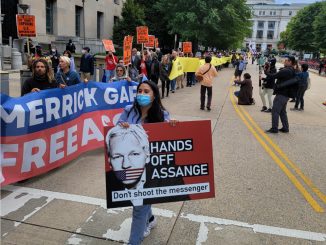
The case of Julian Assange is the most shocking. When Julian and WikiLeaks could win readers and prizes for the Guardian, the New York Times and other self-important “papers of record,” he was celebrated.

When the dark state objected and demanded the destruction of hard drives and the assassination of Julian’s character, he was made a public enemy. Vice President Biden called him a “hi-tech terrorist.” Hillary Clinton asked, “Can’t we just drone this guy?”

The ensuing campaign of abuse and vilification against Julian Assange—the UN Rapporteur on Torture called it “mobbing”—brought the liberal press to its lowest ebb. We know who they are. I think of them as collaborators: as Vichy journalists.

When will real journalists stand up? An inspirational samizdat already exists on the internet: Consortium News, founded by the great reporter Robert Parry, Max Blumenthal’s Grayzone, Mint Press News, Media Lens, Declassified UK, Alborada, Electronic Intifada, WSWS, ZNet, ICH, CounterPunch, Independent Australia, Globetrotter, the work of Chris Hedges, Patrick Lawrence, Jonathan Cook, Diana Johnstone, Caitlin Johnstone and others who will forgive me for not mentioning them here.

And when will writers stand up, as they did against the rise of fascism in the 1930s? When will film-makers stand up, as they did against the Cold War in the 1940s? When will satirists stand up, as they did a generation ago?

Having soaked for 82 years in a deep bath of righteousness that is the official version of the last world war, isn’t it time those who are meant to keep the record straight declared their independence and decoded the propaganda? The urgency is greater than ever.

This article was produced by Globetrotter. John Pilger is an award-winning journalist, filmmaker, and author. Read his full biography on his website here, and follow him on Twitter: @JohnPilger. This article is an edited version of an address to the Trondheim World Festival, Norway.

Strugglelalucha256


The Queen’s diamonds: Why has the monarchy survived?

“The Queen is dead. Long live the King.” On September 8, Buckingham Palace announced the death of Queen Elizabeth II and the succession of the Prince of Wales, now King Charles  III.

During the official coronation ceremony, Charles, currently titled prince of Wales and Earl of Chester, Duke of Cornwall, Duke of Rothesay, Earl of Carrick and Baron Renfrew, Lord of the Isles, and Prince and Great Steward of Scotland, will gain a new title by proclaiming himself the King and the Head of the British Commonwealth.

The English rebellions

The first successful British revolt against feudal relations and the monarchy occurred in a civil war from 1642 to 1660. King Charles I was executed by the authority of Parliament in 1649. 

Although the monarchy was restored under Charles II in 1660, the gains made by the revolutionary movement were solidified under parliamentary law.

In 1668, a constitutional monarchy was established in a parliamentary reform process. New laws broke down the old power relations of the monarchy. The English feudal state was overthrown and became supplanted by the rule of an emerging capitalist class.

According to Marxist historian Christopher Hill: “The Civil War was a class war in which the despotism of Charles I was defended by the reactionary forces of the established Church and conservative landlords, and on the other side stood the trading and industrial classes in town and countryside … the yeomen and progressive gentry, and … wider masses of the population whenever they were able by free discussion to understand what the struggle was really about.”

The guild democracy movement of the period won its greatest successes among London’s transport workers, most notably the Thames Watermen, who democratized their company in 1641–43.

And with the outbreak of the civil war in 1642, rural communities began to seize timber and other resources on the estates of royalists, Catholics, the Royal Family, and the church hierarchy. As a result, some communities improved their conditions of tenure on such estates.

In 1852 Karl Marx wrote: “The Tories in England had long imagined that they were enthusiastic about the monarchy, the church, and beauties of the old English Constitution until the day of danger wrung from them the confession that they are enthusiastic only about ground rent.”

The 17th-century English revolution preceded the French revolution and later struggles that overturned feudal relations across Europe.

In most instances, the old ruling class managed to hold on to its large land holdings and privileges of wealth while adapting to the new system of capitalist state power.

Property relations among this class over generations have obliged them to intermarry. The British monarchy is intimately related to all the monarchies across Europe.

The House of Windsor began in 1917 when the family changed its name from the German “Saxe-Coburg-Gotha.” Queen Elizabeth’s grandmother Queen Mary was born a royal princess of the German Duchy of Teck.

Former British PM Boris Johnson said, “I would have been terribly proud just to have been related to the German King, but I can’t hide it from you that even in our common European home, I am particularly thrilled to have some British Royal ancestry as well.” Johnson is a descendant of Prince Paul Von Wurttemberg.

In 1947, Queen Elizabeth became engaged to Prince Philip of Greece and Denmark. Philip and his family were exiled from Greece during his childhood, so he studied in France and Germany before serving in the British Royal Navy.

Philip’s mother, Princess Alice of Battenberg, was Queen Victoria’s great-granddaughter. She gave him a diamond tiara that could be dismantled and used to create an engagement ring fit for a queen.

The diamonds come from the Romanov dynasty. His mother had been given the tiara on her wedding day by Tsar Nicholas II and Tsarina Alexandra of Russia, the last rulers of the Russian Empire, to whom she was distantly related.

Vast land holdings

The Wall Street Journal reported on Dec. 9, 2021, that each one of the royal couple held control over a billion dollars in real estate, and that is just the property that can be valued. The Journal’s headline reads: “The Billion-Dollar Property Portfolios of Queen Elizabeth and Prince Charles.”

Here is the extensive real estate that they list.

The property holdings include castles, palaces, country houses, townhouses, city apartments, cottages, and farmhouses.

  • Clarence House, London;
  • Buckingham Palace, London;
  • Windsor Castle, Berkshire;
  • Sandringham Estate, Norfolk;
  • Highgrove House, Gloucestershire;
  • Hillsborough Castle, Northern Ireland;
  • Balmoral Castle, Aberdeenshire, Scotland;
  • Palace of Holyroodhouse, Edinburgh, Scotland;
  • Highgrove Estate, Cornwall.

The title of Duke of Cornwall was first established by King Edward III in 1337 to ensure his dominion over Cornwall. The duchy and the title have been passed down to the heir to the throne ever since. Prince William is next in line to become Duke of Cornwall.

The property holdings in Cornwall are vast. They include 130,125 acres of farmland, forests, coastline, and residential and commercial properties. In addition to Highgrove, the estate includes a large section of the Isles of Scilly, an archipelago of 200 islands off the coast of the English county of Cornwall, where Prince Charles has a portfolio of holiday cottages.

Other palaces, castles, and properties include:

  • Llwynywermod, Carmarthenshire, Wales;
  • Viscri property in Romania;
  • and Zalánpatak property in Romania.

The Royal blind trust

Stu Allen, a former diplomat at the British Foreign and Commonwealth Office, reported that: The Queen owns land privately in the United States and Canada, though not in her capacity as Sovereign. She owns a horse farm in Kentucky and is believed to own a prime Park Avenue estate in New York City. Details of ownership and much of her personal wealth are held in what is known as a blind trust.”

This blind trust protects the queen’s private property should the British monarchy be abolished, and the property of the Crown Estates revert to public ownership.

Defending private property and class relations is intrinsic to capitalist rule. Despite revelations of the corrupt character of the Royal Family, they have been allowed to maintain the illusion of a religious-like institution with all the accompanying pageantry and pomp. 

The Queen has been presented as a mother-like figurehead with no real power. That is far from the truth. She has had special consultation allowances regarding Freedom of Information requests to protect the reputation of the Royal household.

Despite this, scandals still manage to leak out. For example, in 2015, the British Guardian newspaper released the “Black Spider Papers,” 27 memos issued by Prince Charles in 2004 and 2005 and released only after the Guardian won its long freedom of information fight with the government. Prince Charles’ memos revealed extensive efforts to influence government policy, including action to expand armaments for British troops fighting in Iraq.

The Queen had numerous powers which could be used against the working class. The Queen was the head of the British state. All bills require the monarch’s signature before they can become law. She is responsible for dissolving parliament; she can call early elections; she swears in the Prime Minister. Private meetings are held weekly between the Queen and the Prime Minister.

The pro-monarchy Telegraph reported that senior royals had used their powers to impede the passage of at least 39 Bills Awaiting Royal Assent over the last 30 years. There is also significant evidence, supported by a BBC documentary “The Plot Against Harold Wilson” and other media reports, of a threat to use the monarch’s powers to overthrow left-leaning Prime Minister Harold Wilson in the 1960s.

David Cameron asked the Queen to intervene publicly to help prevent the success of the 2014 Scottish Independence Referendum. The Guardian reported that the Queen made a statement asking voters to “think very carefully” before voting, aiming to suggest the decision was “full of foreboding.”

Can the Queen’s descendants hold on to centuries of looted wealth and retain ownership of prime real estate all around the world, allowing them untold power?

Strugglelalucha256


Dedan Kimathi was hanged by Queen Elizabeth

The African freedom fighter Dedan Kimathi was hanged on Feb. 18, 1957, while Queen Elizabeth II was on her throne, head of state of Britain and the Commonwealth realms, including Kenya. As head of state, she did nothing to stop Kimathi’s murder nor the execution of over a thousand other freedom fighters in Kenya.

Kimathi was a Field Marshal of Kenya’s Land and Freedom Army. It was labeled the Mau Mau by the media. Being captured with a loaded revolver was enough to send Kimathi to the gallows.

The capitalist media are shedding tears over the death of Queen Elizabeth, who died in Balmoral Castle when she was 96. However, they say nothing about the monarchy’s brutal colonialism and racism abroad and in Britain, a long and ruthless legacy that the Royal Family has overseen and still profits from.

Liberation fighters from Kenya, India, Ireland, and other former colonies who lost their lives struggling for independence from the British government and monarchy are not remembered by the capitalist media.

There’s no mention of Dedan Kimathi being hanged in Nairobi’s Kamiti Maximum Prison when he was 36.

The media helped lynch the Mau Mau in Kenya. They called Jomo Kenyatta a “terrorist.” Typical was Time magazine which described one of the former Land and Freedom Army leaders as “one of the Mau Mau’s bloodthirstiest killers.” 

Queen Victoria’s stormtroopers seized Kenya in 1895. British aristocrats stole the land, with Lord Delamere alone grabbing 160,000 acres.

Africans were forced at gunpoint into “native reserves,” which were modeled on Indian reservations in the United States.

Oppression sparked resistance. On May Day in 1950, the East African Trade Union Congress issued a call for independence and majority rule. These genuine labor leaders in Kenya were immediately arrested by British Prime Minister Clement Attlee of the Labour Party.

One hundred thousand workers joined a general strike to protest. Nairobi was paralyzed for nine days. It took a mobilization of the British army and colonial police to crush this uprising.

Freedom demanded that an armed struggle be launched. Kenya’s Land and Freedom Army was born.

Kenya’s colonial governor, Evelyn Baring, responded by declaring a state of emergency on Oct. 20, 1952. The governor’s family-controlled Barings Bank was founded in 1762 by the slave trader Francis Baring.

Royal fascist terror

Baring ordered the colonial police to frame up Jomo Kenyatta and other independence fighters and imprison them. There was no jury.

According to Caroline Elkins’ Pulitzer Prize-winning book, “Imperial Reckoning,” Baring guaranteed a conviction by paying the judge a 20,000-pound bribe.

Baring hoped Kenyatta’s frame-up would demoralize Africans. Instead, it ignited years of guerrilla warfare.

Mau Mau fighters liberated weapons and ammunition from the colonialist army and police. Mau Mau-supporting blacksmiths made hundreds of guns.

Britain mobilized 55,000 soldiers and cops to fight the Mau Mau. The Royal Air Force bombed guerrilla strongholds in Aberdares Forest and Kirinyaga.

Caroline Elkins estimated that the colonial forces threw 300,000 Kenyans into concentration camps and forced another million into 800 “emergency villages” built with the Africans’ own slave labor.

For Africans in Kenya, British Prime Minister Winston Churchill was their Hitler. Guards used Alsatian dogs to maul women inmates at the Athi River camp, and the guards themselves clubbed prisoners arriving at the Manyani camp.

Six hundred children were confined in Kamati camp alone. Almost none survived.

Prisoners labeled as “hard-core Mau Mau” were selected to bury the children. “They would be tied in bundles of six babies,” recalled former inmate Helen Macharia.

Uncle Sam helped this genocide by financing Nairobi’s Embakasi Airport. Now called Jomo Kenyatta International Airport, it was built by the slave labor of Mau Mau prisoners.

According to David Anderson’s “Histories of the Hanged,” 1,090 Africans were hanged in Kenya during this righteous uprising. Just for supplying food to guerrilla fighters — labeled “consorting” — the British settlers sent 207 people to their deaths.

A posse led by Ian Henderson, a notorious torturer of Mau Mau suspects, finally captured Field Marshal Kimathi on Oct. 21, 1956.

Henderson later spent 30 years as head of the secret police in Bahrain. But, his cruelty couldn’t stop the freedom struggle in Kenya.

Twenty thousand Mau Mau guerrillas didn’t die in vain. Kenya declared its independence on Dec. 12, 1963.

Mandela was inspired

Queen Elizabeth will have a grand funeral. There was no funeral for Field Marshal Dedan Kimathi.

Kimathi was buried secretly by the British colonialists, who feared his gravesite becoming a memorial for Africans. A series of prime ministers, including Tony Blair, refused to reveal the location of Kimathi’s grave.

That was cruel and inhuman for Dedan Kimathi’s family and all Africans. It wasn’t until 2019 that Field Marshal Kimathi’s grave was discovered beneath Kamiti Maximum Prison.

Africa remembers its heroes. Kimathi’s execution is commemorated, and streets are named in his honor. A statue of Dedan Kimathi was unveiled in Nairobi on Dec. 11, 2006.

When Nelson Mandela visited Kenya in July 1990, he said, “‘In my 27 years of imprisonment, I always saw the images of fighters such as Kimathi, China and others as candles in my long and hard war against injustice. It is an honour for any freedom fighter to pay respect to such heroes.”

“China” referred to Waruhiu Itote, known as “General China.” The pseudonyms that Mau Mau leaders used for security reasons were sometimes named after socialist countries. Dedan Kimathi was known as “General Russia.”

In 2005, Mandela again visited Kenya and Denan Kimathi’s widow, Mukami Kimathi. “Mandela told me he is grateful for our struggles in the fight to liberate Kenya,” she said. “He said his experience had taught him how painful it is to fight for independence.” 

Field Marshal Dedan Kimathi was avenged every time Africans seized a white-owned farm in Zimbabwe. After that, Britain and the United States put economic sanctions on Zimbabwe for daring to take back the land.

Mao Zedong wrote, “To die for the people is weightier than Mount Tai, but to work for the fascists and die for the exploiters and oppressors is lighter than a feather.”

Field Marshal Dedan Kimathi’s death was heavier than Mount Tai. The death of a royal parasite in a castle, not so much.

Strugglelalucha256


Argentina VP survives assassination attempt

On Sept. 1, Argentina’s current vice-president and former two-term president, Cristina Fernandez Kirshner (CFK), narrowly escaped assassination when a pistol misfired just inches from her head. The assassin had concealed himself in that evening’s supportive crowd, which mass daily outside her residence to defend her. 

CFK, the most popular politician in the country, is targeted with politically motivated corruption charges wrapped in a campaign of outright threats taken from the right-wing lawfare playbook. If the assassination attempt had been successful, who knows what the streets of Buenos Aires would look like today?

According to Pagina12, when supporters of former president Mauricio Macri demonstrate, they come “with mortuary bags or with gallows or guillotines … and signs saying ‘Death to Cristina.’” Offices of Fernandez’s political organization Frente de Todos have been firebombed and shot up.

In Macri’s four-year term, he saddled Argentina with the International Monetary Fund’s largest loan in its history, $46 billion, condemning the people to years of austerity and privatization with an impossible repayment schedule. 

President Alberto Fernandez declared a public holiday on September 2, characterizing the attack as the worst since the end of the military dictatorship in 1983. The U.S.-backed dictatorship and Operation Condor and the threat of political violence returning were on the minds of demonstrators who marched in cities across Argentina, rejecting the attempted killing.

The Buenos Aires Times reported the outpouring in Buenos Aires, Argentina’s capital, massing in the place made internationally famous by the heroic Mothers of the Plaza de Mayo, whose demands and tireless campaign for the estimated 30,000 murdered and disappeared youth helped end military rule.

“I’m here today because what happened yesterday cannot be permitted in our society,” Leandro, a 28-year-old doctor, tells the Times. “I feel that something very serious happened. We have not seen political violence in our society for a long time. We said ‘Nunca más’ in ’83. We are saying ‘Nunca más’ to political violence.”

A 32-year-old service worker says he and his friends support the vice-president and her achievements in office. “The years of the Kirchner governments have been the best years of my life. We won many rights: gay marriage, the Gender Identity Law, the Transgender Employment Quota Law,” he explains. “I really hope for a commitment from all sectors of the political arena to protect democracy, and to lessen hate speech.” 

In addition to her current role in the Senate, Vice President Fernandez was president from 2007 to 2015 and is considered the most popular candidate for the 2023 election. Fernandez has stated she believes the outcome of the court case against her was predecided to try to block her future candidacy. If she had been found guilty the prosecutor was calling for a 12-year prison sentence and a ban against her ever running for public office again. Even before the assassination attempt, women’s organizations, especially, mobilized in her support. Among the avalanche of support for Fernandez and condemnation of the attempted assassination were messages from Cuban President Miguel Diaz-Canel and U.S. Secretary of State Antony Blinken via Twitter.

Just about elections?

Elections are not revolutions that change the economic system. Nonetheless, powerful global forces in these internal electoral campaigns have sharp political divisions, particularly in Latin America.

Next year the notorious Monroe Doctrine will celebrate its bicentennial in the midst of a desperate attempt by the U.S. to maintain the economic and political hegemony enjoyed by its wealthy rulers since the end of World War II.

In 1823, the Monroe Doctrine laid claim to the Americas as integral to the U.S. empire. Attempts at independence have been met by invasions, assassinations, coups, U.S.-backed and trained military dictatorships, and new forms of disruption and intervention in the digital age. 

The U.S. relentless economic, financial, commercial and media war against socialist Cuba – along with the slanderous listing of the country as a state sponsor of terrorism – is a six-decade example. Other current examples include the U.S. appointment of a faux president of Venezuela; sanctions and slander against Nicaragua; coups in Honduras and Bolivia (since reversed); and rants by U.S. elected officials threatening coup and assassination against the new leadership in Colombia.

In June, the Biden administration hosted a sham Summit of the Americas in Los Angeles, excluding Cuba, Venezuela and Nicaragua, only to face sharp, direct and well-earned criticism from the president of Argentina, Alberto Fernandez, who also spoke as rotating chair of the Community of Latin American and Caribbean States (CELAC) and others. 

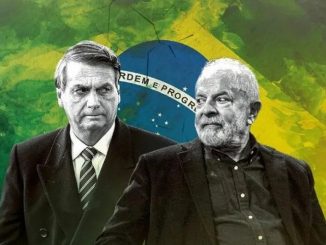
Brazil’s national election is this fall and Argentina’s is in 2023. In Brazil, Luiz Inacio (Lula) da Silva, the front-runner presidential candidate, supported the formation of BRICS economic alliance – Brazil, Russia, India, China and South Africa – that challenges U.S. international economic hegemony by opening up new trade routes and development partners. Argentina and Iran are now BRICS candidates, too.

As the U.S. imperialism and NATO provoked war in Europe continues, and now, while the U.S. aggressively antagonizes the People’s Republic of China over its Taiwan territory, the White House will certainly not welcome the expansion of BRICS in Latin America.

Strugglelalucha256


Predictions on Chile’s constitutional referendum; propaganda or reality?

Sept. 1 was the last day to campaign for the Constitutional referendum to be held on Sept. 4 in Chile. In this vote, Chileans will decide whether to approve the country’s new Constitution, closing over a decade of social struggles, whose final stage began with 2019 people’s massive protests in the subways and streets.

The first step of this constitutional process was the entry (first) referendum, in which 78.28% of voters decided it was necessary to overrule the Pinochet Constitution from 1980. In only 72 hours, this process will end, but tension and uncertainty grow as time goes by.

Many opinion polls point out that the Constitution won’t be passed. It has been something repeated to exhaustion. This prediction never withstood any analysis of the Chilean political context. Today, after irrefutable evidence came out, it can only be considered coarse propaganda.

Propaganda playing its role

Until August 20, mainstream media pointed out that the “I Reject” option might win by a 4 to 15% margin. A quick Google search does not show a single headline differing from this discourse. At most, some analyses conclude there is a lot of indecision, although rejection still prevails in the neoliberal narrative.

In a moment of coming back to solid ground to reflect, it is necessary to ask where are the 80% who voted for a new Constitution elected a progressive Constituent Assembly, and later, a progressive president instead of the right-wing candidate. One has to wonder where does the sudden change come from?

The right-wing propaganda machine has bet on confusion to achieve its objectives. Both traditional media and opinion pollsters played a fundamental role in this strategy, which included fake news, manipulations, and lies.

For example, the “I reject” campaign was built on the false image of a citizen movement instead of right-wing political parties to avoid a defeat like the one they had in the 2019 plebiscite. They want us to believe they have nothing to do with the Chilean right-wing, which bears on its shoulders the gloomy management of the country for decades. That’s why the “I Reject” campaign spokesman stated there wouldn’t be any politicians attending the closing activity. He even went so far as to say his coalition was only made up of civil society organizations not connected to any political parties.

At this point, it is impossible to lie in such an obvious manner. For example, the advertising segment of “I Reject” on public TV was supported by several NGOs in alliance with the “Chile Vamos” coalition and other right-wing parties.

However, despite the efforts to set their media agenda, the poll numbers are not adding up in their favor. Two research teams, Espacio Político (Political Space) and Daoura, recently published two social media-based investigations forecasting the referendum results. Both issues agree that “I approve” should win with around 55 or 56% of the votes.

Both research teams have closely monitored the campaign’s development and have a good record in this type of exercise. Espacio Político predicted the first referendum would be won by “I approve” with 77.8% of the vote, while the final result was 78.28%. In the case of the March presidential election, its prediction was a victory for Gabriel Boric with 57% of the votes, compared to 55.64% of the final count. Meanwhile, the Brazilian team Daoura predicted that 75% of the voters would support the first referendum.

Politically speaking, it is clear that Chile is a country in motion away from the past. In 2019, over 7.5 million people voted in the entry referendum, which was later surpassed in the Presidential runoff, where over 8.36 million people going to the polls. The latest predictions say over 11.6 million people (77% of the electorate) should vote on September 4 since the vote is mandatory and the electoral system has been upgraded.

These statistics show some of the growing political mobilization going on in the country has favored progressive sectors in the last two electoral processes. On the other hand, it must be taken into account that this is a society deeply affected by neoliberalism and that the current constitutional process is the result of great social discontent with the management of right-wing governments.

After all this, it is unlikely that the “I reject” option can have such support as the polls suggest.

Once again, that alliance between the establishment and the corporate media plays a key role in electoral processes. The Chilean right wing is focused on preserving its privileges inherited from the dictatorship through the current Constitution. This time, they disguised themselves as supposedly regular working people opposing civil society. Although, for those who know the reality of the Andean country, it is evident that those behind the “I reject” option are nothing less than the Chilean establishment itself.

It looks like the majority is still supporting the change and are aware of the benefits of the new Constitution. For them, approving it would be a fresh start to build a new type of state, a stronger one that recognizes all the intricacies of the society, guarantees workers’ rights, gender equality, the rights of indigenous peoples, and Chile’s plurinational nature.

Source: Resumen Latinoamericano – U.S.

Strugglelalucha256
https://www.struggle-la-lucha.org/around-the-world/page/40/