BAP rejects calls for more foreign intervention in Haiti

“The Black Alliance for Peace Rejects the Calls for Foreign Intervention in Haiti and Demands that International Community Respect Haitian Sovereignty and the Wishes of the Haitian People for National Self-Determination” 

For Immediate Release    

Media Contact

info@blackallianceforpeace.com

(202) 643-1136

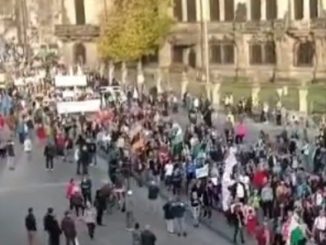
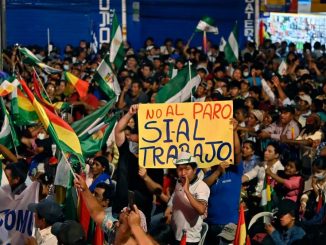
OCTOBER 7, 2022 — The Haitian people have been protesting for months against ongoing foreign occupation and U.S. support for a corrupt government that was not elected by a popular vote or mandate. In the last weeks, popular protests and uprisings have intensified, but the U.S. and its allies have responded by claiming all the disruption in the country amounts to “gang violence” that needs to be quelled with increased foreign intervention, on top of the ongoing BINUH occupation. In addition to the ongoing UN occupation, nine thousand Dominican soldiers are stationed on the border with Haiti and videos have recently surfaced of Dominican military forces entering Haitian territory. Given the Dominican Republic’s history of anti-Haitian sentiment and violence, this is particularly concerning.

Responding to these circumstances, on September 30, The Black Alliance for Peace delivered an open letter to CARICOM (the Caribbean Community), urging the 11-nation group to support Haitian sovereignty and oppose further calls for foreign intervention. BAP reminded the leaders of CARICOM that the situation in Haiti could not be reduced to a sensationalist assertion that so-called gangs were behind the popular uprisings on the island:

“The latest demonstrations are a direct result of two factors. First, they are a response to the everyday economic misery caused by rising inflation, especially through the staggering increase in the price of fuel. Second, they are part of a long history of demands for the end of foreign meddling in Haitian affairs, especially via the installation and maintenance of an unelected and illegitimate government by the Core Group, of which the United Nations is a part.”

BAP urges popular mobilization against continued U.S. intervention in Haiti and in support of Haitian sovereignty. This Sunday, October 9 at 4 p.m. EST in Washington, DC, leaders from 87+ Haitian-American, faith, and human rights organizations will convene at Black Lives Matter Plaza and march to the White House “to demand the Biden Administration stop propping up a corrupt regime that has plunged Haiti into chaos, and to let Haitians decide their own future, including creating a legitimate Haitian-led transition back to democracy and security”. We encourage all who can to show up and support the Haitian people to decide their own future.

The Black Alliance for Peace has been consistent. The crisis of Haitian democracy is the result of the colonialist interventions of the U.S. and other Western powers. As we said in our communication with CARICOM:

“BAP absolutely stands against any foreign armed intervention in Haiti, and continues to demand an end to the unending meddling in Haitian affairs by the United States and Western powers. We call for the dissolution of the imperialist Core Group, an end to Western support for the unelected and unaccountable puppet government of Ariel Henry, and for the respect of Haitian sovereignty.”

We say No to Occupation. Yes to Self-Determination.

Strugglelalucha256


The ‘old’ order and the birth of the ‘new’ one?

Of course, the reference to the order, be it the “old” or the “new”, has to do with the current global geopolitical reordering. The “old” is the one that emerged after World War II, hegemonized by the United States, particularly after the implosion of the Union of Soviet Socialist Republics (USSR).


Of course, the reference to the order, be it the “old” or the “new”, has to do with the current global geopolitical reordering. The “old” is the one that emerged after World War II, hegemonized by the United States, particularly after the implosion of the Union of Soviet Socialist Republics (USSR); and the “new” one, the one that is beginning to become more than evident with the response of Russia to the provocations of the United States, the NATO and their allies that led to the beginning of the war in Ukraine.

It also has to do with China’s response to the provocations of the once undisputed hegemonic country, when it violated the agreement on the recognition of one China and made official visits to the Chinese territory of Taiwan, first by none other than the third in the U.S. hierarchy, and then, in a new provocation, by U.S. congressmen, with the implicit aim of breaking the 1979 agreement recognizing the existence of one China, which had then opened the doors to globalizing neo-liberalism.

And although the attempt to specify the date of the beginning of the end of the old order (including the end of the Cold War, neoliberalism, and globalization) and the beginning of the transition might be controversial, it would not seem to be unwise to place it in the 1990s, due to its symbolism, paradoxically coinciding with the implosion of the USSR. Moreover, and for different reasons, the no less thunderous implosion of Yugoslavia, which took place during the 1990s and culminated in the undeclared war – in violation of the UN Charter and all norms of international law – that ended with the NATO bombing in 1999, causing the death of thousands of civilians.

The beginning of the end could also be placed when, in the 21st century, the very suspicious and never clarified airplane attacks on the Twin Towers in New York, broadcast live, while the President of the country appeared calmly, reading a publication upside down, but ready to declare his readiness to attack the aggressors “in any dark corner of the world”.

There is no doubt that the 2003 invasion of Iraq and the lies to justify it, the enlargement of NATO to include former Soviet countries, the coup d’état in Ukraine and the increase of Nazi followers there, the response of Russia, benefited by the high oil prices as a result of that same war, the rapprochement of Russian and Chinese interests, Putin’s warning call in 2007 in the face of attempts by the United States to create a unipolar world, and the attempts of the same country to create a unipolar world, should also be considered signs of the breakdown of the old order – and of the attempts to maintain it. The US attempts to create a unipolar world with the announcements of the creation of an anti-missile shield, supposedly aimed at protecting Europe from possible attacks by North Korea and Iran; the violation of the Minsk agreements, and the return and accession of Crimea to Russia.

And all at the same time as China was undergoing an unstoppable and accelerated economic and scientific and technological development within the framework of globalization. The result of what has been briefly outlined so far is the strengthening of ties between China and Russia, much feared by the renowned American political scientist Henry Kissinger, aware that the USA will not be able to wage a war on two fronts.

It is necessary to recall the above. It was the context in which the world is “de-globalizing” or, as others point out, in which globalization is “becoming regional,” which makes it necessary to inquire into the causes that determine the return to a “new” Cold War (regardless of ideologies) and because, as UN Secretary-General António Guterres has pointed out, the prospect of a nuclear war is now within the realm of possibility, which puts us on the brink of extermination.

Economics and military capability

The decline of US hegemony and its “rules-based order”, which has made it dysfunctional, as well as the so-called “representative democracy”, which represents the interests of big capital and the oligarchs, and not those of the peoples, is a well-known story; nor shall we refer to the non-existent “economic liberalism”, manipulated by the big transnationals, which makes the States impose “sanctions” that turn it into a fallacy.

Let us stop on the present and, as far as possible, on the immediate future, and on the two aspects we consider most important.

The first has to do with the economy, for its capacity to reflect the whole. The first possible thing to observe is the decrease in the participation of the “West” in the generation of the global gross product (although the United States maintains its participation and continues to be the world’s leading economic power, a situation which, barring a catastrophe, it will maintain until the end of the present decade).

At the same time and because of the above, the increase in the participation of the so-called emerging countries, particularly the BRICS and among them China (which, if a cataclysm does not occur, would surpass the US economy before the end of the present decade). And all this has been accelerated by the war in Ukraine and the sanctions promoted by the U.S., NATO, and the European Union, which have aggravated the aforementioned situation and the inclusion of new members to the BRICS. The shift of the global geopolitical axis towards the Asia-Pacific region is irreversible.

Second in importance is military capability. The vast majority of what can be read on the subject (the Global Firepower 2022 index is an example) combines more than 50 indicators including army size, number of tanks, ships, aircraft, financing, and places the USA in first place, Russia in second and China in third.

To this should be added what Vladimir Putin said in his speech at the opening of the Army2022 defense exhibition: “Russian weapons are years and decades ahead of their foreign counterparts, being far superior in their tactical and technical characteristics,” and the latest demonstrations of their efficiency seem to confirm his words.

The U.S. adventure against Taiwan is not just the individual trip of an irresponsible politician, but part of a conscious and determined movement that seeks to destabilize and bring chaos to that region of the world.

The above seems to be confirmed in the Bloomberg article of August 9, on the “war games,” which simulate the actions that would take place in a possible confrontation between the United States and China over Taiwan, and its grim consequences. Although the exercise itself is scheduled to end in December, suffice it to quote an excerpt from that article: “The results show that, in most but not all scenarios, Taiwan can repel an invasion. However, the cost will be very high for Taiwan’s infrastructure and economy and for U.S. forces in the Pacific.”

Even without considering the human losses of the disaster, some latest data show what it would mean immediately: Taiwan today produces 90% of the world’s advanced semiconductor chips; mainland China produces 40% and by 2025 is expected to produce 70% of semiconductors.

The summary so far is not very pleasant, and even more so if additional data is added, as the USA and the “West”, at best, try to divide the world into opposing blocs and, at worst, to provoke a global confrontation.

The confrontations increasingly impact more nations, which include more and more regional powers such as Turkey and Iran, but also Australia, India or Japan. Ukraine’s proxy war may spread to other European countries such as Serbia, Kosovo, Moldova, Lithuania and Estonia.

Ukraine is getting closer and closer to triggering a nuclear disaster in Europe with the bombing of the largest atomic power plant in the region. If one looks at the possible countries affected, one could say that they are expendable for the “West” and therefore permissible. If this is unacceptable and unheard of, it would be enough to recall Harry S. Truman and Hiroshima and Nagasaki.

Undoubtedly, the non-compliance with the Minsk Agreements and NATO’s approach to Russia to force it to carry out the “unprovoked and unjustified attack” on Ukraine and the visit, first by Nancy Pelosi and then by other members of the U.S. Congress to Taiwan, were moves that started a very dangerous game that Biden, the United States and its acolytes decided to play on the “world chessboard” while disregarding logic and recommendations. Forced to cross the Rubicon, Putin and Russia responded with the “special military operation” and Xi Jinping with the warning that “whoever plays with fire will get burned.” Let us hope that the instinct of conservation is stronger than the lust for power and wealth of those who started the game.

Translated by ESTI

Source: Granma

Strugglelalucha256


After all the pomp and pageantry for Queen Elizabeth II: The apology that never came

How should we remember Queen Elizabeth II and her 70 years on the British throne? It’s perhaps better to consider after the media parade about her funeral is in the rearview mirror.

A number of people have reacted to the glorification of her rule, pointing out the British Royals’ direct connection to the slave tradeBritain’s colonial massacresmass famines , and its loot from the colonies. Britain’s wealth—$45 trillion at current prices from India alone—was built on the blood and sweat of people who lost their land and homes and are today poor countries. Lest we forget, the slave trade was a monopoly of the British throne: first, as the Company of Royal Adventurers Trading into Africa in 1660, later converted to the Royal African Company of England. The battle over “free trade” fought by British merchant capital was against this highly lucrative Royal monopoly so that they could participate in it as well: enslaving people in Africa and selling them to plantations in the Americas and the Caribbean.

According to western legends of the European Age of Discovery, co-terminus with Enlightenment, was what started it all in the 16th century. Explorers such as Vasco de Gama, Columbus, and Magellan went across the world, discovering new lands. The Enlightenment led to the development of reason and science, the basis of the industrial revolution in England. The Industrial Revolution then reached Europe and the United States, creating the difference between the wealthy West and the poverty-stricken rest. Slavery, genocide, land expropriation from “natives” and colonial loot do not enter this sanitized picture of the development of capitalism. Or, if mentioned, only as marginal to the larger story of the rise of the west.

Actual history is quite different. Chronologically, the Industrial Revolution takes place in the second half of the 18th century. The 16th-17th centuries is when a small handful of western countries reached the Americas, followed by the genocide of its indigenous population and enslaving of the rest. The 16th-17th centuries also see the rise of the slave trade from Africa to the Caribbean and the Americas. It destroys African society and its economy, what Walter Rodney calls How Europe Undeveloped Africa. The plantation economy—based on slavery in the Caribbean and Continental America—created large-scale commodity production and global markets.

While sugar, the product of the plantations, was the first global commodity, it was followed by tobacco, coffee and coca, and later cotton. While the plantation economy provided commodities for the world market, let us not forget that slaves were still the most important “commodity”. The slave trade was the major source of European—British, French, Dutch, Spanish, and Portuguese—capital. Gerald Horne writes, “The enslaved, a peculiar form of capital encased in labor, represented simultaneously the barbarism of the emerging capitalism, along with its productive force” (The Apocalypse of Settler ColonialismMonthly Review, April 1, 2018).

Marx characterized it as so-called Primitive Accumulation and as “expropriation,” not accumulation. Capital from the beginning was based on expropriation—robbery, plunder, and enslaving of people by the use of force; there was no accumulation in this process. As Marx writes, capital was born “dripping from head to foot, from every pore, with blood and dirt.”

The British Royals played a key role in this history of slavery and the so-called primitive accumulation. Britain was a second-class power at the beginning of the 17th century. Britain’s transformation was initially based on the slave trade and, later, the sugar plantations in the Caribbean. Its ships and traders emerged as the major power in the slave trade and, by the 1680s, held three-fourths of this “market” in human beings. Out of this, the Royal African Company, owned by the British Crown, held a 90% share: the charge for Britain’s domination of the slave trade was led by the British Royals.

Interestingly, the slogan of “free trade,” under which slogan the World Trade Organization (WTO) was created, was the British merchant capital wanting the abolition of the Royal Monopoly over slave trade. It was, in other words, the freedom of capital to enslave human beings and trade in them, free of the royal monopoly. It is this capital, created out of slave trade and outright piracy and loot, that funded the industrial revolution.

While slavery was finally abolished, in Britain it was not the slaves but the slave owners that were paid compensation for losing their “property.” The amount paid in 1833 was 40% of its national budget, and since it was paid by borrowings, the UK citizens paid off this “loan” only in 2015. For the people of India, there is another part to the story. As the ex-slaves refused to work on the plantations they had served as slaves, they were replaced by indentured labor from India.

To go back to the British Royalty. The Crown’s property and portfolio investments are currently worth 28 billion pounds, making King Charles III one of the richest persons in the UK. Charles III personal property itself is more than a billion pounds. Even by today’s standards of obscene personal wealth, these are big numbers, particularly as its income is virtually tax-free. The royals are also exempt from death duties.

In the three hundred years of the history of British colonialism, brutal wars, genocide, slavery, and expropriation were carried out in its name and under its leadership. After the industrial revolution, Britain wanted only raw materials from its colonies and not any industrial products: the slogan was “not even a nail from the colonies.” All trade from the colonies to other countries had to pass through Britain and pay taxes there before being re-exported. The complement of the industrial revolution in Britain was de-industrializing its colonies, confining them to be a producer of raw materials and agricultural products.

Why are we talking about Britain’s colonial past on the occasion of the death of Queen Elizabeth II? After all, she only saw the last 70 years when the British colonial empire was liquidated. This is not simply about the past, but that neither the British Crown nor its rulers have ever expressed any guilt over the brutality of its empire, and its foundation based on slavery and genocide. No apology for the empire’s gory history: not even for the massacres and mass incarcerations that took place. In Jallianawala Bagh, which Elizabeth II visited in 1997, she called the massacre a “distressing episode” and a “difficult episode”; not even a simple “We are sorry.” Prince Phillip even questioned the number of martyrs.

How do we reconcile the anger that people who suffered from Britain’s colonial empire feel about their leaders making a bee-line to pay homage to the Queen? Does it not shame the memory of those who laid down their lives in the freedom struggle against the British Crown that India lowered the national flag to half-mast to honor the Queen?

One can argue that this happened long before Elizabeth II  took over the Crown, and we cannot hold her personally responsible for Britain’s colonial history. We should: she as Queen represented the British state: it is not Elizabeth, the person that people want an apology from, but the titular head of the British state. That is why Mukoma Wa Ngugi, the son of Kenya’s world-renowned writer Ngugi wa Thiong’o said, “If the queen had apologized for slavery, colonialism and neocolonialism and urged the crown to offer reparations for the millions of lives taken in her/their names, then perhaps I would do the human thing and feel bad,” he wrote. “As a Kenyan, I feel nothing. This theater is absurd.”

Mukoma Ngugi was referring to the Mau Mau revolt for land and freedom in which thousands of Kenyans were massacred, and 1.5 million were held in brutal concentration camps.

This was 1952-1960; Queen Elizabeth II came to the throne in 1952, very much in her lifetime!


This article was produced in partnership by Newsclick and Globetrotter.

Prabir Purkayastha is the founding editor of Newsclick.in, a digital media platform. He is an activist for science and the free software movement.

Strugglelalucha256


Filipino community & allies demand all charges dropped for #MakibekiNYC3

FOR IMMEDIATE RELEASE
October 3, 2022

Contact:
Marion Aguas, GABRIELA New York
bayanusa.ne@gmail.com
609-434-2793

Filipino community & allies demand all charges dropped for #MakibekiNYC3, denounce police violence at anti-Marcos protest

NEW YORK CITY — Filipino pro-democracy activists denounce the security and police violence and arrests that occurred during a protest against Philippine President Ferdinand “Bongbong” Marcos, Jr. on Friday, September 23rd, where the New York City Police Department (NYPD) arrested three activists now known as the Makibeki NYC 3. Makibeki is a slang term used by LGBTQ Filipino activists that derives from the Filipino word “makibaka,” which means “dare to struggle.” All three activists who were arrested are non-binary transgender people.

The Friday protest, organized by BAYAN USA, was the last of a week-long series of actions condemning Marcos’s visit to the United States. Marcos’s trip coincided with the 50th anniversary of his father Ferdinand Marcos, Sr.’s declaration of martial law in the Philippines. The demonstration included a sit-in at the entrance of the Asia Society auditorium, where Marcos was invited to speak despite the stern disapproval of hundreds of Filipino and Asian American writers and artists, followed by a program outside the Asia Society building.

“We wanted to remind Marcos Jr. that we will never forget the crimes of his family,” stated Berna Ellorin of BAYAN USA. “The blood of those who died, either from the military and police or from debt and poverty, are on his and his family’s hands. We will never cease until there is justice and accountability for the over 100,000 victims of martial law.”

While conducting the sit-in, eleven demonstrators held a banner reading “Hold Marcos-Duterte Accountable – No to Fascist Dynasties” and chanted “Never Forget, Never Again, Never Again to Martial Law.” Asia Society security guards responded by aggressively dragging the demonstrators – most of whom were young women, queer, and transgender folks – one by one from the floor of the basement and throwing them forcefully into an elevator, onto the floor, and out of the front entrance onto the sidewalk. The guards grabbed demonstrators by their hair and limbs, in some cases so forcefully that they removed and/or damaged articles of clothing. Protestors were threatened with further violence, with one security guard stating he would break the activists’ arms, if they did not cooperate.

Several activists met Marcos’ motorcade as it left the Asia Society at the intersection of 70th St. and Lexington Ave with placards chanting, “Inutang na dugo ng pasistang rehimen, singilin, singilin, pagbayarin! (The blood debts of the fascist regime must be paid!)” One person was tackled by presumed agents of the Diplomatic Security Service (DSS). According to police reports, they were subsequently taken into police custody for having allegedly thrown a “red substance” at Marcos’s motorcade.

Following this arrest, the remaining group of activists questioned the DSS agents and NYPD, “Why do you protect fascists? Why aren’t you protecting the people?” Instead of de-escalating the crowd, a mob of DSS agents attacked the activists by pushing people to the ground, yanking people by the limbs and hair, and ultimately dragging two others from the crowd and arresting them as well. In the face of this physically aggressive response from law enforcement, community safety marshalls from the activists’ contingent stepped in to protect the people. More than a dozen people suffered physical injuries as a result of the attack.

The Makibeki NYC 3 were arrested, taken into police custody, and held overnight for over 24 hours, during which they were constantly misgendered by law enforcement agents. Collective action from BAYAN members and supporters ensured that the Makibeki NYC 3 were released as swiftly as possible the following evening on their own recognizance. “All of them work in service of our society as a scientist, a nurse, and an immigration lawyer respectively,” said Amanda Katapang, lead organizer for jail and court support. “They will go back to serving and supporting their community while they continue to fight their case.”

“BAYAN USA condemns the arrests of the Makibeki NYC 3,” said Ellorin. “Activism is not a crime. Exerting our democratic rights to genuine change should not be punished.” BAYAN USA calls for all charges against the three to be dropped.

Strugglelalucha256


The world is watching as Brazil’s presidential election goes to a second round

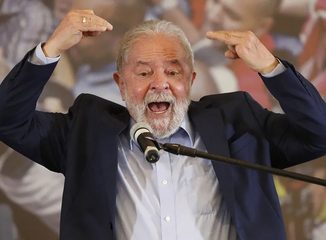
The results of the first round of the presidential election in Brazil are coming and without a doubt, it is the most anticipated news in Brazil, Latin America, and the world too for that matter.  Eleven candidates ran, but as everyone knew it was really a battle between former president Luiz Inácio Lula da Silva and the current president Jair Bolsonaro.

The pre-election atmosphere was very tense including several attacks on Lula’s campaign organizers this past week reflecting the extreme level of politicization and polarization of Brazilian society at this moment. And in the background is Bolsonaro’s threats of a possible coup d’état if he lost in the first round, which also contributed to the growing tension.

Most pollsters had Lula as a comfortable favorite over Bolsonaro partially because of the disastrous management of the ultra-right leader a fact that favored his main opponent. However, it was not enough to make him lose the election in the first round. According to most pollsters, Lula was predicted to win the first round by up to 10-point advantage, but the reality has been a little different.

At the closing of this article, not all polling stations have been counted yet, although the Supreme Electoral Tribunal has already announced the results are irreversible, with over 98% of the polling stations counted. As it stands now, (11 p.m. Brazil time) Lula has 48% of the vote and Bolsonaro has 43%, with the other candidates sharing the remaining 9%. To win in the first round Lula needed to reach 50% showing that those assorted other candidates did not receive a significant number of votes but they siphoned off enough to ensure a second round and save Bolsonaro’s defeat today.

The electoral authorities have already set the date for a runoff between Lula and Bolosonaro that will take place on October 30. Although Lula’s advantage of over 5 million votes is not negligible in a country of over 215 million people, the result of this first round makes it clear that the right-wing cannot be underestimated. It is a very militant and organized force backed by international finance capital, the media, and a strong evangelical base.  Some researchers say, the right tends to take advantage of mandatory vote systems, like in Brazil or the Referendum in Chile, just to mention recent examples.

This result has surprised many, but the most observant analysts foresaw such a scenario. They were clear that Bolsonaro’s electoral base was mobilized and numerous, so the battle would be pitched in this first round. Despite this, Lula remains the most popular candidate in Brazil, with a political strength unmatched so far. But in the second round of Latin America, the script is thrown out the window because of all the variables that come into play.

Lula’s victory in the runoff will depend on two elements, the alliances he may be able to foster with some of the already excluded minor candidates, and a bigger mobilization of the Workers Party (PT) base to gear their efforts to those who did not vote, since about 20% of the population did not go to the polls. Nothing can be taken for granted in this short amount of time.

As for Bolsonaro, the right-wing forces are undoubtedly buoyed by the unexpected results and could gain strength, especially because in the legislature, the ultra-right forces gained seats, as well as some important governorships such as the one in Sao Paulo, the largest city in Brazil.

The next month will be one of intense campaigning for both candidates and with so much at stake, including the saving of the Amazon Jungle and River Basin from destruction, the region will be watching closely as will the world.

Source: Resumen Latinoamericano – US

Strugglelalucha256


Fighting for the rights and sovereignty of Iranian women

The solidarity movement of the Iranian women evoked by the brutal death of Mahsa Amin can serve to encourage women in the U.S. to fight back against the combined repression of the state and the church on their reproductive health. 

The undemocratic ruling of the U.S. Supreme Court eliminating women’s right to abortion is overwhelmingly unpopular. The justices who are appointed for life are not elected. The majority of judges profess conservative religious zeal and far right-wing political ideology. In one 2022 decision, they moved to undo the First Amendment’s separation of church and state in public schools.

The Biden administration, which was elected in opposition to the Trump crowd, appears to be doing nothing to check the Supreme Court’s rabid implementation of racism and bigotry. In states around the country, voting rights are being challenged, history lessons forbidden in schools, the right to gender freedom denied, and state violence against people of color, LGBTQ2S, and disadvantaged workers is validated.

With that in mind, consider the problems faced by our sisters in the Iranian movement. Why is the powerful U.S. corporate media giving it a thumbs up? Why is the Biden administration seeking ways to intervene? President Biden publicly sided with the protesters in his speech at the United Nations. And his administration has moved to set up satellite links and social media with the intention of spurring opposition to the government with dubious information from the U.S.

U.S. economic sanctions on Iran

Can it be that they are concerned about the lives of Iranian women? The hypocrisy is startling. 

Harsh U.S. economic sanctions against Iran began in 1979 and have generally been tightened during the following years. Donald Trump tossed out a deal made by Barack Obama that relaxed the sanctions to deny Iran the development of nuclear energy, a move meant to block the economic development of Iran. Trump amped up the most punishing sanctions, and Biden has not returned to the deal made by Obama.

The years of U.S. economic sanctions have deprived the entire population of the basic necessities of survival. Women, children and the elderly suffer most from the  U.S. sanctions, which even include denying basic medical supplies. 

U.S. sanctions are a form of economic warfare. Sanctions have been imposed on Iran, Zimbabwe, North Korea, Iraq, Cuba, Myanmar, Sudan, Syria and Venezuela — among others.

The goal of sanctions is to destabilize the country and bring about regime change, to deprive those countries of self-determination. U.S. sanctions endanger people’s lives, particularly those already most vulnerable in society: children, women and oppressed genders. 

The human toll was devastating when sanctions were imposed on Iraq. According to the Geneva International Center for Justice, some 1.5 million children were killed by U.S. sanctions on Iraq.

The catastrophic results of U.S.-imposed regime change can be seen in the countries surrounding Iran.

U.S. imperialism and Iran

The U.S. media dwells on the theocratic form of the Iranian government as if the enactment of archaic forms of religious law were unheard of (what about the U.S. Supreme Court?). Even more importantly, how did the Iranian religious leaders come to power?

In 1951 a progressive leader named Mohammed Mosaddeq became Prime Minister of Iran with the rise of massive popular support. Under his leadership, the Iranians nationalized their oil industry. When the Shah, a monarch of the Iranian Pahlavi dynasty, tried to intercede to protect Anglo-U.S. oil interests, the Shah was forced into exile.

The United States CIA, with the active support of the British MI6, responded by organizing a coup. Mosaddeq was arrested and tried for treason. All opposition to the Shah, which had been led by the National Front and Communist Tudeh Party, was suppressed. The U.S. reinstated the Shah’s rule under a martial law regime with brutal measures such as banning the gathering of three or more people. An international consortium took over the Iranian oil facilities for the next 25 years. The U.S. supplied military aid while Iranian workers suffered ever deeper poverty levels, dislocation and decay.

The Iranian Revolution

During the 1978-79 Iranian Revolution, Sam Marcy wrote in November 1978: “The Shah of Iran has not yet been overthrown, but no monarch has ever been so completely a prisoner in his own palace and so thoroughly hated by the overwhelming bulk of the population as is Shah Mohammed Reza Pahlavi.” 

Marcy was a leading Marxist thinker, an active supporter of the Iranian Revolution whose writings were followed by some Iranian revolutionaries.

“First, it should be noted that all the social classes in Iran today — not merely one or the most oppressed but all the classes — are in political motion. None of the classes can any longer openly champion the status quo. To one degree or another, the bourgeoisie, the comprador bourgeoisie, the petty-bourgeoisie in the rural and urban centers, and, needless to say, the workers and the peasants, agree either expressly or by implication that the status quo, the present situation, is unendurable and that the consequent political crisis must be resolved now.”

Thus, the Iranian Revolution began in 1978 with workers’ strikes, most notably the Iranian petroleum workers. Major demonstrations that faced a hail of bullets arose, “not only so in Tehran, in Tabriz, in Isfahan, in Abadan, but all over the country.” The hated SAVAK, the military police of the Shah, was defeated, and large segments of the conscript army came under the influence of the revolution.

Despite the support of Jimmy Carter’s administration, Shah Mohammad Reza Pahlavi was kicked out and forced to retreat to a safe haven in Texas.

At the time, Marcy wrote: “The leadership of the overall anti-Shah opposition is in the hands of bourgeois democratic forces concentrated principally around Ayatollah Ruhollah Khomeini, a religious leader, and not in the hands of a working-class party. 

“This should not be surprising in the light of the catastrophic consequences following the imperialist-engineered overthrow of the Mossadegh regime. What followed was not the mere installation of a puppet in the person of the Shah, but the extermination of practically an entire generation of militants, revolutionaries, and progressives in the annihilation that followed, as were other progressives. A historic defeat of such magnitude as entailed by the overthrow of the Mossadegh government not merely wipes out a generation of political leadership and activists in the anti-imperialist and working class movements, it also leaves a wide generation gap which a long period of repression has filled in with other social and political forces.” 

The Islamic Republic

Ayatollah Khomeini took over the Tehran government, and Iran officially became the Islamic Republic on April 1, 1979. The revolution became limited to the political overthrow of the Shah. The class structure — relations between exploiter and exploited classes — remained intact. The revolution did succeed in releasing the working class from a fascist dictatorship.

The working class, weakened by years of imperialist and colonial domination, succeeded by joining a united front with a hostile class represented by the clerical Khomeini regime. They needed to join other forces to fight for their sovereignty while not subordinating their class interests.

In 1979 Marcy warned: Workers in the U.S. need to avoid the imperialist anti-Muslim bias and consider the difference “between the religious leader of an oppressed country who fights imperialism as against one who, no matter how lofty or advanced his bourgeois conceptions may be, conciliates with imperialism.”

Thirty years later, John Parker, who traveled to Iran in an anti-war delegation in 2010, reported some facts never mentioned in corporate media attacks against Iran. Parker says that more than 65% of Iran’s university students are women, as are more than a third of the doctors. At the time of the 1979 Revolution, 90% of rural women were illiterate; even in towns, the figure was 45%. So, in a little over 30 years, tremendous strides were made in regard to educational opportunities for women. Now large numbers of increasingly well-educated women have been entering the workforce.

Critical support for the current movement

While the mouthpieces of U.S. imperialist interests loudly champion women’s rights, there is no evidence that the U.S. government has alleviated gender oppression anywhere abroad or at home. Quite the opposite.

It is crucial to support Iran’s women and oppressed genders by fighting to end U.S. sanctions, which oppress all the women and oppressed genders in Iran. It is the foremost way to back the fight for self-determination and defend against the opportunistic advances of those who wish to return them to the decades of colonial exploitation.

Strugglelalucha256


Inflation and energy protests explode in Europe

In the wake of the U.S. Ukraine proxy war against Russia, protests have erupted in Europe and around the world over the sky-high energy and food prices caused by the sanctions that the Biden administration and its imperialist allies have imposed on the Russian Federation. These U.S.-promoted sanctions are designed to seize the lucrative EU energy market from Russia and enrich the U.S. oil companies and banks, on the backs of the workers and poor around the globe. As an article from tasminnews.com points out:

Experts warned that as the energy crisis is eating into Europe’s economy and people’s lives, governments’ hands are tied. “Europeans are now muddling through their days, the coming winter will be a crucial challenge for European countries,” Lin Boqiang, director of the China Center for Energy Economics Research at Xiamen University, told the Global Times.

Lin pointed out that the tit-for-tat conflict between Russia and Europe only has one winner— the U.S.; “as the U.S. eggs on Europe to take aggressive measures against Russia, and suffer from energy shortages as a result, the U.S. is sparing no effort in selling gas and oil to Europe and making a lot of money,” said Lin.

The U.S. sent nearly three-quarters of all its liquefied natural gas to Europe in the first four months of 2022, with daily shipments to the region more than tripling from last year’s average, Bloomberg quoted the U.S. Energy Information Administration as saying in June.

Europe will be the underdog during the Russia-Ukraine crisis, yet judging by European leaders’ reactions, they are still determined to further decouple from Russia, choosing politics and ideology over people’s lives and the economy, said Lin.

This worldwide upheaval is only bound to increase, particularly in Europe, as the cold blasts of winter set in.

United Kingdom

In July, the year-to-year UK inflation rate hit 10.1 percent in July, with energy prices projected to rise by 80% this winter. The working class has responded with strikes to demand higher wages to offset inflation. In the summer, rail and other transport workers shut down London and the whole country for days at a time. In Scotland, the rubbish workers struck, while in England criminal lawyers staged a walkout. There is talk in the Trade Union Council of coordinated strikes, perhaps even a general strike.

An August 23 article in the Guardian describes the working class sentiment in Britain as:

When millions of Britons believe rioting is justified over the soaring cost of living, it’s not hyperbole to describe the nation as a powder keg. According to a ComRes poll commissioned by the Independent, 29% of voters believe violent disorder is appropriate given the circumstances. Among 18- to 24-year-olds, nearly half think rioting is justified; and even among 35- to 44-year-olds it’s over 40%. If such a large chunk of the electorate believes that it’s justifiable to smash stuff up in protest even before the projected hike in energy prices plunges millions of households below the waterline, what fury awaits this winter?

Elements of the Council have launched a militant campaign challenging the government on inflation called “Enough is enough

Czech Republic

On September 11th, some 70,000 people marched through the streets of Prague “to protest against high energy costs and call for an end to sanctions against Russia, “according to the “Worldcrunch” website.

Moldova

A September 18th Reuters article reported that at least 20,000 people marched through the streets and rallied in the main square of Chisinau, the capital of this small former Soviet Republic. They called for the resignation of pro-EU, pro-Western President Maia Sandu, who has pledged to bring Moldova into the EU:

Its 3.5 million are enduring serious economic difficulties associated with energy prices, the cost of which has increased by 29% in September after surging almost 50% in August.

Protesters accused Sandu of failing to negotiate a more reasonable gas price with Moscow. Many set up a tent camp outside government headquarters and vowed to remain in place until Sandu resigns and calls early elections.

The country has slashed its growth estimate to zero for 2022, hurt by record high inflation at 34.3% and interest rates at 21.5%.

Belgium

The Associated Press reported that at least 10,000 people attended a “national day of action” through the capital city of Brussels on September 21, “…marching behind banners reading ‘Life is much too expensive, we want solutions now,’ and ‘Everything is going up except our wages,’ or carrying placards marked ‘Freeze prices, not people.’ City traffic and public transportation were disrupted.

Belgium’s leaders made it clear that the people must prepare to suffer long-term to further U.S. energy monopolies’ interests:

Last month, Prime Minister Alexander de Croo warned that “the next five to 10 winters will be difficult” because of high electricity and natural gas prices…

The European Union’s 27 member countries have agreed to cut gas usage by 15% on average this winter and aim in particular to reduce demand during peak hours. 

France

The Worldcrunch website article describes the mood in France:

By introducing energy price caps, France has managed to keep inflation under 6%, the lowest rate in the EU. The government, however, is steeling itself for a “torrid winter” of mass protests, with left-wing populist Jean-Luc Mélenchon announcing a “show of force” and a “march against the cost of living”.

According to a recent survey, only one in 20 households will be able to comfortably cover the higher cost of living. Most will have to dip into their savings. 40% of respondents called for the return of the yellow vests movement. Faced with the spectre of renewed protests, the government has been writing blank cheques for months, although this hasn’t succeeded in truly dowsing the ire of the revolution-loving French.

Populist parties on both sides of the political spectrum have already seen historic victories in the parliamentary elections in June, stripping President Emmanuel Macron of his majority. Macron has called for his fellow citizens to prepare for “an end to abundance and carefree living”. Among protesters, calls for a return to abundance have dominated social media, being shared thousands of times online.

Germany

On September 4th there were large protests in Cologne and Leipzig. An article from tellerreport.com states:

“Energy prices and inflation are out of control.

The cost of heating has tripled, and instead of limiting gas prices, the federal government is raising prices by law,” the agency quoted one of the organizers of the rally as saying.

On September 4, a demonstration was held in Cologne in support of Russia and against the supply of weapons to Ukraine.

As the Worldcrunch website states:

Tensions are running high, and many local and regional politicians are concerned. “The people are telling us that they see no evidence of serious attempts at peace talks, and all the talk is about supplying weapons. The ideologically-driven government needs to respond to the price rises for gas and electricity. Until that support comes into effect, lots of people are facing unemployment and companies are likely to fold,” says Markus Kurze (CDU), member of the state parliament from Burg in Saxony-Anhalt.

Sweden and Italy – Fascists gain strength from U.S. proxy war

Sweden, with its reputation as a progressive social democratic country, is now also facing this U.S.-spawned energy crisis, as the Daily headlines website reports:

In Sweden, electricity prices have increased by around 400% last month as a result of the energy crisis. The rise in prices was linked to high demand from other countries in Europe as well as low electrical output from Sweden’s domestic wind farms and other domestic sources of energy.

On September 12, the far-right Sweden Democrats Party (SD) won 22% of the vote, the largest share of the right-wing coalition set to take control of the government. Founded by NAZIS, it blames the current crisis on immigrants, threatening their communities with harsh repression.

In Italy, the far right gained power in the elections on September 22, with its leader described this way in a CNN article:

Brothers of Italy leader Giorgia Meloni has claimed victory in a general election that seems set to install her as Italy’s first female prime minister, leading the most far-right government since the fascist era of Benito Mussolini.

Meloni has indicated firm support for the U.S. proxy war in Ukraine and the fascist-controlled government there.

Although fascist forces are finding fertile ground for recruiting desperate people in the face of this economic crisis, they can offer no solutions except racism and oppression..

Despite the right-wing electoral victory, trade unions and consumer groups in Italy are planning large demonstrations and rallies to deal with the energy and inflation crisis:

For next October 18, user organizations have called a large public assembly open to all social forces where they will share the reasons and methods of the initiatives to be implemented in the area and a package of measures to be presented to the new government.

This is only a partial list of the struggles that have occurred throughout Europe so far. There are bound to be far more massive protests and other mass actions as winter sets in.

In the U.S., the United National Antiwar Coalition has announced plans for a national week of protests across the country to oppose the devastating U.S. proxy war in Ukraine, and also to protest the devastating sanctions levied against Cuba, China, north Korea, Palestine and Russia that are threatening the lives and livelihoods of millions around the globe.

Source: Fighting Words

Strugglelalucha256


U.S. hybrid war against Venezuela goes to court: The case of Venezuelan diplomat Alex Saab

As Venezuela’s special envoy and a deputy ambassador to the African Union, Saab has diplomatic immunity from arrest and detention under the 1961 Vienna Convention on Diplomatic Relations. Although a party to the convention, the U.S. has flouted this principle of international law.

Judicial overreach on political grounds

Alex Saab was targeted by the U.S. because of his role in helping circumvent their sanctions imposed on Venezuela. These measures, a form of collective punishment, are intended to make conditions so onerous that the people would renounce their elected government. Such unilateral coercive measures constitute hybrid warfare and are illegal under international law.

Ambassador Saab was on a humanitarian mission from Caracas to Tehran to procure food, fuel, and medicine in legal international trade but in contravention of the illegitimate U.S. sanctions. When his plane made a fuel stop in Cabo Verde on June 12, 2020, he was seized and imprisoned at Washington’s behest.

He was tortured and held in solitary confinement until December 2020. Then he was released to strict house arrest but without visits from his wife and children and without necessary medical care.

Although the regional Economic Community of West Africa (ECOWAS) Court of Justice and the UN Human Rights Committee ordered his release, Saab was held captive. The $200,000 award in damages by the ECOWAS court was unpaid.

According to distinguished Nigerian human rights lawyer Femi Falana, the arrest and detention of Alex Saab in Cabo Verde is an example of “extraterritorial politically motivated judicial overreach” and a “twenty-first-century form of colonialism.”

On October 17, 2021, the opposition party won the national election in Cabo Verde on a platform that included freeing Alex Saab. However, the day before, the long arm of Washington “justice” had simply seized the Venezuelan diplomat, dressed him in an orange jumpsuit, and deposited him in a U.S. prison.

The U.S. has no extradition treaty with Cabo Verde and no notice of his extradition was given to Saab’s family or lawyers. Nor had Saab’s legal recourse in Cabo Verdean courts been completely exhausted. His extradition was an illegal fait accompli.

Money laundering charges dropped by U.S.

The original charges against Mr. Saab related to money laundering money in Venezuela with Venezuela as the alleged victim. Even if charges related to defrauding the Venezuelan government were justifiable, they should be laid in Venezuela and not in the U.S., which is attempting to starve Venezuela into submission.

Then on November 1, 2021, after what amounted to a judicial kidnapping to the U.S., Washington dropped all money laundering charges against Saab leaving the single charge of conspiracy to launder money.

An exhaustive three-year investigation of money laundering charges by Swiss courts, where the activity was allegedly perpetrated, had found no evidence to support the U.S.’s claim.

Conveniently for the prosecution, the remaining charge of “conspiracy” is quite easy to prove since it only requires proof of an agreement without the objective being realized. Fighting vague conspiracy charges is a nightmare for defense lawyers. The charge is often called “the darling of the prosecutor’s nursery.”

The labyrinth of the U.S. ‘justice’ system

Ambassador Saab is presently detained in a federal facility in Florida. He has been unable to have family visits because they have no guarantee of safe passage. His prison conditions are difficult with insufficient food and in a dangerous environment without medical care for his cancer and other ailments.

During his unlawful detention in Cabo Verde, counsel for Alex Saab challenged the U.S. extradition proceedings with a “motion to vacate” based on his status as a diplomat.

That motion was first refused in a U.S. “lower” trial court and then appealed “up” to the 11th Circuit Court of Appeals. His appeal challenging the charges based on diplomatic status was then sent right back “down” in June 2022 from the appellate court to the trial court.

In anticipation of his December 12 hearing, Saab filed preliminary motions for disclosure of evidentiary materials with a view to filing a motion to quash the indictment based on his diplomatic status. If diplomatic immunity is recognized, Saab should be released. If not, there will be the trial for conspiracy to launder money in Venezuela.

Saab’s motion to compel disclosure of discovery materials

Exculpatory material could be held by the U.S., which would prove Saab’s status as a diplomat. Under what are known as the Brady rules, the prosecution must provide all evidence available and under its control, which might help in his defense.

Accordingly, Saab requested all information material to his defense held by the U.S. government regarding diplomatic status, including evidence on:

  • His service as Venezuelan special envoy or other diplomatic roles.
  • Whether any other country or international or supranational organization, considered him to be a Venezuelan special envoy or any other diplomatic role.
  • His role in Venezuela’s state-to-state activities with Iran and the purpose of his travel to or from Iran.
  • The flight, diversion, or detention of the plane on which he was traveling, which landed in Cabo Verde.
  • Knowledge by U.S. government personnel of his diplomatic status, appointment as a special envoy, or activities taken on behalf Venezuela.
  • Documents found on his person or plane, following his detention and arrest in Cabo Verde, and any information relating to such documents.

Saab asked the court to order the disclosure of information held by the U.S. departments of Defense, Justice, State, and Treasury, the Office of International Affairs, the National Security Division, the Drug Enforcement Agency, the Federal Bureau of Investigation, the Customs and Border Patrol and Homeland Security Investigations, the Central Intelligence Agency, and the U.S. Coast Guard.

Saab’s counsel anticipates that all these agencies would have information regarding his diplomatic status. Comprehensive disclosure could lead to recognition of full immunity.

U.S. government tries to prevent disclosure of discovery materials

The U.S. government prosecutor made a series of somewhat specious arguments asking the judge to reject the Brady motiondismissing the motion as a simple “fishing expedition” with no merit. In short, this was a legal tactic by the government to hide the truth.

The U.S. prosecutor argued that the requests to review documents outside of the prosecution team’s immediate control should be denied, even if they were held by a government agency and even if they supported Saab’s claim to diplomatic status. The prosecutor contended that only material under the prosecutor’s direct control and related to the investigation can be disclosed; other material held by other branches of the government cannot be sought and disclosed under Brady.

This would mean, if the U.S. government has definitive proof of Saab’s status or recognition thereof in agencies out of the control of the prosecutor, Saab cannot obtain such information under the Brady rule.

Saab’s defense argued that he requires disclosure of information from all branches of the U.S. government. This is because the entire U.S. government is engaged with his extradition and prosecution. The prosecution, for instance, even asked to allow someone from the National Security Division to attend the hearing, although they were not previously part of the prosecution team.

Saab’s diplomatic immunity argued

The following describes the prosecution’s arguments followed by those of the defense. This is based on the respective court statements filed by the two sides and particularly on the transcript of the September 13thhearing.

The prosecution argued that the issue of ignoring diplomatic immunity had been settled in Cabo Verde when it granted extradition. The U.S. court should not depart from precedent and second-guess the legitimacy of a foreign country’s decision to extradite an individual. Such an approach would be contrary to the act-of-state doctrine with respect to Cabo Verde.

Saab’s defense countered that no authority requires deference to Cabo Verde’s decision to allow the extradition. Cabo Verde law applies in Cabo Verde and not in the U.S..

The prosecution maintained that Saab has never been entitled to immunity under either the Diplomatic Relations Act or the International Organizations Immunities Act because he had never been notified to the U.S. State Department as a member of any foreign mission in the U.S., including Venezuela’s bilateral mission and delegation to the African Union.

Saab’s defense disputed that, regardless, Saab was traveling from Venezuela to Iran and at no point transited the U.S.. He had “transit immunity.”

The prosecution contended that U.S. law (U.S. v. Alvarez-Machain, 1992) allows prosecution even if the accused were wrongly sent to the U.S.. Even forcible abduction does not prevent trial in the U.S. for violations of U.S. laws.

Saab’s defense stated that this is a baseless excuse that would allow U.S. agents to kidnap a person in any country and try that person for crimes under U.S. law.

Central to the U.S. government’s case is the self-serving notion that, since Washington does not recognize the Maduro government, no Venezuelan diplomatic nominate enjoys immunity. In other words, the imperial power arrogates to itself the authority to determine whom other countries may appoint as their diplomatic representatives.

Saab’s defense noted that it is an undisputed fact that Venezuela, the sending state, and Iran, the receiving state, not only recognize each other’s government, they recognize that Saab is a special envoy.

In that context, to accord him diplomatic immunity is independent of the U.S.’s position as to which government of Venezuela they recognize. To hold otherwise would completely distort and rob of any meaning both the U.S. obligations and the Vienna Convention and the Diplomatic Relations Act. Failure to do so would be devastating to the diplomatic world and international relations.

Court’s current ruling

Arguments in Mr. Saab’s defense were presented to the court on September 13. On September 15, Judge Scola ruled partially in favor of Mr. Saab, granting him circumscribed access to discovery materials. Disclosure under Brady would include materials under the control of the prosecution: DEA, FBI, and ICE.

Excluded from Brady’s disclosure are materials held by the Department of State, the Office of International Affairs, the National Security Division, the Department of Treasury, the Department of Defense, and the U.S. Coast Guard. The judge held that none of these entities were involved in the investigation leading to his indictment, so these entities need not be searched for proof of diplomatic status.

The U.S. court’s narrow interpretation of the Brady obligations risks causing a major injustice. If in its many international relations and contacts, the U.S. has evidence of Saab’s status, the U.S. can hide this if this evidence is outside the scope of the criminal investigation against him.

This would even be possible if the U.S. had recognized his status as a diplomat in some special context outside the investigation of the alleged conspiracy to launder money. This denial of justice could be likened to a form of judicial lynching.

Trial for December 12 and a proposed non-judicial solution

Saab’s diplomatic immunity will be argued in Southern District Court on December 12. For now, Ambassador Alex Saab is still unjustly detained pending trial.

We believe, Mr. Saab must be recognized as a diplomat and the trial should be terminated. There is a non-judicial means to resolve this. The Biden administration can engage in a prisoner exchange that would unite Mr. Saab and also U.S. citizens imprisoned in Venezuela with their families. Venezuela is willing and the U.S. should do the same.


John Philpot, an expert in international criminal law, is a defense attorney and a member of the Barreau du Québec and of the Consultative Council Asociación Americana de Juristas.

Roger D. Harrisis a recovering political scientist. Both authors are active with the FreeAlexSaab campaign and the Task Force on the Americas, a human rights organization.

Source: Pressenza New York

Strugglelalucha256


Brazil: A presidential election that will mark the immediate future of Latin America

Interview with Latin American political scientist and filmmaker Micaela Ovelar on the current scenario in the South American country and other defining issues ahead of the presidential election

This Sunday, October 2, Brazil, Latin America’s largest economy, will elect its president. This election is decisive not only for the South American country but also for the entire region since its outcome will heavily influence the correlation of forces. Luiz Inacio Lula da Silva (progressive candidate of the Workers’ Party)’s predicted victory would be a boost for the Latin America left and the rejection of neo-liberalism, which has strengthened in the last 3 years. Meanwhile, if Jair Bolsonaro (ultra-right and Trump supporter) wins, it would mean a retrenching for the right-wing to resist.

Regarding this election that carries such weight, Resumen Latinoamericano in English interviewed Micaela Ovelar Marquez, who is in Brazil directing a documentary on the current political electoral process of that country.

Gustavo Maranges (GM): Micaela, first of all, I would like to talk about the internal context in which these elections will take place.

Micaela Ovelar (MO): Extreme polarization is a good way to define Brazil’s current social context. Brazilian society has become very political, like a few times before in its history. For example, issues deeply rooted in the culture, such as football, carnivals, and other major holidays, have taken a back seat to the fierce polarization of political debates.

The confrontation between the followers of president Bolsonaro followers and former PT president Lula has reached the whole society. We understand bolsonarism as an ultra-right and neo-fascist movement whose main figure is the current president Jair Bolsonaro. Meanwhile, Lulism is a progressive movement in its essence, even when it is made up of many social and political sectors ranging from some traditional right groups to social movements and leftist organizations. It is a confrontation between two completely opposite models. It is a very complex scenario involving the entire Brazilian society.

GM: Taking into account the neo-fascist nature of bolsonarism and the fact that ultra-right forces have advanced internationally, especially in Europe and the States, could you comment on Bolsonaro’s electoral base in Brazil and what he proposes?

MO: It is true that the ultra-right has advanced a lot in Europe and the United States. Bolsonaro, to some extent, is the result of this trend’s influence in the region. For example, we cannot forget his affinity with Trump.

However, in Brazil, ultra-right forces’ advances have different characteristics than in Europe. In 2018, the ultra-right comes to power not only because of the growth of its electoral base but also because of the performance of the Brazilian lawfare. There was a dirty campaign against the Workers’ Party (PT), to the point of disqualifying Lula so that he could not run in the 2018 presidential elections. It does not happen like that in Europe.

Bolsonaro’s electoral base is made up of middle and upper-middle-class sectors, which grew thanks to the economic prosperity generated by 13 years of PT governments. These sectors identify very much with Bolsonaro’s main slogan: “God, homeland, family, and freedom”. This describes very well what Bolsonaro’s proposals are. “Freedom” refers to his economic program, which is deeply neoliberal. It is about giving all freedoms to agribusiness to cross over indigenous peoples, the conservation of the Amazon, and taking care of the environment. It is essentially social traditionalism and economic neoliberalism.

He basically proposes to maintain his current management strategy if re-elected, and it is one of Bolsonaro’s weaknesses. He does not have any proposal for change or improvement, something that Brazilians know is needed.

If there is something that joins forces beyond ideology right now in Brazil, it is the environmental deterioration, especially its main ecosystem: the Amazon, the precarious living conditions of the poorest sectors, and the COVID-19 pandemic’s effects. All of these are issues closely related to Bolsonaro’s gloomy management of the country’s natural resources, institutions, and productive capacities.

On the other hand, Bolsonarism counts on some groups which were favored by a law, which allowed them to buy and carry firearms with practically no requirements. It has not only pleased some sectors living outside the law but Bolsonaro’s most radical followers, who became a sort of armed wing of his movement. Something that has cost some lives so far. For the first time in decades, there are politically motivated killings in Brazil.

This is a symptom of the polarization I mentioned before while working as a very subtle element of repression and coercion (since it is not exercised directly by the government), which has an inhibiting effect when it comes to showing opposition to the government by any means.

GM: This element of psychological and physical violence, together with the loyalty he claims to have within the Armed Forces, are two elements that make Bolsonaro feel confident enough to state he will not recognize the election results if he loses. Does the ultra-right president maintain this position, or have the international and institutional criticisms moderated his discourse?

MO: His position about this matter has been inconsistent and changing, nothing different from his mandate in general. Therefore, it is a bit difficult to be sure what he actually intends to do.

First, Bolsonaro went so far as to gather the diplomatic corp to tell them if he lost in October, there would be a coup d’état. This opened a confrontation between the executive and the judiciary, which controls the electoral processes in the country. Later, faced with the judiciary response, the president tried to cover his outburst with a speech on democracy protection. However, he recently assured if he did not win with 60%, it was only because of fraud.

I think it is a strategy to foster confusion and instability while opening an issue for him to exploit after a possible defeat. It is not something new. Donald Trump made it in the United States and is still doing it and Keiko Fujimori did the same in Peru. The assault on Capitol Hill in Washington on January 6, 2021, a failed coup d’état, is the result of this kind of strategy, one that put the US’s entire institutionalism under pressure. Meanwhile, in Peru, Keiko Fujimori almost prevented Pedro Castillo’s victory.

This strategy has kept together and actively mobilized the ultra-right forces. The phantom of fraud has served as a justification to cover the real causes of the electoral defeat, which is the rejection of the model that the right wing has decided to carry out.

GM: Faced with this unstable scenario, what has been the response of Lula and the progressive movement he represents?

MO: Lula has bet on fostering broad political alliances and convincing the majorities. He is a born trade unionist and has gained strength thanks to collective leadership. Today he counts on the trade union movement, the Landless Movement (MST), defenders of the Amazon and the environment, indigenous peoples, defenders of peasants, LGTBQ+, and women’s rights. That is to say, these are forces that see him as an option for progress and change, despite disagreeing in certain aspects with Lula’s positions.

It is a not-ideologically homogeneous group, although united by the fact that they have all been trampled by Bolsonaro’s administration. This is a setback since they have lost rights and spaces gained during the PT governments. For example, the PT managed to get Brazil off the hunger map, although today, over 30 million Brazilians are hungry while 50% of the population is not adequately fed.

It has been one of the main issues of Lula’s electoral campaign, which focused on love, unity, and hope for positive change. Hence, it has not looked for direct confrontation with Bolsonaro, but channeled the dissatisfaction generated by his mismanagement. Lula has exposed what is at stake if Bolsonaro wins, the social schism he has generated, and the instability he has brought to the country in all senses.

The government program presented by Lula is the result of the collective leadership he has built around him. It intends to settle the country’s main needs, but above all, the demands of those movements backing him. It is a comprehensive and ambitious program that goes beyond rebuilding the country and strengthening public services and social assistance. It aims to put Brazil back on the path of development for the benefit of the people. In other words, it is not only to recover what has been lost but to continue building.

GM: This inclusive strategy is often questioned because of the risks it implies. For example, the appointment of Sao Paulo’s former governor, Geraldo Alckmin as Lula’s vice-president, was highly questioned. What criteria led to his addition, and how will it be read?

MO: Certainly, the vice-president appointment was very controversial and judged by some leftist sectors which stand for Lula. However, it is part of the strategy of creating alliances to ensure victory.

Brazil is the 12th largest economy in the world, with a very strong private business sector, which shapes political structures and institutions. We can’t ignore Brazilian politics’ peculiarities when making this type of decision. Likewise, it must be understood that Lula is anti-imperialist, but not anti-capitalist.

Lula’s program is the most progressive among the candidates, but it is useless if he does not defeat Bolsonaro. That’s why he has to unite and add up people.

The right-wing in the region is very organized and has a lot of economic and media power. Therefore, thinking that a chaotic tenure is enough to defeat it is a childish reading. How long did it take Andres Manuel Lopez to become Mexico’s president or Gustavo Petro to win the presidential elections in Colombia? What was their strategy?

The appointment of Alckmin responds to Lula’s will to form a broad front against Bolsonaro, which is the very first step toward saving the country. On top of that, it shows an open-to-dialogue stance, especially with major political forces, even if there are disagreements on certain issues. It is not possible to campaign for unity if sectarianism prevails in practice.

Although the decision was indeed controversial at the time, today almost nobody questions it. All doubts disappeared after these months of the electoral campaign.

GM: Finally, I would like to know which are Lula’s weakest elements and his main challenges going into the October 2 election.

MO: As for the weak points, I think they do not exist or have not been shown. Lula comes out of prison with tremendous moral strength and unequaled political capital. Logically, there are different criteria regarding the strategy, but this type of matter is very subjective. For example, some would say the current alliances or the non-confrontational tone are weaknesses, but I do not think that is the case. These are methods that have their pros and cons.

The challenges are great, but both he and those who follow him are aware of them. The first thing is to get Brazilians to vote since abstentionism is a significant factor in today’s electoral processes. This affects progressive or leftist candidates more since the right wing is very militant and has a lot of organization, as I mentioned before.

All progressive forces understand that the main challenges will come after the elections. Implementing Lula’s government program will not be easy, even if he wins the elections in the first round. There are many obstacles to overcome within the government structures, which still resemble Bolsonaro.

A possible defeat at the polls does not mean that bolsonarism will disappear from society, especially if it has already prepared to act as opposition. Biden’s current situation in the US, putting aside the differences, is a perfect example of how tough it is to deal with the extreme right and neo-fascist opposition.

Four years is not enough to rebuild a country, not one ravaged by a tsunami called Bolsonaro. A revolution is needed in education, health, and culture to recover what has been lost. Nevertheless, Lula’s self-criticism shows a more resilient movement. Acknowledging past mistakes is a very positive step that predicts better management of social problems or political crises, such as the Dilma Rousseff impeachment in 2016.

GM: How has Lula dealt with the stigma of corruption, which is one of the main lines of attack against the left in the world, but especially against him, since he is probably the only left-wing president imprisoned because of it, albeit unjustly?

MO: It is indeed a stigma. It is a stamp that the judiciary and mainstream media have stamped on leftist movements in Latin America, especially in Brazil. Perhaps few have the real perception of how dirty and strong these campaigns are. There is constant harassment in all informative channels, and it is not a matter of months, but years, since the very beginning of the progressive decade. Today, when the scenario is more complex, these ideas, which have been carefully shaped by the right wing, do enormous damage.

Unfortunately, it continues to affect Lula, and it is going to impede better results. On the other hand, it is well known by him and his campaign team. I can assure you they have worked hard to reduce possible damage. No matter how much the courts say he is innocent, corporate media will continue to revive the ghost of corruption against Lula.

GM: Who do you think will win, and would it be possible to have a conclusive result in the first round?

MO: Despite pollsters presenting Lula as the big favorite, even some of them dare to say he might win in the first round, it is very hard to predict anything. Bolsonaro is backed by very influential sectors with a lot of resources.

On the other hand, Lula’s electoral campaign has been very comprehensive, and even some evangelical churches joined him. It is very positive since this is a sector that Bolsonaro controlled almost entirely in 2018.

Still, the opponent cannot be underestimated. Lula’s victory in the first round seems very difficult, but it would be a beautiful surprise.

Micaela Ovelar is Argentine-Venezuelan and was one of President Hugo Chavez’s foreign policy advisors. She has worked with the Venezuelan government for the last 15 years while currently living in Sao Paulo. Micaela specialized in film and TV direction at EMPA (Caracas) and worked as an archive researcher for the film “Silvio Rodriguez. My first calling”. She was also the producer of “A as for Angicos,” a film by Catherine Murphy and is currently a columnist for “Correo del Alba” (Bolivia), United World (Türkiye), and other international media.

Source: Resumen Latinoamericano – US

Strugglelalucha256


The real Babyn Yar

81 years later, the Jewish community, and all those who would resist fascism, remember

The U.S. and European political mainstream love to use the Holocaust. They use it to justify Zionist apartheid. They use it to make millions of dollars off tragedy porn passed as drama films. They use it to draw false comparisons between Vladimir Putin and Adolf Hitler. 

What they rarely do, liberal or conservative, is tell the truth about the Holocaust. This deception includes the massacre at Babyn Yar. 

A standard narrative among the fascist movement and, unfortunately, government officials in Ukraine and its Baltic allies is that Babyn Yar was a despicable Soviet plot designed to cover up their mass slaughter of innocent Jewish children and deflect attention to Nazi Germany. 

NATO and its media allies love to place responsibility for horrendous crimes against humanity on Russia and China. Funny enough, history tells us a different story. History tells us that fascism commits the worst crimes against humanity. Babyn Yar is no different. 

The fact is, there is an incredible amount of disinformation and propaganda regarding Babyn Yar when the truth is fairly simple. The SS Galicia division, aided by Banderite collaborators, murdered over 33,000 Jews over the span of two days. The vast majority perished on the first day. Only 29 Jews subjected to this horror survived to tell the tale. That’s the truth not seen on CNN, BBC, or other big business media. 

What’s important to understand is that Babyn Yar was not an isolated incident but a culminating event after a summer of horrific anti-Semitic and anti-Roma pogroms. Behind the terror in the summer of 1941 were the Stepan Bandera-led Organization of Ukrainian Nationalists (OUN), the SS, and other Nazi collaborators.

This article aims to recognize the anniversary of the Babyn Yar tragedy through a truthful analysis of contemporary conditions and an examination of history. 

Babyn Yar borne from Ukrainian collaboration

The depth of Nazi terror and the Holocaust in Ukraine would not have been possible without a substantial, organized population of collaborators. Ukraine had exactly that. 

Contemporary Ukrainian nationalist propaganda often touts the great resistance in Ukraine against the Nazi and Soviet invaders. As if making the two equivalent isn’t bad enough, the analysis is a historical fantasy. 

Some 100,000 Ukrainians joined Nazi police forces during World War 2. That number does not include the ranks of the OUN nor the SS Galicia Division. Frankly, the level of Ukrainian collaboration with Nazi Germany was likely the most severe on the European continent, except for maybe Poland. 

On January 1, 1941, almost 2 million Jews lived in Ukraine. By the time Bandera and Hitler were done, nearly 1.6 million of those people were dead. This did not happen without a significant Ukrainian fascist movement willing to collaborate with Nazi occupiers. 

This depth of collaboration is exactly what allowed SS forces to perpetrate massacres like Babyn Yar. It’s crucial to understand that Babyn Yar was simply a culmination of a Nazi terror campaign against all those they viewed as sub-human. This included Jews, Roma people, Communists, Russians, Poles, LGBTQ2S people, and even Ukrainians. 

A fallacy has long existed that Nazi collaborationism and fascism will save an occupied country from Nazi violence. This fallacy has repeatedly led countries like Ukraine to its destruction. This was the case during World War 2, and it is certainly the case now. 

The actualization of this fallacy is no better demonstrated than by how quickly the Ukrainian community threw itself into anti-Semitic organizing once the Nazi invasion began in 1941. As soon as Hitler began his invasion of the USSR, the OUN and similar organizations sprang into action against all those who opposed fascism. The OUN had been working with the Nazis for years before the bloody summer that began with the 1941 Lviv pogroms and was bookended by Babyn Yar. 

On June 30, 1941, not long after the Nazi invasion, Bandera and the OUN issued a proclamation “restoring the Ukrainian state.” In this proclamation, the OUN declared its affinity and future collaboration with Nazi Germany. In the OUN’s view, Nazi Germany was aiding the Ukrainian people in freeing themselves from “Muscovite occupation.”

In furtherance of this proclamation, the OUN launched a pogrom of unprecedented proportions the next day, centered in Lviv. The slaughter was immediate and brutal. In less than 12 hours, OUN militants murdered nearly 10,000 Ukrainian Jews. This began a summer of OUN terror against Ukrainian Jews, including a late July massacre known as the “Petliura Days.”

Symon Petliura was a famed Ukrainian nationalist leader and rabid anti-Semite. Petliura was infamous for his particularly brutal pogroms against Ukrainian Jews in the early 20th century. Approximately 2,000 more Jews would be murdered in his name over the span of less than 24 hours in late July 1941. 

This is all to say Babyn Yar came as the summer’s Nazi terror reached a fever pitch. Ukrainian collaborationist organizations were fully mobilized and formed. This allowed the Nazi army and the SS to gain a substantial foothold in Ukraine. 

The result? Babyn Yar — arguably the most notorious anti-Semitic massacre of the Holocaust. German SS paramilitary forces and the recently formed Ukrainian Auxiliary Police carried out this massacre. 

Babyn Yar sticks in the collective memory of all those who would oppose Ukrainian Nazism and NATO imperialism as a firm reminder of fascism’s capabilities. 

Bandera’s ideological descendants

Since the fall of the Soviet Union, Stepan Bandera has again grown into a popular symbol not only for the Ukrainian Nazi movement but for the Ukrainian government itself. It is not uncommon to see UAF or fascist battalion troops wearing Bandera patches or waving flags laden with Bandera’s face. 

In the years leading up to Russia’s  2022 denazification campaign, mass Nazi demonstrations were held in western Ukrainian cities, including Kiev and Lviv. Crowds between 40,000 and 70,000 Nazis brandished swastikas, the Right Sector trident, and flags donning Stepan Bandera’s face. These are the people who really run Ukraine. Whether civilian organizers, elected politicians, or the NATO-equipped military, the veil of “Ukrainian democracy” only thinly covers the fascist reality. 

These forces want to create a new Holocaust, a new Babyn Yar, directed at all those NATO deems undesirable: Russians, Jews, Roma people, all Slavic people, anti-imperialists, communists, socialists, etc. NATO uses the people of Ukraine as meat shields to further its goal of white supremacy and genocide. 

One of the few images captured of Babyn Yar depicts a Jewish mother, stripped naked, trying to protect herself and her child from an SS trooper poised to execute her baby in front of her eyes. She was one of my people. Her child was one of my people. The Ukrop Nazis and their SS handlers murdered her and tens of thousands of others just like her and her child. Stepan Bandera adored this picture. He carried it with him until his death as a reminder of what he was fighting for, the purging of all “mongrel races” from Ukraine. 

That is the Ukraine that NATO wants. That is the Ukraine that the UAF and the Azovites want. That is the Ukraine the U.S. wants. That Ukraine cannot be allowed to re-emerge. In reality, the myth of Ukrainian nationalism is inherently linked to fascism. 

This is what all anti-imperialists, wherever we are, must resist. We must fight against all forms of imperialism, from racist police terror in the U.S. Black community to Ukrop nazi terror in the Donbass. The global working class defeated Bandera once. We must defeat his descendants now, or we will be subject to a million Babyn Yars. 

Lev Koufax is an anti-zionist Jew with ancestral roots in Russia and Ukraine. 

Strugglelalucha256
https://www.struggle-la-lucha.org/around-the-world/page/39/