Honduras on the edge: Xiomara Castro calls for popular mobilization to confront U.S.-backed coup plot

Libre campaign rally
LIBRE campaign rally in November ahead of the elections. Photo: LIBRE

Dec. 17 — After a five-day hiatus and more than two weeks since the elections, the Honduran National Electoral Council (CNE) has resumed counting votes in an electoral process that has been widely questioned by various political forces on the left and right in Honduras. According to the CNE, several technical problems are hindering the count.

According to official data, the candidate of the National Party of Honduras (PNH), right-wing Nasry Asfura (backed, among others, by US President Donald Trump) maintains a slight but sustained lead (40.53%) over television presenter Salvador Nasralla of the Liberal Party of Honduras (PLH) (39.21%).

Thus, Asfura would have 1,302,264 votes in his favor, while Nasralla would have 1,258,580. For her part, the ruling party’s candidate, leftist Rixi Moncada of the Liberty and Refoundation Party (LIBRE), obtained 19.3%.

Moncada and LIBRE denounced that the electoral process was marred by foreign interference (pressure from Trump) and irregularities in the process. But it is not only the ruling party that has severely questioned the elections.

Nasralla denounces “fraud”

Candidate Nasralla said in an interview with CNN that “fraud in the vote count” had been committed: “Today they are stealing from the place where the ballot boxes with the votes are located. Representatives of the National Party turned off the cameras and prevented representatives of the Liberal Party from entering.”

He also directly accused the PNH, which governed Honduras between 2010 and 2022, of being behind a possible fraud plot: “[The CNE] must review vote by vote the ballot boxes that we have claimed from the Liberal Party of Honduras, which are more than 14,000 (2,773 in a special count that begins today at 7 a.m.) of the 19,167 in which they cheated. If they do not, voters in Honduras and around the world will know that the Honduran elections are not decided by the people with their votes, but by the organized crime that ruled from 2010 to 2022.”

Likewise, a congressional commission has severely questioned the way in which the vote count has been conducted and announced that if the irregularities are proven, they will not validate the November 30 election: “We denounce the existence of an ongoing electoral coup… We absolutely condemn the interference of US President Donald Trump.”

Defense of the results

For its part, the observer mission of the Organization of American States called for the recount to resume immediately. “The mission urgently calls on the electoral authorities to immediately begin the special recount and to seek all possible means to obtain the official results in the shortest time possible… The current delay in processing and publishing the results is unjustifiable,” said Eladio Loizaga, head of the mission, during a special session of the OAS Permanent Council.

The President of the CNE, Ana Hall, defends the actions of the institution she presides over and affirms that the highest electoral body is being intimidated: “Today, I have ratified that I reject the intimidation tactics that are being used and that I will stand in the way of those who seek to prevent the declaration of the General Elections.”

The specter of fraud

Candidate Asfura, who currently holds a slight lead, has requested that the review of the records be made public and televised: “Let there be no doubt about the results, [so that the new government] can work in peace and tranquility.”

Asfura knows that the delay in officially announcing the results, in addition to allegations of fraud by his two main opponents, undermines the legitimacy of his possible victory. It is one thing for one of Honduras’ three major political parties to reject the results. It is quite another for two parties, which together account for almost 60% of the votes cast, to do so.

It has not been many years since a large part of the political spectrum denounced alleged electoral fraud in 2017 that gave victory to Juan Orlando Hernández (2014-2022) of the PNH, the same party that today supports Asfura. After the elections, there were major demonstrations that left dozens injured and several dead. Despite this, Hernández took office as president and completed his term after a series of questions about the persecution of left-wing leaders.

After his term, Hernández was investigated, charged, and sentenced to more than 40 years in prison in the United States for being part of a drug trafficking network that allegedly trafficked several tons of drugs into the country. Despite this, Trump pardoned Hernández, who is currently out of prison in the United States.

President Castro denounces attempted coup

According to Honduran President Xiomara Castro, Juan Orlando Hernández’s release could have more serious implications. As she stated in X, Hernández’s upcoming entry into the Central American country is intended to launch a “coup d’état”: “I report with historical responsibility that, based on verified intelligence information, Juan Orlando Hernández, pardoned in the US, is planning his entry into the country to proclaim the winner of the elections while an attack is underway aimed at breaking the constitutional and democratic order through a coup against my government.”

She also called on the Honduran people to defend the Republic and the constitutional order: “In light of this grave situation, I urgently request the conscious and peaceful support of the Honduran people. I call on the people, social movements, collectives, grassroots organizations, activists, and citizens to gather urgently and peacefully in Tegucigalpa to defend the popular mandate, reject any coup attempt, and make it clear to the world that a new coup is brewing here.”

Several demonstrations by LIBRE activists and other social movements have taken place. In response, the police have deployed heavy-handed repression, which was condemned by Castro, who has requested an investigation and the dismissal of the law enforcement officers who participated in the repression.

Source: Peoples Dispatch

Strugglelalucha256


Trump’s interference invalidates the presidential election in Honduras

Honduras

An extraordinary catalog of U.S. interference – amounting to an electoral coup – may have destroyed what was already a struggling democracy in Honduras. Trump has succeeded in closing the door to progressive government and in all likelihood his preferred neoliberal candidate – previously trailing in many opinion polls – will be declared president when the count eventually finishes.

While Washington’s aversion to foreign interference in its domestic elections verges on paranoia, the gross hypocrisy which runs through its foreign policy leaves it free of any compunction when meddling in other countries’ elections, especially in Latin America. Perhaps no country has greater recent experience of this than Honduras. Although most accounts of this meddling begin in 2009 with the ousting by army officers of its democratically elected president, Mel Zelaya, in truth U.S. dominance of the country has a much longer history, as I described at the time.

The U.S. refused to designate Zelaya’s toppling as a “military coup” or to back international calls for his rapid return to office. Washington then backed all the post-coup governments, including those established by Juan Orlando Hernández when his National Party “won” two highly manipulated elections. Rampant corruption by him and his predecessors ensured that Honduras became a “narcostate.” Nevertheless, U.S. administrations embraced Hernández as a prime ally in the war on drugs up until the point when he left office, was extradited and committed to 45 years in a U.S. prison. Only the large majority won by the Libre party’s Xiomara Castro in the 2021 election, and the fact that Hernández had become a liability, temporarily frustrated Washington’s customary ability to get the Honduran president that best suited its interests.

Castro’s government only partly fulfilled its progressive aims, not least because of the continuing power wielded by Honduras’s often corrupt elite, a judicial and security system still strongly subject to U.S. influence, and social media campaigns which often originated in Washington. Opinion polls showed that Castro’s chosen successor as Libre Party candidate, Rixi Moncada, would be in a close race with the right-wing candidates of the two traditional parties, the Liberals’ Salvador Nasralla and the National Party’s Nasry Asfura. Trump favored Asfura, effectively the successor to Juan Orlando Hernández, as the candidate most attuned to his policies.

The fact that the November 30 election took place at the height of the U.S. military build-up in the Caribbean was itself a crucial ingredient in determining the outcome. Both right-wing candidates were able to warn Hondurans that a vote for Libre would be an invitation to the U.S. military to turns its guns on them. Trump emboldened them by asking on Truth Social, “Will Maduro and his Narcoterrorists take over another country like they have taken over Cuba, Nicaragua, and Venezuela?” According to him, a vote for Asfura would ensure that Honduras did not face the same potential fate as Venezuela. “Tito and I can work together to fight the Narcocommunists,” he added. “I cannot work with Moncada and the Communists.” Nor, apparently, could he even trust Nasralla, whom he described as “borderline communist.”

The president then trumped this statement by declaring that only if Asfura won would U.S. aid for Honduras continue. “If he doesn’t win, the United States will not be throwing good money after bad,” he said. When Nasralla appeared to have edged ahead of Asfura, in a close count, Trump said that it “looks like Honduras is trying to change the results of their Presidential Election,” adding, “If they do, there will be hell to pay!” Then, in a night “marked by technical failures and tension in the results system,” the count suddenly gave the lead to Asfura. The International Observation Mission of the American Association of Jurists asserted that Trump’s intervention “has placed the legitimacy of the democratic process in crisis.”

In an even more extraordinary move, Trump announced that he would be pardoning the disgraced former president Hernández, who has indeed since walked free from prison. A move that might have harmed the National Party appears instead to have been an astute boost to Asfura’s campaign, given that many of his supporters still idolize Hernández and regard Asfura as an inferior leader. However, Mike Vigil, a former senior official in the U.S. Drug Enforcement Agency, told the Guardian that pardoning Hernández “shows that the entire counter-drug effort of Donald Trump is a charade.” Activist and author Dana Frank told the Guardian that “his repressive, thieving, dictatorial history, backed by the United States year after year, has evaporated from the story.”

Another, very effective but little publicized intervention appears to have taken place, if Rixi Moncada’s claim in an interview with Telesur is correct. According to her, huge numbers of the 2.5 million Hondurans who receive remittances from family members in the U.S. were warned that, if Libre won, they would not receive their December payments. The magnitude of the threat (whether or not it could have been carried out in practice) is indicated by the fact that remittances account for a quarter of Honduras’s GDP. It seems possible that many poor households’ votes, which might have gone to Libre, didn’t – because of text messages sent directly to their phones.

That electoral fraud would again favor the U.S.-supported candidate was indicated in the run up to November 30 by leaked audios implicating the National Party’s representative on the national election council. The council’s Libre representative, Marlon Ochoa, who denounced that planned fraud, has now published a detailed account of irregularities since counting started, which he claims invalidate 86 per cent of polling returns. Indeed, at the time of writing, following a week of technical problems in vote counting, there is still no official winner.

Rixi Moncada harshly questioned the silence of the electoral observation missions from the Organization of America States and European Union, which she accused of deliberately omitting any reference to Trump’s interference in their bulletins on the conduct of the election. “So far they have not commented on the intervention of the U.S. president in their reports,” Moncada claimed, noting their attitude “borders on complacency.” New York Times interviews with Hondurans showed clearly that Trump’s comments influenced their votes. Mark Weisbrot, of the U.S. Center for Economic and Policy Research, pointed out that his interventions were “a violation of Article 19 of the Charter of the Organization of American States, to which the United States is a signatory.”

Emboldened by his apparent success in defeating “communism,” even if (at the time of writing) he may not yet have secured the victory of his preferred neoliberal candidate, Trump has gone on to publish his own “corollary” to the century-old Monroe Doctrine, endorsing its claims to a unique U.S. sphere of influence covering the whole region. Echoing the 1904 corollary to the doctrine issued by President Roosevelt, which declared that the U.S. would be a “hemispheric police power,” Trump says he is “proudly reasserting” control over “our hemisphere,” guarding the American continents “against communism, fascism, and foreign infringement.”

Nothing could be a clearer manifestation of what has been called the “Donroe Doctrine” than the military build-up in the Caribbean, which provided the threatening backdrop to the final weeks of the Honduran election campaign. As Roger Harris and I noted in a recent article, the deployment of one-fifth of U.S. maritime power is aimed not just at Venezuela, but at starting a wider domino effect in the Caribbean basin. In the aftermath of November’s election night in Honduras, the first domino appears to have fallen.

Source: Resumen Latinoamericano – English

Strugglelalucha256


Trump’s ‘peace plan’ is a war plan for Ukraine

In late 2025, the Trump White House rolled out a new “28-point plan” to end the war in Ukraine. Far from a serious bid for peace, the proposal is designed to lock in NATO’s gains, give the U.S.-backed regime in Kiev time to regroup, and blame Russia when the fighting resumes.

Under Trump’s peace farce, the borders would be frozen along the current line of contact in an immediate ceasefire. Donetsk, Luhansk, and Crimea would officially be recognized as Russian territory. The plan also requires Ukraine to constitutionally commit to not joining NATO. 

At first glance, this seems reasonable. However, the plan also calls for a Ukrainian standing army of 600,000 troops, Ukrainian EU membership, and security guarantees from the United States. In practice, this is NATO by another name. It allows for continued military investment and gives the West an open check for new provocations against Russia.

Russia’s strategic objectives

Washington portrays Russia’s intervention as the first step in a new Napoleonic or Hitler-style march across Europe. Western media depict Putin and the Russian people as power-hungry aggressors bent on rebuilding the czarist empire. This caricature has nothing to do with reality.

Russia is a capitalist state with its own interests, but it did not choose this war in a vacuum. For three decades, NATO has expanded eastward, ringing Russia with bases and missile systems and backing a hard-right regime in Kiev that waged war on the people of Donbass. Russia’s 2022 intervention was, above all, a response to this encirclement.

From the outset, Russian leaders have named four main objectives in Ukraine: to demilitarize the country, to break the power of fascist formations like the Azov battalion, to protect the people of Donetsk and Luhansk from state terror, and to ensure that Ukraine is permanently neutral — not a NATO bridgehead on Russia’s border.

Since the fascist Maidan coup of 2014, Ukraine has received massive Western arms shipments and training. Neo-Nazi formations have been folded into the regular military and security services. The regime has torn down Soviet monuments, outlawed communist organizations, attacked unions, and elevated Nazi collaborator Stepan Bandera as a national hero. For the people of Donbass, this has meant years of shelling, blockade, and repression.

In this context, Russia’s insistence on a neutral Ukraine and real security guarantees is not “imperial ambition,” but a refusal to accept a permanent NATO forward base on its doorstep — a price Russian society has already paid for in lives and hardship.

Why offer a plan Russia cannot accept?

The U.S. proposed this knowing it contained provisions that Russia could never accept. Russian acceptance of this plan would arguably put them in a worse strategic position than when the war began. The Ukrainian army would be over twice the size it was in 2022. The Ukrainian government would remain a hardline right-wing U.S. puppet regime.

While technically keeping Ukraine out of NATO, this provision is in name only. The security guarantees did not exist when this war began. Why would Russia accept a stronger U.S. military alliance with Ukraine? This merely sets up another conflict down the road.

Russia has been clear from the beginning, it cannot allow a NATO military bridgehead on its western border. This peace plan would, de facto, establish such a bridgehead. It also allows for massive U.S. economic investment in Ukraine for rare earth mining, natural gas pipelines, and infrastructure projects. Deepened U.S. control over Ukraine’s economy is not a path to peace; it’s one of the very conditions Russia set out to prevent.

So, why propose this plan when Russia clearly cannot accept it? It’s hard to say exactly, but the most likely reason is rhetorical positioning. Washington puts forward a proposal that appears “reasonable” to a public worn down by war. When Russia refuses, the U.S. blames Moscow as the sole obstacle to peace and uses that propaganda to justify more weapons, more funding, and more escalation.

Now, there is another possibility – even if remote. It is possible that Trump and the generals and billionaires around him truly believe they can enforce this plan on Russia through economic warfare. Russia has faced crippling sanctions since the start of the war, with little impact. Through industrial war mobilization and deepened economic ties with China and the Global South, Russia has consistently circumvented most of the West’s sanctions. 

If there is a belief in Washington that sanctions and financial pressure can force Russia to swallow a plan that cements a hostile Western military outpost on its border, that belief has no basis in reality.

The U.S. doesn’t want peace

The billionaires who control the U.S. economy — and the politicians of both major parties who answer to them — are not seeking peace in Ukraine. They are seeking profit and strategic advantage. The war has been a bonanza for Northrop Grumman, General Dynamics, Raytheon, Lockheed Martin, and the rest of the military-industrial complex. They have made fortunes shipping weapons into Ukraine, and they see no reason to stop.

They are interested in war, profit, and the isolation of their primary target: China.

Even if the West believes Trump’s plan can be implemented, peace isn’t the goal. Any cessation of hostilities under this framework would be temporary — a breather for the U.S. and its proxy in Kiev to regroup, rearm, and prepare for the next round of confrontation with Russia.

The U.S. does not want to cool global tensions or bring Russia back into its fold. The U.S. billionaires want to make money, and they have made loads of it by waging war on Russia. Needing a break to regroup is not the same as a genuine desire for peace. Peace is explicitly opposed to the economic interests of the entire military-industrial complex.

These defense magnates and the U.S. government hope that by draining Russia through endless war, they can eventually force regime change and deprive China of a key strategic ally. Imperialism will do whatever it takes to maintain its dominance and increase its profits, even if that means promoting phony peace plans.


Strugglelalucha256


Japan and the U.S. move toward open military confrontation over Taiwan

Japan’s ultra-rightwing prime minister, Sanae Takaichi, ignited a political storm when she declared that any Chinese move to reunify Taiwan with the mainland would threaten Japan’s very survival — and that Tokyo would be ready to join military action to stop it.

For Beijing, the message was clear: Japan was abandoning its long-standing stance of avoiding any commitment to take sides in a conflict over Taiwan and was now declaring that it would join the United States in a military response. Chinese Foreign Ministry spokesperson Mao Ning denounced the remarks as a serious provocation and a dangerous interference in China’s sovereignty.

Japanese right-wing forces further inflamed the situation. Japan’s Defense Minister, Shinjiro Koizumi, announced that plans were “steadily moving forward” to deploy a medium-range surface-to-air missile unit at a military base on Yonaguni — an island only 110 kilometers (68 miles) off Taiwan’s east coast. A Reuters report quoted Mao Ning warning that “the move is extremely dangerous and should raise serious concerns among nearby countries and the international community,” especially in light of Takaichi’s earlier comments.

Two Japanese government sources also told Reuters that Donald Trump privately urged Prime Minister Takaichi to tone down her public threats during a call this week. The move fits a familiar Trump pattern: loud public belligerence paired with quiet tactical repositioning when trade negotiations or economic pressure campaigns stall. Some commentators have even coined the acronym “TACO” — “Trump Always Chickens Out” — to describe his habit of retreating behind the scenes after aggressive rhetoric. But far from signaling a real shift, this is political maneuvering. Even as the administration adjusts its tone for trade talks with China, U.S. war planning continues without pause, and Washington is pouring new investments into Japan’s military — underscoring that the U.S. strategy in the region is not about peace.

U.S. greenlights new arms for Taiwan

At the same time that Japan was escalating its rhetoric, the United States approved a new $330 million arms package for Taiwan on Nov. 13 — the first such sale under Trump’s return to office. The package includes repair parts, non-standard components, and continued support for Taiwan’s fleet of F-16 fighter jets, C-130 transport aircraft, and other military systems.

Washington’s intention is clear: more weapons, deeper military integration with Taiwan, and further preparation for confrontation with China.

A U.S.–Japan military bloc

Japan remains the centerpiece of Washington’s military strategy in the western Pacific. The United States operates more than 120 military installations across Japan, including 15 major bases, and stations over 54,000 troops there — the largest concentration of U.S. forces anywhere outside the continental United States. Okinawa carries the heaviest burden of this occupation, with bases crowding the island and dominating local life.

The U.S. has also upgraded and expanded the weapons it deploys and rotates through these bases, tightening its forward position against China. This includes fifth-generation F-35 Lightning II stealth aircraft — with the F-35B variant permanently based at Iwakuni and F-35A rotations continuing at Kadena — as well as V-22 Osprey aircraft operating from Okinawa and Iwakuni. The missile-defense network has been reinforced through Standard Missile-3 interceptors aboard Aegis destroyers homeported in Yokosuka, along with Patriot Advanced Capability-3 batteries across multiple bases. A key recent development is the rotational deployment of the Typhon Mid-Range Capability system, capable of firing both Standard Missile-6 and Tomahawk cruise missiles, giving Washington a new ground-based, long-range strike option aimed directly at China’s coastline.

None of this posture is defensive. It is the architecture of a forward-deployed war machine.

How the U.S.–Japan alliance was rebuilt for confrontation

After Japan’s defeat in 1945, the United States reshaped the country’s political and military structure to serve Washington’s aims in Asia. The 1960 U.S.–Japan Security Treaty locked Japan into a permanent, unequal alliance: The U.S. gained open-ended basing rights, and Japan agreed to rely on Washington for its external defense. In practice, the treaty placed Japan squarely inside the U.S. military orbit.

By 1978, updated defense guidelines went even further. For the first time, they committed Japan to joint operations with U.S. forces in “situations in areas surrounding Japan” — diplomatic code for Korea, the Taiwan Strait, and the entire first island chain along China’s coastline. This language marked a major shift: Japan was being integrated into U.S. war planning beyond its borders.

For decades, Washington has pressed Japan to dismantle its postwar pacifist constitution, particularly Article 9, which formally renounces war. Right-wing governments — from Abe to Kishida to Takaichi — have steadily chipped away at those restrictions. With full backing from the United States, Japan is now rearming at a pace not seen since World War II and positioning itself as a direct participant in U.S. confrontations with China.

The deep scars of Japanese imperialism

China’s response to Japan’s new militarism cannot be understood without remembering the past. In the first half of the 20th century, the Japanese Empire invaded, occupied, and devastated large parts of China. This period — known in China as part of the “century of humiliation” — left deep wounds that continue to shape Chinese national memory.

The War of Resistance against Japan (1937–1945) brought mass displacement, famine, and systematic atrocities. The most infamous was the Nanjing Massacre of 1937, when Japanese troops killed an estimated 200,000 civilians and carried out widespread rape and torture. Across the eight-year war, more than 20 million Chinese people were killed — one of the highest death tolls of World War II.

This history is especially present today as China marks the 80th anniversary of the war’s end. For the Chinese people, the conflict with Japan began long before Germany invaded Poland in 1939. It began with Japan’s invasion of Manchuria in 1931 and the full-scale assault on China in 1937.

Taiwan, too, was seized by Japan — colonized after the 1895 invasion and kept under imperial rule until 1945.

Taiwan after the Chinese Revolution

Taiwan’s modern history is inseparable from the Chinese Revolution. As the People’s Liberation Army defeated the reactionary Kuomintang on the mainland, the KMT regime collapsed in rapid retreat. Between late 1948 and 1949 — culminating shortly after the founding of the People’s Republic of China on Oct. 1, 1949 — Chiang Kai-shek evacuated roughly 1.5 to 2 million soldiers, officials, and supporters to Taiwan.

Once on the island, the KMT imposed martial law and unleashed the “White Terror,” a brutal campaign of repression against workers, students, leftists, and anyone suspected of sympathizing with the mainland revolution. Tens of thousands were imprisoned, thousands were executed, and many simply disappeared into military prisons. The terror lasted for decades, well into the 1980s.

After World War II, Taiwan was returned to China when Japan renounced its colonial claims. But the U.S.-dominated 1951 Treaty of San Francisco — drafted without the participation of either the newly founded People’s Republic of China or the Kuomintang authorities on Taiwan — deliberately left Taiwan’s legal status unresolved. Washington exploited this manufactured ambiguity to obstruct China’s reunification and expand its military foothold in the region.

Washington blocks China’s reunification

With the Chinese Revolution victorious on the mainland, Washington moved quickly to prevent the new People’s Republic from completing national reunification. In June 1950, President Harry Truman ordered the U.S. Seventh Fleet into the Taiwan Strait, blocking the People’s Liberation Army from moving on Taiwan and shielding the defeated Kuomintang regime.

The United States soon signed a mutual defense treaty with the authorities on Taiwan and poured military equipment and advisers onto the island. For two decades — long after the Kuomintang had lost all credibility on the mainland — Washington insisted that this regime represented “Free China” and maneuvered to keep the People’s Republic of China out of the United Nations.

This had nothing to do with “defending democracy.” It was part of a broader U.S. effort to contain the Chinese Revolution and suppress anti-colonial movements rising across Asia.

A shifting global balance

Today, the world situation has changed dramatically. Both the United States and Japan are facing deep capitalist stagnation — marked by slowing growth, rising prices, and long-term economic decline. These crises are pushing the ruling classes in both countries toward greater militarism abroad.

At the same time, socialist China has emerged as one of the central engines of the global economy. By purchasing-power parity, China is now the world’s largest economy, and its industrial and technological advances continue to challenge U.S. domination in region after region.

This is the backdrop for Washington and Tokyo’s escalating confrontation with China. For the U.S. and Japan, military expansion is once again being promoted as a way out of capitalist crisis — and that makes the danger to the world far greater.

The danger ahead

Washington’s own think tanks are already sketching out the opening moves of a new war. The Center for Strategic and International Studies, a major Pentagon-aligned institute, released a detailed scenario in its report The First Battle of the Next War: Wargaming a Chinese Invasion of Taiwan. The study lays out step-by-step plans for U.S. and Japanese military action, treating a catastrophic conflict in the western Pacific as if it were a policy blueprint rather than a global disaster.

Both the United States and Japan are preparing for confrontation, not diplomacy. But war is not inevitable. The struggle of the people — in the U.S., across Asia, and around the world — can stop the drive toward a disastrous conflict with China before it begins.

Strugglelalucha256


Is the U.S. orchestrating protests in Mexico to pave the way for war on Venezuela?

The evidence is clear: Washington is actively attempting to destabilize Mexico. The target is not only the progressive government of President Claudia Sheinbaum but the very sovereignty of the nation, a move that aligns with the escalating threats against Venezuela.

The script is familiar. Corporate media outlets like Fox News and CNN are trumpeting violent protests, branding them as a “Generation Z” revolt. The unrest, sparked by the Nov. 2 murder of the mayor of Uruapan, Michoacán, Mexico, who’s been likened to the reactionary Salvadoran President Nayib Bukele, is being cynically directed by right-wing forces. Former Mexican President and Coca-Cola millionaire Vicente Fox is a key player, promoting these demonstrations.

The hidden hand of U.S. imperialism is plain to see. So-called independent media outlet “Animal Politico,” which receives direct funding from the U.S. government’s National Endowment for Democracy (NED), is amplifying the calls for protest. The NED, along with the Open Society Foundations, the Ford Foundation, and the Google News Initiative, provides its funding, and the U.S. embassy provides training. U.S.-based social media platforms have ratcheted up their algorithms to promote the unrest, mirroring the insidious manipulation of the 2011 Arab Spring.

The protests, with their anti-authority branding, carry a sinister, anti-socialist direction, linking Sheinbaum to Cuba and Venezuela. This is not an organic youth movement; it is a manufactured crisis.

Mexican president Claudia Sheinbaum said, “We agree with freedom of expression and freedom of demonstration if there are young people who have demands, but the issue here is who is promoting the demonstration. … People should know how this demonstration was organised so that no one is used.”

Meanwhile, the U.S. far right is seizing the opportunity to advance its agenda. MAGA figures like Steve Bannon and Alex Jones are labeling Mexico a “narco-terrorist state.” 

They have magnified the false narrative that the Mexican government of Sheinbaum is about to collapse under the weight of a popular “revolution.” The official figure for the Nov. 15 demonstration in Mexico City was 17,000 people. President Claudia Sheinbaum’s government approval ratings remain above 70%. Currently, there is no existential risk to her government. 

Trump escalates: open threat of U.S. military strikes in Mexico

Donald Trump has seized on the unrest to issue one of the most brazen threats against Mexico in modern U.S. history: unilateral military strikes on Mexican territory.

On Nov. 17, a during an exchange with reporters in the White House, Trump was asked if he would support or launch military ground strikes inside Mexico similar to the lethal maritime strikes against small boats in the Caribbean.

Trump answered: “Would I launch strikes in Mexico to stop drugs? It’s OK with me. Whatever we have to do to stop drugs.”

Pressed further, Trump pointed to images from Mexico City and said, “I looked at Mexico City over the weekend. There are some big problems over there.”

Although Trump did not announce a formal plan, he openly signaled his willingness to violate Mexican sovereignty — and declared he would be “proud” to use U.S. firepower against foreign targets, a phrasing he has previously used when discussing strikes in the region.

These remarks amount to a public green light for military escalation. Coming from a president who has already designated major Mexican cartels as “Foreign Terrorist Organizations,” a move meant to provide a legal pretext for the kinds of drone strikes and Special Forces raids the U.S. routinely conducts in Somalia, Yemen, Iraq, and Syria.

Mexico’s President Claudia Sheinbaum immediately rejected the threat, stating that U.S. military personnel will not be entering Mexico and that such intervention is “absolutely ruled out.” 

“Mexico’s sovereignty is not negotiable,” she said at a Nov. 18 press conference.

Who are the real drug traffickers?  The CIA.

If Trump were sincere about combating drug trafficking, he would look closer to home — at the CIA.

The CIA’s complicity in drug trafficking is a documented fact. In the 1980s, the agency worked with Contra-connected drug dealers in Nicaragua, a connection exposed by journalist Gary Webb’s “Dark Alliance” series, which revealed how these networks helped spark the crack cocaine epidemic in Los Angeles. 

This pattern repeated in Afghanistan, where the U.S. allied with opium-trafficking warlords and militia allies during the 2001 U.S. war on Afghanistan.

The issue is not about drugs. It is about imperialist control. The issue is about manufacturing consent from the people of the United States who are suffering under an epidemic of drugs, an epidemic that is ironically a by-product of both capitalist profiteering and the resultant despair of its population.

The current orchestrated unrest in Mexico is a dual-purpose operation: to undermine a sovereign government that refuses to bow to Washington and to manufacture public consent for a wider war on the independent nations of the Global South. While Mexico, Venezuela, and Cuba will bear the brunt of this aggression, the U.S. working class will also suffer unless this drive toward war is stopped.

Strugglelalucha256


You can’t build a revolution on Instagram: Cuba and Venezuela explain why

An international conference in Havana on Oct. 15 — the third annual International Meeting of Theoretical Publications of Left-wing Parties and Movements (Encuentro Internacional de Publicaciones Teóricas de Partidos y Movimientos de Izquierda) — brought together communist and progressive forces from across the world. Delegations included the Communist Party of India, the Communist Party of Greece, the Belgian Workers’ Party, the Hungarian Workers’ Party, Ireland’s largest trade union, and dozens of other organizations. Organized by the Communist Party of Cuba, with President Miguel Díaz-Canel participating in multiple sessions, the gathering focused on a critical question: How can the working class win the information war?

One country dominated the discussions: Venezuela. Latin American participants emphasized that Venezuela sits on the front lines of U.S. imperialist aggression, making it a testing ground for both Trump’s neo-fascist ideology and new forms of information warfare. The insights shared by Cuban and Venezuelan speakers — particularly President Díaz-Canel, Ignacio Ramonet (Fidel Castro’s biographer), and Miguel Pérez Pirela, the Venezuelan philosopher who leads the Network in Defense of Humanity — demand serious attention from the U.S. left.

Their central argument was clear: Social media platforms are tools of class warfare, and the left in the United States has fundamentally misunderstood how to use them.

Google’s AI: Manufacturing consent at scale

Artificial intelligence has become imperialism’s latest propaganda weapon. Díaz-Canel described how Google’s AI summaries routinely present Cuba through a distorted, hostile lens. When ordinary people search for information about Cuba — including Cubans themselves — Google’s AI generates a short “overview” that frames the island as a dictatorship without basic rights or freedoms. These summaries appear at the top of search results with an authoritative sheen.

The system does not invent new information; it synthesizes the dominant narratives already produced by Western media and official U.S. sources. Research on search-engine behavior shows that most users never look beyond the first short block of information they see, giving these AI-generated snapshots enormous influence.

Cuba has responded by assembling programming teams to develop alternative AI-assisted search tools that elevate progressive sources. At the same time, presenters explained that Cuban researchers are attempting to flood Google’s AI systems with corrective information to counter the most extreme distortions. As Díaz-Canel and Vasuki Umantha of the Communist Party of India both emphasized: Technology serves the class that controls it. The question is not whether AI is “objective,” but whether it advances working-class interests or ruling-class power.

Why the One Piece flag spreads while Che’s image fades

Ignacio Ramonet posed a provocative question about political imagery in the digital age. Why do certain symbols — like the One Piece pirate flag, which has become a youth-culture emblem of rebellion and adventure — spread virally across color revolutions in multiple countries, while progressive symbols such as Che Guevara’s face, the hammer and sickle, or the Black Power fist circulate far less widely today?

Ramonet said that the answer lies in how social media algorithms operate. These systems accelerate and amplify content that aligns with ruling-class interests. Generic “anti-corruption” imagery — often stripped of any class analysis and weaponized by right-wing movements — spreads far more easily than symbols rooted in socialist struggle. The platforms promote what destabilizes governments targeted by the U.S. and suppress what strengthens working-class movements.

This is not mere coincidence. It reflects the class character embedded in the design of the platforms themselves.

The fundamental mistake: adapting content to hostile platforms

Miguel Pérez Pirela — whose flight to Havana was delayed by U.S. military aircraft operating near Caracas airport — delivered the conference’s most comprehensive analysis of social media. Even though he has more than a million followers on X (formerly Twitter) and uses the platform effectively, he argues that corporate social media is fundamentally hostile to anti-imperialist politics.

Venezuela and other left movements made a critical strategic mistake: trying to adapt robust left-wing content — newspaper articles, theoretical works, deep political analysis — into short social-media formats, assuming this would reach the masses. This approach treats the platforms as neutral tools that simply need the “right” content. It fails.

Meta, X, and similar platforms cannot build revolutionary movements or even real community. They create the illusion of connection while isolating people in algorithm-controlled silos. Their systems bury left-wing material and prioritize propaganda from the U.S. government, corporate media, and far-right actors.

These are not public squares. They are privately owned, billionaire-controlled propaganda machines.

The war for attention

Pérez Pirela framed the information struggle as fundamentally “a war for attention.” The battle between imperialism and the global working class is not only about ideas — it is about getting people to look in the first place.

Right-wing forces dominate this terrain. Trump says something outrageous and the platforms instantly magnify it. A dramatic crisis unfolds — a boat explosion in the Caribbean, an inflammatory speech, a staged provocation — and it floods every feed. Even when media coverage is negative, the attention still flows toward ruling-class narratives.

By the time the left offers a substantive response, the algorithmic firehose has already shaped public perception.

Social media only becomes “useful” when the movement being promoted serves ruling-class interests: color revolutions, right-wing street uprisings, neo-fascist organizing. The Jan. 6 coup attempt spread effortlessly through Facebook and similar platforms.

The 2019 U.S. attempt to install Juan Guaidó as a puppet leader demonstrated this clearly. Venezuelan opposition organizers exploited Facebook’s design — a system built to prioritize right-wing extremism — to spread false claims and confusion. The crisis forced Venezuelan revolutionaries to fundamentally reassess how they approached digital information warfare.

A strategic reorientation

Cuban and Venezuelan revolutionaries have learned through hard experience that mainstream social media serves the class enemy. The task is not to abandon these platforms entirely, but to understand their strictly limited purpose.

The emerging strategy uses social media sparingly: sharp visuals and concise slogans that redirect people away from these platforms and toward anti-imperialist sources — demonstrations, left-wing books, revolutionary websites, political study, organizing work, petitioning, canvassing, writing for socialist publications.

Venezuela’s Network in Defense of Humanity has developed practical innovations. Books include QR codes linking to videos of the text being read, creating an audio-visual entry point that pulls readers out of what Pérez Pirela calls the “cesspit of social media” — not simply a metaphor but a description of platforms engineered to trap users in endless, isolating consumption.

The goal is to move people from passive scrolling toward collective political education and struggle. TikTok and Instagram may serve as initial points of contact, but serious political work must take place elsewhere.

Silicon Valley’s mantle

For decades, the primary tools of U.S. imperialist information warfare were corporate media and Hollywood. Today, that mantle has been seized by Silicon Valley. The major tech corporations function as the new ideological arm of the ruling class, shaping global narratives at unprecedented speed and scale.

The U.S. progressive movement must stop adapting substantial political materials to platforms built to suppress them. We should expect Silicon Valley to wield its power aggressively — because these tools were created by capitalists to defend capitalist rule.

Revolutionary politics must be built in the streets, in study circles, in workplaces, and through direct organization. Mainstream social media was built by imperialists to function on behalf of imperialism. Cuba and Venezuela are developing new methods of political education precisely because they recognize this.

We can learn

The U.S. left faces a choice. We can keep treating social media as if it were a neutral tool that simply needs better content — and watch our message disappear into the circus controlled by Musk and Zuckerberg. Or we can learn from comrades on the front lines of information warfare.

This means thinking critically about technology and class power. It means using social media strategically and minimally. It means prioritizing face-to-face organizing, physical media, political education, and collective struggle over viral posts and follower counts.

The Cuban and Venezuelan people are offering hard-won lessons. It is our responsibility to study them — and to act.

Adapted from remarks delivered at a Struggle for Socialism Party membership meeting.

Strugglelalucha256


Whose news is it — and who decides what we see?

Fidel Castro was one of the great communicators. He focused on the problems of raising the cultural level so that people could gain control of their own destiny.

Castro warned that the great media corporations of the imperialist countries functioned as the heavy artillery of the ideological war — instruments that spread confusion, fear, and demoralization, and that worked to disarm the people politically. He stressed that mass media was the main ideological weapon used by oligarchies to shape consciousness and defend their power.

“When they emerged, the mass media seized minds and ruled them not merely on the basis of lies, but on conditioned reflexes. A lie is not the same as a conditioned reflex. A lie affects knowledge; a conditioned reflex affects the capacity to think. …They don’t teach the masses how to read or write, they spend billions on advertising every year to pull the wool over the eyes of a huge majority of humanity.” (“Fidel Talks About Freedom of the Press,” 2008)

Fidel Castro said, “Illiterate and semi-literate people cannot do it, and for hundreds of years, while colonialism reigned and the capitalist system was developing since the invention of the printing press, four-fifths of the population could neither read nor write, and there was no free and public education system.

“Today, through huge investments alone one can have centers which broadcast the news throughout the planet and only those who direct them decide what is broadcast and how it is broadcast, what is printed and how it is printed. The efforts made by the Pentagon to monopolize information and the Internet networks are obvious.” (“Once Again, the Rotten OAS,” 2009)

Trump attacks on the media

Trump is fond of blasting the media with a rant about “Totally fake news.” It is clear that he is not talking about the paucity of real news. No, it is understood that he is whining about the appeasement of his bloated ego.

Trump has threatened to sue the British government–affiliated BBC for between $1 billion and $5 billion, claiming that a news clip of Trump’s speech before the Jan. 6, 2021, attack on the Capitol was unfairly edited. The controversy led to the resignations of the BBC’s Director-General Tim Davie and Head of News Deborah Turness.

Neither Davie nor Turness is known for left-wing bias. Turness even promoted Nigel Farage, the racist, anti-immigrant leader of Reform U.K. Nonetheless, an ultra-right member of the BBC Board, Robbie Gibb, wrote in an August 2020 Daily Telegraph opinion piece: “The BBC has been culturally captured by the woke-dominated group, think of some of its own staff.” 

“There is a default left-leaning attitude from a metropolitan workforce mostly drawn from a similar social and economic background.”

The media oligarchs

Within the United States, the high-tech media establishment, with its powerful media control, backs Trump’s rule. For the most part, they support his aggressive grasp of the U.S. governing state, which parallels their rapidly expanding media presence.

Elon Musk, the richest man on Earth, now owns X, formerly known as Twitter. He bought it for $44 billion in 2022, giving him control of a platform that had previously served as a broad public source for news stories. Musk promised to unleash its “extraordinary potential.”

Larry Ellison, the second-richest man, has a son, David, whose company, Skydance Media, merged with Paramount Global in July, making David Ellison CEO of the new Paramount Skydance, which owns CBS. The Ellisons have also made bids to acquire Warner Bros. Discovery, which owns CNN.

In July, Paramount paid $16 million to settle Trump’s lawsuit against CBS over a “60 Minutes” interview with Kamala Harris. Two weeks later, on July 17, CBS announced it would cancel The Late Show with Stephen Colbert, with the show ending in May 2026. In August, Brendan Carr, the Trump-appointed chair of the Federal Communications Commission (FCC), approved film studio Skydance’s $8 billion merger with Paramount on the condition that CBS provide “unbiased coverage” and eliminate what he called “discriminatory” programs that promote diversity, equity, and inclusion.

In early October, CBS named the anti-“woke” blogger Bari Weiss editor-in-chief of CBS News. Weiss’s only experience in broadcasting was running a right-wing, pro-Zionist newsletter called The Free Press. It was subsequently leaked that CBS News suppressed Trump’s boast that the network “paid me a lotta money” in a “60 Minutes” interview.

Ellison is a big Trump donor. In fact, he was one of those on a phone call to plot how Trump’s 2020 election defeat could be overturned. In June, Ellison and Oracle were co-sponsors of Trump’s military parade in Washington.

Mark Zuckerberg is the third-richest man in the world, with an estimated net worth of $251 billion according to Forbes. He owns Facebook, Instagram and WhatsApp. Zuckerberg changed Facebook’s name to Meta to reflect his ambition to dominate the “metaverse,” which he says is “the next frontier.”

The fourth-richest man, Jeff Bezos, owns The Washington Post and Amazon MGM Studios. The Washington Post Editorial Board recently published a piece applauding the Pentagon’s push for a new generation of small nuclear reactors — specifically the Army’s Janus Program and Project Pele. This caused controversy because X-energy, a key contender for these military contracts, is now financially linked to Amazon: In October 2024, Amazon announced it was anchoring a $500 million investment in X-energy. Amazon Web Services is partnering with X-energy to deploy small modular reactors (SMRs) to power its data centers, particularly in Washington state and Virginia.

Another multi-billionaire media oligarch, Rupert Murdoch, owns Fox News, The Wall Street Journal, and the New York Post, as well as the book publisher HarperCollins. He and his son own hundreds of local, national, and international publishing outlets around the world, including in Britain (The Sun and The Times), Australia (The Daily Telegraph, Herald Sun, and The Australian), and the television network Sky News Australia — giving them major political influence in Britain, the United States and Australia.

In 2017, Murdoch sold the bulk of his family’s 21st Century Fox entertainment businesses to Disney for $66 billion, but kept the newspapers and the right-wing U.S. cable channel Fox News. “Are we retreating? Absolutely not,” he said during an investor call on the day the deal was announced. “We are pivoting at a pivotal moment.”

The growing menace of misinformation

Fidel Castro spoke about the toxic menace of the capitalist dominance of culture. The support of the media oligarchs for the Trump regime is an ominous sign of the crisis of their decaying class.

At the same time, their attempts to control the consciousness of the masses through the media are becoming less successful. Opposition to the ICE attacks on immigrants and protests against the genocide of Palestinians in Gaza are signs of resistance.

Now is the time to build resistance, to reach out and strengthen communications through our unions and communities — to confidently raise our voices, saying we can build a better world.

Fidel Castro’s centenary will be celebrated on August 13, 2026, marking what would have been his 100th birthday. A comprehensive program of commemorative activities, titled “100 Years with Fidel” (#100AñosConFidel), has been launched by Cuba and solidarity organizations worldwide, extending through November 2026.

Strugglelalucha256


Chile: another turn to the right?

Chile has a general election today. Around 15 million voters can take part in the first round to elect a new president, the lower house and half the seats of the senate. Incumbent President Gabriel Boric, who was elected in 2021, is constitutionally barred from seeking a consecutive second term. So all is up for grabs.

Boric was a former student activist who got a decisive victory in 2021. In a 56% turnout, the highest since voting was made voluntary, 35-year-old Boric took 56% of the vote compared to ultra-right Antonio Kast’s 44%.  But this time, the voter share could be the other way round. Although the leftist alliance led by Jeannette Jara of the Communist Party, who served as Boric’s labor minister, is ahead in the opinion polls, she will not get an outright majority in the first round as Boric did.  And a collection of right-wing parties is likely to combine their vote and get Kast into the presidential office in the second round in December.

Image

Chile is the richest country in Latin America as measured by GDP per head. It is a member of the OECD, the rich nations club, and in the (NAFTA-USMCA) trade bloc with Canada, Mexico and the US.  As a result, its real GDP growth rate has generally been slightly faster than the rest of Latin America, and so its successive governments have thus been relatively stable. 

Many mainstream economists and political theorists often use this to claim that Chile is a ‘free market’ capitalist economic success story and consider Chile as the “Switzerland of the Americas”. But this apparent success story is only relative compared to other Latin American economies.  Moreover, such gains have mainly gone to the rich in Chile.  Income inequality is among the worst in the OECD, only surpassed by Brazil and South Africa. The income share of the bottom decile in Chile is one of the lowest in the world. Only a few countries, largely from Latin America, have lower income share accruing to the bottom decile of the distribution, and this share has deteriorated in relative terms in the last 20 years. 

Chile’s relative economic success has always been based on its copper and mineral exports. The country has been the world’s top copper producer now for over 30 years, and close to 50% of the country’s exports come from copper-related products. The mining sector contributes 15% of Chile’s GDP  and generates 200,000 jobs.  If copper and mineral prices are high and rising, Chile’s economy does better and conversely. The profitability of Chilean capital has been driven by the copper cycle, as the graph below shows.

The neo-liberal period after the military coup by General Pinochet from 1973 and after the global slump of the early 1980s achieved a temporary rise in profitability, enabling the regime to maintain its control during the 1980s. Eventually, Chile returned to democracy in 1989, and the commodity price boom of the 2000s led to a new rise in profitability until the Great Recession of 2008-9.

The fall in profitability after 2010 led to slowing growth in GDP, investment, incomes and a further squeezing of public services prior to the COVID slump. With COVID and the health disaster, there was a collapse in the economy, with the main impact falling on those with the lowest incomes and worst jobs.  Copper prices jumped hugely when the pandemic slump ended, but then fell back by nearly 10% during the Boric presidency.

Why is the Leftist Alliance likely to lose? The main reason is that the Boric presidency failed to change the economic structure and the social inequalities in Chile. In recent decades, public services have been reduced, forcing people to use private profit operations. In particular, pensions are dominated by private sector companies. Most Chileans find that their savings for retirement are just too meagre to fund a decent standard of living in old age. Replacement rates (ie, pension income relative to average working income) in Chile are very low relative to other OECD economies. Amid high and rapidly increasing costs of living since the pandemic, alongside limited income growth and low pensions, many households have accumulated considerable amounts of debt. Taxes on the rich are small, so that income redistribution is lower than almost all OECD peers and many other poor economies.

The damage of the COVID pandemic on people’s lives and livelihoods was blamed on Boric, as it was on many incumbent governments during COVID.  Boric did not take on the mining companies, but merely tried (and generally failed) to redistribute the largesse appropriated by capital somewhat more evenly.  After the pandemic, inflation rocketed, and the multinationals and the Chilean business sector, Congress and the media mounted an incessant campaign of attack.  Boric’s popularity plummeted. Boric was blamed for everything, including rising crime rates and increased immigration from Venezuela, as millions left that country in the search for a better living in Chile. These issues now seem to dominate the electorate, rather than the economy and the cost of living.

Image

The main right-wing candidate in the election, José Kast, is pitching hard, Trump style, on these issues. Kast, an admirer of the former dictator Pinochet, opposes the rights to abortion and same-sex marriage. He wants to build a Trump-style wall – called Escudo Fronterizo (Border Shield) –of ditches and barriers along Chile’s northern border to keep immigrants out. “Chile has been invaded … but this is over,” Kast has declared.

So it seems likely that another centre-left government in South America will eventually fall to the hard right, as it has recently in Bolivia and perhaps soon in Colombia and Peru. As Javier Milei put it on winning Argentina’s recent mid-term elections, Latin America was undergoing a “liberal renaissance.” Expressing hope that elections in several big nations over the next year would return conservative governments, Milei said: “We hope the blue wave continues. We’ve had enough reds. The world today is heading towards a different format, in which there will be a bloc led by the United States, a bloc led by Russia and a bloc led by China.  In this world order, the United States understands that its bloc is in America — and without doubt, we are its biggest strategic ally.”

Source: Michael Roberts Blog

Strugglelalucha256


The global class war today

With U.S. imperialist confrontations sharpening on multiple fronts — from the New Cold War against China and the proxy war in Ukraine to the genocide in Gaza and military threats against Venezuela — seeing how these battles link with the liberation struggles spreading across the African Sahel — from Mali to Burkina Faso and Niger — has never been more urgent.

These are not isolated crises. Each reflects the same global struggle between the imperialist powers and the oppressed peoples fighting for sovereignty, equality, and self-determination.

To fight against racism, sexism, transphobia, LGBTQIA oppression, and capitalist exploitation here, we need to connect with the struggles abroad — we need to see the world as one battlefield. 

Sam Marcy provided that view in his theory of the global class war — developed in the wake of the 1949 Chinese Revolution, the Korean War, and the great wave of decolonization. These upheavals transformed the global balance of forces and confirmed Lenin’s insight that the struggle between imperialism and the oppressed nations had become the decisive front of world politics. Marcy’s framework still helps us make sense of today’s world — and reminds us which side we’re on.

Lenin’s foundations

Lenin had already shown that imperialism created a single, interlinked global system — a world economy dominated by finance capital and monopolies, where a handful of oppressor nations exploited the labor and resources of the vast majority.

In “Imperialism: The Highest Stage of Capitalism” (1916), he demonstrated that this new stage fused banking and industrial capital into finance capital, turned capitalism’s main drive from exporting goods to exporting capital, and made colonial conquest an essential part of the economic rivalry among imperialist powers.

From that point forward, class struggle could no longer be understood as separate national battles. Imperialism had created a global class war: workers in imperialist countries and the liberation struggles of colonized nations were now fighting the same enemy — the system of finance capital and imperialist domination.

The Communist International under Lenin captured this new reality by updating the Communist Manifesto’s call to read: “Workers and oppressed peoples of the world, unite!”

It made clear that workers in the imperialist countries and the peoples of the oppressed nations share one fight against imperialist domination.

Just as important was Lenin’s work on the national question, especially “The Right of Nations to Self-Determination” (1914). He argued that the fight of oppressed nations against imperialist domination was objectively revolutionary, regardless of the class composition of their leadership. Each victory of a colonized or semi-colonized people struck a direct blow against the imperialist system as a whole.

The right of nations to self-determination was not an abstract slogan but a concrete weapon against imperialist rule. Lenin understood that genuine independence required breaking not only the grip of foreign imperialism but also the power of local capitalist collaborators who profit from it.

Lenin also showed how super-profits from the colonies allowed the ruling class of the imperialist countries to “bribe” an upper layer of the working class, creating a social base for opportunism and reformism. Lenin called this layer a “labor aristocracy.”

This analysis explained why revolutions were likely to break out first in the “weakest links” of the imperialist chain, rather than in the most advanced capitalist countries.

At the Communist International, Lenin stressed that communists in the imperialist centers had a special duty to support the liberation struggles of colonized peoples, even when led by moderate non-aligned forces.

In short, Lenin uncovered the global structure of capitalism — and therefore the global character of the class struggle itself.

Marcy’s development of the framework

Sam Marcy took this Leninist insight — the global nature of imperialism and the global character of class struggle — and developed it into a guide for revolutionary strategy in the post–World War II world.

Lenin revealed how imperialism worked; Marcy took those lessons and applied them to the battles of the mid- and late-20th century: the global class war was not a metaphor but a living struggle between the imperialist powers, led by the United States, and the oppressed nations — at home and abroad — united with the working peoples of the world.

Marcy recognized that the rise of socialist states, the national liberation movements sweeping Asia, Africa, and Latin America, and the uprisings against racism, inequality, and imperialist war inside the imperialist countries were all fronts of the same world conflict.

He emphasized that workers in the imperialist countries bore a special responsibility to fight against their own ruling class’s wars, sanctions, and occupations — embodied in Lenin’s slogan: “The main enemy is in your own country — your own ruling class.”

By bringing Lenin’s ideas into the age of neocolonialism and nuclear threat, Marcy developed the concept of global class war as the central dynamic of the postwar world.
This framework transformed Lenin’s theoretical discovery into a method of political practice — linking every struggle, whether in the workplace or in the streets, to the worldwide fight against imperialism.

From theory to political practice

This analysis shaped a practical program of revolutionary organizing.

It meant active involvement in strikes and workplace struggles and militant participation in movements against systemic racism, police violence, mass incarceration, and for Black liberation and self-determination.

It meant standing with struggles for women’s equality, trans rights and LGBTQIA liberation, immigrant rights, Indigenous sovereignty, disability justice, and environmental survival — understanding all of them as connected struggles in the same global fight against imperialism.

The fight against racism, sexism, and all forms of oppression inside the imperialist countries was inseparable from the anti-imperialist fight abroad.

These systems of oppression keep capitalist power in place at home — and work hand in hand with imperialism abroad.

Marcy’s outlook also demanded unwavering opposition to one’s own government’s wars and interventions.

Support for states and movements resisting U.S. domination — from socialist Cuba to national-liberation fronts in Africa, Asia, and the Middle East — was not charity but solidarity in a common war against the imperialist system itself.

Imperialism and resistance in our time

Marcy’s framework, grounded in Leninism and shaped by the great struggles of the 20th century, still guides revolutionaries today.

The world Marcy described has only intensified: more billionaires, more bombs, and more lies to keep the workers of the world divided.

From Gaza to Venezuela, from the Sahel to the streets of New York, the same forces are colliding: the drive of U.S.-led imperialism to maintain world domination, and the determination of oppressed peoples to break free.

The unity of domestic and international struggle — and the recognition that the main enemy is at home — remain the foundation of true internationalism.

For Marcy, the global class war was not a contest of blocs or nations but of classes. It was a dialectical struggle — constantly shifting with the contradictions of imperialism — internationalism, not geopolitics, and solidarity rooted in working-class unity, not allegiance to states or ruling classes.

The global class war is not an abstraction — it is the daily fight between imperialism and humanity. It is the recognition that our struggle is bound up with the struggles of workers and oppressed peoples everywhere.

Every struggle — for housing, for land, for liberation — is part of the global class war.

Sam Marcy’s insight was simple but revolutionary: The front lines of the class struggle encircle the globe.

Our task is to join them — and win.

Gary Wilson, a managing editor at Struggle-La Lucha, worked closely with Sam Marcy in the 1980s and 1990s, transcribing and editing his political writings.

Strugglelalucha256


Pentagon confirms ‘decapitation strikes’ for Venezuela as armada builds

An immense naval and air armada — the largest in the Caribbean in a generation — is gathering off the coast of Venezuela. The Pentagon calls it a “regional security deployment.” But it looks, sounds, and moves like a war.

What Washington is building is not merely a show of force; it is a forward posture aimed at breaking the Bolivarian Republic’s resistance and installing a pliant, pro-U.S. order in Caracas. Regime change is not an accidental byproduct of this mobilization — it is a central objective.

Regime change at the center of the operation

Reporting in the Wall Street Journal and the Miami Herald has confirmed what observers and Venezuelan officials have long warned: The Pentagon and the White House have compiled target lists inside Venezuela and discussed so-called “decapitation strikes” meant to remove the country’s leadership. 

The deployment functions as both psychological warfare and military readiness. Its purpose is to intimidate Venezuelan officers, fracture loyalty within the armed forces, and present a fait accompli that weaker hands might accept rather than resist.

As Christopher Hernandez-Roy, a senior fellow at the Center for Strategic and International Studies (CSIS) in Washington, put it, the whole show “is designed to scare the pants off the Maduro regime.” 

Put another way: The U.S. hopes to frighten generals into turning on their government — or to have the firepower ready if intimidation fails. This is classic imperialist practice: destabilize from the outside while waiting for fractures from within.

A massive force on Venezuela’s doorstep

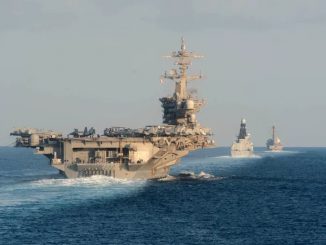
At the center of the operation is the USS Gerald R. Ford, the newest and costliest carrier ever built. With its strike group and support elements, the Ford brings nearly 10,000 personnel to the theater. It is accompanied by multiple guided-missile destroyers, a nuclear submarine, and the MV Ocean Trader — a floating Special Forces hub capable of launching helicopters and amphibious teams.

Air power has been mobilized on a continental scale. F-35 stealth fighters operate from bases in Florida and Puerto Rico; B-1B bombers conduct long-range patrols from airfields in Texas and North Dakota; and P-8 Poseidon surveillance aircraft fly near-daily intelligence sorties over the Caribbean. The logistics and command architecture assembled here would support sustained air and sea strikes across northern South America.

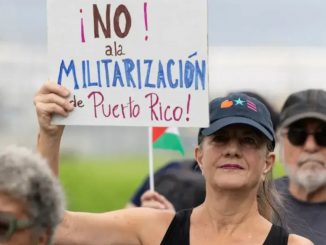
Even the ground is being remade for war. The Roosevelt Roads naval complex in Puerto Rico — shuttered since 2004 — is being revived as a launch point for regional operations. Civilian airports in Puerto Rico and St. Croix are being militarized with new ammunition depots, mobile air-traffic towers, and expanded runways, signaling an intention to sustain permanent power projection in the hemisphere.

This is not a drill. It is a forward operating network.

Threats to sovereignty across the region

Venezuelan officials have condemned the deployments as an act of aggression. President Nicolás Maduro warned that the Trump administration is “fabricating a new eternal war” against Venezuela. Latin American governments — from Caracas to Havana, Managua, Bogotá, and across the Caribbean — view the armada as a direct threat to regional sovereignty.

Cuba, which has withstood more than 60 years of U.S. blockades and invasion attempts, denounced the mobilization as part of Washington’s escalating campaign to strangle independent nations of the hemisphere. The Cuban government warned that the buildup “revives the darkest traditions of gunboat diplomacy.”

Nicaragua, a historic target of U.S. intervention and sanctions, has likewise condemned the escalation. President Daniel Ortega said it represents “a threat not only to Venezuela, but to all of Latin America that refuses to bow to the empire,” describing the buildup as a U.S. attempt to “topple governments” in the region, according to a report by Al-Mayadeen English.

Colombian President Gustavo Petro has called the U.S. presence a violation of Latin American autonomy, declaring, The aggression is against all of Latin America and the Caribbean,” in remarks reported by Reuters. Caribbean leaders fear any pretext — real or manufactured — could ignite a wider conflict.

Control over Venezuela’s vast oil reserves remains an obvious motive. U.S. strategists have long sought to bring those resources back under imperialist control. When the 2019 attempt to install U.S.-aligned proxy Juan Guaidó failed, Washington turned to sanctions, diplomatic isolation, and now overt militarization.

Guaidó’s own 2019 operation was aided by Los Rastrojos, a Colombian narco-paramilitary group tied to drug trafficking along the border. Photographs published by Colombian and international media showed Guaidó posing with members of the gang who helped him cross into Colombia during the U.S.-backed “humanitarian aid” stunt. The episode exposed how Washington’s coup project relied on criminal networks at the heart of the regional drug trade.

The new deployments mark the next stage in that same campaign: If political and economic pressure fail, open coercion will follow.

The costs of empire

The human and financial toll is already severe. Operating a carrier group and long-range bomber sorties costs at least $18 million per day — more than $600 million since the deployment began. That figure represents billions diverted toward domination while tens of millions at home face cutbacks in food benefits, housing, and health care.

Violence has followed the deployment. At least 14 U.S. air and naval strikes in the Caribbean and Pacific have killed some 61 people — many unidentified — after being labeled by the Pentagon as “hostile.” Families on several islands insist the dead were fishermen, not combatants. 

Volker Türk, the United Nations High Commissioner for Human Rights, condemned the attacks, stating:

“These attacks — and their mounting human cost — are unacceptable. The U.S. must halt such attacks and take all measures necessary to prevent the extrajudicial killing of people aboard these boats.” (Al Jazeera)

These are not isolated tragedies. They are the predictable product of a military posture that treats entire waters and peoples as battlefields in a campaign to reassert empire.

Strugglelalucha256
https://www.struggle-la-lucha.org/around-the-world/page/2/