Despite ceasefire, U.S.-backed Israeli forces keep murdering in Lebanon

Lebanon

Another U.S.-enforced “ceasefire” is turning out to be the opposite in southern Lebanon. Roughly a year ago, then-President Joe Biden announced a “cessation of hostilities” between Hezbollah and “Israeli” forces. In his announcement, Biden promised that Hezbollah infrastructure would be completely destroyed and would remain destroyed. 

Since that announcement, Zionist military forces have launched over 500 airstrikes against southern Lebanon, claiming to be targeting Hezbollah military infrastructure. This number does not include the dozens of Israeli ground incursions into Lebanon. 

Many of these attacks have struck civilian targets — government buildings, farms, schools, and private homes. Hundreds of people, including many children, have been killed. The reality is clear: U.S.-negotiated “ceasefires” are not ceasefires at all. “Israel” continues to bomb Gaza, Lebanon, or Yemen whenever it pleases, acting on behalf of the same imperialist power that pretends to enforce the peace.

Just days ago, “Israeli” troops, armored vehicles, and drones entered the town of BIida. The fascist troops proceeded to raid the town’s city hall and murder a sleeping municipal employee, Ibrahim Salameh. 

Even the current Lebanese President and Prime Minister, who have historically been hesitant to resist Israel or the United States, denounced the terrible attack. President Joseph Aoun went as far as to instruct the Lebanese military to confront any further “Israeli” incursion into southern Lebanon. 

Donald Trump and Joe Biden may seem to disagree on many things, but one thing they don’t disagree on is the full prosecution of imperialist war against any who would dare resist. Hezbollah is one of such groups that would dare to resist. 

Trump’s administration, through his special envoy to Syria, Tom Barrack, has placed immense pressure on the Lebanese government and military to completely disarm Hezbollah by the end of 2025. Just recently, the U.S. approved $230 million in military assistance to Lebanon with the specific purpose of fighting Hezbollah. 

U.S. imperialism truly has no shame. The Trump administration talks about and demands disarmament while directing its attack dog, known as “Israel,” to continue to smash southern Lebanon. 

Working-class people and progressive movements around the world must continue to stand with the people of Lebanon, with Hezbollah, and with the broader resistance against U.S. imperialist aggression in West Asia. 

Lev Koufax is an anti-Zionist Jewish activist. 


Strugglelalucha256


Trump approves war escalation against Russia

The so-called “peacemaker” president is at it again. Donald Trump talks peace while preparing war.

Much has been made in the media in recent weeks about whether Donald Trump would deliver Tomahawk cruise missiles to Ukraine. It is without question that sending such missiles would represent a significant escalation in NATO’s proxy war against Russia. 

Tomahawks now join a long list of military equipment touted as the game-changer for Ukraine in the war with Russia. Narratives that a particular weapon will turn the tide of war have saturated the news and social media since the war began in 2022. 

If it wasn’t the F-16 fighter jet, it was Germany’s “Leopard” tank. If it wasn’t German tanks, it was cluster munitions, or the High Mobility Artillery Rocket System or Patriot missile systems. And every time, the propaganda was the same: Ukraine just needed one more piece of crucial equipment to achieve its victory. 

This narrative was a lie from the beginning, and an intentional one. Ukraine has already deployed all these so-called game-changing weapons. None of them has led to the reversal or even the slowing of Russia’s steady advance. 

The ‘silver bullet’ myth

From the beginning, this “silver bullet” narrative was just a smokescreen to justify spending millions upon millions of government funds on a U.S.-NATO war to drain Russia strategically. 

Just like the rest of the equipment now burning on the war’s long front, Tomahawks will make little difference in the grand scheme of the war’s progress. While these are powerful weapons intended to decimate enemy logistical infrastructure and supply hubs, the math doesn’t add up. 

The Tomahawk illusion

Currently, the Trump administration has proposed sending 50 Tomahawks to Ukraine. Military analysts note that the number under discussion — just 50 missiles — would barely dent Russia’s vast energy infrastructure. Further, the missiles are wildly expensive to produce. 

To make any significant difference in the outcome of the war and have any chance to overcome Russia’s advantage in mobilization and war industry over Ukraine – the U.S. would have to send thousands of Tomahawk missiles. And even that could be futile

The U.S. would likely exhaust its entire arsenal of an estimated 4,000 missiles without seeing real deterioration in Russia’s military capabilities. 

The real motive: profit

So why the push for Tomahawks? It’s not strategy — it’s profit.

The U.S. and European arms industries have made record gains from the war in Ukraine. Each new shipment guarantees new government contracts to replace what’s sent. When Washington ships 50 Tomahawks abroad, it must order 50 more — using state funds diverted from social needs to corporate profit.

That’s how the system works. The government transfers the public wealth to the monopolies of war. Every missile fired means another payday for Raytheon, Northrop Grumman, and General Dynamics.

Even with the limitations of the Tomahawk missile and the motivation having more to do with profit than with the actual prosecution of a war, the shipment of such missiles to Ukraine for strikes deep in Russia would still represent a dangerous escalation. 

Such missiles would allow Ukraine to strike major Russian cities like Moscow and St. Petersburg. There is no other way for Russia to interpret U.S.-supplied Tomahawks to Ukraine than as a signal of escalation from NATO. 

For now, Donald Trump has seemingly decided that he isn’t prepared to publicly provide Ukraine with the capability to strike deep in Russian territory via Tomahawks. But in the same stroke as publicly declining to send Tomahawks, Trump’s State Department lifted key restrictions on Ukraine’s use of missiles provided by European allies. 

Even with Trump’s bluster, the escalation is apparent, dangerous, and terrifying. 

Trump’s administration lifted these restrictions a day after Ukraine used a British-supplied Storm Shadow missile to strike a Russian chemical plant in Bryansk, deep behind the front lines. The message here seems clear: “Keep it up, but get what you need from Europe.” 

This has been Trump’s strategy since he took office. The right-wing demagogue claims to be a peacemaker while pushing the war through European allies and enacting new sanctions against Russia. 

The world doesn’t need another “peacemaker” who feeds the war machine. The working class of the United States — and everywhere — needs those vast public resources now wasted on war redirected to human needs: housing, healthcare, education, and rebuilding communities, not destroying them.


Strugglelalucha256


Rubio and international blackmail

Marco Rubio has unleashed an aggressive campaign of falsehoods and bullying to secure votes against Cuba in the United Nations General Assembly. With one week to go before the annual vote on the blockade of Cuba, the Secretary of State has launched a diplomatic offensive to try to shift the balance: not so much to add “no” votes as to transform affirmative votes into abstentions or absences.

A State Department cable, leaked to Reuters and dated October 2, reveals the strategy: to link the resolution on the blockade to the war in Ukraine and present Cuba as a threat to regional peace.

The document, distributed to dozens of embassies, instructs U.S. diplomats to pressure governments to oppose the resolution, based on the accusation that between 1,000 and 5,000 Cubans are fighting alongside Russian forces. “After North Korea, Cuba would be the largest contributor of foreign fighters,” the text states.

The objective is explicit: to significantly reduce the number of affirmative votes in the UN; “no” votes are “preferred,” but abstentions or non-participation also serve the purpose. Speaking to the press on Wednesday in Havana, Cuban Foreign Minister Bruno Rodríguez Parrilla showed a facsimile copy of the State Department document and stated that Cuban-born congressmen had sent additional letters in which, in a threatening tone, they made the vote conditional on other aspects of the bilateral relationship. These are unmistakable gestures of neighborhood bullies.

The offensive comes in a context of tougher sanctions following Trump’s return to the White House, which does not tolerate the fact that last year the resolution was approved by 187 votes in favor, with the United States and Israel against and Moldova abstaining. This precedent highlights the countercurrent nature of the current maneuver.

Havana’s response has been categorical: Cuba is not part of the armed conflict in Ukraine nor does it participate with military personnel “there or in any other country.” The Ministry of Foreign Affairs has published details of criminal proceedings for mercenary activities related to this front: nine cases (2023-2025) against 40 defendants; eight trials and five convictions involving 26 people, with sentences ranging from five to 14 years; three cases pending sentencing and another in progress. The Foreign Ministry maintains a policy of “zero tolerance” against mercenary activity, trafficking, and the participation of nationals in conflicts abroad.

Meanwhile, the Caribbean is being militarized under the pretext of the “war on drugs.” Washington extrajudicially kills crew members on board ships, reinforces its naval presence, and tests rules of engagement that increase the intensity of the use of force. The campaign to blackmail governments into rejecting the Cuban resolution is not a separate chapter, but rather the narrative cover for this escalation, which also opportunistically takes advantage of a diplomatic operation to divert attention from the profound suffering caused by the blockade of the Cuban people.

Confirmed as Secretary of State in January, Marco Rubio has placed Cuba at the center of his hemispheric agenda. Among his measures is the repeated use of visa restrictions against foreign officials whom he accuses of participating in the alleged “coercive labor export scheme” of Cuban medical missions. Rubio has done everything possible to criminalize one of the island’s most recognized cooperation programs.

The Secretary of State has also amplified controversial narratives from the past—such as hypotheses about the external causes of the so-called “Havana syndrome”—which the U.S. intelligence community considers “highly improbable” following interagency assessments in 2023 and 2025. The contrast between that evidence and political rhetoric illustrates the method: loading the media climate with fallacious national security allegations to weaken support for the resolution.

But historical arithmetic is stubborn. Since 1992, the General Assembly has overwhelmingly approved calls to end the blockade, and in 2024, the score was 187-2-1.

With that precedent, the most likely scenario is that the resolution will again pass by a very large majority, even if Washington manages to scrape together a few abstentions or absences.

If history is any guide, the overwhelming pronouncement of the assembly will be repeated once again.

Source: La Jornada, translation Resumen Latinoamericano – English


Strugglelalucha256


‘We can win this struggle’: Sankara’s message for today

“We can win this struggle if we choose to be architects and simply not bees.” – Thomas Sankara, Imperialism is the arsonist of our forests and savannas, 1986

We honor the life and revolutionary achievements of Thomas Sankara, known as “Africa’s Che Guevara.” A man on a mission to lift Burkina Faso out of the death grip of imperialism and transform it into a beacon of progress and true liberation on the African continent.

Under the leadership of Thomas Sankara, Upper Volta became the country of Burkina Faso, “The Land of Upright People.” Literacy rates rose exponentially across the whole country. Over two million Burkinabé children were vaccinated. He ended Burkina Faso’s reliance on Western aid and set out to create self-sufficiency for the country.

Land was redistributed amongst the working class and peasants of the country, and out of the hands of wealthy landlords under the control of Western imperialists. Ten million trees were planted across the country. Roads and railways were built to connect the country. All of these steps helped create better living conditions for the people of Burkina Faso while also healing the old wounds caused by imperialism and setting the country on a path towards progress.

Thomas Sankara saw the full picture of the global class struggle. He did not set out to create a better Burkina Faso without the country’s women. He banned genital mutilation, forced marriages and polygamy. Women were appointed to government positions and were able to, and encouraged to, join the country’s workforce and military. Pregnancy leave was granted for all expectant mothers. 

He was a man committed to the people. Under his guidance, the old Western luxury and corruption within the Burkinabé government were done away with. Public servants drove cars produced in Burkina Faso and wore clothing made entirely of 100% Burkinabé cotton, tailored by Burkinabé artisans. He never allowed portraits and monuments of himself to be erected in public because he fully believed that it was the people who made this progress happen. He said himself that there are “seven million Thomas Sankaras.”

His love of his country extended to the entire African continent. He believed that all of Africa had the right to tear away from the claws of Western imperialism. His passion for pan African liberation made him a target of Western imperialists and those of the African elite who wanted to continue gutting their continent all for their Western masters.

Thomas Sankara was brutally assassinated and gunned down in 1987, only four years into his presidency. Betrayed by Blaise Compaoré, a onetime ally turned rival who seized power and reversed Sankara’s policies until a popular revolution ousted him in 2014 and sent him into exile. France has yet to release its classified records regarding the assassination of Thomas Sankara.

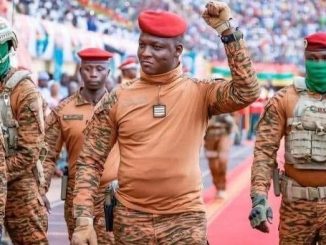
In the 21st century, the revolutionary spirit of Thomas Sankara lives on. Currently, Captain Ibrahim Traoré, the sitting president of Burkina Faso, is continuing the mission set out by Thomas Sankara to see a fully liberated Burkina Faso, free of neocolonial rule and Western interference. 

Strugglelalucha256


How pinkwashing is used to slander anti-colonial revolutions from Palestine to Burkina Faso

Oct. 15 marks the 38th anniversary of the assassination of Thomas Sankara, a Pan-Africanist and Marxist revolutionary, who seized state power in a 1983 popular coup. Sankara was president of Burkina Faso until his killing in 1987 by Western-backed forces. Sankara’s staunch anti-imperialist leadership radically transformed the nation, which threw off the shackles of French domination during that period. For more, see Thomas Sankara, “Africa’s Che Guevara.”

Additionally, October is the celebration of LGBTQ+ History Month, a history long defined by the blood and solidarity of all working-class LGBTQ+ people worldwide in their liberation struggle against capitalist, imperialist and neo-colonialist oppression in the forms of homophobia and transphobia.

On Sept. 1, 2025, Burkina Faso’s Legislative Assembly passed an updated family amendment code that included declaring “homosexual behavior as a criminal offense, punishable by two to five years in prison, fines, and possibly deportation for foreign nationals.” Almost immediately after this announcement, major Western capitalist media outlets used this to further justify their imperialist propaganda against Burkina Faso and President Ibrahim Traoré, whom they have already demonized as an “anti-gay dictator.” 

The audacity of the West to pretend like they care about LGBTQ+ rights in Burkina Faso, while actively committing and supporting multiple live-streamed genocides in Palestine, Sudan, the Congo and elsewhere, is nothing short of baffling. 

Western nations posture as the “safest places in the world for LGBTQ+ people.” But in the United States, the ruling class is backing a fascist political movement aimed at denying gender-affirming health care to trans and non-binary people, nullifying passports and other documents that affirm one’s gender, and allowing for the escalation of anti-trans and anti-queer violence to continue unchecked, and perhaps worst of all, falsely accusing “mentally ill” trans people as the primary cause of mass shootings. 

Pinkwashing: a tool in imperialism’s belt

Historically, pinkwashing has been nothing more than a means of manufacturing consent for pushing illegal sanctions and regime change in countries that either have overthrown Western imperialist influence or are in the process of doing so. The imperialists’ goal is to prevent them from achieving sovereignty and self-determination. The tactics to achieve this have always been the same:

  • Dehumanize the people, culture and society through capitalist media propaganda.
  • Destabilize the economic, social, and political climate through sanctions and military control.
  • Implement regime change by any means necessary to strengthen Western hegemony.

Burkina Faso now falls into that same category of nations that have Washington terrified.

Why does Washington hate Traore?

In a 2022 popular coup, Captain Ibrahim Traore seized governance from the French-installed puppet leader, Paul-Henri Damiba. He has since expelled all French and U.S. colonizers from the land and has re-nationalized its natural resources for the benefit of the Burkinabe people, rather than the predatory World Bank and IMF. 

Alongside the leaders of Mali and Niger, Traoré has joined the Alliance of Sahel States, a critical step towards achieving sovereignty and self-determination. Its formation and continued cooperation are reason enough for Washington to be unfriendly. 

Some have referred to Traoré as the “second coming of Sankara,” and for many reasons. He has already survived numerous Western-backed assassination attempts, as well as defended the nation against Western-backed ISIS and Al Qaeda terrorists. 

For more on the revolutionary government’s accomplishments, see “From Sankara to Traore: Burkina Faso’s anti-imperialist legacy.”

Colonial Europe plants the seeds of gender oppression and bigotry

This particular anti-LBGTQ+ policy didn’t just appear out of thin air.  

France, the colonial power in Burkina Faso, Mali, and Senegal, directly imposed its legal and cultural systems across West Africa, exporting the Napoleonic Code that criminalized “acts against nature.” This colonial legislation actively supplanted often more fluid pre-colonial social norms and planted the deep-seated seeds of institutionalized homophobia. The profound irony, therefore, is that the very anti-LGBTQ+ laws now used by Western powers to pinkwash and slander anti-imperialist governments like Traoré’s were themselves a Western colonial import.

International precedent

The pinkwashing campaign against Burkina Faso is reminiscent of the slanderous anti-LGBTQ+ propaganda the Zionist entity has used against Palestine to justify its illegal occupation. “Israel” has boasted for decades that it is the “bastion of democracy and LGBTQ+ rights in the Middle East,” while it has perpetuated ethnic cleansing against the Palestinian people, and also has treated its own LGBTQ+ population miserably.

Or take the example of Cuba. Even 10 years after overthrowing the U.S.-backed Batista dictatorship in 1959, the Cuban Revolution had to contend with patriarchal values. In 1971, a congress on education in Havana called for the removal of homosexuals from the field of education.

Western capitalist media used this policy in Cuba to try to discredit the revolution. Some anti-imperialist activists denounced Cuba, thinking that Cuba’s seizing state power should result in an instantaneous social transformation. 

At that time, the U.S. had widespread discriminatory policies against homosexuals in the workplace, including schools. In 1953, President Eisenhower signed Executive Order 10450, which banned homosexuals from working for the federal government or any of its private contractors. In 1978, Oklahoma and Arkansas passed laws banning gay and lesbian teachers from working in public schools.

Fast forward to 2022, when the Cuban Revolution, through a massive grassroots organizing and mobilization effort, achieved the Code of Families —the world’s most inclusive revolutionary code. Among its many leaps forward, the Code guarantees the right of all people to form a family without discrimination, legalizes same-sex marriage, and allows such couples to adopt children.

It is the duty and responsibility of queer anti-imperialist revolutionaries in the belly of the beast to defend all movements that are actively breaking the chains of Western imperialism when they are branded as homophobic by the same countries that scapegoat trans people at the first chance they get. 

To paraphrase what revolutionary trans communist Leslie Feinberg asserted regarding Cuba, the current problems that exist in Burkina Faso do not invalidate the anti-colonial revolution.

May we see a Burkina Faso that continues to build upon the revolution first undertaken by Thomas Sankara, and that lives to struggle internally on the principles of gender and sexual liberation, the same way that Cuban workers of all sexual and gender orientations have struggled against these contradictions post-Revolution, as they continue to build socialism.


Strugglelalucha256


International forum denounces war, calls for global solidarity from Venezuela to Palestine

At New York’s Riverside Church, diplomats and activists unite against imperialism and genocide, emphasizing shared struggle.

A powerful message of international solidarity echoed through the packed Assembly Hall at Manhattan’s Riverside Church on Sept. 25. The forum, titled “No to War Against Humanity, from Venezuela to Cuba, Nicaragua, Palestine,” brought together diplomats, activists, and community leaders to condemn escalating warfare and build a unified front for peace.

The event featured high-level speakers from Venezuela and Cuba, who used their platform at the United Nations General Assembly to highlight the interconnected nature of struggles against imperialism, sanctions, and military aggression.

A unified front against imperialism

Ana Teresita Gonzalez, Director General of Consular Affairs for the Cuban Mission, opened with a pledge of Cuba’s unwavering support for Venezuela against a potential U.S. attack. She underscored the deep connection between the plights of Cuba, Venezuela, Nicaragua, and Palestine, pointing to the resilience of her own people in overcoming the U.S. embargo as a model of resistance.

This theme of solidarity was powerfully reciprocated by Hasam Marajada of the U.S. Palestinian Community Network (USPCN). “With the support of the people in this room and the people of the world, the Palestinian people will be victorious!” he proclaimed. 

“We will finally defeat Zionism, apartheid and colonialism! We will free Palestine, from the river to the sea!” He concluded by affirming that the Palestinian people stand “in unconditional solidarity with all the progressive movements and struggles, especially in Venezuela, Nicaragua and Cuba.”

Exposing the justifications for war

A significant portion of the forum was dedicated to dismantling the narratives used to justify military aggression. Blanca Eekhout, President of the Simon Bolivar Institute for Peace and Solidarity Among Peoples, directly addressed the U.S. accusation of Venezuelan drug trafficking.

“The corporate elites are not representing the interests of the people of the United States,” Eekhout stated. She described the recent illegal missile strikes on Venezuelan fishing boats, which killed 17 people. “They were traveling in small boats that could not make it to the United States. …These people were assassinated without a trial.”

Eehout also detailed the alarming military buildup near Venezuela, noting the presence of “nuclear submarines, warships, military airplanes,” which starkly contrasts with Venezuela’s self-declared status as a “territory of peace.” To debunk the drug trafficking claim, she cited a current United Nations report: “Venezuela is a country that has zero acres of crops of drugs. There is not one acre that is dedicated.”

A shared struggle with workers and poor

Venezuelan Foreign Affairs Minister Yvan Gil framed the conflict not as a confrontation with the U.S. people, but with the U.S. ruling class and its imperialist apparatus. He proclaimed that Venezuela’s revolutionary struggle shares the same objectives as those of the workers, women, and poor in the United States.

“We need to create together a critical mass capable of providing peace,” Gil urged. “It’s not through bombs, missiles, that we can put food on our table; it is not through soldiers that eggs are going to be cheaper, not through violence that happiness and stability will be achieved in our society.” He argued that the threat of war stems from a desire to control Venezuela’s independent path and its vast natural resources, including oil and gold.

Gil concluded with a call to action, stating that “peace and life are the most revolutionary” values. He announced President Maduro’s signing of a world conference for peace and sovereignty but warned that it “will fail if the people in the U.S. don’t join in this effort.” He invited all attendees to participate, emphasizing the urgent need to “stop this bombardment” of threats designed to create fear.

Broad coalition of support

Gail Walker, former director of IFCO / Pastors for Peace, co-chaired the event, along with Sara Flounders of the United National Antiwar Coalition and Workers World News, and Tom Burke of the Anti-War Action Network and the Freedom Road Socialist Organization. It showcased a wide-ranging coalition, with over 20 antiwar and solidarity groups from across the U.S. standing on stage to express their support. 

These groups included Alberto Lovera Bolivarian Circle NYC, Anti-War Action Network, Arm The Dollz, Bayan, Black Is Back Coalition, Bronx Antiwar, Citizen Revolution of Ecuador, Code Pink, Cuba Sí, December 12 Movement, Free Mumia Abu-Jamal Committee – NYC, Workers World Party, Freedom Road Socialist Organization, Struggle for Socialism Party / Struggle-La Lucha, The Peoples Forum, Jazz Against Genocide, Nicaragua Solidarity Coalition, SanctionsKill Campaign, United National Antiwar Coalition, U.S. Palestinian Community Network, Venceremos Brigade, Venezuela Solidarity Network, and the U.S. Peace Council.

The forum was organized through the initiative of Dozthor Zurlent of the Simon Bolivar Institute and William Camacaro of the Bolivarian Circle in New York.

A teleSUR video of the event is available at: youtu.be/kqBTwAwSKvY

Strugglelalucha256


From Ukraine to Gaza, profit is the policy: Trump’s wars enrich defense conglomerates

The State Department recently updated its list of wars that Donald Trump allegedly ended. Trump now claims that he has brokered a peace between Armenia and Azerbaijan. Trump would have the world believe that this is another feather in his cap as a peacemaker. Previously, Trump and his State Department have taken credit for six other conflicts: India and Pakistan, the Democratic Republic of Congo and Rwanda, Serbia and Kosovo, Egypt and Ethiopia, Israel and Iran, Thailand and Cambodia. 

We have previously reported on the patent factual inaccuracies of these claims. India and Pakistan have both denied that any third party played a role in mediating the Kashmir-centered skirmishes of 2025. The last war between Egypt and Ethiopia ended in 1876. Trump started the war between Israel and Iran, which he also claims to have ended. Does an arsonist really deserve credit for dousing the fire they started?

Even where Trump and his administration have played some role in mediating conflicts, there is still an inherent Western arrogance in claiming complete credit for any brokered peace. This arrogance is compounded when considering the continued U.S.-funded genocide in Gaza and the U.S.-NATO proxy war against Russia in Ukraine. 

Just three days before Trump’s claim that he was “the President of Peace,” his administration approved $6.4 billion in weapons sales to apartheid Israel. That is $6.4 billion to bomb hospitals and murder children — some President of Peace. 

While claiming to be a peacemaker, Trump simultaneously announced a strategy that ensures NATO’s war in Ukraine continues indefinitely. Three hours before his seven wars ended claim, Trump ranted on Truth Social that “with the support of the European Union is in a position to fight and WIN all of Ukraine back in its original form. With time, patience, and the financial support of Europe and in particular, NATO, the original Borders from where this War started, is very much an option.” 

Trump’s latest rant makes the U.S. imperialist strategy in Ukraine even more apparent. As we wrote in March, Trump and his cohorts never planned to end the war in Ukraine. U.S. imperialism had no intention of ending its NATO war in an attempt to bleed Russia of resources and political will. Burden shifting the Ukraine war to Europe is an imperialist strategic decision aimed at refocusing for war on China. The Republican Party effectively used war weariness to parlay a 2024 election victory over the deeply unpopular Joe Biden. However, rhetoric is not the same as policy. 

Outright U.S military aid to Ukraine may have ended, but the Trump administration has continually arranged for Ukrainian purchases of U.S. weapons with NATO funds. In the end, the result is the same. The war rages on, and with it, so do massive profits for U.S. defense conglomerates. 

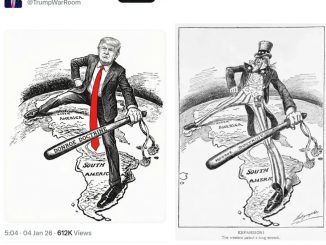
Donald Trump is nothing more than an imperialist war monger. The proof is in the pudding. Trump’s first fascist administration murdered Qassem Soleimani in cold blood. Just a few months ago, Trump ordered strikes on Iranian nuclear sites. Strikes on Iran followed a several-week-long naval and air campaign against Yemen. With Trump’s approval, Israel has launched its largest-ever ground offensive into Gaza. Bloodshed has not been limited to the Middle East. The U.S. military destroyed multiple small boats off the coast of Venezuela under the pretext of fighting “narco-terrorism.” These extrajudicial executions have accompanied an unprecedented U.S. naval buildup across the Caribbean Sea. 

To be clear, the fascist demagogue is not acting alone. He is supported by a whole circus of generals, DOD staffers, the defense lobby, and fascist demagogues like Pete Hegseth. Trump’s administration unleashing war across the planet is not a matter of one man or even a Republican majority in Congress. Imperialist escalation against the entire Global South is a reflection of the imperialist goal to break all resistance.

Trump’s continued war drive is a threat to the entire working class across the globe. Workers everywhere face a literal fight for survival. The only way forward is global working-class resistance against the global billionaire class. 

Strugglelalucha256


Petro implodes U.S.-Colombia relations with his final U.N. speech

Colombian President Gustavo Petro used his final address to the United Nations General Assembly on September 23 to deliver a blistering denunciation of U.S. foreign policy and President Donald Trump, calling for criminal charges against the  U.S. leader, and accusing Washington of complicity in genocide.

Speaking in New York at the 80th General Assembly, Petro – dressed in a white guayabera – launched into a fiery speech that quickly prompted the U.S. delegation to walk out of the chamber. His remarks went far beyond diplomatic criticism: they appeared aimed at imploding what remained of U.S.-Colombia relations, severing decades of strategic partnership on a global stage.

“This hall is a mute witness, and an accomplice, to genocide in today’s world. When we believed it was only the property of Hitler, Trump does not speak of democracy, he does not speak of the climate crisis, he does not speak of life – he only threatens, kills, and lets tens of thousands be killed,” Petro declared, accusing Trump of presiding over policies that cost countless lives.

The Colombian leader then called on the United Nations to initiate criminal proceedings against the current U.S. president. “There must be criminal charges opened against those officials of the United States, including the senior official who gave the order – President Trump, who allowed missiles to be fired against young people who simply wanted to escape poverty,” he said.

Petro alleged that Trump had personally authorized missile strikes against migrant boats in the Caribbean, killing vulnerable youths fleeing poverty. “Trump fires missiles at unarmed migrant boats and accuses them of being drug traffickers and terrorists, when they did not have a single weapon to defend themselves. The traffickers live in New York, just a few blocks away from here, and in Miami,” he told the assembly.

As he escalated his attack, Petro drew historical parallels between Trump’s America and Europe in the 1930s. “And today, irrationalism is filling the United States, and it was the prelude to Hitler in 1933,” he warned. “As collapse approaches, while the old white societies of Europe and the United States continue applauding their new fashionable Hitlers, they do not listen to their young people, to their children, or to humanity.”

The accusations grew sharper when Petro addressed U.S. drug policy. He claimed that the true beneficiaries of the narcotics trade were not Latin American traffickers but elites in the United States. “When most of the drug traffickers are blond and blue-eyed, keeping their vast fortunes in the world’s largest banks, and do not live in Bogotá, Caracas, the Caribbean, or Gaza, but in Miami – they are the neighbors of the President of the United States,” he said.

At that point, the U.S. delegation stood up and exited the chamber, leaving only a handful of allies to hear the remainder of Petro’s remarks.

Turning to Gaza, Petro urged the international community to act outside the U.N. Security Council, which he accused of paralysis due to U.S. veto power. “The genocide must end with what follows diplomacy. It is with a vote of the United Nations General Assembly and not with a vote of the Security Council, where they veto. It is with a United for Peace for Palestine, forming an armed force to defend the life of the Palestinian people,” he said.

He insisted that blue-helmeted peacekeepers were insufficient and called instead for the formation of a powerful international army to intervene in Gaza. “Not with blue helmets, untrained and sometimes unwilling to do what is necessary. It is with a powerful army from the countries that do not accept genocide. That is why I invite the nations of the world and their peoples, as part of humanity, to unite their armies and weapons. Palestine must be liberated,” Petro said, appealing to Asian, Slavic, and Latin American militaries to join forces.

In one of his most pointed accusations, Petro directly linked Trump to the ongoing war in Gaza. “Trump not only lets missiles fall on young people in the Caribbean, not only imprisons and chains migrants, but he also allows missiles to be launched against children, women, and the elderly in Gaza. He makes himself an accomplice to genocide – because it is genocide, and we must shout it again and again.”

Petro further claimed that U.S. foreign policy in Latin America was being advised by Colombian political actors allied with drug cartels. “I do not know if Trump realizes that his foreign policy toward Colombia, Venezuela, and the Caribbean is advised by Colombians who are political allies of the cocaine mafia,” he charged.

As his speech drew to a close, Petro denounced the veto power wielded by Washington and its allies over U.N. resolutions. “Humanity cannot allow one more day of genocide, nor allow the genocidaires like Netanyahu and his allies in the United States and Europe to remain free,” he said, demanding that the Assembly act to stop what he repeatedly described as genocide in Gaza.

By the end of his 40-minute intervention, Petro had branded Trump a criminal, accused the United States of racism and imperialism, compared Western leaders to Hitler, and called for the creation of an international armed force to counter U.S. and Israeli power.

The fallout was immediate. Analysts warn that Petro’s words, delivered in front of world leaders, represent a deliberate rupture with Washington. Colombia, once described as the United States’ closest ally in Latin America, now appears to be positioning itself as a radical outlier. For Petro, the objective seemed clear: not to salvage a fragile relationship, but to bring it crashing down in real time.

Source: Resumen

Strugglelalucha256


Trump’s U.N. tirade: Threats, invasion plans, and cheers for bloodshed

President Donald Trump used his U.N. speech to boast about the use of U.S. military power in recent actions, threatening nations with war and celebrating the criminal actions of his administration with unvarnished glee.

Trump indicated that Washington will act alone when it wants and won’t let international law get in the way. The message was that the U.S. will deploy threats, tariffs, and military force at will.

In a nearly hour-long tirade, Trump mocked the U.N., saying it creates problems instead of solving them. The message was that global institutions only matter when they back U.S. goals.

Trump sneered that “your countries are going to hell,” branding migration an “invasion” and urging governments to replicate Washington’s brutal policy of mass detention and deportation, disrupting and ruining people’s lives.

Dismissing climate efforts as the “greatest con job,” he attacked clean-energy plans, giving protection to Big Oil’s profits and asserting U.S. control.

Trump shrugged off the genocide in Gaza — unsurprising from the man who armed Israel to the teeth and pitched Netanyahu on his “Riviera of the Middle East” plan, a thinly veiled blueprint for ethnic cleansing.

As Israel cut off food, bombed neighborhoods, and stormed Gaza City to level it, Trump fixated on denouncing Palestinians, ignoring the U.S.-funded carnage on the ground.

He bragged loudly about last June’s joint U.S.-Israeli assault on Iran. After luring Tehran into sham “peace talks,” Washington and Tel Aviv launched massive strikes on civilian nuclear facilities. Trump gloated: “Today, many of Iran’s former military commanders, in fact, I can say almost all of them, are no longer with us. They’re dead.”

For Trump, the empire’s bloodshed is just another applause line for his bloated ego.

Targeting Venezuela

At the U.N., Trump laid the groundwork for a U.S. invasion of Venezuela — part of Washington’s bid to overthrow the popular Venezuelan government, seize Venezuela’s oil and push back China’s influence in South America.

In recent weeks, U.S. forces sank three boats off Venezuela’s coast, killing at least 17 people on baseless drug-trafficking claims. Even if that were true (there’s not even an attempt to present any evidence because there is none), no state — least of all an empire — has the right to carry out summary executions on the high seas.

Trump didn’t bother with excuses. He flaunted Washington’s violence, warning from the General Assembly: “We will blow you out of existence / obliterate you,”

For the empire, murder is policy — and Trump holds much of the world, especially Venezuela and Cuba, under the gun.

Strugglelalucha256


Regime crisis in France: Bayrou falls, now Macron must go!

The ‘Bloquons tout’ mass movement precipitated the fall of French PM François Bayrou with its call to block everything on September 10.

On September 8, Bayrou raised the question of confidence at the National Assembly, that is, two days before ‘Bloquons tout’ had even gone into action.

As soon as Bayrou presented the 2026 intensified austerity budget in July, the ‘Bloquons tout’ mass movement erupted on social media. Over the summer, it gained incredible momentum.

Bayrou called for a parliamentary vote of confidence. He was defeated by 364 to 194. The defeat was a first stunning victory for a movement that had not even started, a movement which expresses the anger of the French people who, in the vast majority (87%), reject Bayrou’s austerity budget.

The September 10 ‘Bloquons tout’ movement was a success, with about half a million people joining a broad range of actions, demonstrations, pickets, and blockades all over France. ‘Bloquons tout’ has also planned to carry on.

The 2026 Budget and the So-Called French ‘Debt’

On July 15, the Prime Minister, Bayrou, announced the 2026 budget of €43.8 billion, which includes austerity measures. He recalled that France’s debt was €3300 billion. He drew a catastrophic picture, saying, “Every second the debt of France increases by 5000 euros… France has become the country in the world that spends the most public money.”

Among the measures announced by Bayrou that really shocked people were the abolition of two national holidays, a so-called ‘blank year’, that is, a freeze on social security, pension scales, and limiting the access to the health system of thirteen million patients with long-term conditions.

To justify these $44 billion cuts, Bayrou claimed France was near chaos due to debt, and they would have to resort to the IMF, that is, a disaster scenario in which the IMF was on the verge of taking control of the French economy.

In reality, France’s budget deficit is not out of control, and an IMF bailout is not needed. Supporters of austerity in France are engaged in scaremongering.

Frenchchart

The Mobilizations of ‘Bloquons tout’

Bayrou’s blackmail about the debt did not convince people that they should once again submit to more austerity. They have had enough. In the eight years of the Macron presidency, the economic, social and ecological degradation have peaked. Inflation has drastically reduced living standards. Many workers have lost their jobs. Poverty has drastically increased [1.2 million more people since 2017], and now 15.4% of people live below the poverty line. In addition, 350,000 people are homeless, with 2000 children, including newborn babies, living on the streets. Public services have been under constant attack. All this while the wealthiest not only saw their taxes diminished or erased, they also received financial help from the state.

Even if the Macronists chose Bayrou’s fall to curb and disarm the growing mobilization for September 10, they failed.

When Bayrou announced his budget, a movement of angry citizens, on the model of the Gilets Jaunes, started to organize through the social networks. Through the whole summer, it spread and grew, with an unprecedented level of self-organization. Telegram groups were set up on a regional basis, but people soon realized they needed to meet physically in big general meetings to prevent the far right from joining in. The meetings established an antiracist prerequisite for joining, and by meeting in person, it was easier to identify who was who. Activists were also very aware that some information could not be given in the Telegram groups.

The aim of the movement is to block the economy. Strikes are one method, but some can’t afford to. But everybody can do something. ‘Bloquons tout’ envisages a long-term movement that does not stop after days of action. The proposals were to organize pickets, strikes or blockades, for example, not spending money on September 10, not using bank cards, blocking roads and trucks for merchandise, transportation or logistics like Amazon. And for others to organize support for activists, e.g., free meals.

‘Bloquons tout’ is a movement from the bottom, which, unlike the Gilets Jaunes, is open to everybody, including political or social activists and trade unionists who help with their experience, as long as they don’t take over the leadership.

Many lessons have been drawn from previous mass mobilizations, such as les Gilets Jaunes and also the 2023 movement against the raising of the state pension to age sixty-four. Despite those huge mobilizations, Macron is still there.

Another lesson is the experience of the high level of state repression. With the Gilets Jaunes, the police shot rubber bullets that resulted in forty yellow vests losing an eye, six losing one hand and many other serious injuries. Therefore, ‘Bloquons tout’ has been preparing legal teams to help with the predictable detentions and aid from paramedics in response to police violence.

Contrary to the government and the media predictions that September 10 would be a flop, it was a real success. Nearly 500,000 participated, while the government had estimated only 100,000. There were 849 actions – 596 were rallies and 253 were blockades. The university student protests were 80,000 strong, and 150 high schools were blockaded. On the evening of the 10th, general meetings were held all over France (including 5000 in Paris and 2000 in Lyon). They decided to carry on the movement through different actions and new blockades.

The media and the government predicted ultra-left violence from ‘Bloquons tout’. The latter deployed 80,000 police officers. But on the contrary, it was a very peaceful mobilization. The only violence came from the police, who attacked the demonstrators and the pickets and arrested many young people.

Some labor unions joined the call of ‘Bloquons tout’ on September 10, as did the political left. In the end, the alliance of all labor unions decided to call for a day of strike action on September 18, prompted by this big mobilization. Thursday, September 18, is the second national day of action. Meanwhile, ‘Bloquons tout’ is organizing and attempting to convince more people to join.

According to the communist newspaper l’Humanité, 74% of the population is in favor of strike action.

Macron Must Go

After Bayrou’s fall, Macron immediately nominated a new PM, Sébastien Lecornu. It is interesting to notice how fast this went compared to the nomination of the last two PMs, and it shows the degree to which the government is afraid. Not only will Lecornu pursue the same Macronist orientation, but as former defense minister, he has carried on Macron’s line – first on the sale of military armaments to the genocidal regime of Israel and secondly Lecornu was at the meeting which agreed that European military budgets should reach 5% of the GDP which means 195 billion euros, that is a total submission to Trump’s rule.

Fundamentally, Lecornu is in the same unstable position as Bayrou and Barnier were, who both had to resign. Therefore, he is expected to fall, whether it takes weeks or months. Already, two-thirds of the population are saying he should leave.

Macron is responsible for the chaos in France. He is hanging on to power, although he has lost legitimacy. In the 2017 presidential election, 33% voted for him in the first round; his support has now fallen to 15%.

Macron is also paving the way for the RN to take power. His Interior Minister, Bruno Retailleau [leader of Les Républicains, the conservative party], has the same rotten and racist rhetoric as the RN, and has been implementing many attacks on migrants. Throughout this year, Macron and Retailleau have not stopped giving assurances to the RN, although the president has always presented himself as the last bulwark against the RN in order to win elections. But it has become evident that Macron’s main enemy is rather LFI. Lecornu, the new PM, is also close to the RN, as is a growing part of the Les Républicains conservative party.

Dissolution of the National Assembly in July 2024: Macron’s Big Mistake

The degradation of the political situation started in July 2024 when Macron decided to dissolve the National Assembly after his disastrous 15% result in the European elections. The RN came first with 31%, and the left were divided. The RN’s support has grown with their racist rhetoric by presenting migrants as the cause of the economic crisis. Much of the LR’s electoral base has shrunk and is moving to the RN.

Macron undoubtedly thought the division of the left was the right moment to have a coalition government with some RN members in it.

Unfortunately for Macron, his calculation went wrong. Under the impulse of La France Insoumise, the left very quickly united under the banner of the New Popular Front NPF, and against the far right. Therefore, despite all the polls that is 27, predicting they would lose, the NPF came first. This was a shock.

Macron decided to ignore the results of the vote and appointed Michel Barnier from the LR, the party that got the least votes at the elections, as PM.

Barnier proposed an austerity program of $40 billion cuts. LFI proposed instead a counter program to generate around $40 billion of new income for the state, which was broadcast everywhere. Barnier, in his budget, had refused to abolish the law imposing pension age increase to 64, which 92% of the working population were opposed to and which had unleashed huge mobilizations. Consequently, the RN had no choice but to vote for the no-confidence motion against him proposed by the left. Barnier fell. He was replaced by Bayrou.

The lesson Macron drew from this sequence was the absolute necessity to divide the NPF. Bayrou therefore attracted the Socialist Party into a trap of so-called ‘negotiations’ in exchange for the promise not to censure the government anymore. In so doing, the SP broke their commitment to the program of the NFP that allowed them to be elected as MPs in the previous election. It was the unity of the left in the NFP that rescued the SP from the disastrous position they were in after the 2022 presidential election. [LFI 22% – Greens 4.6% Communist Party 2.3% Socialist Party 1.7%]

LFI is adamant that what comes first is the program. The negotiations and little arrangements with Bayrou on an austerity plan are obviously in utter contradiction with the NFP program. Nevertheless, and despite six refusals to vote no-confidence against Bayrou each time he imposed his measures without a vote using Article 49.3, the SP had at last to face reality – Bayrou’s promises were just lies. After six months, the Socialist Party eventually proposed a no-confidence motion.

As regards the RN, which claims to be close to the people, they are more and more revealing their true nature as a prop of capital. They supported Bayrou in exchange for their racist agenda being promoted and implemented by Retailleau.

Thanks to the SP and RN, who did not vote for six no-confidence motions each time Bayrou used the 49.3 to impose his attacks on the population, the PM remained in office.

Consequently, six months were lost until ordinary people decided to fight back themselves.

Due to the undemocratic use of presidential decrees, the struggle in parliament was unable to defeat Macron’s policy of austerity. Finally, July saw an upsurge of mass national opposition outside of parliament. The first development was a petition against the Duplomb law allowing the use of pesticides in agriculture, which received in about two weeks more than two million signatures. It was launched by a young female student and got the support of another woman who has cancer and shouted in the National Assembly, ‘you are allies of cancer and we will make that known’. It was followed by the national ‘Bloquons tout’ movement erupting onto the national scene.

Crisis of the Regime

The issue at stake is more than short-term. Indeed, Macron is desperately and stubbornly hanging on to power. But what is at stake is more institutional: the 5th Republic is not working anymore.

The 5th Republic was set up in 1958 when decolonization was underway and in the midst of the Algerian War of Independence from French imperialism. De Gaulle used it to put an end to the parliamentary regime of the 4th Republic. Parliament could never establish a majority government, making it impossible to get a united and stable government. As many MPs were in favor of independence for Algeria, there was an attempted coup led by far-right army officers. They called on De Gaulle to come back to power. He agreed but asked for a new constitution. The latter reinforced the executive powers of the President, while a parliament still existed. It is thanks to the 1958 constitution that Macron and his government could endlessly bypass the National Assembly in recent years.

In one way, we are back to the 4th Republic: no political group has an absolute majority. And the 1958 Constitution, by giving a predominant role to the president, means that Macron can decide many things alone.

Macron has abused his constitutional rights as no president has done during the 5th Republic. He resorted more than forty times to Article 49.3, bypassing parliament and imposing his policies by decree. Now the people are fed up and have started to move. As Mélenchon said, Bayrou fell, and now it is Macron who is on the front line against the people.

What Next?

The discontent in France is general and has been building up for years. Small measures like keeping the national holidays or that PMs will not have a chauffeur for life but only for 10 years won’t quench it!

This is a historical moment, as Mélenchon said. Two-thirds of the National Assembly voting against a PM is unprecedented in the 5th Republic, and no dialogue with Macron, as the SP proposed, will work. The SP continues to be overwhelmed by an internal crisis after the Hollande presidency. The right wing of the party was reinforced thanks to the NPF, which allowed them to have more MPs. But as Hollande said, the role of social democracy in a time of turmoil is to ensure stability. Concretely, it has meant betraying its commitment against austerity in the NPF and preventing Macron and his government from being overthrown. After Bayrou fell, they hurriedly proposed to form a coalition cabinet, without LFI, with a plan of austerity of $22 billion rather than the $44 billion proposed by Bayrou. But Macron was not even interested.

LFI has repeatedly said that nothing will be improved by changing Prime Ministers – Macron is the problem. Only new presidential elections will break the deadlock.

As Jean-Luc Mélenchon recently explained, “We will not support any other government than our own. [The LFI]. We are not here to make a career, to be minister of this or that. Our goal is to decide what must be done: how do we develop the country? It is the program which matters. This is why we need a presidential election.”

Source


Strugglelalucha256
https://www.struggle-la-lucha.org/around-the-world/page/3/