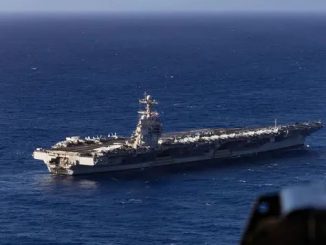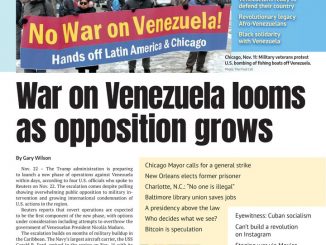
- War on Venezuela looms as opposition grows
- Chicago Mayor Brandon Johnson calls for a general strike
- Charlotte students lead mass revolt against Trump’s immigration raids
- A presidency above the law – and the struggle ahead
- Former prisoner elected New Orleans court clerk
- Whose news is it – who decides what we see?
- Union wins jobs back for Baltimore librarians
- Palestinians reject U.S.–backed U.N. plan: ‘A new form of occupation’
- What the U.N. Gaza vote revealed about the imperialist world order
- No peace on stolen land: protesting the settler fair
- ILWU rank-and-file leader tells students how Local 10 led the battle against apartheid
- Bitcoin’s latest crash shows what it really is: speculation, not money
- Japan and U.S. move toward open military confrontation over Taiwan
- ‘I will never be a slave again’: Revolutionary legacy Afro-Venezuelans
- Black solidarity with Venezuela
- Hands off Venezuela! Wall Street antiwar rally
- You can’t build a revolution on Instagram: Cuba and Venezuela explain why
- Eyewitness accounts bring Cuban socialism to life
- Bolivarian Revolution is bigger than Maduro: Venezuelans ready to defend their country
- Is the U.S. orchestrating protests in Mexico to pave the way for war on Venezuela?
- La Revolución Bolivariana es más grande que Maduro: Los venezolanos listos para defender su país
- ¿Está Estados Unidos orquestando protestas en México para allanar el camino a la guerra contra Venezuela?
Struggle ★ La Lucha PDF – December 1, 2025
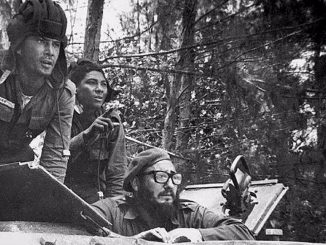
History is still absolving Fidel Castro
Fidel Castro was born on Aug. 13, 1926. If he were alive today, he’d be turning 100 next year. In Cuba, preparations are already underway to celebrate his centennial. But even without the anniversary, current events – the dangerous world situation right now – warrant a reappraisal of Fidel’s life and the Cuban revolution. They have a lot to teach us.
Right now, the U.S. government is intensifying its attacks on Venezuela and other countries of Latin America. This imperialist government, run for the billionaires, has already been illegally assassinating people in the Caribbean who are just trying to make a living, offering zero proof that they are smuggling drugs.
War is a real danger. This would not only be a disaster for Latin America, but also for working-class and oppressed people here in the U.S. itself. (We always seem to get poorer as the war profiteers get richer.)
But Washington’s attempts to subjugate Latin America to Wall Street are nothing new. Fidel Castro spent his life fighting against the murder machine that is U.S. imperialism. And with his leadership, the Cuban revolution first threw off the U.S.-backed Batista dictatorship and then spent decades fighting off U.S. attempts to resubjugate Cuba. Sixty-six years later and they haven’t beaten the Cuban revolution.
Fidel understood that there really was no making peace with imperialism. The leaders of the global capitalist system might soften their tone from time to time, pretend that they will start playing fair. Trump exemplifies this pattern. But the unrelenting profit motive that drives the whole system can never allow peace, and the imperialists can never accept it when people of formerly colonized countries of the Global South, like Cuba, start to run their own affairs.
The problem, from the oligarchs’ point of view, is that if Global South countries are independent, the working-class and oppressed majority there could get hold of the reins of power and actually help the people. When that happens, it threatens corporate profits (the same corporations keeping us down here).
That’s why the U.S. and Britain backed a coup in Iran in 1953, inaugurating decades of bloody dictatorship. The Iranian government had nationalized the oil industry and wanted to use the country’s resources to raise living standards. That meant stopping U.S. and British capitalists from stealing everything.
Venezuela’s crime
There are similarities between Iran and Venezuela, which happens to have the largest proven oil reserves in the world. Venezuela nationalized its oil in 1976, and when Hugo Chávez was elected in 1998, bringing the Bolivarian revolution to power in 1999, the government used the country’s wealth to undertake massive efforts to uplift the people, expanding access to housing, education, health care, etc. Washington has been trying to destroy Venezuela’s Bolivarian government, essentially from day one, long before the bogus narco-state accusations.
Venezuela’s crime is threatening foreign capitalist profits. That was the crime of Iran, and it’s the crime of Cuba. The imperialists can’t accept anything that looks like self-determination. That’s why the Palestinian people’s resolve makes them crazy. That’s why Trump vilifies the Black majority government of South Africa.
There are many things we can learn from Fidel Castro’s life as we contemplate his centennial. But one is that the imperialist system will never accommodate itself to us – to oppressed people, to workers. So, we should not accommodate ourselves to it. Instead, we have to fight it.
‘Kill everybody’: War crimes in the Caribbean expose imperialism in crisis
The execution of defenseless survivors in the water — an act that meets every definition of a war crime — exposes the real thrust of U.S. actions in the Caribbean. This is not about drug trafficking. It is open aggression undertaken by an imperialist system in crisis, relying ever more on force as its authority erodes.
Extrajudicial killings at sea and threats against Venezuela’s sovereignty are not isolated outrages. Taken together, they show a system losing control and turning to force, illegality, and war crimes.
The United States is not acting from a position of strength. It is responding to the decline of U.S. imperialism in the world economy and a shrinking ability to impose its will abroad. History shows that imperialism becomes most dangerous in crisis, turning to open force when it can no longer get its way through economic dominance or political manipulation.
A criminal order that strips away the mask
On Sept. 2, a U.S. aircraft spotted a small boat near Trinidad and the Trump administration quickly declared it was “suspected” of carrying drugs. A missile destroyed the vessel. Two survivors, wounded and unarmed, clung to debris in the water.
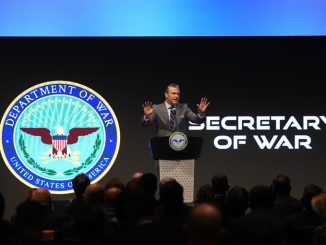
According to a detailed Washington Post investigation, Defense Secretary Pete Hegseth issued a verbal instruction: “Kill everybody.” A second strike was ordered. The survivors were killed where they floated.
This was no battlefield confusion. It was the deliberate killing of shipwrecked people — an act explicitly condemned in the Pentagon’s own Law of War Manual. Former Judge Advocates General warned that if the U.S. claims this was an armed conflict, the order amounted to a prohibited “no-quarter” command, a war crime. If it were not an armed conflict, the killing of defenseless civilians would be murder under U.S. law.
Trump brushed the matter aside, calling the mission “lethal kinetic” and labeling the dead “narco-terrorists.” The terminology changes from era to era, but the purpose is the same: to strip human beings of rights and to justify violence without restraint. This is how imperialist power behaves when its legal façade collapses.
Growing fractures inside the state
The effects of these unlawful killings don’t stop in the Caribbean. They’re also creating tension and divisions inside the U.S. government and the military.
On Nov. 18, six Democratic members of Congress — each with backgrounds in the military or intelligence agencies — released a video reminding U.S. troops of their duty to refuse illegal orders. Their intervention brought into the open a conflict that had been simmering for months.
Trump’s response was immediate and extreme: He accused the six of treason and suggested they should face execution. His tirade only brought more attention to the video.
The six did not call for disobedience in general. They stated a basic legal fact: Troops cannot defend themselves later by claiming they were “only following orders” if they carry out war crimes. The significance lies elsewhere. Their intervention signals growing concern within parts of the ruling class and the state apparatus that Trump is steering the military toward confrontation with the population — and speeding up the decline of U.S. imperialism in the process.
These tensions have been visible for months. National Guard units deployed in Los Angeles to support ICE raids reported discontent and refusals to serve. Members of Congress say they have received increasing calls from active-duty troops and Guard members questioning the legality of the missions they are being sent on. Whatever their motives, the six lawmakers’ video has made the question of refusing illegal orders impossible to ignore.
That question applies as much to the Caribbean as it does to the streets of U.S. cities. Troops have the same duty to refuse orders to fire on civilian boats near Venezuela as they do to refuse orders to fire on people at home. The killings carried out by the U.S. fleet since August — more than 100 people blown apart in the water under the pretext of drug enforcement — are crimes. Those who carry them out are responsible for those crimes, even if the officials giving the orders bear the greater guilt.
The removal of Adm. Alvin Holsey, who reportedly objected to the attacks and instructed that survivors be rescued, underscores the depth of the internal conflict.
Trump’s threat against the six lawmakers exposed a division inside the government that had been simmering for months. Some now respond to any criticism as if it were a criminal act, while others worry that Trump’s use of military force — at home and abroad — is damaging the state they depend on. The clash reflects the deepening instability of the imperialist state amid its global decline.
For anti-imperialists, there is now space to speak directly to U.S. troops and the National Guard: They must refuse illegal orders, whether those orders call for firing on migrants, protesters, or civilians in the Caribbean. Rejecting criminal directives is not merely permitted — it is required.
LA teach-in exposes U.S. war lies on Venezuela
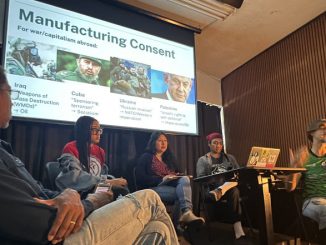
The United States is escalating its threats against sovereign Venezuela — and working overtime to manufacture public support for intervention. In Los Angeles on Nov. 22, activists gathered for a community teach-in to break down the lies driving this new war push and to equip people with tools to challenge it.
The teach-in opened with a concise overview of Venezuela’s modern history and the achievements of the Bolivarian Revolution. Presenters emphasized that Washington’s hostility did not begin yesterday: It is rooted in decades of U.S. attempts to dominate Latin America and crush any nation that asserts its independence.
From there, the discussion turned to how corporate media creates the illusion of consensus for war. Facilitators walked participants through the core tactics of “manufacturing consent” — selective facts, emotional manipulation, and the erasure of U.S. economic sabotage — all designed to portray targeted countries as crises that demand foreign intervention.
A segment from CBS’s “60 Minutes,” “Life on the Ground in Maduro’s Venezuela,” served as the centerpiece for analysis. Attendees examined how the piece relied on distortion, omission, and sensationalism to recast Venezuela’s hardships as proof of government failure rather than the predictable result of brutal U.S. sanctions and continuous destabilization campaigns.
After dissecting the clip, the teach-in shifted to strategy. Participants discussed how to push back: building popular education, joining anti-war organizations, and mobilizing in the streets to oppose any U.S. attack on Venezuela or any other sovereign nation.
Only after the main program concluded did organizers acknowledge the collaboration that made the event possible, including members of the Struggle for Socialism Party (SSP), the Harriet Tubman Center (HTC), and the Los Angeles Tenants Union Koreatown (LATU).
The core message that carried through the event was clear: No war on Venezuela. No more public money for imperialist aggression while communities at home are denied housing, health care, and basic social services. The fight against U.S. intervention abroad is inseparable from the fight for justice at home.
A public link to the slideshow shared at the event is available here for readers who wish to explore the material further.
With imaginary decree, Trump attempts to ‘close’ Venezuela’s airspace
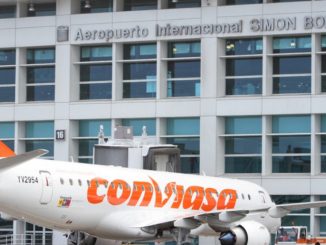
CARACAS, Venezuela (OrinocoTribune.com)—In a bizarre social media post on Saturday, November 29, U.S. President Donald Trump issued a warning amid escalating military action and pressure on Venezuela and President Nicolás Maduro: “To all airlines, pilots, drug dealers and human traffickers, please consider the airspace above and surrounding Venezuela to be closed in its entirety.”
This unprecedented attempt at an air blockade is another step in the escalating aggression that Washington is carrying out against Venezuela. However, experts in international law emphasize that Trump does not have the authority to close the airspace of another sovereign country, as that power belongs solely to the state that exercises sovereignty over its territory or to the United Nations Security Council (UNSC).
The threat comes a week after the U.S. government itself urged airlines to exercise extreme caution due to “military activity” in the region, thus disrupting international air operations in Venezuela. A few days later, the New York Times revealed that Trump held a telephone conversation with President Maduro, in which the possibility of a face-to-face meeting was discussed.
According to analysts, Trump’s delirious social media post is evidence of the failure of the U.S. strategy toward Venezuela, which relied on a military uprising leading to a coup d’etat or a far-right uprising aimed at ousting Maduro. Neither option has materialized; instead, President Maduro’s position becomes stronger by the day, especially after U.S. warnings affecting Venezuelan airspace and disrupting the freedom of the Venezuelan people to transit local and international routes.
Venezuelan experts also consider that Trump’s announcement means the de facto cancellation of migrant repatriation flights that have been operating regularly since February. Despite U.S. military threats, these flights have brought home more than 17,000 Venezuelan migrants who had been victims of racist and xenophobic U.S. immigration policies.
Recent history of no-fly zones
Although Trump’s announcement falls short of a formal no-fly zone, its intent seems to be exacerbating a psychological operation or preparing the ground for direct U.S. military strikes against Venezuela.
A low-intensity electronic warfare operation has been ongoing in the country since October, visibly affecting global positioning systems and impacting fields that rely on them, including air transport. Cuban Foreign Minister Bruno Rodríguez denounced this fact on social media on Saturday.
In Libya, the implementation of a no-fly zone in 2011 was a complex and controversial military and diplomatic operation authorized by the UNSC, allegedly to protect civilians from “government bombardments.” It quickly evolved from a neutral airspace denial mission into a broader air campaign in support of forces opposing President Muammar Gaddafi.
Critics, including the abstaining states on the UNSC, argued that NATO overstepped its mandate. They contended that the no-fly zone morphed into a de facto air war in support of U.S. imperial interests, with the ultimate goal of regime change. This led to Gaddafi’s overthrow and assassination, and ultimately to the destruction of the Libyan state, now dismembered and with different chunks controlled by sectarian forces.
In Iraq, no-fly zones were created in 1991 without a UNSC mandate following the Gulf War. This was a larger, longer and more controversial operation than the one in Libya. It served as a key element in the U.S.-led military aggression and occupation campaign, paving the way for the 2003 U.S. invasion of Iraq under the excuse of “weapons of mass destruction” that did not exist.
U.S. imperialism justified the creation of the “no-fly zone” under UNSC Resolution 688, which condemned the repression of Saddam Hussein and demanded Iraq end it. However, Resolution 688 did not explicitly authorize the use of force or no-fly zones, making their legal basis a subject of continuous controversy. Without explicit UN Chapter VII authorization, the U.S. and UK relied on the argument that the resolution provided a legal “basis” for action. Russia, China, France, as well as many international law experts have consistently demonstrated the no-fly zones over Iraq were illegal under international law.
Both cases ended with hundreds of thousands of deaths, the dismemberment of the affected states, and migration crises. Experts argue that these would pale in comparison to what might happen in Latin America and the Caribbean if the U.S. launches a full-scale military operation against Venezuela.
Trump threatens Venezuela: Another escalation in Washington’s war
Statement of the Struggle for Socialism Party
Nov. 30, 2025
Trump’s threat to strike Venezuela violates the U.N. Charter and exposes Washington’s collapsing justifications for war.
U.S. imperialism and the policies of colonial domination rely on distortion, deception, and the prioritizing of profits over human life. Their entire imperialist project depends on lies — and today we are witnessing one of its most reckless and dangerous escalations in real time against Venezuela.
Donald Trump’s recent declaration on Truth Social, threatening U.S. military strikes against Venezuela’s land, sea, and air, is a unilateral act of aggression.
In a powerful response, the Bolivarian Republic of Venezuela officially denounced this “colonialist threat that seeks to affect the sovereignty of its airspace — an action that constitutes a new extravagant, illegal, and unjustified aggression against the Venezuelan people.”
Article 2, paragraph 4 of the U.N. Charter clearly states that threats or use of force against another nation are violations of international law and are prohibited.
Venezuela’s statement correctly identifies the claimed extraterritorial jurisdiction as a “hostile, unilateral, and arbitrary act, incompatible with the most basic principles of international law. … a permanent policy of aggression against our country, with colonial pretensions over our region.”
This illegal threat to “close” Venezuelan airspace is the latest maneuver in a war Washington has waged since the dawn of the Bolivarian Revolution — beginning with the U.S.-sponsored military coup attempt against President Hugo Chávez in 2002. The war continues by other means: economic sanctions, blockade, and the freezing of sovereign assets, all designed to produce poverty, hunger, and social destabilization.
The real crime of Chávez — and of President Nicolás Maduro today — in the eyes of Trump and both Democratic and Republican administrations is that Venezuela prioritizes social needs over the demands of U.S. imperialist capital. Major advances in housing, food programs, literacy, and health care took shape only after the Bolivarian Revolution, empowering the majority of Venezuelans with sovereignty and real grassroots democratic reforms.
The staggering hypocrisy of Washington’s justification for war — claiming that Venezuela is “flooding the U.S. with drugs” — falls apart under scrutiny. There is no evidence that Venezuela is a major source of cocaine, fentanyl, or other narcotics entering the United States. Even the Washington Post and New York Times — usually reliable accomplices in the vilification campaigns that precede U.S. wars — have admitted there is no verifiable evidence of a Venezuelan drug cartel.
Yet the extrajudicial assassination of dozens of fishermen and civilians by U.S. Navy SEALs and drone strikes is framed as “necessary,” despite the victims having no due process, no evidence, and no link to terrorism or military activity. They are effectively sentenced to death based on alleged ties to a cartel that does not exist. Meanwhile, Trump has indicated he may pardon his convicted drug-trafficking ally, former Honduran President Juan Orlando Hernández — the man who actually did flood the U.S. with cocaine. The hypocrisy, cynicism, and state terrorism could not be clearer.
The covert war is now becoming overt.
History provides powerful lessons. Decades of a cruel blockade could not break Cuba; it forged a nation of resilience and dignity. The genocide in Palestine has not crushed the Palestinian cause; it has magnified it worldwide. In this same spirit, the Venezuelan people remain unbroken — and continue building socialism with determination and collective strength.
The international solidarity movement, especially inside the United States, must remain firm and active. Our greatest weapon against imperialism and colonialism is solidarity: in the streets, in the workplaces, in the unions, and in every arena where the working class can assert its power. We must demand an immediate halt to all U.S. aggression against Venezuela.
1