The K-shaped economy is monopoly capitalism working as designed

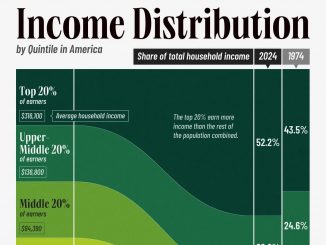
Income Distribution in America v3 Site

What is being called a “K-shaped economy” is not a temporary distortion or the result of recent shocks, but the normal outcome of monopoly capitalism.

The image suggests two trajectories diverging from a common point—one arm rising, the other falling. The term has gained traction in economic coverage because it names the visible split between those who own and those who work, but it does not explain the system that produces that divide. 

In the third quarter of 2025, the economy grew at an annual rate of 4.3%. Corporate profits rose by $166 billion. Unemployment climbed to 4.6%. Real disposable income for households did not grow at all. These figures do not contradict one another. GDP growth records the expansion of value for capital, not improvements in living conditions. Taken together, the numbers describe an economy organized so that accumulation at the top proceeds even as conditions deteriorate for most working people.

The “K” image captures this split only at the surface. It describes two paths separating from a common starting point, one rising and one falling, without explaining why the split occurs or why it persists. 

By framing the outcome as an imbalance or an unusual pattern, the metaphor suggests something temporary or accidental. Under monopoly conditions, however, this gap is neither. It is the routine operation of an economy in which profits are secured not by expanding employment or raising wages, but by cutting jobs, keeping pay flat, and shifting economic risk onto households — a process enforced through labor law, credit systems, and public policy.

This pattern did not emerge suddenly, and it did not begin with the pandemic, inflation, or recent policy shifts. The split now described as “K-shaped” has been widening for decades. What today’s figures make visible is the cumulative result of a long shift of income and power away from wages and toward profits. To understand how the economy came to operate this way, it is necessary to look at how income has been divided over the past half-century.

Fifty years of upward transfer

The data on income distribution tells the story plainly. In 1974, the top 20% of households captured 43.5% of total national income. By 2024, their share had grown to 52.2% — a gain of 8.7 percentage points. Every other income group saw its share decline. The bottom 20% fell from 4.3% to 3.1%, a drop of roughly 28% in their portion of national income.

This redistribution reflects monopoly capitalism’s inherent drive to concentrate wealth, a tendency that was temporarily constrained from the 1940s through the early 1970s. Strong unions, laws that limited Wall Street speculation and made it harder to move factories overseas, and the political pressures of that period — including the existence of the Soviet Union, socialist China and the anti-colonial national liberation struggles worldwide — extracted real concessions from the ruling class. 

Starting in the 1970s, facing overproduction and overaccumulation — more goods produced than could be sold profitably, more capital accumulated than could find profitable investment — the ruling class launched a sustained counteroffensive. Through union-busting, tax cuts for the wealthy, deregulation of finance, and the movement of production to where labor was cheaper and less organized, the ruling class broke that compromise. The widening divide visible in income data since 1974 marks not the beginning of a new trend but the success of that counteroffensive.

One-quarter of all U.S. households now report no job / wage income at all, according to the Census Bureau’s American Community Survey. These are not statistical anomalies. They represent millions of people living at the margins or entirely outside formal employment. Monopoly capitalism no longer requires a broad base of stable employment to generate profits. Profits can be sustained through price increases, cost-cutting, and through debt and finance, even as employment becomes more unstable and real wages fall.

Growth Without Jobs

The current expansion makes this visible in sharp terms. The economy grew rapidly in the third quarter, yet hiring stalled and unemployment rose. Real disposable income for households did not increase at all. This is growth detached from work. 

Under monopoly conditions, output and revenue increasingly expand without corresponding growth in payrolls. Workers are pushed to do more with less, and hiring is held back even as production increases. What is labeled productivity is often just speed-up — more output demanded from fewer workers who have little power to refuse.

At the same time, consumer spending is being driven not by rising incomes but by basic needs. A significant portion of recent expenditure has gone to health care costs that cannot be deferred. People are spending because they must, not because they can afford to, and they are financing it by drawing down savings or taking on debt. This is survival spending, and it is unsustainable.

Debt as fuel

Younger workers are carrying a particular share of this burden. Gen Z credit card balances have surged by 36 to 37%, while their credit scores have dropped to their lowest levels in years. They are relying on high-interest debt to cover basic costs that wages no longer meet, even though their pay, adjusted for inflation, is nominally higher than previous generations at the same age.

The gap between what workers earn and what they can actually afford reveals how inflation works under monopoly conditions. Prices rise because dominant firms control supply chains, housing, energy, and food, and use that power to raise prices in order to maintain profit margins, rather than allowing returns to fall. 

Under monopoly conditions, inflation becomes a way of transferring income from workers to capital. Dominant firms control supply chains, housing, energy, and food, and use that power to raise prices in order to protect profit margins, even when demand does not justify those increases. Debt then keeps consumption going for a time when wages no longer cover basic costs.

This arrangement is precarious. Gen Z’s debt-heavy spending helps keep the economy moving, but only because they still have jobs and can make their payments. When the next downturn comes, those holding the most debt with the least cushion will stop paying first, stop spending, and deepen the collapse. The economy’s stability depends on workers who are already drowning.

Profits under a divided economy

Major firms operate within this split and profit from it. Coca-Cola sells lower-cost products to price-constrained buyers while relying on premium brands like Smartwater and Fairlife milk for higher profit margins. Delta reports that revenue growth is driven by first- and business-class tickets, while lower-income passengers are falling behind. Best Buy reports that two-thirds of consumption comes from the top 40% of households.

These practices reflect how profit-making adjusts to a divided economy. Profits are increasingly drawn from high-end consumption on one side and debt-driven spending on the other. The middle, where steady employment once meant steady spending, is shrinking. The wealthiest 10% of Americans own roughly 87% of all stock. When stock prices rise, their wealth increases automatically. The bottom 50% owns just over 1% of the stock market. When prices go up, they just pay more for rent and groceries while owning nothing that increases in value.

Not a recovery, but a structure

What is being described in economic reports as unusual is actually characteristic of monopoly capitalism under conditions where profitable expansion has become difficult. Monopoly firms control enough of their markets to set prices independent of competition. 

When profit margins are threatened, prices are raised rather than profits allowed to fall, with state policy tolerating or enforcing that outcome. At the same time, productive capacity expands faster than profitable markets can absorb. The response is not to raise wages or expand employment — that would cut into profits — but to eliminate jobs, automate, and rely on debt to sustain consumption for a time when wages fall short.

This produces the pattern now visible: GDP growth without job creation, corporate profits without rising incomes, spending without security. When you add it all up, the economy can look like it’s expanding even as conditions worsen for most people, because the growth shows up in stock prices and corporate earnings rather than in paychecks or jobs.

Calling this a “K-shaped recovery” implies something temporary and self-correcting. In reality, it describes a structure enforced through law and state power. The result is an economy that concentrates wealth at the top while pushing the majority toward more unstable work, lower pay, and rising household debt.


The K shape is not an anomaly. It is a plain description of how monopoly capitalism actually works.

Strugglelalucha256


CIA claimed to have launched strike on ‘remote dock’ in Venezuela

It is important to note that no open sources, that do not rely on Pentagon reports or the fabrications so embedded in the White House, have reported an attack on the Venezuelan coast.  It is also important to remember that U.S. wars are started by lies; from the created Gulf of Tonkin incident in Vietnam to the non existence “weapons of mass destruction” in Iraq. -editorial

Caracas, Venezuela, Dec. 30 —

According to CNN, citing “sources familiar with the matter,” the CIA carried out a drone strike against a “remote dock on the Venezuelan.” US officials allegedly believed the facility was being used for drug storage and shipping.

There was reportedly no one present on site during the attack, which is only specified to have taken place “earlier this month.” A New York Times report, likewise relying on anonymous sources, presented similar claims and added that the strike took place last Wednesday.

US President Donald Trump first alluded to a purported strike inside Venezuelan territory during an interview on Friday, claiming that US forces had destroyed a “big facility where ships come from” two days earlier.

Trump elaborated on a Monday press conference, adding that the site was along the Venezuelan shore and that there was a “big explosion in the dock area where they load the boats up with drugs.”

US agencies have not confirmed the attack, with the CIA, the White House and the Pentagon refusing comment. Analysts relying on open source data tracked no signs of an explosion on the Venezuelan coast in recent days.

For its part, Venezuelan authorities have not released any statements on the matter.

If confirmed, the land strikes would mark a significant escalation in the US’ military campaign against Venezuela. Since August, the Trump administration has amassed the largest build-up in decades in the Caribbean and launched dozens of strikes against small boats accused of narcotics trafficking, killing over 100 civilians in the process.

Trump has repeatedly vowed to bomb purported drug targets inside Venezuelan territory while escalating regime change threats against the Nicolás Maduro government. The White House allegedly approved lethal CIA operations in the country in October.

Despite recurrent “narcoterrorism” accusations against Maduro and other high-ranking Venezuelan officials, Washington has not provided court-tested evidence to back the claims. Specialized agencies have consistently shown Venezuela to play a marginal role in global drug trafficking.

In recent weeks, Trump has turned his discourse toward Venezuelan oil, claiming that the Caribbean nation had “stolen” oil rights from US corporations during nationalization processes in the 2000s and 1970s.

The US president ordered a naval blockade against Venezuelan oil exports, with US forces seizing two oil tankers carrying Venezuelan crude in international waters earlier this month. A third vessel reportedly refused to be boarded and headed toward the Atlantic Ocean. According to Reuters, US forces have been ordered to enforce a “quarantine” of Venezuelan oil in the next two months in order to exacerbate the South American country’s economic struggles.

A group of UN experts issued a statement on December 24 condemning the US’ maritime blockade as “violating fundamental rules of international law.”

“The illegal use of force, and threats to use further force at sea and on land, gravely endanger the human right to life and other rights in Venezuela and the region,” the experts affirmed, while urging UN member-states to take measures to stop the blockade and the vessel bombings.

The attempted blockade builds on widespread US economic sanctions, particularly targeting the Venezuelan oil industry, the country’s most important revenue source. US coercive measures have been classified as “collective punishment” and found responsible for tens of thousands of civilian deaths.

For its part, the Maduro government has condemned US “acts of piracy” in capturing oil tankers and blasted the Trump administration’s actions as blatant attempts to seize Venezuela’s natural resources.

Caracas has received diplomatic backing from its main allies, with China and Russia both condemning Washington’s military escalations as violations of international law. However, a recent UN Security Council meeting convened by Venezuela produced no resolutions.

Source: Venezuela Analysis

Strugglelalucha256


The dollar’s weakness is imperialism’s weakness

Austerity

The economic reports arriving in late 2025 point to a system in breakdown. Prices keep rising while jobs disappear. Factories sit idle or close even as corporate profits are maintained and expanded through higher prices and layoffs.

The dollar no longer anchors the world economy but forces other countries to absorb U.S. inflation, interest rate shocks, and financial pressure. These are not separate problems. 

What gets called the “decline of the dollar” is not a market mood swing or a technical currency problem at all, but the expression of an imperialist system that can no longer organize production, prices, and employment on a stable basis — or sell what it produces at a profit without war spending, monopoly pricing, and debt.

Production has outrun profitable markets under monopoly capitalism. Productive capacity expands faster than profits can be realized, leaving goods unsold at prices that sustain profit rates.

To compensate, excess capacity piles up and prices are raised to maintain profit growth. Military budgets are expanded to keep factories operational and revenue to continue flowing. But fewer countries are willing or able to finance this system by holding U.S. dollars.

Dominant firms use control over energy, housing, food supply chains, and military contracting to raise prices rather than increase output. The permanent war economy reinforces this dynamic.

A hollowed productive base

After World War II, the United States produced more than half of the world’s manufactured goods. Today, its share of global economic output is less than 15%. The industrial base that once supported the dollar’s international role has been systematically stripped back through deindustrialization — plant closures, outsourcing, and the diversion of capital away from domestic production.

The results are now visible. U.S. shipyards miss deadlines by years. Weapons systems are produced slowly and in limited quantities even as the United States arms multiple wars at once and prepares for further conflict. Factories cannot meet the demands of Ukraine, Israel, Taiwan, and domestic stockpiles at the same time. The military reach that once reinforced the dollar now exposes its weakness.

Military overstretch and inflation

War spending has never been productive in any social sense, despite the myths used to justify it. It mobilizes labor, materials, and technology to manufacture destruction — goods that do not enter social reproduction or sustain society. Weapons do not feed, house, or transport people; they are built to be destroyed or to destroy.

Military production is insulated from normal price pressure. Long-term government contracts guarantee sales at high prices regardless of efficiency or social need. Costs are passed on to the state, profits are secured in advance, and there is no competitive pressure to expand useful production. Capacity remains narrow, prices stay high, and resources are locked into weapons rather than goods that support everyday life.

In earlier periods, war spending did not generate productive growth so much as enable imperialist expansion — the violent seizure of markets, resources, and labor that temporarily offset capitalism’s internal limits. That outlet no longer exists. 

Today, military production expands spending while shrinking society’s ability to reproduce itself. Money circulates and profits are booked, yet future production is not developed and the goods working people rely on are not produced in greater quantities.

The United States now pours resources into multiple wars and preparations for future ones without stabilizing accumulation or rebuilding industry. While military spending does create jobs, it does so by diverting labor into production that does not expand housing, health care, food, or infrastructure, leaving society poorer in real terms even as payrolls are temporarily sustained.

Sanctions intensify these pressures. They block access to energy, fertilizer, medicine, metals, and food inputs, forcing trade through longer, more expensive routes or cutting it off entirely. Fuel prices rise, transport costs climb, and essential goods arrive late or not at all. These measures are punitive by design. Sanctions are economic warfare, aimed directly at civilian populations, degrading living conditions in order to exert political pressure and reorganizing supply chains around military and geopolitical priorities rather than social benefit.

Tariffs compound the damage by functioning as taxes on imports. Although imposed at the border, their costs are passed through prices and ultimately paid by working people. The result is persistent price increases without an expansion of useful production — higher living costs alongside layoffs, plant closures, and stagnant wages.

Weaponized finance and currency blowback

As U.S. wars, sanctions, and deficits have expanded, holding dollars has become a political risk rather than a neutral financial choice. Dollar reserves are not stacks of cash, but government-owned accounts, bonds, and deposits held inside U.S. and allied financial institutions. Countries that once treated these reserves as a stable store of value have watched them turned into instruments of coercion — frozen, seized, or rendered unusable when political alignment breaks down.

The 2022 seizure of Russian reserves did not come out of nowhere. For decades, the United States had used control over the dollar-based financial system to isolate and punish governments it opposed, freezing state assets and cutting countries off from the international payment networks needed to sell goods, receive revenue, or access foreign currency. 

Iranian assets were frozen beginning in 1979 and later paired with exclusion from global banking channels and oil markets. Venezuelan state assets and gold reserves were seized after Washington demanded a regime change. Afghan central bank reserves were frozen overnight in 2021 after the Taliban takeover, triggering economic collapse and creating conditions of mass hunger. In each case, access to reserves depended not on law or contract, but on political compliance with U.S. imperialist authority.

What changed in 2022 was scale. For the first time, these measures were applied to a G20 economy and a major nuclear power. The seizure of Russian reserves made the underlying rule unmistakable: Assets held inside the U.S.-controlled financial system are protected only as long as governments accept Washington’s political terms. Economic size offers no immunity. Sovereign reserves function not as neutral safeguards, but as conditional claims that can be revoked when geopolitical lines are crossed.

Central banks across Asia, Africa, and Latin America have sharply increased their gold holdings in recent years. The response has been material, not ideological, because states act on necessity, not belief.

Gold is being accumulated because it cannot be frozen or seized through sanctions, while dollar reserves — electronic balances inside U.S. and allied financial systems — can be blocked with a keystroke.

Gold prices pushing past historic highs reflect this shift: When dollar reserves can be frozen or confiscated for political reasons, states turn to an asset outside administrative control.

Countries are taking steps to reduce dependence on the dollar. China and Russia conduct trade in yuan and rubles. BRICS countries are developing payment systems outside SWIFT, the U.S.-controlled network that routes international payments. Bilateral currency swap arrangements have expanded, allowing countries to settle trade directly without converting through dollars. Saudi Arabia now accepts yuan for oil sales alongside dollars. 

These are not comprehensive replacements for the dollar system, but they represent infrastructure being built to reduce dependence on a currency that now finances war, enforces sanctions, and carries the risk of confiscation. The dollar’s declining dominance reflects that shift: Fewer governments are willing to hold reserves that double as leverage against them.

Stagflation and the assault on labor

The instability exported through war, sanctions, and currency coercion does not stay abroad. It returns home as higher prices, job losses, and deeper insecurity for working people. Stagflation is not a mystery or a policy failure; it is a class outcome.

It is the domestic form of an imperialist system that can no longer stabilize accumulation internationally and compensates by extracting more from labor at home.

Prices rise because monopolies use their market power to maintain profit growth. When workers win higher wages, this cuts into profit margins – profits fall because more of the value created goes to workers rather than capitalists. But price increases themselves are driven by monopoly control, not by wages.

The response to the last major episode of stagflation was to make working people pay. In the late 1970s and early 1980s, the Federal Reserve drove interest rates sharply higher, triggering deep recessions. Millions lost their jobs. Unions were weakened or broken. Wages were forced down. Inflation eventually eased not because the system was stabilized, but because unemployment rose, wages were forced down, and working people were made poorer.

The Federal Reserve now swings between two tools, neither of which resolves the crisis. When interest rates are raised, hiring slows, unemployment rises, and workers are pushed into weaker bargaining positions. When rates are lowered, as they have been repeatedly in recent months, the result is not renewed production but cheaper credit, rising debt, and asset inflation that benefits corporations and investors while prices remain high for working people.

In both cases, the burden falls in the same place. Jobs stay insecure, wages remain under pressure, and prices do not come down because the underlying problem is not monetary policy, but an economy that can no longer expand production profitably. Stagflation persists because capitalism under imperialist decline no longer has a policy path that restores stability. It delivers inflation and unemployment together.

From creditor to debtor

The United States was once the world’s main creditor because it produced a large share of the world’s goods, ran trade surpluses, and lent capital to stabilize capitalism and consolidate U.S. dominance in Europe and Japan after World War II. That material foundation no longer exists.

Today, the United States is the world’s largest debtor, running chronic trade deficits and borrowing continuously to finance consumption, war spending, and financial stability at home. This arrangement is sustained not by expanded production, but by issuing growing quantities of dollar-denominated debt — Treasury bonds, credit, and financial claims — that are absorbed globally because of the dollar’s reserve role.

Since the early 1970s, the United States has operated without any gold backing for its currency. Before then, under the postwar Bretton Woods system, foreign governments could exchange U.S. dollars for gold at a fixed rate, which limited how many dollars Washington could issue without draining its gold reserves.

In 1971, President Richard Nixon ended that arrangement. From that point on, the dollar was no longer tied to gold at all. Its value rested instead on the power of the U.S. state, its dominance of global trade and finance, and its ability to enforce the dollar’s use through political and military means.

This shift allowed the United States to run large deficits indefinitely. Rather than settling international obligations by exporting goods or gold, Washington could pay in dollars whose value declined over time. In practice, this meant financing wars, imports, and bailouts by simply printing more dollars – no longer backed by gold – and issuing debt, shifting the cost onto others through inflation and dollar depreciation instead of expanding production.

In effect, debts are settled with claims worth less in real terms — a modern equivalent of paying obligations with clipped coins. The dollar’s reserve role still props up this arrangement, but it now rests on the ability to export inflation and absorb global savings, not on the material strength of U.S. industry.

Money that once would have gone into factories and equipment is now poured into stock buybacks, real estate speculation, and financial markets. The AI boom fits the same pattern: Companies are valued on promises to replace workers and cut costs rather than on producing more goods people actually need. Productive capacity shrinks even as paper wealth, corporate valuations, and executive pay soar.

Earlier periods of dollar devaluation and deficit spending were used to restore profitability while preserving monopoly power. Those measures shifted losses onto workers and weaker economies but were backed by a growing industrial base.

Automation and the dollar’s shrinking base

The push toward automation is not driven by abundance or social benefit, but by capitalism’s inability to expand profitably. Firms invest in machines because expanding production no longer reliably produces higher profits. Jobs are eliminated not because society needs less work done, but because wages are treated as a cost to be removed in an economy that can no longer expand profitably.

As automation spreads and more investment goes into machinery rather than labor, profit rates are squeezed because machines do not create new value. Only living labor does. The result is overproduction relative to profitable opportunities: more goods produced with less labor employed, while capital accumulates faster than it can find profitable outlets.

The dollar’s reserve role once rested on U.S. capitalism’s productive strength — its factories drew in investment and organized production worldwide. Automation under crisis conditions produces the opposite: fewer productive jobs, shrinking opportunities for profitable investment, and an economy that spreads instability instead of growth. The dollar becomes a tool for debt and speculation, not for building anything.

Even sections of the ruling class recognize the impasse. Proposals for universal basic income reflect an awareness that automation under capitalism displaces workers faster than the system can provide wages or stable employment. Jobs are eliminated, incomes are cut off, and purchasing power shrinks, leaving goods that cannot be sold at prices that sustain profit.

Capitalism has no mechanism for organizing abundance without undermining the profit system itself. What remains is a reserve currency backed not by productive expansion, but by financial coercion, military force, and debt — a narrowing base that cannot sustain a stable global monetary system.

Imperialist decay

The weakening of the dollar marks an advanced stage of imperialist decay. It reflects an economy that can no longer stabilize itself through production, but relies instead on debt, war, monopoly pricing, and coercion.

Imperialist profits increasingly come not from producing and selling goods in competitive markets, but from monopolizing energy, technology, shipping, credit, and payment systems — and using military force to maintain that monopoly.

The crisis of the dollar is inseparable from this broader breakdown of imperialism itself. It is not a technical malfunction or a temporary adjustment, but the unraveling of an imperialist system that can no longer expand on its own terms. It can only manage decline by transferring costs — through inflation, war, and austerity — onto workers and oppressed peoples worldwide.

Strugglelalucha256


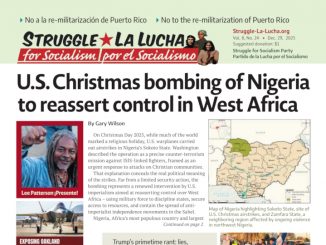
Struggle ★ La Lucha PDF – December 29, 2025

Get PDF here

  • U.S. Christmas bombing of Nigeria  to reassert control in West Africa
  • At Army–Navy game, activists confront Trump over Venezuela
  • ICE targets Chicago union picket line, threatens all workers
  • Immigrant youth lead anti-ICE protests in south Louisiana
  • Trump’s primetime rant: lies, racism, and crisis at the top
  • Community runs to aid of older woman hit by speeding Baltimore cop
  • Blockade and plunder: Trump escalates war on Venezuela
  • USS Intrepid: From Dominican invasion to Venezuela threats
  • How the U.S. lost its chip war on China
  • U.S. escalates military buildup across the Pacific, pushing region toward war
  • Only U.S. imperialism benefits from Thailand-Cambodia war
  • Greta Thunberg arrested as Britain lets Palestine Action prisoners starve
  • Embargo movement exposes Oakland airport’s role in weapons shipments to Israel
  • No a la re-militarización de Puerto Rico
  • No to the re-militarization of Puerto Rico
Strugglelalucha256


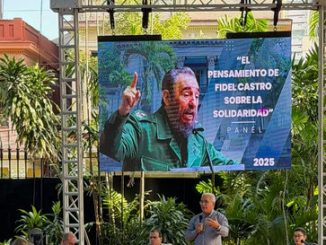
Reflections on Fidel Castro’s internationalism in Cuba on ICAP’s 65th anniversary

Some 240 activists and representatives of solidarity organizations and movements with Cuba from 32 countries highlighted today the internationalist thought and action of the historical leader of the Revolution, Fidel Castro.

Gathered at the Cuban Institute of Friendship with the Peoples (ICAP), the participants reflected on the legacy of the institution’s founder, which will celebrate its 65th anniversary on December 30th, having promoted and coordinated international support for the causes of the world’s peoples.

Speaking on the panel, René González, director of the Fidel Castro Ruz Center, emphasized that Cuba’s commitment to solidarity arose and was strengthened in the struggles of Latin America and Cuba for independence, with the participation, commitment and solidarity of Latin American patriots in those struggles.

These values, González pointed out, are part of the humanist essence of the Cuban Revolution, which drew on the thought of  Cuba’s National Hero José Martí and the ideology of Fidel Castro, who stated that “To be an internationalist is to repay our own debt to humanity.”

For her part, the center’s deputy director, Sissy Abay, recalled that Cuban solidarity was expressed from the very first moments of the revolutionary triumph on January 1, 1959, through concrete actions in various parts of the world, and today Cuba is a recipient of that support.

According to the president of ICAP, Fernando González, solidarity is a fundamental pillar of Fidel Castro’s thought and action, and is understood here as a human duty and an unrenounceable principle of the Revolution, which continues to manifest itself in a practical and consistent internationalism.

At the event, representatives of solidarity organizations and movements from the United States, Australia, Europe, Asia, and several Latin American nations presented the actions they are taking to support Cuba in the face of its complex economic situation and the unprecedented intensification of the blockade and U.S. aggression.

Photos: Bill Hackwell

translation: Resumen Latinoamericano – English

Source: Siempre con Cuba 

Strugglelalucha256


Gaza’s ‘ceasefire’ exposes why Zionism must be defeated

IDF strikes continue

Nearly three months into the supposed ceasefire between Nazi IDF forces and the united Palestinian resistance in Gaza, the fire has hardly ceased. Since Oct. 10, the IDF has violated the ceasefire in Gaza at least 875 times. Out of these 875 violations, 421 were airstrikes or artillery shelling. 

These strikes have resulted in the deaths of more than 400 people. Injuries from the strikes number well over 1,000. Many of these strikes have targeted aid distribution stations and the Egyptian border crossing. UNRWA’s facilities in the strip have also faced IDF bombardment in the period since the ceasefire. 

While the attacks are not the same pace as seen between Oct. 7, 2023, and Oct. 10, 2025, they are still aimed at the oppression and genocide of the Palestinian people. Meanwhile, there are no verified reports of any Hamas or other resistance group violating the ceasefire. This ceasefire is really less a pause in fighting than it is a license for slow death in Gaza. 

The Western world happily tolerates constant IDF ceasefire violations yet continues to frame the resistance as terrorists and criminals.

Weather and famine plague Gaza

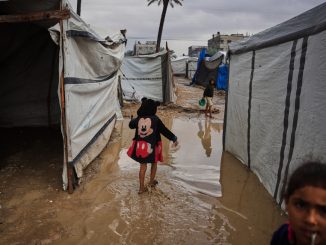
As if U.S. imperialist-backed occupation wasn’t bad enough, the weather has battered the Gaza Strip constantly over the past several months. Rain and wind have pelted the strip, leading to severe flooding. Hundreds of tents washed away as the rain pounded Gaza. 

To be clear, the weather is not the real cause of this suffering. Intense cold, rain, and wind are proving fatal to the Palestinians in Gaza because the U.S. and the IDF destroyed most of the livable structures. 

Further, the flood waters coursing through Gaza are full of debris from Zionist bombing. Between the leveled apartment complexes and the debris-filled water, the Zionist occupation has managed to plunge Gaza further into hell. 

All of this, during a ceasefire.

Mossad escalates against West Bank

Gaza is not alone in being the focus of U.S. imperialist and Zionist genocidal aspirations. The situation in the West Bank has worsened with every month since the events of Oct. 7, 2023. 

The last two plus years have seen a significant intensification of the IDF police state that rules the West Bank from Tulkarem to Nablus to Ramallah. Video footage showing IDF soldiers shooting children, raiding homes, and even throwing Palestinians off buildings has continually circulated. 

The assault on human rights and Palestinian life in the West Bank has only escalated since the supposed ceasefire. Cities like Beit She’an, Jenin, Hebron and many others have faced daily raids from IDF soldiers and armed settler militias. 

Raids have included the murder of dozens of Palestinians and the indefinite arrest without due process of hundreds. Zionist occupation and apartheid in the West Bank is as much a heinous crime as the genocide in Gaza. 

U.S.-backed Zionist settlers and troops have no right to any role in determining Palestine’s future, whether it’s in Gaza or the West Bank or occupied Palestinian land within the “48” borders. 

Don’t forget Palestine

Ending the escalation of genocide that began on Oct. 7 is simply not enough. Palestine will only achieve justice when every inch of Palestinian land from the Jordan River to the Mediterranean Sea is free from U.S. imperialism and Zionist rule. 

U.S. progressives cannot rest on their laurels simply because the pace of the genocide has marginally slowed. Now, more than ever, it is crucial to expose the crimes of the U.S. military industrial complex and the Zionist regime in their destabilization of the entire Middle East. 

Struggle cannot stop until Palestine is 100% free. The political line for the working class and the entire anti-imperialist movement has to be the return of all Israeli-occupied land to the people of Palestine. Existing in any form, Israel will continue to carry out its reason for existence: to terrorize and destabilize the region on behalf of the U.S. 

Lev Koufax is an anti-Zionist Jewish activist.

Strugglelalucha256


Ukraine: The erased evidence

Since 1991, the year Ukraine became an independent republic after the dissolution of the USSR, NATO has been building a network of ties within the Ukrainian armed forces. Simultaneously, through the CIA and other intelligence services, neo-Nazi militants are recruited, funded, trained, and armed. Photographic documentation shows young Ukrainian neo-Nazi militants from UNO-UNSO being trained in Estonia in 2006 by NATO instructors, who teach them urban combat techniques and the use of explosives for sabotage and attacks. This neo-Nazi paramilitary structure came into play on February 20, 2014, in Maidan Square in Kiev, during a political demonstration where supporters and opponents of Ukraine’s accession to the EU clashed. While armed and organized groups stormed government buildings, “unknown” gunmen (who later turned out to be snipers recruited in Georgia) fired with the same sniper rifles at both protesters and police officers, causing dozens of deaths. On the very day of the Maidan Square coup, the NATO Secretary General addressed the Ukrainian armed forces in a commanding tone, warning them to “remain neutral” under penalty of “serious negative consequences for our relations.” Abandoned by the top brass of the armed forces and by a large part of the government apparatus, President Yanukovych was forced to flee.

The Maidan Square coup was followed by an immediate attack against Russians in Ukraine and Ukrainians friendly to Russia. It was a wave of terror, organized with a precise strategy: headquarters of the Communist Party of Ukraine and other political movements were devastated, leaders were lynched, journalists were tortured and murdered; activists were burned alive in the Odessa Labor House; unarmed residents of eastern Ukraine of Russian origin were massacred in Mariupol, and white phosphorus bombed in Sloviansk, Luhansk, and Donetsk. Faced with the offensive against Russians in Ukraine, the Supreme Council of the Republic of Crimea—a Russian territory transferred to Ukraine during the Soviet era in 1954—voted for its secession from Kiev and its re-annexation to the Russian Federation. The decision was confirmed with 97% of the vote in a popular referendum. On March 18, 2014, President Putin signed the treaty granting Crimea the status of an autonomous republic in the Russian Federation.

While in the Donbass the self-proclaimed People’s Republics of Donetsk and Luhansk, inhabited by Russian populations, resist attacks from Kiev that have caused 14,000 deaths, the roadmap for NATO-Ukraine military-technical cooperation, signed in 2015, fully integrates the armed forces and the war industry into those of the Alliance under US leadership. Neo-Nazi groups are integrated into the National Guard, trained by hundreds of US instructors from the 173rd Airborne Brigade, transferred from Vicenza to Ukraine, along with others from NATO.

Kiev’s Ukraine became a breeding ground for resurgent Nazism in the heart of Europe. Neo-Nazis from all over Europe (including Italy) and the USA arrived in Kiev, recruited primarily by Pravy Sektor and the Azov Battalion, whose Nazi identity is embodied by its emblem, a copy of that of the SS Das Reich division. After being trained and tested in military actions against Russians in Ukraine in the Donbass, they were allowed to return to their country with the privilege of using Ukrainian passports. At the same time, Nazi ideology was being disseminated among younger generations in Ukraine. The Azov Battalion played a key role in this, organizing military training camps and ideological indoctrination programs for children and teenagers, who were taught above all to hate Russians.

In the 2019 Ukrainian elections, actor Volodymyr Zelensky—famous for his television series about high-level political corruption in which he played a professor who is unexpectedly elected president—actually became president of Ukraine. During his campaign, Zelensky promised to end the war in the Donbass and clean up the oligarch-dominated government system, accusing the wealthy Poroshenko, then president, of hiding his assets in foreign tax havens. But once elected president, Zelensky did everything he could to fuel the de facto NATO-led war against Russia. Regarding his second commitment, to eliminate corruption, particularly the export of capital to tax havens, the facts speak for themselves in a documented investigation by The Guardian: Zelensky is a co-owner of three companies headquartered and capitalized in Belize, the British Virgin Islands (Central America), and Cyprus. Through these companies, he receives more than $40 million from obscure financiers. An investigative documentary by Scott Ritter—a career US Marine specializing in intelligence, who headed the UN inspectors in Iraq from 1991 to 1998—shows the luxurious villas Zelensky owns in Miami (this one alone is worth $34 million), Israel, Forte dei Marmi in Italy, London, Georgia, Greece, and other countries.

This is a brief summary of an international press review from Friday, December 5, 2025, on the Italian TV channel Byoblu. Translation by Roger Lagassé.

Manlio Dinucci a geographer and journalist. He has a weekly column “The Art of War” in the Italian daily newspaper Il manifesto.

Strugglelalucha256


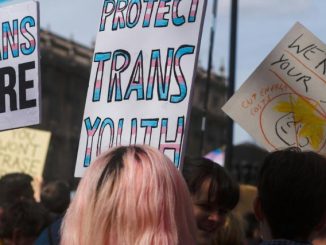
We must not look away: The escalating targeting of trans people

The Department of Health and Human Services’ chilling new regulatory actions seeking to impose a ban on trans healthcare (that HHS refers to as “sex-rejecting procedures”) for youth is the latest manifestation of the Trump administration’s violent, despotic position on trans youth. Per the Associated Press, the goal of the proposals is to: “restrict the use of puberty blockers, hormone therapy and surgical interventions for transgender children — include cutting off federal Medicaid and Medicare funding from hospitals that provide gender-affirming care to children and prohibiting federal Medicaid dollars from being used to fund such procedures.”

Twenty-seven states already have laws restricting or banning trans healthcare for youth. Only 15 have protections in place.

This is an established tactic of this regime: unconstitutionally weaponizing federal funding cuts to bully states and institutions into compliance, forcing them to choose between defending basic human dignity and crucial, often life-saving, funding needed to care for their constituents—a farcical Trump-era trolley problem. Like clockwork, the administration fires up state-sponsored propaganda machines to turn marginalized people against their neighbors through misinformation and fearmongering. The result? When it comes to trans folks, few if any officials hold the line and call his bluff.

As we know, trans healthcare is medically necessary, age-appropriate, and extremely safe and is backed by decades of research and supported by every major medical association (the American Medical Association, the American Psychiatric Association, the American Academy of Pediatrics, the American Academy of Child & Adolescent Psychiatry, the World Medical Association, and the World Health Organization, to name a few). Gender affirming surgical procedures are not new and are widely known to have lower regret rates than elective surgery operations (e.g. plastic surgery, knee replacements) and major non-surgical life decisions (e.g. tattoos or having children).

Every trans adult that you know today is here not by chance but through sheer grit; we were all once trans children and youth who at different points in our lives fought uphill battles against systems and institutions to receive the care that we need to exist in a country that increasingly wishes to see us genocided.

Trump’s anti-trans executive orders received a fair amount of attention, and but they were only the beginning of a steady onslaught. It’s difficult to understate just how bad things are (and how quickly they’re gaining momentum). In the past few weeks alone:

Is my passport still valid if I have an X marker on it, or if it lists a sex other than my sex at birth?
All passports are valid for travel until they expire, are replaced by the applicant, or are invalidated pursuant to federal regulations.

And this is just recent memory — there is so much more. There’s a whole Wikipedia page for Persecution of transgender people under the second Trump administration documenting the phenomenon.

I know many can relate because this is not unique to the trans community, as there are so many communities under threat inside and outside of this empire, but we need you to understand and internalize that trans people in this country, myself included, are under relentless psychic (and sometimes physical) attacks and chronic stress. We are fearing for our lives, the safety and wellbeing of our loved ones, friends, and community — and not just in places like Texas and Florida — but nationwide. Nobody I know is well right now.

This administration knows that if they can’t kill us directly (yet), that if they inundate the public with enough anti-trans rhetoric, they can propagandize and deputize anyone who might wish to cause us harm.

And if not that, they’ll slowly kill us through prolonged exposure to distress: fight or flight hormones, long-term exposure to elevated cortisol levels, and feelings of powerlessness and hopelessness that enable a crisis of mental health that has claimed so many, including some of my loved ones this year.

Trans death is on the rise: A4TE’s Trans Day of Remembrance report highlighted the 58 trans people we lost this year that we know of. Twenty-seven were lost to interpersonal violence (the majority of whom were Black, trans women) and 21 to suicide (61 percent were trans youth ages 15-24). We often say that “the cruelty is the point” — but, more specifically, the cruelty is killing us.

How do we quantify the many ways in which our bodies internalize the trauma of surviving in a country filled with complete strangers who want trans people, and specifically trans women, dead?

I don’t have words of inspiration or encouragement. I simply urge you to not turn away, put on blinders, give in to tunnel vision, or otherwise ignore the coordinated campaign taking place to erase and eradicate trans people from public life. We’ve passed most of the stages of genocide: classification, dehumanization, polarization, discrimination, persecution, and preparation — what’s next?

Lexi Webster is the Digital Engagement Manager at the Center for Constitutional Rights.

Source: CCR

Strugglelalucha256


The Alliance of Sahel States launches unified military force and strengthens regional security

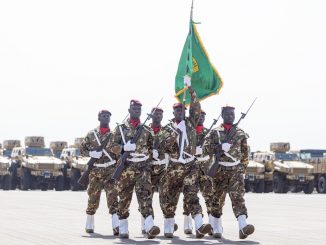
The Alliance of Sahel States (AES) has taken a decisive step toward regional self defense after officially launching a joint military force aimed at combating Islamist insurgency and terrorism across the Sahel. The force was inaugurated on December 20, 2025, during a ceremony held at an air base in Bamako, Mali’s capital.

The ceremony was presided over by Mali’s Transitional President, Head of State, Supreme Chief of the Armed Forces, and outgoing President of the AES, Army General Assimi Goïta. The event was the formal handover of the Unified Force of the AES banner, marking the operationalization of a long-declared commitment by Burkina Faso, Mali, and Niger to jointly secure their territories’ sovereignty.

The newly established force, known as the FU AES, brings together approximately 5,000 troops drawn from the three member states. It is designed to integrate air power, intelligence sharing, and coordinated ground operations to confront armed groups that have destabilized large parts of the Sahel for over a decade.

Addressing the gathering, Malian General Aliou Boï Diarra delivered a deeply symbolic and emotional speech, underscoring the historical and moral significance of the banner. He described the banner as far more than a ceremonial object.

“The standard that you are presenting to the unified AES force represents a memory, a will, an irreversible commitment. It profoundly affirms a certainty now deeply engraved in the hearts of our beloved peoples. This is indeed a truly historic and momentous act,” General Diarra said.

Diarra declared that the banner embodied sacrifice and struggle rather than decoration: “This sacred standard is not merely a decorative symbol. It is the profound and enduring result of precious blood bravely shed, immense courage valiantly embraced, and fundamental truth profoundly rediscovered.”

Paying tribute to the fallen, he added:

“To our cherished martyrs, to all innocent civilians, and to the brave soldiers who have fallen in battle, I humbly pay a solemn and heartfelt tribute beneath the eternal snow. They did not die in vain.”

Mali’s leader, General Goïta, in his own address, described the launch as a historic turning point for the Sahel. He began by saluting the defense leadership and troops of the region.

“On this significant occasion, I would like to extend my sincere congratulations and profoundly salute the exceptional courage, unwavering professionalism, steadfast commitment, and resolute determination of the ministers of defense, the chiefs of general staff, and especially all the brave defense and security forces of the AES area for the remarkable achievements they have made in their relentless fight against armed terrorist groups,” he said.

The AES president recalled that since the Niamey Mutual Initiative (NMI) declaration of July 6, 2024, joint military operations have already been underway, noting that they resulted in the neutralization of several terrorist leaders and the destruction of multiple insurgent sanctuaries.

According to Goïta, “All these positive results were achieved thanks to meticulous planning, timely and effective intelligence sharing, and above all the comprehensive pooling of our collective efforts and resources.”

He further announced key institutional steps consolidating the unified force, including the appointment of a new commander, the establishment of a central command post in the strategic city of Niamey, and the assignment of specialized battalions fully dedicated to AES operations. He stressed that the task ahead would require adaptability to the evolving tactics of armed groups.

“It is now critically important for the new commander not only to anticipate the increasingly complex operating methods of terrorist groups, but above all to resolutely continue this crucial fight to secure the entire Sahel region and ensure lasting peace and stability.”

General Goïta added that the conflict confronting the Sahel is multidimensional, “This war is not only military. It is also political, economic, and informational.”

He identified what he described as three major threats facing Sahelian states: armed terrorist violence, economic terrorism, and media terrorism. In response, he noted that the confederation has adopted a comprehensive strategy that goes beyond battlefield operations.

“We have taken measures to counter these threats not only by establishing this unified force, but also by creating AES Television, AES Radio, and AES print media,” he said, framing these platforms as tools to counter disinformation and psychological warfare.

The military launch follows a series of symbolic and political moves that underline the bloc’s growing autonomy. Earlier in the year, the AES unveiled a new flag, representing the confederation’s shared identity and its intention to redefine political, economic, and security cooperation outside the shadow of French imperialism and Western neoliberal frameworks. Leaders of the bloc have repeatedly criticized past military partnerships with France and other Western powers, arguing that foreign interventions failed to bring peace while undermining national sovereignty.

The AES summit

Mali hosted a summit of the Alliance of Sahel States in the same week, which concluded on Tuesday, December 23. During the summit, Burkina Faso’s leader, Captain Ibrahim Traoré, was appointed as the new head of the Alliance of Sahel States. Following the meeting, the Alliance announced that the summit would be followed by a large-scale military operation.

Earlier this year, the three countries also introduced a joint AES passport, a major step toward deeper integration. This move came after Burkina Faso, Mali, and Niger formally withdrew from the Economic Community of West African States (ECOWAS), an organization they now openly describe as hostile.

The launch of the unified force also takes place amid rising regional tensions. Nigeria and Côte d’Ivoire, both influential ECOWAS members, have been criticized by AES leaders and their supporters for what they see as counter revolutionary postures. In official and popular discourse within the Sahel, these countries are increasingly portrayed as attempting to contain or reverse the radical political shifts unfolding in Bamako, Ouagadougou, and Niamey.

What is clear is that Burkina Faso, Mali, and Niger are charting a new path, one that is redefining power, alliances, and resistance in the heart of West Africa.

Source: Peoples Dispatch

Strugglelalucha256


No to the re-militarization of Puerto Rico

We are now on the threshold of a new year, and for the Puerto Rican people, it means a renewal of our struggle for independence and sovereignty. With renewed vigor, we may resume the battle against the militarization of our archipelago. 

In 2003, we were able to expel the most powerful naval force in the world, the U.S. Navy, after four years of relentless struggle. The entire population, regardless of political beliefs, bravely united, facing beatings and arrests at the hands of U.S. security forces. The people were determined to close the bases that stored deadly weapons and from which the Navy bombed the pristine beaches of our small island of Vieques, sowing pain, disease, and death among its inhabitants. The people said, “Enough!” And they succeeded.

Now, with its new version of the Monroe Doctrine, but with the addition of new military technology, the empire intends to use us again to attack sister nations. Primarily Venezuela, with the main objective of seizing its energy resources. And for that purpose, they are filling our island, Puerto Rico, with troops, weapons, and military vehicles — land, sea, and air — to train their army of death.

And they don’t limit themselves to their military bases, which, unfortunately, although somewhat inactive, are still scattered throughout our territory, but rather they operate wherever they please. Without permission, without apologies, without any regard for our residents. They do it because they can. Because in 2016, in a double jeopardy case in which the issue was whether a person could be tried for the same crime in U.S. federal courts and Puerto Rican courts, the U.S. Supreme Court made it clear that Puerto Rico belongs to but is not part of the U.S. In other words, those who still clung to the fallacy of the Commonwealth as a state in collaboration with the U.S. had to wake up to the reality that we are a classic colony from the last century. Without rights or autonomy. 

So the only way to stop the abuse by the gringos is independence.

Meanwhile, demonstrations are being organized in solidarity with Venezuela while we continue our century-long struggle for definitive liberation.

Gringos out of the Caribbean!
Venezuela must be respected!
Long live a free Puerto Rico!

From Puerto Rico, speaking to Radio Clarín of Colombia, Berta Joubert-Ceci

Strugglelalucha256
https://www.struggle-la-lucha.org/2025/12/