The Main Street recession: how monopoly capital makes workers pay

Shuttered
What Washington calls “growth” looks very different on Main Street, where shops shutter and jobs disappear.

Small businesses are collapsing at the fastest rate since the pandemic. In November alone, small firms eliminated 120,000 jobs — the steepest drop in years. Bankruptcy filings are at their highest level since 2019.

At the same time, the corporations that dominate the U.S. economy are thriving. Tech giants are pouring billions into artificial intelligence, data centers and chip production. The stock market surges while workers face layoffs, shrinking paychecks and rising costs for basic necessities.

Politicians call this a strange “divergence.” But nothing unusual is happening. 

Capitalism churns out far more goods and services than can be sold at a profit, and when capital can no longer realize profit on the goods it produces, the system restores itself by destroying the weakest parts of the economy. The collapse of smaller competitors and the tightening grip of the ruling class aren’t accidents — they’re built into how capitalism works.

Monopoly is not an accident — it’s the system

When a neighborhood restaurant shuts down, or an independent hardware store goes under, it is not simply a personal tragedy. It is capitalism moving in its usual direction. Larger firms negotiate lower prices, shift production across borders, ride out downturns that sink smaller rivals and use their political connections to shape government decisions.

A corporate economist admitted it plainly: “They have more tools in the toolbox.” He was only echoing what Marx showed long ago — competition drives capital into fewer, larger hands.

Every collapse on Main Street strengthens the corporations that already dominate retail, logistics, technology and finance. Capital doesn’t just expand — it concentrates. And when profits tighten in glutted markets, the system clears space for the monopolies by wiping out smaller firms.

The capitalist state picks winners — and it isn’t small business

The Trump administration’s response makes the class character of state policy unmistakable. Commerce Secretary and billionaire financier Howard Lutnick blamed small business failures on immigration restrictions, claiming firms can’t survive without hyper-exploited undocumented labor. When data showed that falling consumer demand — workers not earning enough to sustain small firms — was the real driver, the administration simply ignored it.

The capitalist state does not protect “business in general.” It serves the monopolies, the banks, the tech giants and the energy corporations. It funnels government-funded research and development into private hands, turning collective resources into corporate profit. Trump’s tariffs, tax cuts and attacks on social programs all move wealth upward while claiming to help workers and small business owners. 

Tariffs marketed as “protective” act as taxes on workers. The corporations best positioned to gain are those that can reorganize supply chains, push costs onto workers and their communities, and secure special carve-outs.

Small manufacturers and independent contractors are left to fend for themselves in a system stacked against them.

The AI boom exposes capitalism’s priorities

The artificial intelligence boom shows the system’s direction clearly. Tech monopolies are investing staggering sums into chips, cloud platforms and sprawling data centers. Stock prices rise. Corporate profits climb.

But these projects create remarkably few jobs. A data center costing billions to build and operate may employ only about a hundred people. Capital pours into machinery and infrastructure while less and less is spent on living labor.

For corporations, this is ideal: Fewer workers mean fewer wages and fewer rights to contend with. But stripping labor out of production sharpens capitalism’s basic contradiction. 

Output and productive capacity grow much faster than profitable markets can absorb them. This deepens the crisis of overproduction inherent in the system. Machines cannot create new value; they only transfer the value previously created by workers.

That is why AI’s immediate impact is job elimination. Automation sweeps through retail, logistics, office work, customer service, transportation and media. These jobs do not return in the tech sector. They simply vanish.

Wall Street’s boom has nothing to do with workers’ well-being

The soaring stock market is advertised as proof of economic strength. But the gains flow overwhelmingly to the ruling class. Workers own none of the financial wealth behind this supposed prosperity.

Working-class life tells a different story. Rents and home prices push families out of their communities. Health care premiums climb. Electricity bills rise as data centers devour power. Food assistance is cut. These hardships are not accidental. They are how corporations turn every human need into a source of profit — and force workers to cover the cost. By driving down wages to raise profits, corporations intensify the imbalance that fuels crisis: production outrunning what can be sold for a profit.

This is not inflation driven by “labor shortages.” It is a deliberate upward transfer of wealth.

Instability as a method of rule

Trump’s unpredictable trade policies are often dismissed as incompetence. In reality, they function as political pressure. Tariffs appear, vanish and change without warning. This uncertainty disciplines foreign competitors, unsettles domestic firms and keeps workers on edge.

Businesses hesitate to hire or invest when economic rules shift week to week. Workers brace for layoffs and price hikes. Trump’s interference in federal agencies worsens the instability. When he fired the head of the Bureau of Labor Statistics for releasing accurate but politically inconvenient data, he signaled that economic information must follow political dictates — a hallmark of crisis and reaction.

Crisis and its meaning

The “Main Street recession” is not an exception. It is capitalism in motion. Capital concentrates ownership, sheds workers and reorganizes society around the demands of the ruling class, not those who produce the wealth.

Small business owners occupy an in-between class position. They employ workers but are squeezed by banks, landlords, debt and the monopolies that dominate every sector. Their collapse is one more expression of monopoly capital tightening its grip.

Workers are being told to carry the cost. Layoffs, stagnant wages, rising prices and cuts to social programs are treated as unavoidable, even as corporate profits and stock buybacks hit new highs. The ruling class’s message is simple: The crisis belongs to you; the gains belong to us.

This is the classic pattern of capitalist crisis: production and productive capacity outrunning what can be sold at a profit, and a ruling class that restores itself by wiping out smaller capitals and pushing the burden onto workers.

Strugglelalucha256


65 U.S. cities mobilize against war on Venezuela

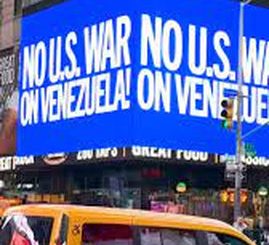
Hundreds of protesters confronted the U.S. military’s Times Square recruiting office on Dec. 6, part of 65 demonstrations across the U.S. demanding: No war on Venezuela!

Among the sponsors of the anti-war mobilization were The People’s Forum; ANSWER Coalition; December 12th Movement; Palestinian Youth Movement; PAL-Awda, Palestinian Assembly for Liberation; Palaver; All-African People’s Revolutionary Party; Party for Socialism and Liberation; and Code Pink.

Many flags of the Bolivarian Republic of Venezuela were carried. The colorful signs and banners — as well as chants — attracted friendly attention from people passing by. Polls show that at least 70% of people in the United States oppose a war against Venezuela.

Speakers in Times Square denounced Trump’s assassination of over 100 people in the Caribbean. The continuing murder on the high seas by the Pentagon is no different than the pirates who kidnapped Africans and enslaved them.

Andre Easton, the socialist candidate in the Bronx’s 15th congressional district, called it a “criminal enterprise. … that has killed people. Shame!” Claudia de la Cruz, Executive Director of the IFCO (Interreligious Foundation for Community Organization), said that Trump and his White House predecessors “have sanctioned the people of Venezuela, stealing from the economy.”

Roger Wareham, a member of the December 12th Movement’s International Secretariat, reminded people how the late Venezuelan President Hugo Chávez provided free heating oil to poor people in both the United States and Haiti.

Speaking for PAL-Awda, Bill Dores pointed out that the U.S. -financed genocide in Gaza and the attacks on Venezuela were the same war.

Former New York State assemblymember and New York City councilperson Charles Barron denounced the killings and the war moves against Venezuela.

Following the rally, 1,000 people marched through the streets. Chants and drums echoed against the skyscrapers.

People on the sidewalks waved in support. Some joined in the chants. Nobody wants a war.

The march ended at Fox News headquarters in Rockefeller Center. The liars at Fox serve the Rockefellers and all the other families of Big Oil.

Venezuela has the largest oil reserves in the world. No blood for oil company profits!

Strugglelalucha256


Louisiana communities organize rapid response to ICE terror raids

Metairie, Louisiana, Dec. 6 — A protest at a Metairie Home Depot demanded answers after ICE agents allegedly struck and possibly killed a pedestrian during a high-speed chase the previous night. While the Jefferson Parish Sheriff’s Office claims the crash was unrelated to Border Patrol, officials have not released evidence. Community activists are calling for JPSO to make surveillance footage public.

Regardless of what JPSO releases, the ICE terror is real. People are living in fear of being snatched up by masked Nazi-like agents in unmarked vehicles. 

Back in September, the U.S. Supreme Court greenlit racial and ethnic profiling by immigration agents, allowing roving patrols to stop people whom they suspect to be immigrants because of their appearance or the language they speak. 

Jefferson Parish — where Metairie is located — is 20% Latine, with some neighborhoods being as high as 54%. Louisiana has also been made into an immigrant detention hub, further enriching the shareholders of the for-profit prison industry.

NOLA1

Speaking at the rally, Deborah with the New Orleans Party for Socialism and Liberation said:

“We’re out here today because we see the violence that ICE — that Border Patrol — is injecting into our community. They’re committing acts of violence and terrorizing our neighbors. 

“People are too afraid to leave their houses out of fear of being targeted, arrested, deported. People are afraid to go to work.

“We saw a few days ago images and videos of workers repairing someone’s roof and had guns pointing at their faces. And they arrested these workers — people who were just showing up to do their job and contribute to society. 

“We’re hearing reports from all over the city — in New Orleans, and in Jefferson Parish, all over Louisiana — of neighborhoods being terrorized. This is an invasion, a racist occupation of our city, and the majority of us reject it.”

On the same day, two other anti-ICE protests happened in New Orleans. And the day before, people came out to confront ICE agents and Border Patrol chief Gregory Bovino in Metairie’s Lafreniere Park, live-streaming everything that the agents were doing. Community members responded to calls posted on social media by Unión Migrante and other organizations, showing that real-time response networks are forming here, just as in other parts of the country. 

The people of Louisiana — especially the workers — have the power to drive ICE out, just like they did in Charlotte, North Carolina. The South is not some place where the people passively accept every injustice inflicted on them by the racist ruling class. This is where the Civil Rights and other movements started. That can happen again.

Strugglelalucha256


Marjorie Taylor Greene isn’t anti-war — she’s a fascist

On Nov. 21, Rep. Marjorie Taylor Greene, a prominent figure in the MAGA movement, announced she will resign from Congress in January 2026. Her decision follows a public split with President Donald Trump, whom she had loudly championed for years.

Since entering Congress, Taylor Greene has been the face of MAGA. She openly identifies as a Christian nationalist and commonly promotes white-supremacist ideas. For years she has accused the left of promoting a fabricated “white genocide” and has compared basic COVID-19 safety measures to Nazi-era euthanization policies.

Her legislative initiatives include fascist insanity like the “Gulf of America Act,” the “Death Penalty for Dealing Fentanyl Act,” and the “Tren de Aragua Border Security Assessment Act” — all grounded in an openly reactionary, anti-immigrant agenda. At every turn, her politics have been defined by xenophobia, anti-communism, and antisemitism.

Taylor Greene has repeatedly pushed the racist lie that immigrant workers “steal American jobs.” In a 2023 appearance on the Charlie Kirk Show, she went so far as to call for U.S. air strikes and ground troops to wage war against Mexican drug cartels — a position she promoted for years. Greene and neo-fascist demagogue Charlie Kirk were political allies until his death, and she even backed legislation to award him a posthumous Medal of Freedom.

To Taylor Greene, the 2020 Black Lives Matter upsurge against racist police violence was simply an “antifa terrorist” plot. Before entering Congress, she promoted the claim that “Jewish bankers” operating space lasers had caused California wildfires. At her most fundamental, Marjorie Taylor Greene is a racist, xenophobic fascist. Her resignation does not change that. 

Even so, a number of progressive commentators and media outlets praised the tone of Greene’s resignation letter. Some even urged her to remain in Congress. A few Democratic Party–aligned publications went further, recasting her as a potential ally in an “anti-Trump resistance.”

It’s true that Greene has criticized U.S. funding for Ukraine, and more recently made limited comments about military aid to Israel. But these statements don’t reflect any principled opposition to war. Greene has a long voting record backing Israel and has consistently supported Trump’s massive Department of War agenda.

Even in these small moments of criticism, Greene’s objection is never to the brutal genocide being carried out against Palestinians. Her problem is the supposed influence of “foreign interests” over Washington — a recycled, antisemitic conspiracy theory claiming that a Zionist or Jewish cabal controls the U.S. government. Such myths have long been used to misdirect working-class anger and shield the real beneficiaries of U.S. imperialism, including billionaires like Musk and Trump.

Greene’s occasional opposition to funding Ukraine or Israel has nothing to do with anti-imperialism or pacifism. She wants U.S. imperialism to remain dominant and is an open advocate of “America First.” What some commentators mistake as progressive gestures are, in fact, entirely consistent with her real politics: the classic fascist blend of nationalism, conspiracy theory, and authoritarianism.

Fascism has always used a façade of “anti-establishment” rhetoric to mobilize a base that ultimately serves the interests of the establishment itself. Hitler railed against “big business,” portraying capitalism as a Jewish conspiracy to rob “real Germans” of their livelihoods. Yet the moment he took power, he wrapped his arms around German steel magnates, U.S. bankers like Prescott Bush, and wealthy automakers across the West. His regime was the hardline, right-wing rule of German and American capital. The same pattern defined Mussolini’s Italy. Like the fascist leaders she echoes, Greene blended conspiracy theory with false anti-elite rhetoric:

“If I am cast aside by MAGA Inc and replaced by Neocons, Big Tech, Military Industrial War Complex, foreign leaders, and the elite donor class that can’t even relate to real Americans, then many common Americans have been cast aside and replaced as well.”

Greene showed no discomfort with the military-industrial complex when she bought thousands of dollars in defense stocks at the outbreak of the Ukraine war. Likewise, her outrage at the “elite donor class” never stopped her from taking hefty contributions from the auto industry, investment firms, and Big Oil in 2024. Nor did she object to Big Tech when she invested heavily in Palantir just days before ICE awarded the company a $30 million contract. Greene is committed to capitalism. She is committed to fascism. And she is committed to militarized police, ICE, and U.S. domination abroad.

The left cannot mistake Greene’s fascist maneuvering for a genuine shift in sentiment. Treating far-right demagogues as “anti-war” or “anti-capitalist” only disorients working people and weakens real opposition to U.S. imperialism. Greene’s resignation reflects a traditional fascist strategy: mobilizing sections of the small-business class — and parts of the working class — against oppressed communities and the Global South.

The movement cannot afford such illusions. Fascist politicians gain strength whenever confusion spreads about their aims. It is not Greene or any faction of the right that offers a way forward, but the independent struggle of the working class against war, racism, and capitalist rule.

Strugglelalucha256


NYC rises for Gaza on Day of Solidarity

Hundreds of people gathered in Manhattan on Nov. 29 to mark the International Day of Solidarity with the Palestinian People. The United Nations established the day in 1977 in recognition of the catastrophe unleashed by the 1947 partition of Palestine — a vote forced through the General Assembly by the Truman administration using open threats and bribery.

That vote paved the way for the Zionist settler state. Within weeks, U.S.-armed Zionist militias launched a campaign of terror that destroyed hundreds of Palestinian villages and drove more than 750,000 people into exile, many into refugee camps. Large numbers were crowded into the small coastal area that would later be known as the Gaza Strip.

This November, after two years of U.S.-funded genocide, the Trump regime forced what amounts to a partition of Gaza itself through the UN Security Council. Nearly 2 million descendants of the refugees of 1948 are imprisoned in a small part of the strip, where they are denied adequate food and medicine and bombed daily by Israel’s U.S.-made warplanes.

The resolution puts the whole strip under the control of a so-called “board of peace” controlled by Donald Trump himself. 

Nycgaza2

Free Palestine! on Fifth Avenue

Dozens of Palestinian flags were waved by protesters along with signs condemning the ongoing U.S.-financed genocide in Gaza and the West Bank. The initial rally — alongside Central Park at 59th Street and Broadway — confronted the surrounding corporate headquarters and the penthouses of the super-rich.

The Palestinian Youth Movement helped initiate the action along with other rallies across the United States, as well as in Toronto, Canada. One of the main demands was an arms embargo on Netanyahu’s murder machine, which has already killed more than 70,000 Palestinians, including tens of thousands of children.

Among the speakers were those from PYM; PAL- Awda; Nodutdol for Korean Community Development; the Party for Socialism and Liberation; and Neturei Karta, an organization of anti-Zionist religious Jews.

Manolo De Los Santos of The People’s Forum held the flag of the Bolivarian Republic of Venezuela as he addressed the crowd. “If you stand with Gaza, you have to stand with Venezuela,” he said, speaking beneath the statue of the enslaver Columbus. “The Venezuelan people have committed the crime that under their feet stands the world’s largest proven reserves of oil. For this crime, Trump and his army of criminals in Washington have threatened war against them.”

People then marched down 59th Street past billionaires’ row and the hotels of the wealthy. Going down Fifth Avenue, they marched in front of Trump Tower and blocks of luxury stores.

Pedestrians on Fifth Avenue shouted support for the marchers and joined in chants of “Free Palestine!”

The final rally was held in front of the reference library on 42nd Street. Palestine will win!

Strugglelalucha256


Trump’s ‘peace plan’ is a war plan for Ukraine

In late 2025, the Trump White House rolled out a new “28-point plan” to end the war in Ukraine. Far from a serious bid for peace, the proposal is designed to lock in NATO’s gains, give the U.S.-backed regime in Kiev time to regroup, and blame Russia when the fighting resumes.

Under Trump’s peace farce, the borders would be frozen along the current line of contact in an immediate ceasefire. Donetsk, Luhansk, and Crimea would officially be recognized as Russian territory. The plan also requires Ukraine to constitutionally commit to not joining NATO. 

At first glance, this seems reasonable. However, the plan also calls for a Ukrainian standing army of 600,000 troops, Ukrainian EU membership, and security guarantees from the United States. In practice, this is NATO by another name. It allows for continued military investment and gives the West an open check for new provocations against Russia.

Russia’s strategic objectives

Washington portrays Russia’s intervention as the first step in a new Napoleonic or Hitler-style march across Europe. Western media depict Putin and the Russian people as power-hungry aggressors bent on rebuilding the czarist empire. This caricature has nothing to do with reality.

Russia is a capitalist state with its own interests, but it did not choose this war in a vacuum. For three decades, NATO has expanded eastward, ringing Russia with bases and missile systems and backing a hard-right regime in Kiev that waged war on the people of Donbass. Russia’s 2022 intervention was, above all, a response to this encirclement.

From the outset, Russian leaders have named four main objectives in Ukraine: to demilitarize the country, to break the power of fascist formations like the Azov battalion, to protect the people of Donetsk and Luhansk from state terror, and to ensure that Ukraine is permanently neutral — not a NATO bridgehead on Russia’s border.

Since the fascist Maidan coup of 2014, Ukraine has received massive Western arms shipments and training. Neo-Nazi formations have been folded into the regular military and security services. The regime has torn down Soviet monuments, outlawed communist organizations, attacked unions, and elevated Nazi collaborator Stepan Bandera as a national hero. For the people of Donbass, this has meant years of shelling, blockade, and repression.

In this context, Russia’s insistence on a neutral Ukraine and real security guarantees is not “imperial ambition,” but a refusal to accept a permanent NATO forward base on its doorstep — a price Russian society has already paid for in lives and hardship.

Why offer a plan Russia cannot accept?

The U.S. proposed this knowing it contained provisions that Russia could never accept. Russian acceptance of this plan would arguably put them in a worse strategic position than when the war began. The Ukrainian army would be over twice the size it was in 2022. The Ukrainian government would remain a hardline right-wing U.S. puppet regime.

While technically keeping Ukraine out of NATO, this provision is in name only. The security guarantees did not exist when this war began. Why would Russia accept a stronger U.S. military alliance with Ukraine? This merely sets up another conflict down the road.

Russia has been clear from the beginning, it cannot allow a NATO military bridgehead on its western border. This peace plan would, de facto, establish such a bridgehead. It also allows for massive U.S. economic investment in Ukraine for rare earth mining, natural gas pipelines, and infrastructure projects. Deepened U.S. control over Ukraine’s economy is not a path to peace; it’s one of the very conditions Russia set out to prevent.

So, why propose this plan when Russia clearly cannot accept it? It’s hard to say exactly, but the most likely reason is rhetorical positioning. Washington puts forward a proposal that appears “reasonable” to a public worn down by war. When Russia refuses, the U.S. blames Moscow as the sole obstacle to peace and uses that propaganda to justify more weapons, more funding, and more escalation.

Now, there is another possibility – even if remote. It is possible that Trump and the generals and billionaires around him truly believe they can enforce this plan on Russia through economic warfare. Russia has faced crippling sanctions since the start of the war, with little impact. Through industrial war mobilization and deepened economic ties with China and the Global South, Russia has consistently circumvented most of the West’s sanctions. 

If there is a belief in Washington that sanctions and financial pressure can force Russia to swallow a plan that cements a hostile Western military outpost on its border, that belief has no basis in reality.

The U.S. doesn’t want peace

The billionaires who control the U.S. economy — and the politicians of both major parties who answer to them — are not seeking peace in Ukraine. They are seeking profit and strategic advantage. The war has been a bonanza for Northrop Grumman, General Dynamics, Raytheon, Lockheed Martin, and the rest of the military-industrial complex. They have made fortunes shipping weapons into Ukraine, and they see no reason to stop.

They are interested in war, profit, and the isolation of their primary target: China.

Even if the West believes Trump’s plan can be implemented, peace isn’t the goal. Any cessation of hostilities under this framework would be temporary — a breather for the U.S. and its proxy in Kiev to regroup, rearm, and prepare for the next round of confrontation with Russia.

The U.S. does not want to cool global tensions or bring Russia back into its fold. The U.S. billionaires want to make money, and they have made loads of it by waging war on Russia. Needing a break to regroup is not the same as a genuine desire for peace. Peace is explicitly opposed to the economic interests of the entire military-industrial complex.

These defense magnates and the U.S. government hope that by draining Russia through endless war, they can eventually force regime change and deprive China of a key strategic ally. Imperialism will do whatever it takes to maintain its dominance and increase its profits, even if that means promoting phony peace plans.


Strugglelalucha256


Garbage in the White House, Somali resistance in Minneapolis

Trump’s racist tirade and ICE raids aim to terrorize an oppressed community — and send a warning to the whole working class.

On Dec. 2, President Donald Trump used a White House Cabinet meeting to spit out a stream of racist abuse against Somali immigrants in Minnesota. He called Somalis “garbage,” claimed they “contribute nothing,” sneered that their country “stinks,” and said they should “go back to where they came from.”

This was not just another ugly performance for the cameras. The next day, Immigration and Customs Enforcement launched a major operation in the Twin Cities, sending teams of agents into Minneapolis–St. Paul to hunt undocumented Somalis. At the same time, the administration moved to strip Temporary Protected Status from Somalis and to freeze immigration and naturalization from Somalia and 18 other mostly African and Muslim-majority countries.

Trump’s rant was the political cover for a concrete state offensive. His words from the Cabinet table were connected by a straight line to the raid teams pounding on Somali families’ doors before dawn.

Scapegoating an oppressed nationality

Trump’s attack on Somalis is not just personal bigotry. It’s part of how the ruling class governs in a time of crisis.

Somalis in Minnesota are overwhelmingly working class. They drive cabs and trucks, work in warehouses and nursing homes, study in schools and colleges, and struggle with low wages, high rents, and debt like other workers. Many came as refugees from wars, invasions, and economic strangulation in which U.S. imperialism played a direct role.

Now, the same system that helped wreck their homeland brands them a “security threat” and a drain on public resources. Trump falsely links them to fraud scandals, crime, and “terrorism” – pure inventions used to justify raids, detentions, and deportations. The message to the rest of the working class is: Blame Somali immigrants, not Wall Street, not the Pentagon, not the billionaires.

National oppression under capitalism is not just a matter of prejudice. It is built into the way the state, the labor market, and the borders are organized. When the ruling class whips up hatred against an oppressed nationality, it is deflecting anger over unemployment and poverty, testing how far it can go in criminalizing a whole people, and refining methods of repression that can later be used against anyone who resists.

The targeting of Somalis, Afghans, and immigrants from 19 countries lays bare the cynicism of imperialism. People fleeing wars, occupations, and sanctions created by Washington arrive here, only to find themselves treated as suspect, surveilled, and disposable.

Toward second-class citizenship by nationality

What makes this moment especially dangerous is the way Trump’s campaign reaches beyond raids and deportations to the question of citizenship itself.

The administration is talking openly about “reverse migration,” mass removals, and re-examining the status of people who already have papers. Agencies are ordered to comb through applications, green cards, and naturalizations from people born in the targeted countries. At the same time, Trump threatens a “denaturalization campaign” that would strip citizenship from those the government decides should never have become citizens in the first place.

In practice, this means building a system in which some people’s citizenship is permanent and others’ is conditional. A white immigrant from an imperialist ally is treated as a full “American.” A Black Muslim from Somalia or a refugee from Afghanistan is treated as always on probation, always one accusation away from being thrown out.

On paper, this country has seen formal citizenship rights expand over time. In reality, Black people, Indigenous people, migrants and refugees have always faced second-class status enforced by police, prisons, and the border regime. What Trump is doing now is trying to codify that inequality into new laws and procedures that divide the population into tiers, with oppressed nationalities forced to live under the constant threat of losing everything.

This is a warning. A state that claims the power to strip Somalis of their status today will claim the power to strip others tomorrow, as the crisis of the system deepens and resistance grows.

Omar and the community push back

The Somali community in Minnesota has not met this campaign with silence.

Rep. Ilhan Omar, herself a Somali refugee who became one of the most visible progressive figures in Congress, has called Trump’s language racist and Islamophobic and has made it clear that this is not a “personal feud.” She insists that his words are meant to pave the way for raids and deportations, and she has demanded investigations into the political use of ICE as a weapon against her community.

On the ground, Somali-led organizations, mosque networks, and youth groups in Minneapolis–St. Paul have moved into emergency defense. They are holding know-your-rights trainings, setting up hotlines so families can report ICE activity, and organizing legal teams to respond rapidly when people are detained. Community leaders stress that most Somalis in the Twin Cities are citizens or legal residents, and they warn that Trump’s blanket portrayal of them as criminal outsiders invites vigilante violence as well as state repression.

Neighbors are urged to document ICE raids, refuse cooperation with “voluntary” searches, and spread the word that people do not have to open their doors without a warrant signed by a judge. This is community self-defense in embryo: the first steps toward making it practically impossible for agents to operate in silence and secrecy.

Local and state officials have been forced, by pressure from below, to take a stand. Officials in Minneapolis and St. Paul have reaffirmed policies limiting local cooperation with ICE. The governor and attorney general have spoken publicly in defense of the Somali community and against discriminatory targeting. Schools, clinics, and social service agencies are being pushed to adopt “safe space” protocols so that ICE cannot freely turn everyday places into hunting grounds for deportations.

These measures are limited, and they are fragile. But they show that when a community organizes itself and fights back, it can force concessions even from officials who would otherwise stand aside.

From defense to street-level resistance

Alongside legal work and policy fights, people are turning to the streets.

In Somali neighborhoods and in downtown Minneapolis, multiracial crowds have gathered for rallies and vigils. Somali youth, Black community organizers, Latine immigrant groups, students, and faith leaders have come together to denounce the raids and the racist campaign behind them. They connect Trump’s slurs against Somalis to the broader system of police terror, border violence, and mass incarceration that targets oppressed peoples across the country.

At Minneapolis–St. Paul International Airport, demonstrators have confronted deportation flights head on. Protesters have marched to the terminals used by charter companies that service ICE, demanding that airlines and contractors cancel removal flights. Union members have joined these actions, raising the question that goes to the heart of the matter: Will workers use their power to refuse to fuel, maintain, or handle planes used to haul families away in chains?

Here we see the beginnings of a front that can make the state think twice: organized labor linked to the self-defense of an oppressed community. When workers at airports, warehouses, rail yards, or docks say, “We will not move deportation cargo, we will not help ICE,” they begin to turn abstract solidarity into concrete power.

Strugglelalucha256


Feeding the Pentagon, starving the poor: The class politics of the 2025 U.S. budget

In late 2025, after the long federal shutdown, the new federal budget said more about the real priorities of the billionaire class and the politicians who serve them than any campaign speech or press conference.

On one side, the Pentagon’s budget now tops $1 trillion, with tens of billions more handed to war contractors for ships, missiles and the F-35 fighter jet. On the other side, food assistance and health care for tens of millions of poor and working-class people are being cut or threatened. This is not a mistake or bad planning. It is class policy.

A “K-shaped” economy means up for the rich, down for the poor

Economists have given today’s economy a polite name: “K-shaped.” In plain language, that means the line goes up for the rich and down for the poor.

The numbers make the divide plain. Over the last year, retailers in low-income neighborhoods saw their sales grow by only 0.2%, which is basically standing still. Stores in middle- and high-income areas saw sales grow by 2.5% over the same period. When businesses that serve poor communities are barely hanging on while those in wealthier areas keep expanding, that is a map of class inequality.

Surveys of business owners tell a similar story. Stores that serve low-income communities report deep pessimism about the future. Owners who serve wealthier customers are much more hopeful.

Yet on Dec. 2, Treasury Secretary Scott Bessent went on TV to promise “substantial tax refunds” to the wealthy and “real wage increases” for the upper layers in 2026. At the same time, Goldman Sachs predicts “continued underperformance in low-end spending” — in other words, continued weakness in the parts of the economy where poor and working-class people live.

These are not just mixed signals. This is how the system talks to us. Officials and experts are brought out to say that things are getting better even when their own data shows that life is getting harder for working people.

A budget written for the rich and for war

The clearest picture of class priorities is in the budget itself.

During the recent government shutdown crisis, the Senate voted 77–20 to approve a $32 billion increase for the Pentagon. That came on top of an already approved $156 billion increase. Together, these hikes pushed U.S. military spending past $1 trillion a year.

Much of this money will flow straight into the coffers of a handful of giant corporations that build weapons and military equipment. Many of these contracts are “cost-plus,” which means the companies are guaranteed a profit. The more they spend, the more they make.

At the same time, Congress refused to extend subsidies under the Affordable Care Act that would cost around $35 billion for a year — a small fraction of the Pentagon increase. Without those subsidies, health insurance premiums for millions of people will double or worse. In combination with cuts to Medicaid, as many as 17 million people are expected to lose health coverage altogether.

When a government can easily find hundreds of billions of dollars for war but claims it cannot afford basic health care, that is not hypocrisy. It is a clear sign of whose interests it serves. The Pentagon budget acts as a massive public support system for the biggest banks and corporations. It guarantees profits for military contractors, pumps government money into private hands, backs up U.S. corporate power around the world, and finances research that later becomes private technology and private profit.

Programs that help poor and working-class people do not enrich the wealthy in the same way. That is why they are always on the chopping block.

Turning hunger into a weapon

The Trump administration has escalated its attack on the Supplemental Nutrition Assistance Program, or SNAP, which helps more than 42 million people buy food.

Officials are now threatening to withhold federal SNAP administrative funds from 22 states led by Democratic governors. Agriculture Secretary Brooke Rollins claims these states are refusing to share data needed to fight “rampant fraud,” and says that $24 million per day is supposedly being lost to fraud and errors — about $9 billion a year.

But federal data undercuts this scare campaign. A 2023 report by the U.S. Department of Agriculture found that only 0.1% of households on SNAP were even referred for fraud review. Policy expert Katie Bergh of the Center on Budget and Policy Priorities has said clearly that intentional fraud by recipients is rare.

So the question becomes: If fraud is rare, why the loud campaign about “rampant abuse”?

The answer is political. Accusations of fraud are used to demonize poor people, justify cuts to lifesaving programs, and distract from the real transfer of wealth. While officials wag their fingers at a tiny number of supposed cheaters on SNAP, billions of dollars flow without question to Pentagon contractors and the corporations behind them.

This is not the first time hunger has been used as leverage. During the recent six-week government shutdown, the administration carried out an unprecedented 13-day halt in SNAP benefit distribution. Families went without money for food while the government defended the stoppage in court all the way to the Supreme Court.

Shifting the burden onto states and working people

New rules in the budget shift the cost of SNAP away from the federal government and dump it onto the states. Beginning Oct. 1, 2026, states will be required to pay 75% of SNAP administrative costs, up from the current 50–50 split. States will also have to pay part of the benefits themselves if their “administrative error rate” is judged too high.

In practice, this means that poorer states will be squeezed the hardest. State officials will claim they “have no choice” but to restrict access, reduce benefits, or limit eligibility. Some states may threaten to pull out of SNAP entirely.

This is a familiar pattern. When capitalism runs into crisis, those at the top use every tool available to push the costs downward onto workers, poor people and local governments, while keeping profits flowing upward.

The human impact is enormous. SNAP serves about 42 million people. That includes around 14 million children and large numbers of older adults and disabled people. Households that include at least one disabled person experience food insecurity at about twice the rate of those without. For them, delays and cuts are not abstract policy questions. They are a question of whether there will be enough to eat.

Economic warfare on working-class communities

SNAP is not only a lifeline for families. It also supports local economies.

Every dollar in SNAP benefits generates about $1.80 in economic activity. When people use SNAP at grocery stores, that money circulates in the community. It helps pay workers’ wages, covers rent and utilities for local businesses, and supports farms and food suppliers.

In some rural communities, SNAP purchases can make up 20% of a store’s sales. If those benefits are cut back or interrupted, small grocery stores in these areas may be forced to close. When that happens, entire communities can lose their only nearby place to buy food.

While this program that supports poor and working-class communities is being choked off, the Pentagon budget — which concentrates money in a small circle of giant military corporations — is expanding rapidly. That is not a sign of economic confusion. It is a sign of deliberate class policy.

Crystal FitzSimons of the Food Research and Action Center summed up the reality: “The problem isn’t that we have 42 million people on SNAP. The problem is that we have 42 million people who live in poverty.”

The system is doing what it was built to do

A $1 trillion Pentagon budget and 42 million people relying on food assistance are not separate, accidental problems. They come from the same system.

On one side, the U.S. state pours money into weapons, war and corporate profits to keep a crisis-ridden capitalist order afloat. On the other side, that order produces mass poverty, hunger and insecurity, then blames the victims and cuts the programs that keep them alive.

The question is not whether this is sustainable. It is not. The real question is whether working-class resistance — from food justice campaigns and union struggles to antiwar organizing — can come together as a political force that challenges not only each round of cuts, but the whole system that makes those cuts “necessary.”

That is the choice in front of us: a future of permanent war and permanent hunger, or a fight for a society where budgets are written to meet human needs, not to guarantee profits for war corporations and the rich.


Strugglelalucha256


International workers build ‘people’s embargo’ against Israeli genocide

EmbargoMovement

From the docks of Oakland to the ports of Morocco, from Italian logistics hubs to South African coal mines, an international movement is taking shape to do what governments have refused: Cut off the flow of weapons and fuel sustaining Israel’s assault on Gaza.

On Nov. 22, labor organizers, Palestinian activists, and anti-war campaigners from six countries gathered online to launch the People’s Embargo for Palestine — a coordinated effort to leverage workers’ power at critical chokepoints in the global military supply chain. The webinar brought together a veteran of the anti-apartheid struggle with a new generation of organizers who have notched concrete victories over the past year.

“Anything that comes off of a ship is handled by longshore workers, some of the most critical workers of the global economy,” said Clarence Thomas, a retired member of the International Longshore and Warehouse Union (ILWU) Local 10 and veteran of the 1980s campaign against South African apartheid. “The commerce of the world is handled through dock worker power.”

That power is now being mobilized for Palestine. And it’s working.

Maersk retreats, Zim expelled

Members of The Palestinian Youth Movement (PYM) reported that their research unit has been tracking military cargo shipments to Israel, publishing detailed reports on shipping routes, weapons components, and fuel supplies. According to Kaleem Hawa, speaking for PYM, their “Mask Off Maersk” campaign has successfully forced the Danish shipping giant to reroute vessels away from Spanish and French ports, where workers have refused to load Israel-bound cargo.

“Maersk has become afraid to bring arms through these ports, and they have rerouted to avoid targeting,” Hawa reported. The campaign also claims a breakthrough: Maersk announced this past summer it would cease carrying imports or exports from Israeli settlements in the occupied West Bank — “marking the first time an international shipping company has enacted a de facto sanction of Israel,” according to PYM.

In Oakland, the Israeli shipping line Zim has been entirely expelled from the Bay Area since 2014, when the Arab Resource and Organizing Center (AROC) organized a “Block the Boat” action. ILWU Local 10 members refused to cross community picket lines for four days, and the Zim line never returned. In the case of the ILWU Local 10 members, it has meant a loss of wages, because longshore workers make their money unloading and loading ships.

“There has not been any complaints from any longshoremen that I know about missing money from the Zim line vessels that no longer come into the port,” Thomas said, addressing the reality that solidarity comes at a cost. He said: “Many years ago trade union activist Baldemar Velasquez said, ‘Solidarity is not an empty slogan.’ It means that you give something up.”

Learning from the anti-apartheid movement

The parallels to the 1980s campaign against South African apartheid are deliberate. The same ILWU locals that refused to handle South African cargo then are organizing against Israeli shipments now. The same combination of labor action, divestment, and sanctions is being deployed.

Thomas recalled that in 1988, the ILWU International Convention officially condemned Israel’s treatment of Palestinians, calling it “state-sponsored terrorism” and quoting Israeli journalist Amos Elon’s description of Gaza as “the Soweto of the state of Israel.”

But he was candid about setbacks. In 2024, a resolution written by ILWU Local 10 calling for the entire union to refuse military cargo to Israel “was voted down resoundingly,” Thomas acknowledged. “It was a very discouraging moment.” The union’s membership, he noted, has changed significantly over the decades.

“Each generation has to fight its own battles,” he said. “I’m almost 80 years old, and I’m not giving up.”

From South Africa, Noxolo Bhengu of COSATU (Congress of South African Trade Unions) brought a message of solidarity rooted in her country’s history. “During apartheid, it was workers in the ports of Oakland, in Liverpool, in Australia, in the Nordic countries — workers just like you who refused to handle South African goods,” she said. “From Cape Town to Cairo, their courage saved lives, and their actions built pressure when governments were too timid.”

COSATU, which represents government workers, teachers, nurses, mine workers, and transport workers, is now pushing to end South African coal exports to Israel. South Africa supplies the majority of Israel’s thermal coal, according to organizers, making this campaign potentially one of “the most substantial blows against the genocide to date,” as Hawa put it.

Italy: Millions strike against complicity

In Italy, the logistics union S.I. COBAS has led strikes and blockades targeting companies involved in the military supply chain. Alessandro Zedra, the Milan coordinator, described their approach: “For S.I. COBAS, embargo work is not only about policy proposals but about building real power from below.”

The actions face “heavy repression — investigation, trials, and police violence,” Zedra said, but they prove “that workers can play a direct role in disrupting the machinery of war.”

On Oct. 3, Italy saw what organizers describe as a historic convergence: Grassroots unions coordinated with CGIL, the country’s largest union federation, to call a general strike. According to Mariam of Giovani Palestinesi Italia (GPI), millions of workers across the country walked out against the Italian government’s complicity in the Gaza genocide.

“These dates are especially important because they were not only demonstrations but also strikes,” Mariam said. The actions included blockades at ports and airports between Sept. 22 and Oct. 3. Another round of national strikes and mobilizations was scheduled for Nov. 28-29.

The Italian movement is also contesting a new financial bill that would massively increase military spending as Italy participates in what organizers call “the plan for rearmament of Europe.”

Tracking the supply chain: From Poland to Oakland

The People’s Embargo relies on detailed research to identify vulnerable points in the weapons supply chain. PYM’s methodology involves tracking shipments before they’re loaded, mapping manufacturing sites, and understanding specific routes.

Recent reports have exposed surprising nodes in the network. According to PYM, 90% of TNT imported by the United States — where domestic production has ceased — comes from Poland. “This TNT is used in the bombs that are dropped on Gaza,” Hawa said.

In Canada, the government claims it suspended some weapons export licenses to Israel. But a PYM report released the week of the webinar documented how Canadian manufacturers exploit a loophole, shipping components to the United States which then forwards them to Israel.

Shatha M., speaking for Arms Embargo Now Canada, described how the report “triggered a national crisis” with senators referencing it in Parliament and a bill now proposed to close the loophole. When PYM exposed a shipment of antennas used in Elbit drones, the suppliers suspended future shipments to Elbit “within days,” she reported.

“What started as a scattered demand is now the shared political baseline across the country because the movement made it so,” Shatha said.

Perhaps most surprising was Oakland’s role. Despite the city’s progressive reputation and history of solidarity with Palestine, PYM research revealed that Oakland’s civilian airport has been one of the most frequent departure points for F-35 components destined for Israel.

“These shipments have flown through the Oakland airport multiple times per week, almost every single week this year,” said Voulette, a PYM organizer coordinating the Oakland People’s Arms Embargo campaign. According to the research, 96% of the cargo went directly to Nevatim Air Base, where Israel’s entire F-35 fleet is stationed.

The shipments included bomb release units for 2,000-pound bunker-busters, guidance systems, and targeting components — all transported through civilian infrastructure. The revelation was particularly shocking because Oakland passed one of the first ceasefire resolutions in November 2023, and ILWU Local 10 has long refused to handle Israeli military cargo at the maritime port.

“FedEx, Lockheed Martin, and these genocide profiteers have been exploiting our city and our public infrastructure to facilitate a genocide that we never consented to,” Voulette said. The campaign has built a coalition of over 30 organizations and won endorsement from the Alameda Labor Council, representing 135,000 workers and 135 unions.

Morocco: Organizing under repression

In Morocco, the campaign against weapons shipments operates under difficult conditions. Ismail Lghazaoui of BDS Morocco was imprisoned for his role in organizing protests against ships carrying military cargo.

“It was the first protest on-site back in Nov. 13 to 16, and we were only five people,” Lghazaoui said. “I was imprisoned but released two months later, and suddenly we have more mobilizing.”

The movement has since identified at least 25 ships carrying military goods — from F-35 parts to maintenance components — through Moroccan ports. Dock workers in Tangier and Casablanca have contributed by halting boats or refusing to work them.

Morocco’s complicity is particularly painful, Lghazaoui noted, because the country has historical and cultural ties to Palestine and signed onto international resolutions condemning the genocide. The Moroccan government came under pressure after ships denied docking in Spain were rerouted to Moroccan ports instead.

“UN rapporteur Francesca Albanese [has said] that Morocco is complicit in genocide by allowing or harboring ships that make deliveries to the Zionist regime,” Lghazaoui reported. The campaign is now pursuing legal complaints and coordinating with movements across the Mediterranean to halt ships wherever they appear.

The movement also honors Sion Assidoun, a founder of BDS Morocco, who led early campaigns against the Zim shipping line, which led the Zim campaign back in 2010 or 2011. It helped identify how complicit the Zim company is and helped Tunisia to actually remove Zim completely from its itinerary. Assidoun recently passed away. “We will take the torch and continue forward,” Lghazaoui said.

A strategy for the long haul

The People’s Embargo represents a shift in strategy for the Palestine solidarity movement. Rather than focusing solely on mass demonstrations or lobbying governments, organizers are targeting the material infrastructure of genocide — the ships, ports, airports, and factories that keep weapons flowing.

“This has been a logistics genocide, full spectrum and integrated, the result of a networked world of war profiteers and resource extraction working together against oppressed peoples globally,” Hawa argued in opening the webinar. “Close study of supply chains can teach us as people’s movements what the ruling classes have not yet admitted, or hope never to admit.”

The approach requires detailed research, international coordination, and the willingness of workers to take action at personal sacrifice. It faces government repression in multiple countries. And it operates in the context of a ceasefire agreement that organizers view as fundamentally unjust — what Hawa described as “the theft and primitive accumulation of almost half of Gaza, with the rest left to siege and concentration camp conditions.”

But the victories, while modest in scale, demonstrate what’s possible when workers exercise power at chokepoints in the global economy. Zim was expelled from Oakland. Maersk rerouting from European ports. Canadian suppliers are suspending shipments after exposure. Italian workers are shutting down logistics for days.

“The military-industrial complex operates across borders,” said S.I. COBAS organizer Zedra. “Therefore, our resistance must also be transnational.”

As Voulette put it in closing the Oakland section of the webinar: “History is not just something that is done to us. It is something that we can shape through our actions.”

How to support the campaigns

Palestinian Youth Movement (PYM)
Website: https://www.palestinianyouthmovement.com

Arms Embargo Now (Canada)
Website: https://armsembargonow.ca

BDS Morocco Boycott, Divestment & Sanctions Movement
Website: https://www.bdsmovement.net
Statement honoring Sion Assidoun: https://www.bdsmovement.net/Rest-In-Power-Sion

Congress of South African Trade Unions
Website: https://mediadon.co.za

Oakland People’s Arms Embargo
Website: https://armsembargonow.com

Arab Resource and Organizing Center (AROC)
Website: https://www.araborganizing.org

S.I. Cobas Sindacato Intercategoriale Lavoratori Organizzati
Website: https://sicobas.org

Giovani Palestinesi Italia (GPI)
Instagram: https://www.instagram.com/giovanipalestinesi.it/?hl=en

Italian General Confederation of Labour
Website: https://www.cgil.it

Million Worker March Movement, Mobilizing in Our Own
Website: https://millionworkermarch.com

Editor’s Note: This article is based on a Nov. 22 webinar launching the People’s Embargo for Palestine. Organizations provided the URLs listed above; readers should verify current campaign information directly with these groups.

Strugglelalucha256


It’s about making trans people unemployable

Trans

By now, you may have seen the story making the rounds. It’s about a University of Oklahoma student named Samantha Fulnecky who received a zero on a psychology essay, filed a discrimination complaint, and got her trans graduate instructor placed on administrative leave. Conservative media have framed this as religious persecution: a brave Christian student punished for citing the Bible. The governor of Oklahoma has weighed in. Libs of TikTok has amplified it to hundreds of thousands of people. Turning Point USA is demanding that the instructor be fired.

But if you actually read the essay — which TPUSA helpfully published — you’ll find something different than what’s being advertised.

The assignment asked students to write a 650-word reaction paper responding to an article about “Gender Typicality, Peer Relations, and Mental Health.” The rubric was straightforward: 10 points for showing a clear tie to the assigned article, 10 points for providing a thoughtful reaction rather than a summary, and 5 points for clarity of writing. Students were given suggested approaches like discussing whether the topic was worthy of study, applying the findings to their own experiences, or offering alternate interpretations of the researchers’ conclusions.

Fulnecky’s essay mentions the article exactly once: “The article discussed peers using teasing as a way to enforce gender norms.” That’s it. The remaining words are a sermon about what God wants for gender roles, culminating in the claim that “society pushing the lie that there are multiple genders and everyone should be whatever they want to be is demonic and severely harms American youth.”

She also calls her classmates “cowardly” for not sharing her views.

This is not a good essay. Not because of the religious content — you can absolutely bring religious perspectives into academic work — but because she just. … didn’t do the assignment. A reaction paper is supposed to react to something. Fulnecky barely acknowledged the source material existed before launching into a position statement that would have worked just as well (or poorly) for any article tangentially related to gender.

The graduate instructor, Mel Curth, gave remarkably patient feedback. “Please note that I am not deducting points because you have certain beliefs,” Curth wrote, “but instead I am deducting point[s] for you posting a reaction paper that does not answer the questions for this assignment, contradicts itself, heavily uses personal ideology over empirical evidence in a scientific class, and is at times offensive.”

Curth explicitly told Fulnecky that it’s “perfectly fine to believe” normative gender roles are beneficial. The problem was the logical contradictions (arguing people aren’t pressured into gender roles while simultaneously arguing religious pressure to conform is good), the lack of engagement with actual course material, and, yes, calling a group of people “demonic” in an academic paper.

“I encourage all students to question or challenge the course material with other empirical findings or testable hypotheses,” Curth wrote, “but using your own personal beliefs to argue against the findings of not only this article, but the findings of countless articles across psychology, biology, sociology, etc. is not best practice.”

Another instructor, Megan Waldron, who teaches a different section of the same course, backed the grade. She found it “concerning” that Fulnecky didn’t view bullying or teasing as a bad thing, and noted that “your paper directly and harshly criticizes your peers and their opinions.”

None of this matters to the people amplifying this story. The essay is a prop. The point is that Curth is trans.

The quiet part out loud 

Fulnecky’s mother, Kristi Fulnecky, a lawyer who defended a number of Jan. 6 rioters, has been busy on social media. She’s been retweeting posts that say things like “If you claim to be a transgender — you should be banned from working in any school. Transgenderism is a mental illness,” and “Individuals who identify as trans should be automatically disqualified from holding any position as teacher or professor.”

To that last one — a post explicitly calling for employment discrimination against all trans people — Kristi Fulnecky replied: “Agreed! Proud of my daughter!”

This is the tell. The family isn’t arguing that this particular grading decision was wrong. They’re celebrating their daughter’s role in a broader campaign to make trans people unemployable. The discrimination complaint, the media tour, the outrage — it’s all in service of the goal stated plainly in the posts Kristi Fulnecky is boosting: Trans people should not be allowed to work in education.

Chloe Cole, a detransitioner who’s built a lucrative career as an anti-trans activist, demanded that the university be defunded until Curth is fired. TPUSA’s post about the incident included the line: “We should not be letting mentally ill professors around students.”

The playbook here is familiar. Find a trans person in a position of minor institutional authority. Manufacture or amplify a confrontation. Blast it through the conservative media ecosystem until it becomes national news. Watch as institutions capitulate.

It works. Curth — who, by the way, had reportedly just received an Outstanding Graduate Teaching Award from OU’s Department of Psychology — is now on administrative leave. The university’s statement emphasized its commitment to “protecting every student’s right to express sincerely held religious beliefs,” which is a fascinating way to describe giving a bad grade to a bad essay.

The targeting system

The throughline in all of these cases is Libs of TikTok, an account run by Chaya Raichik that has become a kind of targeting system for the anti-trans movement. Raichik reposts content from LGBTQ people and their allies, often with mocking commentary, and her millions of followers do the rest.

Schools, children’s hospitals, and libraries featured on the account have reported receiving bomb threats. Teachers have resigned or been fired. Medical providers have faced death threats. The pattern is consistent enough that critics have called Raichik a “stochastic terrorist” — someone who publicly demonizes people in ways that predictably inspire supporters to commit violence, while maintaining plausible deniability about any specific act.

The case studies are piling up.

Remember Dylan Mulvaney? In April 2023, she posted a single sponsored Instagram video featuring a personalized Bud Light can. That was it. That was the whole controversy — a trans woman appeared in a beer ad. … to her own audience. The resulting harassment campaign left her scared to leave her house, ridiculed in public, and followed. Kid Rock filmed himself shooting cases of Bud Light with a rifle. The company’s sales tanked, and Bud Light never publicly stood by her.

“For a company to hire a trans person and then not publicly stand by them is worse, in my opinion, than not hiring a trans person at all,” Mulvaney said. “It gives customers permission to be as transphobic and hateful as they want.”

Or take what happened at Texas A&M just a few months ago. In September, a Republican state representative named Brian Harrison posted a 23-part social media thread with the headline: “CAUGHT ON TAPE. TEXAS A&M STUDENT KICKED OUT OF CLASS AFTER OBJECTING TO TRANSGENDER INDOCTRINATION.” The post got millions of views. Within days, the professor — Melissa McCoul, who had taught the same children’s literature course at A&M at least 12 times since 2018 — was fired. The dean and department head were removed from their positions. And then the university president resigned.

A faculty committee later unanimously ruled that “the summary dismissal of Dr. McCoul was not justified” and that the university failed to follow proper procedures. But by then the damage was done. The message had been sent.

This is Oklahoma

It’s worth noting that this is all happening in Oklahoma, a state that has become something of a laboratory for anti-trans policy. Governor Kevin Stitt has signed bills barring trans students from using bathrooms consistent with their gender identity, banning gender-affirming care for minors, prohibiting nonbinary gender markers on IDs, and blocking trans girls from girls’ sports.

In January 2024, the state’s then-Superintendent of Public Instruction, Ryan Walters, appointed Raichik, who has no connection to the state and does not live there, to the Oklahoma Department of Education’s Library Media Advisory Committee — giving the person behind Libs of TikTok an official role in deciding what books Oklahoma students can read.

A month later, a 16-year-old nonbinary student named Nex Benedict died. Just one day after being beaten in a school bathroom at Owasso High School — the same district where, in 2022, a teacher “greatly admired” by Nex had resigned after being targeted by a Libs of TikTok post. According to Nex’s mother, the bullying had started after Stitt signed the bathroom bill.

Nex’s death was ultimately ruled a suicide. The climate in which Nex lived — a climate shaped by the very people now celebrating Samantha Fulnecky as a “warrior of Christ” — is not incidental to this story.

What this is actually about 

There’s a reason Riley Gaines, a middling college swimmer who once tied for fifth place in an NCAA championship, now has a full-time career as an anti-trans activist with a nonprofit, speaking fees, and congressional testimony.

In 2023, the Leadership Institute — a nearly 50-year-old nonprofit that trains conservative activists and counts Mitch McConnell and Mike Pence among its alumni — launched the Riley Gaines Center with the goal of “protecting women’s sports.” The organization is funded by the Charles Koch Foundation and serves as a member of Project 2025’s advisory board. The Dick & Betsy DeVos Family Foundation donated $100,000 to the center in 2023. In the first five months of its existence, the Leadership Institute paid Gaines more than $126,000 as director.

She now has a podcast on Fox Nation, a merchandise line, two book deals, and has testified in or appeared with politicians in at least 21 states. Ron DeSantis’s presidential campaign paid her nearly $12,000 for travel and consulting. She stood next to Donald Trump when he signed his executive order banning trans women from sports. This is what a fifth-place finish buys you if you’re willing to make hating trans people your full-time job.

And it’s not just Gaines. The infrastructure is growing. The Independent Council on Women’s Sports (ICONS), a nonprofit that describes itself as “not political,” went from about $100,000 in revenue in 2022 to over $1 million by 2024. ICONS is now funding three major lawsuits against the NCAA, arguing that trans athletes should be banned from women’s sports entirely. Chloe Cole, the 20-year-old detransitioner who demanded OU defund itself over the Fulnecky essay, testified in court that she earns upwards of $200,000 annually for opposing gender-affirming care — money that flows through speaking engagements, donations, and her employment with the far-right organization Do No Harm.

This is an industry now. There are jobs, salaries, speaker bureaus, and career tracks. The right is always looking for new faces to put on this movement — young, photogenic people who can be positioned as victims of trans overreach. The detransitioner who regrets her surgery. The swimmer who tied with a trans woman. The Christian student whose essay got a bad grade.

Samantha Fulnecky fits the profile. She’s a college student. She’s Christian. She wrote about her faith and got a bad grade from a trans instructor. It doesn’t matter that the essay was genuinely bad, that two instructors agreed on the assessment, that the feedback was professional and patient, or that the grading rubric supports the decision. The narrative writes itself: trans professor fails Christian student for quoting the Bible.

What Fulnecky’s mother is saying out loud — that trans people shouldn’t be allowed to teach at all — is what this movement actually wants. The individual controversies are just vehicles to get there. Each one is designed to make an example of a trans person, to signal to every other trans person in education or health care or any public-facing role: This could happen to you. Keep your head down. Better yet, leave.

The next one

Here’s what’s going to happen next.

Somewhere, right now, a trans person is teaching a class, or coaching a team, or working at a library, or providing health care. They’re doing their job. They’re probably good at it. And at some point, someone is going to have a problem with them. Maybe a parent, maybe a student, maybe a coworker. The problem won’t really be about job performance. The problem will be that they’re trans.

That person, or someone connected to them, will take their grievance to social media. If they’re lucky, Libs of TikTok will pick it up. Or Turning Point. Or one of the other accounts that have built massive followings by turning trans people into content. The post will frame the trans person as a predator, or a groomer, or a bully, or a tyrant. It won’t matter what actually happened. The framing is the point.

Then the calls will start. To the school board, to the administration, to the HR department. Local news will cover the “controversy.” A state legislator will demand an investigation. The institution, desperate to make the problem go away, will put the trans person on leave. Maybe they’ll be fired outright. Maybe they’ll resign because the harassment makes it impossible to do their job. Either way, they’re gone.

And then the person who started it all will go on Fox News. They’ll get a GoFundMe. Maybe a speaking gig at a conservative conference. If the story is big enough, if it goes viral enough, they might get something more. A podcast. A book deal. A center with their name on it.

This is not a guess. This is a pattern. We’ve watched it happen over and over again, and we will keep watching it happen until the institutions that capitulate to these campaigns start recognizing them for what they are: coordinated attempts to purge trans people from public life, dressed up as individual controversies.

Oklahoma University had a choice. They could have looked at the essay, looked at the rubric, looked at the feedback, and said: this grade was justified. They could have noted that two instructors independently reached the same conclusion. They could have pointed out that Curth had just won a teaching award. They could have said, simply, that they don’t put instructors on leave for doing their jobs.

Instead, they folded. They issued a statement about protecting religious expression, as if the issue were ever about that. They gave the machine exactly what it wanted: another trans person removed from a position of authority, another signal sent to every other trans person watching.

The next time this happens, and there will be a next time, the institution will face the same choice. Most of them will make the same decision Oklahoma did. They’ll calculate that the cost of standing firm is higher than the cost of sacrificing one employee. They’ll tell themselves it’s just one case, one person, one controversy. They won’t see, or won’t admit, that each capitulation makes the next one easier.

Mel Curth did nothing wrong. They graded a bad essay honestly and gave thoughtful feedback that any reasonable educator would recognize as fair. For that, she’s on administrative leave, her name is circulating through right-wing media as the latest villain, and her career may never recover.

The essay isn’t the point. Curth is the point. And the point after Curth will be someone else — another trans teacher, another trans health care provider, another trans person who made the mistake of existing in public while the machine was looking for a new target.

That’s what this has always been about.

Parker Molloy is the writer of The Present Age newsletter.


Strugglelalucha256
https://www.struggle-la-lucha.org/2025/12/page/5/