AI for the people? How China’s AI development challenges U.S. big tech

The following text is based on a talk given by Gary Wilson at the “Deep Seek and the Challenge to U.S. Technological Hegemony” webinar on Feb. 16, hosted by the Friends of Socialist China and the International Manifesto Group. The full webinar is available on YouTube at

Let’s start with the U.S. tech war against China. Some call it a New Cold War. A problem with that term is there’s no guarantee it will stay “cold.” There is a major U.S. military buildup around China, with a U.S. Army drone warfare Green Beret unit now stationed in Taiwan, and aircraft carriers from the U.S., France and Japan conducting “war games” in the South China Sea.

Nancy Pelosi’s visit to Taiwan in 2022, the first high-level U.S. official visit since the 1990s, was a provocation challenging China’s sovereignty, that was backed with an unprecedented escalation in U.S. military activity in the region that came dangerously close to sparking a “hot war.” 

Anyway, whatever we call it, a New Cold War, an economic war, trade war or tech war — the U.S. has made China’s science and technology a target. The U.S. has imposed strict limits on technology transfers, restricted access to semiconductors, sanctioned Chinese tech companies, blocked academic and research collaboration, and halted many scientific exchanges.

This tech war didn’t just start. It really began in 2011 with Barack Obama’s Pivot to Asia, a Cold War-style containment policy. The Pivot to Asia was primarily a military operation but also introduced export controls on advanced technologies. 

As a military operation, it involved moving 60% of U.S. naval forces into the Asia-Pacific region, militarily surrounding China, and expanding military exercises like RIMPAC, the world’s largest naval war games.

The tech war escalated significantly during Donald Trump’s first presidency with trade restrictions and sanctions on Chinese firms, including Huawei and ZTE. 

Then, with Joe Biden, even more severe restrictions were imposed. The U.S. also expanded military and technology alliances against China, like AUKUS – some call it the Asian NATO — and the U.S.-Japan-South Korea trilateral pact.

In the first few days of his second term, Trump implemented more aggressive export controls. The media is calling it a “tough on China” policy. Just two days ago, Trump’s State Department removed the statement “We do not support Taiwan independence” from its U.S. relations with Taiwan web page. The Financial Times reported this week that Trump has threatened China with 60% tariffs and he may ban Nvidia semiconductors.

Why are semiconductors such a big deal?

Semiconductors are the foundation of modern technology — enabling the functionality of virtually every device and system we use every day. For example, since the 1970s, every automobile has required semiconductors in order to operate. 

Biden’s Commerce Secretary said – and I quote – “the goal is to limit China’s ‘access to advanced semiconductors that could fuel breakthroughs in artificial intelligence and sophisticated computers.’”

Despite the restrictions, China has been making significant strides in semiconductor technology. Huawei is developing advanced high-powered chips, and the performance of its new Ascend 910C compares to Nvidia’s H20, the GPU used to build DeepSeek R1. While DeepSeek was trained on the Nvidia H20, it used the Ascend 910C for inference, the process where a trained AI model draws conclusions.

This brings us to DeepSeek AI, a large language model or LLM built in China that equals the best in the U.S. 

It was developed using less data and computing power and at a fraction of the cost of U.S. models.

With its release it profoundly became clear that the U.S. is not winning its tech war against China. Instead of falling behind, China showed its strength.

It’s not just DeepSeek — China has built entire high-tech industries that now dominate globally:

  • Huawei is the world’s leading 5G telecommunications company.
  • BYD is the world’s top electric vehicle maker.
  • CATL leads in advanced battery technology.
  • Tongwei is tops in solar power.
  • DJI is the world’s largest commercial drone maker.

U.S. restrictions haven’t stopped China

When the Pivot to Asia began in 2011, the U.S. led in 60 of 64 key technologies globally. 

By 2022, China had surpassed the U.S. in 52 of those technologies.

For years, AI was dominated by U.S. companies like Google and Microsoft’s OpenAI, but today, China is leading in AI development and applications, not just with DeepSeek. Why?

Unlike the U.S., which focuses on AI for corporate profits, China sees AI as a driver of economic transformation — a way to modernize its economy.

Lenin famously said that communism is Soviet power plus electrification. Today, he might say, high tech.

In 2017, China released its “Next Generation Artificial Intelligence Development Plan.” That plan is based on building open-source platforms to coordinate hardware, software and cloud-based systems. 

This approach is similar to how technologies like the Internet’s World Wide Web or Linux (the operating system for servers, cloud computing, mobile devices, and supercomputers) became dominant: They were built on open source standards that allowed for worldwide collaboration and innovation.

Accessible open-source AI can overtake the for-profit proprietary tech monopolies. 

One of DeepSeek AI’s most groundbreaking features is its ability to run on low-cost hardware, including laptops, even smartphones — making AI more accessible than ever before. This decentralized approach contrasts with how AI is used in the U.S., where companies like Amazon and Walmart deploy closed AI systems for worker monitoring, automation and robotics while using it to cut wages and suppress union organizing.

The potential benefits of treating AI as a public utility are immense. Rather than displacing workers or driving inequality, open-access AI can be used for equitable planning of production and distribution.

China is already leveraging AI for public services

China has embraced smart cities, using AI to optimize urban management, traffic control, waste management, and energy efficiency. There are over 500 smart city pilot projects in China right now. AI is also being used in health care, education, and disaster response:

  • Health care: AI is being used to predict disease outbreaks, optimize hospital resource allocation, and provide personalized health care.
  • Education: AI is being used to enhance personalized learning and helps bridge urban-rural education gap.
  • Disaster Preparedness: AI assists in flood prediction, earthquake monitoring, and emergency response coordination.

Despite U.S. restrictions, China continues to advance in AI, semiconductors, and other high-tech industries. China is shaping the future of global technology, and AI could play a key role in the economic planning of production and services to meet people’s needs. 

Gary Wilson is a long-time socialist agitator currently working as co-editor of Struggle-La Lucha. A retired computer network engineer, Gary is the author of a couple of guides to the Linux operating system and, more recently, “War & Lenin in the 21st Century.”

Strugglelalucha256


Community drives out Nazis in Ohio

On Feb. 7, a hundred residents of Lincoln Heights, Ohio, drove out a dozen armed neo-Nazis waving swastika flags. This community is about 70 miles from Springfield, where Silicon Valley darling JD Vance and Elon Musk whipped up hysteria with lies about Haitian immigrants. Nazi groups also marched in Springfield before Vance’s big lie. 

Idavox, a local reporter on It’s Going Down, said: 

“A neo-Nazi group, ‘Hate Club,’ showed up on Friday (2/7/25) armed with long guns and flying swastika flags on an I-75 overpass in the Lincoln Heights neighborhood, just north of Cincinnati. They showed up in the wrong damn neighborhood.

“A historically Black community, Lincoln Heights is home to generations of residents committed to a strong sense of community and culture, impactful civic engagement, and self-organization – especially as the first self-governing Black community north of the Mason-Dixon line. So when armed neo-Nazis showed up here there wasn’t even a question they were going to get run out. Within minutes of arriving on the I-75 overpass, neo-Nazi group ‘hate club’ got sent packing as community members, angry that Nazis had come armed to terrorize them in their own neighborhood, showed up to tell the fash they weren’t having any of it.”

The community members were able to seize one of the Nazi flags and burn it. 

Police protecting neo-Nazis

WKRC Cincinnati reports that at a town hall on Feb. 10, residents confronted representatives of the Hamilton County Sheriff’s Office – the only police agency to attend, even though officers from Lockland and Evandale were involved in the incident. Residents pointed out that footage from the event shows the police protecting the Nazis and helping them escape. 

A resident at the town hall said:

“Again, this is super unfortunate because when it comes to African Americans, you guys arrest first and ask questions later. And I just feel like you guys did not do that in that moment.” 

In the days following the incident, residents formed armed patrols to ensure the community’s safety. This is amid ongoing threats. WPCO 9 News reports that four days after the rally on Feb. 11, a flyer was circulated “that used a racial slur and declared a ‘race war.’” 

These developments show that organized people can push back the shock troops emboldened by the fascist MAGA movement. We cannot rely on the police or courts to do it. 

Threats from fascist groups are only going to get worse. On Feb. 14, JD Vance met with the successor to the German Nazi Party in Munich, the Alternative for Germany (Alternative für Deutschland, AfD). Elon Musk appeared virtually at an AfD rally before the Feb. 23 German elections.

Billionaires and MAGA

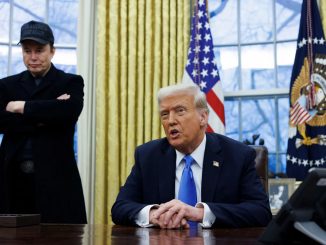
Unelected Musk is the world’s richest oligarch and is currently looting the U.S. people’s money in preparation for more tax cuts for billionaires. This is the money of the working people, wealth created through our labor. The convergence of the MAGA movement and Silicon Valley – combined with this naked plunder – shows exactly what the Trump phenomenon is about. It’s a big anti-worker swindle. The neo-Nazis on the ground are an essential part of it because the terror they instill is supposed to paralyze the people while the rich hang us out to dry. 

But the people in Lincoln Heights aren’t bowing down to King Donald and his Co-regent, Elon Musk, and neither should the rest of us!

Strugglelalucha256


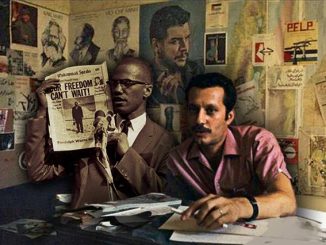
Malcolm X and Ghassan Kanafani: Revolutionary thinkers across worlds

Malcolm X and Ghassan Kanafani: Two revolutionary thinkers and writers who preached the same message, worlds away. Both men understood the complexity of the style of capitalism that had been unleashed on Black and Brown communities specifically. 

They both understood how it was a war of extermination guided by fanatical religious white supremacy in the names of Zionism and Manifest Destiny/American Exceptionalism. Both imperialistic projects aim for the enslavement and even erasure of, as Malcolm X would say, “All of Dark Mankind.” Internationally, the victims suffer the same fates through loss of homes, land, jobs, lives, history, and culture. 

Colonial oppression in Palestine

In his analysis of the 1936-39 Revolution in Palestine (against the British colonial government and Zionist land theft), Ghassan Kanafani writes that “Every plot of land the Jews buy becomes alien to the Arabs as if it were severed from the body of Palestine and transferred to another country.” This feeling of tremendous loss was aided by the British Mandate government’s passing of laws specifically to aid Zionist settlement of the land owned by the native Palestinian population. 

The Mandate allowed the expansion of Zionist militias and gangs along with the creation of Jewish-only work projects to continue to divide the population and keep money in the pockets of those friendly with white supremacy. 

Malcolm X on systemic oppression in the U.S.

Likewise, Malcolm X explains this great trick that is being played on Black Americans by the U.S. government, where even after the Civil War, Emancipation, and the Civil Rights movement, Black Americans are still being killed and incarcerated en masse, denied jobs and education and attacked by white racist mobs chasing them off their land. Malcolm X sees that in America, the Black man has always been a beggar – a beggar politically, economically, socially, and in education due to colonialism. 

For the Black population in America, we have felt the similar severing of the land here. We were banned from National Parks and hunted in Sundown towns. 1921 saw the Black-dominated town of Tulsa, Oklahoma, bombed off the map and its inhabitants butchered for 48 hours. In its place now sits a deeply racist white-dominated city firmly in the hands of white supremacists. 

The shift toward revolution

Ghassan Kanafani emphasizes this cultural shift within his people that took place leading up to the 1936 Revolution. Ghassan Khanafani says that, “abject poverty, crushing oppression, and centuries of class and national repression combined to establish the ‘perfect system’ for defeatism, fatalism, and political quietism that was reflected in the most widespread popular proverbs and sayings.” 

In this shift, old terms and slang that referenced helplessness and defeat were replaced with sayings of justice and to stand up and do something about the situation they saw themselves in. Calls to arms became commonplace, and the desire to lash out and physically strike your enemy was beginning to be acted on. Malcolm X mentions how, in 1965, people were starting to see that “the Black man has ceased to turn the other cheek, that he has ceased to be nonviolent, that he has ceased to feel that he must be confined to all these restraints that are put upon him by white society in struggling for what white society says he was supposed to have had a hundred years ago.” 

A shared struggle against empire

In Palestine, Kanafani writes how “the rage pouring out simultaneously against the trinity of enemies –  Zionist colonization, the British Mandate, and Arab reactionary forces locally and regionally – grew in tandem with the deepening of the crisis.” The crisis for the Palestinians was the same for Black Americans then as it is now. Malcolm X puts it like this:

“It’s a problem anytime the United States can come up with so many alibis not to get involved in Mississippi and to get involved in the Congo and involved in Asia … the government is incapable of taking the kind of action necessary to solve the problem of Black people in this country. But at the same time she has her nose stuck into the problems of others everywhere else.” 

Revolution the only path to liberation

This feeling describes both the American government and the British Empire’s unwillingness to slow the spread of white supremacy because they depended on it. Both men preached revolution to smash this feeling and to regain control of the land from the absentee landlords and reclaim the ability to exist and work freely as human beings on the land; they understood that it was death or total liberation by any means necessary.

Strugglelalucha256


The demise of USAID: Few regrets in Latin America

“Take your money with you,” said Colombia’s President Gustavo Petro, when told about Trump’s plans to cut aid to Latin America, “it’s poison.”

USAID (US Agency for International Development) spends around $2 billion annually in Latin America, which is only 5% of its global budget. The temporarily closed-down agency’s future looks bleak, while reactions to its money being cut have been wide-ranging. Only a few were as strong as Petro’s and many condemned the move. For example, WOLA (the Washington Office on Latin America), a leading “liberal” think tank which routinely runs cover for Washington’s regime-change efforts, called it Trump’s “America Last” policy.

While USAID does some good – such as removing landmines in Vietnam (themselves a product of US wrongdoing) – as an agency of the world’s hegemon, its fundamental role is aligned with projecting US world dominance.

Not unexpectedly, the corporate media have largely come to the rescue of USAID. They try to give the impression that they are mainly concerned that some countries would be badly effected by its loss. In fact, the follow-the-flag media understand that USAID is part of the imperial toolkit.

Both the Los Angles Times and Bloomberg suggested that USAID’s shutdown would “open the door” to China. The Associated Press described the withdrawal of aid as a “huge setback” for the region; the BBC echoed these sentiments. The NYT and other mainstream media point to the irony that many of its programs help stem outward migration from Latin America, an issue which is otherwise at the top of Trump’s agenda.

Weaponization of humanitarian aid

The corporate media, not surprisingly, give a one-sided picture. It’s true, of course, that an aspect of USAID’s work is humanitarian. But, as Jeffrey Sachs explained, “true, and urgent, humanitarian aid” was only one element in a larger “soft power” strategy. From its inception, USAID’s mission was more than humanitarian.

A year after President John Kennedy created USAID in 1961, he told its directors that “as we do not want to send American troops to a great many areas where freedom may be under attack, we send you.”

The organization is “an instrument of [US] foreign policy …a completely politicized institution,” According to Sachs. It has mainly benefitted US allies as with the program to limit hurricane damage in Central America, cited by the NYT which omits Nicaragua, hit by two devasting storms in 2020. Needless to say, Nicaragua is not a US ally.

Although USAID provides about 42% of all humanitarian aid globally, the Quixote Center reports that most of the funds are spent on delivering US-produced food supplies or on paying US contractors, rather than helping local markets and encouraging local providers. The Quixote Center argues that “a review of USAID is needed,” though not the type of review which Trump or Elon Musk probably have in mind.

Indeed, the dumping of subsidized US food products undermines the recipient country’s own agriculturalists. While hunger may be assuaged in the short-term, the long-term effect is to create dependency, which is the implicit purpose of such aid in the first place. In short, the US globally does not promote independence but seeks to enmesh countries in perpetual relations of dependence.

Regime change

The third and most controversial element, identified by Sachs, is that USAID has become a “deep state institution,” which explicitly promotes regime change. He notes that it encourages so-called “color revolutions” or coups, aimed at replacing governments that fail to serve US interests.

The State Department is sometimes quite open about this. When a would-be ambassador to Nicaragua was questioned by the US Senate in July 2022, he made clear that he would work with USAID-supported groups both within and outside the country who are opposed to Nicaragua’s government. It is hardly surprising that Nicaragua refused to accept his appointment. The progressive government has since closed down groups receiving regime-change funding.

The history of US regime-change efforts in Latin America is a long one, much of it attributable to covert operations by the CIA. But since 1990, USAID and associated bodies like the National Endowment for Democracy have come to play a huge role. For example, they have spent at least $300 million since 1990 in trying to undermine the Cuban Revolution.

Regime-change efforts in Cuba involved a vast organization known as Creative Associates International(CREA), later shown by Alan MacLeod to be directing similar USAID programs across Latin America. Currently, CREA is working in Honduras whose progressive government is under considerable pressure from the US government. Yet CREA is only one of 25 contractors which, in 2024, earned sums ranging from $32 million to a whopping $1.56 billion.

Culture wars

USAID’s regime-change work often foster ostensibly non-political cultural, artistic, gender-based or educational NGOs whose real agenda is to inculcate anti-government or pro-US attitudes. Examples proliferate.

In Cuba, USAID infiltrated the hip-hop scene, attempted to create a local version of Twitter, and recruited youngsters from Costa Rica, Peru and Venezuela to go to Cuba to run a particularly inept project that risked putting them in jail.

In Venezuela, USAID began work after the unsuccessful US-backed coup attempt against President Hugo Chávez in 2002. By 2007, it was supporting 360 groups, some of them overtly training potential “democratic leaders.” The Venezuelan rock band Rawayana, recent winners of a Grammy, are funded by USAID to convey pro-opposition messages in their public appearances.

In Nicaragua, after the Sandinista government returned to power in 2007, USAID set up training programs, reaching up to 5,000 young people. Many of those who were trained then joined in a coup attempt in 2018.

Astroturf human rights and media organizations

Another tactic is to undermine political leaders seen as US enemies. In 2004, USAID funded 379 Bolivian organizations with the aim of “reinforcing regional governments” and weakening the progressive national government.

It did similar work in Venezuela, including in 2007 holding a conference with 50 local mayors to discuss “decentralisation” and creating “popular networks” to oppose President Chávez and, later, President Nicolás Maduro. USAID even expended $116 million supporting the self-declared “interim presidency” of Juan Guaidó.

In a similar vein, Nicaragua was the subject of a USAID program intended to attack the credibility of its 2021 election. Likewise, after the election of Xiomara Castro in Honduras, USAID set up a democratic governance program to “hold the government to account.”

Creating or sustaining compliant “human rights” organizations is also a key part of USAID’s work. Of the $400 million it spends in Colombia each year, half goes to such bodies. In Venezuela, where USAID spends $200 million annually, part goes to opposition-focused “human rights” groups such as Provea. USAID funded all three of the opposition-focused “human rights” groups in Nicaragua, before they were closed down, and now probably supports them in exile, in Costa Rica.

Finally, USAID creates or sustains opposition media which, as Sachs put it, “spring up on demand” when a government is targeted to be overthrown. Reporters without Frontiers (RSF, by its French initials) reported: “Trump’s foreign aid freeze throws journalism around the world into chaos.” It revealed that USAID was funding over 6,200 journalists across 707 media outlets. In the run-up to the 2018 coup attempt in Nicaragua, USAID was supporting all the key opposition media outlets.

RSF, while purporting to support “independent journalism,” itself is funded by the National Endowment for Democracy (NED), George Soros’s Open Society Foundations, and the European Union – hardly neutral parties.

Few regrets

This is why there may be few regrets about the demise of USAID in Latin America among governments beleaguered by the US. Indeed, opposition groups in Venezuela and Nicaragua admit they are in “crisis” following the cuts to their funding.

Even Trump’s ally President Nayib Bukele is skeptical about USAID: “While marketed as support for development, democracy, and human rights, the majority of these funds are funneled into opposition groups, NGOs with political agendas, and destabilizing movements.”

The evidence that USAID has weaponized so-called humanitarian aid is incontestable. Yet, according to US Secretary of State Marco Rubio, it is the Latin American countries that Washington has targeted for regime change – Nicaragua, Cuba, and Venezuela – who are “enemies of humanity.” In response, Venezuelan Foreign Minister Yvan Gil retorted that the “only enemies of humanity are those who, with their war machinery and abuse, have spent decades sowing chaos and misery in half the world.”

Regrettably, USAID has been a contributor to this abuse, rather than opposing it. While temporarily shuttered at USAID, the empire’s regime-change mission will with near certainty continue, though in other and perhaps less overt forms.

Nicaragua-based John Perry is with the Nicaragua Solidarity Coalition and writes for the London Review of Books, FAIR, and CovertAction. Roger D. Harris is with the Task Force on the Americas, the US Peace Council, and the Venezuela Solidarity Network.

Source: Resumen Latinoamericano – English

Strugglelalucha256


USAID: the Empire reinvents itself

Elon Musk, sworn in as Secretary for Government Efficiency, thundered: “The time has come for USAID to die.” His words resonated like the harbinger of an imminent storm. Shortly afterwards, Donald Trump, on his first day back in the White House, ordered the suspension of almost all US foreign assistance for three months, especially that of the US Agency for International Development (USAID).

The closure was abrupt and forceful: dozens of senior officials were sent on forced leave, thousands of contractors were laid off and the USAID headquarters in Washington closed its doors without warning. As if they had never existed, the agency’s website and its X account disappeared from the digital world, leaving behind a vacuum that was soon filled with speculation and rumors on the Internet.

The confusion increased when, from the Dominican Republic and at the end of his first tour of Latin America, the Secretary of State, Marco Rubio, announced that his department would take over the functions that the agency had been performing until then. Rubio, appointed as acting administrator of USAID, assured that Washington’s foreign aid would continue, but with one condition: “It must make sense and align with our national interests.”

This move, which some want to see as a mere administrative restructuring, is a strategic shift that augurs profound changes in US foreign policy aimed at greater efficiency and new repressive measures. The aim is not to park the objectives of the agency recognized as a front for the CIA, but quite the opposite, to adjust them and perfect the empire’s system of international influence. As Dr. Vergerus would say in Igmar Bergman’s film Das schlangenei, “anyone can see the future here, it’s like a snake’s egg. Through the thin membrane you can make out a reptile already formed”.

USAID, born in 1961 during the Cold War, had become a colossus of interference, covert operations and destabilization networks. While doing charity work in some countries, they tried to dismantle any opposition to Washington’s allies. It has also been the scene of scandalous cases of corruption. Without going any further, last week the Federal Bureau of Investigation revealed that it is investigating Juan Guaidó, the short-lived interim president of Venezuela, and his ambassador in Washington, Carlos Vecchio, for embezzling one billion dollars, managed between 2018 and 2020 under the guise of “humanitarian aid”. These funds, channeled through USAID, vanished in a whirlwind of opaque spending.

In the case of Cuba, the covert program known as ZunZuneo, the failed “Cuban Twitter,” is notorious. Funded by USAID and designed to stoke “dissidence” on the island. Millions of dollars were funneled into shell companies, while violating the legislation of several countries, including that of the US.

Trump, pragmatic and ruthless, seems to have understood that USAID’s covert operations are not only ineffective on the ground, but also difficult to control and counterproductive. It is foreseeable that the millions of dollars that fed these failed operations will be redirected towards more subtle and effective channels. For example, they will cease to flow to Spanish-language propaganda websites operating out of Florida which, although useful for spreading toxic content against Havana on social networks, lack the legitimacy and reach necessary to reach US public opinion.

It is likely that the money will be allocated to media and spokespersons with greater weight in US and international public opinion. It will also go to the coffers of private contractors, as analysts warn. In a sort of “Gattopardism”, the “regime change” programs do not disappear with USAID’s subordination to the State Department, but rather the immoralities of the interventionist and anti-democratic methodologies of USAID and other international “aid” agencies will deepen the control of the “deep state” and the austerity policies of the new Trump administration.

The closure of USAID and the transfer of its functions to the State Department are more than a bureaucratic maneuver. It is the prelude to a more aggressive foreign policy, more aligned with the interests of the ultra-conservative sectors of the US, and much more refined in communicational and political terms. In this new scenario, the manipulation of information and the use of funds to promote ideological agendas could intensify, with direct consequences in countries such as Cuba, where the media battle is just another aspect of the economic, financial and diplomatic blockade that the island has endured for decades.

Thus, the disappearance of USAID marks the end of an era, but also the beginning of a new phase in US interference, more sophisticated, more covert and, perhaps, more dangerous.

Source: La Jornada, translation Resumen Latinoamericano – English

Strugglelalucha256


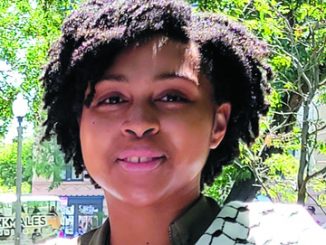
Apryle Everly: What Malcolm X means to me

We share this piece to commemorate the revolutionary leader Malcolm X, who was assassinated 60 years ago on Feb. 21, 1965. 

Malcolm X, to me, embodies one of the many great examples of what it means to be a communist. Malcolm would not have always considered himself a communist earlier on in his life. His own considerations, as many know, were far more religious in nature, with Black power at its center. After being forced out of the Nation of Islam for pointing out precisely how the struggles of all Black people across the world are interconnected and for voicing his principled opposition to American imperialism, he solidified his communist turning point.

In some twisted sense of irony, Henry Kissinger said it best, “Disciplined communists see everything in relation to the class struggle.” Malcolm’s view on the crisis facing Black Americans was initially that Black people needed separate services, communities, education, health care, etc. to uplift poor Black communities. As Malcolm saw that not all the needs of Black people were being met through the measures taken by the Nation of Islam, he began the journey of joining class struggle politics with Black Power. 

Malcolm understood that class and race intersect in such a way that the material change needed to bring millions of Black Americans out of poverty would never come to fruition simply by banding together to create exclusively Black services. Rather, an overhaul of the current power structure would have to occur. That means overthrowing the ruling class – the capitalists, those who own the means of production. This was true in Malcolm’s time, and it is still true in our own. 

As we all understand, the ruling class knows no specific skin color or nationality. Malcolm put it best when he said: “It doesn’t mean that we’re anti-white, but it does mean we’re anti-exploitation, we’re anti-degradation, we’re anti-oppression.”

 Being against these very actions goes to the heart of the problem because if we own nothing, then the very goal of extinguishing poverty becomes infinitely harder to accomplish. From my perspective, communities organizing together and pooling resources is more of the beginning step in the larger revolution, not the ultimate goal. Joining this concept with the reality that many African nations were simultaneously undergoing their own independence movements, he understood that tactics at home had to change. It is at the crux of this understanding that explains what a communist aims to do: provide material changes for their community. 

Lastly, I want to add that Malcolm showed great wisdom. For the movement today, I want us all to embrace the ability to reflect on current methods that we utilize to organize and continue to learn from others who are in the movement with us. Malcolm was in community with many revolutionaries around the world, many of whom gave him ideas for some of the speeches and actions he was involved in. I wish for the communist movement in the U.S. to continue to change tactics when the old ones no longer serve their intended purpose. I think Malcolm’s life shows us that tactile change is one of the most disciplined decisions we, as revolutionaries, can make.  

Apryle Everly is a youth activist and organizer with the People’s Power Assembly and Struggle for Socialism. They contributed to the new book The U.S. War drive against China – What it means for workers.

Strugglelalucha256


Federal workers’ unions hold the line against Trump

Attack on federal workers is an attack on all workers

The Trump-Musk axis has never been shy about the fact they wanted to bust up federal organized labor. 

The Trump campaign made a lot of promises about the sort of hell they would unleash on federal workers and their unions. Since the inauguration, the Trump administration has followed through on that promise to the private sector and his fascist base. 

Since he took office, Trump has issued executive orders aimed at slashing federal jobs and weakening federal labor unions. These orders have included a return-to-work order, a hiring freeze, a deferred resignation program, and the restoration of policies that make it far easier for federal agencies to terminate career workers. 

Targeting organized labor

If the previous Trump administration’s labor policy is any indication, this is just the beginning. All unions in the federal sector are braced for executive orders and regulations that will remove local unions from their offices on government property, ban the deduction of union dues from paychecks, and severely limit the amount of duty time given to union officials to represent their fellow workers. 

With these attacks, Trump, and the ruling class more broadly, hope to break any organization that would see federal money spent on its workers or social programs rather than war or kickbacks for billionaires. 

Not only will the federal government save money to invest in the war machine, the cumulative effect of these policies is to function as a de-facto massive layoff. With this level of layoff, the labor market will be flooded with experienced workers in various professions. It’s not as if the U.S. jobs market is booming currently. For months, more and more people have had trouble finding a job. Capitalist economists have described it as a “low fire low hire” job market. This translates: “We know nobody can find a job but we don’t want to admit that we are also laying people off.” 

Since December, Meta, Microsoft, Workday, Amazon, Intel, JP Morgan, and Chevron have announced layoffs. Now, the federal government, via Elon Musk’s DOGE, will join the fray through literal layoffs, disciplinary removals, and employee buyouts called “deferred resignations.” 

Federal unions fight back

With a flooded labor market and a federal policy offensive against public and private sector unions, the Trump administration escalates its variety of fascism and looks to completely break what is left of organized labor in the federal sector and beyond. All there is left for the working class to do is fight back. 

To that end, federal sector unions have attempted to challenge this wave of Trump policies in the courts and to some extent, in the street. The American Federation of Government Employees, the largest federal union, has already joined or initiated lawsuits against Trump and DOGE for these policies. Further, AFGE has issued guidance that its members should refuse any deferred resignation offer. The slogan on this issue has become “hold the line.” AFGE represents over 600,000 workers across the country, with 300,000 members in the federal sector alone. 

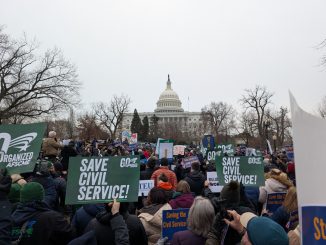
On Feb. 11, AFGE held a rally on Capitol Hill to confront Trump and Musk’s attacks on federal workers. Representatives from American Postal Workers, AFSCME, Unite Here, the Office of Professional Employees International Union, and the United Steelworkers all joined AFGE in this demonstration of several hundred unionized workers. 

The message was clear: All workers must stand up to these attacks from Trump and Musk. This means organizing and defending their contracts to the letter. While the leadership of AFGE is heavily entrenched in the Democratic Party, this should not stop the progressive movement from coming to the defense of it as a workers’ organization. 

Trump wouldn’t be attacking AFGE and the other federal sector unions if they didn’t curb the efforts of the ruling class to some extent. In this period of rising fascism, it is important to stand by unions as they face this assault. An organized workforce is never a bad thing. 

AFGE staff union fights for their rights

With that said, support for AFGE’s mission cannot stop the workers who are employed at AFGE as staff from asserting their own rights as a union and as workers. In fact, the reason union staff are asserting their contractual rights and challenging AFGE upper management’s hypocrisy is exactly so they can better assist the AFGE members in their fight against Trump and Musk. 

Since the November election, AFGE’s upper management has increased its attack on its own workforce, which is represented by OPEIU Local 2. AFGE management has forced its employees back into the office 80% of the time after bargaining for 50% of the time. Further, the AFGE national president has continued to threaten layoffs and buyouts against its own staff. In general, AFGE’s upper management and human resources have worked to scuttle the attempts of their staff union to represent the workers. 

Due to these attacks, OPEIU Local 2 has mobilized to challenge these attacks on their contract. The day before AFGE’s rally, AFGE’s staff held a picket line where they demanded that AFGE “fight Trump not its staff” and to “respect the contract.” Well over 100 people showed up to the informational picket, including AFGE staff and members. 

While these AFGE attacks on their staff are hypocritical and anti-worker in themselves, they should not stop workers and progressives from supporting AFGE overall, particularly the rank and file, in their fight against DOGE fascism. The struggle of the OPEIU-represented workers aims not to hurt AFGE but to improve representation and put AFGE in a better position to fight Trump. 

The moral of these stories should not be to worship or condemn outright any particular workers’ organization. The lesson to be taken from these two struggles is to support worker organizations at all levels in their fights for not just better conditions, but existence.

Strugglelalucha256


Malcolm X had global view of struggle

Feb. 21, 2025, marks the 60th anniversary of the assassination of Malcolm X (El-Hajj Malik El Shabazz). Malcolm was killed just two months before his 40th birthday while speaking at an Organization of African American Unity indoor rally at the Audubon Ballroom in Manhattan. His pregnant wife and four children witnessed his murder.

The mosque where Malcolm spoke, Temple #7, was firebombed after Malcolm’s murder. Malcolm’s supporters had a difficult time finding a venue for his memorial service due to the threat of violence. The Faith Temple Church of God in Christ agreed to conduct the funeral service. Between 20,000 to 30,000 people waited in line to pay their respects to Malcolm X as his body lay in state at the Unity Funeral Home in Harlem. 

Ossie Davis’ eulogy

Betty Shabazz chose Ossie Davis to give the eulogy. Despite the damage that it may cause his mainstream acting career, Davis agreed. His eulogy delivered on Saturday morning, Feb. 27, 1965, would be among the most memorable words he ever wrote.

A quote from Davis’ eulogy states “There are those who will consider it their duty, as friends of the Negro people to tell us to revile him, to flee, even from the presence of his memory, to save ourselves by writing him out of the history.”

Honoring Malcolm X by commemorating his death serves as a reminder of his lasting impact on social justice, racial equality, and human rights movements.

On Jan. 24, 1965, Malcolm gave his first lecture on Afro-American history, which was planned to be the first of three public meetings designed to lay the political groundwork for the new program, the Organization for African American Unity (OAAU), leaders were preparing. The second meeting addressing the current condition of Afo-Americans was on Jan. 3. The third meeting set for Feb. 7 was postponed to Feb. 15 because Malcolm accepted invitations to speak in London and Paris. On Feb. 14, Malcolm’s house was firebombed while he and his family slept. At the Feb. 15 meeting, Malcolm spoke on the attack and the issues it raised. The third public OAAU meeting was postponed to Feb. 21, where Malcolm was cut down by assassins’ bullets as he started to speak.  

FBI and COINTELPRO

The assassination had signs of involvement by the FBI, which targeted for assassination members of the Black Panther Party, like Fred Hampton in Chicago. Cointelpro began the special attention of harassment and threats against Black liberation leaders in the U.S. in 1956. Those threats included other collaborations that were directly or indirectly responsible for the death of other Civil Rights leaders like Martin Luther King Jr.

The text of the OAAU Basic Unity program, read and approved by Malcolm X, is printed in the appendix of Malcolm X: The Final Speeches.

In the preface to the book Malcolm Talks to Young People, Steven Clark states that “Malcolm seized every occasion to talk to young people. All over the world, it is young people [quoting Malcolm X] ‘who are actually involving themselves in the struggle to eliminate oppression and exploitation.’” 

Malcolm said, “One of the first things I think young people … should learn how to do; see for yourself, listen for yourself, and think for yourself. Then you come to an intelligent decision for yourself.”

We are seeing today another genocidal threat from the Department of Justice targeting Black and Brown and Palestinian people in the U.S., with Trump increasing the already heinous violations of human rights by the Democratic Party.

However, young Latine people are now in the streets almost daily, not backing away from Trump’s threat of massive raids.

LA Times reported on Feb. 10 about a leaked memo by the State Department of a “large scale” immigration raid that is expected to happen in Los Angeles by the end of February. 

ICE raids and resistance

ICE agents began targeting major sanctuary cities immediately after Trump’s inauguration – the same day, including LA, Chicago, and Atlanta. The following day, Trump lifted well-established guidelines that restricted ICE from operating at “sensitive locations” such as schools, churches or hospitals.

Sixty organizations in LA united in response: The press conference held in LA on Feb. 12 – launching now one of the largest Immigrant and Migrant solidarity organizations – had the greatest participation of leading youth who were making their own way, while respecting history’s lessons and older activists and leaders who led the historic 2006 demonstrations on May 1. Indeed, the youth heeded Malcolm’s words.

In Malcolm’s 1964 speech, “Ballot OR The Bullet” he explained the difference between civil rights and human rights. Civil rights mean you’re asking Uncle Sam to treat you right. Human rights are something you were born with. Human rights are your God-given rights. Human rights are the rights that are recognized by all nations of this earth. Any time anyone violates their human rights, you can take them to the World Court. Malcolm spoke of the need to expand the civil rights struggle to a higher level – to the level of human rights.

Malcolm would have today seen the immigrant struggle as part of the broader struggle for human rights.

International solidarity

Malcolm saw that solidarity with the international victims of U.S. and Western imperialism empowers those struggling here, especially in terms of Black and Brown unity and solidarity with the Global South.

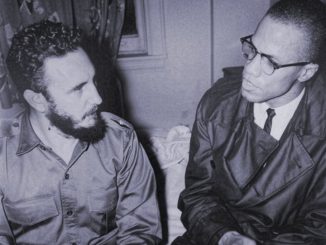
On Sept. 19, 1960, 35-year-old Nation of Islam member Malcolm and 34-year-old Cuban Head of State Fidel Castro had a historic meeting of the minds on the ninth floor of the Black-owned Hotel Theresa in Harlem. The midnight meeting lasted about 15 minutes, in which the two revolutionaries exchanged ideas and experiences. Malcolm said, “I just wanted to Welcome Fidel.” Fidel delivered a powerful speech at the 15th U.N. General Assembly summarizing the policy of the revolutionary government of Cuba.

Malcolm once said that you can’t understand what is going on in Mississippi if you don’t know what is going on in the Congo.

Malcolm X condemned the assassination of Patrice Lumumba, the first Prime Minister of the Democratic Republic of the Congo in January of 1961. He believed the U.S. government arranged Lumumba’s murder to protect investments and profits in the Congo.

He understood the importance of international solidarity, especially with Africa and Latin America and Asia. And after his trip in April 1964 to Mecca, Saudi Arabia, performing the Hajj – he declared that unity of the oppressed nationalities was essential. After seeing the people he shared that trip to Mecca with, he began to think that “race” and ethnicity were not the determinants of friends, allies or comrades in the struggle against oppression and imperialism.

From Malcolm’s letter on his trip to Mecca:

“There were tens of thousands of pilgrims, from all over the world. They were of all colors, from blue-eyed blonds to black skin Africans. But we were all participating in the same rituals, displaying a spirit of unity and brotherhood that my experiences in America had led me to believe never could exist between the white and non-white. America needs to understand Islam, because this is the one religion that erases from its society the race problem. …”

“On this pilgrimage, what I have seen, and experienced, has forced me to re-arrange much of my thought-patterns previously held, and to toss aside some of my previous conclusions … I have always kept an open mind, which is necessary to the flexibility that must go hand in hand with every form of intelligent search for truth.” – the “Autobiography of Malcolm X”

He understood that the unity and the struggle of African people was an intrinsic part of the victory of the entire international working class.

Malcolm’s international global view and his experiences as a Black person in the U.S. provided the fuel building the wisdom and courage to see and feel much of the pain of the Palestinian people. In September of 1964, he visited a Palestinian refugee camp in Gaza and witnessed firsthand the displacement and suffering caused by the 1948 Nakba. This visit was significant because it reflected Malcolm X’s growing international perspective and his commitment to linking the fight against racial oppression in the U.S. with anti-colonial and liberation movements worldwide. He spoke out against Israeli occupation of Palestinian territories, calling it unjust and unsustainable. He condemned the annexation of Jerusalem and other Palestinian lands, emphasizing the importance of human rights for all, including Palestinians.

Malcolm X was no friend of capitalism and his hatred of the system grew into an understanding that, as long as it existed, oppression and division would thrive.

“You can’t have capitalism without racism. And if you find a person without racism, usually they’re socialists or their political philosophy is socialism.”

Ossie Davis eloquently portrayed Malcolm X in his eulogy. In Honoring him, we honor the best in ourselves. Read Malcolm X, “our own Black shining Prince! – who didn’t hesitate to die, because he loved us so.”

Malcolm’s speeches are available on YouTube, and in books. 

Suggested Malcolm X Books: 

  • “By Any Means Necessary“
  • “Malcolm X Talks to Young People”
  • “Malcolm X on Afro-American History”
  • “Fidel & Malcolm: Memories of a Meeting”
  • “Malcolm X’s Letter from Mecca”
  • “The Final Speeches”
  • “The Last Speeches”
Strugglelalucha256


National Forum honoring Malcolm X – Feb. 23

Immigration and Black Liberation – What Would Malcolm X Say

This is the 60th anniversary of the assassination of Malcolm X, which took place on Feb. 21, 1965. To pay tribute to this anniversary, the Harriet Tubman Center for Social Justice, Peoples Power Assembly, and Struggle for Socialism are paying tribute by holding a national forum, “Immigration & Black Liberation – What Would Malcolm X Say.”  

On Feb. 23, an in-person forum will be staged at the Harriet Tubman Center for Social Justice, 5278 Pico Blvd, Los Angeles, California,  90019.  Participants can attend nationally by registering at http://tiny.cc/HonorMalcolmX.  The program begins at 2 p.m. sharp on the West Coast (doors open at 1:30 p.m.). Hybrid begins at 3 p.m. Mountain time, 4 p.m. Central and 5 p.m. East Coast.  

Strugglelalucha256


Colby Byrd: What Malcolm X means to me

We share this piece to commemorate the revolutionary leader Malcolm X, who was assassinated 60 years ago on Feb. 21, 1965. 

Malcolm X means an unshakable Brotherhood made in Blood. He means Uncompromising Resistance. He means Revolution … violent and untameable. Finally, Malcolm X means Liberation by any means Necessary. 

All these principles build on each other. As one discovers their fellow Blood Brothers, they begin to help them and fight for them. As the fighting continues, it reaches a point of no return where there is no longer just a fight to stay afloat, to stay alive, but now an uncontrollable brawl. A complete and total struggle to rid your Blood Brothers of whatever is afflicting them. And this struggle is fought until total victory.

Malcolm X reminds us that our fight is one for human rights, not civil rights. We are fighting for our equality as human beings, not as citizens of the U.S. We are fighting to end the exploitation of us all worldwide. We are fighting to destroy this hypocritical “democracy” for the rich and kill the bloodsucker known as Capitalism. 

He respected the fight. He analyzed what the revolution would look like and never once shied away from explaining how a mutually bloody fight was coming. He openly endorsed armed resistance to occupation and oppression. Whether it be Police in Harlem or Paratroopers in Vietnam, he understood that occupation is a tool of war used by the ruling class on all those below. 

His words from 1964 and ‘65 hold the same weight and relay the same relevant warnings here in 2025. The casbahs of Algiers back then are the refugee camps of Palestine today. The tactics used by French Paratroopers and Harlem police are now the tactics of the Zionist state of Israel and any city Police department. The game played on Black people of this nation back in 1964 continues to be played on us now. Forced to vote to “save” the nation, while no matter the outcome, getting left behind. His warnings against following the leadership that, although may be preaching for change and progress, they are ultimately tools of compromise that are backed by and rooted within the systems of oppression. His times’ Mau-Mau are our Al-Qassam.

In 2025, who are my blood brothers? Who are the people that have struggled as I have struggled? The list is almost never-ending, and that is the point. My Blood Brothers are the victims of racism, of homophobia, of misogyny. They are those fighting against Western Imperialism in defense of their homes and ways of life. My blood Brothers are the victims of natural disasters here, left abandoned by their government, the many people snatched up by today’s slave catchers, Queer people fighting to not be erased from society, and women fighting for bodily autonomy. My blood brothers are the Palestinian Resistance overseas and everyone of the Global South.

This family must learn how to support one another and how to fight off each other’s enemies. This family must always step together, where one blood brother goes we all go. When one is humiliated, we all are, and when one fights back, we all fight back. 

Colby Byrd is a young union member and organizer with the People’s Power Assembly and Struggle for Socialism. Byrd organized support for Baltimore Sanitation workers.

Strugglelalucha256
https://www.struggle-la-lucha.org/2025/02/page/3/