Let them eat plague!

“When one individual inflicts injury upon another such that death results, we call that manslaughter. When society places hundreds in a position that they inevitably meet early & unnatural death … its deed is murder just as the individual.”

Friedrich Engels, The Conditions of the Working Class in England

COVID emerging from cells using false-color images from an electron scanning microscope.

We have been betrayed. For three years, we have been abandoned, misled, shepherded to our dooms. Millions have died. Hundreds of millions have been disabled. All the while, respectable faces with plastered-on grins breathlessly offer hopeful platitudes, assuring us we’ll all be ok. Just trust the system.

You could be forgiven for not realizing we’re still in the middle of a pandemic, considering the total absence of media coverage. If it was important, you’d surely be hearing about it, right? The last variant you heard about was likely omicron. The last you heard about vaccines was likely, “we strongly encourage everyone to get boosted.” The last you heard about masks was that they work, but they’re not required. And why would you bother wearing masks anyway if, as the United States president himself proclaimed, “The pandemic is over”?

Here’s the truth: the pandemic is not over. It’s much worse than you have been led to believe. And unless you’ve spent the past several years reading scientific studies on the subject, it can be hard to convey just how wrong the public perception of COVID really is. Everything from how it’s spread, to how it’s prevented, to what it does once it’s in your body, is being tragically misunderstood.

None of this is an accident. It’s not your “fault” if you aren’t a virologist, immunologist, epidemiologist, or evolutionary biologist. It’s the job of experts and trusted voices to convey the truth and give you guidance. Not only have they failed at this, they have engaged in an active disinformation campaign dedicated to making the pandemic “disappear.” This has not been the result of a classic caricature of conspiracy — some tiny council of elites gathered in the shadows to craft policy out of whole cloth. What we’re actually witnessing is the quiet collusion of class interest. This form of conspiracy is a feature of cultural hegemony, and it has aligned itself in direct opposition to public health and scientific reality. A “conspiracy” of this sort takes place in full view of the public. Every actor within it has openly telegraphed motivations that we are all taught to see as acceptable: keeping the current economic system intact at all costs.

From the moment humanity learned of the novel coronavirus, uncertainty swirled. SARS-CoV-2, named for its terrifying viral cousin, seemed to be even worse than SARS: more deadly, more transmissible, better at evading detection. A singular question arose in the minds of two very different classes of people: “How do we survive this?” For one of those classes, the question was literal: how do we avoid being killed by a disease that seems to be spreading and killing invisibly and indiscriminately? For the other class, the question being asked in boardrooms and capitols was really: “Could this dislodge our grip on power?”

For infectious disease experts, the emergence of an unknown human pathogen — quickly identified as a novel virus — necessitated a pretty clear course of action: contain it, characterize it, and share information as freely as possible. Days after the first cluster of cases were found in Wuhan, Chinese health authorities issued a warning to the WHO. The full genome of the virus that would come to be called SARS-CoV-2 was released to the world before it was even documented outside of China. Coronavirus labs around the world began mobilizing rapidly to study the virus, including creating synthetic versions to study in cultured mammalian cells to learn as much as possible about its life cycle and pathogenicity.

Why did experts mobilize so quickly, even before human-to-human transmission was conclusively proven? The primary reason is the precautionary principle: when dealing with an unknown, if you don’t know conclusively that it isn’t dangerous, presume the worst-case scenario and take the proper precautions. If that wasn’t enough of a reason, researchers figured out pretty quickly that this was a relative of SARS, which has caused enough mayhem on its own to warrant every measure possible to avoid a repeat tragedy. This principle was particularly upheld in China, which had borne the brunt of the SARS crisis, but true precaution never truly materialized in the capitalist world.

After a brief experiment in precautionary measures (stay-at-home orders, mask mandates, quarantine guidelines) many countries in the West quickly saw the writing on the wall — these precautions were not sufficient to stamp out the emerging pandemic. There were measures that could have stopped the virus in its tracks: contact tracing (testing every single person who was in the vicinity of a potential case), enforced quarantines combined with guaranteed paid time off for even the hint of exposure, mandating fitted respirators (and distributing multiple N95s to every resident). But these measures would have required central governments to nationalize key industries, companies to pay employees not to work, and individuals to get comfortable with some discomfort in the name of social welfare (although many already were). These measures would have been a tremendous imposition on the free market, and even then, there was no guarantee they would completely eradicate SARS-CoV-2.

Even half measures, like local mask mandates, were better than nothing, and they did keep many people safe in the beginning. But despite them being utterly insufficient in the face of the crisis we were thrust into, they were still too much for the capitalists to tolerate. They were “harming the economy” by impeding production and discouraging consumption. Tiny protests, led by business owners demanding an end to “restrictions,” garnered massive media attention. Less than 2 months after their implementation, stay-at-home orders were already on their way out, even as cases continued to rapidly climb. Injected into every news story about the pandemic was a consideration for the malaise of the capitalists, whose economic ruin would surely spell the end of our society. The drive to “end the pandemic” began almost as soon as the pandemic arrived in the U.S.

The lies and the truth

Near the beginning of the pandemic, you may have heard a common refrain from public health sources: if we address the situation properly, it’ll look like we overreacted. And yet, by the time community transmission started ramping up in the U.S. in March 2020, we had already failed to “overreact.” The consensus had already come in from the highest levels: at all costs, do NOT start a panic. World leaders at the time, including the U.S.’s Donald Trump, the U.K.’s Boris Johnson, Mexico’s Andrés Manuel López Obrador, Brazil’s Jair Bolsonaro, Spain’s Pedro Sánchez, and Italy’s Giuseppe Conte, all spent the first few months of 2020 exhorting the public not to “give in to fear.” Following precipitous stock market crashes in February and March of 2020, every market analysis firm reported on the tremendous financial damage being done by “coronavirus concerns.” The overwhelming narrative in the early days was that fear of the virus would be worse than the disease it causes. This philosophy manifested in several ways, including outright lies that still haunt us to this day, driving misinformed “personal risk assessments” among the population, including:

  • Masks don’t work.
  • Masks do work, but cloth masks are fine.
  • Stop the spread by washing hands, standing 6 feet apart, and sanitizing surfaces.
  • COVID is not airborne
  • COVID is airborne, but that’s not the main way it spreads.
  • The only people harmed by COVID are old and immunocompromised people.
  • Children don’t get COVID.
  • Children can get COVID, but they can’t spread it.
  • Reinfections are rare.
  • Breakthrough infections after vaccination are rare.
  • Reinfections and breakthrough infections happen, but they’re mild.
  • Once enough people have been exposed, herd immunity will end the pandemic.
  • Viruses naturally evolve to become less deadly.
  • Once you recover from acute infection, you’re out of the woods.
  • Long COVID is psychological, not physical.
  • Long COVID is physical, but not a big concern.
  • Heightened lethality of non-COVID diseases is due to “immunity debt.”

The list of officially-sanctioned lies could potentially go on for pages. The most critical feature of the misinformation is that it is always centered around that same core philosophy of minimization. That trend continued to evolve throughout the pandemic: whether it’s Anthony Fauci admitting that he discouraged masks because he didn’t want to trigger panic-buying, the CDC shifting its metrics from transmission levels to “community levels” in soothing pastel colors, school districts touting their supposed low transmission rates, or any of the other examples of public health malpractice, everything has been geared toward pushing people to underestimate danger rather than overestimate. This pattern has continued to this day, with officials attempting to head off panic in the face of the extremely infectious and immune-evasive XBB.1.5 variant (colloquially referred to as the “Kraken” variant).

Before going further, let’s clarify what that danger actually is. Because of how complex biological systems are, it is difficult to convey all the nuances of a viral pandemic without getting too technical. Nevertheless, we can make some pretty clear assertions based on condensing hundreds of scientific studies into a few paragraphs. With that in mind, here’s everything you need to know about COVID-19 and the virus that causes it:

COVID is airborne. Airborne transmission is different from droplets, which are large particles containing the virus, expelled when you speak, cough, sneeze, etc. Droplets are heavy enough that they will eventually drop to the ground or nearby surfaces, meaning it’s relatively easy to contain: any physical barrier — like a cloth mask or plexiglass — will block these droplets before they can reach another person. “Social distancing” is a concept that applies to droplet transmission under the presumption that the virus-containing droplets will fall to the ground before reaching someone 6 feet away. Sanitizing surfaces kills any viral droplets that have landed on them before someone can touch them and then touch their orifices.

However, COVID is not confined to droplets. We have known for years that it can spread through aerosol, as papers from the New England Medical JournalNational Library for Medicine, and the Wiley Online Library demonstrate going back to 2020. Aerosol is composed of much smaller particles that bounce around between air particles and can stay suspended and infectious in the air. Picture someone smoking: the behavior of the smoke is much more akin to the behavior of viral aerosols. Can you still smell the smoke behind a plexiglass shield? How about if you’re six feet apart? In a crowded, enclosed space, how many people would breathe in the smoke of one smoker? Measures designed to protect against droplets aren’t exactly pointless against COVID since it also spreads via droplets. But just because you’re not spewing COVID-laden spittle in someone’s face does not mean you’re keeping your germs to yourself.

You can get COVID over and over. The idea that you become immune to COVID after getting infected or vaccinated is based on the concept of immune memory. Every time a pathogen enters your body (either through infection or vaccination), your immune system mounts a defense to stop it: first, a broad “kill anything that moves” phase we call innate immunity, then a phase of adaptive immunity, which is targeted to kill the specific thing that triggered the immune response. Pieces of the invader are used to create, recruit, and activate a variety of immune components — including antibodies, T cells, and B cells — that are trained to recognize that specific pathogen. Some cells of the immune system, called memory cells, are kept around from that second stage as a sort of permanent record. If the exact same pathogen shows up again, the immune system already knows what to look for. This is the key behind vaccination: expose your immune system to a harmless piece of the virus, and it’ll remember it when it encounters the real thing.

Except this isn’t even close to the whole story. For one thing, the snapshot stored in your immune memory is just a physical piece of the pathogen, and viruses evolve very quickly. As the virus changes, the real thing starts to resemble the record being kept by your immune system less and lessand it becomes easier and easier for new variants to evade adaptive immunity. The more people that get infected, the more times the virus randomly mutates — and the more likely it is that a particular combination of those mutations makes a virus that is unrecognizable to your immune system. For a while, the WHO used to categorize these mutants as “variants of concern,” giving them each a new name. When the virus mutated enough to evade the immunity to the wild-type virus, they named it alpha. The lineage that was able to evade alpha was called beta. Delta was particularly immune evasive and its mutations brought high levels of lethality. Omicron was so different from all existing strains that it was practically able to infect everyone, no matter when they got infected and/or vaccinated. And then… they stopped giving the variants names. “Omicron” is still used to describe every descendant of that original variant, despite the dozens of highly infectious, highly dangerous variants circulating today, none of which look enough like omicron itself for your immune system to efficiently recognize them.

COVID screws with your immune system. Upon infection, SARS-CoV-2 immediately gets to work, suppressing attempts to stop it. It hijacks your cells’ machinery to shut down production of crucial immune system alarms. This includes the component used to present pieces of the virus on the surface of the cell to tell the immune system, “Hey! This cell is infected, and here’s the culprit!” This component is necessary for specific immune cells to identify the target and proceed with the adaptive immune response, leading to both delayed innate and adaptive immune responses.

When immune cells arrive on the scene, the SARS-CoV-2 virus is able to infect them as wellMonocytes, which are involved in ushering in the adaptive immune response, get infected by SARS-CoV-2, anare reprogrammed to prevent them from presenting antigens and teaching the adaptive immune system what to look for. T cells rush to become cell killers, causing the signature massive tissue damage that can be fatal in severe cases. Every infection depletes your body’s reserve of naïve T cells — that pool of “blank” immune cells your body keeps on hand for later deployment and specialization — damaging your ability to mount an effective immune response to future infections — including other pathogens. This is why, no matter how many people get infected or vaccinated, we have not — and will not — reach “herd immunity.” Naïve T cells are also necessary for stopping the cell-killing activity of activated T cells, which is a factor in the severity of acute COVID. Worse still, the population is steadily becoming more vulnerable to infections of all types. We are in the middle of an alarming surge of diseases beyond just COVID: RSV, influenza, strep A, and many others are hospitalizing people in record numbers — opportunistic infections handed the gift of a softened-up population of victims.

For a while, vaccines were highly effective against severe acute infections — not because they prevented infection or created lasting immunity, but because they prompted your body to create antibodies to the virus, which can persist in your blood for months. If you got infected while these antibodies were present, it helped your immune system compensate for the virus’s suppression of adaptive immunity. Your immune response was less likely to go haywire, cause massive tissue damage, and lead to severe clinical outcomes. However, by the time boosters became available, the vaccines were already obsolete: they were engineered to target the original version of the virus, which you were already unlikely to ever see again.

COVID evolves rapidly. An idea has been floating around for years that SARS-CoV-2 will naturally reach an “evolutionary ceiling,” where it can no longer adapt around our immune systems, and will become no more pathogenic than a cold. This is predicated on a misunderstanding of evolutionary and viral dynamics. The main factors guiding the evolution of the virus are: how well it can spread from person-to-person, how well it can infect cells, and how well it can evade the immune system. This latter factor is the most crucial since, as previously noted, the virus’s effect on the immune system is a significant driver of its danger. The idea of an evolutionary ceiling stems from the notion that, in order to adapt around our immune system, the virus needs to change, and those changes necessarily impact its other features — namely, its ability to spread and infect. But this is not the case.

As the virus spreads, it racks up mutations. Every new host gives the virus trillions of opportunities to mutate before sending it on to the next victim. By the time SARS-CoV-2 first took over the world, it had already diverged so thoroughly into separate lineages, giving rise to variants like alpha, beta, delta, and omicron. The Omicron lineage eventually emerged with another profoundly unique and highly-infectious set of mutations and followed the same pattern. In its wake, it left behind many more child lineages, each distinct enough from each other to create a “variant cloud.” For months, the various omicron sublineages have been unable to outcompete each other because none has had a set of adaptations so exceptionally advantageous as to outstrip the spread of the others. However, as the mutations continue to accumulate across all lineages, it’s only a matter of time before a new mega-variant emerges. It will sweep across the population, again diverging as it goes, spawning new lineages of its own — and leaving millions dead and disabled in its wake.

COVID is persistent. We’ve known for years that other coronaviruses, like SARS, can persist in your body long after initial infection. This is likely a byproduct of their evolutionary history; they evolved to spread through bat populations and survive bats’ unique immune systems. Bats are very long-lived for their size, potentially living for decades, even with multiple different infections quietly simmering inside them. However, in humans, these viruses’ tactics for suppressing a well-regulated bat immune system present a form of overwhelming force, which wreaks havoc on our bodies.

After the chaotic and potentially-lethal initial stage of acute infection, the virus is able to settle in for the long haul — evidence has been found in the gut, in human waste, and among “cured” patients. This can happen whether the acute phase was disastrous and hospital-worthy or quiet enough for you to experience no symptoms at all. By this point, the virus will have suppressed your body’s immune memory, infiltrated throughout various organ systems — including your cardiovascular, nervous, and renal systems — and begun pumping out a steady supply of new virus. Of course, this persistent infection causes damage to the various organs where the virus has made its home, especially since it can trigger further inflammation. Your immune system is constantly trying to smoke it out, damaging more organ tissue as it does so. Your risk of heart attacks, strokes, neurological symptoms, and death, in general, are much higher during this persistent phase — and it only gets worse with every reinfection. It still remains unclear how long this persistent phase can last — certainly as many months as have been studied so far.

Evidence has been mounting for years that COVID is actually a type of autoimmune disorder, with several components of your immune system turning against your own cells. Not only are pro-inflammatory molecules heightened in both the acute infection and in so-called long COVID, high levels of antibodies against normal cellular pieces have been found in over half of patients hospitalized with COVID. The implications of COVID-triggering autoimmunity are broad and can get fairly technical, but needless to say, the population being infected over and over with such a debilitating virus is catastrophic.

The motive

Why would governments, public health officials, news media, business leaders, and every other trusted voice tell us outright lies (such as “COVID is not airborne!”) and avoid highlighting crucial truths (such as COVID’s propensity to damage immune systems)? Why would such a simple thing as distributing and mandating the proper usage of high-quality respirators — a layup of public health policy — be portrayed as being so toxic that to suggest it would get you laughed out of the room? Why would institutions like the CDC casually mention the existence of long COVID with one breath, and with the next, pat themselves on the back for “diminished hospitalizations”? Why has the entirety of public health policy contracted down to “Get vaccinated and you’re free”?

Part of it is simple ignorance: in the beginning of the pandemic, there was a lot we didn’t know. There were clues, of course, hypotheses based on what we knew about other coronaviruses. We could have guessed at airborne transmission, immune suppression, viral persistence, and rapid evolution, but we didn’t know these things conclusively. We didn’t know the exact numbers for case fatality, transmission, long-term symptoms, etc. But we didn’t need to know. The precautionary principle could have guided us to keep up avoidance and containment practices until we knew exactly what we were dealing with. And yet, the clearer the picture has become, the more we have reduced those measures, instead of ramping them up. COVID is more dangerous than initially expected, and yet we have continued to make ourselves more vulnerable.

The cold truth of the matter is that the motive behind COVID minimization is greed and social control. The capitalist system depends on constant growth: constant production, constant consumption, constant expansion of profits. Even brief pauses — such as a month-long stay-at-home order — have disastrous effects on capital. Implementing the mass prevention strategies necessary to slow down transmission (daily rapid testing, contact tracing, guaranteed paid leave for exposed workers, high-quality respirators, etc.) is expensive and eats into profits. An information campaign explaining why everyone needs to stay home instead of contributing to “the economy,” eats into profits further. Winding down all non-essential business and keeping it shuttered until the true end of the pandemic would contract the economy down to only what is necessary for society to function. The opportunities for financial capital to invest in new, profitable enterprises would vanish faster than they reemerge.

For capitalism to function, it requires two things: a steady supply of workers producing value and an unending flow of consumption to realize that value as profit for the capitalist. The onset of a pandemic presented a challenge on both of those fronts. Workers getting sick en masse and being forced to stay home for a couple of weeks — or even dying or becoming disabled and exiting the workforce altogether — was only one potential headache for the capitalist class. Far worse was the prospect of workers staying home out of precaution, thereby grinding production to a halt. Consumers staying home and buying only the essentials would prevent the realization of profits across huge swathes of the economy, cutting off the flow of capital necessary to keep the whole system running.

The moment it became obvious to market analysts that COVID was more than just a local Chinese outbreak, it triggered utter panic in the financial sector. Fears about the slowdown of profits led to several mass stock sell-offs from investors, lowering stock value, triggering even more panic-selling, across multiple different days. This wasn’t just speculation: decreased demand for oil rapidly triggered a massive price war that caused prices to spiral for months until becoming negative, with the holders of oil futures paying to offload their contracts. Without ramping demand back up, production of this and other key commodities would be financially toxic.

Capitalism also relies on a reserve army of labor to keep labor costs artificially deflated. A contracted economy, in which any worker willing to work is a rare commodity, tips the balance of power in favor of workers. Workers could more easily bargain for higher wages and safer working conditions (including liberal COVID leave). Most worryingly of all, in the context of long-term precautionary measures, the population would get used to a dangerous notion — that we have value beyond our labor and our consumption. When faced with the prospect of death or disability, the contradictions become sharpened in our eyes. Hundreds of millions of workers would suddenly ask “Why am I risking my life for this?” The frustration at a choice between abject poverty and potentially contracting a debilitating condition would galvanize workers to stand up for our rights. Waves of labor mobilization, rent strikes, workplace lockouts, boycotts, and more would sweep the country — and the world. It would be the greatest challenge to the political power of the capitalist class in a century.

The strategy

Actually solving the pandemic was never in the cards for the U.S. and the rest of the capitalist world. It would have necessitated deep international cooperation, massive investment in clean air infrastructure, a persistent information campaign (and censoring of hazardous misinformation), efforts to build public trust in government, guaranteed paid leave, nationalization of key industries, and more. Basically, it would involve massively undercutting the philosophy of free market capitalism.

Instead, the explicit goal of the ruling class has been to make the pandemic simply disappear from public perception. Any reminder of the existence of a highly-transmissible, highly-dangerous, mass-disabling disease could trigger panic, or worse: organized, militant labor action. Averting this crisis required a careful campaign of culture-crafting; the people themselves needed to become convinced that there was no reason to fight. Consent for protracted mass infection needed to be manufactured.

There are three main ways this hegemonic narrative around COVID has been propagated to the public: official rhetoricpublic policy, and media framing. These three facets of idea propagation feed into each other, and all three are maneuvered in various ways by the interests of capital. The process by which a hegemonic narrative is crafted in the capitalist sphere is not quite as straightforward as one might expect. It’s not a simple matter of a state propaganda department deciding on a central doctrine, issuing scripts to paid actors, and imprisoning all who dissent. There is no party line for the capitalists, no single convocation of business elites, and relatively few shadowy backroom deals. Explicit planning meetings are held — independently — among the leadership of different ruling class parties and distinct business interests, and their similar class interests lead them to similar priorities. But the way narrative unity of this sort is achieved is not through an all-powerful conspiracy. Instead, the “decision” for how to frame events arises organically from the interplay of the many individual sectors that comprise the ruling class propaganda machine.

The tone struck by what we think of as official sources sets the stage for the broader social response. This rhetoric comes from a variety of places — heads of state, government agencies, individual experts, think tanks, and other entities imbued with a sense of authority. These are voices that we are socialized to pay attention to. When they speak, they easily garner media attention. A news outlet that ignores or disputes these sources loses access to them and invites flak, thereby harming their ability to sell more news. These voices are generally in the room when policies are crafted — or crafting the policies themselves. What “the experts” say matters, and the particular experts being promoted by governments and corporations have steadily coalesced around rhetoric that minimizes the public health threat of the virus.

Official rhetoric does not always come to total agreement on presentation. The two-party system in the U.S. is often characterized by competing “official” stances, even when both stances are de facto acceptable to the established capitalist order. Throughout 2020, many prominent figures, including Donald Trump, attempted to prematurely declare the end of the pandemic. The Great Barrington Declaration attempted to launder the notion that attempts to mitigate the pandemic were harmful, and that we should instead try to reach “herd immunity” by allowing the virus to run rampant through the population. This was a non-starter in terms of propaganda material, since we could all see the devastation in plain sight. However, this was still valuable to the ruling class, because it laid the groundwork for a potent narrative — that of the “level-headed pragmatists” guiding us through the pandemic. Against the backdrop of conspiracy theories, bunk cures, and political disengagement from the reality of the pandemic, there came a promise from the liberal wing of the ruling class: “Unlike our opponents, we actually care, and we will get you through this.” Despite the difference in tone, the trajectory of the policies themselves has largely been preserved across political lines.

Pandemic public policy has been both shaped by and indicative of the official rhetoric of whoever happens to be in charge. It has reflected the recommendations of experts — those experts which had been chosen by the ruling government. In places governed by more liberal tendencies, curfews and cloth mask mandates lasted longer, instilling an implicit message that, unlike those science-denying conservatives, the liberals were “following the science.” This meant that, when these half-measures were rescinded, it seemed obvious that now people could feel safe putting themselves at risk.

Every policy choice has acted to shape the public’s perception of the pandemic. Mandating that businesses put stickers on the floor to demarcate 6 feet of distance hammered home the false notion that being 6 feet apart from others protected you. Requirements that bars and restaurants be closed for indoor dining made people reckon with the fact that these necessarily-unmasked spaces were dangerous. Reversing that restriction while mask recommendations were still in effect created confusion and demonstrated that the recommendations were meaningless. School districts shuttering physical classrooms put every parent on high alert for their children’s safety, while so-called “hybrid learning” taught people that safety was a parent’s choice. As school districts moved away from virtual school altogether, the message became clear: there is no reason to worry about your children getting sick. Steadily, measures put into place to protect people from the virus have been reversed until the current state of affairs, where every public health “policy” has become instead a recommendation — and those recommendations don’t even come close to establishing true safety.

Economic measures taken during the pandemic have worked in a similar way to public health policy. In the beginning, policies were put in place to help the people who would be economically impacted: paycheck protection programs, tax credits, expanded unemployment benefits, eviction moratoria, stimulus checks, and student debt deferral. This aid was granted to ensure that the economic situation for the working class never got so despondent that workers would have greater incentive to rebel through labor militancy, rent strikes, or even violent uprisings. As these measures dried up, they came with the accompanying message: “You’re on your own now.”

Throughout the pandemic, media attention has been focused on reproducing official rhetoric through op-eds and interviews. The experts promoted above all have always been selected based on their proximity to power, both in terms of their official appointment and their rhetorical line. As governments and agencies solidified their pandemic-minimization rhetoric and policies, individuals who championed that line became even more appealing. The lure of manufactured conflict allowed media companies to profit by highlighting astroturfed, unpopular movements protesting all forms of public health policy. Depending on their particular cultural bent, news corporations could position themselves either as “freedom-fighters,” standing up to the government tyranny of half-baked precautionary measures or as “champions of reason,” pushing back against misinformation and science denial.

In all cases, the pivot in 2021 was palpable. Now that vaccines had arrived, there was a feasible narrative for transitioning away from “economically-disruptive restrictions.” As soon as you got vaccinated, you were free to get back to normal. “Fresh air smells sweeter without masks!” proclaimed the first lady, triumphantly. Summer of 2021 was full of freshly-inoculated people enjoying significant levels of antibody-based protection, and cases were at their lowest point. The media trumpeted this wonderful news at every opportunity, showcasing ecstatic public health officials, booming businesses, and throngs of maskless people while ignoring the still-omnipresent circulation of background cases.

Prognosis

With every new major variant, cries of “No one could have seen this coming!” quickly give way to “At last, the pandemic is over.” The same refuted myths of herd immunity, hybrid immunity, and vaccinated immunity keep cropping up, only to be dashed to pieces by the next wave. In the latter half of 2022, we entered a phase of multiple overlapping variants — all deliberately still referred to by their parent, omicron, to avoid panic. The baseline of weekly infections and deaths have remained higher than at any other phase of the pandemic, save for spikes as a new dominant strain emerged. The expert, government, and media line has stagnated at a calibrated silence, interspersed with the occasional recommendation to get vaccinated. Fitted respirators are recommended (lumped in with less-effective cloth and surgical masks), but they are not mandated, and rarely even modeled. Schools are fully in-person, despite their established role as hotspots of community transmission. At every opportunity, governments, corporations, and community organizations congratulate themselves on making it through the pandemic.

This is not simple negligence on the part of those who govern and shape our society. It amounts to social murder: the establishment of policies that place large numbers of people on the path to an early and unnatural death. You have the right to health, and that right is being deliberately stripped away from you with a policy of mass infection. Just because the choice isn’t being made with the specific goal of eliminating us (such as in the case of genocide), doesn’t absolve the choice itself. And that choice is being continually reaffirmed every day. The calculation has been made with no special regard for human health; only the preservation of the social order. Too much death and disease could challenge the power of the ruling class; 15 million excess deaths are just the cost of doing business.

We are at a crossroads in this ongoing crisis. As we continue to pretend everything is normal, the virus continues to evolve. Multiple lineages are circulating, accumulating mutations that help them evade immunity and run roughshod over defenseless populations. The next uber-variant is likely already here: the XBB.1 lineage is as different from the original SARS-CoV-2 virus as that virus was from SARS, and has an even higher ability to infect cells. With every wave that washes over us, our organs and our immune systems become weaker. Life expectancy is declining at an alarming rate. We are an increasingly disabled population, with no community support — or even awareness. The longer we allow ourselves to be governed by a culture of individualism, capitalist greed, and ignorance, the sicker we will all become.

Source: Red Clarion

Strugglelalucha256


Hands off Lorena Peña

The members of Women in Struggle/Mujeres en Lucha, both in Puerto Rico and in the United States, stand in solidarity with our compañera Lorena Guadalupe Peña Mendoza, president of the Women’s International Democratic Federation (WIDF-FDIM), in the face of the outrageous attack by the government of President Nayib Bukele of El Salvador.

We repudiate and denounce before the international community the political persecution of Lorena Peña at the hands of the Salvadoran government for alleged “embezzlement.” It is despicable that Bukele wants to submit her to a civil trial based on a rigged process against her.

The reason for this trial seems more like a vendetta against our compañera because of her long record in favor of true justice for the Salvadoran people and women and for being part of the opposition to the current government.

A leader of the Farabundo Marti National Liberation Front (FMLN) who participated in the peace negotiations that concluded with the signing of the Chapultepec Peace Accords in 1992, Lorena Peña was the third woman in Salvadoran history to preside over the Legislative Assembly of El Salvador in 2015. Since 2016 she has been the president of the WIDF-FDIM, unanimously elected at our World Congress held in Bogotá, Colombia. 

We urge the international community to join this denunciation, endorsing it or writing their own messages with the hashtags #SolidaridadConLorena and #FdimAmericaConLorena.


Strugglelalucha256


Manos fuera de Lorena Peña

La membresía de Mujeres en Lucha/Women in Struggle tanto en Puerto Rico como en Estados Unidos, se solidariza con nuestra compañera Lorena Guadalupe Peña Mendoza, presidenta mundial de la Federación Democrática de Mujeres, FDIM, ante el atropello en su contra por parte del gobierno de Nayid Bukele del Salvador.

Repudiamos y denunciamos ante la comunidad internacional la persecución política de la que es objeto Lorena Peña a manos del gobierno salvadoreño. Es inaudito que el señor Bukele la quiera someter a un juicio civil a partir de todo un proceso amañado en su contra.

La razón de este juicio, más bien parece una vendetta en contra de nuestra compañera por su largo historial en pro de la verdadera justicia para el pueblo y las mujeres salvadoreñas y ser parte de la oposición al gobierno actual. Dirigente del Frente Farabundo Marti para la Liberación Nacional y quien participó en las negociaciones de paz que concluyeron con la firma de los Acuerdos de Paz de Chapultepec, en el año de 1992, Lorena Peña es la tercera mujer en la historia salvadoreña en presidir la Asamblea Legislativa de El Salvador, por respaldo unánime en el 2015. Desde el 2016 ha sido la Presidenta de la FDIM, elegida por unanimidad en nuestro Congreso Mundial celebrado en Bogotá, Colombia.

Exhortamos a la comunidad internacional a unirse a esta denuncia, avalándola o escribiendo sus propios mensajes con las etiquetas #SolidaridadConLorena y #FdimAmericaConLorena.


Strugglelalucha256


China’s Cultural Revolution and the Fall of Lin Biao

Sam Marcy, a leading Marxist thinker and fighter of the second half of the 20th century, died 25 years ago on Feb. 1, 1998. To mark the occasion, Struggle-La Lucha is publishing a selection of Marcy’s articles that demonstrate the breadth and depth of his analysis and strategic thought on behalf of the workers and oppressed, while also providing insight into today’s struggles.

Editor’s introduction from ‘China 1977: End of the Revolutionary Mao Era’

“The Cultural Revolution and the Fall of Lin Biao” was written by Sam Marcy in August, 1972, after the appearance of the official version of the death and purge of Lin Biao. This event signaled a struggle over policy in the highest levels of the Chinese leadership, particularly over the Nixon visit and the rapprochement with U.S. imperialism.

The suppression of the Left in China begins with the fall of Lin Biao and Chen Boda. These articles offer a broad historical overview of the Cultural Revolution — the blocking of capitalist restoration and the safeguarding of the new social relations established by the Chinese Revolution of 1949 and deepened by the Great Leap Forward and the Commune movement of 1958-59.

Sam Marcy makes extensive use of Engels’ analysis of earlier great revolutions to show how, the Cultural Revolution grew from historical necessity but that once that historical task was fulfilled in China, the base of the revolutionary left was eroded and the ideas of “storming the heavens” and creating a new Paris Commune-type of state were jettisoned. Subsequent events have confirmed this analysis.

Part 1

August 4, 1972: The public confirmation of the tragic end of Lin Biao and some of his collaborators ends a momentous inner struggle over the future course of the Chinese Revolution and, in particular, of China’s foreign policy. The defeat of Lin Biao, Chen Boda, Huang Yongsheng, Wu Faxian and others means that the Chinese Revolution has, to a considerable degree, run its course. From now on, the word is stability at home at the expense of revolutionary policy abroad.

Lin Biao, it will be remembered, was the author of the theory of encircling the imperialist powers — the “cities” — with global guerrilla war. Whether the theory was right or wrong, it had a revolutionary perspective in foreign affairs. As has become evident in the last few years, Chairman Mao and his supporters devised a different foreign policy. Theirs is symbolized by the invitation accorded Nixon to visit Peking and the accommodation that the Chinese leaders have been developing with the U.S.

The Chinese Revolution, however, is by no means finished. It has been the longest, most protracted, and, and in many respects, the profoundest social upheaval in history. It spans well over half a century and is full of the most remarkable revolutionary feats. It is no wonder that so many of its leaders have become genuinely legendary figures.

Effect of international situation

At each stage of its development the Chinese Revolution was profoundly influenced by the nature of the international situation. The Chinese Revolution caught fire on the basis of the conflagration, which commenced with the October Revolution in 1917. The false policies of Stalin inhibited and protracted the character of the Chinese Revolution. The 1927 defeat of the Revolution and Stalin’s promotion of the theory of the block of four classes, which meant subordination to the Kuomintang, retarded the development of the Chinese Revolution. It was Mao’s resistance to Stalin’s policies that, in the long run, enabled him to save and fortify the revolution. 

But again, the attempt of Japanese militarism to colonize China, in turn, served as a spur to the revolution. The preoccupation of U.S., British, and French imperialism with the struggle against Hitler for a time had a favorable effect on developments for the Chinese Revolution. Finally, the victory of the Soviet Union in the war and the defeat of the Japanese imperialists helped tremendously to pave the way for the victory of the Chinese Revolution in 1949.

Unquestionably China is again being profoundly affected by the international situation. Faced with the threat of U.S. and Japanese imperialism — a threat which daily demonstrates itself in the genocidal aggression against a socialist ally on its very doorstep — and the hostility of the Soviet bureaucracy on the other hand, Chairman Mao and his followers have decided to come to terms, in large measure, with the U.S.

Cultural Revolution blocked capitalist restoration

The ouster of the Lin-Chen grouping also signifies the end of that phase of the Chinese Revolution, which has become known to the world as the Great Cultural Revolution. The lasting significance of the Cultural Revolution is that it reversed a tidal wave of bourgeois reaction and set back a process of development that would have ended up in capitalist restoration.

The Lin-Chen grouping can, with qualification, be called the radical or left faction, which was in alliance with Chairman Mao and his supporters during the Cultural Revolution. Together they led the struggle against Liu Shaoqi, who then represented the neo-bourgeois restorationist movement. The defeat of Liu Shaoqi cleared the road for the commencement in earnest of the socialist transformation of China. Naturally, not all the claims made for the Cultural Revolution are valid. Certainly, there has been a great deal of exaggeration. But none can deny that, in essence, the Cultural Revolution marked a turning point in the historical evolution of China.

It prevented, at its barest minimum, capitalist restoration and ushered in a new stage in the building of a socialist society in China. Of course, no revolution is ever accomplished without a great deal of excess, without serious setbacks and errors. Once the Cultural Revolution was launched, it involved huge masses of people and set forces in motion that could not be controlled, even under the best of circumstances.

To some observers on this continent, the Cultural Revolution reduced itself to a mere factional dispute between Chairman Mao and his supporters, Lin, Chen, and others, against Liu Shaoqi and his formidable right-wing forces. In the view of these observers, such a dispute should have been carried out by literary and polemical methods in the classical style in which Lenin polemicized against his opponents in the Bolshevik party. Of course, winning a revolutionary victory with polemics alone is more desirable than a violent struggle.

But what if the character of the adversary and the historical context in which the struggle is opened up, both at home and abroad, makes this impossible? What if the struggle for a neo-bourgeois restorationist course has already been started and has already taken on flesh and blood in leading cadres of the party and the mass organizations? What if this grouping has, in fact, already reached such dimensions that practically all the significant political currents of the imperialist bourgeoisie are already aware of it and are, in fact, applauding and egging it on? 

What if the weight of the entire Soviet Union, through its leadership, particularly in the case of Kosygin and Brezhnev, is openly supporting the neo-restorationist elements? What if, in the given historical context, there is no other way but to openly appeal to the party and to the masses to commence the struggle against the right-wing restorationists?

Class interests versus legal norms

From the point of view of pure formal procedure, the Cultural Revolution may have been a violation of democratic centralist principles, but only if we forget that the party as a whole was already shattered by the course of events: deep incursions had already been made into the body-politic of Chinese society by the Liu Shaoqi forces. Marxism teaches that where fundamental class interests are involved, class interests must not be subordinated to purely formal or legalistic norms. To make the outcome of the class struggle dependent on formal procedures at the expense of class interests is the height of folly.

Certainly, it would have been preferable to have a literary and polemical debate end in a victorious decision by a party congress. But in the case of the Cultural Revolution, the struggle had spilled over from the party ranks and from the bourgeois intelligentsia into the general mass of the population before the discussion could get under way — assuming it ever could have been done that way in the first place.

At any rate, once the struggle started, the only correct position for progressive and revolutionary workers throughout the world was to support the proponents of the Cultural Revolution. All the more so because in a revolution, just as in a workers’ strike, the first and most important element to consider is the determination of which side to support. In the course of a strike, there may be any number of formal violations of the democratic rights of those who promote crossing of the picket line, but as long as the strike is on, every worker is duty-bound to support it.

It was quite clear during the entire course of the Cultural Revolution that the bourgeoisie and the Soviet bureaucracy were openly supporting Liu Shaoqi and the restorationists. There is no question that the Soviet leadership would prefer a bourgeois restorationist regime over a revolutionary socialist regime, especially if the bourgeois restorationists would be on friendly terms with the Soviet bureaucracy and retain the governmental and party facade of “socialism.”

Belated charges

Is the elimination of Lin Biao to be regarded in the same way as the ouster of Liu Shaoqi? By no means.

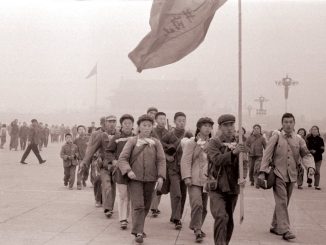
The neo-restorationist tendency in China has made itself quite evident, so much so that even foreign observers could see its slow but sure development. It was a formidable force. The struggle that was fought by Chairman Mao and his supporters was an open revolutionary struggle. It is an incontestable fact that Chairman Mao openly appealed to the masses to participate in the struggle. Events soon demonstrated that the masses vigorously responded to the call and overwhelmingly supported it. It was particularly evident in the tremendous enthusiasm exhibited by the youth. This had worldwide repercussions in the movement of the youth all over the world.

The recent indictment against Lin Biao charges that he “attempted a coup d’etat and tried to assassinate Mao Zedong.” After the plot was foiled, it is said, “he fled on September 12 toward the Soviet Union in a plane which crashed over the People’s Republic of Mongolia.” It is also charged that “he undertook anti-Party activities in a planned, premeditated way with a well-determined program with the aim of taking over power, usurping the leadership of the party, the government and the army.” But, “Mao Zedong unmasked his plot and blocked his maneuver. Mao Zedong made efforts to recover him, but Lin Biao did not change his perverse nature one iota.”

So reads the first official confirmation from China of the many rumors which have circulated in the imperialist press for many months, rumors which were based on leaks from Chinese officials to the capitalist world.

The dimensions of the “plot” indicate it could scarcely have taken place in secrecy. The very fact that the Chinese leadership waited so long to divulge it lends itself to extreme incredulity. And the fact that so many rumors could be floating in many capitalist countries while the mass of the people at home was not at all informed about the “plot” completely differentiates this type of struggle from that launched in the Cultural Revolution.

During the Cultural Revolution, Chairman Mao and the leadership confined themselves to enlisting the revolutionary support of the masses. It was the restorationists who maintained contact with and gave leaks to the imperialist bourgeoisie. But in the present case, the very fact that Chairman Mao himself first gave the news to the world through Ceylonese Prime Minister Bandaranaike and French Foreign Minister Schuman, leaders of bourgeois states, speaks volumes in itself.

Accommodation with U.S. is real answer

There is no way to verify any of the allegations concerning the bizarre plot of Lin Biao. Even if we take everything at face value, the allegations in themselves are internally contradictory. The only truth that emerges from the statement issued by the Chinese Embassy in Algiers is that Lin opposed “the revolutionary foreign policy worked out by him (Mao Zedong).” But the essence of this “revolutionary foreign policy” is pointedly illustrated by the invitation to Nixon and the pursuit of an accommodation with U.S. imperialism.

The indictment against Lin and the others smacks of a police version of a great historical event. If Lin Biao was opposed to “the revolutionary foreign policy” — that is to an accommodation with the U.S. — it doesn’t necessarily follow that he is a Soviet revisionist and on such friendly terms with the Soviet Union as to be able to flee there. Rather, this opposition appears to verify the existence of a progressive opposition to the new foreign policy followed by the CPC.

If speculation about this opposition is rampant, the CPC leaders have only themselves to blame. It is not likely that the party and the state in China are so weak that they could not possibly bring the nature of this dispute to the attention of the party and the public, that is, to bring the masses into the struggle. Was it not really fear of the masses, or fear of the response the masses would have to the new foreign policy that made the CPC leaders keep everything secret so that only the bourgeoisie in the West and the revisionists in the Soviet Union knew about it?

The ouster of Lin bears a remarkable resemblance to Stalin’s purge of the Red Army general, Tukhachevsky, et al. They were executed in secret and it was only afterwards that Stalin was able to make a deal with Hitler — the Stalin-Hitler pact. But even Stalin did not tell the then-French Premier Daladier about the executions and ouster of the generals before at least informing the Soviet public.

Lin’s ouster also bears a strange resemblance to Khrushchev’s elimination of the Molotov-Kaganovich group from the Central Committee on grounds that are again similar to the hints that the CPC is making about Lin Biao. Molotov and Kaganovich, two of the oldest members of the Bolshevik party and two of Stalin’s closest supporters, were indicted by Khrushchev on grounds that they were opposed to peaceful coexistence with the West.

The Western imperialist press showed unconcealed glee at the expulsion of Molotov and Kaganovich. All those who were following events in the Soviet Union knew that Stalin, as well as Kaganovich and Molotov, who was Foreign Minister of the Soviet Union for a long time, had been preaching and practicing peaceful coexistence for years. The indictment had no basis in fact. The real issue was that Khrushchev was taking a course in foreign affairs which was so far to the right — so much further than Stalin had gone — that they, in a measure, opposed it.

The fundamental turn in foreign policy initiated by Mao is the very type of turn which Mao so vehemently and correctly fought against in Khrushchev — the turn towards peaceful coexistence, a phrase which symbolizes abandonment of the revolutionary struggle abroad, support of the nationalist bourgeoisie in underdeveloped countries, and friendship with the imperialist West, particularly with the U.S. Moreover, the turn comes at a time that could scarcely hurt the world struggle more, when the beleaguered Vietnamese people are spilling their blood to get the U.S. imperialists off their backs.

Frank appeal to masses or secrecy

The CPC was duty-bound to present its position frankly and publicly to the masses — not a year after it all happened, and not through the mouths of Bandaranaike and Schuman, but through party documents and party discussion. Lin, as well as his collaborators and allies, are not just a few accidental individuals. They constituted an entire stratum in the leadership of the party and the revolution. Lin, as everybody knows, was considered to be the successor to Mao. In fact, his succession was even put into the constitution. To remove a leader who is constitutionally destined to succeed Mao without informing the masses, let alone obtaining their approval, is a sharp break from the earlier revolutionary practice of the CPC.

We draw a sharp line between support for the Cultural Revolution and support for unverified, unfounded, and concocted fabrications against Lin Biao. Even assuming that Chairman Mao and his supporters are correct in their charges, it is also clear by now, according to Chairman Mao’s own words, that Lin opposed the turn to peaceful coexistence with the imperialist bourgeoisie.

Any attempt to apologize for the handling of the Lin Biao ouster will not hold water. Even assuming that it was not possible to openly conduct a struggle over foreign policy, it points up a tremendous weakness in the present political structure of People’s China. Even if we were to agree that it was not possible to conduct an open struggle, the Chinese Revolution is by now strong enough to call a weakness by its right name, rather than to embellish it by calling it a virtue.

At the present time, the U.S. ruling class is most eagerly seeking an accommodation with People’s China because it hopes that the CPC leadership will help it out of the abysmal military and diplomatic crisis in which it finds itself. Vietnam is, of course, at the very heart of the U.S. crisis. The capitalist media, too, is taking its cue from the needs of U.S. imperialist strategy. In contrast to the way the media handled the Great Leap Forward and the Cultural Revolution — which they maligned and misrepresented — they are very discreetly handling the Lin Biao affair.

Engels on revolution: Analogy with two tendencies in Cultural Revolution

“All revolutions of modern times,” wrote Engels, “beginning with the great English revolution of the seventeenth century, showed (certain) features which appeared inseparable from every revolutionary struggle. They appeared applicable, also, to the struggles of the proletariat for its emancipation.”

What are these features?

“As a rule,” Engels goes on, “after the first great success, the victorious minority [here Engels speaks of the bourgeoisie which is a minority in their revolution — S.M.] became divided; one half was pleased with what had been gained, the other wanted to go still further, and put forward new demands, which to a certain extent at least, were also in the real or apparent interests of the great mass of the people.

“In individual cases these more radical demands were realized, but often only for a moment; the more moderate party again gained the upper hand, and what had eventually been won was wholly or partly lost again; the vanquished shrieked of treachery, or ascribed their defeat to accident. But, in truth, the position was mainly this: the achievements of the first victory were only safeguarded by the second victory of the more radical party; this having been attained, and with it, what was necessary for the moment, the radicals and their achievements vanished once more from the stage.”

“The achievement of the first victory” in China, the ouster of Chiang Kai-Shek, and the destruction of the bourgeois-landlord state machine, “was only safeguarded,” according to Engels’ analysis, “by the second victory,” the Cultural Revolution. “This having been attained, and, with it, what was necessary for the moment, the radicals and their achievements vanished once more from the stage.” This is what happened to the left faction in the Cultural Revolution.

One part of the leadership of the Cultural Revolution was, in the words of Engels, “pleased with what had been gained,” the other section of the leadership, Lin, Chen Boda, and others, “wanted to go still further, and put forward new demands, which to a certain extent, at least, were also in the real or apparent interests of the great mass of the people.”

Many radical demands were made during the Cultural Revolution, some were wild ones, but on the whole, they were healthy. “In individual cases, these more radical demands were realized.” But, “the more moderate party again gained the upper hand and what eventually had been won was wholly or partly lost again; the vanquished,” whom Mao now calls ultra-lefts, “cry treachery or ascribe their defeat to accident, where in truth their position was mainly this: the achievements of the first victory were only safeguarded by the second victory of the more radical party.”

What does this mean? It means that the real lasting achievements of the Cultural Revolution were not the idealistic and occasionally ultra-revolutionary proposals made by the more radical elements in the Cultural Revolution, of whom there were many, especially among the youth. The real achievement was the safeguarding of the new property relations, of blocking the road to capitalist restoration. That could “only have been done with the aid of the more radical party” leaders, as Engels says. “This, however, having been attained, and with it what was necessary for the moment,” — the stabilization of the new class relations in China — ” the radicals and their achievements vanished once more from the stage.

This really explains the elimination of the Lin Biao-Chen Boda group. “Their real work was done.” Their participation and leadership in the Cultural Revolution helped block capitalist restoration and to safeguard the new property relations established by the revolution.

A proletarian revolution, however, differs, among other things, from a bourgeois revolution, in that a proletarian revolution organically tends in the direction of worldwide proletarian revolution. It also needs a revolutionary worldwide perspective for its further socialist development. A bourgeois revolution, on the other hand, is nationalistic in character and subordinates everything to the material interests of the national bourgeoisie. 

Peaceful coexistence and accommodation with the West is what Mao proposed as the new foreign policy. This is what the “radical faction,” as Engels would call it, rejected and opposed. They were vanquished as earlier opponents of peaceful accommodation with the West were vanquished in the long period following Lenin’s death in the Soviet Union.

But the decay of the worldwide system of imperialism daily brings in its train economic, social, and political catastrophes for the masses as well as genocidal imperialist wars. This makes the worldwide proletarian revolution all the more imperative and inevitable, and peaceful accommodation with the West a reactionary utopia.

Source: Marxists Internet Archive

Part 2

August 25, 1972: No social revolution has ever coincided with the conception entertained by the ideologists of its time or its leading participants. Probably the Russian Revolution comes closest to conceptions that were held by its principal leaders. So many misconceptions of the Chinese Revolution prevailed that years after the triumph of the Revolution and the ouster of Chiang Kai-Shek, the class character of the Chinese Revolution was still shrouded in confusion.

Just as the West European social democrats and the Mensheviks in Czarist Russia could not believe that a proletarian revolution was possible in a backward country overwhelmed by a huge preponderance of the peasantry and an ill-developed bourgeoisie, so Western scholars and Marxists to boot, went even further in the case of China and even denied that a proletarian revolution had taken place. They advanced substantially the same erroneous theories as their colleagues in the earlier era and compounded them.

The long years in which the Chinese Red Army, led by the CPC was conducting the struggle against the bourgeois-landlord regime of Chiang Kai-Shek was characterized as agrarian in its class nature. The CPC itself, regardless of its advocacy of Marxism-Leninism, they explained, was merely promoting an agrarian revolution. This view was particularly rampant in the United States and vigorously pushed by the liberal bourgeoisie, including some of the highest-ranking State Department officials, not to speak of the influential liberal publicists such as Owen Lattimore and others.

Some organizations which proclaimed themselves Marxists were particularly stubborn in promoting this view, and even the CP leaders in this country, undoubtedly getting their cue from the Soviet leaders while expressing solidarity with a fraternal party, nonetheless conveyed the impression that they, too, in a large measure, regarded it as basically an agrarian revolution successfully carried out. Whether this objectively reflected the arrogance implicit in the attitude of an imperialist ruling class toward a formerly colonial country, only history will be able to confirm. It is at least as likely that the reservations of the Western CP leaders, generally, reflected the fear of the Soviet bureaucracy of the consequences that a proletarian revolution in China would entail in the struggle for leadership over the Communist movement and of the world working class.

As we have seen, the Chinese Revolution can be divided into two great phases. The first one — we are still using the words of Engels — “displaced one definite class rule by another” — in this case the ouster of the bourgeois-landlord class from power and the establishment of what was in essence a Proletarian Dictatorship. But this victorious revolution, like all previous victorious revolutions (at least in European history), became endangered by restorationist elements. What was needed historically, was a second, supplementary revolution, in order to fortify, consolidate, and safeguard the fundamental accomplishment of the first revolution, the new class dictatorship. Hence the Cultural Revolution. 

In the minds of its participants, it might have been conceived as an entirely new revolution, a revolution that had far loftier objectives than the mere safeguarding and securing of new property relations which had already been won more than a decade ago. But the subjective desires of the participants and the objective historical result, while not completely at variance, certainly did not conform with reality as it has unfolded.

Historical parallels

What was the historical mission of the Jacobin dictatorship? It was to clear the road for the rule of the French bourgeoisie. In France, more than anywhere else, feudalism had been extinguished, cut root and branch, by the Revolution. Yet the bourgeoisie did not, until late in the nineteenth century, hold exclusive political power. It, again and again, fell back to sharing it with other class formations. Even more so in England. The bourgeoisie there never held undivided sway. 

“Even after the victory of 1832,” says Engels, “the bourgeoisie left the landed aristocracy in almost exclusive possession of the leading government offices.” It took Bismarck to unify Germany. He swept away the feudal obstructions to the development of German capitalism. He himself was, of course, a junker, and it was the junker feudal landed aristocracy that dominated Germany. Indeed the German bourgeoisie did not rule directly until the Weimar Republic (after World War I).

The basic reason why it is possible for the bourgeoisie to share power with segments of the older feudal classes, such as the aristocracy, is, of course, that they are both possessing classes, both exploiting classes, and they share a common hostility to the exploited. Their interests, nevertheless, are antagonistic.

This is equally well demonstrated by the Civil War in the United States. What was the historic mission of the North’s struggle against the South? In order to arrive at a conclusion, we ought to view the entire period of the Civil War and Reconstruction as two phases, two great historical turning points, just as in the Chinese Revolution. 

What was the objective of the struggle? The Northern ruling class and the Southern ruling class, as we said, were both possessing, oppressing, and exploiting classes. But the North based itself in and had its origin and development in the modern capitalist mode of production, which is based on the private ownership of the means of production and on wage labor. 

The Southern ruling class was also an exploiting, oppressing, possessing class no more avaricious than the Northern ruling class. It, too, based itself on the private ownership of the means of production but on chattel (slave) labor, not on wage labor. Slavery in the U.S. was an integral part of the bourgeois mode of production in the system of commodity production. 

But whereas the North based itself on the modern capitalist industrial form of wage exploitation ( “free labor” ), the South was based wholly on slave labor. The two systems were economically incompatible. A struggle between them became inevitable because the slave system could not adequately compete with the wage system of exploitation and was doomed to destruction.

In the minds of its progressive participants, the struggle was between “freedom and slavery.” But the struggle of the Northern bourgeoisie against the slave-owning aristocracy was not out of any regard for freedom as such but was pursued because the slave system of exploitation was inhibiting the expansion of the modern capitalist system of wage slavery, capitalist production, and accumulation. 

Four years of Civil War proved inadequate to firmly establish the capitalist wage system and the economic framework necessary for its functioning or to completely root out the remnants of chattel slavery which later took the form of a feudal type of peasant-landlord relationship on the land (peonage). This tended to reduce the mass of the emancipated slaves to second-degree citizenship, devoid of the rights of emancipated wage labor in the North. 

The period in history known as Reconstruction was a great effort by the Radical Republicans to bring about full freedom (“free labor”), full political equality for all (all males). This was the second phase of the revolution. It was historically needed, not as it was conceived in the minds of many who participated in it, to bring about full political equality of all citizens, but merely to secure, as Engels would say, “safeguard, the achievements of the first revolution.”

The historic mission of the second revolution was to complete the destruction of chattel slavery, to destroy the power of the former slave-owning aristocracy, and to safeguard the revolution against any restoration.

Having achieved that, the conservative wing of the second revolution “was satisfied.” The other wing, the Radical Republicans, which wanted to go further and bring about complete equality in political life, “vanished from the scene.” Finally, the revolution ended in the shameless episode of the betrayal of 1877, which gave the Southern ruling class complete sway over the emancipated Black masses. The Southern ruling class was rearmed to protect its newly regained power. 

Full political rights to the Black masses, as the bourgeoisie saw it, were not necessary for the functioning of their capitalist industrial system of exploitation. The maintenance of the Black masses in a subjugated and politically expropriated status served the Northern ruling class’ ability to expand capitalist accumulation but only in alliance and partnership with the Southern ruling class.

As can be seen, the Northern capitalist class made an accommodation with the Southern ruling class with whom it shared power rather than to leave them powerless by a continuation of the revolutionary struggle. To this very day, Northern capitalists share power with their Southern colleagues because of, among other reasons, the compromise that they made a century ago, which smoothed the way for capitalist expansion and accumulation and the ultimate conversion of the competitive stage of capitalism into monopoly capitalist imperialism. 

Therein lies the origin of the super-exploitation of the Black masses and the reason why the Northern bourgeoisie did not fully emancipate the Black people. Only a proletarian revolution can fully emancipate all the oppressed, Black and white.

Sharing of power between hostile classes

As we have seen, the bourgeoisie as a class has not always been able to rule exclusively without sharing power in a coalition with other classes or their representative factions. It has been able to rule exclusively only since the late nineteenth century. Only the North American bourgeoisie has held exclusive power — but only because feudalism was unknown on this continent. The settlers who ventured to the shores of the new world were not confronted with an entrenched feudal social order. 

How different it was with the establishment of the two great socialist states, the Soviet Union and China. In both countries, there was a huge preponderance of peasant masses, an ill-developed bourgeoisie that had not bequeathed the necessary industrial and technological framework to enable the proletariat to commence an easy transition to socialism. In both countries, the legacy that the former possessing classes left was one of backwardness in industry, in technique, in education, and practically all fields of social development. 

Moreover, an imperialist bourgeoisie, which had survived numerous social catastrophes and attempted proletarian revolutions (in Europe at least), still dominated over the major portion of the human race. Its industrial, technological, and military power stood, and still stands, as the greatest threat to the socialist development of the USSR and China, other socialist countries, and the liberation movements.

Basic historical factors behind Soviet foreign policy regression

Almost a quarter of a century after the Chinese Revolution and more than half a century since the October Socialist Revolution, the factors of industrial backwardness, preponderance of a huge peasantry, and the strengthening and revival of the imperialist system after the Second World War are still the basic factors that account for the eagerness, particularly on the part of the Soviet and Chinese leadership, to make an accommodation with the imperialists and renounce revolutionary internationalism.

There are those who see the regressive policy of both the Soviet Union and China as emanating almost exclusively from treachery and conspiracy. Others attribute it solely to mistakes in policy, the victory of reactionary over revolutionary leaders and the absence of proletarian democracy. Even taking all this into account, these policies can only be understood in the light of the broader perspective of objective circumstances of which they undoubtedly are the result.

However, if we view the problem in the light of half a century of experiences and in the light of the earlier experience of the bourgeoisie in the struggle against opponent possessing classes, we see that at certain stages in its development, as a ruling class, they were forced at various times and under varying circumstances to share power with opponent possessing classes. We see now that it is also characteristic of proletarian dictatorships established in backward countries. 

The same tendency toward accommodation evidenced by the bourgeoisie before it attained full, exclusive political power is also common to the governing groups representing the socialist countries. There is however a fundamental difference between the objective historical result obtained by the bourgeoisie as against that obtained by the governing leadership in the USSR and China.

The alliance that the bourgeoisie made with the older class formations, such as the landed aristocracy, had thus indubitable advantage which enabled it ultimately to conquer the feudal classes and take them completely in tow. The feudal system is a basically static system. The bourgeois system is dynamic. The bourgeoisie must constantly revolutionize its methods of production, speed development, improve technology, and adapt itself to the changing needs of the capitalist market. This is the law of life for the bourgeoisie. 

The development of the productive forces in the imperialist epoch is, of course, retarded if compared with what a social system will do, but within the framework of capitalist production, the bourgeoisie continues the pursuit, with breakneck speed; of the development of technology. The feudal classes were not only static but they based their existence, as Marx pointed out as early as the Communist Manifesto, on the preservation of the old methods of production.

The bourgeoisie bases itself on constantly revolutionizing the method of production. The old mode of feudal production (or chattel slavery as it existed in the United States) having been destroyed, the bourgeoisie by the mere automatic processes of capitalist production and the blind forces of the market was ultimately able to reduce all previous social classes to its sway. Thus, elements of the landed aristocracy in Britain ultimately became bourgeois industrialists. 

The bourgeoisie for a long time used a feudal monarchy and was able to convert it into a bourgeois monarchy. And the former parties of the feudal classes were absorbed into the bourgeois political system and became bulwarks of reaction on behalf of the bourgeois ruling class against revolutionary threats by the proletariat and oppressed peoples.

Difference between bourgeois and socialist systems

The socialist system, at least in its initial formative stages, does not develop automatically; by its very nature, it has to be consciously planned and organized. And in this respect, it differs vitally from the bourgeois mode of production which is regulated by blind economic forces.

Because the first two great socialist proletarian revolutions took place not in the industrialized capitalist countries, but in underdeveloped countries, they faced some of the same problems that the early bourgeoisie faced in its struggle as a nascent ruling class.

Every political upheaval at the summit of governmental leadership is a symptom of social disturbance below.

An attempted coup, such as is attributed to Lin Biao, can only be a reflection of serious instability in the social and political relations between the basic classes in contemporary Chinese society.

According to the official statement issued by the Chinese Embassy in Algiers on Lin Biao, the explanation for Lin Biao engaging in a plot to assassinate Chairman Mao and seize power through a coup can be understood in a large measure from (1) “his underhanded nature” (2) “he was a two-faced man” who in reality was opposed to the “revolutionary foreign policy of Mao,” and (3) “did not change his perverse nature one iota.”

Acceptance of such an explanation for an enormous historical event does violence to history itself, especially if one examines the array of leaders involved.

These include: Lin Biao, the Defense Minister, Politburo member, and military leader since the early Thirties; Chen Boda, a member of the standing committee of the Politburo, a leader of the Cultural Revolution and for many years Mao’s personal secretary; Huang Yongsheng, former chief of the general staff of the armed forces; Wu Faxian, commander of the air force; Li Tsopeng, deputy chief of staff and political commissar of the navy; Chiu Huitso, deputy chief of staff of the army and head of the logistics department; Yeh Chun, a member of the party Politburo and director of the administrative office of the party military affairs committee; and Lin Liguo, Lin Biao’s son who was deputy director of the air force operations department.

Such a conception brings us back to pre-Marxist notions of history where good men and evil fought plots and counterplots and where the reign of the arbitrary was the supreme rule of history.

But Marx’s development of the materialist conception of history demonstrates conclusively that all political phenomena have a class base. It is especially true of political events of such enormous historical import as this elimination of an entire stratum of leadership. They not only were most prominent during the Cultural Revolution, but some of them spent their entire lifetime in the midst of the leadership of the CPC throughout the course of the Chinese Revolution.

Lenin wrote on December 24, 1922, in one of his last letters, regarding “grave differences in our party” which might cause a split. He went on to say: “Our party relies on two classes (workers and peasants) and therefore its instability would be possible and its downfall inevitable if there were no agreement between those two classes. In that event this or that measure, and generally all talk about the stability of our Central Committee, would be futile. No measures of any kind could prevent a split in such a case. But I hope that this is too remote a future and too improbable an event to talk about.”

Collectivization in China and the Soviet Union

Lenin wrote this, of course, before collectivization in the Soviet Union took place. But even a collectivized peasantry is by no means a proletarian class. Collectivization sets the framework, and the socialist future depends on a multitude of factors in which a thoroughgoing industrialization and rationalization based on the most modern technique is most essential. The gap between rural life and life in the city is a great factor. It cannot be easily overcome even under the best of conditions.

The political denouement of the Lin-Chen grouping is the objective result of the instability of class relations in China, following upon the heels of the Cultural Revolution. Of course, they are immeasurably more stable than the relations in any of the bourgeois countries. The political crisis resulting in the Lin-Chen ouster reflects the true dimensions of this instability, and of Chairman Mao’s quest for a resolution of it by fundamental changes in the foreign policy.

The extraordinary degree to which the Chinese peasantry was receptive to the revolutionary propaganda of the CPC and the PLA is often attributed solely to the tactics and strategy pursued by the leadership. This, of course, was very important and decisive.

But what is often lost sight of are the objective conditions that enabled the masses to respond to a revolutionary call to arms from a Marxist-Leninist party.

The Chinese peasantry, unlike peasants in Western Europe or in other semicolonial countries, had a great deal more in common with the Chinese proletariat. As Engels says in The Peasant Wars in Germany, concerning events more than four hundred years ago, “the German peasant of that time had this in common with the modern proletariat: that his share in products of the work was limited to a subsistence minimum necessary for his maintenance.” (International Publishers, 1926)

The protracted character of the Chinese Revolution and the ruthless war upon the Chinese people conducted by the Japanese imperialists, which had caused such unspeakable havoc, economic dislocation, ruination and destruction of lives and property, reduced the bulk of the Chinese peasantry, not only to the level of subsistence of the Chinese proletariat, but way below it, making the peasant far more susceptible to the revolutionary overthrow of the bourgeois landlord regime.

The dictatorship of the proletariat has the economic and political problem of how to share, not only the work of socialist construction, but the distribution of the income between the classes, the workers, the peasants and all intermediate strata of the population.

Moreover, there is still the bourgeois intelligentsia, which, although shorn of its power, has not been destroyed but in the process of being reeducated, necessarily plays a key, if not central role in the economic, industrial, scientific and other phases of life.

More than in any other socialist country, the gap between the privileged and the ordinary worker or peasant has been narrowed and material inequality reduced, certainly by comparison with the Soviet Union. But the social contradictions continue, and are exacerbated, among other things, by the ever-increasing need of scientific and technological resources diverted for defense needs, which consume no small portion of the fruits of socialist construction.

Collectivization in China has made truly remarkable accomplishments. This is accounted for particularly by the participation of the masses, and the enthusiasm it evoked in the course of such a radical transformation. It took place without pushing, in fact avoiding, the type of material incentives which break up the solidarity of the masses, which was the practice in the Soviet Union. Nevertheless, the peasantry as a class is distinguished from the urban proletariat.

Both China and the Soviet Union have had to resort to huge purchases of wheat from the imperialist countries. This is only one aspect of an internal contradiction in socialist countries which manifests itself in the form of some dependence on the West. Some of the more sophisticated technology developed in the capitalist countries is needed for socialist construction both in the USSR and in China. This is another aspect of dependency.

Finally, the productive forces, which are restricted by the character of having national states in the socialist bloc, with just bare economic ties between the countries, and lacking the necessary comradely economic cooperation, is another drawback. 

The socialist camp, economically speaking so far as China and the Soviet Union go, is merely a potential. Great power chauvinism shown by the Soviet leaders since the death of Lenin in relation to the other socialist countries has alienated them, forced each to seek its “own” road to socialist construction, which, from the point of view of Marxism, is a reversion to anachronistic national self-sufficiency in the socialist camp.

COMECON and socialist cooperation

Although the Soviet Union has somewhat relaxed its rigid dominant economic control over COMECON (which is the USSR’s answer to the imperialist Common Market) in Eastern Europe, it is nothing like the necessary socialist cooperation between socialist countries which respect each other’s sovereignty and are all pledged to socialist construction for the common good of all.

Romania is a classic example of a small socialist country that ordinarily has everything to gain by economic cooperation with the Soviet Union and other socialist countries in a common bloc or socialist federation. Ceaucescu’s half-turn to the West can only be explained on the basis of the Soviet leaders’ shabby treatment of the People’s Republic of Romania. What the Soviet Union tried to do or force upon Romania was the kind of division of labor in COMECON which would leave Romania underdeveloped, economically deformed, and an appendage to Soviet needs rather than on the basis of the common needs of all the socialist countries.

The PRR has no fundamental political differences with the Soviet leaders and its overtures to the West are based strictly on economic considerations.

Lin Biao case flows from combination of historical forces

These then are some of the fundamental factors that lie behind the latest phase of developments in both China and the Soviet Union.

The Lin Biao affair must be seen in that historical perspective, as China’s and the Soviet Union’s eagerness to make an accommodation, some sort of more or less stable detente, with the imperialist West at the expense of the Vietnamese people and the world revolution flows from the constellation of historical forces.

Any number of erroneous conclusions can be drawn from this, especially in this land of classic rabid anticommunism. In a recent issue of the New York Review of Books, the well-known liberal publicist I.F. Stone, writing about the capitulation of both China and the USSR on the Haiphong crisis, said, “Brezhnev and Zhou Enlai have become the running dogs of the U.S. imperialists.” 

Certainly, the conduct of the Chinese and Soviet leaders in the Haiphong crisis can evoke an easy protest and utter disgust. I.F. Stone is angry at the Nixon administration for its imperialist brinkmanship and is frustrated, as are millions of others throughout the world, that neither the Soviet nor the Chinese leaders should pick up the challenge (not necessarily in a nuclear confrontation). Stone’s characterization of the leadership of China and the Soviet Union cannot, however, be taken for a serious appraisal. Stone will take comfort from his frustration in joining the McGovern campaign.

Revolutionary Marxists cannot for long afford the luxury of pessimism. The need is to chart a course for the revolutionary struggle against imperialism based upon an accurate appraisal of the position and orientation of the Soviet and Chinese leaders as well as the domestic situation.

Two types of accommodation

The Soviet leaders (and the Chinese leaders to a lesser extent) have renounced the perspective of world revolution and have abandoned the liberation struggle. But by no means have they galloped into the arms of imperialist policy and stabilized their relations with the U.S. on the basis of carrying out Washington’s orders.

Such mistaken conclusions have been made with regard to the Soviet Union in the late thirties during the Stalin-Hitler pact period which swung an entire generation back into the camp of social democracy.

Regardless of any and all attempts at accommodation, the two social systems — that of the imperialist system and the socialist system prevalent in the Soviet Union and China — are diametrically opposed to each other and are based on antagonistic class structures.

Any accommodation, any secret arrangements that have been made can only be of a temporary character. They will, of course, hurt the world movement. They are not however like the accommodations and alliances made between the bourgeoisie and the feudal classes or between the North and the South in the United States. 

The accommodations made between those classes were viable accommodations because the bourgeoisie, by virtue of the automatic processes of capitalist production, was able to assimilate whatever class fragments of the feudal classes were left into the bourgeois order of society and actually strengthen the system against the exploited classes. There was a common denominator between those classes. They were both possessing, exploiting social formations and had a common hostility to the oppressed.

It is otherwise with the socialist states. The class differences between them and the bourgeoisie are of an utterly irreconcilable character. Neither system can long endure, as Lenin so well said in 1921, without there being a funeral for one or the other. 

The fundamental basis for the revival of the capitalist system of exploitation, as particularly evidenced following the Second World War, lies in the fact that contrary to Marx’s original prognosis, the socialist revolution came first not where conditions were most favorable for the development of socialist society, but where the imperialist system was weakest. The failure to overthrow the capitalist system in Western Europe, aside from fundamentally false policies, indicates that the task of proletarian revolution is an immeasurably more difficult one than had been conceived prior to World War I.

On the other hand, the imperialist system in the epoch of its general decline cannot go on without enormous economic crises, political catastrophes, counter-revolutionary coups, subversion of socialist countries, and the prosecution of imperialist wars. This alone makes the proletarian revolution necessary and inevitable.

Source: Marxists Internet Archive

Strugglelalucha256


War economy: Tanks, jets, missiles to Ukraine

Immediately after the United States and Germany announced that they were sending Abrams and Leopard battle tanks to Ukraine, Politico reported that the Pentagon is preparing to send F-16 fighter jets. “The campaign inside the Defense Department for fighter jets is gaining momentum,” the report says.

“Ukraine has identified a list of up to 50 pilots who are ready now to start training on the F-16,” says a Pentagon official. “Many of them have already trained with the U.S. military in major exercises before the invasion,” starting in 2014, Politico reports.

‘That’s called World War III’

Almost a year ago, in March 2022, President Joe Biden said, “The idea that we’re going to send in offensive equipment and have planes and tanks and trains going in with American pilots and American crews – just understand, don’t kid yourself, no matter what y’all say, that’s called World War III.”

Since that statement, the U.S. and NATO have steadily expanded operations in Ukraine, from anti-tank Javelins and portable air-defense systems such as Stingers, to HIMARS rocket launchers and, more recently, surface-to-air Patriot missiles, tanks, and armored vehicles.

On Jan. 24, the New York Times headlined the super-expansion of artillery production. “The Pentagon is racing to boost its production of artillery shells by 500% within two years, pushing conventional ammunition production to levels not seen since the Korean War … The effort, which will involve expanding factories and bringing in new producers, is part of ‘the most aggressive modernization effort in nearly 40 years’ for the U.S. defense industrial base, according to an Army report.”

The Abrams tanks and Bradley fighting vehicles the Pentagon is sending can be equipped with depleted uranium ammunition. Depleted uranium is a byproduct of manufacturing nuclear weapons. The shells can punch through the thick armor of a tank and ignite everyone inside.

When asked if the Bradleys the U.S. is sending to Ukraine will be equipped with depleted uranium, a senior Biden administration official was slippery: “I’m not going to get into the technical specifics.” The official also declined to answer if the Abrams tanks will be equipped with a depleted uranium cage.

The long-term consequences for the people in Ukraine and Donbass are dire. Depleted uranium ammunition is radioactive, extremely toxic, and linked with a variety of birth defects, cancers, and other illnesses. In Iraq, doctors reported a spike in birth defects and cancers since the Gulf War, when the U.S. fired nearly a million depleted uranium rounds in the invasion of that country.

In 2022, Congress approved more than $113 billion in U.S. “aid” to Ukraine. However, not one cent of that will feed, clothe or house anyone in Ukraine, though there is a great need for that. Every cent of that money goes to the Pentagon and its contractors and suppliers. Whatever gets to Ukraine is through the Pentagon.

Pentagon spending fuels inflation

The increased military spending is a source of inflation, pushing up prices across the economy.

Marx called military spending fictitious capital. It’s money put into circulation without any value (commodities that people need) being produced.

Arms manufacturers do not produce constant capital — that is, factories, machines, electronics, or any infrastructure for productive use. Nor do they produce consumer goods that meet human needs. 

Armaments are the means of destruction, produced to destroy. Military spending does not go to expanding commodity production. Military spending actually contracts the capitalist market. Factories that normally produce commodities for profit are instead producing the means of destruction — no use values — so there’s no profit, no surplus value in Marxist terms. 

This is a source of inflation in the economy.

When the government buys bombs, tanks, jets, missiles, and destroyers and purchases the labor power of soldiers, it does not produce surplus value. It lines the pocketbooks of the military-industrial complex. The use value of the military-industrial complex’s commodities is not that it increases wealth for society but instead that it destroys wealth as well as human lives.

‘A war against Russia’

Since the beginning of the U.S.-NATO proxy war in Ukraine in 2014, the White House has maintained that it’s not a war on Russia. But those are not the words they use in their private conversations, especially inside NATO.

On Jan. 25, German Foreign Minister Annalena Baerbock bluntly said what they’ve been saying privately – that NATO is fighting a war against Russia.

Baerbock said: “Yes, we have to do more also on tanks. But the most important and the crucial part is that we do it together and that we do not do the blame game in Europe, because we are fighting a war against Russia and not against each other.”

Russian Foreign Ministry spokeswoman Maria Zakharova responded that this is more proof that NATO was planning a war on Russia all along.

“If we add this to Merkel’s revelations that they were strengthening Ukraine and did not count on the Minsk agreements, then we are talking about a war against Russia that was planned in advance. Don’t say later that we didn’t warn you,” Zakharova said.

Russia is not an imperialist power

Russia is not an imperialist power, economically or politically. Russia is mainly an exporter of raw materials — crude oil, natural gas, and grains.

In 2022, U.S. military spending was $828 billion. Add to that NATO’s $324 billion. Compare that to Russia’s military spending of $65.9 billion, according to the Costs of War project at Brown University. 

Russia’s total defense expenditure is only about half of what Congress authorized for the U.S. war effort in Ukraine.

Russia is not one of the historic imperialist powers — the U.S., Britain, Germany, France, and Japan. Originally called the Group of Five, now, with the addition of Canada and Italy, they call themselves the G7. Nevertheless, they are still the imperialist dominators.

Strugglelalucha256


U.S. tanks in Ukraine: What will be the next step?

Statement from Borotba (Struggle), a revolutionary Marxist organization banned by the government of Ukraine.

Jan. 29 — The situation is escalating. The U.S. decision to supply Ukraine with Abrams tanks is very dangerous. It threatens a world war because the design of the Abrams engines requires constant maintenance. There are no specialists for this in Ukraine. Therefore, civilian specialists from the United States will be involved for repair and maintenance, who will work at Ukrainian enterprises that are targets for the Russian army. 

Everyone understands that as a result of the fighting, there is a very serious risk that these specialists will be killed. However, the death of a U.S. citizen will allow Biden to demand the introduction of a no-fly zone over Ukraine and may become a reason to declare war. 

Thus, Biden intends to use ordinary workers as victims to unleash a war with Russia.

We understand that such a decision by the U.S. authorities carries a huge danger for all humanity. We need all our comrades, all European citizens, and the entire international community to realize that they don’t want to be drawn into someone else’s conflict. 

Neither Russia, nor the anti-fascists of Donbass and Ukraine, have contradictions with common people who live in Europe and the U.S. However, due to such aggressive actions of the American leadership, the world may be on the verge of disaster. Biden doesn’t have much time left to live, but we and our children have. 

It is very important that everyone who is against such a decision will not be silent. Everyone has to express their position openly on social networks, in progressive media and friendly Telegram channels, at rallies and demonstrations, with the help of leaflets and graffiti. 

If we all say NO to the actions of the United States, it will be difficult for our common enemies to take this step. 

Comrades! Your solidarity is more important today than ever!

Strugglelalucha256


Tanques estadounidenses en Ucrania: ¿cuál será el próximo paso?

Declaración de Borotba (Lucha), una organización marxista revolucionaria prohibida por el gobierno de Ucrania.

29 de enero: La situación se agrava. El suministro de tanques Abrams por parte de Estados Unidos es muy peligroso. Amenaza la Guerra Mundial porque el diseño de los motores de Abrams exige un mantenimiento constante. No hay especialistas ucranianos para ello. Por lo tanto, participarán en las tareas de reparación y mantenimiento especialistas civiles estadounidenses que trabajarán en empresas ucranianas, blanco del ejército ruso.

Todos entienden que a causa de los combates existe un alto riesgo de muerte de estos especialistas. Sin embargo, la muerte de un ciudadano estadounidense permitirá a Biden instaurar una zona libre de vuelos sobre Ucrania y puede convertirse en motivo de declaración de guerra. Biden pretende así utilizar a los trabajadores normales como víctimas para desencadenar una guerra contra Rusia.

Entendemos que esta decisión de las autoridades estadounidenses supone un gran peligro para toda la humanidad. Todos nuestros camaradas, todos los ciudadanos europeos y toda la comunidad internacional debemos darnos cuenta de que quieren entrar en el conflicto exterior (el de otros). Ni Rusia, ni los antifascistas de Donbass y Ucrania estan enfrentados a la gente humilde que vive en Europa y EEUU. Sin embargo, las acciones agresivas de los líderes americanos pueden hacer que el mundo esté al borde de la catástrofe. A Biden no le queda mucho por vivir, pero a nosotros y a nuestros hijos sí.

Es muy importante que no callen todos los que se oponen a una decisión así. Cada uno debe expresar claramente su posición en las redes sociales, en los medios de comunicación progresistas y en los canales de Telegram afines. En concentraciones y manifestaciones. Con la ayuda de folletos y graffitis.

Si todos decimos no a las acciones de Estados Unidos, será difícil que nuestros enemigos comunes den este paso.

¡Amigo! ¡Tu solidaridad es hoy más importante que nunca!

Translation: Euskal Herria-Donbass

Strugglelalucha256


Protests and repression in Peru’s capital intensify

55-year-old Víctor Santisteban Yacsavilca was declared dead on Saturday, January 28, after he was shot in the head with a pellet gun by the National Police of Peru. Yacsavilca is the first protester to die in Peru’s capital Lima since the protests against the coup began in December. Videos of him being shot show him standing with a group of journalists, medical brigade members, and other protesters and falling to the ground immediately when police begin shooting at the group. Subsequent videos show a large pool of blood on the ground where Yacsavilca fell.

His death occurred on one of the bloodiest nights to date in Peru’s capital. January 28 began with a mass march in the center of the city with traditional dances, songs, and chants, but after a couple hours, the events turned ugly. Once night fell, police ramped up their repression of the protests by shooting tear gas and pellet guns at protesters, press, human rights defenders, and medical brigades. Several people were rushed to the hospital with grave injuries, a large number of them cranial, including Yacsavilca’s.

Videos on social media have shown that police aimed tear gas canisters and pellets at people’s bodies, namely heads and chests, suggesting an intent to wound.

The night also saw a record number of attacks against journalists. Two journalists from Wayka Peru, Kevin Huamaní and Valía Aguirre, were attacked by police officers when they were recording the arrest of a citizen. The media outlet denounced that their equipment was taken and reported that the journalists were subsequently brought to the emergency room at Grau Hospital. A journalist from Comunicambio, Lucciano Balvin Ñahuis, was arrested while covering the protests, and remains in detention until today, according to the media outlet. A Spanish journalist from El Salto Diario was hit in the face with a projectile by the Police, narrowly missing his eye.

Following the violent repression, many human rights organizations, political activists, journalists, and members of Congress went to the hospitals and police stations to monitor the status of those injured and detained. At the Grau Hospital, where many of the severely injured were brought, police attacked those waiting outside with batons and tear gas. They also arbitrarily detained some of the people who were hospitalized.

The events of January 28 have been widely condemned by human rights organizations within Peru and internationally. On January 29, a vigil was held where Yacsavilca was shot, to honor the more than 60 fatal victims of the violent repression in the country. Several major marches are planned this week to continue demanding Dina Boluarte’s resignation, elections this year, and a constituent process.

Early elections

On Monday, January 30, the Peruvian Congress will be voting on a bill to hold early elections in October 2023. The bill proposed by Hernando Guerra García of the Popular Force party was voted upon on January 28 but did not receive sufficient votes to be passed. The session was suspended and reconvened for January 30.

In its current form, the bill proposes that the first round of elections be held in October 2023, with a potential second round to be held in December 2023. Accordingly, the new head of state would be sworn in on January 1, 2024, and finish their mandate on July 28, 2029, while parliamentarians would begin their mandates on December 31, 2023, and conclude on July 26, 2029.

Boluarte’s bills for early elections and constitutional reform

On January 29, in an address to the nation, de-facto President Boluarte requested the Congress to approve the bill presented by legislator Guerra García. She also announced that if the parliament does not reach a consensus to advance the general elections to 2023, the government will immediately present two urgent bills: the first for the elections to be held in October and the second seeking the “total reform” of the Constitution through the Legislature, instead of a Constituent Assembly as demanded by the majority of Peruvians.

“I announce that if the consensus in Congress does not prosper to advance the elections to 2023, the Executive will immediately present two bills, the first to debate a constitutional reform so that the general elections are held inevitably this year, 2023, the first round in October and the second, if applicable, in December,” said Boluarte.

Regarding the second bill, Boluarte said that “I am proposing that the next elected Congress entrust the Constitution Commission with the total reform of the 1993 Constitution. This bill fits perfectly into the expectation of the other sector of Congress that also wants to make political reforms through a constituent assembly.”

For many of the protesters on the streets, Boluarte’s proposal falls short, as she still refuses to resign. Lucía Alvites of the New Peru party said, “The exit from this crisis Ms. Dina Boluarte is only possible with your resignation, because no one with your political responsibility and almost 60 Peruvians killed, can continue in office. Stop the political acrobatics to try and make this illegitimate Congress solve this. Resign and face justice.”

Source: Peoples Dispatch

Strugglelalucha256


Marxism and insurrection: In defense of the LA rebellion

Sam Marcy, a leading Marxist thinker and fighter of the second half of the 20th century, died 25 years ago on Feb. 1, 1998. To mark the occasion, Struggle-La Lucha is publishing a selection of Marcy’s articles that demonstrate the breadth and depth of his analysis and strategic thought on behalf of the workers and oppressed, while also providing insight into today’s struggles.

May 5, 1992 — The brutal suppression of the Los Angeles insurrection offers a classic example of the relationship of bourgeois democracy to the capitalist state. The statistics most eloquently demonstrate the relationship.

The number of arrests in Los Angeles County alone as of May 5 is 12,111 and still rising. The number of injuries has reached a staggering 2,383. Several hundred are critically wounded. Thus the number of dead at present will undoubtedly continue to rise.

All this has to be seen in light of the repressive forces amassed by the city, state and federal government: 8,000 police, 9,800 National Guard troops, 1,400 Marines, 1,800 Army soldiers and 1,000 federal marshals. (Associated Press, May 5)

At the bottom of it all Marxism differs from all forms of bourgeois sociology in this most fundamental way: all bourgeois social sciences are directed at covering up and concealing — sometimes in the most shameful way — the predatory class character of present-day capitalist society. Marxism, on the other hand, reveals in the clearest and sharpest manner not only the antagonisms that continually rend asunder present-day bourgeois society but also their basis — the ownership of the means of production by a handful of millionaires and billionaires.

Bourgeois sociology must leave out of consideration the fact that society is divided into exploiter and exploited, oppressors of nationalities and oppressed. The basis for both the exploitation and oppression is the ownership of the means of production by an ever-diminishing group of the population that controls the vital arteries of contemporary society. They are the bourgeoisie, the ruling class. At the other end of the axis is the proletariat of all nationalities, the producer of all the fabulous wealth. Material wealth has been vastly increasing along with the masses’ productivity of labor. But only 1% of the population amasses the lion’s share of what the workers produce while a greater and greater mass is impoverished.

Flattering ‘the people’

Especially during periods of parliamentary elections as in the U.S. today, bourgeois sociologists are full of effusive praise for “the people.” Each and every capitalist politician embraces “the people” with what often becomes disgusting flattery. The people are everything during periods when the bourgeoisie needs them most of all, as during its many predatory wars. Indeed, at no time is the bourgeoisie so attached to the people as when it is in deepest crisis.

But the people — the unarmed masses — become nothing, not even human beings, when they are in the full throes of rebellion against the bourgeoisie’s monstrous police and military machine. Does not the Los Angeles insurrection prove all this?

No amount of praise, no amount of flattery, can substitute for a clear-cut delineation of the class divisions that perpetually rend society apart.

To the bourgeois social scientists the masses are the object of history. Marxist theory, on the other hand, demonstrates that the masses are the subject of history. Where they are the objects of history they are manipulated as raw material to suit the aims of ruling class exploitation. They become the subject of history only when they rise to the surface in mass revolutionary action.

Their rising as in Los Angeles is what Karl Marx called the locomotive of history. Their revolutionary struggle accelerates history bringing to the fore the real character of the mass movement.

To speak of the people in general terms, without cutting through the propaganda to reveal the relations of exploiter to exploited, of oppressor to oppressed, is to participate in covering up the reality. 

Oppression of a whole people

Most indispensable for an understanding of contemporary society is the relation between oppressor and oppressed nationalities. One cannot apply Marxism to any meaningful extent without first recognizing the existence of national oppression — the oppression of a whole people by capitalist imperialism. This is one of the most characteristic features of the present world reality.

This concept above all others must be kept foremost if we hope to understand what has happened in Los Angeles and in other major cities of this country.

The insurrection and the way it is being suppressed closely follow the exposition by Frederick Engels in his book “The Origin of the Family, Private Property and the State,” and later brought up to date by Lenin in “State and Revolution.”

What is the state? What is democracy?

Bourgeois sociologists and scholars and above all capitalist politicians always confound the relationship between the two. They often treat them as a single phenomenon. In reality, the relation between democracy and the state is based on an inner struggle — between form and essence.

The state can take on many different forms. A state can have the form of a bourgeois democracy; it can be a monarchy; it may be ruled by a military junta. And in modern society, on the very edge of the 21st century, it may have a totalitarian or fascist form.

Whatever its form, its essence is determined by which class is dominant economically and consequently also dominant politically. In contemporary society, this means the rule of the imperialist bourgeoisie over the proletariat and the oppressed nationalities.

Bourgeoisie needs different forms of rule

The bourgeoisie cannot maintain its class rule by relying solely on one particular form of the state. It can’t rely only on the governing officialdom — even those at the very summit of the state, even when they are solely millionaires and billionaires. Under such circumstances, should there be an imperialist war or a deep capitalist crisis that leads to ferment among the masses, the bourgeois state would be vulnerable to revolutionary overthrow.

But the state is not just the officialdom — who presume to govern in the interest of all the people. The state in its essential characteristics is the organization, to quote Engels, of a “special public force” that consists not merely of armed men and women but of material appendages, prisons and repressive institutions of all kinds.

The decisive basic ingredient of the state is the armed forces with all their material appendages and all who service them. Most noteworthy are the prisons — more and more of them — calculated to break the spirit of millions of the most oppressed while pretending to some mock forms of rehabilitation. All the most modern means — mental and physical — are used to demoralize and deprave the character of those incarcerated. These repressive institutions, this public force, appear so omnipotent against the unarmed mass of the oppressed and exploited. 

But it stands out as the very epitome of gentility and humaneness when it comes to incarcerating favored individuals, especially the very rich, who have transgressed the norms of capitalist law.

In general then, the Los Angeles insurrection shows that democracy is a veil that hides the repressive character of the capitalist state. The state at all times is the state of the dominant class. And the objective of the special bodies of armed men and women is to secure, safeguard and uphold the domination of the bourgeoisie.

Growth of the state

Engels explained that in the course of development of capitalist society, as the class antagonisms grow sharper, the state — that is, the public force — grows stronger.

Said Engels, “We have only to look at our present-day Europe where class struggle, rivalry and conquest has screwed up the public power to such a pitch that it threatens to devour the whole of society and even the state itself.”

Written more than 100 years ago, this refers to the growth of militarism. The sharpening of class and national antagonisms had even then resulted in larger and larger appropriations for civilian and military personnel employed for the sole purpose of suppressing the civil population at home and waging adventurist imperialist wars abroad. The state grows in proportion as class and national antagonisms develop. Democracy is merely a form that hides the predatory class character of the bourgeois state. Nothing so much proves this as the steady and consistent growth of militarism and the police forces in times of peace as well as war.

The ruling class continually cultivates racism to keep the working class divided, in order to maintain its domination. This is as true at home as it is abroad. The forces of racism and national oppression have been deliberately stimulated by Pentagon and State Department policies all across the globe.

Marxism on violence

After every stage in the struggle of the workers and oppressed people, there follows an ideological struggle over what methods the masses should embrace to achieve their liberation from imperialist monopoly capital. There are always those who abjure violence while minimizing the initial use of violence by the ruling class. They denounce it in words, while in deeds they really cover it up. That’s precisely what’s happening now.

Yes indeed, they readily admit the verdict in the Rodney King beating was erroneous and unfair. But — and here their voices grow louder — “The masses should not have taken to the streets and taken matters into their own hands.” Their denunciation of the violence of the ruling class is subdued and muffled — above all it is hypocritical, a sheer formality. It’s an indecent way of seeming to take both sides of the argument when what follows is, in reality, a condemnation of the masses.

In times when the bourgeoisie is up against the wall, when the masses have risen suddenly and unexpectedly, the bourgeoisie gets most lyrical in abjuring violence. It conjures up all sorts of lies and deceits about the unruliness of a few among the masses as against the orderly law-abiding many.

Marxism here again cuts through it all. The Marxist view of violence flows from an altogether different concept. It first of all distinguishes between the violence of the oppressors as against the responsive violence of the masses. Just to be able to formulate it that way is a giant step forward, away from disgusting bourgeois praise for nonviolence. It never occurs to any of them to show that the masses have never made any real leap forward with the theory of nonviolence. Timidity never made it in history.

Indeed, Marxists do prefer nonviolent methods if the objectives the masses seek — freedom from oppression and exploitation — can be obtained that way. But Marxism explains the historical evolution of the class struggle as well as the struggle of oppressed nations as against oppressors.

Revolutions, force and violence

As Marx put it, “force is the midwife to every great revolution.” This is what Marx derived from his study of the class struggle in general and of capitalist society in particular.

None of the great revolutions has ever occurred without being accompanied by force and violence. And it is always the oppressor — the ruling class and the oppressing nationality — that is most congenitally prone to use force as soon as the masses raise their heads. 

In all the bourgeois revolutions in Europe, this new would-be ruling class used the masses to fight its battles against the feudal lords. Then, when the masses raised their heads to fight for their own liberation against the bourgeoisie, they were met with the most fearful and unmitigated violence. All European history is filled with such examples, from the revolutions of 1789 and 1848 to the Paris Commune of 1871. 

Does not the bourgeoisie, once it has tamed the proletariat at home, use force and violence through its vast military armada to more efficiently exploit and suppress the many underdeveloped nations throughout the world?

It is so illuminating that Iraq, the nation subjected to the most violent, truly genocidal military attack in recent times, has taken upon itself to press a formal complaint in the UN Security Council on behalf of the embattled masses in Los Angeles and other cities. Iraq called on that body to condemn and investigate the nature of the developments here and the irony is that the head of the Security Council felt obligated to accept the complaint. Not even the U.S. delegate, obviously taken by surprise, objected.

How much real difference is there between the suppression of the Paris Commune in 1871 and that of the revolutionary rising of the masses in Los Angeles in 1992? The brutal suppression differs only in magnitude and not in essence. While it might seem that in Los Angeles national oppression alone is involved, in reality it derives from the class exploitation of the African American masses dating back to the days of slavery.

Watts and social legislation

Following the Watts insurrection the bourgeoisie made lofty promises to improve the situation. The Watts, Detroit, Newark and other rebellions did win significant concessions that eventually were enacted into law. They became the basis for a temporary improvement in the economic and social situation of the oppressed people.

None of the progressive legislation, up to and including affirmative action, would have been enacted had it not been for the rebellions during the 1960s and the 1970s. Yet now, almost three decades after the Watts rebellion, the masses are in greater poverty and the repression is heavier than before. The fruits of what was won have withered on the vine as racism and the deterioration of economic conditions took hold once again. 

Once more the bourgeois politicians attempted to mollify the masses with endless promises of improvements never destined to see the light of day. This evoked a profound revulsion among the masses. It took only an incident like the incredible verdict of the rigged jury that freed the four police officers in the Rodney King beating to ignite a storm of revolutionary protest.

If revolutionary measures are ever to have any validity, doesn’t a case like this justify the people taking destiny into their own hands?

Less workers, more cops

How interesting that technology everywhere displaces labor, reducing the number of personnel.

There was a time when it was hoped that the mere development of technical and industrial progress, the increase in mechanization and automation, would contribute to the well-being of the masses. This has once again shown itself to be a hollow mockery. The truth is that the development of higher and more sophisticated technology under capitalism doesn’t contribute to the welfare of the masses but, on the contrary, throws them into greater misery.

What has been the general trend? The growth of technology, particularly sophisticated high technology, has reduced the number of workers employed in industry as well as in the services. The introduction of labor-saving devices and methods has dramatically reduced the number of workers in all fields.

But the opposite trend prevails in the police forces. This is an absolutely incontestable fact.

At one time the police patrolled the streets on foot. Maybe they used a public telephone for communications with headquarters. Today they are equipped with sophisticated gear. They ride either on motorcycles or in police cars or helicopters. They communicate by radio.

All this should reduce the number of police. But the trend is quite the contrary: to increase the forces of repression. This is not geared to productivity as in industry. Their growth is geared to the growth of national antagonisms, the growth of racism, and the bourgeoisie’s general anti-labor offensive.

In Los Angeles, the bourgeoisie is forced to bring in federal troops to assist city and state authorities. The social composition of the Army is not just a cross-section of capitalist society. The Army and Marines, especially the infantry, have a preponderance of Black and Latino soldiers. What does this signify?

The U.S. imperialists had to wage a technological war against Iraq out of fear that the preponderance of Black and Latino soldiers could end up in a disastrous rebellion; they might refuse to engage in a war against their sisters and brothers in the interests of the class enemy. That’s why the armed forces never really got into the ground war that seemed at first to be in the offing.

In Los Angeles the local police and state forces were inadequate. Only because the masses were unarmed was the bourgeoisie able to suppress what was in truth an insurrection — a revolutionary uprising. Spontaneity and consciousness as Marx would put it, such a rising is a festival of the masses. The incidental harm is far outweighed by the fact that it raises the level of the struggle to a higher plateau. The wounds inflicted by the gendarmerie will be healed. The lessons will be learned: that a spontaneous uprising has to be supported with whatever means are available; that a great divide exists between the leaders and the masses.

No viable class or nation in modern capitalist society can hope to take destiny in its own hands by spontaneous struggles alone. Spontaneity as an element of social struggle must beget its own opposite: leadership and organization. Consciousness of this will inevitably grow.

Source: Marxists Internet Archive

Strugglelalucha256


London protest exposes Ukraine’s crimes against political prisoners

A protest was held in London Jan. 28 opposite the residence of the prime minister to bring the crimes of the Ukrainian government to the attention of the British people.

A spokesperson for International Ukraine Anti-Fascist Solidarity said: “We want the people of Britain to know that the regime in Ukraine, to which the British government has given billions of pounds in financial and military support, has been committing horrific crimes against its own people, including Russian speakers, opposition activists and campaigners, journalists and Roma people, under the cover of accusing them of treason.

“Several mayors and local elected civilian officials in eastern Ukraine have been summarily executed for ‘crimes’ such as negotiating humanitarian corridors with the Russian military. They should have been entitled to a due process of law, instead of being tortured, shot, and then dumped in the street.

“Hundreds of journalists, bloggers, politicians, elected representatives, activists, priests, sportspeople, and even Ukrainian negotiators and military officers have been arrested and beaten, and some tortured or murdered. Most were charged with treason simply for opposing Kiev’s policies and not brought to trial after many months.

Alexander Matyushenko, one of dozens of leftists arrested in Dnipro, central Ukraine, was an activist with the Livizta (Left) organization, which campaigned against social spending cuts and right-wing propaganda. He was arrested by Security Service of Ukraine (SBU) and Azov Brigade members, tortured, and forced to shout the nationalist salute, ‘Slava Ukraini,’ while his wife’s hair was cut off with a knife. 

“One of Ukraine’s most prominent human-rights activists, Elena Berezhnaya, director of the Institute of Legal Policy and Social Protection, who has spoken before the U.N. Security Council, was arrested in March 2022 in Kiev. There has been no news of her since. 

“We know about these crimes because Ukrainian ultra-rightists and even regular soldiers have bragged in social media posts, including posting a Russian soldier who had one of his eyes gouged before he was killed, with the caption ‘One-eyed captured Russian pig.’

“We think it is essential to speak out about the actions of a regime for whom the British government seems to have unlimited resources to support, at a time when millions here in Britain are facing a grim and uncertain future and our basic public services are chronically underfunded and understaffed.”

During the protest, a Lithuanian supporter was attacked by a Georgian rightist, but he was dragged away by police and an Iranian from another nearby protest. Later, a small group of Ukrainian and English supporters of the Nazi-infested regime in Kiev launched an aggressive verbal assault. They were confronted by the protestors before the police intervened to warn them about their behavior.

Members of the parties joined the protest including the Revolutionary Communist Party of Britain (Marxist Leninist), Socialist Fight, the Socialist Labour Party, Consistent Democrats, the New Communist Party, the Communist Party of Britain (Marxist Leninist), the Labour Party and the Posadists in Britain.

Solidarity messages were received from Chris Williamson, former Labour Party MP and now a leading member of the Socialist Labour Party, Phil Wilayto of the Odessa Solidarity Campaign in Richmond, USA, and Leonid Ilderkin from the Union of Political Refugees and Political Prisoners of Ukraine, who recently moved back to Ukraine.

Strugglelalucha256
https://www.struggle-la-lucha.org/2023/page/73/