What the banks did to Poland

Pope Jean Paul II and President Ronald Reagan in 1987. The Catholic Church was a crucial imperialist tool for undermining Poland’s socialist government.

Sam Marcy, a leading Marxist thinker and fighter of the second half of the 20th century, died 25 years ago on Feb. 1, 1998. To mark the occasion, Struggle-La Lucha is publishing a selection of Marcy’s articles that show the breadth and depth of his analysis and strategic thought on behalf of the workers and oppressed, while also providing insight into today’s struggles.

Editor’s introduction to 1988 pamphlet

In April 1988, thousands of workers in steel, shipbuilding, and transport went on strike in cities throughout Poland. The strikers demanded higher wages to keep pace with price increases that had been imposed on food and other basic items as part of a new economic reform package introduced by the Polish government.

The article featured in this pamphlet was written by Sam Marcy while the strikes were still in progress. Marcy contrasts the 1988 strike wave, which he characterizes as a spontaneous movement of workers seeking economic relief from regressive price hikes, to the rightwing, pro-imperialist “Solidarity”-led movement of 1980.

While noting vast differences between the movements of 1980 and 1988, Marcy explains that the cause of both crises stems from the “profound and decisive influence on the Polish economy of the International Monetary Fund (IMF), the World Bank … and most importantly of the government of the United States.”

How could a socialist country, a neighbor and ally of the Soviet Union, come under the “decisive influence” of the capitalist countries and international finance capital?

Part of the problem comes from the fact that Poland sought massive loans from Western capitalist banks and turned to the capitalist world market in an effort to accelerate its industrial development.

The big capitalist banks and the U.S. government, in spite of their hatred for socialism, eagerly granted $35 billion in loans to Poland. Their goal was not to “help develop” socialism, but to ensnare Poland in the same neocolonial vise, popularly known as the “debt trap,” that has taken hold of Brazil, Mexico, Egypt, and other developing countries today.

The capitalist banks first granted massive bank loans and then, a few years later, pushed the Polish government to impose austerity plans designed to raise capital to meet the debt payment, including extortionate interest.

The debt service to the banks is paid for by lowering wages, raising prices, and cutting social programs in the debtor country. It wasn’t the failings of socialism, as the Western media claims, but the imperialist-mandated reforms that caused the economic hardship prompting the Polish workers to fight back.

Marcy writes that the strike struggle was the consequence of the relationship between imperialist neocolonialism and a weakened socialist state, and he asserts, “the two cannot peacefully coexist for any length of time … one or the other will have to give way.”

Marcy wrote extensively about Poland for over three decades. A more comprehensive collection of his writings appears in “Poland — Behind the Crisis.”

Causes and consequences of the Polish crisis

May 19, 1988 – It’s about time that the public in the world and in the United States be told the truth about the crisis in Poland.

What needs to be revealed is not some deep, dark secret fortified by unpublished documents or unavailable data. It’s all in the public record here and in other leading capitalist countries as well as in Poland. The fundamental problem is to distinguish the causes of the crisis from its effects.

The cause of the crisis lies in the profound and decisive influence over the Polish economy of the International Monetary Fund, the World Bank, several hundred West European and Japanese banks, and most importantly, of the government of the United States.

Last October’s reforms

The most recent problem convulsing Polish society arose from a series of economic reforms and some political changes announced by the Polish government on Oct. 10, 1987. Details of these reforms were reported in the New York Times on Oct. 11, 14 and 17 of 1987. In the Oct. 11 article, the Times characterized the reforms as a “package of far-reaching governmental and economic changes mixing capitalism with socialism which would bring higher prices and increased unemployment, but would also create the conditions for advance.”

But it didn’t say how the advance would take place.

“The measures,” wrote the Times, “appear destined to change Poland’s centralized communist economy drastically and many economists and officials say they pose a crucial test for the government of General Wojciech Jaruzelski.”

Not reported in this account, however, is that these reforms as they are called were tailor-made to meet the demands of the international capitalist bankers and the government of the United States. That’s the cause of the crisis.

The strikes of the Polish workers and the social chaos are the social effect of the Polish government’s attempt to implement the arrogant demands of the imperialist banks. To blot out this truth, to obscure it with a heavy volume of anti-communist capitalist propaganda completely covers up the real situation in Poland.

Of course, the Polish People’s Republic has made a gross miscalculation, first in going along with the demands and then by trying to implement them in a way that has caused deep social and economic chaos and forced the workers out on strike.

Let us see precisely what these reforms are and just how the government is trying to implement them.

Breakup of Poland’s banking system

The first and most important reform, which is made little of in the capitalist press, is the breakup of the Polish national banking system. Assuming the plan goes through, it would put Poland’s banks on the road to a return to capitalist competition and free them from virtually all government control.

As is well known, each one of the imperialist states has a centralized monetary and financial system which the imperialist governments control on behalf of the bankers. There are also, of course, independent banks, some small, some large, that compete with each other as part of the capitalist system.

Under imperialism, the banks are so tightly linked to industry and agriculture that Lenin defined this complex intimately tied together by the banking system as “finance capital.”

The Polish banking system had been tied to the development of socialist industry and agriculture. The attempt to break it up into small competing units more or less independent of the government divorces it from industry, from the socialist sector, and gives it the upper hand in relation to the socialist sector of the economy, particularly the heavy industries which are its core in Poland.

The second aspect of this breakup of the banking system is to permit the banks to lend more liberally to the private sector, which has grown enormously in the last few years.

Another aspect is to make access to foreign currency more easily available to borrowers, especially the independent entrepreneurs. This will multiply the links between Polish banking and finance and the private, so-called independent sectors of the Polish economy, on the one hand, and foreign capital.

In a socialist economy, the banks merely make credit available to the industrial sector in accordance with an economic plan. It is purely a financial and bookkeeping matter, rather than one conveying economic and political authority. The banking officialdom in Poland have generally been considered lower-ranking government officials, not invested with a great deal of either political or economic power.

However, the reform intends to create competitive commercial banks. It will also facilitate companies (it doesn’t say which ones) which seek cheap sources of capital. Thus, it seeks to elevate the banks to a dominant role in relation to industry.

What bankruptcy means to the workers

The reforms will for the first time permit bankruptcy of industrial establishments. There are two kinds of bankruptcy under U.S. capitalist law.

In the first, there is a reorganization in which an understanding is arrived at with the creditors on how to continue management and operation of the company after writing off the losses and putting the reorganized company on a solvent basis. Usually, the smaller creditors lose out and the larger, more important ones reap the harvest.

Almost always the burden of the reorganization is put on the backs of the workers (witness what has happened at LTV, Bethlehem Steel, Continental Airlines, Chrysler, etc.). The plants continue operating but with a much smaller workforce.

The second type of bankruptcy brings outright liquidation, which means closing the plant altogether.

Who has the authority to close the plants or reorganize under the Polish reforms? Not the workers councils. Not the trade unions. All this is vague and left up in the air. But it is being pushed through and the implication is that the reorganization will fall on the backs of the workers.

The next aspect of the reforms is a very familiar one in capitalist economies, especially during the Reagan years. It is to link wages to productivity, which means speedup and promoting a rat race among the workers instead of working-class solidarity.

Another one is to sell company shares to the workers. This means to put a company strictly on its own as sort of a caricature of a large corporation. We know what turning workers into shareholders has meant in the U.S. — the collapse of the union and fraudulent manipulation of the remaining assets, ultimately ending in bankruptcy anyway.

The most important change, of course, whose effects are immediately apparent to the workers, is the institution of wage and price controls. Price controls in the years since the reformers have been in power have resulted in scarcities and a burgeoning black market. As in the capitalist countries, however, the control of wages is carried out very effectively by the administrators and is the cause of the strikes. The wages don’t keep up with galloping inflation.

Another of the reforms dear to the heart of the IMF and the Western bankers is to slash government subsidies in public housing and transportation. Some forms of rent control will be abolished. There is already a significant real estate market in private housing.

These then are basically what the reforms are about. The particular regulations which would concretely implement them are not available and for the most part have not been published here.

What happened with the referendum

What has the government done with respect to these onerous banker-imposed reforms? The government leaders were fearful of enacting them without in some way submitting the reforms for public approval. So they hit upon the idea of putting them in the form of a referendum. Like most referendums of that character, it did not tell the masses much but was high on promises of great advances and alleviation of the economic situation.

It is interesting that the pro-imperialist leadership of Solidarity didn’t know quite what to do about this. First they got the high sign that the Western imperialists were for the reforms. They were made aware that most of the capitalist newspapers, especially in the U.S., looked favorably on them as great steps forward.

Apparently the imperialists forgot that Solidarity also has to answer to its own constituency, which contains many workers. This forced Solidarity to become evasive and ambiguous about what to do. First they said no to the reforms, but after seeing what the imperialists were for, they changed their mind to indifference and then halfheartedly and ambiguously said they were boycotting the referendum.

Also, the militant and enlightened working class elements schooled in socialism either didn’t vote or gave the reforms unenthusiastic support out of loyalty to the government. While the vote was for the reforms, not enough people participated in the referendum for the government to get a majority of the eligible voters, as required under Polish law. (No capitalist government makes that requirement of a referendum, it is to be noted.)

This should have been very disappointing to the government but it went ahead with implementing the reforms anyway. Now the most outstanding feature of the Polish economy is the continuing rise in prices and the inability of the workers to catch up with the cost of living.

In order to soften the pro-capitalist character of the reforms and the belt-tightening austerity measures that were causing hardship for the workers, the government attached to them certain language to convey the impression, as the Times put it, of mixing capitalist with socialist reforms. This didn’t please the bankers.

Banks demand austerity

In an article headlined “World Bank Urges More Austerity by Poland,” the New York Times reported on Oct. 27, 1987, that “The World Bank has urged Poland to speed up the pace of economic change and enact even tougher austerity measures than Warsaw is planning.” The bank reportedly had said that the rates of growth in consumption and income expected by the Polish government were not austere enough.

How incredible that a socialist government could let itself be lectured, even commanded, by an arm of the imperialist governments to enact tougher austerity measures! But that is precisely what happened.

The banks read the riot act to the government. “The World Bank warned that Poland’s foreign debt … would grow from $34.5 billion this year to $37.35 billion in 1992. It warned that further debt relief measures would be needed from creditor nations.”

So what did the World Bank recommend? Cancellation of several large-scale Polish public projects that it considered wasteful. These included a new coal mine at Stefanow, two nuclear power stations and an extension of the Warsaw subway system.

How can a socialist government let itself be lectured about what is wasteful and what public projects it should cancel?

What did the bank want? That Poland “relax central planning and encourage more private initiative.” Could anything show more clearly what it means to become so heavily indebted to imperialist banks?

These reforms, the banks say, will help Poland’s competitive position in the world market. What hypocrisy and deceit! How could the socialist leadership swallow this?

Poland’s chief export is coal. Are the Western bankers really interested in improving Poland’s competitive position? What about the British banks, for instance, which have one of the leading roles in the IMF? They not long ago tried to break the coal miners’ union in Britain after forcing the workers out in a long and bitter strike, all in order to improve Britain’s competitive position through modernization and restructuring, which means layoffs and wage cuts.

Does France want Poland to modernize and improve its economy so it can compete more effectively with the French capitalists who own the coal fields in Alsace-Lorraine?

What the bankers want is not to make Poland’s socialist economy more competitive, but to get the interest payments on Poland’s debt. And the debt is the result in the first place of an attempt to impose a capitalist economy on the socialist foundations of Poland.

Capitalism in agriculture

In demanding that subsidies on goods and services for the mass of the people be abolished, the bankers were careful to avoid cutting subsidies to the decollectivized, that is, the “free” agricultural sector. This rarely gets mentioned in the capitalist press. The Polish government subsidizes private farmers, although at one period the farms were collectivized and did well for their time, until a counterrevolutionary insurrection in 1956 led to their downfall.

All the efforts of the government since then have been to try to win back the individual farmers, the bourgeois sector of the economy, by granting them concessions. These, however, have strengthened capitalism in the agricultural sector.

Marx and Engels had suggested, long before there was any socialist revolution, that the best way to win over the bourgeois farmers was to show them the advantages of large-scale agriculture, that in this way the farming sector would become socialized along with industry.

What has happened in Poland is a corrupt form of trying to bribe the farmers. However, they are politically dominated by the Catholic hierarchy. The reformist elements of the government have extended great privileges to the Catholic hierarchy, that is, to clerical reaction. The church has far more privileges in Poland than in capitalist Italy or Spain, where the Catholic hierarchy is continually under political attack by progressive and working-class organizations.

All-Poland Trade Union Alliance

In attempting to rebuild the workers’ movement after the collapse of Solidarity, it appears that the government encouraged the formation of the All-Poland Trade Union Alliance (OPZZ).

It is incorrect to call this organization a state-sponsored union. Abraham Brumberg, an observer of the Polish scene who is certainly not a friend of the Polish government, wrote in the New York Review of Books, Feb. 18, 1988, that “The new trade union organization OPZZ is now seven million strong and still growing.” This is a significant revelation.

Brumberg doesn’t call the alliance a state-sponsored organization, although of course it has received the encouragement of elements in the government. Unfortunately, the government hasn’t shown any inclination to heed the union’s counsels.

According to Business Week of Jan. 19, 1987, “Jaruzelski’s government gets harsh criticism, even from the All-Poland Trade Union Alliance. … At last month’s trade-union conference in Warsaw, the chairman of the alliance denounced the “level of social benefits and workers’ housing,” which he said were “much lower” than in other socialist countries.

It was therefore not surprising that when the bus drivers in Bydgoszcz went out, sparking the recent wave of strikes, the OPZZ represented the workers and won a settlement from the government. But this set up other strikes, particularly in the Nowa Huta area, which the government decided to crush by force. At any rate, it is very plain that the OPZZ has been disregarded.

How Solidarity got back in the picture

This gave Solidarity the opportunity to reemerge, after it had been considered almost defunct except perhaps in the Gdansk area. It tried to turn the just economic demands of the workers into political channels, compounding the government’s problem overall.

The reemergence of the pro-imperialist leadership of Solidarity can only lead to further deterioration of the economic problems in Poland and ultimately to a forceful resolution of the crisis in one way or another.

In the midst of all this, the U.S. government was forced to publicly reveal its hand. Forgotten by the press was Reagan’s breaking of the PATCO union and his administration’s ensuing virulent anti-labor offensive. Instead, there were headlines when the U.S. made a loud outcry against the use of force by the Polish government.

Almost totally lost was what the Reagan administration spokesman, Deputy Secretary of State John C. Whitehead, said about the economic reforms in a May 7 interview with the New York Times. After going through the routine of denouncing the use of force, the lack of freedom, etc., he made sure to weave into his interview that “the economic program of the government strikes us as being a basically sensible program.”

There you have it! He approves of the reforms, but their consequences — that’s for the Polish government to deal with!

Furthermore, he said, “In due course we would hope the U.S. would take a constructive attitude with the IMF, World Bank loans and Paris Club rescheduling.” What hypocrisy to give the impression that the IMF and World Bank are independent organizations! If they were fully independent, he wouldn’t be talking for them.

If the Polish government behaves itself in accordance with the rules laid down by Wall Street, Lombard Street and the Bourse, according to Whitehead, “commercial bank lending from U.S. banks is a possibility” and further down the road there may be “some kind of direct U.S. government assistance.” Such is the real relationship between the Polish economic reforms and the imperialist banks and U.S. government.

The strike struggles are the consequence of this relationship of imperialist neocolonialism to a faltering socialism. The two cannot peacefully coexist for any length of time. One or the other will have to give way. The present chaos consists almost entirely of this untenable relationship.

Relation to reforms in USSR

In earlier years, the Soviet government was denounced regularly in the imperialist press for encouraging and assisting the Polish government in socialist construction. These attacks are always couched in such terms as the “imposition of a regimented economy,” etc. Now that the Soviet government has embarked upon a series of bourgeois reforms of its own, it has encouraged the Polish leadership to do likewise and, given the circumstances in Poland, to go much, much farther.

The capitalist press has been heaping praise on the Gorbachev reforms and is regarding his relations with the Polish government, at least at this stage, as wholly beneficial for the future of the Polish reforms. Some of the Solidarity leaders are openly jubilant about perestroika. Lech Walesa himself has said it is too bad that Brezhnev didn’t die two years earlier, meaning before the government showdown with Solidarity.

What ultimately happens in Poland is bound to decisively influence events in the USSR. The outcome of the situation will not only affect the socialist countries but also the movements in the oppressed countries and events in the West as well.

Poland a halfway house

Over the years we have characterized Polish society as a halfway house. The heavy industries, transportation, communications and utilities were nationalized by the government and are the social property of the working class. They make up the socialist sector, however badly or well it may be managed.

Matters are different in agriculture. Right after World War II the large estates were expropriated from the landowners and collectivized, which is a semi-socialist form of ownership. But then in 1956, after a counterrevolutionary insurrection, the collectives were returned to private hands.

Over the years since then, there has been a considerable growth of the private sector. The door was opened up to the imperialist West. This laid the basis for the developing economic and financial stranglehold by the imperialist banks and their governments.

The series of rebellions and strikes, which started in 1956, ushered in a new first secretary of the Communist Party, Wladyslaw Gomulka, who decollectivized many of the farms. In 1970, after workers rebelled in several cities protesting price increases and incentive wage rules, he was ousted and replaced by Edward Gierek. In 1980 Gierek was replaced by Stanislaw Kania. A year later Kania was dismissed and replaced by Jaruzelski.

What does this series of political eruptions and swift changes of government and party personnel indicate?

It indicates that the government has moved from one that represented, at least objectively, the general socialist interests of the workers and the masses, to a Bonapartist form of regime. What does that entail?

A Bonapartist regime

A Bonapartist regime is a regime of crisis that tries to balance itself on antagonistic classes or social systems. It tries to straddle two opposing social camps. Ultimately, it has only the support of the police, the state apparatus, and the military.

Jaruzelski is also trying to balance the Catholic hierarchy, which is pro-bourgeois and pro-imperialist through and through. The Catholic hierarchy has the dominant ideological influence with the decollectivized and atomized peasantry. It carries in its van a substantial segment of the new bourgeois intelligentsia and the leadership of the Solidarity movement.

It goes without saying that this camp is the promoter of the bourgeois reforms of links with the imperialist governments and the banks. It covers itself with demagogy, however, whenever the government attacks the masses in its effort to overcome the abysmal crisis.

The Jaruzelski regime tries to hold onto and secure the socialist foundations of the economy, that is, the ownership of the basic industries. But the means used continually weaken the class camp of which the regime is the sociological protector. It is continually giving way to the enemy camp.

A Bonapartist regime of this type is like a person whose legs are in two different rowboats, each moving in an opposite direction. Maintaining one’s balance under these conditions, especially in stormy weather, becomes virtually impossible. It is characteristic of Bonapartism, going back to Napoleon III, to resort to referendums that superficially show popular support for the regime but cover up the acute class and social antagonisms.

In the year since martial law ended, the government should have known that it had to win over the workers. When the OPZZ succeeded in signing up as many as 7 million union members, it appeared there was a sufficient foundation to start on a new working class course. Difficult though that may be, it is far preferable to going hat in hand to the bankers begging for their panaceas — which every worker in Mexico, Argentina, Chile, Brazil, or Nigeria has learned to despise.

The nouveau riche

The bankers’ reforms, of course, are wonderful for the imperialist bourgeoisie and for the nouveau riche in the entrapped countries.

A disillusioned former cheerleader for Solidarity, Daniel Singer, described in frightened tones in The Nation of March 5, 1988, what he saw both on the right and also in the government. “Watching the situation in Poland now is a painful exercise. There are moments of near despair,” he wrote. “In a country that before the war had a strong lay left, the ideological domination of the Catholic church is now overwhelming. Red is a dirty word. Reagan is a hero and Milton Friedman provides food for economic thought.”

Singer quotes from Polityka, a weekly magazine put out by the reformist element in Poland. An article in the January issue entitled “The Poor and the Rich” created a stir, according to Singer. It described the new bourgeois element that has grown up as a result of the reform policy of the government: “winter skiing in the Alps, summer on the Riviera, a BMW, jewels from Gucchi, children in a French kindergarten and an American school, provisions from West Berlin.”

That’s the nouveau riche. That’s the product of the decay of socialist construction and the westward orientation. As for the poor, they would be on the picket lines if they knew who could lead them to what.

Neither Brumberg nor Singer remotely suggested in their articles that a spontaneous eruption of the mass movement of the workers would be taking place now. Each of them bemoaned the loss in standing and disintegration of Solidarity, but neither foresaw that the workers themselves would move on their own. It would be most unfortunate if Solidarity’s pro-imperialist leadership were again to take over the movement of the workers.

Jaruzelski cannot long have his feet in two boats as the storm signals grow. Only a clear working-class revolutionary socialist perspective can bring economic security and socialist fraternity in the population and chart a path to genuine communism. The halfway house means peace with the exploiters and poverty for the masses.

Source: Marxists Internet Archive

Strugglelalucha256


Peru rejects the coup!

Jan. 28 — Close to a hundred people gathered in Manhattan’s Union Square this afternoon to protest the coup in Peru and the bloody police terror there. Peru’s President José Pedro Castillo Terrones was overthrown on Dec. 7, 2002.

Since then, at least 66 people protesting the coup have been murdered by police and the army. President Castillo continues to be jailed along with hundreds of protesters.

Pictures of dozens of people who had been killed were displayed at the rally. Long paper banners were taped to the ground.

One called for freeing President Castillo. Another demanded a new constitution.

A person carried a sign with a picture of Christian Rojas. A student who came from a farm family, Rojas was 19 years old when he was killed.

Speakers denounced Vice President Dina Boluarte, who has presided over the terror by the military and cops. A sign read, “Dina is a murderer of innocent people.” A man spoke eloquently about the brutality of the police.

One of the speakers was Lucy Pagoada-Quesada, a New York City schoolteacher who’s the coordinator of D19/Partido Libre de Honduras.

As in Peru, Honduras President José Manuel Zelaya was overthrown in 2009 at the direction of the U.S. State Department. Both presidents, Zelaya and Castillo, were elected by the poor.

After years of struggle and hundreds of people being killed, Xiomara Castro—the candidate of the Partido Libre de Honduras — was elected president last year. One of her first acts was to call for free electricity for poor people. We need that in the United States!

Steve Millies spoke for Struggle-La Lucha newspaper. He pointed out that behind Dina Boluarte were the U.S. government and U.S. mining companies.

Millies said that since the 16th century, the wealth of Peru has been plundered by world capitalism, beginning with its silver mines.

Strugglelalucha256


‘Indigenous communities are fighting to keep our families together’

Talk given by Mahtowin Munro of United American Indians of New England (UAINE) at the webinar “What We Can Learn from Cuba’s ‘Code of Freedom’ for Families,” hosted by Women In Struggle/Mujeres En Lucha on Jan. 22.

The new Families Code is an incredible achievement of the Cuban people, born out of thousands of hours of discussions and a desire to ensure that ideas and policies properly reflect what families should have at this historic time in their socialist system.

I contrast what Cuba has with what we have in the U.S. – or perhaps I should say, what we don’t have. I will largely speak about this from an Indigenous family perspective, but we know that conditions are also abysmal for other oppressed and marginalized communities.

Because I have been to Cuba, I know that there are many supports for families there, with daycare and health care right there in their communities. Housing is a right, whereas here, there are many thousands of unhoused children – more than 100,000 in New York City alone. 

In Cuba, families are supported, and the children are treated with great care, and this is reflected in the confidence of the children themselves and the extension of key rights through the Families Code.

Here in the U.S., children are criminalized as part of the school-to-prison pipeline. Many thousands of children, disproportionately children of color, are detained, disciplined at schools, and subjected to harsh discipline. Some of these children are as young as kindergarten age.

In the U.S., it can be hard to even have a family. Back in the 1970s, it was revealed that the U.S. government was sterilizing Indigenous women, Puerto Rican women, and Black women without their consent. 

It can also be hard to choose not to have a family. This is true not only because of Roe v. Wade being overturned. For instance, the Indian Health Service, upon which many Indigenous people rely, does not provide abortion services. So Native child-bearers must overcome substantial hurdles in order to get the services they need. 

Indigenous, Black, and other women of color are less likely to have the prenatal care that they need as well. In addition, maternal mortality and infant mortality rates are much higher in Black and Indigenous communities than for white people.

Boarding schools = concentration camps

The attacks on Indigenous families have been severe and have endured for generations. These attacks are not accidental but are key features of settler colonialism and capitalism. Because settlers and the U.S. government have been dedicated to stealing Indigenous lands and extracting resources from the lands, Indigenous families and communities have been shattered in many ways in order to weaken ties to the land and to make it easier to steal and exploit even more land and resources. These attacks are meant to destroy our spirits and cultures, break our communities, and break our ties to the land.

The Indian boarding schools that were established in Canada and the U.S. in the latter part of the 1800s were very much part of consolidating these attacks that had been occurring since invasion. The Canadian and U.S. governments worked hand in hand with churches to fill the seats at these schools. 

While some Indigenous families were persuaded that their children would be better off at the schools, many families were coerced and told that they would not receive their rations if they did not let their children be removed, at a time of starvation when many Indigenous people were denied the right to hunt and fish on their own homelands. Many children were forced to attend these schools, even at the point of being kidnapped from their home communities. 

Once at the schools, which in reality were not schools but concentration camps for kids and instruments of genocide, children were stripped of their clothing and put into uniforms, had their hair cut off, were beaten for speaking their own tribal languages, and were physically and sexually abused on a routine basis. 

In some of the schools, children were not allowed to return home at all for years. When they became older and went back home, they often no longer felt they belonged and could not even speak their own language. Children died at these so-called schools by the thousands. 

These institutions did not close until the 1960s and, in some cases, later than that. In the U.S. and Canada, there have been recent efforts by Indigenous people to speak the truth about what happened at these institutions, to demand reparations, to talk about the resulting intergenerational trauma, and to begin the very hard work of trying to find and identify unmarked graves at these schools.

Far from being over, the attacks on Indigenous families continued. By the 1970s, about a third of Native children in the U.S. had been taken from their families and adopted, usually by non-Native families, where they grew up without knowing who they were. 

ICWA under attack

Following a huge effort by tribes and individuals, the Indian Child Welfare Act was passed in 1978 and was intended to keep Native children in Native communities.

However, the ICWA is now under attack. Right-wing think tanks like the Goldwater Institute, evangelicals, and funding from energy companies have led to a case now before the Supreme Court that would and may overturn ICWA.

Indigenous children are also much more likely to be in foster care, with many hurdles existing before their families can get the children returned.

There are many more attacks against our families, including the ongoing epidemic of violence against Indigenous women, girls, and Two Spirit people in the U.S., Canada, Mexico, and elsewhere. In the U.S., at least 84% of Native women have experienced violence. While the government and police often say that this is due to the violence of Native men, in fact, it is non-Natives who commit the vast majority of this violence. 

Native women are murdered at a rate of 10 times the national average. The rates in urban areas, where the majority of Native people live, are also disproportionately high. Indigenous women hold families and cultures together. When one of them is attacked, disappears, or is killed, the impact is shattering. 

This is not a new issue, but rather is part of the ongoing violence against all Indigenous peoples that first began when Europeans arrived.

The violence against Indigenous women, Two Spirit people and children has deep roots in the invasion and colonization of Indigenous homelands and in white supremacy, marginalization, and poverty. The violence is a mechanism of domination and oppression. It is intended to terrorize, disrupt and demoralize Indigenous populations. It is a direct function of white supremacy, settler colonialism, and capitalism. 

But Indigenous communities throughout the Americas have been fighting back and are continuing to do everything possible to keep our families together, strengthen our communities, and defend the land and water.

Strugglelalucha256


Al-Awda NY statement on the Zionist massacre in Jenin refugee camp – 1/26/23

Al-Awda NY calls on all individuals and organizations to stand with the Palestinian liberation struggle and to publicly condemn the massacre committed in the Jenin refugee camp on the morning of Thursday, January 26. We denounce the normalization by the international community of the ongoing subjugation and ethnic cleansing of Palestinians by the Zionist regime, and affirm the right and necessity of Palestinian resistance — a right enshrined by law and custom for colonized and subjugated people. We further demand that the international community and the U.S. government immediately decriminalize and facilitate support to Palestinians to protect themselves against Zionist colonization and crimes. Additionally, Al-Awda NY calls for the criminalization of U.S. citizens participating in the colonization of Palestine and contributing to Zionists’ crimes against humanity and war crimes against Palestinians, and an immediate prohibition on any future material support for these crimes. We, Al-Awda NY, will not forget the role of President Biden, the U.S. Congress, and all those who facilitate the endless flow of arms and financial support to the Zionist murder machine. We demand an immediate end to the supply of arms and money by the U.S. government to the Zionist regime without delay or qualification.

Al-Awda NY mourns the nine martyrs of Jenin refugee camp following the Zionist massacre committed the morning of January 26: Saeb Azriqi, Al-Aqsa Martyrs’ Brigade fighter Izzuddin Salahat, Abdullah al-Ghoul, Waseem Jaas, the elderly woman Majda Obeid, Mu’tasim Abul-Hasan, Mohamed Soboh, and brothers Mohamed and Nour Ghoneim. The Palestinian Health Ministry reported an additional twenty Palestinians were wounded with live ammunition in the Zionist massacre; four among the injured are in critical condition. The massacre came less than 24 hours after two Palestinians were killed in the West Bank and al-Quds/Jerusalem, including the 20-year-old Aref Lahlouh, who was a resident of Jenin camp. At least 30 Palestinians have risen to martyrdom in January, 2023 alone a precipitous intensification of violence by the new, ultra-fascist Zionist regime.

We condemn the massacre of another three Palestinians today, Friday January 27, 2023, murdered by an ‘israeli settler’ and stress again the demand that all states must stop the flow of Zionist settler colonizers and war criminals from their territory into Palestine.

On Thursday January 26, Zionist military jeeps and bulldozers operated by the Zionist forces entered the camp, destroying everything in their path. As they did at Sabra and Shatila, these murderers closed off all of the entrances and exits of the camp, stopping anyone from fleeing. Mohammed Abed, a local journalist, reported that the Zionist forces also “completely destroyed and ransacked” the Jenin camp’s community center, used by residents for community gatherings, funerals, and other events. According to a statement by the Jenin Freedom Theatre, a monument to the martyr Dawood Zubaidi was also destroyed. The Freedom Theatre’s statement further stressed that Palestinian youth in the camp have once again been traumatized, their mental health further violated, by the massacre and destruction witnessed on Thursday. The news agency Wafa reported that seven of the wounded were heroic youths shot while attempting to defend the Jenin camp from the Zionist forces.

During the massacre, Zionist forces shot at ambulances and blocked their passage to stop the evacuation of the wounded. Minister of Health Mai Al-Kaileh reported that Zionist forces fired tear gas at the pediatric unit of Jenin Hospital, causing suffocation cases from gas inhalation at the hospital, including among mothers and children. The Health Ministry announced Thursday: “All of the injuries that reached hospitals from Jenin camp were in the head and chest, meaning that the shots were intended to kill.”

Al-Awda NY honors the resistance fighters in Jenin. The Jenin Brigade made the following statement: “Our fighters in the Jenin Brigade and our resistant people confronted the occupation forces and its special forces units on more than one axis (the neighborhood of Al-Hawashin, Jouret Al-Dahab and Al-Saha) from the first moment, and a fierce battle took place, in which our fighters used explosive devices, guided bombs, and bullets … [leading] to certain injuries among the occupation forces. 6 military jeeps and a truck carrying the special forces were damaged.” (We thank the Resistance News Network for their tireless efforts to bring news from on the ground and for their translation work).

After the massacre, thousands of mourners gathered to bear the bodies of the nine martyrs from the Jenin Hospital, bringing them to cemeteries in the Jenin camp and the towns of Burqin, Yamun. We are humbled by the calls of funeral attendees for continued resistance to the genocidal Zionist project. Militant operations and protests have erupted across the West Bank in Bethlehem, Ramallah, Qalqilya, and al-Khalil in response to the massacre at Jenin camp. A tenth martyr, 22-year-old Youssef Yahya Muhaisen, was murdered by Zionist forces during a protest in al-Ram, near occupied al-Quds/Jerusalem. A general strike has been announced across the West Bank.

Al-Nakba has intensified in recent weeks under the leadership of criminals such as Itamar Ben-Gvir, yet the Zionist colony’s genocidal barbarism has never ceased. We reject liberals’ framing of the current colonial administration as an aberration, as a threat to “democracy.” No democracy can exist in a colony. Palestinians have been resisting Zionist colonization for over 75 years, and the Thursday morning massacre at Jenin camp is part of the decades-long Zionist effort to suppress a colonized people’s resistance; a resistance that has never died and can never be killed — so long as olive trees are planted by Fellahin, as stones are thrown by the youth of Gaza, as the Palestinian flag is raised against all odds, as rifles are shouldered by our courageous fighters.

Strugglelalucha256


The ‘debt ceiling’ and our struggle to live: No limit to capitalist crimes & cutbacks

Jan. 19 was the date that the United States government was supposed to go bankrupt. Or at least had to start shuffling around bills to be paid, according to Treasury Secretary Janet Yellen.

What’s called the “debt limit” or “debt ceiling,” reached by Jan. 19, is the amount of money that can be owed by the federal government. First imposed by Congress in 1917 during World War I, the amount is currently set at $31.4 trillion.

Since the 1990s, the need to raise the debt limit has been used to demand cutbacks in any programs that benefit poor and working people. Social Security, Medicare, Medicaid, and SNAP benefits (food stamps) are the biggest targets.

Cruel, lengthy lockouts of government workers took place during 1995-1996, 2013, and 2018-2019. The last one lasted five weeks.

The $31-trillion federal debt is the result of continuous wars for the banksters and Big Oil while giving tax cuts to the rich. Two-thirds of the $1.7 trillion “omnibus” spending bill approved by Congress last December went to the Pentagon, spy agencies, and cops. That’s a $1.1 trillion Christmas gift for those who deserve it the least.

The cost of the U.S. wars since Sept. 11, 2001, is estimated to be $8 trillion. Total Pentagon spending since 2001 has been more than $14 trillion. That amounts to $42,000 for every person in the United States or $168,000 for a family of four.

Hundreds of thousands of people were killed by U.S. bombs and sanctions. It was a bonanza for the war profiteers.

Halliburton charged $100 to wash every 15 pounds of laundry for GIs in Afghanistan. Then Vice President Dick Cheney got a lush $33.7 million retirement package from Halliburton, his old employer.

Back in 1996, the Brookings Institution ― a Washington think tank ― estimated that the U.S. nuclear weapons arsenal cost $5.8 trillion. That’s worth $11 trillion in current dollars

Just one of these nukes can kill millions. There are 3,608 of them in the Pentagon stockpile. 

These fantastic sums could have been used to lift people out of poverty around the world. That’s reparations money. 

The truth about the debt 

The congressional debt limit is arbitrary. The real limit is how many of Uncle Sam’s IOUs can be sold on the world capitalist market.

Foreign capitalists and their governments hold $7.5 trillion of the debt because the interest is guaranteed. This helps finance the Pentagon war machine. Buying U.S. Treasury Bills also recycles the dollars accumulated because of the huge U.S. trade goods deficit that reached $1.1 trillion in 2021.

This deficit is the result of deliberate deindustrialization that has been the biggest cause of union busting. Between 1979 and 2019, 6.7 million U.S. manufacturing jobs were destroyed. Nearly 70,000 factories have been shut down since 1998.

Many of the employees in the abandoned factories had union jobs. The biggest losers were Black workers.

The more developed capitalism is, the more it wallows in debt. Non-financial corporations in the United States owed almost $13 trillion in 2022. 

During the bloody rise of capitalism, establishing national debts accompanied the African Holocaust and the Holocaust of Indigenous peoples in the Americas. 

The need for the U.S. government to establish a national debt played a crucial part in adopting the Constitution. The historian Charles Beard showed this in his book, “An Economic Interpretation of the Constitution of the United States.” 

Karl Marx described the historical role of national debt in “Capital”: “As with the stroke of an enchanter’s wand, it endows barren money with the power of breeding and thus turns it into capital, without the necessity of exposing itself to the troubles and risks inseparable from its employment in industry or even in usury.”  

U.S. capitalism is so decayed that the $475 billion in interest that capitalists collected from the national debt in 2022 was greater than the $447 billion in profits they got from their factories in 2021.

Lenin — the leader of the Bolshevik Revolution — described this “parasitism and decay of capitalism” in “Imperialism, the Highest Stage of Capitalism.”

In 1911, 146 garment workers died miserably in New York City’s Triangle Shirtwaist fire. Many of the young immigrant women workers leaped to their deaths rather than burn alive.

A century later, the garment industry has virtually disappeared in the United States. Sweatshop conditions were exported. In 2013, 1,134 garment workers were killed in the collapse of the Rana Plaza garment complex in Dhaka, Bangladesh. 

‘Only the little people pay taxes’

New York hotel boss Leona Helmsley was right when she said, “Only the little people pay taxes.”

All taxes are taken out of the surplus value produced by the working class, both employed and unemployed. That includes 2 million workers in prison.

Commonly called profits, surplus value is the difference between what the working class produces and what they get back in wages and benefits.

The huge tax cuts given to the wealthy over the past 40 years have been a way to raise the average rate of profit. None of the politicians who want to cut Social Security and Medicare wants to cut sales taxes.

Thirteen states charge sales taxes on groceries. In Mississippi—the poorest state in the country—people have to pay a 7% sales tax on a loaf of bread.

House of Representatives Speaker Kevin McCarthy is going to use negotiations over the debt limit to demand more cutbacks. Despite people lining up at food banks coast to coast, SNAP benefits (food stamps) may be cut.

President Reagan raised the retirement age to 67. Some in congress want to raise it to 70.

We can’t trust “Amtrak Joe” in the White House — who double-crossed the railroad workers — to stop new cutbacks. The money for the war against Russia is being stolen from the working class.

The wealthy and powerful will continue to grind us down if we don’t fight back. Look at the tragedy unfolding in Britain. Cutbacks in the country’s National Health Service have resulted in tens of thousands of people needlessly dying.

Only the power of the people can reverse the cutbacks and prevent the Pentagon from launching World War III against Russia and China.

Strugglelalucha256


The whole of Europe turned into a battlefield

The Federation of American Scientists confirms in January the news given by Grandangolo in December 2022 based on a U.S. Air Force document: the C-17A Globemaster aircraft has been authorized to carry the U.S. B61-12 nuclear bomb to Italy and other European countries. Since Biden Administration officials had announced that the B61-12 shipment would be brought forward to December, we believe that the new US nuclear bombs are already arriving in Europe to be deployed against Russia.

The U.S. and NATO are pouring into Ukraine huge amounts of heavy artillery munitions supplied to the Kiev armed forces. The U.S.-according to official figures-has so far sent more than one million rounds of ammunition for 155 mm howitzers to Ukraine, plus tens of thousands of missiles. About 300,000 rounds of ammunition come from U.S. military depots in Israel. The arms shipment is managed by an international network, in which Camp Darby- the largest U.S. arsenal outside the motherland, connected to the port of Livorno and Pisa military airport – plays a central role. Britain, France, Poland and Finland are supplying Kiev with tanks, and Poland is purchasing Abrams tanks from the U.S. Some of which may be destined for Ukraine.

At the same time, the U.S. and NATO are enhancing the deployment of their forces in Europe, increasingly close to Russia. In Romania, NATO deployed AWACS aircraft, equipped with the most sophisticated electronic equipment, kept constantly in flight near Russian airspace. Also in Romania, the Pentagon deployed the 101st Airborne Division, which is being deployed to Europe for the first time since World War II.

NATO and the EU establish “a task force on resilience and critical infrastructure.”

“NATO,” declares the Council of the European Union, “remains the foundation of our collective defense. We recognize the value of a stronger European Defense that contributes to transatlantic security and is complementary and interoperable with NATO.”

Source: Voltairenet

Strugglelalucha256


‘People in the U.S. have a lot to learn from Cuba’s Families Code’

Talk by Gloria Verdieu of the Prisoners Solidarity Committee at the webinar “What We Can Learn from Cuba’s ‘Code of Freedom’ for Families,” hosted by Women In Struggle/Mujeres En Lucha on Jan. 22.

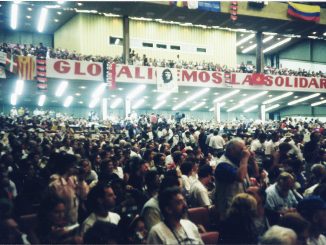
I remember my first trip to socialist Cuba in November 2000. I attended the Second World Meeting of Friendship and Solidarity. I have the poster that was given to all participants. It has a quote from José Martí: “The world is a beautiful temple where all men on earth fit in peace.”

I knew then and I know now that “all men” translates to “all of humanity.” We can all fit in peace on this beautiful earth — our home. 

The reason I went on this trip was that I wanted to see what socialism looked like.

The conference was attended by people from over 60 countries condemning the U.S. blockade.  I came with a delegation; buses took us to the many programs on our packed schedule. We visited factories, polyclinics and communities, where we learned about the Committees for the Defense of the Revolution (CDRs). There were cultural performances in these communities.

The daily events gave the delegates a chance to experience what life is like with a government that is concerned with the needs of the people rather than profits.

The delegates gathered daily at the Karl Marx Theater, within walking distance of our hotel. When I went walking, I did not feel any restrictions, though I did not wander too far.

We didn’t know if President Fidel Castro would speak at any of the conference gatherings.  I figured not – with thousands of people there, it would be a big security risk.

During our final meeting at the Karl Marx Theater, Fidel appeared on the stage. No bulletproof glass barriers, no extra security checks that I was aware of.

Fidel began to speak; we were given devices for interpretation. People listened and listened until it was time for discussion. Fidel gave lengthy, thoughtful answers to questions, not only from the delegates, but from Cuban workers. 

At one point a child ran on stage and Fidel gave him a hug and said something that I could tell was a show of affection for him and his family.

Healthcare in Cuba vs. U.S.

One of the many things that had an impact on me was when we visited one of the polyclinics. 

There was a group of doctors at the clinic, and one explained to us how closely connected doctors are with the communities they serve. They know who smokes, drinks, takes drugs (prescribed or not), struggles with mental illness, which teenagers are sexually active – intimate details that individuals voluntarily share with their doctors. Doctors know the health of families in their community through home visits and family counseling. 

Doctors were told things that we in the U.S. would not dare tell our primary health care provider, because it could mean higher monthly costs for those who have insurance coverage, or changing health care providers, which means transferring all your health history to another doctor. You can be denied coverage or even lose your job because of a chronic health issue.

Health care is a huge problem in the U.S. There have been many reforms, many updates to the system, and yet there are still millions of people who have minimal or no health insurance.

I continue to learn what socialism looks like and how participatory democracy works. I was impressed with the way Cubans at home and abroad were involved in the decision-making process of updating Cuba’s Families Code. Some 6.5  million people participated, a sincere display of democratic centralism.

As an organizer of the Socialist Unity Party’s Prisoners Solidarity Committee, one of the many things that registered with me in Cuba’s new Families Code is its promise to promote happy, healthy families. Everyone is included (great-grandparents, grandparents, aunts, uncles, nieces, nephews, in-laws, close partners), from the most senior members to the youngest, and everyone in between. You choose your family.  

It also promotes the right to a family life free from violence and unprovoked stress. A family life that values love, affection, solidarity and responsibility.  

I recently attended a day of solidarity with formerly incarcerated prisoners and families in California’s capital, Sacramento. So many things are wrong with the “criminal justice system” in the U.S., which is why we know that it cannot be reformed or updated; we must shut it down.

You can see and feel the grief and stress of the families with loved ones in prison, and of those recently released, who are having a difficult time transitioning to life outside. Housing, healthcare, jobs and community acceptance are some of the obstacles that formerly incarcerated individuals face. 

There are over 2 million people in prison in the U.S. Many more are detained in immigration centers and holding cells awaiting litigation, affecting millions of families.

Cuba: ‘We encourage family to stay involved’

Gerardo Hernández, who was one of the Cuban 5 political prisoners held in the U.S., and is now head of the Committees for the Defense of the Revolution, highlighted the differences for families in Cuba: “Our purpose is to help. We talk with the family, we encourage the family to stay involved, because it is understood that the family suffers when a loved one is incarcerated.

“Prisoners need not be discriminated against because they went to jail. Our objective is not to make a repressive action against those persons but to help those persons, who are victims themselves in many cases.”

Cuba’s neighborhood CDRs number 138,000, with over 8 million members, and continue to work on programs and solutions to the problems of petty crime, drugs and mental illness.

The United States incarcerates more of its youth than any other country in the world. Most states continue to use outdated and harmful “training school” models, confining children in remote, prison-like facilities cut off from their families and communities. 

Overcrowding and violence, prosecution of youths as adults, and the long-term consequences of incarceration on the individual’s chances for success in adulthood are huge controversies.

President Miguel Diaz-Canel stated, “before our people and the world, that in Cuba no one under 16 years of age is imprisoned!”

People in the U.S. have a lot to learn from Cuba’s Families Code, especially from the process in which it was passed. All citizens over 16 years of age were eligible to vote in the Families Code referendum. 

We must support Cuba by demanding the U.S. government end the more than 60-year blockade and remove Cuba from the so-called “State Sponsors of Terrorism” list. We must demand normalization of relations and an open dialog with Cuba.

We must learn about socialism and Cuba’s participatory democracy. Socialism is the path to a better world for everyone.

Strugglelalucha256


‘Struggle against sexual and gender violence goes hand in hand with struggle for decolonization’

Remarks by Berta Joubert-Ceci of Mujeres En Lucha/Women In Struggle at the webinar “What We Can Learn from Cuba’s ‘Code of Freedom’ for Families” on Jan. 22.

Buenas tardes compañeras y compañeros,

First, I wanted to thank Mariela Castro for taking the time to record this message. Because as we know, part of the effect of the U.S. blockade against Cuba is that the application Zoom cannot be used there.

As a member of Mujeres En Lucha/Women In Struggle, which is a member organization of the Women’s International Democratic Federation (WIDF or FDIM in Spanish), I also wanted to acknowledge the fact that Mariela’s mother, Vilma Espín, was instrumental in saving the FDIM after the dismemberment of the European socialist countries. 

At that time, Vilma was vice president while the FDIM headquarters was in Berlin. And it was her swift action of saving documents and materials from that office, securing them, that preserved the FDIM from extinction.

Compañeres, this topic is also very pertinent to our process in Puerto Rico. As a colony of the U.S., we suffer in greater degree some of the ills that affect the U.S. Violence against women and LGBTQ+ people have been on the rise, including against children. This has been fueled by a rising wave of fundamentalist religious sectors that affect the government’s actions and policies and seem to be a copy and paste of what happens in the U.S. 

So, for us here, the struggle against sexual and gender violence has to go hand in hand with the struggle for decolonization, for independence.

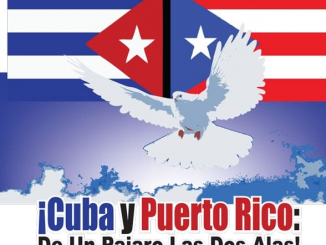
But as the poem of Lola Rodríguez de Tió says, “Cuba y PR son, de un pájaro las dos alas,” “Cuba and Puerto Rico are wings of the same bird.” We can look up to Cuba’s development and Families Code as an inspiration.

We hope to fulfill here in PR what is expressed in the introduction of the new Cuban Families Code: “The emancipatory conception of the family that guides the transformation of Cuban socialist society intertwines social interest and personal interest, promotes its development, contributes to the formation of the new generations and satisfies deep human, affective and social interests of the person.”

Strugglelalucha256


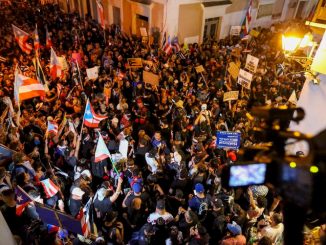
Nuevo junte electoral da esperanzas en Puerto Rico

Mientras el gobierno de Puerto Rico y sus secuaces hacen todo por vender nuestro patrimonio por medio de privatizaciones a entes extranjeros, hay sin embargo una noticia muy esperanzadora.

Y es que se está forjando una unión de voluntades de dos partidos progresistas: el Partido Independentista Puertorriqueño y el Movimiento Victoria Ciudadana, para hacerle frente a ese gobierno en el terreno electoral.

Las próximas elecciones generales están pautadas para el 2024 y un junte de estos dos partidos tiene una gran posibilidad de ganar. Ya en las pasadas elecciones demostraron que tienen la simpatía de una cantidad considerable del pueblo que votó. Y si se unen, no cabe duda de que podrían ganar la gobernación.

Pero en Puerto Rico está prohibido un frente electoral. Los partidos PNP y PPD que se han alternado en el gobierno para destruir el país, han implantado leyes en contra de la formación de cualquier unión de partidos que amenace su supremacía en el gobierno. 

Así que este nuevo junte tiene como estrategia varias vías: La Judicial, para desafiar esta ley retrógrada; la Legislativa para enmendar la ley; y la de un entendido político que exhorta a sus seguidores a votar por candidatos fuera de líneas partidistas. 

Ganar las próximas elecciones es esencial para derrotar el bipartidismo que está acabando con el país. Sabemos que lo crucial es la descolonización con independencia, pero mientras se lucha para ese último fin, se necesita urgentemente detener el saqueo, la destrucción y la migración masiva que nos deja sin boricuas mientras extranjeros millonarios se quedan con el país.

Desde Puerto Rico, para Radio Clarín en Colombia, les habló Berta Joubert-Ceci.

Strugglelalucha256


Baltimore emergency protest: Justice for Tyre Nichols, Jan. 28

Baltimore emergency protest: Justice for Tyre Nichols
Justice for Tyrone West & all victims of police brutality
Saturday, January 28 – 3:00 p.m.
Corner of North Ave and N. Charles St., Baltimore
Called by People’s Power Assembly
On Facebook
Strugglelalucha256
https://www.struggle-la-lucha.org/2023/page/74/