Sanctions imposed by U.S. and allies hamper relief and rescue work in earthquake-devastated Syria

The Syrian Arab Red Crescent demanded Western countries lift sanctions on Syria to help with rescue and relief work, February 7. Photo: SANA

The head of the Syrian Arab Red Crescent, Khaled Hboubati, demanded on Tuesday, February 7, that Western countries, specifically the U.S. and its allies, lift their siege and sanctions on Syria so that rescue and relief work can proceed unimpeded after the country was devastated by a powerful earthquake on Monday.

“We need heavy equipment, ambulances, and fire fighting vehicles to continue to rescue and remove the rubble, and this entails lifting sanctions on Syria as soon as possible,” Hboubati said at a press conference on Tuesday, as reported by the Syrian Arab News Agency (SANA).

A powerful earthquake registering a magnitude of 7.8 struck Turkey and Syria on Monday. Over 5,000 people have been reported dead so far. In Syria alone, the death toll was 1,602 on Monday. These numbers are only expected to rise as a large number of people are suspected to be still buried under the debris of houses that collapsed in the earthquake and its aftershocks.

Kahramanmaraş, a city in Turkey, was reported to be the epicenter of the earthquake, and the nearby city of Gaziantep—home to millions of Syrian refugees—was reportedly hit the hardest. Relief and rescue operations in Turkey have been affected by bad weather, as several of the affected areas received heavy rain and snowfall on Monday and Tuesday.

Syria’s northern provinces, such as Idlib, Latakia, Hama, and Aleppo, have also been badly affected by the earthquake. Some of the affected areas in Idlib and Aleppo are under rebel control and densely populated by refugees from other parts of the country.

Though several countries, including the U.S. and its allies, have extended their support to Turkey in its relief and rescue work, they have refused to extend similar assistance to Syria. The U.S. State Department made it clear on Monday that it was only willing to support some work carried out in Syria by NGOs, but that it would have no dealings with the Bashar al-Assad government. “It would be quite ironic—if not even counterproductive—for us to reach out to a government that has brutalized its people over the course of a dozen years now,” State Department spokesperson Ned Price said, as quoted by Al Jazeera.

On Monday, the Syrian government had issued an appeal to the international community asking for help. Syrian Foreign Minister Faisal Mekdad is quoted in Al-Mayadeen as having said that his government was willing “to provide all the required facilities to international organizations so they can give Syrians humanitarian aid.”

Sanctions hamper relief and rescue work

Claiming that “Current U.S. sanctions severely restrict aid assistance to millions of Syrians,” the American Arab anti-Discrimination Committee (ADC) asked the U.S. government on Monday to lift its sanctions. While it said that the NGOs working on the ground were doing a commendable job, it also said that the “lifting of the sanctions will open the doors for additional and supplemental aid that will provide immediate relief to those in need.”

The U.S. Congress had adopted the so-called Caesar Act in 2020, according to which any group or company doing business with the Syrian government faces sanctions. The act extends the scope of the previously existing sanctions on Syria, imposed by the U.S. and its European allies since the beginning of the war in the country in 2011.

The impact of sanctions on Syria’s health and other social sectors and its overall economic recovery has been criticized by the UN on several occasions in the past. The UN has also demanded that all unilateral punitive measures against Syria be lifted.

Meanwhile, countries such as China, Iran, Russia, Cuba, Algeria, and the UAE, among others, have expressed their willingness to provide necessary support to Syria, and have sent relief materials already.

Al-Mayadeen has, however, reported that the delivery of international aid, as well as the speed of relief and rescue work in Syria, continue to be impeded as the Damascus international airport is not fully operational at the moment. The airport was hit by an Israeli missile on January 2, and repair work is not yet complete.

Source: Peoples Dispatch

Strugglelalucha256


The people of France continue to denounce pension reform

On February 7, while the French National Assembly was debating the controversial pension reforms proposed by the Emmanuel Macron-led government, the working class hit the streets once again in protest. Around 2 million people took part in mobilizations held in over 250 locations across France, called by the coordination of trade unions, left-wing parties, and youth groups. The protesters demanded that the French government finance a retirement at the age of 60 with full benefits with a minimum pension of 2,000 euros (2144 USD) per month. The president of the Workers’ Party of Belgium (PTB/PVDA); Raoul Hedebouw, and a PTB delegation joined the mobilization in Paris in solidarity with the French working class. The unions have called for another round of mobilization on February 11.

The government’s plans to increase the retirement age, announced by French Prime Minister Elisabeth Borne on January 10, sparked widespread protests from the workers of  France. The government has proposed an increase in the retirement age from 62 to 64, and workers will need to have worked for at least 43 years to get a full pension, starting from 2027. On January 19, around two million people participated in the mobilizations across France against the pension reforms. A second day of protest was organized on January 31. News outlets have reported that in many cities, the level of mobilization increased to 2.8 million compared to the first strike. Macron’s first attempt to change the pension system, during the first term of his presidency, was met with protests and postponed due to the COVID-19 crisis.

The MPs from the left-wing New Ecological and Social People’s Union (NUPES) coalition in the French National Assembly resolved to resist the pension reforms in the parliament.

On February 7, while addressing the National Assembly, Pierre Dharréville MP from the French Communist Party (PCF) said, “our pensions have always been too expensive for the big owners of the economy, the great owners of our lives. Right from the first penny. Plus, they are subjected to market and speculation.”

“Doesn’t our society where labor productivity increases year after year and the alleged cost of labor is reduced year after year, have the means to preserve a real right? Where does the extra wealth produced annually go? In the wages? In retirement? No, they mostly go into the big bottomless pocket of the shareholders,” he added.

On February 7, in a communique, the General Confederation of Labor (CGT) stated that “in the context of galloping inflation, sharp rises in energy and everyday goods prices, a general price-indexed wage increase is more necessary than ever. This is one of the demands of the protesters and strikers that would also make it possible to strengthen the resources of pension schemes.”

Source: Peoples Dispatch

Strugglelalucha256


New Orleans: Stop Racist Candidate-for-Governor Landry, Feb. 12

SUNDAY, FEBRUARY 12, 2023, AT 10 AM
Press Conference: Stop Racist Candidate-for-Governor Landry
Roosevelt Hotel (New Orleans)

Landry, on behalf of his corporate donors and secret political PACS, filed lawsuits to make Louisiana workers poor and deny us our rights.

Landry has used his office to oppose a higher minimum wage, expansion of Medicaid, and workers safety. He opposes rent control, sick leave, and union rights.

Landry is a white supremacist who opposes voting rights and civil rights laws. He’s for racist electoral districting and mass incarceration. He is for running schools for profit and censoring Black history in classrooms.

Landry hates women and has led the charge against abortion access, birth control, maternal health care to impoverish and control women’s lives to enhance corporate profits.

Landry personally profits from oil and gas and receives funds from oil companies. He opposes measures to reverse climate change and protect our children’s futures. Landry criminalizes environmental protests by jailing the people on behalf of his bosses, the polluters.

Landry brutally imprisons immigrants, including children, while pushing to expand the super-exploitation of their labor. Immigrants’ rights raise citizens’ wages.

Landry is creating hate and violence against LGBTQ people, our family members and coworkers, scapegoating them to turn attention away from himself, the legislature, and the obscenely rich who are the real enemy of the people.

Join us in saying NO to Landry and his gang of bigoted thieves

Strugglelalucha256


Danish working class opposes government’s bid to abolish public holiday to raise money for arms

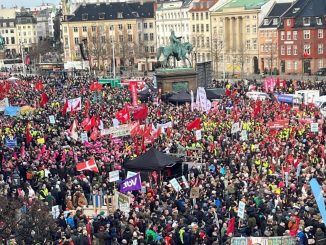
Major opposition parties, left-wing groups, and trade unions in Denmark have protested the incumbent coalition government’s proposal to abolish the public holiday on ‘Great Prayer Day’ (Store Bededag). On Sunday, February 5, around 50,000 people marched in the capital Copenhagen denouncing the government’s plan to abolish the holiday. Unionists affiliated with the Trade Union Confederation and activists from the Red-Green Alliance (Unity List), Red-Green Youth, Green Left, Socialist youth Front (SUF), Communist Party, and Communist Youth of Denmark (DKU), among others, took part in the massive rally that culminated at Copenhagen’s Christiansborg Palace Square.

In January, the government, headed by Mette Frederiksen, proposed a bill to add an extra working day to the calendar year by abolishing the public holiday on Great Prayer Day from next year. Great Prayer Day is a traditional holiday that falls on the fourth Friday after Easter Sunday and has been recognized since the 17th century.

The government’s decision to add an extra working day is part of its plan to raise an extra 3 billion kroner (USD 0.43 billion) for the rearmament of the country. The move has led to outrage from opposition parties and the Danish working class, who have condemned the attempt to abolish a paid public holiday for the sake of funding the military and weapons of war.

According to reports, the ruling Social Democrats and their right-wing coalition partners have decided to increase Danish military spending to 2% of the GDP by 2030 — against the backdrop of the ongoing NATO-U.S. proxy war in Ukraine and to cater to larger NATO plans in the Arctic, Nordic, and Baltic regions.

The Trade Union Confederation (FH) launched a petition on January 17 demanding to preserve the Great Prayer Day holiday, which had received the endorsement of approximately 467,730 people as of February 7.

On February 6, Anders T. Sorenson, editor-in-chief of the communist publication Dagbladet Arbejderen, told Peoples Dispatch that “the issue of ‘Great Day of Prayer’ is really about much more than just a day off. It is about the redistribution of wealth and a fundamental attack on the tradition that wages and working conditions are something that is agreed between workers’ organizations and employers—and without interference from legislators. I think the government has struck a nerve here that reaches into all sections of the working class. They are going to regret this attempt to pass the bill for the rearmament on to the workers.”

On February 6, Communist Youth of Denmark (DKU) stated that “the anti-worker SVM government and the other bourgeois parties in the government all agree that cuts in [spending on] the public sector and tax cuts for the richest are the way forward, with poor excuses that massive rearmament is a necessity. The abolition of [Great Prayer Day] is just a strategic disagreement in bourgeois Denmark, because in the end those in power will find a way to get the money for their mega-profits. Either way, the working class must work more efficiently for less pay, all while the capitalists’ profits grow and grow.”

Source: Peoples Dispatch

Strugglelalucha256


How the U.S. Navy blew up the Nord Stream pipeline

Seymour Hersch, the investigative journalist, has published a powerful exposé titled “How America took out the Nord Stream Pipeline.” The subtitle says: “The New York Times called it a ‘mystery,’ but the United States executed a covert sea operation that was kept secret—until now.”

Hersch reports: “Last June, the Navy divers, operating under the cover of a widely publicized mid-summer NATO exercise known as BALTOPS 22, planted the remotely triggered explosives that, three months later, destroyed three of the four Nord Stream pipelines, according to a source with direct knowledge of the operational planning.”

Hersch’s full report can be read at SeymourHersch.substack.com.


Strugglelalucha256


Socialist Unity Party honors Sam Marcy

This year marks the 25th anniversary of the death of the noted revolutionary leader, Sam Marcy. He is well known for his penetrating Marxist analysis of world events.

Based in the revolutionary conceptions of Karl Marx, Frederick Engels, and V.I. Lenin, Marcy began his many writings on the true nature of the global class war following the end of World War II.

Following the defeat of Hitler in the war, the U.S. and Western Europe turned their sights on the Soviet Union. Marcy clarified that with the buildup to the Korean War, the world had now fallen into two class camps. The Soviet Union and the recent Chinese communist revolution headed the socialist camp. The U.S., Western Europe, and Japan led the imperialist camp. His analysis spelled out how the two class camps were irreconcilable.

“It is not a war between the nations, but a war between the classes. In this war, the geographical boundaries are social boundaries, the battle formations are class formations, and the world line of demarcation is the line rigidly drawn by the socialist interests of the world proletariat,” Marcy wrote.

Marcy presented many writings and speeches that showed the many mechanisms of the class struggle outlining the role that capitalist exploitation of the working class plays in everyday life. He analyzed developments in the U.S. and in so many countries abroad throughout Africa, Asia, and Latin America. 

Marcy stressed the need for complete international solidarity with other socialist countries that fell under the military and economic attacks of the imperialist apparatus. He was a strong supporter of the many revolutionary liberation struggles. 

In his book “High Tech, Low Pay,” Marcy showed how the scientific-technological changes in the structure of capitalist industry brought with it a change in the social character of the working class. There was a massive general shift of workers away from relatively high-skilled, high-paid jobs into lower-skilled, lower-paid service jobs. 

The working class in the U.S. was opened up to include more women in the workforce as well as people of color. There was a growing proportion of Black, Latinx, Asian, Indigenous, women, and undocumented workers. Marcy saw the fight against racism and oppression as pivotal to the struggle for socialism. He boldly broke tradition by coming out in support of the early Gay Liberation movement in the U.S. He was the first socialist leader to do this in the early 1970s. 

One of his last major writings was the book “Perestroika: a Marxist Critique” in which he foresaw the pending disaster of Soviet President Mikhail Gorbachev’s policies as a complete capitulation to capitalism and imperialism. Gorbachev’s policies led to the dismantling of the Soviet Union and its allies in Eastern Europe.

Sam Marcy was a fearless fighter on behalf of the working class against capitalism. He firmly believed in the ability of the working class to act in unity to overcome our oppression and to abolish the capitalist class on the way to building worldwide socialism.

Strugglelalucha256


Gobierno de PR defiende intereses privados a costa del interés público

En PR, las organizaciones defensoras del medioambiente, no sólo tienen que luchar en contra del poder invasor yanki, concentrado ahora en una Junta de Control Fiscal que impone políticas para beneficiar a los bonistas extranjeros, sino que a la vez, tiene que enfrentar a una clase criolla de millonarios que intentan robarse y destruir el patrimonio del pueblo con el aval del gobierno. 

Esta semana, la guardia paramilitar de uno de esos criminales locales, disparó con balas vivas contra un grupo de manifestantes- incluyendo familias con sus hijos pequeños, que defendían el terreno supuestamente protegido por las leyes ambientales, en Aguadilla, que está en el noroeste de PR. Un manifestante fue herido en la pierna y tuvo que ser llevado a sala de emergencias donde la seguridad del hospital prohibió la entrada de su esposa para que no le tomara y publicara fotos de la herida.

El lugar de la confrontación es un acantilado en la zona marítimo terrestre y es techo de una cueva marítima con valor arqueológico y cultural de la presencia indígena en el área.

Este dueño millonario que se beneficia de exenciones contributivas, ha hecho caso omiso a las órdenes del tribunal y del Departamento de Recursos Naturales para que remueva las edificaciones ilegales. Sin embargo, no solo no ha removido las estructuras, sino que sigue adelantando proyectos de construcción en el área. 

Aquí la impunidad reina cuando se trata de la defensa del pueblo y sus intereses. El Estado, que ha abandonado totalmente su deber de proteger el interés público se ha convertido en el más poderoso defensor de los intereses privados y corporativos.

Pero la lucha del pueblo sigue y se extiende a pesar del contubernio de la policía, el gobierno y los agentes mercenarios privados para reprimir al pueblo. Porque ¡Solo el pueblo salva el pueblo!

Desde Puerto Rico para Radio Clarín en Colombia, les habló Berta Joubert-Ceci.

Strugglelalucha256


What’s the significance of the ‘spy balloon’ incident?

While an alleged “spy balloon” dominates the news, U.S. Secretary of Defense Lloyd Austin was just in the Philippines to announce the expansion of U.S. bases in anticipation of war with China over Taiwan.

On Feb. 2, General Austin spoke at a news conference at the Philippine military headquarters in Manila. U.S. troops, ships, and aircraft will be stationed in nine military bases in the Philippines, including a base on the Philippines’ most northern island, about 118 miles from Taiwan. This puts the U.S. military in place for a rapid operation in Taiwan.

“This is a big deal,” Austin said. “This is a very big deal.”

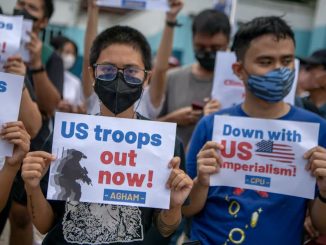
Outside the Philippine military headquarters, dozens of protesters opposed to the U.S. military occupation rallied with chants of “U.S. troops out now” and “Down with U.S. imperialism.”

As to the weather balloon, what is significant is not its presence. There have been three or more other times in the last few years that Chinese weather balloons have flown over the U.S., but none of them were reported in the news at the time.

This time the Pentagon announced the balloon’s presence “on an espionage mission.” The Pentagon managed the daily news reports, not the White House or the State Department. The generals were in charge. It was war propaganda.

All the news coverage in the U.S. called it a spy craft, never a weather research balloon, as China said.

According to a Politico report, Defense Secretary Austin, U.S. Northern Command Chief Gen. Glen VanHerck, and Joint Chiefs Chair Gen. Mark Milley were in charge, giving orders (called “recommendations” in the report) to the White House and the State Department as well as dictating the news reports.

One result was that U.S. Secretary of State Antony Blinken canceled his trip to Beijing for high-level diplomatic talks, which was to be the first secretary of state visit since Michael Pompeo’s belligerent confrontation in October 2018.

Blinken’s trip had become a focus of war hawks in Congress. Republican senators led by Marco Rubio from Florida signed an open letter to Blinken demanding that the trip be a confrontation with China, particularly focusing on Taiwan.

Signers of the letter, in addition to Rubio, were Senators Chuck Grassley, Bill Cassidy, Eric Schmitt, Dan Sullivan, Kevin Cramer, Ted Budd, Rick Scott, Marsha Blackburn, Lindsey Graham, Shelley Moore Capito, Pete Ricketts, John Hoeven, and Bill Hagerty.

Not that the Biden administration hasn’t followed or even escalated the anti-China policies of the Trump administration. In December, Biden approved $180 million in arms to Taiwan. Biden extended the ban on telecommunications equipment from China’s Huawei Technologies and ZTE. And the Biden administration instituted comprehensive restrictions on selling semiconductor chips and manufacturing equipment to China.

Air Force general says war

The Pentagon has been aggressively raising the threat levels.

In a memo dated Feb. 1 but leaked several days earlier, a four-star Air Force general instructed units under his command to begin concrete preparations for war with China that he predicted would come by 2025. Gen. Mike Minihan heads the U.S. Air Mobility Command.

Minihan’s memo seems to echo Air Force General Jack Ripper, a character from the 1964 movie “Dr. Strangelove” who orders his command wing to launch a nuclear attack on the Soviet Union.

Minihan lays out a nine-point plan as “preparation for the next fight.”

“I hope I am wrong,” he commented after the memo was made public. “My gut tells me we will fight in 2025.”

Michael McCaul, the new chair of the House Foreign Affairs Committee and the most powerful figure in the House on foreign policy, said on Fox News: “I hope he’s wrong as well. I think he’s right, though, unfortunately.”

That’s a war threat.

Japan and Australia

On Jan. 13, Japan’s prime minister, Fumio Kishida, met with Biden at the White House, the New York Times reports, “to work together to transform Japan into a potent military power to help counterbalance China and to bolster the alliance between the two nations so that it becomes the linchpin for their security interests in Asia.”

Washington and Tokyo are deliberately undermining the basis for diplomatic ties with China — the One China policy recognizing Beijing as the legitimate government of all China, including Taiwan.

“We have to protect Taiwan,” Japan’s deputy defense minister, Yasuhide Nakayama, said in 2021.

Japan had seized Taiwan in 1895, the beginning of Japan’s colonial empire in Asia.

The U.S. has secured military alliances with Japan and the Philippines that makes a north-south arc around Taiwan. A third treaty ally, Australia, is being equipped with nuclear-powered submarines by the U.S. and Britain to operate in the South China Sea. “Attack submarines are a big deal, and they send a big message,” the New York Times reported when the fleet of submarines were announced in 2021.

Today, the U.S. is the primary armaments manufacturer and exporter worldwide. Almost 40% of all armaments production in the world is in the U.S. The military industry is the core of manufacturing in the U.S., estimated to be more than 60% of all industrial production and supply in this country.

The military escalation against China was begun by the Trump administration. It should not be forgotten that Donald Trump was, first and foremost, an operative of the military-industrial complex. His cabinet and staff came from Raytheon and Boeing, as well as a slew of U.S. Army officers – generals and colonels. U.S. military expansion increased under Trump. 

Trump was the “cheerleader for U.S. arms exports.” He touted it as “making America great.” The New York Times cheered, too, saying that Trump had revived manufacturing in the U.S.

The weapons industry, of course, directly arms the military for the purpose of expansion and conquest of the world. But arms exports are another way to conquer. A country that adopts U.S. weapons and equipment puts itself under the control of the U.S. systems.

The industrial half of the military-industrial complex drives the arms buildup. It is they who are most in need of expanding the military. The military expansion is the expansion of business.

General Carl Von Clausewitz famously said: “War is the continuation of politics by other means.” And politics is concentrated economics, as V.I. Lenin pointed out. The politics producing this war buildup are the economic interests of big business.

Strugglelalucha256


Peru : “Our Demands Are Now Political” – Interview with Lourdes Huanca Atencio

A conversation with Lourdes Huanca Atencio, President of the Federation of Peasant, Artisan, Indigenous, Native and Salaried Women of Peru (FENMUCARINAP)

The peasant uprising in Peru has achieved what seemed impossible: the left and academia have been left speechless. Or at least it seems so, since their analyses have been silenced under the popular Indigenous clamor, which has organized delegations from the four “suyos” of Peru in “The Taking of Lima,” as the march to the capital has been called.

Few suspected that the removal of Pedro Castillo was more than a political crisis in partisan terms.  Rather, it was the beginning of a symbolic and historical cataclysm, threatening the very foundations of the colonial pact still in force in the country that is seen abroad as the land of electronic cumbia, magical villages, and Ayahuasca retreats.

The story begins with an electoral campaign strongly marked by racist violence directed at Castillo, a peasant and rural teacher originally from the Northern Andes. Insults such as “donkey,” “brute,” “illiterate,” and “beast,” among others, have a genealogy clearly located in the tradition of the haciendas, authentic fiefdoms under the control of a white oligarchy until their expropriation during the Agrarian Reform in 1969. Since then, colonial-racist interests have been busy maintaining the narrative of the dumb, at best naïve, Indigenous person who wastes the capitalist potential of the land and does not know what to do with freedom.

Lourdes Huanca Atencio, President of the Federation of Peasant, Artisan, Indigenous, Native and Salaried Women of Peru (FENMUCARINAP), is currently in Europe, asking for the support and solidarity of the international community.

E.F.: What motivates this tour?

L.H.A.: I have come to denounce the militarization of our country, because they are killing us one by one. Our right to protest is being brutally violated. It has reached a point where we can no longer even walk freely. To speak of peasant or Indigenous people in Peru under this dictatorial regime of terror is tantamount to being considered a terrorist. All of the government agencies are colluding, and we have no one to protect us or guarantee our rights. The police and the army shoot us at point-blank range; the legislature and the executive give orders together. The church’s pronouncements are lukewarm.

What is the human rights situation?

This began before the president was elected when, during the campaign, the press called him all kinds of racist insults. We, rural men and women, felt those insults as if they were also for us—because they were! Since Castillo’s dismissal, the response to our peaceful protest has been bloodthirsty. Sixty dead and rising, more than a thousand wounded, arbitrary arrests, missing persons, sexual violence and torture. In addition, we have evidence that the army infiltrates agents in the demonstrations to generate all kinds of disturbances and, thus, criminalize us. We have Congressmen demanding: “Shoot the terrorists.” The police are shouting at us: “Shut up, Indian!” We are in the hands of a genocidal and racist government. There are no guarantees for Indigenous lives.

What interests are behind these actions?

Those of the big transnational corporations, the mining companies, the oligopolies. This year is crucial for them in terms of renewing the concession contracts on the extractive exploitation of our territories. In the Puno region there is lithium, what they call white gold. Before this massacre took place, the U.S. Ambassador spoke with the executive branch and Dina Boluarte. Immediately after this meeting, a state of emergency was declared.

They want us as a tourist attraction, as decorative objects, as “the cholita with her llama” for their photos, not as people conscious of the knowledge they safeguard and as political agents. We know that while they poison the Earth, we cool the planet and guarantee food sovereignty. We know that cities do not feed on gold, silver, and copper, that they depend on us for food. We know that our worldview is invaluable for the survival of life on this planet. And today we have risen up against racism, against the contempt for Indigenous blood.

They thought that since Pedro Castillo was of peasant origin, it would not be difficult to get him out of the way. They believe that the impoverished education reserved for us has made us submissive, but they have been mistaken. We are not going to back down. The only thing they have left is to kill us.

What are the demands?

They are clear: dismissal of Dina Boluarte, freedom for Pedro Castillo, justice for the more than 60 murdered protesters, closure of Congress and installation of the Plurinational and Parity Constituent Assembly. Previous governments have tried to silence our demands for justice with schools and roads. It is not enough. Our demands are now political.

What does a Plurinational Parity Assembly mean?

There is an abysmal difference between what we consider “buen vivir” (good living) and what is considered development in the capital. For us, the most important things are land, seeds, and water. The Plurinational Assembly is about respect; about participating in the processes of political deliberation based on the full recognition of our value and political legitimacy. Regarding the parity aspect, we want women to be considered as agents within this construction.

What is the status of the articulation process between the different peasant and Indigenous communities, unions, associations, and collectives?

We entered into this dialogue a year and a half ago—since President Castillo took office—always with the aim of working on a new constitution. Articulation is a process and a project. It is not easy, but we are getting closer and closer to reaching consensus. It’s not only with them, though: we also need the support of the academy; the intellectuals.

Many in these communities, both academics and leftist activists, might be tempted to want to intervene in the peasant deliberation processes. Some, to this day, still think their role is to guide them. It has happened before…

We will defend our rights and demand respect. There are times when we will be open and receptive and times when we will raise our voice, as we are doing now. I respect intellectuals if they respect me, but many have to shake off the need for prominence. They don’t have the answers to everything. But we do not lose hope. We have great allies like Héctor Bejar and within some sectors of feminism.

What tasks arise from all this?

When there is an earthquake, the walls fall down. The roof falls down. But then comes the calm, and from there, an opportunity to build something better; to lay very strong foundations so that the new house is resilient. The most difficult thing will be to abandon the legacy of the neoliberal right-wing, which always puts the individual before everything. We have to unlearn a lot and turn our gaze toward the collective.

Are we at the beginning of an anti-colonial revolution?

Absolutely. Fear is over.

Elisa Fuenzalida is a researcher and cultural worker.

Source: Resumen

Strugglelalucha256


Struggle ★ La Lucha PDF – February 6, 2023

Get PDF here

  • U.S.-NATO threaten to unleash new world war
  • Baltimore demands justice for Tyre Nichols
  • Damar Hamlin’s collapse exposes NFL greed, racism
  • The ‘debt ceiling’ and our struggle to live
  • Cuban leader Mariela Castro Espín on ‘progressive conquest of new rights’
  • ‘Struggle against sexual, gender violence goes hand in hand with decolonization’
  • Cuba’s Families Code shows: Queer people need a socialist revolution!
  • ‘Indigenous communities are fighting to keep our families together’
  • ‘People in the U.S. have a lot to learn from Cuba’s Families Code’
  • End the U.S. economic war against the Cuban people!
  • Peru rejects the coup!
  • Hands off Lorena Peña
  • NATO’s top military official says it’s time to shift to a ‘war economy’
  • U.S. tanks in Ukraine: What will be the next step?
  • Marxism and mass action: Strategies for the struggle ahead
  • Tanques estadounidenses en Ucrania: ¿cuál será el próximo paso?
  • Manos fuera de Lorena Peña
  • Nuevo junte electoral da esperanzas en Puerto Rico
Strugglelalucha256
https://www.struggle-la-lucha.org/2023/page/71/