What’s the matter with Montana? Deindustrialization and political reaction

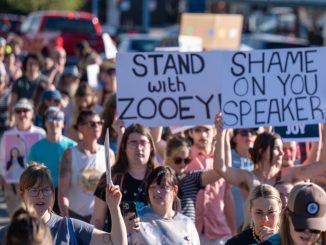
Why has the ruling class in Montana become so hateful? Transphobic bigots in the legislature banned Rep. Zooey Zephyr from speaking or even entering the chamber of the state’s House of Representatives.

Montana Gov. Gregory Gianforte signed the anti-transgender bills that Zephyr objected to, despite pleas from the governor’s son. “These bills are immoral, unjust, and frankly a violation of human rights,” said David Gianforte, who is non-binary.

The vicious legislation denies gender-affirming care to minors and endangers legal protections for transgender people. Drag shows on public property or anywhere young people might be present will be prohibited. That’s canceling everybody’s First Amendment right to free speech and could even threaten Halloween parades.

Gov. Gianforte is a super-rich thug who should have been jailed for body-slamming Guardian reporter Ben Jacobs in 2017. Jacobs had dared to ask Gianforte, who was running for Congress, a question about health care policy.

Even though Jacobs was hospitalized, Gianforte was sentenced to just 40 hours of community service and 20 hours of anger management therapy. Nobody on Fox News said the judge was “soft on crime.”

Gianforte sold RightNow Technologies, in which he had a large stake, to Oracle in 2011 for $1.5 billion. That made Gianforte the richest member of the House of Representatives for a while.

Montana Sen. Steve Daines, who was then a RightNow executive, also made millions from the deal. The 100 employees who had their jobs shipped to Texas weren’t so lucky.

The dynamic duo of Gianforte and Daines then pushed in Congress for “cybersecurity” legislation that could result in megabuck federal contracts for Oracle. 

Even though Gianforte has a degree in electrical engineering, the moneybags bully is no supporter of science. On the contrary, his tax-exempt family foundation is a big benefactor of the Glendive, Montana, Dinosaur and Fossil Museum.

This misnamed museum claims the dinosaurs and human beings lived together and even shared space on Noah’s ark. Apparently, none of the humans were eaten or died of the smell.

This junk is being fed to schoolchildren nearly 100 years after the Scopes “Monkey Trial,” in which Tennessee teacher John Scopes was fined for teaching evolution. Yet it’s Drag Queen story hours that are being banned.

Militant history of struggle

Plenty of people in Montana are disgusted by the bigots in the state legislature. In a state with a population that’s less than half that of Brooklyn, N.Y., a quarter-million people voted against Gianforte in the 2020 election for governor.

The bigots running the state certainly don’t speak for 75,000 Indigenous people living in Montana. State representative Johnathan Windy Boy, a member of the Chippewa Cree Tribal Council, defended Zooey Zephyr. He schooled the legislature about transgender people in Indigenous nations who are often called two-spirit.

The Mountain State’s lurch to the right betrays the militant history of the working class there. The Butte Miners Union was founded in 1878. Butte was known as the tightest union town on earth.

These unions, including the Western Federation of Miners, the Industrial Workers of the World, and the Mine, Mill, and Smelter Workers, waged strikes for decades.

IWW organizer Frank Little was lynched in 1917 for organizing a strike against Anaconda Copper. Future communist leader William F. Dunne carried on the struggle and founded the socialist Butte Miner, which became a daily newspaper.

Dunne, like Zephyr, was elected to Montana’s House of Representatives but was arrested on state sedition charges because of his opposition to World War I. His attorney was future U.S. Senator Burton K. Wheeler. Dunne was convicted, but Montana’s Supreme Court threw out the charges.

Havre, Montana, was the center of the American Railway Union’s 1894 strike against the Great Northern, forcing James J. Hill to rescind wage cuts.

When the former locomotive fireman and ARU president Eugene Debs ran for president in 1912, the Socialist Party candidate got nearly 14% of the vote in Montana. In 1932, Communist presidential candidate William Z. Foster and his running mate James W. Ford got nearly 18% of the vote in Sheridan County, in Montana’s northeastern corner.

Foster had been the organizer of the 1919 steel strike. Ford had been a Black postal worker in Chicago.

The Sheridan County sheriff’s office was decorated with a poster calling for the freedom of union organizers Tom Mooney and Warren Billings. The two were framed for a bombing in San Francisco and sentenced to death by hanging.

There was worldwide outrage and protests. Lenin and the Bolsheviks surrounded the U.S. embassy in 1917. President Woodrow Wilson was compelled to beg California Gov. William Stephens to commute their sentences to life imprisonment. The labor movement finally forced California to free Mooney and Billings in 1939.

Dispersing the working class

The ruling class always tries to poison public opinion. As late as 1959, Anaconda Copper owned seven daily newspapers in Montana. All of them parroted Anaconda’s lies.

A big reason for the rise of political reaction in Montana is the dispersal of the working class. Many of the mines have closed. Unions have shrunk.

Only 1,500 people in Montana still have mining jobs. Butte has a smaller population today than it did in 1920.

Anaconda is exploiting copper miners in Chile instead. The corporation celebrated the bloody overthrow of elected President Salvador Allende on Sept. 11, 1973, in which thousands were killed.

With the help of the CIA and Henry Kissinger, the corporation took back the mines that the people of Chile had taken over.

The massive 90% drop in railroad workers since 1947 particularly hurt states like Montana, which are large in land area with thousands of miles of track but sparsely populated.

The Northern Pacific, now part of Warren Buffet’s BNSF, closed its shops in Livingston, Montana. The tracks of the old Milwaukee Road line to the Pacific Northwest were largely abandoned.

Montana and neighboring Idaho have also attracted a certain number of racists and neo-Nazis. They have a nightmare vision of creating an all-white state in western Montana, northern Idaho, and nearby areas.

Idaho is even more in the grip of reaction than Montana, but it, too, has a history of labor struggles. U.S. troops were sent to crush miners’ strikes in the 1890s.

In the 1940s, Idaho Sen. Glen Taylor was the running mate of Presidential candidate Henry Wallace in the 1948 elections. They ran against racism and the Cold War. 

For defying segregation laws during the campaign, U.S. Senator Taylor was clubbed by Bull Connor in Birmingham, Alabama. As a result, Taylor was arrested and convicted for violating the segregation laws. Connor would later use dogs and fire hoses against Civil Rights Movement demonstrators in 1963.

We look forward to future struggles in Montana and Idaho as part of an upsurge of workers and oppressed peoples. Walmart employs nearly 5,000 employees in Montana. Organizing drives will win union contracts for Walmart’s workers and thousands of others in Montana and Idaho. 

Solidarity with Zooey Zephyr!


Strugglelalucha256


Never forget Jordan Neely!

Poor and working people in New York City are horrified by the lynching of Jordan Neely on May Day. They want justice administered to Daniel Penny, the ex-Marine sergeant who strangled the Black homeless man to death on the subway.

On May 3, Militant protesters filled the Lexington/Lafayette subway platform, where the train in which Jordan Neely was killed had stopped. Police arrested several of the protesters.

On May 4, hundreds gathered at the Barclays Center in downtown Brooklyn to express their outrage. Speakers, including Chivona Newsome and Hawk Newsome, co-founders of Black Lives Matter of Greater New York, denounced Neely’s lynching.

Protesters marched across the Manhattan Bridge into lower Manhattan. Drivers honked their horns in support.

On May 5, the Young Communist League organized a protest outside the office of Manhattan District Attorney Alvin Bragg, who hasn’t brought any charges against the killer Perry.

Later that Friday, hundreds of people went to Washington Square for a rally called by the Party for Socialism and Liberation; the Audre Lorde Project; ANSWER Coalition; the Palestinian Youth Movement;  the People’s Forum; and family members whose loved ones were killed by police.

Many speakers denounced the cops for releasing Neely’s killer. Jordan Neely’s half-brother Queens spoke eloquently, describing his sibling’s talents and burdens.

Eugene Puryear of the Party for Socialism and Liberation ended the rally by calling for people to march. Hundreds of people took to the streets and ended up at Union Square, where another short rally was held.

On May 6, demonstrators courageously jumped onto the subway tracks at the Lexington Ave./63rd St. station to protest Neely’s death. Police, who let the killer of Jordan Neely go free, arrested several protesters.

People are demanding justice for Jordan Neely.


Strugglelalucha256


Repression in Puerto Rico

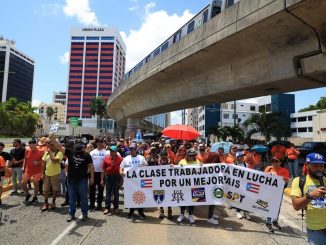
This week the priorities of this government have been very clearly exposed: on the one hand, the unjustified arrest of three well-known leaders of the union and people’s struggle during the May 1st demonstrations; and on the other hand, the false charges against Mariana Nogales, a legislative representative who is well known for her fight for the environment, for LGBTQ+ rights, and against government corruption.

There are many details in both cases, but what is really important is to know what these cases represent, which involve a police force that is under investigation for its unjustified attacks against demonstrators and a “justice” system that opens a so-called judicial process through the questionable Office of the “Special Independent Prosecutor” at the request of two complainants from the Legislature who, in themselves, are the ones who should be in the public eye accused of misogyny and corruption.

This pro-statehood NPP government, in collaboration with the pro-statehood Popular Party, has begun a campaign of hatred against protesters and their leaders and any leader like legislator Nogales, who represents a threat against their corrupt governments. In this case, Nogales belongs to the Movimiento Victoria Ciudadana, which, together with the Puerto Rican Independence Party, is advancing a joint effort to defeat the bipartisanship that has done so much damage to our country in the 2024 elections.

But, contrary to the government’s goal, what is happening is that despite the media submissive to the government’s corporate interests, there are many sectors of the people who are learning about the mafia-like and corrupt affairs of the government and its cronies, and as they say, “the tables will turn” on the government.

All our solidarity to these people who do represent us: Mariana Nogales, Eva Ayala from EDUCAMOS, Jocelyn Velázquez from Jornada Se Acaban Las Promesas, and Josué Mitjá, president of UTIER.

From Puerto Rico, for Radio Clarín de Colombia, Berta Joubert-Ceci

Translation: Resumen Latinoamericano – US

Strugglelalucha256


Cuba holds impressive May Day demonstrations on their own terms

It was pitch dark at 4:30 as we started out to find that already thousands were taking over the streets chanting, Viva Fidel! Viva Raul! And Viva Diaz Canel! Moving with purpose past the Plaza of the Revolution, turning onto La Rampa and down towards the Malecon.

This is how Cuba dawned today in celebration. It was not the customary International Workers’ Day on May 1, but it was celebrated with great enthusiasm as if it were. Tens of thousands of Cubans in the streets and avenues of their communities, with banners, flags, and lots of music. Everyone walked to the event, including President Miguel Diaz-Canel, who arrived with other leaders of Cuba; waiting for them was Army General l Raul Castro Ruz.

The familiar attendees were there: the father with his son on his shoulder, the grandfather walking holding the hand of his granddaughter, known Cuban cultural and sports figures, and our many friends from other latitudes. There were the curious eyes watching from the balconies, private sector workers, the local Conga musicians merging with their energy and rhythm carrying drums and trumpets.

Over 300 Cuban municipalities held International Workers Day events today including 100,000 people at the Malecon in Havana.

Right at 7, when the sun began to rise over the Florida Straits, the Cuban National Anthem was played, followed by music and two talks that could be heard all along La Piragua at the foot of the emblematic and renowned Hotel Nacional.

Karen Urrutia Pérez, researcher at the Center for Genetic Engineering and Biotechnology, recalled that the Cuban scientific community responded to our president’s call on May 19, 2020, when he summoned them to create their own vaccines.

“May Day, the day of the world proletariat, is commemorated in a complex international scenario because of the global economic crisis and the ravages of a pandemic that left in its wake a trail of pain and death.”

“In Cuba it is even more challenging because of the cruel imperialist blockade for more than 60 years. Today we have absolute control of covid-19 and it is due to the effective protection of our vaccines, all this thanks to the greatness of scientists and health personnel,” she stressed.

Ulises Guilarte de Nacimiento, secretary general of the Central de Trabajadores, said that the celebration of the day of the workers was preceded by the International Meeting of Solidarity with Cuba, which allowed more than 1,000 representatives of 261 political, youth, trade union, and social organizations to share with work centers and neighborhoods, “where our realities prove the ability to overcome obstacles and shortages of our people, and reaffirm the solidarity and commitment that Cuba is not alone.”

Although this year the May Day parade changes its traditional scenario -commented the union leader-, the Malecon is a space of historical and multitudinous mobilizations, many of them led by Commander-in-Chief Fidel Castro Ruz to demonstrate Cuba’s right to its sovereignty and independence, including those held to demand the return of the child Elián González and the five heroes who spent many years in US prisons for defending their country against terrorist attacks.

According to the union leader, this celebration of the world proletariat is dedicated to the daily heroism of the Cuban people, and to the high responsibility and decisive contribution of the workers to achieve a superior performance of the economy, focused on raising and diversifying food production, the use of idle productive capacities and the increase of foreign exchange income consolidating the transformations demanded today by the socialist state enterprise.

The shortage of fuel in the country prevented the traditional march that takes place every year in the Revolution Square and the main monuments of the country.

To further complicate things on May 1st, there was a risk of a serious storm so the country’s authorities decided to postpone the workers’ gathering. The day before, on Sunday, April 30, heavy rains and strong winds knocked down trees and affected part of the technical equipment due to be used on May Day, creating the necessity to move all the events to today.

The corporate media took the opportunity to cast the decision to not have a march in the Plaza of the Revolution, where thousands of workers would have to be bussed in from the provinces, as a failure of Cuba, implying that it was a defeat rather than a pragmatic decision based on what is best for the people.

El Pais, The Guardian, and others made it seem that the shortage of gas in Cuba was their fault and not the blockade and the sanctions that are piled up against the island and its ability to function with any normalcy. “A Cuba Without May Day?” a sensationalized New York Times headline read.

Writing on how the corporate media operates, Fidel once explained how they come up with repetitive negative themes about Cuba, creating a conditioned reflex that takes away the capacity for many to think critically about what they are reading.

One thing clear today was that the tens of thousands of Cubans in the streets were anything but defeated.

The celebrations today also coincide with the 205th anniversary of the birth of Karl Marx, who characterized the exploitation of man as the source of surplus value, the very essence of capitalism and was “one of the paradigms of the struggle against domination; who believed in the decisive and radical social struggle to obtain freedom for all, and believed in the need for political institutions of the workers to make proletarian policies,” as Cuban philosopher Fernando Martínez Heredia described him.

“He deserves honor as he stood by the side of the vulnerable ones,” Jose Marti wrote in 1883 after hearing about his death.

This year there was no tight parade through the Plaza of the Revolution, but the world witnessed again that the Cuban people can stand against any adversity as long as they remain united, defending causes for justice and fighting from their space for a more just Cuba. There is much work ahead, but today was a day of pride.

Source: Resumen Latinoamericano – English with contributions from Cuba en Resumen


Strugglelalucha256


Cuba Celebra Impresionantes Manifestaciones del Primero de Mayo a su aire

Estaba muy oscuro a las 4:30 cuando salimos para encontrarnos con que miles de personas ya estaban tomando las calles al grito de ¡Viva Fidel!, ¡Viva Raúl! y ¡Viva Díaz Canel! Pasamos con determinación por la Plaza de la Revolución, giramos hacia La Rampa y bajamos hacia el Malecón.

Así amaneció hoy Cuba de fiesta. No era el habitual Día Internacional de los Trabajadores del 1 de mayo, pero se celebró con gran entusiasmo como si lo fuera. Decenas de miles de cubanos en las calles y avenidas de sus comunidades, con pancartas, banderas y mucha música. Todos caminaron hacia el evento, incluido el Presidente Miguel Díaz-Canel, quien llegó con otros líderes de Cuba; esperándolos estaba el General de Ejército l Raúl Castro Ruz.

Allí estaban los asistentes conocidos: el padre con su hijo al hombro, el abuelo caminando de la mano de su nieta, conocidas figuras de la cultura y el deporte cubanos y nuestros muchos amigos de otras latitudes. Estaban los ojos curiosos observando desde los balcones, los trabajadores del sector privado, los músicos locales de Conga fusionándose con su energía y ritmo portando tambores y trompetas.

Más de 300 municipios cubanos celebraron hoy actos con motivo del Día Internacional de los Trabajadores, incluidas 100.000 personas en el Malecón de La Habana.

Justo a las 7, cuando el sol comenzaba a salir sobre el Estrecho de la Florida, sonó el Himno Nacional Cubano seguido de una animada música con baile y dos charlas que pudieron escucharse a lo largo de La Piragua, al pie del emblemático y renombrado Hotel Nacional.

Karen Urrutia Pérez, investigadora del Centro de Ingeniería Genética y Biotecnología, recordó que la comunidad científica cubana respondió al llamado de nuestro presidente el 19 de mayo de 2020 cuando los convocó a crear sus propias vacunas.

“El Primero de Mayo, día del proletariado mundial, se conmemora en un escenario internacional complejo por la crisis económica global y los estragos de una pandemia que dejó a su paso una estela de dolor y muerte.”

“En Cuba es aún más desafiante por el cruel bloqueo imperialista durante más de 60 años. Hoy tenemos el control absoluto del covid-19 y se debe a la eficaz protección de nuestras vacunas, todo ello gracias a la grandeza de científicos y personal de salud”, subrayó.

Ulises Guilarte de Nacimiento, secretario general de la Central de Trabajadores (CTC), dijo que la celebración del día de los trabajadores estuvo precedida por el Encuentro Internacional de Solidaridad con Cuba, que permitió a más de 1.000 representantes de 261 organizaciones políticas, juveniles, sindicales y sociales compartir con centros de trabajo y barrios, “donde nuestras realidades demuestran la capacidad de superación y las carencias de nuestro pueblo, y reafirman la solidaridad y el compromiso de que Cuba no está sola.”

Aunque este año el desfile del Primero de Mayo cambia su escenario tradicional -comentó el dirigente sindical-, el Malecón es un espacio de históricas y multitudinarias movilizaciones, muchas de ellas encabezadas por el Comandante en Jefe Fidel Castro Ruz para demostrar el derecho de Cuba a su soberanía e independencia, entre ellas las celebradas aquí para exigir el regreso del niño Elián González y de los cinco héroes que pasaron muchos años en cárceles de Estados Unidos por defender a su país de ataques terroristas.

Según el dirigente sindical, esta celebración del proletariado mundial está dedicada al heroísmo cotidiano del pueblo cubano, y a la alta responsabilidad y decisiva contribución de los trabajadores para lograr un desempeño superior de la economía, centrado en elevar y diversificar la producción de alimentos, el aprovechamiento de las capacidades productivas ociosas y el incremento del ingreso de divisas consolidando las transformaciones que hoy demanda la empresa estatal socialista.

La escasez de combustible en el país impidió la tradicional marcha que cada año se realiza en la Plaza de la Revolución y los principales monumentos del país.

Para complicar aún más las cosas, el 1 de mayo existía el riesgo de una fuerte tormenta, por lo que las autoridades del país decidieron posponer la concentración obrera. La víspera, el domingo 30 de abril, fuertes lluvias y vientos derribaron árboles y afectaron a parte del material técnico que debía utilizarse el Primero de Mayo, lo que obligó a trasladar todos los actos a hoy.

Los medios de comunicación corporativos aprovecharon la oportunidad para presentar la decisión de no celebrar una marcha en la Plaza de la Revolución, donde miles de trabajadores habrían tenido que ser transportados en autobús desde las provincias, como un fracaso de Cuba, dando a entender que se trataba de una derrota en lugar de una decisión pragmática basada en lo que es mejor para el pueblo.

El País, The Guardian y otros hicieron parecer que la escasez de gas en Cuba era culpa suya y no del bloqueo y las sanciones que se acumulan contra la isla y su capacidad de funcionar con alguna normalidad. “¿Una Cuba sin Primero de Mayo?”, rezaba un titular sensacionalista del New York Times.

Al escribir sobre el funcionamiento de los medios de comunicación corporativos, Fidel explicó en una ocasión cómo crean temas negativos repetitivos sobre Cuba, creando un reflejo condicionado que impide a muchos pensar de forma crítica sobre lo que leen.

Una cosa clara hoy fue que las decenas de miles de cubanos en las calles no estaban derrotados.

Las celebraciones de hoy coinciden además con el 205 aniversario del nacimiento de Carlos Marx, quien caracterizó la explotación del hombre como fuente de plusvalía, esencia misma del capitalismo y fue “uno de los paradigmas de la lucha contra la dominación; que creyó en la lucha social decisiva y radical para obtener la libertad de todos, y creyó en la necesidad de instituciones políticas de los trabajadores para hacer política proletaria”, como lo describió el filósofo cubano Fernando Martínez Heredia.

“Merece honores por haber estado al lado de los desvalidos”, escribió José Martí en 1883 tras enterarse de su muerte.

Este año no hubo desfile apretado por la Plaza de la Revolución, pero el mundo volvió a ser testigo de que el pueblo cubano puede resistir cualquier adversidad mientras permanezca unido, defendiendo causas de justicia y luchando desde su espacio por una Cuba más justa. Queda mucho trabajo por delante, pero hoy fue un día de orgullo.

Fuente: Resumen Latinoamericano – Español con aportes de Cuba en Resumen


Strugglelalucha256


Remember Khader Adnan, martyr of freedom

On May 2, Palestinian resistance leader, rights activist, and prisoner Khader Adnan died at the age of 45 after an 87-day hunger strike. He leaves behind his spouse Randa Adnan and nine children, who are now without their father. Adnan came to international prominence as a symbol of Palestinian human rights due to his continued hunger strikes against the inhumane practice of administrative detention common throughout Israel-occupied Palestine. 

The administrative detention procedure allows Israel to detain people for renewable periods of 6 months without filing charges or a trial. The IDF and other Israeli security forces use the procedure to indefinitely detain Palestinians for “activities that threaten regional security.” 

The IDF arrested Adnan for the 12th time on February 5. This was far from Adnan’s first hunger strike, but it would tragically be his last. Unfortunately, the IDF’s use of administrative detention to repress Palestinian life came to define Adnan’s own life. 

For the past 20 years, the IDF has constantly harassed and arrested Adnan for alleged political activity with the Islamic Jihad Movement in Palestine. The Jihad Movement is a militant organization dedicated to freeing Palestine from Israel’s apartheid clutches.  From all accounts, Adnan stopped his involvement with the Jihad Movement in 2005 after serving as their spokesperson for five years. 

The IDF and the Palestinian National Authority arrested Adnan five times previously. These detentions and corresponding hunger strikes were relatively short compared to the stint in 2005 and those that followed. The IDF held Adnan for 15 months without charge in 2005. In response, Adnan held a 12-day hunger strike in support of all Palestinian prisoners. This was the beginning of his more prominent hunger strikes against Israeli apartheid. 

In 2011, the IDF arrested Adnan again, even though it was 100% confirmed that Adnan was no longer the Jihad Movement spokesperson. The IDF raided Adnan’s home in the middle of the night and arrested his entire family, including Randa Adnan, who was pregnant, and their young children. One cannot help but be reminded of the Chicago Police Department’s midnight raid that resulted in the execution of Fred Hampton and injury to Akua Njeri, who was pregnant. 

While detained in 2011, IDF soldiers beat Adnan, deprived him of sleep, and made sexual-ladened threats against Randa Adnan. When Randa was finally allowed to visit him in 2012, she found him starved, dirty, and shackled to a hospital bed after a 50-day hunger strike. 

This is the true face of the enemy that the Palestinian people face every day. This is the real Israel – sexism, racism, brutality. The interrogation itself lasted 18 days. At the time of Adnan’s 2011 detention, Israel held over 300 Palestinians in administrative detention, including 21 members of the Palestinian legislative body. 

Through all this, Adnan was never formally charged or tried. Safe to say, even if Adnan organized militant resistance against Israeli forces, he would have been justified. 

Adnan was detained again in 2014, 2015, 2017, and 2021 — every time without charge or trial. And every time, Adnan refused to take the repression quietly. He never stopped fighting for the liberation of all Palestinian people. Hunger strike after hunger strike, many lasting a month or more, Adnan persisted in his cause to stand in solidarity with all political prisoners and demanded an end to Israeli apartheid. 

Mainstream media may call Adnan a terrorist or a dangerous criminal even as he no longer walks this earth. However, the Palestinian people know the truth. Anti-Zionists know the truth. We all know the truth. Adnan was neither a criminal nor a terrorist. He was a liberation fighter. He is now a martyr for the ongoing struggle for Palestinian liberation. That is how we will remember Khader Adnan. 

Khader Adnan presente! Down with Israel! From the river to the sea, Palestine will be free!

Lev Koufax is an anti-Zionist Jewish activist.


Strugglelalucha256


Harry Belafonte: problems faced by people of color are ‘as dire and entrenched as they were half a century ago’

Harry Belafonte’s album “Calypso,” which included Day-O (The Banana Boat Song) and Jamaica Farewell, reached the top of the Billboard album chart shortly after its release in 1956 and stayed there for 31 weeks. It was said to be the first album by a single artist to sell more than a million copies.

His voice stirred hearts, many wakened for the first time to the melodies and rhythms of Caribbean music. The charismatic artist soon became the first Black actor to achieve major success in Hollywood as a leading man. 

Belafonte starred in the iconic 1954 movie “Carmen Jones” with Dorothy Dandridge. 

His 1957 movie, “Island in the Sun,” was a romantic drama that dealt with social inequality and racism on a British-ruled Caribbean Island. That movie challenged the racist policies followed by the film industry. A bill was introduced in the South Carolina legislature that would fine any theater showing the movie.

Almost as soon as Belafonte’s meteoric career blossomed, it ran into the wall of racism – a barrier designed to stifle the voices and words of Black and Brown people, to erase images that evoke a dream of equality, justice, and love between people.

Belafonte refused to perform in the South from 1954 until 1961. 

When he arrived in Atlanta to appear in a benefit concert for the Southern Christian Leadership Conference in 1962, a popular restaurant refused to serve him. 

During the 1960s, Belafonte felt that Hollywood was not interested in the socially conscious films he wanted to make, and in turn, he was not interested in the roles that cast racist stereotypes. He turned to television and his 1960 TV special “Tonight With Belafonte.” 

“The show begins with images of hard labor while Belafonte belts a viscous version of ‘Bald Headed Woman.’ The whole hour is just this sort of chilling: percussive work songs, big-bottomed gospel, moaning blues, dramatically spare sets that imply segregation and incarceration, the weather system that called herself Odetta. Belafonte never makes a direct speech about injustice. He trusts the songs and stagecraft to speak for themselves. Folks — Black folks, especially — will get it. It’s their music,” writes Peter Keepnews in the New York Times obituary.

The show won an Emmy, the first for a Black performer. However, after the first show, the contract was broken. According to Belafonte, the sponsor, Revlon, asked him not to feature Black and white performers together. 

The taping of a 1968 special with director Petula Clark was interrupted when Clark touched Belafonte’s arm. The sponsor, Chrysler-Plymouth, demanded a retake. Later they apologized. Belafonte reportedly said: “The apology came one hundred years too late.”

Harold George Bellanfanti Jr. was born on March 1, 1927, in Harlem, N.Y. His father, a chef on merchant ships, was born in Martinique. He changed the family’s name. His mother, Melvine (Love) Bellanfanti, born in Jamaica, took jobs as a housekeeper. She took her son to Jamaica, where he spent some of his childhood living with relatives.

Belafonte dropped out of high school in Manhattan in 1944 to enlist in the Navy. Black shipmates introduced him to the works of W.E.B. Du Bois and other African American authors and urged him to study Black history. 

Returning to New York after his discharge, Belafonte became interested in acting and enrolled at the Dramatic Workshop, where his classmates included Marlon Brando and Tony Curtis. 

His lifelong friendship with Sidney Poitier began when both worked at the American Negro Theater in Manhattan. His first job was working as a stagehand. 

From early in their careers, Belafonte and Poitier witnessed the unrelenting persecution by the U.S. government of Paul Robeson, the legendary Black freedom fighter who sought to use his enormous artistic talent to fight against racism in the U.S. and Western colonialism in Africa.

In “My Song: A Memoir,” Belafonte wrote: My whole life was an homage to Robeson. He recalled, “Paul Robeson had been my first great formative influence; you might say he gave me my backbone. Martin King was the second; he nourished my soul.” 

Like Robeson, Belafonte fought for freedom at home and overseas. Like Robeson, he was blacklisted during the McCarthy era. 

Belafonte emerged from the Civil rights movement as a mover and shaker. During the 1963 Birmingham campaign, he bailed King out of the Birmingham, Alabama, jail and raised funds to release other civil rights protesters. He contributed to the 1961 Freedom Rides, supported voter registration drives, and helped to organize the 1963 March on Washington. 

His New York City apartment often served as a headquarters for the Civil Rights Movement. Belafonte wrote that Dr. Martin Luther King “wrote the outline to his 1967 antiwar speech denouncing the Vietnam War in my apartment.”

Belafonte described a trip with Sidney Poitier in Freedom Summer 1964 to deliver the desperately needed funds he had raised to the Student Non-Violent Coordinating Committee in Greenwood, Mississippi. The Ku Klux Klan threatened them from the moment their small plane touched down. 

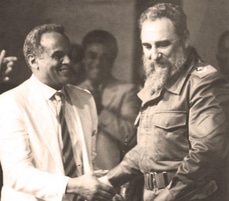
Belafonte was a longtime critic of U.S. foreign policy. He made statements opposing the U.S. embargo on Cuba; praising Soviet peace initiatives; attacking the U.S. invasion of Grenada; praising the Abraham Lincoln Brigade; honoring Ethel and Julius Rosenberg; and praising Fidel Castro. 

Belafonte was active in the anti-apartheid movement. He was a board member of the Trans Africa Forum and the Institute for Policy Studies. He helped organize a cultural boycott to end apartheid in South Africa. 

In 2005, Venezuelan President Hugo Chávez initiated a program to provide cheaper heating oil for poor people in the United States. Belafonte supported this initiative. He was quoted as saying during a meeting with Chávez, “No matter what the greatest tyrant in the world, the greatest terrorist in the world, George W. Bush says, we’re here to tell you: Not hundreds, not thousands, but millions of the American people support your revolution.” 

The comment ignited a great deal of controversy. Hillary Clinton refused to acknowledge Belafonte’s presence at an awards ceremony. AARP (American Association for Retired Persons), after naming him one of its 10 Impact Award honorees in 2006, released the statement: “AARP does not condone the manner and tone which he has chosen and finds his comments completely unacceptable.”

Belafonte and Danny Glover met with Chávez in January 2006 when they led a delegation, including activist/professor Cornel West, to meet with the Venezuelan president. 

When the people of St. Denis, France, named a street for U.S. political prisoner Mumia Abu-Jamal in May 2006, Harry Belafonte recorded a video message to be presented at the ceremony.

Speaking about Haiti in 2011 on Democracy Now, he noted that the U.S. has a pattern in looking at the devastation that takes place in regions where they have great interests. And they move in, first and foremost, to look at how to use the moment of distress to further those interests.  

https://www.youtube.com/watch?v=V-qgfRsEnJY 

In 2013, Belafonte was named a grand marshal of the New York City Pride Parade alongside Edie Windsor and Earl Fowlkes. Windsor won a legal victory for the same-sex marriage rights. Earl Fowlke is the President/CEO of the Center for Black Equity (formerly the International Federation of Black Pride – IFBP).

Harry Belafonte wrote a New York Times opinion article in 2016 urging people not to vote for Donald J. Trump, whom he called feckless and immature, a film flam man. “What Langston Hughes so yearned for when he asked that America be America again was the realization of an age-old people’s struggle, not the vaporous fantasies of a petty tyrant. Mr. Trump asks us what we have to lose, and we must answer, only the dream, only everything.”

Harry Belafonte, born Harold George Bellanfanti Jr., joined the ancestors on April 25, 2023. He was 96 years old.

Lallan Schoenstein contributed to this article.

Strugglelalucha256


Represión en Puerto Rico

Esta semana se han expuesto muy claramente las prioridades de este gobierno: por un lado, arrestan injustificadamente a tres conocidos líderes de la lucha sindical y del pueblo durante las manifestaciones del 1ro de mayo; y por el otro, le someten cargos fatulos a Mariana Nogales, una representante legislativa que es muy conocida por su lucha por el medioambiente, por los derechos LGBTPlus, y en contra de la corrupción del gobierno.

Hay muchos detalles en ambos casos, pero lo que verdaderamente es importante, es saber qué representan estos casos que atañen a una policía que está bajo sindicatura por sus ataques injustificados contra manifestantes, y un sistema de “Justicia” que abre un proceso dizque judicial a través de la cuestionada Oficina del “Fiscal Especial Independiente” a pedido de dos querellantes de la Legislatura que de por sí, son los que deberían estar en la palestra pública acusados de misoginia  y corrupción. 

Este gobierno PNP estadista, en colaboración con los estadolibristas Partido Popular, han comenzado una campaña de odio contra manifestantes y sus líderes y cualquier líder como la legisladora Nogales, que represente una amenaza contra sus gobiernos corruptos. En este caso, Nogales pertenece al Movimiento Victoria Ciudadana, que junto al Partido Independentista Puertorriqueño, está avanzando un esfuerzo conjunto para que en las elecciones del 2024, se derrote el bipartidismo que tanto daño le ha hecho a nuestro país.

Pero, contrario a la meta del gobierno, lo que sí está sucediendo, es que pese a los medios sumisos a los intereses corporativos gubernamentales, hay muchos sectores del pueblo que están conociendo los asuntos mafiosos y corruptos del gobierno y sus secuaces, y como se dice, “se le volteará la tortilla” al gobierno. 

Toda nuestra solidaridad a estas personas que sí nos representan: Mariana Nogales, Eva Ayala de EDUCAMOS, Jocelyn Velázquez de Jornada se Acabaron Las Promesas, y  Josué Mitjá, presidente de la UTIER.

Desde Puerto Rico, para Radio Clarín de Colombia, les habló Berta Joubert-Ceci

Strugglelalucha256


After years of attacking protesters, Sudan’s army and paramilitary RSF turn on each other

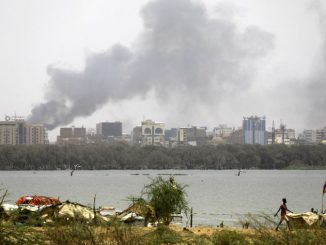
More than 500 people have been killed and 4,000 injured since fighting broke out between the Sudanese Armed Forces (SAF) and the paramilitary Rapid Support Forces (RSF) on April 15.

Groups such as the Sudan Doctors Union are worried the fighting could escalate after the evacuation of foreign nationals. Thousands have already fled the country. Over 69 percent of the hospitals in and around the conflict zones are inoperable. There is a severe shortage of medicine, food, water, and electricity.

The fighting is the latest in a series of political convulsions since massive pro-democracy protests overthrew long-time dictator Omar al-Bashir in April 2019. Army chief General Abdel-Fattah Burhan, who is the chair of the ruling military junta, and his deputy and RSF head, General Mohamed Hamdan Dagalo, aka Hemeti, were key members of Bashir’s regime. The RSF was formed out of janjaweed militias who were responsible for mass killings in Darfur during Bashir’s reign.

Burhan and Hemeti took over de facto control after Bashir’s fall and were responsible for the massacre of more than 100 protesters who were demanding civilian rule at a sit-in in Khartoum in June 2019. In its aftermath, they negotiated with right-wing parties in the Forces for Freedom and Change (FFC) coalition and inaugurated a civilian-military transitional government in August.

While this government had a civilian Prime Minister, Abdalla Hamdok, defense, police, and foreign policy were under the control of the army, with Burhan heading a ‘Sovereignty Council.’ The army controls a substantial chunk of the economy while the RSF has gorged on the mineral wealth of Darfur.

The transitional arrangement was supposed to pave the way for civilian rule. Instead, in October 2021, Burhan and Hemeti took complete control in a coup.

Throughout the years since the coup, protesters took to the streets, often in the hundreds of thousands, refusing any compromise with the junta and demanding genuine democracy and civilian control of the military. The protests were spearheaded by the Resistance Committees (RCs), a network of over 5,000 neighborhood organizations. Left forces, including the Sudanese Communist Party, were a key force too. Over 120 people were killed in the attacks on demonstrations in the months following the October 2021 coup.

Disregarding popular sentiment against any negotiations with the junta, the international community—the UN, U.S., UK, European Union, African Union, and the regional Intergovernmental Authority on Development—supported renewed talks between the junta and the FFC.

This negotiation led to the Framework Agreement in December 2022, which was to be concluded with a final political agreement that would have led to the formation of another joint government with civilians on April 11, 2023.

This plan did not materialize as the SAF and RSF turned on each other after disagreeing over the timespan for the integration of the latter into the former.

The Sudanese Communist Party has reiterated its rejection of any compromise with the junta. It maintains that international support for another power-sharing compromise after the October coup served to legitimize the junta, which eventually led to this infighting.

This article was produced in partnership by Peoples Dispatch and Globetrotter. Pavan Kulkarni and Prasanth Radhakrishnan are journalists with Peoples Dispatch and Newsclick.

Strugglelalucha256


Tras años atacando a manifestantes, el ejército sudanés y los paramilitares de las FAR se enfrentan entre sí

Más de 500 personas han muerto y 4.000 han resultado heridas desde que el 15 de abril estallaron los combates entre las Fuerzas Armadas de Sudán (FAS) y las paramilitares Fuerzas de Apoyo Rápido (FAR).

Grupos como el Sindicato de Médicos de Sudán temen que los combates se recrudezcan tras la evacuación de los ciudadanos extranjeros. Miles de personas ya han huido del país. Más del 69% de los hospitales de las zonas de conflicto y sus alrededores están inoperativos. Hay una grave escasez de medicinas, alimentos, agua y electricidad.

Los combates son las expresiones más recientes de una serie de convulsiones políticas desde que las masivas protestas pro-democráticas derrocaron al dictador Omar al-Bashir en abril de 2019. El jefe del Ejército, el general Abdel-Fattah Burhan, que preside la junta militar gobernante, y su adjunto y jefe de la FAR, el general Mohamed Hamdan Dagalo, alias Hemeti, fueron miembros clave del régimen de Bashir. Las FAR se formaron a partir de las milicias janjaweed, responsables de matanzas masivas en Darfur durante el reinado de Bashir.

Burhan y Hemeti asumieron el control de facto tras la caída de Bashir y fueron responsables de la matanza de más de 100 manifestantes que exigían un Gobierno civil en una protesta-sentada en Jartum en junio de 2019. Tras ella, negociaron con los partidos de derecha de la coalición Fuerzas por la Libertad y el Cambio (FFC, por sus siglas en inglés) e inauguraron un Gobierno de transición civil-militar en agosto.

Aunque este Gobierno tenía un primer ministro civil, Abdalla Hamdok, la defensa, la policía y la política exterior estaban bajo el control del ejército, con Burhan al frente de un “Consejo de Soberanía”. El ejército controla una parte sustancial de la economía, mientras que las FAR se han atiborrado de la riqueza mineral de Darfur.

Se suponía que el acuerdo de transición allanaría el camino a un Gobierno civil. En cambio, en octubre de 2021, Burhan y Hemeti se hicieron con el control total mediante un golpe de Estado.

A lo largo de los años transcurridos desde el Golpe, los manifestantes salieron a la calle, a menudo por centenares de miles, rechazando cualquier compromiso con la junta y exigiendo una auténtica democracia y el control civil del ejército. Las protestas fueron encabezadas por los Comités de Resistencia (RCs, por sus siglas en inglés), una red de más de 5.000 organizaciones vecinales. Las fuerzas de izquierda, incluido el Partido Comunista Sudanés, también fueron una fuerza clave. Más de 120 personas murieron en los ataques contra las manifestaciones en los meses posteriores al Golpe de octubre de 2021.

Haciendo caso omiso del sentimiento popular – contrario a cualquier negociación con la junta – la comunidad internacional (léase la ONU, los Estados Unidos, el Reino Unido, la Unión Europea, la Unión Africana y la Autoridad Intergubernamental para el Desarrollo regional) apoyó la reanudación de las conversaciones entre la junta y el FFC.

Esta negociación condujo al Acuerdo Marco, en diciembre de 2022, que debía concluir con un acuerdo político final que habría llevado a la formación de otro Gobierno conjunto con civiles el 11 de abril de 2023.

Este plan no se materializó, ya que las SAF y las FAR se enfrentaron entre sí tras discrepar sobre el plazo para la integración de las segundas en las primeras.

El Partido Comunista de Sudán ha reiterado su rechazo a cualquier compromiso con la junta. Sostiene que el apoyo internacional a otro compromiso de reparto del poder tras el Golpe de octubre sirvió para legitimar a la junta, lo que finalmente condujo a esta lucha interna.

Strugglelalucha256
https://www.struggle-la-lucha.org/2023/page/50/