Britain’s royal rip-off

Today in Britain, King Charles III will be crowned in a ‘coronation’.  All the other remaining monarchies in Europe (Scandinavia, Netherlands, Belgium, Spain) don’t bother with a coronation, but the British monarchy has had a much more prominent role in helping the British state build its huge global empire in the 19th century.  A coronation is part of the rituals developed to cement this feudal relic into the state machine.

The cost of the coronation to public funds is estimated at £100m.  The British royal family could easily afford to pay for this jamboree itself.  Recent calculations put the personal wealth of Charles at £1.8bn.  Some estimates put that even higher. The British monarch is “one of the world’s wealthiest individuals,” according to the Financial Times, owning property worth £15.6 billion as well as the £1.8 billion held in lands called the Duchies of Cornwall and Lancaster. Brand Finance, a brand valuation consultancy, puts the whole family’s wealth at £44 billion!

A key part of the monarch’s wealth is the land that they claim to own. The royal family owns more than 1% of all the land in the UK – by comparison, the top 10 landowners in the United States collectively hold 0.7 percent of the land.

The family’s right to these lands and the income earned from them is dubious.  Surely, these lands should be part of the national estate, not owned by one family.  Indeed, after the civil war in England in the mid-1640s, when England had a republic for ten years under Cromwell, these lands were nationalized.  With the restoration of the monarchy under the last King Charles, the Stuart royal family regained them.  It was the policy of the Labour Party in the 1930s to bring them into public ownership – but the Labour government after WW2 failed to implement that.

The Duchy of Cornwall estate has grown to more than 130,000 acres in 20 counties in southern England and Wales.  The assets include farmland and woodlands, as well as the Oval cricket ground in London, offices, vacation rentals and residential developments.  The family also benefits from the Crown Estate — yet another collection of land holdings, this one originating from the Norman Conquest in the 11th century. Today, this £15.6 billion ($19.4 billion) portfolio includes marquee properties such as London’s Regent Street, the Windsor Estate, shopping malls, much of the coastline and even the seabed out to 12 nautical miles offshore. Wind farm leases on the seabed are contributing to soaring profits.

Different from the duchies, the Crown Estate is managed by the government, and its profits go to the state treasury. But a set percentage then goes to the royals in the form of the “Sovereign Grant,” earmarked for official travel and entertainment, property upkeep, and staff salaries. A “golden ratchet” clause means the yearly grant can’t go down even if profits do.  The latest Sovereign Grant amounted to £86.3 million — or £1.29 per person in Britain (roughly $1.60). In addition, security for the royal family is paid for separately out of the Metropolitan Police’s budget, and this is estimated to be considerably greater than the sovereign grant.

Other parts of the British monarch’s huge wealth are in obscure possessions like the royal philatelic collection, considered the best stamp collection in the world, containing hundreds of thousands of stamps, some of which were harvested by Charles’s great-grandfather, George V, from the British Post Office and colonies, worth at least £100m.  Also, Charles’ father, Philip, and the king’s grandmother, the queen mother, were avid collectors of art and purchased many pieces at bargain prices that would, if sold today, realize many times the original price tag.  They include a Monet bought by the queen mother in Paris shortly after the second world war, when prices were low, for £2,000. An art valuer estimated it could now be worth £20m. In addition, almost 400 pieces of art that are known (there may be more) in the “private” or “personal” royal collections are valued at £24m.  Many of these were ‘gifts’ from foreign potentates.

The crown that King Charles III will wear at today’s coronation is five pounds in weight of solid gold, velvet, ermine, and gems. Another crown is adorned with 2,868 diamonds. Charles will also be handed bejeweled scepters, swords, rings, and an orb. Afterward, he will travel through the streets of London in a golden carriage.  Indeed, the value of all the 54 privately owned jewels ‘owned’ by the monarch is estimated at £533m.

And there are some other bizarre private rights.  The new king will technically own all the swans in England and Wales and a number of sea creatures, including all the whales, dolphins, and porpoises in the waters around the United Kingdom.

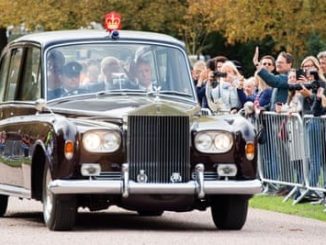
These are the physical assets, but also the royals get free services eg they live in palaces and other homes funded by the state but for their own exclusive personal use.  Indeed, there is a real difficulty in disentangling the family’s private wealth from public ownership.  The Royal family has a fleet of luxury cars for their use in public activities and events.  But these “state cars” are often used privately, such as when Princess Eugenie, who has never been a working royal, arrived at her wedding in a “state” 1977 Rolls-Royce Phantom VI worth £1.3m.

A recent policy states that gifts received in an “official capacity” are “not the private property” of the royal family. Still, the ambiguity of “official” allowed the late Queen Elizabeth to claim horses from world leaders as personal gifts that didn’t need to be declared.

And then there is tax.  Or the lack of it. Charles did not pay a single penny of inheritance tax on the fortune the late Queen left him last year.  The £1bn Duchy of Cornwall estate – previously inherited by Charles and recently passed on to his heir Prince William – is not liable for either corporation tax or capital gains tax.  The Duchy of Lancaster provides whoever sits on the throne with lucrative annual payments of around £20m a year.  Again, no tax. Charles has “volunteered” to pay income tax. As the Guardian newspaper put it: “Volunteering to pay tax feels a little like a wanted criminal volunteering to hand himself over to the authorities. It doesn’t seem to be something the rest of use typically get a choice in.”  It is compulsory for the rest of us as part of a social contract that does not apply to this royal family.

The usual response to these points is that the British monarch is doing the country a ‘public service.’  And King Charles is apparently keen to ensure that he is seen to do this.  And even more that we should all do our bit. Charles has urged everybody to celebrate his kingship by helping out at the local food bank.

The British monarchy is a particular example of an archaic feudal institution that has been converted into a capitalist one for the purpose of representing and enhancing the idea of empire.  The British empire, built up from the mid-18th century until the end of the 19th century, was one of the greatest imperialist projects ever.  Sustaining an inherited family monarchy on top was a vital ingredient in sustaining the empire.

The current British royal family are called the Windsors.  They had only a tenuous claim to being the current royal family. The royal website admits there were 52 candidates with a better claim to the throne than the Windsors’ ancestor, Georg Ludwig, Elector of Hanover, when he became George I in 1714.  So they are German in origin and were originally called ‘Saxe-Coburg and Gotha’ – until the first world war with Germany forced a name change in 1917.  The family was closely related to both the German and Russian absolute monarchies.

Many in the family have had extreme political views. A book by the US biographer Kitty Kelley, which was banned from sale in Britain, recounts that Princess Margaret, Elizabeth II’s sister, walking out of the film Schindler’s List complaining of “tiresome movies about the Holocaust”:  Kelley: “What she resented was the lingering stench of the wartime German connection that continued to hang over her family. Their secrets of alcoholism, drug addiction, epilepsy, homosexuality, bisexuality, adultery, infidelity and illegitimacy paled alongside their relationship with the Third Reich.

Few remember King Edward VIII (Margaret’s uncle), who was forced to abdicate in 1936  and who then backed Nazi Germany as Europe’s savior.  There are photographs of the future Queen Elizabeth giving the Hitler salute as a child in 1933, coached by her Nazi-supporting uncle. Elizabeth’s husband, Prince Philip of Greece, had his own Nazi links. His sisters married German noblemen, one of whom, Prince Christoph of Hesse, was an SS colonel on Heinrich Himmler’s personal staff. They named their son Karl Adolf in honor of the Führer.

The royal “traditions” being acted today supposedly stretch back deep into the history of Britain.  But the rituals of coronations, royal weddings, state openings of parliament, and state funerals are actually an artificial product developed in the 19th century to sustain the British empire.  Back in 1952, when Elizabeth II started her reign, over 70 countries and territories were part of ‘her’ empire.  But that empire was already disappearing.  At her death, Elizabeth remained head of state in only 14 countries beyond Britain.  And now, six Caribbean countries have indicated they plan to go the same way as Barbados and end the connection with the British monarchial state and its exploitation of slavery in those islands.

As long ago as 1844, Engels noted that: “This loathsome cult of the King…the veneration of an empty idea…is the culmination of monarchy”.  Yet the new monarch’s coronation will be widely celebrated and watched.  The British monarchy retains a majority of support.  According to the latest poll, of those asked, 62% of Britons favored keeping the monarchy.  But that’s down from 75% only ten years ago.  And 25% want the monarchy replaced by an elected head of state.  Moreover, among the youngest Britons (18-24 years), only 36% want to maintain the monarchy.  And a majority of Britons do not want the government to pay for Charles’ coronation.

Source: Michael Roberts Blog

Strugglelalucha256


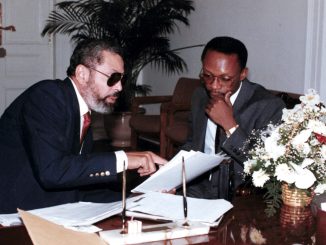
Ben Dupuy, the revolutionary whose vision and organizations radicalized and formed a generation in Haiti

The second of two parts.

(Part 1)

Haiti’s Sep. 30, 1991 coup d’état was a challenge that tested and strengthened the organizations in Ben Dupuy’s revolutionary network.

Ambassador-at-Large Dupuy was returning from an outreach trip to Scandinavia when the coup struck. After a brief stopover in New York, he quickly flew to Caracas, Venezuela (then ruled by President Carlos Andrès Perez), where he met with the now exiled President Jean-Bertrand Aristide.

The bloody, brazen coup by the Armed Forces of Haiti (FAdH) against Haiti’s nascent democracy and overwhelmingly popular young president had shocked the world. This is the moment, Dupuy told Aristide, to train and arm a liberation force to restore his government to power. Dupuy said that he could raise hundreds, if not thousands, of willing young Haitians, starting with his own National Popular Assembly (APN), who could be trained in Venezuela or another country. Aristide listened but was hesitant.

This would be the beginning of a two-year struggle between Dupuy and an opposing sector of Aristide’s Foreign Service and inner circle, which viewed the path to restoration, not as an armed insurrection from Haiti’s mountains and slums against the coup-making military, but “finding the correct levers of power” in Washington, as Haitian Ambassador to the U.S. Jean Casimir told a large gathering of anti-coup activists in Washington, DC in October 1991.

Dupuy was categorically opposed to the specter of U.S. foreign military intervention into Haiti, which from the coup’s first days, before any other Haitian diplomat, he recognized as the likely end-game of negotiations with Washington and its vassal institutions acting as intermediaries, the Organization of American States (OAS) and the United Nations (UN). The Soviet Union had just crumbled, and Dupuy saw Washington’s unipolar “New World Order” as a beast with no constraints nor scruples.

His virtually one-man crusade to foil their interventionist push was epitomized by one early 1993 meeting in which UN Secretary General Boutros Boutros-Ghali received Aristide at UN Headquarters in New York. According to his account, Dupuy practically forced himself into the meeting where he sat uninvited at the table amidst the other visibly uncomfortable diplomats and the ousted head of state.

“What would you like us to do?” Boutros-Ghali placidly asked Aristide, according to Dupuy, who sat glaring across the table. Perhaps flustered by Dupuy’s presence, Aristide beat around the bush, by Dupuy’s account, and did not ask that day for the UN to place Haiti under its Chapter 7 powers, where the Security Council takes control of a country.

However, Aristide did request Security Council intervention in a May 7, 1993 letter to Boutros Ghali and on Jun. 16, 1993, the Security Council put Haiti under Chapter 7 with its Resolution 841, thereby signaling an invasion’s inevitability.

Like Dupuy, Cuba, in a Jun. 14, 1993 letter to the Council, had argued strongly against the move, “opposing with the greatest energy the Security Council’s adoption of measures concerning the internal situation of this country” because it would create “a dangerous precedent which is in line with several previous attempts to give this body powers and a mandate which are larger than those granted in the Charter.”

“By requesting the Security Council to take up the case of  Haiti, Aristide has surrendered his leadership and control over efforts for his own restoration to an international body controlled by the very nation which had a hand in the coup which overthrew him,” wrote in a Jun. 26 statement the New York-based Haiti Commission of Inquiry into the September 30th Coup d’Etat, which was headed by Ben’s close friend and ally Ramsey Clark, the former U.S. Attorney General. “Having usurped control of the crisis in Haiti, the UN and the U.S. have begun forcing Aristide into a corner.”

In response, on Jun. 23, 1993, Dupuy resigned as Haiti’s Ambassador at Large with an open letter to Aristide that stated “without pretending to be more patriotic than anyone else, I think that it is extremely dangerous to put the country’s national sovereignty in the hands of an international organization whose real defense of the peoples’ rights, and even its impartiality, can legitimately be put in doubt at this time.”

Meanwhile, Dupuy was working feverishly on many other fronts. In December 1991, the Haiti Commission, which had Haïti Progrès cadre in its leadership, sent the first major human rights delegation to Haiti after the coup. That Ramsey Clark-led investigation was chronicled in the 1992 Crowing Rooster Arts documentary Killing the Dream, which aired nationally to great fanfare on the PBS network.

Inside Haiti, the international embargo blocked the importation of Haïti Progrès. So the newspaper sent a portable printer into the country which clandestinely produced a local version of the paper. In those pre-Internet days, the articles had to be either dictated over the phone, sent by modem-to-modem communications, or transmitted by ham radio links, which Ben had mastered in his underground operations during the Duvalier regimes.

APN cadre conducted many acts of clandestine sabotage, like chain-sawing down trees on the routes between Port-au-Prince and Pétionville to impede the transport of soldiers. Dupuy also proposed to Aristide an aerial leaflet-drop, which was later carried out by formerly-Poughkeepsie-based Haitian pilot Frantz Gabriel and democracy activist Patrick Élie.

Dupuy’s network undertook numerous other clandestine operations against the coup, but on Sep. 19, 1994, U.S. troops finally landed in Haiti, beginning a six-year military occupation that was handed off to the UN in 1995.

Despite the people’s demands, Washington did not allow Aristide to recuperate the three years he spent in exile, and in 1996, his erstwhile ally René Préval became head of state. Dupuy’s Haïti Progrès, APN, and its new U.S.-based support group, the Haiti Support Network (HSN) worked doggedly to resist and denounce the privatization campaign of Haiti’s state industries that Préval carried out.

In 1999, as the year 2000 elections approached, APN transformed itself into the National Popular Party (PPN). It was not a traditional bourgeois electoral party but followed the Leninist model of a disciplined cadre “fighting organization.”

Meanwhile, Aristide’s new party, the Lavalas Family, formed in 1996, swept 2000’s legislative and presidential elections, hoisting Aristide again to power on Feb. 7, 2001. The U.S., now led by George W. Bush, immediately began a diplomatic, economic, and political campaign to overthrow Aristide, and Dupuy, with the PPN, came to his defense.

One of Dupuy’s strong recommendations to Aristide was to drop relations with Taiwan and recognize the People’s Republic of China. Toward this end, Dupuy led two delegations to China to send out feelers and promote the project of establishing relations, but it was not to be.

Aristide was again overthrown in a second coup d’état on Feb. 29, 2004. Having foreseen this eventuality, Dupuy had trained select PPN cadre for underground operations, which they successfully carried out during the second coup d’état.

Meanwhile, in the U.S. and Canada, Dupuy spearheaded a coalition which conducted in 2005 and 2006 the International Tribunal on Haiti, which held hearings in Washington, DC, Boston, Miami, and Montreal.

In 2006, several members of Haïti Progrès left the paper to form Haïti Liberté. Following the 2010 earthquake and the U.S. facilitating Michel Martelly’s election, a split arose in the PPN and Haïti Progrès, resulting in Ben’s 2011 ouster, what he referred to as “the coup.”

By 2012, he was back in touch with his old comrades at Haïti Liberté and regularly advised the paper on its editorial line and analysis. He made several trips to New York to participate in Haïti Liberté events.

In the last decade of his life, Ben Dupuy became a familiar fixture at Miami Beach’s Tap Tap Restaurant, along with his old friend, singer and composer Manno Charlemagne, who died in 2017.

Dupuy was already suffering from emphysema, and in late 2022, a doctor suspected he may have developed lung cancer after a life-time of smoking unfiltered Pall Mall cigarettes. However, the doctor advised against treatment, citing Ben’s age and frailty of health.

Up until entering a Miami Beach nursing home in August 2022, Ben maintained regular contact with his former comrades in New York and Haiti.

Despite his body’s deterioration and some mild confusion and repetition, Ben’s mind remained sharp until his final days. As friends and family visited his bedside, he would converse with them about world events and developments in Haiti.

Until the end, he maintained his methodical intellectual approach, drawing on lessons he had learned and books he had read over his nine decades of life as he held forth, between bouts of coughing.

A long-time APN and PPN leader, Harry Numa, who tragically died in 2014, summed up Ben Dupuy’s historical legacy. “Our nation had three great ideologues in the late 20th and early 21st century,” Numa said. “Serge Beaulieu [who had Radio Liberté] was the ideologue of the Macoute sector, articulating the outlook of the grandon [big landowner] class. Jean Dominique [who had Radio Haïti Inter] was the spokesman for Haiti’s bourgeoisie. But Ben Dupuy has given voice to Haiti’s working masses, analyzed and interacted with the world from their point of view, in their interests, and engaged with them.”

The champion of Haiti’s exploited and oppressed working masses: Ben would have been very satisfied with that epitaph.

The last of his seven siblings to die, he is survived by his four children – Frantz, Mike, Regine (Gigi), and Sarah – along with seven grandchildren and five great-grandchildren.

A memorial to his life will be held at Guarino Funeral Home in Brooklyn’s Canarsie, NY on Jun. 3 from 11 a.m. to 2 p.m.

Other memorials are planned for Miami on May 28, at Haïti Liberté in June, and a final one later in Haiti.

Source: Haiti Liberté

Strugglelalucha256


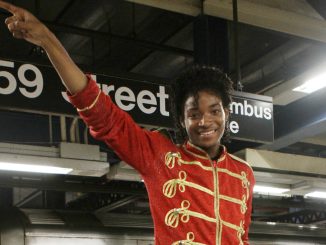
Justice for Jordan Neely! Not another lynching!

Jordan Neely was lynched because he was Black, poor, and homeless. He was strangled to death in a New York City subway car on the afternoon of May 1.

Neely’s murder is no different than the murder of George Floyd by Minneapolis policeman Derek Chauvin, who put his knee on Floyd for 9 minutes and 29 seconds. Or the death of Eric Garner, who cried “I can’t breathe” 11 times as he was choked to death by a cop in Staten Island.

It took 15 minutes to strangle Jordan Neely on the “F” subway line at the Broadway/Lafayette stop in Manhattan. The homicide was recorded on video. 

The perpetrator, Daniel Penny, a white ex-Marine sergeant from West Islip, N.Y., wasn’t even arrested by police and was allowed to leave the scene. Nor were the person or persons detained who had assisted the killer by holding down the 30-year-old Black man.

The only arrests were several people demonstrating against this racist atrocity on May 3 in the subway station where Jordan Neely died. 

The murder of Jordan Neely is linked to the campaigns against poor and homeless people by New York Mayor Eric Adams and the capitalist media. Homeless people are hounded, and police attack their encampments.

Thousands of cops infest the subway trains and stations, arresting people who can’t afford the $2.75 fare. But they couldn’t stop the murder of Jordan Neely and refused to arrest his killers. 

The U.S. capitalist government claims that its bloody trillion-dollar war machine defends freedom. Meanwhile, this regime can’t even stop lynch mobs in the capital of capitalism, New York City.

Thirty-two years ago, on March 30, 1991, 18-year-old Manuel “Manny” Mayi was murdered by a white racist mob in Corona, Queens, New York City.

The Dominican honor student who wanted to be an engineer was killed two blocks from the former home of Louis Armstrong, now a museum. None of Manny Mayi’s killers were brought to justice; some may have become police officers.

Jordan Neely was murdered on May Day when millions of workers worldwide marched for their rights. The first workers’ May Day was on May 1, 1886. Hundreds of thousands of workers demonstrated across the United States for the 8-hour workday. Their leaders, the Haymarket Martyrs, were hanged in Chicago on bogus charges on Nov. 11, 1887.

The labor movement needs to speak out against racist killings, like the lynching of Jordan Neely. We need a new Solidarity Day to fight back against hate and cutbacks.

Bring the lynchers of Jordan Neely to trial!

No Justice, No Peace!


Strugglelalucha256


Migrants are not welcome as Biden to send 1,500 troops to the border to stop them

On March 27, a fire at a migrant center in Juarez City, on the border with the United States, brought the world’s attention back to a problem that has worsened in recent years. Forty undocumented migrants from various countries in the region died in the fire. They are just a small fragment of the thousands who die and thousands more who endanger their lives while seeking asylum in the United States, where they are not welcome.

What are the causes of the increasing migratory flows in Latin America? What are the situations faced by those who decide to leave their country? What public policies are being implemented? These questions are repeated year after year, the answers are almost always the same, and the “solutions” usually exacerbate the problem.

Migration has been increasing since the second half of the 20th century due to the rising inequality, decreasing labor supply, violence, food insecurity, increasingly fierce weather events, and the absence of public policies to help the most vulnerable to escape poverty. In recent years, the COVID-19 pandemic also accelerated the increase of migrants along the shared U.S.-Mexico border.

According to a December 2022 New York Times publication, U.S. Border Patrol agents recorded nearly 2.4 million apprehensions along the entire southern border in one year. In March of this year, the number of migrants apprehended by U.S. immigration authorities increased by 25% as the Joe Biden administration prepares for a major policy shift this May.

The policy known as Title 42, which allowed for the expedited deportation of undocumented immigrants due to health reasons, will cease to be in effect. The Trump-era order is set to lapse once the national COVID-19 public health emergency expires on May 11. This week, the Homeland Security Department offered a statement to the press on what “solutions” the Biden administration will seek to contain the possible increase in border arrivals now that the nefarious Title 42 will no longer be in effect.”

After May 11th, our court-compelled use of Title 42 will end, and we will once again process all migrants under Title 8 of the United States code. The return to processing migrants under Title 8 authorities will be swift and immediate,” Homeland Security Secretary Alejandro Mayorkas explained.

But what does this Title 8 mean? First of all, it will not offer a substantial change from the xenophobic policy implemented by former President Donald Trump, so often criticized by Biden during his 2020 election campaign.

In the second place, the regulation would disqualify migrants from asylum if they enter the U.S. illegally after failing to ask for protection in a country other than the one they fled that they traversed to reach American soil. According to CBS News, the rule is likely to be challenged in court by migrant advocates, who have denounced it as a Trump-like effort to gut U.S. asylum laws.

Biden also plans to deploy more than 1,500 military troops to the border to “contain” the flow of undocumented immigrants into the country.

Biden’s desperate and erratic actions and the death of 40 people in the migrant detention center, just a few kilometers from the U.S. border, shows that the Biden Administration is clueless and the crisis is far from being solved. What happened also proves that the fate of undocumented migrants, once they are quickly removed from U.S. territory, cannot be the sole responsibility of the Mexican government.

“What happened also speaks to the internal political tensions, of Central America and other southern countries, of the caravans and the dissonance between good intentions and reality. The border is a vital and bureaucratic abyss for tens of thousands of people waiting to define their status after a long and dangerous journey through the Darien jungle,” journalist Francesco Manetto described.

There is an urgent need for more diagnostic work and research on the situation of migrants, the “criminalization” to which they are subjected, the closing of borders to vulnerable foreign populations. There is a need to make visible that migration policies based on “national security” can hardly guarantee respect for the rights and needs of migrants who are human beings in the first place.

Source: Resumen Latinoamericano – English

Strugglelalucha256


Returning Cuba solidarity activists harassed by U.S. Customs and Border Patrol

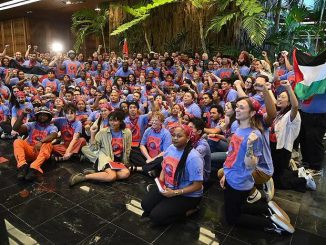
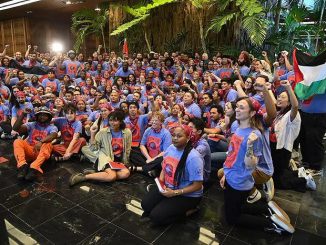
Havana, May 4 — This year marked the largest delegation of people from the U.S. in decades to be in Cuba for the events around the International Day of Workers.  Over 350 people from the states participated, and it was easy to see how youth made up the largest percentage, many of whom were visiting revolutionary Cuba for the first time.

Yesterday delegates began to return home, and some were met and detained by U.S. Customs and Border Patrol in multiple cities. One reported that several of them traveling with the International Peoples Assembly (IPA) and the LA Hands of Cuba Committee were yanked into secondary questioning pertaining to their political motives. At least two people had their phones confiscated. At this time, all have been released.

Imagine it, being harassed for being on a legal trip to the island to make friends with the Cuban people and to see for themselves the struggles that the Cuban people have had to endure while in the vice grip of a unilateral blockade that has been maintained through 13 presidents no matter which big business party was in power.

For many of us, we remember the battles at the borders as we fought to get symbolic aid to Cuba in defiance of the blockade on the Pastors for Peace Caravans, but this level of harassment has not been seen in years.

Not meaning to the Biden Administration has struck a rock because if they thought this would intimidate our growing movement in solidarity with Cuba, they are wrong. What I have seen this past week is a government here more concerned about the well-being of the next generation of U.S. youth than their own government that marginalizes them by constricting access to jobs with a living wage, which makes access to education nearly impossible without the burden of student loans that they will carry for years, and that incarcerates them at a rate like no other country in the world.

As of now, there has been no comment from the White House about the detentions but the President of Cuba has shown his concern by sending out the following message on his Twitter account.

“Cheer up guys, we’re with you. Thank you for your courage, for supporting #Cuba & for facing the hatred of those who cannot stand the fact that the Cuban Revolution has the support of the most progressive youth in the belly of the beast. We send you a big hug”. – Miguel Díaz-Canel Bermúdez. President of the Republic of Cuba.

Source: Resumen Latinoamericano – English

Strugglelalucha256


Activistas de Solidaridad con Cuba acosados por la Patrulla Fronteriza de EE.UU.

Por Bill Hackwell on Mayo 4, 2023 from La Habana

Este año marcó la mayor delegación de personas de los EE.UU. en décadas para estar en Cuba para los eventos en torno al Día Internacional de los Trabajadores. Participaron más de 350 personas y fue fácil ver cómo los jóvenes constituían el mayor porcentaje, muchos de los cuales visitaban la Cuba revolucionaria por primera vez.

Ayer los delegados comenzaron a regresar a sus hogares y algunos fueron recibidos y detenidos por la Patrulla Fronteriza y de Aduanas de EEUU en múltiples ciudades. Fueron interrogados políticamente y en algunos casos se les confiscaron los teléfonos. En este momento todos han sido puestos en libertad.

Imagínense, ser acosados por estar en un viaje legal a la isla para hacer amistad con el pueblo cubano y ver por sí mismos las luchas que el pueblo cubano ha tenido que soportar en las garras de un bloqueo unilateral que se ha mantenido a través de 13 presidentes sin importar qué partido de las grandes empresas estaba en el poder.
Muchos de nosotros recordamos las batallas en las fronteras cuando luchábamos por conseguir ayuda simbólica para Cuba desafiando el bloqueo de las Caravanas de Pastores por la Paz, pero este nivel de acoso no se ha visto en años.

No quiere decir que la Administración Biden haya golpeado una roca porque si pensaban que esto intimidaría a nuestro creciente movimiento en solidaridad con Cuba están equivocados. Lo que he visto esta semana pasada es un gobierno aquí más preocupado por el bienestar de la próxima generación de jóvenes estadounidenses que su propio gobierno que los margina constriñendo el acceso a empleos con un salario digno, que hace imposible el acceso a la educación sin la carga de préstamos estudiantiles que llevarán durante años, y que los encarcela a un ritmo como en ningún otro país del mundo.

Por ahora no ha habido ningún comentario de la Casa Blanca sobre las detenciones, pero el presidente de Cuba ha mostrado su preocupación enviando el siguiente mensaje en su cuenta de twitter.

“Ánimo chicos, estamos con vosotros. Gracias por su valentía, por apoyar a #Cuba & por enfrentar el odio de quienes no soportan que la Revolución Cubana cuente con el apoyo de la juventud más progresista del vientre de la bestia. Te enviamos un fuerte abrazo”.
– Miguel Díaz-Canel Bermúdez. Presidente de la República de Cuba

Source: Resumen Latinoamericano – English

Strugglelalucha256


Cuban president meets with over 300 enthusiastic U.S. supporters pledging to end the blockade

Havana, May 1 — This morning, Cuban President Miguel Díaz-Canel received at the Palace of the Revolution 300 friends of Cuba coming from the United States to demand an end to the blockade. Brigades, groups, and other delegations are in Cuba to take part in the May 1 activities celebrating the International Day of Workers and to show their solidarity with the Cuban people who have withstood the longest continuous blockade in modern history.

Students, trade unionists, lawyers, and political activists are here, many making their first visit to the socialist island. Recognizing this, President Díaz-Canel said: “from the United States, we not only receive sanctions and blockades, we also receive your friendship, support, trust and hope.”

The president underscored the significance of what he described as one of the largest delegations to the island in decades while acknowledging that it was made up of a combination of people who were visiting for the first time and others with a long history of solidarity and support for the Cuban Revolution.

Voices of support for Cuba

Manolo de los Santos, co-executive director of The People’s Forum and researcher at Tricontinental: Institute for Social Research, explained how the struggle of the Cuban and North American people is the same, “it is the struggle against imperialism, it is the struggle against the domination of capital over lives and the planet; and it is the struggle for that future we all want to build, where we all fit, where diversity is respected, where there is social justice.”

He further noted that the delegation he brought has witnessed the strength of the Cuban people, how they resist and bring out the best of their creativity. “Our commitment upon our return will not only be to raise our voice, but to organize a different political project in the United States. We will always be by Cuba’s side,” he said.

Chris Smalls, a trade unionist who organized and founded the first Amazon warehouse union, was on the island for the first time and spoke about the immediate affinity that he felt with the Cuban people. “We have to build support against this cruel blockade. We have shown that when young people unite, it is impossible to impede the will of the people.”

Smalls recalled how after the union victory, President Biden invited him to the White House and told him that he was making a good kind of trouble and to keep it up. “That is exactly what I am doing today making trouble by calling for the end of the Blockade”

Although he acknowledged that he is aware that when he returns to his country, he will face many accusations for being here today, his message to Cuba was very clear in his words: “We love you, and we will fight with you until the blockade is lifted”.

Bill Camp, a labor leader in California who has been instrumental in getting labor council resolutions passed throughout the state to get Cuba off the List of State Sponsors of Terrorism, clearly stated the inspiration of many in the hall by saying, “We honor Cuba’s leadership because you have set the right course and we are very happy to be here”.

Many young people spoke, including Calla Walsh and Shaquille Fontenot, new co-chairs of the National Network on Cuba, who talked about the work ahead for the US solidarity movement, including a national protest to get Cuba off the unfathomable list of State Sponsors of Terrorism to be held at the White House on June 25th.

A better world is possible

In his words, the Cuban President shared how much it means to hold meetings like this one “with representatives of the American people, with representatives of the American workers, with representatives of the American youth, who come with this message of encouragement and support, which we know also requires an effort and has a price for you, because you must then face the hatred of those who are against Cuba, the hatred of those who are against the most progressive ideas in the United States.”

The blockade, above all, he stressed, is a “violation of the human rights of Cubans and condemns a people to vicissitudes that can only be explained by the arrogance of the policy of the United States Government.”

But be assured that “this is a people that has had the capacity, in the midst of so much aggression, to never confuse the genocidal policy, the criminal policy, the aggressive policy of the United States Government, with the kindness, friendship, values, culture and history of the American people.”

Source: Resumen Latinoamericano – English with contributions for Cubadebate and Granma

Strugglelalucha256


U.S. judicial system’s bias against workers

There are various concepts of the law. One often hears reference to “Constitutional Law.” The U.S. Constitution, with the passage of the Judiciary Act of 1789, did not extend equal rights to people kidnapped from Africa, the Indigenous population, women and other oppressed genders, or those without property — only white men with substantial property holdings. Constitutional law was written primarily to protect the rights of private property. This “Constitutional law” is presented as intractable rules carved into marble, with the upholders as sacrosanct.

At the same time, others call on the law to protect and support the advance of human society. Recently this concept of the law was affirmed in Cuba by the passage of the 2022 Family Code. In a 2022 referendum, 87% of the entire population approved a constitutional reform that provided for the protection of all forms of families, ­including chosen families; the rights of children, elders, and the right of people with disabilities to independence, ­dignity, accessibility; the right of gender equality, including for trans and nonbinary Cubans; and a duty to contribute to the family and recognition of the value of domestic labor; and finally the institutional and community responsibility to uphold these rights.

In a debate on the U.S. judiciary, various U.S. Republican and Democratic think tanks raise the difference between elected and appointed judges. While they acknowledge that elections are a more democratic option, they claim that judges and judicial rulings should be based on an “objective interpretation of the law and therefore must not be influenced by public opinion.” 

U.S. federal judges, Supreme Court justices, Court of Appeals judges, and District Court judges are nominated by the President and confirmed by the Senate. State judges are chosen by appointment or an election.

Corporate lawyers who become judges

A study conducted by Emory University found that former prosecutors and corporate lawyers make up nearly 7-in-10 judges in the federal district courts, which consider cases over employment, immigration, the environment, and other topics.

Judges appointed by former President Barack Obama who have a background as prosecutors are most likely to decide in favor of employers. Obama-appointed judges with corporate backgrounds are 36% less likely to rule on behalf of employees.

Further, former President Donald Trump’s judges are overwhelmingly white and male, with one-quarter coming from the country’s 200 biggest law firms.

After an investigation of judicial stock holdings in the U.S., the Wall Street Journal reported in 2022 that 152 federal judges improperly heard 1,076 court cases between 2010 and 2018 in which they or their family members owned shares of companies that were plaintiffs or defendants in the litigation. In two-thirds of those cases, they ruled in favor of the company.

The Supreme Court

Public opinion on the nature of the Supreme Court has sunk to an all-time low, and in December, Chief Justice John Roberts urged, “We must support judges by ensuring their safety.” However, he notably said nothing about the revelations of the judges’ gross breach of ethics.

A ProPublica report on April 6 centered public attention on Harlan Crow, a Dallas, Texas, real estate magnate who has given more than $13 million in publicly disclosed political contributions to right-wing political campaigns and judicial appointments.

Featured in the ProPublica report were Crow’s undisclosed contributions to Supreme Court Justice Clarence Thomas and his wife, far-right activist Ginni Thomas. Ginni Thomas co-founded the secretive right-wing strategy group Groundswell with Steve Bannon.

ProPublica details trips gifted by Crow in super yachts and private jets for luxurious holidays at properties owned by Crow in Indonesia, New Zealand, California, Texas, and Georgia. 

Harlan Crow is also involved in refurbishing and selling a Thomas property in Savannah, Georgia.

The mainstream media reports on the Thomas bribes often contrast them to the “untarnished ethical standards” of the other Supreme Justices.

Chief Justice John Roberts has declined to respond to a Congressional request to investigate Justice Clarence Thomas. Since he became Chief Justice in 2005, his spouse Jane Roberts began a career as a legal recruiter, earning more than $10 million in commissions from a host of elite law firms and corporations. At least one of those firms argued a case before Chief Justice Roberts after paying his spouse hundreds of thousands of dollars. “There are many paths to the good life,” Jane Roberts reportedly said. “There are so many things to do if you’re open to change and opportunity.”

Roberts appears to be overwhelmed with revelations such as this and scandals involving his cohorts.

For example, Politico reported that Supreme Court Justice Neil M. Gorsuch gained nearly $2 million in the sale of a 40-acre property on the Colorado River. It was sold to Brian Duffy, chief executive officer of the prominent law firm Greenberg Traurig in May 2017, just one month after Gorsuch was sworn in as a Supreme Court associate justice.

The Greenberg Traurig law office represented the state of North Dakota in a dispute over the Environmental Protection Agency’s authority in regulating carbon emissions as part of the Clean Air Act.

Gorsuch was part of a six-member majority on the Supreme Court that ruled last June in favor of North Dakota and other Republican-led states to cut back the EPA’s authority to regulate carbon emissions from existing power plants.

Funding a far-right agenda

Scalia Law School at George Mason University in a Virginia suburb of Washington, D.C., was funded with $30 million by Leonard Leo, an executive of the Federalist Society, in 2016.

Leo’s scheme is to shift the federal judiciary to a far-right agenda. He boasts of significant ties to the Vatican. He has spent millions of dollars in television advertisements attacking schools for teaching “critical race theory” and “WOKE agendas.” His initiatives are financially supported by an opaque, sprawling network of wealthy patrons such as the Koch Foundation, usually through anonymous donations commonly called “dark money.”

The network has spent nearly $504 million, including grants to about 150 allied groups. Leo’s efforts have been turbocharged by an unusual $1.6 billion infusion from Barre Seid, a Chicago electronics manufacturing (Tripp Lite) mogul, in late 2020.  

Among the school’s most notorious alumni was William Consovoy, a Supreme Court clerk who helped persuade the high court to strike down key provisions of the Voting Rights Act.

The Scalia law school faculty includes Justice Gorsuch, Justice Thomas, and Justice Kavanaugh.

Documents show how Scalia Law has offered the justices academic cocoon, where their legal views can be promoted, where they are given top payouts and treated to “teaching” trips abroad, where their personal needs are anticipated from lunch orders to – in Justice Gorsuch’s case – house hunting.

When the law school courted Gorsuch in 2017, it asked him to help choose the Italian city where he would co-teach a seminar on national security and the separation of powers. A memo offered options including Padua (a “first-tier city in a picturesque setting”), Venice (with a “seven-mile-long-sandbar known as Lido”), and Bologna (“Italy’s most prestigious academic city”).

 “Fantastico!” Gorsuch responded.

As a Roll Call report points out, the Supreme Court justices have no formal limits outside the annual financial disclosure requirement. “Other federal judges are bound by the Code of Conduct for U.S. Judges, which places strict limits on honorariums, gifts and political activity. But the code does not apply to Supreme Court justices.”

Justices Gorsuch and Kavanaugh each made salaries approaching $30,000 for teaching summer courses that generally ran for up to two weeks. 

Many justices have augmented their government salaries, roughly $300,000, by holding classes at schools including Harvard, Duke, and Notre Dame.

Justice Amy Coney Barrett, Trump’s final appointee to the high court, recently felt obliged to say, in a speech at the University of Louisville, “My goal today is to convince you that this court is not comprised of a bunch of partisan hacks.” Barret is a longtime faculty member at Notre Dame.

The Scalia law school creates the perks programs for the justices in far-flung locations. Justice Gorsuch has traveled to Iceland and Italy to teach; Justice Kavanaugh has taught in Britain. 

Gorsuch, Kavanaugh, and Thomas regularly used the employees in their chambers to coordinate their outside academic duties in performing activities for which extra compensation was to be received. 

“The school has also been able to entice the court’s liberals: Justice Elena Kagan, who has called for the court’s conservative and liberal wings to rediscover ‘common ground,’ Kagan joined Justice Gorsuch as a distinguished guest when he taught his summer course in Iceland in 2021. Justice Sonia Sotomayor spoke on a Scalia Law panel with him the same year,” the New York Times reported.

Strugglelalucha256


Free Mumia Abu-Jamal! Free Leornard Peltier! Free Them ALL!

Talk given by Gloria Verdieu of the Socialist Unity Party at the May Day rally in San Diego.

Freeing Political Prisoners is a Working-Class Struggle. Why? It is our class, our families. Our youth, brothers, sisters, aunts, and uncles, are being locked up.

Employed and Unemployed; Organized and Unorganized; Unionized or not! We are the Working Class! It is up to us to Free All Political Prisoners! Our Elders are facing death by incarceration, and our brothers, sisters, and youth are spending decades in prison.

The Power is in the hands of the Working Class. 

Freeing All Political Prisoners is our Struggle.

Let me give you an example; in 1999, when Mumia’s death sentence was signed for the second time, the International Longshore Workers Union Local 10 in San Francisco, the most radical union in the United States, shut down all 29 ports on the West Coast to stop the execution of Mumia Abu-Jamal and just recently on Feb. 16 Local 10 shut down 16 bay area ports demanding Judge Clemons to grant Mumia a new trail to prove his innocence. Imagine if all the unions across the nation had taken the same action.

We need a movement of millions of the poor, of workers, women, youth, students, prisoners, and all people dedicated to change, to build independent organizations that can’t be bought or sold and will do the work necessary to be free.

We need a movement of millions that is anti-imperialist, anti-racist, and that unites us, not divides us.

We need a movement of millions in the United States, and we must begin right here.’

Bring Mumia Abu-Jamal and Leonard Peltier home!

Free all Political Prisoners! End Mass Incarceration! 

Shut down the Prison Industrial Complex!

What’s the Call?  Free Them All!


Strugglelalucha256


U.S. imperialism and the fight for trans rights

Strugglelalucha256
https://www.struggle-la-lucha.org/2023/page/51/