Workers at Target attacked by far-right

Newsflash: The anti-LGBTQ+ bigots are anti-worker

The far right’s agitation around corporate brands is not limited to boycotts and outlandish social media posts. They are harassing and threatening retail workers in person. When Target pulled back Pride merchandise in response to the far right’s bullying tactics – likely emboldening these neo-fascists – it was in the aftermath of real disturbances that occurred in stores.

The Washington Post describes multiple incidents at one Target location in South Florida, where workers have been confronted by bigots calling them “groomers.” At this same location, a manager wearing a safety vest over a Pride shirt was told by a customer, “Oh, is that so I could shoot you easier?”

Part of a broad trend

Retail workers are no strangers to customer attacks, which rose during the COVID-19 pandemic. UNI Global Union, an international service workers’ union federation, released a 2022 report with data from 20 countries showing a dramatic increase in abuse and physical violence against workers, including workers in the U.S. being shot to death for asking customers to wear masks. For example, in Decatur, Georgia, cashier Laquitta Willis was murdered by an irate customer over masking.

The recent anti-LGBTQ+ incidents in stores can be considered in relation to that trend. And the political link is not incidental. The same far right promoted conspiracies during the pandemic and opposed basic public health measures, ratcheting up tensions at a time when social solidarity was quite literally a matter of survival.

Anti-LGBTQ+ panic is anti-worker

With some 500 anti-LGBTQ+ bills being rammed through state legislatures, the fascist shock troops on the ground – the ones causing trouble in stores, libraries, and other public places – are attempting to scare LGBTQ+ people back into the closet. We will not let them succeed, but their intentions should be clear.

It is coming from the top. The same politicians implementing austerity are promoting queer and trans panic. They are enemies of the working class, and their attacks on LGBTQ+ people are meant to divide workers.

All retail workers are endangered by this onslaught, regardless of gender and sexual orientation. Any worker can get harassed by a bigot. If a shooter decides to open fire in a store, it will not be only queer and trans people who die. All policy goals and outcomes aside, this fact alone should demonstrate the anti-worker nature of this astroturfed movement.

Target workers rally for hazard pay and PPE. Photo: Target Workers Unite!

The problem of pinkwashing

Target and other corporations are no friends of workers or LGBTQ+ people.

Target has used union-busting tactics as workers organized in recent years. The bosses have fought against the national rank-and-file effort, Target Workers Unite!, which seeks to unionize stores. 

Despite those efforts, last year, Target workers in Christiansburg, Virginia, got as far as filing for a union election with the National Labor Relations Board – a major achievement, especially considered in relation to the big organizing wave, including Amazon and Starbucks unions.

Early in the pandemic, Target workers forced the company to implement safety measures. Management tried to prevent employees from wearing masks. On May Day 2020, some 200 Target workers across the U.S. staged a sick-out, which likely helped force the company’s hand to implement $2-an-hour hazard pay and improved protections. Target Workers Unite! was instrumental in organizing the sick-out.

In addition, radical LGBTQ+ activists have long sounded the alarm about handing Pride over to corporations, banks, police, municipalities, and the military. We have seen the dangers of this play out recently when Pride events were canceled in Tampa and other Florida cities after Ron DeSantis signed an anti-drag bill into law.

Revolutionary, anti-imperialist LGBTQ+ people have also called out the cynicism of imperialist governments and complicit NGOs when they use LGBTQ+ people, women, and other oppressed groups as props to justify war and sanctions.

Danger of right opportunists in progressive movement

Today, a section of people formerly on the left are now re-aligning with the neo-fascist right. Largely informal networks, these groupings have gone by various names, such as “patriotic socialists” and even “MAGA communists.” Despite the titles they give themselves, these people are anti-communist, and share many characteristics with historical fascists, such as making vague diatribes against “elites.” All the while, they tail behind the likes of Trump and DeSantis, whose policies are emphatically anti-worker.

These people obfuscate matters by asserting that because corporations have attempted to attract LGBTQ+ consumers with PR and merchandising, then the LGBTQ+ movement must itself be bourgeois.

The reality is that Pride started as a riot, led by working-class Black and Brown trans people. The struggle for basic rights, including for humane treatment during the AIDS epidemic, was hard and heroic. As with Civil Rights, womens’ rights, and other struggles, it resulted in real gains, however limited by the continued existence of capitalism and co-option by the Democratic Party.

The capitalists adapted to changing situations. They learned to take advantage of the new social landscape, of the terrain transformed by struggle. This is why some corporations sponsor official Pride events and try to seem progressive in general. These facts should neither surprise nor confuse us.

Nevertheless, with the current neo-fascist trend – intensifying as bourgeois democracy declines – it has become increasingly clear that the capitalists are just as ready to cast off all those trappings of “tolerance.” 

The dictator Augusto Pinochet certainly did not pander to progressive forces in Chile after the U.S-backed coup murdered the democratically elected socialist president, Salvadore Allende, inaugurating the global “neoliberal” period. (Some erroneously conflate the austerity economics of neoliberalism with “social liberalism” or progressive politics in general).

Politicians like Ron DeSantis represent a section of the ruling class pushing for that direction. They are ready to destroy every single gain made by workers and oppressed people to extract the last bits of value as the planet burns.

When the formerly left, now right opportunists join in the chorus against “wokeness,” echoing Tucker Carlson and others, we should have no problem recognizing them for what they are: a renegade section of the movement aligning themselves with thoroughly anti-worker neo-fascism.

Today’s revolutionary movement should not give an inch to any of these forces. We need a united working-class movement prepared to confront all attacks with unshakable solidarity.

Strugglelalucha256


Cuban official condemns Wall Street Journal’s claim about Chinese base as ‘unfounded’

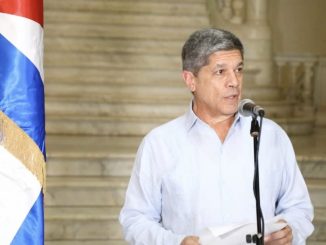
Cuba’s Vice Foreign Minister Carlos Fernández de Cossío held a press conference on the afternoon of June 8, wherein he rejected accusations leveled by US corporate media giant The Wall Street Journal that the island had reached a “secret” agreement with the Chinese government to establish a spying base. He said the information the WSJ published was “completely dishonest and unfounded”.

The report authored by Warren P. Strobel and Gordon Lubold called the alleged agreement a “brash new geopolitical challenge by Beijing to the US” and claimed that the “eavesdropping facility in Cuba, roughly 100 miles from Florida, would allow Chinese intelligence services to scoop up electronic communications throughout the southeastern US, where many military bases are located, and monitor US ship traffic.”

The “exclusive report” was published in the early hours of June 8 and cited “US officials familiar with highly classified intelligence” as its key source for the information about the agreement.

The rest of the report uses contextual information and conjectures to make the primary allegation more convincing. The authors claimed that Beijing would likely cite the fact that the US has military and intelligence activities close to China to justify its alleged base in Cuba. They highlight that “US military aircraft fly over the South China Sea, engaging in electronic surveillance” and that the US sells arms to Taiwan and sails Navy ships through the Taiwan Strait.

The authors also point to Cuba’s current economic crisis in an attempt to make their point even more convincing stating “China has agreed to pay cash-strapped Cuba several billion dollars to allow it to build the eavesdropping station.” (emphasis added)

The report released by the Dow Jones-owned outlet has been widely criticized and many have questioned the veracity of the claims given the similar occurrences such as the “Havana Syndrome” allegations which formed the basis for the application of over 200 unilateral coercive measures by the administration of Donald Trump and was eventually debunked.

Vice Foreign Minister Cossío stated in the press conference that “All these are fallacies promoted with the deceitful intention of justifying the unprecedented tightening of the blockade, destabilization, and aggression against Cuba and of deceiving public opinion in the United States and the world.”

The official also affirmed that Cuba is a signatory of the Declaration of Latin America and the Caribbean as a Zone of Peace and as such “reject[s] any foreign military presence in Latin America and the Caribbean, including that of numerous bases and military personnel of the United States, especially in the military base that illegally occupies a portion of the national territory in the province of Guantanamo.”

Manolo De Los Santos, co-executive director of The People’s Forum wrote, “Trump invented “Havana Syndrome” as the excuse to place 243 new sanctions on Cuba. Biden is more imaginative and invents a Chinese ‘Spy Base.’ What will come next in Washington’s aggressive foreign policy towards Cuba?”

Source: Peoples Dispatch

Strugglelalucha256


Is Washington seeking to fabricate a casus belli against Cuba?

The fake media machinery, obeying the dictates of the U.S. government, has started a new dangerous and infamous campaign against Cuba.

According to the U.S. newspaper The Wall Street Journal, which had the “honor” of putting the lie into circulation, there is an agreement between Cuba and China, in military matters, for the installation of an alleged espionage base.

The Fake News was immediately spread by other media, among them, CNN and Deutsche Welle, which misinformed its readers with the statement that “China will install a large base in Cuba to spy on the U.S.”.

Carlos F. de Cossio, Vice Minister of Foreign Affairs, denied from Havana, the allegations made by the media outlets, about the existence of plans to install a base of the Asian country on Cuban soil.

“Regardless of Cuba’s sovereign rights in defense matters, our country is a signatory of the Declaration of Latin America and the Caribbean as a Zone of Peace, signed in Havana in January 2014”, stated Cossio.

He also ratified the island’s position of rejecting all foreign military presence in Latin America and the Caribbean, including that of numerous US military bases and troops, especially in the military base that illegally occupies a portion of the national territory in the province of Guantanamo.

This is not a light accusation; behind this false news lies the intentions of reactionary sectors in Washington that seek to justify the intensification of the blockade and escalate aggressive actions against the island.

It is part of a premeditated and sustained process aimed at destroying credibility, delegitimizing the government and justifying any punitive measure. Even though the Pentagon denied the article the lie has been set into motion.

Including Cuba in black lists of all kinds, accusing it of “threatening the national security of the U.S.”, in addition to the immediate effect on economic relations with the world, is aimed at destroying the reputation of the island, depriving it of international solidarity, isolating it from the world, so that no one will act against its aggressors in case they decide to use force.

Discrediting, through coordinated attacks, using all the resources of technology, carrying out long-lasting black campaigns, without rest, that psychologically affect the aggressor, that lower his self-esteem, that diminish his credibility and legitimacy, is part of every fallacy that is gestated against the Island.

The machinery of infamies, lies and provocations set in motion acts against Cuba with the objective of fabricating a casus belli (justification for war).

Raul Capote is a professor, researcher and a special correspondent for Resumen Latinoamericano

Source: Cuba en Resumen

Strugglelalucha256


Xiomara Castro arrives in China for historic 6-day visit

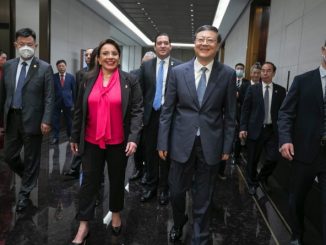
Honduran President Xiomara Castro has arrived in China on Friday, starting what is called by both sides a “historic visit.”

This is Castro’s first visit to China. She is also the first Honduran President to pay a state visit to the country. Her visit comes on the heels of the inauguration of China’s Embassy to Honduras, less than three months of the establishment of diplomatic relations between China and Honduras.

Hailing bilateral ties has ushered in a new chapter at a quick pace, officials and experts from both countries hold confidence that cooperation on multiple fields and closer exchanges are about to set off in full swing.

‘A historic meeting’ 

Castro would visit China from June 9 to 14 and she wrote on Twitter “the refounding of Honduras demands new political, scientific, technical, commercial and cultural horizons.”

“We are delighted to visit China and will travel with the President to several cities so that we can get to know each other and strengthen our bilateral relations, fostering an everlasting China-Honduras friendship,” Hector Zelaya, secretary of Castro, said in an interview with the China Media Group (CMG) ahead of the visit.

During Castro’s visit, the two heads of state will have a historic meeting to jointly chart the course for further growth of bilateral relations, according to the Chinese Foreign Ministry.

Discussions between the two leaders are anticipated to center around the augmentation of Honduras’ agricultural exports to the Chinese market, extending China’s investment in Honduras, and collaborative endeavors under the Belt and Road Initiative, forging paths towards shared development and connectivity between the two countries.

“China looks forward to working with Honduras and taking this visit as an opportunity to deepen mutual trust, expand cooperation, enhance friendship, and promote the steady and sustained development of the bilateral relations,” said Wang Wenbin, spokesperson for the Chinese Foreign Ministry, on Wednesday.

Quick-pace development 

On March 26, 2023, China and Honduras officially established diplomatic relations, opening a new chapter for bilateral relations.

Officials from both countries said that since the establishment of diplomatic ties, the two countries have delivered on their commitments and worked together with a sense of urgency to bring bilateral relations to a fast track with the principles and objectives of mutual respect, equality, mutual benefit and common development in mind.

Members of the media were in the first Honduran delegation to visit China after the two countries established diplomatic ties.

From April 30 to May 9, about 30 reporters from Honduran radio, TV, newspapers and social media platforms, visited Chinese cities, including Guizhou, Chongqing, Zhejiang, Jiangsu and Shanghai, to experience the country’s economic, social and cultural development on different dimensions.

On June 2, Castro appointed Salvador Moncada as the first ambassador of Honduras to China.

Three days later, the inauguration ceremony of the Chinese Embassy in Honduras was held in Honduran capital Tegucigalpa.

All the Chinese diplomats at the embassy, representatives from the Honduran government and National Congress, renowned figures from various sectors, members of the diplomatic corps and representatives from Chinese institutions and the Chinese community in Honduras attended the event.

“The newly opened Chinese Embassy in Honduras will serve as a bridge between the two countries for deeper political mutual trust, more practical cooperation and closer friendship between the two peoples,” said Wang at Tuesday’s press conference commenting on the event.

‘Great potential, great benefits’ 

Noting that establishing Honduras-China diplomatic ties is an independent and courageous historic decision, Manuel Antonio Diaz, attorney general of Honduras, said that no country can ignore China’s status and role in the global economy, finance and trade.

According to Chinese Customs statistics, trade between China and Honduras reached $1.589 billion in 2022.

Honduran Foreign Minister Eduardo Enrique Reina told CMG that the two countries will begin trade talks “soon.” He noted that the two countries are evaluating other products such as shrimp and melons, adding China has also expressed interest in buying Honduran products such as beef and bananas.

“There will be new possibilities for the Honduran people to fight against poverty, and new opportunities to enhance the Honduran economy and its development,” Reina said in another interview with CGTN.

Other Honduran officials expressed willingness to cooperate with China under the Belt and Road Initiative.

Notably, the construction of Honduras’ Patuca III dam project, was successfully finished by the Power Construction Corporation of China. Building upon this fruitful collaboration, Honduras now looks to secure China’s assistance for the Patuca II project, further cementing their partnership in advancing sustainable energy solutions.

As China has embarked a journey for high-quality development, it is able to provide great opportunities for Honduras to boost regional, agricultural and also tourist development, Rong Ying, vice president of the China Institute of International Studies told CGTN.

“So, great potential and certainly great benefits for the two countries,” he added.

Source: Kawsachun News

Strugglelalucha256


The crisis of fascist attacks on transgender lives

In 1933, a town councilor in Paris was very concerned by what he called “a moral crisis.” This crisis was the fact that those known as ‘inverts’ at the time existed and, moreover, that they have the nerve to do so in public. ‘Invert’ was a common term for what we call members of the LGBTQIA2S+ community today. This counselor is remembered today for saying,

“Far be it for me to want to turn to fascism, but all the same, we have to agree that in some things those regimes have sometimes done good… One day Hitler and Mussolini woke up and said, ‘Honestly, the scandal has gone on long enough’ … And … the inverts … were chased out of Germany and Italy the very next day.”

Of course, they were not ‘chased out’ by fascists. They were murdered outside or inside concentration camps.

In 2019 Posie Parker gave an interview to Jean-François Gariépy. Parker is part of a British establishment of women fashioning themselves as feminists dubbed ‘Trans Exclusionary Radical Feminists, or TERFs. The political project of TERFs is to attack not patriarchal systems but the political rights, well-being, and dignity of transgender people. Parker is admired by Harry Potter author J.K. Rowling, herself the celebrity figurehead of transphobic hate. Gariépy is a podcast host and a white nationalist who believes in the genetic superiority of white people and frequently hosts infamous fellow white nationalist Richard Spencer. Earlier this year, Parker took her hateful rhetoric to New Zealand. She was met by cadres of the far right, including some wearing skull masks and patches for the neo-nazi Azov Battalion and Boogaloo Boys. They welcomed her with Nazi salutes. In an interview she gave while there, she invoked a classic anti-semitic trope.

“Do you not know that the billionaires who are — the billionaire men, who are pushing this ideology and funding it — Are you not aware of those people?”

Interviewer Kim Hill followed up Parker’s claim by asking, “No, tell me more” repeatedly as Parker failed to offer a shred of evidence. In the end, Parker refused to address the topic further.

J.K. Rowling, as well as other TERFs, expressed continued support for Parker, even as her ties to the far right deepen and become more undeniable.

As we can see, it is easy for people who start out not explicitly in support of fascism to be pulled into supporting fascists and fascist ideas. From the starting line of common cause, they can then introduce new scapegoats. People who fashion themselves as progressive, who have exposed themselves to the right, sometimes fall into their broader ideologies of hate with a tiny push.

Of course, TERFs are simply a small pool the right has won support from. The right has a broader population from which to recruit, and they attempt this by invoking child mutilation and the eternal canard of queer pedophilia. To be clear, the right-wing movement doesn’t care about pedophilia.  They lionize right-wing figures like Judge Roy Moore, who are linked to it. Trump has been accused of sexual assault by a woman who was 13 at the time, and was a close friend of child sex trafficker Jeffery Epstein. Trump even called him a “terrific guy” who likes women “on the younger side.” Of course, the far right aren’t the only ones who overlook ties to Epstein. There aren’t a lot of Democrats discussing Bill Clinton’s ties to Epstein and his Lolita Express. That said, right-wingers also wholeheartedly support child marriage. Any amount of time monitoring the far right will expose you to their support for abolishing age of consent laws. Even though a child is much more likely to be raped by a straight man, it’s queers that they smear.

Queer sexuality has always been perceived as a threat in our society. The general public has only recently become somewhat comfortable with homosexuality. Yes, today it’s okay to have queers in our sitcoms, giving way to an already tired trope of gay dads falling into the 1950s sitcom-style suburban heterosexual dichotomy of breadwinner and happy homemaker raising a precocious child with no room for a romance or sexuality in their lives. It’s a soft form of neutering.

On the other hand, gender-affirming care is a topic most people don’t know a whole lot about. It’s easy to invoke the boogeyman of Frankensteinian doctors performing dreadful disfigurements on innocents who are deluded by a shady cabal of villains. To be clear, gender-affirming care for minors requires a longstanding and pervasive pattern of the child asserting self-knowledge of their gender. This care takes the form of puberty blockers, which delay puberty and, therefore, the development of secondary sex characteristics. Should one choose to stop taking puberty blockers, their bodies then proceed along the typical path of development. Secondary sex characteristics are distressing and leave the patient forever with a body that makes them far more uncomfortable than it needed to be. Such care is well documented to lead to positive outcomes, including higher self-esteem and reduced suicidal ideation. But to the right, it is a horror, and to the evangelical right, it is an abomination before an angry God.

Fascism trades on the notion that national greatness has been lost. It sells the idea that the country was great and now is not due to being undermined by a scapegoated group. It says the country needs to be restored to a mythic past by breaking the scapegoat’s influence on society. They must purge the scapegoated element, they believe. Hand in hand with their fetishization of weapons, the final means is force. They may float the idea that the rest of society can avoid this by simply falling in line. But they know, in their endgame, that this will not happen. There will be no other option, and they gleefully anticipate the violence.

The elements they believe must be purged include the voting rights act and Black enfranchisement. Immigration from the South. Secularism. Women’s autonomy. To be restored is the domination of white men and subjugation of women. What is more of a threat to the rule of men over women than the idea that the categories of men and women themselves are not immutable?

Patriarchy developed hand in hand with the institution of private property and inheritance along patrilineal lines. As patriarchy developed, so did the gender binary. While the right likes to present the gender binary as eternal and universal, it is not. Anthropologists identify past and present cultures that recognize multiple genders around the world, most especially in pre-patriarchal, cooperative societies. Once there is patriarchy and private property, society divides into those who have property and those who have not. Because of the role of patrilineal inheritance, this happens along the lines of reproductive function. A binary arises, and notions of gender are then tied to this function. Therefore, to challenge the binary threatens patriarchy, and because we were carried to the present on the back of years of patriarchal societies, it is unthinkable to challenge this with evolving understanding. Despite the scientific community sharing the knowledge that biological sex and gender exist on a spectrum, the right insists that they have science on their side even when presented with the facts. They do so because accepting the falsity of the gender binary is unthinkable to them. As the gender binary begins to be challenged in science and society, they see the world changing. They become afraid and angry. Fear and anger in the face of a changing world wins Republicans votes, and for fascists, it provides a call to militant action.

In contrast, for Democrats, we’re an obstacle. Dems believe that they can reach their desired world by building a broad enough base to vote their enemies out. No matter how bad things get, the belief among the rank and file is that if they can get enough votes next time, they’ll somehow turn back the things that scare them. When it comes to winning votes, in a patriarchal and transphobic society, transgender people are a wedge. We’re small in number. Acceptance for us from the general public is tenuous at best and, with the slightest push easily reverses into suspicion and hatred. For most Democratic politicians, keeping their mouths shut is a far safer bet than taking a principled stand.

In the 2016 presidential debates, reporter Edward Luce posed the following question to Hillary Clinton:

“Democrats seem to be going out of their way to lose elections by elevating activist causes, notably the transgender debate, which are relevant only to a small minority. What sense does it make to depict J.K. Rowling as a fascist?”

Her response was this:

“We are standing on the precipice of losing our democracy, and everything that everybody else cares about then goes out the window. Look, the most important thing is to win the next election. The alternative is so frightening that whatever does not help you win should not be a priority.”

Of course, there is always the next election, and we will always be told it’s the most important election of our lives. When’s the last time a politician told you that you should vote for them, but the stakes are lower than they were last time? They always tell us that their “democracy” itself is on the line, and in this way, they hope to win votes again and again. Also, and not for nothing, which Democratic politician had “the author of the most beloved children’s book series in the world is bad” as a plank on their platform? The question was the softest of lay-ups, allowing Clinton to reassure voters that Democrats weren’t about to champion icky transfolk who don’t even wield enough electoral power to make a difference in an election.

The right wing knows that any time Democrats express any support of transgender people, they are in aggregate being performative. The far right are militant and animated by their opposition to transgender people. Democrats, they know, are not likewise animated in support of us, and they’re certainly not militant. Liberals can be counted on to sometimes hold a candle and nonviolently observe a moment of silence for queer people, and one of those conditions is usually whiteness and bourgeois respectability. The murder of white university student Matthew Shepard in ‘98 brought liberals and their candles to memorials. The outpouring of support for an oppressed gay man was good and proper.  However, the multitude of murders of Black and Latina transwomen around the same time, such as Rita Hester, won only shrugs from the same liberals, many of whom expressed only that they were surprised that it didn’t happen more.

The sad truth is that while liberals and Dems today sometimes play lip service to us, fascists need us. They rely on the widespread hate and fear that’s so successful in animating their base. The world they want in their imagined endgame is one where we are crushed into non-existence to cleanse their society and to serve as a warning to people to get in line. Today, we are an animating force for them and the right writ large.

So what do we do? We turn to our greatest weapon…. solidarity.

The far-right can’t build a base of true solidarity because their ideal world is not solidarity but submission. They aren’t working with the likes of Posie Parker because they see her ilk as equals. They don’t intend to share power with women just because some women share one of their hatreds. Gay alt-right troll Milo Yiannopoulos was useful until he wasn’t, leaving him bankrupt and scrambling to regain relevance with his claims that he’s no longer gay and opening a ‘conversion therapy’ torture center. Fascism is an ever-tightening noose. As they make steps toward their end goal, they shed allied groups on a last-hired, first-fired basis because what they want is a hierarchy of oppressed and oppressors.

They want homogeneity. The book banning, denial of gender-affirming care, the anti-drag laws that threaten any trans person existing in public, the defining of parents of trans kids as child abusers allowing their children to be taken from them to keep them from gender-affirming care shows they see the threat we pose to homogeneity, and they want us gone. Pairing the act of taking children and placing them into another cultural group with Michael Knowles’ CPAC speech saying, “transgenderism must be eradicated from public life entirely,” we start to see genocidal ideas gaining steam. While the right quibbles over definitions whenever this is pointed out, all the work they’ve been doing…. all the recruitments they gained from fear-mongering, and all of the alliances they made with anti-trans feminists and other groups is conferred into this push: eradicating transgenderism. Make no mistake, this can only mean eliminating transgender people. We are in their sights. They have been working to build the cultural machinery needed to destroy transgender lives. Furthermore, they won’t be satisfied to stop at us.

It wasn’t long ago when nearly everyone balked when ‘fascist’ was said. Over time, we’ve been seeing it used more frequently, even in mainstream media, as people examine the meaning of the word. We need to do the same for the word ‘genocide’. Genocide is one of those heavily charged words that we are loathe to trot out in a cavalier manner. This is understandable, but what’s clear is that the right wants to, eliminate us. Therefore, when we find ourselves asking, “are transgender people really a distinct cultural group that can be genocided?” we need to reflect on the fact that this question keeps presenting itself in the first place and act accordingly.

The left can be challenging to cohere into a united front. However, where the right has to content itself with alliances that will end up being purged, we can achieve solidarity. We want a cooperative society where poor, working-class, and oppressed people take the reins of progress. We don’t want a world divided between oppressor and oppressed, we want an end to oppression. As we recognize solidarity as our greatest strength, we need to understand that when this falters, this leaves us open to division. To leave any oppressed group behind leaves us vulnerable to division. It’s imperative that we reject this weakness. Leave the view of us as a wedge to the Democrats. We cannot make their mistakes.

Therefore we defend Drag Queen Story Hour. When they talk about ‘drag,’ they mean all trans people, but even if they didn’t, as drag performers are oppressed queer peoples, we stand with them in solidarity. When they attack gender-affirming health care, we protect trans people’s ability to survive and thrive in a hostile world. As they criminalize the parents of trans youth and try to transfer trans children into a system that seeks to crush their thriving and drive them into suicide, we fight back. When they pull books that accurately describe our existences from libraries or burn them, we defend knowledge of ourselves out in the world, available to all. The knowledge to help people understand and build compassionate relationships among oppressed peoples and the knowledge of trans kids to understand themselves is sacrosanct. We do all of this not just to uplift queer people. We do this because to achieve victory, we cannot be divided, we cannot concede an inch, we cannot compromise by giving up on any poor, working class, or oppressed peoples because when we do, they slide in the knife to split us down the middle.

Stand with us. Fight with us. Arm in arm and hand in hand, march with us into the world to come. We have a world to win, and nothing to lose but our chains.

Strugglelalucha256


‘Pride on the picket line’ for Writers Guild strike

“New York is a union town, the queers are here to shut you down!” 

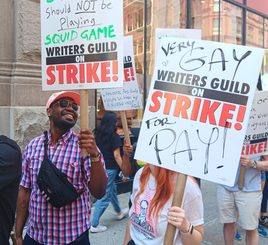
The chant rang out loud and strong through Manhattan’s Union Square neighborhood on June 1, the first day of LGBTQ+ Pride Month, as striking members of the Writers Guild of America (WGA) and supporters picketed the New York office of streaming giant Netflix.

Hundreds of workers joined “Pride on the Picket Line,” many waving or wearing Trans Pride and Progress Pride rainbow flags as they carried picket signs. The turnout was so big, in fact, that pickets had to be set up on both sides of 19th Street. 

Writers Guild members were joined by many members of sister union, the Screen Actors Guild-American Federation of Television and Radio Artists (SAG-AFTRA), who may strike on July 1 if their own contract demands aren’t met by the media bosses. There were also contingents from UNITE HERE, the United Auto Workers, and other unions.

“Netflix screws writers and trans people,” one picketer told Struggle-La Lucha, referring to the company’s history of championing anti-trans “comedians” and canceling queer-friendly shows. “It’s time to pay up!”

Netflix and other streaming services have profited greatly by refusing to update labor provisions left over from the days when network and cable television predominated. This has meant an enormous loss of wages and job security for industry writers.

The actions of queer strikers and the LGBTQ+ community have been crucial to the Writers Guild strike, now in its second month – with actions like this one and the Trans Takeover in Los Angeles.

Fittingly for a union of professional writers, WGA picket signs were decorated with individualized slogans by the strikers: “Striking is gay in the best way;” “We’ve got BEEF with Netflix;” “We are not content;” “You’ll miss 100% of the shows we won’t write;” “I’m on strike for dykes who write;” “You’re a literal Disney villain – the villain is Disney;” and “Your AI’s got nothing on my childhood trauma.” 

One striker’s sign summarized the feeling on the picket line: “Spoiler alert: We will win!”

Strugglelalucha256


U.S. proxy war: Kakhovka dam and the weaponization of water

June 7 — Tuesday morning, just a few hours after the first serious Ukrainian attacks against Russian positions began in various areas of the Donbass and Zaporozhye fronts, a prelude to the major offensive that Ukraine has been announcing for months, the bursting of the Kakhovka dam immediately diverted the focus of attention from the alleged Ukrainian advances to the part of the southern territories furthest from the battle. 

Novaya Kakhovka and the Soviet dam built in the times of Stalin and Khrushchev are already familiar to those who have closely followed the course of the war. In the initial phase of the Russian intervention at the end of February 2022, the Ukrainian command prioritized the defense of Kiev and sacrificed territorial battalions in areas of secondary importance such as the southern front, where the Russian advance came with virtually no resistance. From Crimea, Russian troops reached the Dnieper River in just a few days and shortly after captured the city of Kherson, on the right bank of the river, which they would lose after their defense became impossible in the autumn of that year.

Throughout the summer, Ukraine had begun preparing the ground for a counteroffensive to regain control of Russia’s most vulnerable territories: those north of the Dnieper, whose defense was made impossible by destroying the infrastructure linking both banks of the Dnieper. Target of the newly arrived U.S. HIMARS [multiple rocket launchers], the Antonovsky bridge was at that time one of the major targets, but not the only one. The bombardments of Novaya Kakhovka were not spontaneous or sporadic, but a planned destruction strategy to make the situation of Russian troops at key strategic points untenable. The same can be said of the Zaporozhye nuclear power plant, located in the town of Energodar, also south of the Dnieper, and still under Russian control.

Cities and towns flooded

The partial collapse of the dam yesterday has led to the flooding of a whole series of towns and cities in the area. In the morning, the mayor of Novaya Kakhovka reported that the rise in the water level exceeded 12 centimeters per hour. The water affected the city of Kherson, the most populated town in the area, although in a clearly less serious way than other cities. In Novaya Kakhovka, a few hours after the dam breached, water rose up the pedestal of the Lenin statue, and swans glided through the empty center of the flooded city in a post-apocalyptic scene about the effects of war in the post-Soviet world.

The accusations were not long in coming and both Russia and Ukraine alleged sabotage on the other side. Ukraine put in place the mechanisms both to react to what happened and evacuate the population from the affected towns, and to achieve the maximum possible political and informational benefit. Without having to wait for a minimal study on whether the dam had collapsed due to deliberate demolition or the effects of previous bombings, the Western press and political class en masse took Russia’s guilt for granted. In the same way as with what happened after the Nord Stream explosions, the media and politicians of all countries and ideologies began to look for why it was in Russia’s interest to blow up the dam.

Thus, the argument of last autumn was revived, when the possibility of the humanitarian and environmental catastrophe that occurred yesterday was first raised publicly. At the time, Russia accused Ukraine of planning the dam’s destruction, an argument that was denounced by Ukraine and its partners as a nonsensical conspiracy theory. The aim, according to Russia, would have been to flood the lands on the left bank of the Dnieper under Russian control and force Russian troops back or drown in their positions. Ukraine, for its part, accused Russia of planning to blow up the dam to prevent its troops from advancing on that territory. Unlike the Russian accusation, the Ukrainian one, although nonsensical since the Russian troops were preparing trenches in that area of ​​the Dnieper at that time, was disseminated by the media, giving it credibility.

Something similar happened yesterday, and the nuances or clarifications, such as “the BBC has been unable to verify either the Russian or Ukrainian allegations,” were the exception rather than the rule. And for the moment, it has not even been possible to confirm if the collapse was due to an attempted sabotage, to the consequences of the usual Ukrainian bombings, or simply to the accumulation of damage in recent months. 

Rush to judgment

Since the Russian withdrawal from the territories on the right bank of the Dnieper, which provided protection for the territories on the left bank as they kept Ukrainian troops at a greater distance, the safety of the dam and its workers has been compromised. What is naive is to think that the work of reconstruction and repair of the damage caused by the Ukrainian bombings could be carried out. Blaming Russia for the collapse due to poor conservation – without taking into account the circumstances and the Ukrainian bombing — has been one of the four main positions shown throughout the day yesterday. 

This position can be seen in the person of David Puente, Italian “verifier” and collaborator of Facebook in that verification task, who made this argument just as he did last September about the Nord Stream explosion. Then also, Russia was guilty because of the lack of maintenance of the gas pipeline.

The second position, maintained by Ukraine and the Western political class, has limited itself to taking Russia’s guilt for granted and arguing that it is a scorched-earth policy in the face of alleged Ukrainian advances on the front, although, in this area, there have not been such advances. “It is the children, women and men of Ukraine who will suffer the consequences of the terrible destruction of the Nova Kakhovka hydroelectric plant,” wrote the president of the European Parliament, Roberta Metsola, adding that “it is an act against humanity. A war crime that cannot go unanswered. Today, more than ever, Ukraine needs our help.” 

Even clearer in her message, Ursula von der Leyen stated that “Russia will have to pay for the crimes committed in Ukraine. The destruction of the dam, an intolerable attack on civilian infrastructure, puts thousands of people in the Kherson region at risk,” she wrote, later pledging help through available civil protection mechanisms.

“It is not yet clear what caused the dam to collapse,” the BBC admitted yesterday. However, politicians and journalists from all over the European continent have already passed sentence. 

Forgetting its supposed neutrality, the Ukrainian Red Cross accused Russia of a war crime in messages that it was later forced to delete. Without accusing either side, the International Committee of the Red Cross recalled that “the dams enjoy special international protection under international humanitarian law, since they contain dangerous forces which, if released, can lead to severe suffering for the civilian population.” 

Thousands of people on both sides of the Dnieper are being affected right now. As Dmitry Steshin recalled, the territories under Russian control are at a lower altitude, so it is that area on the southern bank of the Dnieper that will be most affected. Russia has mobilized its resources to also evacuate thousands of people affected in localities in the area, some of which, like Aleshka, are difficult to access and have a very complicated situation. The explosions that appeared in several videos taken by the population of the area – spontaneous explosions in the mines displaced by the river’s rise – show another of the dangers of what happened.

Without the need for any investigation or assessment of the damage and with the absolute certainty that Russia is always guilty, journalists like Paul Mason quickly showed their anger, the third of the four positions that were repeated throughout yesterday. “Russia has blown up the huge dam on Kherson, risking a catastrophe at the Zaporozhye nuclear power plant,” wrote the journalist, who appears to have believed Zelensky’s claim that the nuclear power plant is in imminent danger and not that of the International Atomic Energy Agency’s director. The IAEA, whose representatives have access to the area, stated that this danger does not exist at the moment. The plant requires water from the Kajovka reservoir, so the risk does not exist in the short term. Going beyond assignment of blame and future effects, lasexta.com said: “Stalin already used water as a weapon of war in Zaporizhia in 1941: the USSR destroyed the Dneprostoy dam and caused more than 20,000 deaths.”

Washington Post reported Ukraine test strike

Finally, there were also those who yesterday wanted to see the bright side of things. Carl Bildt, a professional hawk, lamented that the destruction of the dam “will cause extensive flooding mainly on the left bank of the Dnieper,” describing the part of the river under Russian control, “complicating any military operation,” that is, the Ukrainian advance. “But, I suppose, it also deprives the Crimean canal of its water.” 

That the Crimean canal is drying up again a year after the demolition of the wall built by Ukraine to deprive the peninsula of running water seems to be the positive part of what happened for certain sectors of the European establishment. In Crimea, Sergey Aksyonov confirmed that, given that possibility, the peninsula had proceeded to fill the canal to its limits. Crimea may have to live without that supply again in the coming months, just as it did during the years when Kiev used its flow control of the Dnieper as collective punishment against the population.

None of the four positions mentioned – lack of maintenance, prosecution by default, anger or the search for benefits for Ukraine – take into account the precedents of recent months, in which Ukraine has not hesitated to attack and endanger critical civil infrastructure. 

It’s also been convenient to forget something that, despite having gone unnoticed at the time of its publication, became relevant yesterday. In December 2022, the Washington Post published a report in which the commander of the Ukrainian forces in the Kherson region confirmed that Ukraine had considered blowing up the Kakhovka dam. “Kovalchuk considered the possibility of flooding the river. The Ukrainians, he claimed, even conducted a test strike with a HIMARS launcher against the gates of the Nova Kakhovka dam, punching three holes in the metal to see if the Dnieper water could rise high enough to destroy the Russian crossings without flooding the nearby towns. 

The Washington Post not only confirmed that the Russian accusations were not a conspiracy theory, but that the Ukrainian attacks, which have continued ever since, could have caused the damage necessary for the collapse without the need for sabotage.

Translated by Melinda Butterfield

Source: Slavyangrad.es

Strugglelalucha256


U.S. activists are campaigning to remove Cuba from the State Sponsors of Terrorism list

To most countries, particularly fellow nations in the Global South, Cuba is a sovereign nation recognized for its leadership in healthcare, diplomacy, and human development. The US government, however, has a different, and quite unique, view: Officially, Cuba is categorized as a “State Sponsor of Terrorism.”

Only four countries on earth are currently designated by the US as State Sponsors of Terrorism (SSTs): Iran, Syria, Cuba, and the Democratic People’s Republic of Korea.

Cuba was first placed on this list under the Reagan administration in 1982. In 2015, the Obama administration rescinded Cuba’s SST status as part of a broader push for normalization of relations. However, a lame-duck maneuver by the Trump administration in January 2021 placed Cuba back on the State Sponsors of Terrorism list. This designation has continued under President Biden.

Now, 57 member organizations of the National Network on Cuba (NNOC) have launched the #OffTheList campaign to remove Cuba from the State Sponsors of Terrorism List.

Following a campaign launch on Valentine’s Day 2023, activists across the country made hundreds of calls to the White House on March 14 and 15. NNOC plans to follow up with an action in Washington, DC, on June 25, and are calling on supporters to join a rally in front of the White House. Advocates say that Cuba’s SST designation is unwarranted, unjust, and ultimately harmful to the people of the island.

Beyond the use of social media and direct action, the NNOC campaign is also urging participants to pass resolutions in their trade unions, schools, and local municipalities: “We encourage you to initiate a resolution to expand public support for removing Cuba from the U.S. ‘State Sponsors of Terrorism’ List.”

“It’s critical for those of us in the United States to speak up about it—and for people around the world to speak up,” Shaquille Fontenot, an NNOC co-chair, told The Real News. “It’s a humanitarian issue at this point, not just a political issue. It’s way beyond that.”

Washington’s rationale for Cuba’s designation

Upon announcing its decision to place Cuba back on the State Sponsors of Terrorism List, the Trump administration made it pretty clear that the decision was rooted in longstanding, Cold War-era hostility towards Cuba for being a sovereign socialist nation—and, as such, being a source of political and economic influence in Latin America that runs counter to the influence and hegemonic dominance of the US. “The Trump Administration has been focused from the start on denying the Castro regime the resources it uses to oppress its people at home,” a Jan. 11, 2021, memo issued by the US Embassy in Havana stated, “and countering its malign interference in Venezuela and the rest of the Western Hemisphere.”

That being said, the stated pretext for the Trump administration’s fateful decision allegedly stemmed from the island’s role in hosting peace negotiations between the Colombian government, the Revolutionary Armed Forces of Colombia (FARC), and the National Liberation Army (ELN).

Colombia has been locked in an ongoing civil war for decades, but in 2016 a peace deal was struck between the government and the FARC guerrillas. Negotiations with the ELN began shortly after, with Cuba stepping in as a guarantor and host of the peace process.

In 2018, Ivan Duque was elected president of Colombia on a platform that pledged to “correct” the peace process, which he claimed did not impose harsh enough penalties upon former FARC combatants. As the ceasefire began to crumble, a faction of the ELN bombed a police academy in Bogota in 2019, killing 22 and injuring dozens more. Duque unilaterally ended the peace talks in response and demanded the Cuban government extradite 10 ELN peace negotiators.

The Cuban government refused, noting that complying with the extradition order would violate the negotiation protocols based on international norms previously agreed to by the ELN and the Colombian government. The government of Norway, another key player in the peace process, backed up Cuba’s stance. Colombia’s recently elected President Gustavo Petro has since rescinded Duque’s extradition order and resumed peace talks with the ELN.

Two years after the Colombian peace talks in Cuba fell apart, and just nine days before Trump himself left office, the Trump administration slapped Cuba with the SST label, citing both the extradition orders against the ELN and Cuba’s longstanding commitment to providing asylum for US political refugees, including former Black Panther Assata Shakur. A number of former intelligence and diplomatic officials decried the move.

Despite promises to the contrary, the Biden administration has yet to significantly alter the sanctions against Cuba instituted by Trump, including its designation as an SST.

Although the consequences of a country finding itself on the  SST list have global implications, Washington is under no obligation to demonstrate the substance of its accusations to the world—or even to courts within the US. The decision to label a country an SST is entirely at the president’s discretion. No process to regularly review or appeal states’ inclusion on the list exists. “We know the State Sponsors of Terrorism List is maintained solely by the US… that already makes it unfair because there aren’t any checks or balances,” noted Fontenot.

Cuba is not the only country with an SST designation that seems more motivated by fickle political considerations than any clear or consistent definition of terrorism. In the 1980s, for instance, Iraq had its designation removed to facilitate US arms transfers during the Iran-Iraq War—only to be placed back on the list once the First Gulf War began. Other states, including Sudan and North Korea, have been shuffled on and off the list depending on the status of their relations with Washington.

Cuba’s ongoing SST designation continues to obstruct relations between Washington and Havana. In March, Cuban Foreign Minister Bruno Rodriguez Parrilla tweeted: “the State Department qualifying lists are nothing but instruments for political and economic coercion that are totally alienated from issues so sensitive as terrorism, religion, human rights, drug trafficking and corruption, among others.”

El Bloqueo

When the US government designates a country a State Sponsor of Terrorism, it triggers a series of sanctions against the targeted country designed to restrict its ability to engage in international banking and trade. Contrary to the euphemistic explanations offered by Washington (that such sanctions are “targeted,” that they only affect the government or certain industries, that they are a “more peaceful” alternative to war, etc.), such measures inevitably and directly affect the lives and livelihoods of everyday citizens in sanctioned countries.

In the case of Cuba, the effects of being designated an SST compound the effects of Washington’s decades-long blockade. For more than 60 years, the blockade has severely restricted Cuba’s ability to engage in international trade, provide for its people, and advance its own development. A State Department memo circulated in 1960 clearly spelled out Washington’s ultimate goal with the blockade: “to decrease monetary and real wages, to bring about hunger, desperation and overthrow of government.”

The blockade’s effects became particularly pronounced after the fall of the Soviet Union—a time remembered in Cuba as the “Special Period.” Previously, the overwhelming majority of Cuban imports and exports had flowed through the Soviet Union, enabling the former to develop in spite of the US-imposed blockade, but the sudden collapse in trade starved the island of fuel and capital, sending agricultural and industrial production tumbling. Although wages and caloric intake plummeted, historian Helen Yaffe notes, the state continued to do everything it could to meet basic needs. Not a single school or hospital closed.

The succeeding decades have been a period of recovery and reorientation to a changed world. Tourism, medical services, pharmaceuticals, and mining exports have become important new industries for Cuba’s survival. While the thaw in relations with the US during the Obama era seemed to brighten Cuba’s prospects, recent years have proven harsher for the country and its people.

That’s precisely why Fontenot says the NNOC #OffTheList campaign is so urgent. “Right now, the effects of the blockade and the State Sponsor of Terrorism designation have created conditions in Cuba that many scholars and Cuban people are comparing to the Special Period.”

How the SST designation impacts the Cuban people

Once in office, the Trump administration dedicated itself to reversing whatever progress had been made on a myriad of policy issues under Obama, including imposing 243 new sanctions against Cuba. Then, to make matters worse, the COVID-19 pandemic hit, and the Cuban government closed its borders to tourists out of the necessity to save lives.

Washington ignored international calls to lift the blockade during the pandemic, even going as far as to block flights delivering humanitarian aid. Despite manufacturing its own domestically developed vaccines, Cuba lacked sufficient needles to administer them for a number of months. When the delta variant wave of the coronavirus struck in the summer of 2021, the country’s sole oxygen plant failed due to a shortage of supplies caused by the blockade.

It’s a certain fact that the US blockade directly contributed to the 8,500 deaths from COVID-19 in Cuba. In spite of these challenges, Cuba’s medical response was objectively superior to that of the US, both in terms of proportion of the population served and lives saved

This is the crucial background that throws the barbarity of the Trump administration’s SST label into relief. During the darkest days of a novel pandemic that gripped the world, as the Cuban people wrestled with mass human suffering, death, and fear, the United States chose to tighten the screws rather than extend a hand in solidarity, or at least mercy.

International banks were already reluctant to engage in business with Cuba due to the blockade, and they were right to be: the US has not shied away from prosecuting even non-US banks that violate its dicta. In 2012, British bank HSBC forfeited $1.2 billion—and in 2015, French bank BNP Paribas surrendered $8.9 billion—after being targeted by US prosecutors for conducting transactions on behalf of individuals in a number of sanctioned countries, including Cuba. The US government’s ability to enforce its sanctions internationally, a function of the dollar’s supreme position in global trade and banking as the world’s international currency reserve, is precisely what has made the blockade against Cuba so powerful.

Once Cuba was redesignated an SST, banks doubled down on their restrictions, and the few that had once been willing to do business with Cuban nationals stopped doing so. In 2021, dozens of Cuban entrepreneurs addressed an open letter to President Biden describing the ongoing, US-imposed restrictions on travel, banking, and electronic transfers as both harmful to their businesses and “cruel.” Cuba’s Foreign Ministry estimates that the blockade costs Cuba as much as $15 million a day.

In another letter delivered to President Biden this March, over 20 faith-based organizations in the US cited the SST designation as a direct impediment to their efforts to deliver humanitarian aid:

In response to relisting on the SST, banks, financial institutions, and international vendors ceased helping facilitate both regular trade and cooperation with faith groups seeking to provide humanitarian and development support to Cuba. Overnight our denominational partners in Cuba began to face shortages of necessary items, including a lack of access to clean water, sanitation, and hygiene articles, and materials essential for public health, such as medicines and medical devices. It has become increasingly impossible for our denominations and faith-based organizations to get much-needed aid and funds to our Cuban partners. Banks have frozen our funds for permitted religious and humanitarian activities, demanding additional licensing. They perceive the risks of fines and so insist on over-complying with the current restrictions.

Even Cubans living abroad have felt the sting. According to Spanish media, dual citizens of Cuba and Spain have been unable to open personal bank accounts and have even had their existing accounts frozen since the SST designation.

For everyday Cuban people, the blockade alone was bad enough before the implementation of additional restrictions tied to the SST List. Cuba’s efforts to survive in spite of the blockade are a testament to its people’s ingenuity and determination; however, there are limits to what can be achieved without access to global markets and production. A recent Oxfam report titled Right to Live Without a Blockade found substantial impacts on sectors as diverse as education, agriculture, and biotechnology stemming from the blockade—owing to limitations imposed by lack of access to computers, fertilizers, and other technologies and inputs that could transform existing industries.

In 2022, the UN General Assembly voted for the 30th consecutive year to approve a resolution calling for an end to the blockade against Cuba. Yet, as of now, the blockade continues.

Last May, the Biden administration announced a series of measures to support the Cuban people, including the restoration of remittance deliveries. However, none of these measures included substantial changes to the comprehensive blockade against Cuba, nor did they involve changing its designation as a State Sponsor of Terror.

Time is running out for the Biden administration to act. A new Congressional bill, HR 314: Fighting Oppression until the Reign of Castro Ends (or FORCE) Act, would seek to prohibit Cuba from ever being removed from the SST List “until the President makes the determination that a transition government in Cuba is in power.” (Given the bill’s name, it ought to be noted that Castro has not been in power in Cuba since the election of current President Miguel Díaz-Canel in 2019.)

Biden, however, doesn’t appear to be making any significant moves on Cuba any time soon, and with the 2024 election cycle officially in full swing, that is unlikely to change. When asked in March by Florida Republican Rep. Maria Salazar if the Biden administration had any plans to remove Cuba from the SST List, Sec. of State Anthony Blinken denied any such plans existed.

Building bridges for a shared future

For Fontenot, the significance of the blockade extends to its effects on people living in the US. “Being able to see what Cubans have decided for themselves is a major wake-up call for young people in America. We don’t have free education or free healthcare in the United States.”

Indeed, despite being a blockaded nation, Cuba’s socialist healthcare system and highly innovative medical industry put the US’s extortionately inaccessible system to shame. As of 2022, average lifespans in the US are three years shorter than those in Cuba. Fontenot also referred to several Cuban medical innovations that US patients are largely unable to access due to the blockade, such as an internationally recognized lung cancer vaccine.

Fontenot didn’t stop there. She also gestured towards the Cuban democratic process itself as something Americans might envy, if they only knew. “Look at the 2022 Cuban Family Code referendum,” she noted, referring to the passage of what many legal experts have recognized as the world’s most progressive set of laws on gender equality and the rights of children, the elderly, and LGBTQ people. “Compare that to what we’re seeing in the United States right now—this massive attack against queer and trans people, and ultimately against access to education.”

By all indications, the US government is not keen on US citizens learning about all that Cuba’s socialism has to offer. In May, activists with two separate youth delegations returning from Cuba were detained and interrogated by US Customs and Border Patrol—including members of a 60-person delegation organized by NNOC. In a public statement released by NNOC, the organization remained defiant, “Solidarity is not a crime—the US blockade is!”

“There are so many cultural, environmental, and educational exchanges that could happen if relations were normalized,” Fontenot says. “We’re in a moment here where people [in the US] are seeing the parallels between our own experiences and what’s done in our name to people abroad. People here need food, water, shelter—and people in Cuba need those things too. The same institutions are keeping

those things from all of us. That’s why it’s critical for us in America to speak up about it. People around the world need to see the truth.”

Source: Resumen

Strugglelalucha256


UPS Teamsters start strike authorization vote

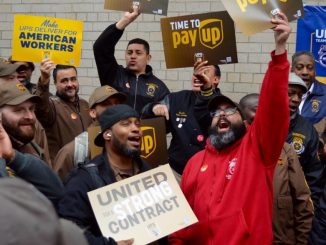
With the largest private sector labor contract in the United States set to expire on July 31 at midnight, the eyes of the American labor movement are on United Parcel Service (UPS) and the nearly 350,000 Teamsters who work there.

The Teamsters announced a UPS strike authorization vote starting this week, with results to be announced on June 16. Union leaders are strongly urging a yes vote. “This is how we win,” said Teamsters General President Sean O’Brien.

Our contract fight matters for the entire working class. We want workers everywhere—and especially at Amazon and FedEx—to see that organizing a union leads to better pay and working conditions and greater control over their working lives and opens the door to a better world.

There’s no better opportunity to show what we mean than a strike victory against UPS and Wall Street this summer.

Second-tier drivers

The roots of this fight go back decades. UPS jobs were once considered a yardstick of secure union jobs. Now 60 percent of the workforce is part-time, making around the minimum wage in many regions.

Drivers in many locations are forced to work six days a week and up to 14 hours a day with forced overtime. Managers follow drivers in personal vehicles and relentlessly harass workers to scare us into working faster.

In 2018, former Teamsters President James P. Hoffa forced a contract upon members despite a majority no vote. It kept part-time wages low and established a second-tier driver position, named “22.4” for the contract section that created it. Now new drivers make less money and get fewer overtime protections than existing drivers doing the same work.

The rank and file, organizing through the reform caucus Teamsters for a Democratic Union, fought these concessions the whole way. TDU activists organized a “vote no” campaign in 2013 and again in 2018 against concessionary contracts. Then in 2021, TDU led the charge to elect a coalition slate of reformers to the union’s top leadership on a platform of fighting more aggressively to reverse these concessions.

Now UPS Teamsters are demanding a significant pay increase for part-timers to $25 an hour, the elimination of 22.4’s two-tier wages for package car drivers, an end to forced sixth days of work, increased pension payouts for 60,000 workers so they’re more equal across the country, no driver-facing cameras, more holidays, and an end to subcontracting and the use of gig workers.

In the rank and file, expectations are high. If the two-tier wage structure for drivers is not eliminated on day one of this contract, it is a strike issue. If part-time workers do not get a significant pay increase, it is a strike issue. If all workdays beyond the five-day work week are not totally voluntary, it is a strike issue.

Some of these demands are about regaining ground lost by past union administrations. But for many workers, especially those hired since the last contract, this is about fighting for more. UPSers kept the economy running throughout the Covid-19 pandemic without a penny of hazard pay, and we watched UPS make record profits off our backs while working forced overtime. Of course, we now want our fair share.

There’s widespread support for these demands, and people are ready to fight for them. The rank and file will not accept a half deal, trade-offs, or “sharing the burden” with UPS.

Wall Street marching orders

Seventy-two percent of UPS stocks are owned by Wall Street firms; the two largest shareholders are Vanguard Capital and BlackRock. These firms and others own big chunks of our economy, including not just UPS but also its main private competitors, including FedEx and the railroads.

What does Wall Street want out of the UPS contract? Steady and massive profits. From their perspective, UPS is one of the great success stories of the pandemic.

From 2012 to 2019, UPS’s yearly profits ranged from $7.1 billion to $8.2 billion. In 2020, when the rest of the economy was suffering, UPS still made over $8.7 billion. Then the company reported the largest profits in its history: $13.1 billion in 2021 and $13.9 billion in 2022.

UPS will try to further increase these profits in the 2023 contract by asking for “flexibility” to schedule employees to work any of the seven days in a week, the installation of driver-facing cameras to further harass workers, and the continued use of gig workers to deliver packages.

The biggest impediment to Wall Street dictating terms for the entire logistics industry is the Teamsters’ UPS contract. Simply look to the competitors to see what corporations would do without a unionized counter-force: Amazon drivers are paid nearly minimum wage and get their hours cut next week if they do not meet inhumane production standards this week; FedEx is moving to eliminate all direct hires and switching to a 100 percent subcontractor model.

A two-week strike could cost UPS about $3.2 billion. But more importantly, a strike at UPS would be the largest demonstration of working-class power seen yet in the post-Covid economy. Every worker could see that they have the power to win better conditions by collectively withholding their labor.

That result is what Wall Street fears the most.

Started a year ago

Our contract fight started nearly a year ago. Last August, we had contract kick-off rallies around the country. In the fall, we filled out contract surveys, affirming the popularity of ambitious demands. Over the winter, thousands of us stood at gates and in break rooms handing out Contract Unity Pledge Cards to build support for the major contract demands we’re willing to strike over.

In the spring, we held Contract Action Team trainings around the country to map our workplaces, select picket captains, and develop organizing plans to engage our co-workers. And in the last month, rank-and-file TDU activists began petitioning at dozens of UPS “barns” to demand the company accept a higher national pension plan and raise part-time pay to $25 an hour.

We’re firm in our high expectations. We want to win the best contract in Teamster history—and if we have to, we’ll be willing to hit the streets on August 1 to do it.

Sean Orr is a UPS package car driver and elected shop steward in Teamsters Local 705 in Chicago. Elliot Lewis is a UPS package car driver and alternate shop steward in Teamsters Local 804 in New York City.

Strugglelalucha256


Defiance and joy at Baltimore Trans Pride March

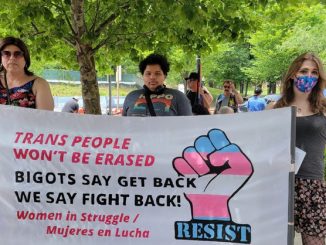
Hundreds of transgender people, other members of the LGBTQ+ community, loved ones, and supporters took to the streets on June 3 for the annual Baltimore Trans Pride March. Despite the grave threats to trans people’s lives and human rights across the U.S., the mood was both defiant and joyful. 

Friends, new and old embraced, families came together to support their trans members, and people proudly waved flags and banners. Neighbors and community members of this majority-Black city lined the sidewalks to cheer on the march.

People gathered at 33rd Street near the Baltimore Museum of Art and Johns Hopkins University campus, then marched down Charles Street to North Avenue, where a festival and street party were held. This neighborhood is home to Baltimore Safe Haven, a housing and wellness center for the city’s trans community, which sponsors the annual event. 

A delegation from Women in Struggle-Mujeres en Lucha, the Baltimore Peoples Power Assembly, and Socialist Unity Party carried banners and distributed hundreds of leaflets for the Oct. 7 National March to Protect Trans Youth in Orlando, Florida. Organizers said there was an enthusiastic response to the call to bring the fight for trans rights to the doorstep of ultra-right Florida Gov. Ron DeSantis.

Melanie, a local trans activist, told Struggle-La Lucha: “Saturday’s Trans Pride March was a wonderful experience. I was surrounded by hundreds of people overflowing with love for each other. I could feel their energy. 

“I’ve gotten used to seeing so many awful, awful political developments and news stories about us lately. Being a part of all this energy and love and acceptance helped reaffirm my vision of a bright future,” she said.

Strugglelalucha256
https://www.struggle-la-lucha.org/2023/06/page/5/