Debt ceiling deal means austerity for workers and the poor

Democrats and Republicans vote to raise the debt ceiling benefits Wall Street banks and corporations – hurts workers and poor.

With tremendous media fanfare, President Joe Biden and Speaker of the House Kevin McCarthy agreed to allow the so-called “debt ceiling” to be raised until 2025. Despite assuring the public that cutting money to federal programs designed to assist workers and poor people was “off the table,” Biden once again surrendered to the Wall Street demands that the working class and oppressed shoulder the burden for resolving the crisis that the capitalist class itself created.

Central to the agreement was a 3% hike in the massive military budget, $886 billion next year, $896 billion in 2025, to be paid for, not by any new taxes on corporations or any fabulously wealthy billionaires, but instead by literally stealing bread from the mouths of the poor by imposing new racist “work requirements” for recipients of food stamps and by eliminating any more student debt moratoriums.

The environment also takes a big hit from this new deal as well. A huge natural gas pipeline project, the Mountain Valley Pipeline, which will cross 300 miles of West Virginia, including many rivers and streams, is included in this package. The deal specifically rules out any court review of this project.

It’s no accident that two key Democratic Senators tied to this project have gained big money, according to a May 30 New York Times article:

One of the companies behind the pipeline, NextEra Energy, is a major donor to Mr. Schumer and Mr. Manchin. In the 2022 cycle, NextEra’s employees and political action committees gave $302,600 to Mr. Schumer and $60,350 to Mr. Manchin, according to the Center for Responsive Politics.

Millions of people now suffer from the intense smoke coming into the country from Canadian wildfires made far more intense and widespread by energy companies’ carbon emissions. This deal shows that Wall Street’s minions from both parties in Congress and the Senate are far more loyal to the oil and gas industry than to the public struggling to breathe.

Also, an $80 billion item to catch corporate and billionaire tax cheats was reduced to ensure that the wealthy are protected from paying for essential social services for our class. A June 4 Market Watch article points out:

If there were no tax cheats in America, there would be no Social Security crisis. Benefits could be paid, and payroll taxes kept the same, for the next 75 years.

Student loan payment moratorium ends

The moratorium on payments for student loans, which had been extended nine times since the beginning of the pandemic, will end in late August, according to the debt ceiling agreement. Pleasing to the banking patrons of both political parties, this will place a heavy new burden on the vast number of underpaid young people across the country.

According to a June 4 Time article:

The number of people taking out mortgages and auto loans has substantially risen this year, but people are still struggling to pay off debt. Americans are making late car payments at higher rates today than they have since the Great Recession, according to the New York Fed. As inflation rates surpassed incomes throughout 2022 and early 2023, Americans were going into credit card debt at alarming rates, largely over groceries and other essentials.

Biden’s proposal for modest student loan forgiveness faces a severe challenge by the right-wing Supreme Court this year.

Work or starve

The radical Republican Party made it a point to push for new “work requirements” for those people who need food stamp assistance to purchase food. Biden decided to cave to this demand by Trumpist Republicans by agreeing to raise the top age where childless people have to work or look for work from the age of 50 to 54 to be eligible for the Supplemental Nutrition Assistance Program (SNAP).

report from the Center on Budget and Policy Priorities notes that this change will put nearly 750,000 people at risk of losing essential food. Nearly half of those affected by this are women.:

The expansion of this requirement would take food assistance away from large numbers of people, including many who have serious barriers to employment as well as others who are working or should be exempt but are caught up in red tape.

Strong research evidence on SNAP’s existing work-reporting requirement shows that it does not increase employment or earnings but does cause many people to lose food assistance. Those who would be newly at risk of losing food assistance have very low incomes, typically well below the poverty line, and would be pushed even deeper into poverty if they lose SNAP.

The debt ceiling agreement also imposes new onerous work requirements for those in the Temporary Assistance for Needy Families (TANF) program. The agreement requires states to prevent more poor families with children from exempting people from stringent work requirements. This places more children into poverty at a time when the tax relief program that briefly lifted millions of children out of poverty was eliminated.

On June 3, the NAACP commented on the debt ceiling agreement:

The NAACP warned earlier this month that while a congressional impasse would fall most heavily upon Black Americans, work requirements for assistance “must be resoundingly rejected.” [NAACP President Derrick] Johnson said such proposals “play on racist stereotypes.”

Why austerity now?

Why is the ruling class eager through its politician minions to impose harsh cutbacks to social programs now? After all, the unemployment rate is a low 3.6%. The answer may lie in a June 13 LA Times article with an unusually truthful title: “Column: Wage growth doesn’t drive inflation. So why is the Fed out to crush workers?”

The writer, Michael Hiltzik, points out that Fed Chairman Jerome Powell constantly opines that the only way to reduce inflation is to rob workers of their jobs:

Powell treated every statistic showing labor market strength — low unemployment, “excess demand” for workers, persistent wage increases — as an obstacle to reducing inflation.

Hiltzik describes this analysis as common among economists:

The most direct expression of this argument came last June from former Treasury Secretary Lawrence Summers, who said in a June 20 speech in London, as reported by Bloomberg: “We need five years of unemployment above 5% to contain inflation — in other words, we need two years of 7.5% unemployment or five years of 6% unemployment or one year of 10% unemployment.”

But as Hiltzik points out, contrary to what these well-heeled and well-paid economic “experts” always at the beck and call of the billionaire class say, low unemployment does not increase inflation:

They ignored the contribution of corporate profiteering, despite data clearly showing that business profits were expanding sharply — in other words, businesses were raising prices far more than they needed to cover rising costs.

Hiltzik points out that workers use hard-won wage increases to try to “catch up” with inflation, not cause it:

According to the most recent wage report by the BLS, earnings increased by an average of 3.4% in May, compared with a year earlier. Real wages, however — accounting for inflation — fell by 0.7%.

Capitalist crisis unfolds

The billionaire class employs an army of economists, many of whom are pointing to storm clouds ahead for their economic system.

In the aftermath of the March and April panic bank runs at three large regional banks, the Politico journal published an article with an apt title – “The slow-motion trainwreck everyone sees coming”:

As the federal government strives to contain financial market turmoil, the next risk looming over the nation’s banks is in plain sight: the $20 trillion commercial real estate market.

Some $1.5 trillion in mortgages will come due in the next two years, a potential time bomb as higher interest rates and spiraling office vacancies push down property values.

And because 70 percent of bank-held commercial mortgages sit on the balance sheets of regional and smaller lenders, a write-down in commercial loans could spell big trouble for the financial system and spill over into the larger economy just as the 2024 presidential campaign gets underway.

With the country careening toward a possible recession, the financial system is especially vulnerable to shocks as the turbulence sparked by the collapse of three regional banks showed. Adding a commercial real estate market slide to the mix would be particularly perilous. It’s a concern that’s top of mind for policymakers in Washington — even as they acknowledge there’s not a lot they can do to fend off a crisis.

The unfolding austerity program that the right wing is pushing so hard for and which the Biden White House has largely settled on is meant to protect the profit streams of the huge banks and multinational corporations. Hand in hand with the so-called “culture wars,” it is meant as a preemptive strike to weaken and divide the workers and oppressed, to force us to accept a lower standard of living for ourselves and our families, to toil even harder to enrich the billionaire class, even while the planet burns.

The question is: Are we going to accept this without a unified mass struggle?

Strugglelalucha256


New U.S. anti-immigrant measures: Militarization and racism watches over the border

It is hard to imagine it could get any worse, but another calamitous situation has been created at the U.S.-Mexico border due to the new policies implemented by Joe Biden’s administration, which have forced hundreds of migrants to wait on the Mexican side.

One month after the end of the controversial Title 42, Washington points to the reduction in the number of people arrested crossing the border irregularly as an achievement.

During the month of May, the U.S. government deported more than 38,000 people, including Mexicans, Venezuelans, Cubans, Haitians, and Nicaraguans.

Those who arrive at the border after walking thousands of kilometers, many of them after crossing the hell of the Darien jungle between Colombia and Panama, are forced to wait for weeks and even months to get an appointment at the Customs and Border Protection (CBP) and be able to request asylum, according to a recently published study by the Human Rights Campaign, and reported in La Opinión.

Migrants at the border are exposed to robbery, kidnapping, and extortion by criminal groups.

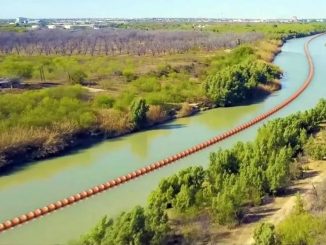
Meanwhile, Texas Governor Greg Abbott announced on Thursday that he will soon install a “new buoy barrier” on the Texas-Mexico border to prevent “the record level of illegal immigration, weapons and deadly drugs entering Texas.” The first 300 meters of the floating barrier will be deployed near Eagle Pass in Maverick County.

The new anti-immigrant laws signed by Abbott allow the governor of Texas to coordinate and execute border security pacts with other states without the approval of the U.S. Congress.

One of the measures expands the authority of Border Patrol agents to search and arrest felony suspects and authorizes the military to use unmanned aircraft to monitor the border.

It also designates Mexican criminal groups and drug cartels as foreign terrorist organizations in the state of Texas.

Separately, the governors of Virginia, West Virginia, and South Carolina on Wednesday joined the growing list of Republican leaders sending National Guard soldiers to the border to prevent undocumented immigrants from crossing, according to The Associated Press.

Virginia Gov. Glenn Youngkin, South Carolina Gov. Henry McMaster, and West Virginia Gov. Jim Justice announced they are sending soldiers and airmen to support Gov. Greg Abbott’s $4 billion “Operation Lone Star.”

Ron DeSantis, Governor of Florida, an aspiring candidate for the U.S. presidency, noted for his anti-immigrant policies, announced that he will send more than 1,100 state law enforcement agents and members of the National Guard to the Texas-Mexico border. The sum total of this escalation can only be viewed as a declaration of war against immigrants.

Raúl Antonio Capote is a professor, researcher, journalist, and special correspondent to Cuba en Resumen

Source: Resumen

Strugglelalucha256


Cuba’s Queer Rights Revolution – Eyewitness Cuba Pride Month

Pride Month Webinar – Cuba’s Queer Rights Revolution – Eyewitness Cuba

Just 90 miles from Ron DeSantis’s Florida, socialist Cuba is making huge advances in LGBTQ+ rights with its new Families Code.

  • How did Cuba achieve the ‘most advanced policy in the world’? *Why isn’t the U.S. media reporting it?
  • Why does Biden maintain Trump’s punishing blockade measures and keep Cuba on the state sponsors of terrorism list?
  •  Hear from LGBTQ+ activists from across the U.S. who went to Cuba to see for themselves.
  • Learn how queer rights are being prioritized from the grassroots to the National Assembly.
  • Why U.S. queers should work to end the U.S. blockade of Cuba, and how you can join next year’s delegation.

PANELISTS

  • Lizz Toledo, Women in Struggle-Mujeres en Lucha • Atlanta
  • Serena Sojic-Borne, Real Name Campaign & FRSO • New Orleans
  • Jordan David, Lavender Guard • Los Angeles
  • Deirdre Deans, Women in Struggle • Atlanta
  • Gregory Esteven, Socialist Unity Party • New Orleans
  • Kiana Fok, Peoples Power Assembly & Friends of Latin America • Baltimore
  • Melinda Butterfield, Women in Struggle • New York

HOSTED BY

Women in Struggle / Mujeres en Lucha
An affiliate of the Women’s International Democratic Federation

Strugglelalucha256


Trump boasts he wanted to take Venezuela’s oil after overthrowing its government

Former U.S. President Donald Trump boasted at a Republican Party rally that he wanted to “take over” Venezuela and “we would have gotten all that oil.” This confirms the sinister motives behind Washington’s 2019 coup attempt to overthrow President Nicolás Maduro and install Juan Guaidó.

Former U.S. President Donald Trump gave a speech in which he boasted that he wanted to “take over” Venezuela and exploit its large oil reserves.

“When I left, Venezuela was ready to collapse. We would have taken it over; we would have gotten to all that oil; it would have been right next door”, Trump said.

“But now we’re buying oil from Venezuela. So we’re making a dictator very rich. Can you believe this? Nobody can believe it”, he added.

Trump made these remarks on June 10 at a speech for a convention organized by the North Carolina Republican Party.

The U.S. government initiated a coup attempt against Venezuela in 2019. The Trump administration appointed a little-known right-wing opposition politician, Juan Guaidó, as the supposed “interim president” of the South American nation, despite the fact that he had never participated in a presidential election.

Venezuela has the world’s largest known oil reserves – although its crude is very heavy, and in order to be used, it must be mixed with lighter crude or diluents, which the country is often incapable of importing due to illegal, unilateral U.S. sanctions.

As president, Trump made it clear that Washington seeks to control the natural resources of foreign countries.

In a January 2020 interview on Fox News, Trump boasted that he was militarily occupying Syria’s crude-rich regions in order to “take the oil”:

DONALD TRUMP: And then they say he left troops in Syria. You know what I did? I left troops to take the oil. I took the oil.

The only troops I have are taking the oil. They’re protecting the oil. I took over the oil.

Maybe we should take it. But we have the oil. Right now, the United States has the oil.

So they say he left troops in Syria. No, I got rid of all of them, other than we’re protecting the oil. We have the oil.

Other members of the Donald Trump administration made similar comments.

Trump’s neoconservative National Security Adviser John Bolton stated clearly at the beginning of the coup attempt in January 2019, in an interview on Fox News, that Washington and U.S. corporations wanted to profit off of Venezuela’s oil:

JOHN BOLTON: We’re looking at the oil assets. That’s the single most important income stream to the government of Venezuela. We’re looking at what to do to that.

We want everybody to know. We’re looking at all this very seriously. We don’t want any American businesses or investors caught by surprise. They can see what President Trump did yesterday. We’re following through on it.

We’re in conversation with major American companies now that are either in Venezuela or, in the case of Citgo, here in the United States. I think we’re trying to get to the same end result here.

You know, Venezuela is one of the three countries I called the “Troika of Tyranny.”

It’ll make a big difference to the United States economically if we could have American oil companies really invest in and produce the oil capabilities in Venezuela.

It would be good for the people of Venezuela. It would be good for the people of the United States.

We both have a lot at stake here, making this come out the right way.

Venezuela’s massive oil reserves were nationalized by former President Hugo Chávez, who launched the country’s leftist Bolivarian Revolution.

Venezuela’s state-owned oil company PDVSA used the revenue from the oil sales in order to fund social programs, public housing, transportation, health care, and education.

Academic studies have found that countries with large oil reserves are more likely to suffer wars and foreign military interventions.

In April 2002, there was a briefly successful military coup that overthrew democratically elected President Chávez. But the leader was so popular that the people of Venezuela stormed the streets, overthrew the coup regime, and demanded that Chávez be reinstated as president.

The George Bush administration was deeply involved in supporting this 2002 coup in Venezuela.

Since then, Washington has sponsored several more coup attempts, including violent riots in 2014 and 2017, culminating in the 2019 designation of Juan Guaidó as the supposed “interim president.”

The fact that this was a coup attempt was admitted by Trump’s national security advisor himself.

In a 2022 interview on CNN, Bolton boasted of how difficult it was to organize the coup attempt:

JAKE TAPPER: One doesn’t have to be brilliant to attempt a coup.

JOHN BOLTON: I disagree with that, as somebody who has helped plan coups d’etat – not here, but, you know, other places. It takes a lot of work.

JAKE TAPPER: I do want to ask a follow-up. When we were talking about what is capable or what you need to do to be able to plan a coup, and you cited your expertise having planned coups.

JOHN BOLTON: I’m not going to get into the specifics, but uh…

JAKE TAPPER: Successful coups?

JOHN BOLTON: Well, I wrote about Venezuela in the book. And it turned out not to be successful – not that we had all that much to do with it. But I saw what it took for an opposition to try and overturn an illegally elected president, and they failed. The notion that Donald Trump was half as competent as the Venezuelan opposition is laughable. But I think there’s another –

JAKE TAPPER: I feel like there’s other stuff you’re not telling me, though.

JOHN BOLTON: I think – I’m sure there is.

Bolton’s 2020 memoir, “The Room Where It Happened,” mentions Venezuela and Venezuelans more than 300 times and has a 35-page chapter recounting the coup attempt in the country, titled “Venezuela Libre” (Free Venezuela).

Bolton wrote that President Trump had repeatedly asked for a military attack on Venezuela.

This was further confirmed by Trump’s former Secretary of Defense, Mark Esper, who wrote in his 2022 memoir “A Sacred Oath” that “Trump had been fixated on Venezuela since the early days of his administration.”

“Again and again, Trump would ask for military options” to overthrow Venezuela’s democratically elected President Nicolás Maduro, Esper recalled.

Trump’s National Security Council meetings on Venezuela “always began with the consideration of military options, rather than on the other end of the spectrum—diplomacy,” Esper wrote.

There, in fact, was an attempted invasion of Venezuela in May 2020, known as Operation Gideon.

The figures involved in planning this botched invasion admitted they had the support of the Trump White House and were in contact with the CIA, other U.S. government agencies, and Colombian intelligence services.

Venezuelan government blasts Trump’s confession

In response to Trump’s admission in June 2023 that he wanted to “take over” Venezuela and its oil, the country’s foreign minister, Yvan Gil, responded: “Trump confesses that his intention was to take over Venezuela’s oil. All the damage that the United States has done to our people, with the support of its lackeys, here has had one objective: to steal our resources! They were not able to, and they will not be able to. We will always overcome!”

Venezuela’s vice minister for North America, Carlos Ron, declared, “What further evidence do we need? Here’s Trump confessing that his aim, all along, was to take over Venezuela’s oil. The Biden [administration] keeps his illegal sanctions policy still in place. Venezuela has and will continue to prevail!”

Venezuela’s ambassador to the United Nations, Samuel Moncada, stated, “Trump took the mask off of 60 satellite countries, the international propaganda, and all of those politicians and intellectuals who supported a puppet [Juan Guaidó] to govern Venezuela. The only aim has been to pillage the oil of the Venezuelan people. How shameful! This is the confession of a criminal”.

The “60 satellite countries” that Moncada referenced were those that joined the United States in formally recognizing unelected coup leader Guaidó as the supposed “interim president” of Venezuela.

Venezuela’s former foreign minister, Jorge Arreaza, who served during the 2019 coup attempt, said Trump’s confession was legal evidence that the U.S. was motivated to try to steal his country’s natural resources.

“The international justice system must act,” Arreaza implored.

Source: Geopolitical Economy Report

Strugglelalucha256


A trans person reflects on Cuba and Florida: 90 miles and a world apart

Returning from 12 days in Cuba in mid-May, I spent an uncomfortably long six-hour layover at the Miami airport, waiting for my connecting flight to New York.

It wasn’t uncomfortable just because of the usual inconveniences like overpriced food and crappy seats but because I was a trans woman existing in the state of Florida, where the far-right anti-trans crusade has been centered this year. 

As I sat in Miami, I was keenly aware that Gov. Ron DeSantis was preparing to sign several laws aimed at banning trans people from public life and getting the health care they need to live. 

(DeSantis did sign these laws just a few days later, not by coincidence, on May 17 – the International Day Against Homophobia, Biphobia, and Transphobia.)

One of those state laws bans trans people from using public restrooms that match their gender expression – including those in airports. When that law takes effect on July 1, trans women like me will be faced with the choice of risking arrest using the women’s room or risking humiliation and violence using the other option.

During my six-hour sojourn, I used the airport restroom three times. Yes, I kept count; I was on guard for my safety and hyper-aware of everything around me. But as usual, no one objected to my presence or even noticed. 

Waiting in Miami, I had plenty of time to reflect on the stark contrast between Cuba, where queer rights are advancing by leaps and bounds, and the United States, where they are being dragged backward by state-sanctioned violence. 

That violence comes in the “official” form carried out by bigoted politicians like DeSantis and the off-the-books sort used by fascists coast-to-coast, who get a wink and a nod from the cops and big bucks and lavish media attention from the capitalists.

International Trans Colloquium

In May, I was part of the LGBTQ+ delegation to socialist Cuba organized by Women in Struggle-Mujeres en Lucha in cooperation with the Cuban Institute for Friendship with the Peoples (ICAP) and the National Center for Sex Education (CENESEX). 

We went to learn about Cuba’s revolutionary new Families Code, adopted by referendum last year. This document, described as the most advanced of its kind in the world, elevates the legal status of queer and other nontraditional families. It expands the rights of LGBTQ+ family members, children and youth, elders, people with disabilities, and more.

We also went to learn about the effects of the six-decade-long U.S. blockade on LGBTQ+ Cubans and all Cuban people. Our mission was to bring back information to help educate our communities, encourage them to oppose the blockade, and understand that another world is possible.

Officially, our delegation lasted for one week, from May 7-14. But two of us, both trans women, arrived in Havana a few days earlier to attend the VII International Colloquium on Trans Identities, Gender, and Culture, held from May 4-6. 

This annual event, organized by CENESEX, brings together experts, medical professionals, and academics from several countries to discuss the latest research on gender-affirming care and the social challenges facing trans communities. This year there were participants from Mexico, Italy, Argentina, the U.S., and other countries, as well as Cuba.

Trans voices heard and respected

A lot of valuable information and views were shared throughout the colloquium. It was especially enlightening to hear how U.S. anti-trans propaganda is rippling throughout Latin America and Europe. 

But for me, the most memorable moment came during the first afternoon’s session, held in the beautiful building that is home to CENESEX. 

A panel of doctors and researchers had just spoken about the medical challenges of gender-affirming care, from hormone therapy to surgery to mental health and treatment for trans youth. A group of trans women from Cuba, Uruguay, and Mexico had been sitting in the front row, listening intently to the presenters.

After the final panelist spoke, the women consulted among themselves, then demanded the floor. They objected to the tone and perspectives of some of the experts, who focused entirely on clinical research and standards of care divorced from the actual lived experiences and needs of trans people.

Mariela Castro Espín, CENESEX director and convener of the colloquium took the floor to support the trans activists, emphasizing how Cuba’s approach to all kinds of health care, and trans health in particular, can never be divorced from the social conditions of the people it serves.

I couldn’t help but imagine what would happen if a group of trans activists demanded the floor at a medical or academic conference in the U.S. to object to statements by official presenters. In all likelihood, they would be dragged out by security, perhaps even arrested. 

This has happened in several U.S. state capitols recently when people dared to speak out against anti-trans legislation in those supposed “houses of the people.”

But at this international event in Cuba, hosted by an official body of the Ministry of Health and in the presence of representatives of the country’s media, trans people were not only free to take the floor and voice their concerns; their opinions were treated with respect and, in my view, helped change the tone of the rest of the conference.

Conga and the future

Following the conclusion of the International Trans Colloquium, on the evening of May 6, we were invited to attend the Gala Against Homophobia and Transphobia at the National Theater near Revolution Square. The fantastic, colorful annual event featured well-known Cuban musicians, live theater and dance, and incredible drag performances. 

Unlike the recent invitation-only Pride event at the White House in Washington, D.C., the gala was open to everyone, and the 3,500-capacity hall was packed with happy, cheering queer couples and families. Tickets cost the equivalent of 35 U.S. cents.

The following day, we welcomed the rest of the delegation, including activists from Atlanta, Baltimore, Los Angeles, and New Orleans. 

Over the next week, we attended several sessions at CENESEX to learn about different aspects of the Families Code and the development of queer rights; we visited a polyclinic to learn more about Cuba’s primary health care system and how the recommendations made by CENESEX for trans health care are integrated into the system from top to bottom; toured the Denunciation Memorial, a museum that exposes the history of U.S. terrorism against the Cuban Revolution; and received a briefing at the biotechnology center about Cuba’s development of groundbreaking vaccines.

We also met with the Federation of Cuban Women and learned about its long history of elevating LGBTQ+ issues (going back to the early 1970s); spoke with district representatives about their responsibilities as elected community leaders; received a guided tour of the new Fidel Castro Center, documenting the life of the Cuban revolutionary leader; and finally, visited the national capitol to learn about Cuba’s electoral and legislative process from a member of the National Assembly of People’s Power.

One of the most exciting things I learned about was Cuba’s constitutional “progress principle.” This means that once granted, rights cannot be taken away. How unlike the U.S., where every one of our hard-fought rights is liable to be rolled back like the right to abortion was a year ago!

On our final full day in Havana, we joined the Conga Against Homophobia and Transphobia, marching through the streets shoulder to shoulder with our Cuban siblings, chanting, “¡Socialismo, sí! ¡Homophobia, transphobia no!”

The memory of the marchers’ joy and political determination, of the happy neighbors and families cheering from apartment windows and sidewalks, of revolutionary political leaders in the front ranks, helped me get through the long hours in Florida, a state increasingly suffocated by censorious, repressive, and frankly murderous laws meant to keep workers down and the rich on top.

In Cuba, I was never misgendered, never worried about using a restroom, and never felt unsafe for being openly and unabashedly myself. I want that for myself and all my trans siblings, everywhere, every day.

As I boarded my flight home, I felt more determined to build a National March to Protect Trans Youth and Speakout for Trans Lives in Florida this autumn – to give hope to our trans community there, to other communities under attack, to all of us. And more convinced of the need to show the LGBTQ+ movement that the Cuban path – the path of revolutionary socialism – is the way forward to trans and queer liberation.

Strugglelalucha256


Justice 4 Palestinian Martyr Nizar Banat! – Brooklyn, June 18

All Out to Support the struggle for
Justice 4 Palestinian Martyr Nizar Banat!
Join us on Sunday, June 18th at 4 pm
Bay Ridge Community Development Center,
9818 Fort Hamilton Parkway, Brooklyn, NY 11209

Organized by Palestinian Assembly for Liberation & Al-Awda-NY,
endorsed by NY4Palestine, AMP-NJ, & PYM

“Traitors” is the actual voice of Nizar Banat talking about the Palestinian Authority. Hear his brother and their lawyers speak to their demands for accountability for his murder.

Sunday 6/18, 4 pm, Bay Ridge Community Development Center, 9818 Fort Hamilton Pkwy, Brooklyn, 11209

Join us in Brooklyn as part of the U.S. Speaking Tour for Justice for Palestinian activist Nizar Banat and all human rights defenders oppressed by the israeli occupation and the Palestinian Authority. Two years after Nizar Banat’s brutal murder, Nizar’s family demands justice.

Nizar Banat was an outspoken critic of the Palestinian Authority. He was killed after being beaten during a PA raid, as officers arrested him. Banat’s family say the focus has been on low-ranking officers and not the Palestinian officials who gave the orders.

The event will feature Ghassan Banat, Nizar’s brother, and Mohanad Karajah and Thafer Saadieh of Lawyers for Justice, who are documenting violations carried out to submit to the International Criminal Court.

Join our Facebook event for updates and more background information:
https://www.facebook.com/events/789490579379080?

On June 3rd The Palestinian Assembly for Liberation Unite To Return Conference hosted the brother of the honorable martyr Nizar Banat along with Education and Labor Expert Monadel Herzallah and Human Rights Watch’s (HRW) Omar Shakir to discuss mechanisms and third state and third-party engagement to protect Palestinian democracy activists from Zionist and Zionist-coordinated repressive, foreign and internal forces, within Palestine.

Strugglelalucha256


Anti-war activists in Germany protest NATO’s ‘Air Defender 23’ military exercise

Around 10,000 military personnel and 250 aircraft from 25 countries are participating in NATO’s ‘Air Defender 23’ exercise scheduled from June 12-23. Anti-war groups have called it a provocation

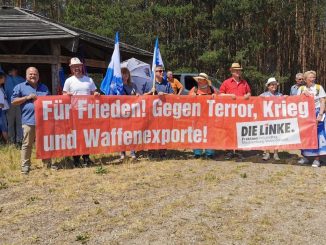
On June 10, hundreds of activists from various anti-imperialist and anti-war groups as well as the Communist Party of Germany (DKP) marched to the Wunstorf Air Base in Hannover to protest the NATO’s Air Defender 2023 exercise scheduled from June 12-June 23. A vigil was also held at the Spangdahlem Air Base near Trier, which will also serve as a base for the exercise. Die Linke organized protests against the NATO exercise on June 11. The protestors denounced war-mongering and projection of military might by NATO amid the ongoing Russia-Ukraine war and demanded a ceasefire and peace negotiations in Ukraine, as well as removal of US nuclear weapons from Germany. The airpower drill is likely to cause civil aviation delays in Germany.

According to reports, around 10,000 military personnel and 250 military aircraft from 25 NATO countries will participate in the exercise to showcase their capabilities in the backdrop of the ongoing Ukrainian counteroffensive against Russia. Peace groups have warned that the NATO maneuver will likely escalate the conflict in Ukraine and increase tensions in the region. Fierce battles are currently ongoing in southern and eastern Ukraine. However, despite the arms, ammunition and funds it has received, Ukraine has not been able to make any significant breakthrough on the Russian front lines. Ukraine is now waiting for US-made F-16 fighter jets from its allies in the European Union (EU) to use in its counter-offensive.

According to many observers, Air Defender 2023 is intended as a warning to Russia. However, many sections of the population in EU countries including in Germany are unhappy with the prolonged war and bids by NATO-EU to escalate the conflict. The inflation and energy crisis triggered by the war remains unabated and millions across Europe are struggling to cope. The defense budget has increased manifold in several EU nations alongside heavy cuts in social spending. Germany itself slipped into a recession following a steep contraction in its economy since the last quarter of crisis-ridden 2022. It is facing an acute energy crisis due to sanctions on cheap Russian oil.

On June 9, Vincent Cziesla wrote in Unsere Zeit (UZ) that Air Defender 23 is not an exercise, but seems like a brazen but usual provocation, and is a tangible danger to world peace in times of war. “An accident with a Russian military aircraft, misguided navigation, or pilot error can be enough to make a training flight seem like an act of attack.”

“It will be particularly threatening if Ukraine were to use the slipstream of the maneuver to carry out attacks, while Russian air surveillance is forced to follow NATO activities. Currently, there is almost daily shelling of Russian territory, and the Ukrainian president is threatening major attacks. The potential for escalation of a Ukrainian military strike while NATO jets patrol nearby is obvious in this situation,” Cziesla added.

Die Linke stated on June 12, “today, the NATO-air weapons maneuver ‘Air Defender 2023’ begins over Germany. It’s the largest air force maneuver since NATO. This military saber rattling is irresponsible! We will not adapt to war and the military as tools of foreign policy. Right now, when another war is raging in Europe, de-escalation and diplomacy are the order of the hour—not upgrading, military demonstrations of power, and fueling the escalation spiral.”

Source: Peoples Dispatch

Strugglelalucha256


Struggle ★ La Lucha PDF – June 12, 2023

Get PDF here

  • Workers at Target attacked by far-right
  • ILWU to celebrate Juneteenth with a shutdown
  • Cleophas Williams: My Life Story in the ILWU Local 10
  • Solidarity and defiance at Trans Pride March
  • ‘ Pride on the picket line’ for Writers Guild strike
  • They stole us, they sold us, they owe us: Reparations must be paid!
  • December 12th Movement shuts down Harlem’s 125th Street in honor of Malcolm X
  • NYC’s biggest hate march protested
  • LGBTQ+ delegation meets with Federation of Cuban Women
  • War criminal Kissinger doesn’t deserve to be 100 years old
  • South Korean prisoners of conscience: ‘They are still warriors’
  • U.S. proxy war: Kakhovka dam and the weaponization of water
  • Defienden educación pública
  • NO causa para detenidos por el Gobierno de Puerto Rico
Strugglelalucha256


The First Nations at the frontline of Canada’s fires

As smoke and smog choke the Northeast, Alberta’s Indigenous Nations face down apocalyptic wildfires

And the provincial government’s “let-it-burn” climate policy.

This story was produced by Ricochet Media and IndigiNews, and is being co-published by The Real News.

As he watched the last plane lumber down the runway, Chief Allan Adam was finally able to breathe freely again.

He had just posted a live video from the Fort Chipewyan airport on the evening of May 31, documenting the last flight out with evacuees fleeing impending disaster. A wildfire was advancing approximately seven kilometres from his remote community, which is accessible only by boat or plane.

But the relief was short-lived. The straight-shooting leader of the Athabasca Chipewyan First Nation, one of three Indigenous communities in Alberta who call Fort Chipewyan home, was abruptly hit with biting pain.

“That was the stress that hit me, right after that post, that’s when the pain came to my neck,” he said in a telephone interview the evening of June 1, between back-to-back meetings with local leaders, authorities and firefighting officials.

Despite the searing ache in his neck, he continues to roll with the punches. The homes and livelihoods of nearly 1,000 people are on the line. It’s the first time in anyone’s living memory that the hamlet, located about 300 kilometers north of Fort McMurray, has been under a mandatory evacuation order. Chief Adam — together with Billy-Joe Tuccaro, chief of the Mikisew Cree First Nation, and Kendrick Cardinal, president of the Fort Chip Métis — has stayed behind to oversee efforts to save his homelands.

“We had to get everybody out. Everything that we’ve done, that was our main focus, to get everybody out immediately. And then once that was accomplished, it was a relief for me because now we can focus our attention on preparedness (for) what’s coming.”

Record heat waves and dry conditions have sparked an unrivaled wildfire season of destruction across the country, affecting almost every province and territory.

In May, roughly 2.7 million hectares of forest — an area equal to about five million football fields — were burned to the ground in Canada, said Emergency Preparedness Minister Bill Blair at a press conference. Over the last 10 years, the average number of hectares burned in the same month was just 150,000.

Natural Resources Minister Jonathan Wilkinson told reporters at the same press conference that the rampant infernos are caused by climate change.

“It’s a simple fact that Canada is experiencing the impacts of climate change, including more frequent and more extreme wildfires,” he said.

Chief Adam is all too familiar with the consequences of climate change, and particularly the contamination of his territories. Fort Chipewyan, commonly referred to as Fort Chip, is downstream from Alberta’s notorious tar sands, one of the largest oil developments in the world.

The settlement is perched on the tip of Lake Athabasca, the largest body of water in Alberta and Saskatchewan. Known as the oldest community in the province, it once served as a hub for the Indigenous Nations who live up and down the mighty Athabasca River, as well as the European settlers who trekked north for trade. But since commercial-scale extraction of the oil sands began in 1967 — and then expanded to fuel the economic wellspring of Canada — the water, land and air quality of the vast Indigenous territories downstream has deteriorated.

Finding deformed fish and polluted water here is a normal occurrence. And dozens of Fort Chip residents have succumbed to a rare strain of bile duct cancer.

In April, Chief Adam testified before a House of Commons committee hearing in Ottawa to decry the release of millions of litres of toxic tailings waste in two separate incidents involving Imperial Oil’s Kearl mine. Just weeks later, Suncor reported it had released almost six million liters of contaminated water into a tributary of the Athabasca River.

Earlier, he had predicted his community would become environmental refugees.

Now, Fort Chip could be swept away by out-of-control flames.

“I tell them this,” he said during the phone interview, explaining that he confronts the Alberta and federal governments about climate change.

“I speak with them all the time and we hold them very accountable. The climate change issue is not going to go away. And we’re gonna have to deal with it — and you (governments) are gonna have to deal with us.”

Tar sands smokestacks belch smog into the sky.
Syncrude’s Mildred Lake site north of Fort McMurray, Alberta on Thursday, June 1, 2023. Over 1000 people have been evacuated from Fort Chipewyan as wildfires threaten the community downriver from the oil sands. Amber Bracken
Dwight Courtorielle, 48, with his son Kade McKay, 10 months in Fort McMurray, Alberta on Thursday, June 1, 2023. Over 1000 people have been evacuated from Fort Chipewyan as wildfires threaten the community downriver from the oil sands. Amber Bracken
Rob Leavitt, right, and Preston Wanderingspirit watch smoke on the horizon after clearing trees for a fire break in the Allison Bay area of Fort Chipewyan, Alberta on Friday, June 2, 2023. Over 1000 people have been evacuated from Fort Chipewyan as wildfires threaten the community downriver from the oil sands. Amber Bracken

Feels like 2016 all over again 

About 250 kilometres south from Fort Chip, the boat launch in Fort McKay First Nation — a community of 800 people about 58 kilometres north of Fort McMurray — is clogged with dozens of docked boats. Volunteers are patrolling the river day and night, searching for evacuees whose boats may have gotten stuck or broken down.

It’s déjà vu for Fort McKay residents, who are survivors of the worst natural disaster in Canadian history. They were forced to flee their homes during the massive 2016 blaze that ravaged Fort McMurray.

Even so, ushering Fort Chip evacuees to safety is a treacherous undertaking, according to Fort McKay Métis Nation president Ron Quintal.


“There’s a combination of the smoke, of the water coming up and having sticks in the water and traveling at night — it’s a concern for damage to your boat and could cause an emergency,” he says while visiting evacuees at a hotel in Fort McMurray.

Quintal directed his staff to focus on comforting the displaced, including whole families with children and elders who had made the eleventh-hour trip.

“We were there when families were pulling in,” says Quintal, his voice pinched with emotion. “You try to put on a happy face. These kids, they’re afraid, you know, they’ve had to leave their homes, given they’re an isolated community. And we let them know that you’re safe here, we’re here to help you.”

Jimmy Shortman, 64, waits at the boat launch for Ginger, his German Shepard, and her six three-week-old puppies to be delivered by a peace officer. He fled his home in Fort Chip by boat along with his wife and granddaughter. His beloved dog was cared for by officials in Fort McKay while he escorted his family to a hotel in Fort McMurray.

Shortman also fled the infamous Fort McMurray blaze in 2016. Now, he’s experiencing flashbacks of flames, falling ashes, and traffic jams holding back frantic passengers desperate to escape.

A former firefighter, he witnessed the moment the current wildfire ignited near his home community.

“When that lightning happened on Saturday in Fort Chip, I was outside my house, sitting on the deck. All of a sudden, lightning strikes.” His brown eyes widen as he describes the jolt of electricity hitting the ground.

“It started that night, because the lightning did it. It got bigger and bigger, and the wind was picking up.”

He did not expect the blaze would burn out of control and turn so many lives upside down. He describes people panicking in their rush to get out of Fort Chip. “My wife was scared and crying. Everybody was excited to just get out of there.”

“There were 14 boats trying to get out at the same time, and that’s unheard of. You couldn’t even see across the lake — it was covered in smoke. I don’t panic, but.…” His eyes briefly well with tears. “The only thing I worried about was my wife and the little girl.”

Now, he’s happy to be heading out to his cabin along the river with his brother, Stanley Shortman, about an hour and a half south of the fire. He feels most comfortable there, as do hundreds of other Fort Chip families whose cabin homes dot the shoreside. They have a kinship with the land and water. Many, like Shortman, spend half their lives in the wilderness of their territories.

Shortman says he will clean the yard around his cabin while he waits out the fire. But he predicts the situation will intensify.

“Look how hot May was.” Shaking his head, he emphasizes that the dry weather isn’t helping. “We haven’t gotten hardly any rain yet. Wait ’til July. Wait ’til it’s really hot. Oh, it’ll be worse. It’s scary.  Maybe the whole country will burn.”

A woman's hand extended over the flatbed of a truck, where various packaged and canned foods can be seen.
Loretta Waquan sorts care packages for evacuees in Fort McKay, Alberta on Friday, June 2, 2023. Three boats delivered eight care packages to evacuees staying in cabins. Each cabin received: one 10lb bag of flour, dried beans and barley, bread, 20lbs of potatoes, evaporated milk, canned tomatoes, baking powder, canned ham, canned corned beef, minute rice, two flats of canned soup, oats, vegetable oil, chocolate, coffee, red rose tea, arrowroot cookies, macaroni, powdered milk, jam, sugar, chocolate chip cookies, powdered coffee creamer, onions, oranges, apples, granola bars, honey, canned beans, water, and lard. Amber Bracken
View of Lake Athabasca. The sky is cloudless but smothered by smoke. The sun burns dimly in the sky.
Smoke hangs over oilsands tailings ponds north of Fort McMurray, Alberta on Friday, June 2, 2023. Over 1000 people have been evacuated from Fort Chipewyan as wildfires threaten the community downriver from the oil sands. Amber Bracken
An elderly First Nation woman sits in a hospital bed. Her hands are wrapped around a rosary.
Madeline Piche, 93, holds the rosary she evacuated with at the elders residence in Fort McKay, Alberta on Thursday, June 1, 2023. At 93-years-old, Piche is the oldest resident of Fort Chipewyan and says she is praying for everyone as they navigate the crisis. Amber Bracken

‘Praying helps’

The oldest resident evacuated from Fort Chip rests in her bed at the long-term care facility in Fort McKay. Madelaine Piche, 93, clutches a sparkling rosary, her milky brown eyes conveying a gentle naivety.

“I’m so tired,” she says with a sigh. “I’m scared, I was nervous inside the plane.”

Along with several other elders, Piche was airlifted out of Fort Chip and transported to the Fort McKay facility on May 30. She’s comfortable, she says, and the food is “good here.”

The view of the river outside her window reminds her of home.

Now Piche — grandmother of 43 and great-grandmother to countless great-grandchildren —  patiently waits for one of her daughters to visit from Fort McMurray.

She cries as she prays for her hometown, the only place she’s ever lived.

“Fort Chip is beautiful.… Praying helps,” she says with a whisper. “I pray a lot for everybody and for it to stop burning.”

Meanwhile, hundreds of displaced residents are scattered in various hotels throughout Fort McMurray. The Municipality of Wood Buffalo’s Emergency Social Services department is accepting donations of essential supplies such as toiletries, clothing, diapers, baby wipes and menstrual products. Families gather in hotel parking lots to catch up on the latest updates about the wildfires and let their children play on the grass.

But essential supplies for cabin dwellers are needed.

Riding the river

Mikisew Cree Nation evacuees Matthew Coutoreille and Yancey Kaskamin volunteer to deliver packages of food and water to nine cabins spread out along the river. They work alongside Coutoreille’s father, Lloyd Donovan, a resident of Fort McKay.

After sorting through various dried goods, gassing up, and loading their boats, the crew embarks on a Friday morning mission that will last until dusk.

Coutoreille, 36, has travelled the river since he was a young boy. He knows every bend swirling throughout the hundreds of kilometres of his homelands. He studies the current and weaves in and around sandbars, islands and debris to safely navigate his boat.

“My grandpa was one of the old-timers that used to come up and down this river,” he says in a calm and steady voice.

“You always have to have an eye out here. When you’re travelling with the old-timers, they tell you where the rocks are, where the sticks are and where to go. So I’ve learned from them.”

The river is ever-changing and unpredictable. Coutoreille is an environmental monitor for the Mikisew Cree. He observes the dwindling water levels as a result of impacts from industry and B.C. Hydro’s damming system. It makes maneuvering the river more dangerous.

“You can tell how much water dropped here and if it’s safe. And it’s gotten worse over the years because of water levels. Now everything is just drying up.”

A thick, smoggy gray haze blankets the horizon. Another wildfire to the east of the river a few hours south of Fort Chip is colliding with the smoke blowing in from there — as if Armageddon were descending upon the territory.

But Courtoreille isn’t afraid. He’s fixated on the task of helping his neighbours. Approaching the mouth of Lake Athabasca, he slows to assess the strength of the winds.

“It’s going to be rough.” He winks with a slight smile and takes a shallow breath.

After pulling on a hoodie and securing the boat canopy, he confers with his father and Kaskamin. They will steer their boats in the direction of the northeast-blowing winds.

Courtoreille nods as if to reassure me as he explains his boat is designed to take on water at the bow. If the waves are not navigated properly, they can swamp an open boat or capsize it. He’s crossed the lake in poorer conditions and is confident in his ability to safely do it again.

“Let’s get ’er done!” yells Donovan.

Motors roar in succession. Courtoreille leads the way to create a trail for the ensuing boats to have a smoother ride. After a harrowing 15-minute journey of dodging full-length logs and climbing whitecaps that crash against the boat, Courtoreille securely guides us to a bay in Fort Chip.

Whirling sounds of helicopters flying to and from the small airport penetrate the stillness of the near-empty hamlet. Pickup trucks, emergency vehicles and ATVs intermittently race between the emergency command centre in the middle of town and areas that personnel are working to fireproof.

Sheets of smoke billow into the sky less than three kilometres from Alison Bay, a residential area of the Mikisew Cree Nation on the boundaries of Fort Chip. Workers have dug trenches to the lake there to make the water more accessible.

Excavators clear fields of trees and shrubs surrounding the Mikisew community and Fort Chip. Pumps connected to water hoses supply a web of sprinklers attached to the rooftops of homes and other structures around town.

At an emergency meeting that evening of approximately 200 people, including local leaders, authorities, firefighters and community volunteers, one person yells out that they will work through the night to protect Fort Chip.

Chief Adam echoes the sentiment: whatever it takes to keep the fire at bay.

“We can cut grass, remove all the garbage and debris, and do all these little things,” he tells the crowd, appearing exhausted but unwavering.

“We will make it happen. If the fire does come into the community, we will assist in some way with the fire department,” he says. “But the forest fire, that belongs to Alberta Forestry and the professional firefighters. Now a lot of prayers are with us from other communities. Stay strong.”

After a hot meal, volunteers line up to attest to their skills so officials can enter them into a database.

It has been stressful to coordinate a community-led emergency operation at times, says Jay Telegdi, intergovernmental relations senior manager for the Athabasca Chipewyan First Nation. Yet he has been down this road before. He helped evacuate members of Fort McKay Métis Nation in 2016. Now he buckles down to make sure every community member on the ground is assigned a task.

Evacuee John Edmund Mercredi, 84, plays the fiddle in Fort McKay, Alberta on Thursday, June 1, 2023. Over 1000 people have been evacuated from Fort Chipewyan as wildfires threaten the community downriver from the oil sands. Amber Bracken
A dog eyes an overnight offering of coffee and cookies for residents and first responders at Chiefs Corner gas station and corner store in Fort Chipewyan, Alberta on Saturday, June 3, 2023. Over 1000 people have been evacuated from Fort Chipewyan as wildfires threaten the community downriver from the oil sands. Amber Bracken
Sprinklers protect houses on the edge of town in Fort Chipewyan, Alberta on Friday, June 2, 2023. Over 1000 people have been evacuated from Fort Chipewyan as wildfires threaten the community downriver from the oil sands. Amber Bracken

No time to contemplate causes

Calvin Waquan, Mikisew Cree, is the general manager of the Chief’s Corner gas station and convenience store in Fort Chip. He didn’t question staying behind to keep the store open when others closed their businesses down and left. After kissing his wife and two young children goodbye at the airport so they could fly to safety and find shelter in a Fort McMurray hotel, he sprang into action.

He cooks meals every day for up to 150 people in his store’s kitchen and caters to the varied schedules of anyone needing cigarettes, snacks or toiletries. He’s tallying the purchases on a charge basis, having buyers sign receipts for reimbursement from the province, which he says will be covering the full costs.

“I’m here to serve,” he says while mopping the store floor.

“I know one guy in town already passed out and fainted. So I’m making sure I get a lot of fruit and vegetables in me. And I don’t want my wife to come home right now.” He stops to laugh.  “Because it’s pretty messy around the kitchen at home. But I’ve been trying to listen to what she used to tell me about taking in nutrients and vitamins.”

“It’s tough because it’s emotional. It’s tough on my daughter, she cries and then I start crying. The way I see fires, what’s happening with Mother Nature, it’s kind of resetting and teaching us a lesson to slow down maybe and appreciate what we have.”

Calvin Waquan, Mikisew Cree, general manager of the Chief’s Corner gas station and convenience store in Fort Chip

Waquan is a former elected councillor of the Mikisew Cree Nation. He lobbied governments for compensation and accountability from the oil industry for damages to his territories. Lately, he’s noticed rapid changes to the seasons.

“We had the winter road come in way late this year, the water was open right until January. And now this.”

But in an active emergency, there isn’t much time to contemplate root causes. Every night since the evacuation, before he heads home to catch a few hours of sleep, Waquan sets up a table outside the store with two filled coffee urns, cream, sugar and a package of cookies for workers.

He speaks to his family daily, although he tries to avoid video calling them.

“It’s tough because it’s emotional. It’s tough on my daughter, she cries and then I start crying. The way I see fires, what’s happening with Mother Nature, it’s kind of resetting and teaching us a lesson to slow down maybe and appreciate what we have. And I think that’s what the families are learning and especially myself. Not having the kids being in here grabbing a slush, kids running by to go to the park or just hanging out on the concrete outside — I miss seeing the kids and all the noise that’s always going on.”

Lifelong Fort Chip resident Doris Cardinal works at the K’ai Talle Market a few blocks from Chief’s Corner. She and her husband, Happy, chose not to leave.

“This is my home and I wasn’t going to go anywhere,” she says while having a break outside the market. “I’d be afraid if I see the fire coming over the hills, then I’d run for the water.”

Cardinal is still processing the news that her cabin burned down two days prior. The home she and her husband built along the river just three years ago was their retirement plan. It was located north of Fort Chip, around the corner of what’s called Devil’s Gate, by Little Rapids, she explains.

She grew up on the land and river. It’s a special place she goes to wind down and take in the northern lights while sipping strong tea.

“Some of the leaders went up in the choppers and took a snapshot. And then my niece told me my house burned. I shed tears, I’m not gonna lie, and I swore. It was not the greatest feeling.”

Cardinal’s was one of several cabins devoured by the wildfire. Her husband vows to rebuild one day. For now, Cardinal is immersed in keeping the market afloat and lifting the morale of others on the ground.

“As long as the robins are singing, I’ll be okay,” she says with a chuckle.

Enter the army

That afternoon the Fort Chip airport is abuzz with anticipation as local rangers, chiefs and workers congregate to welcome the Canadian military. A gray Lockheed C-130 Hercules plane rumbles down the airstrip as a crowd watches in awe from behind a metal fence.

The warplane is carrying 65 soldiers dressed in camo and combat boots ready to battle the flames. It will return with dozens more soldiers later that evening.

The encroaching wildfire is less than three kilometres away, and smoke is descending on the site.

Chief Adam paces the parking lot while recording a Facebook live video. His long silver hair is tied back, and his shoulders slightly droop from an overwhelming cocktail of emotions. His eyes light up at the sight of the incoming army, and a grin emerges.

Kendrick Cardinal, the Fort Chip Métis Nation president, greets each soldier with a handshake as they march to an awaiting bus that will shuttle them to their command post.

He feels relieved. “I’m happy the army is here to help us out. It’s more manpower. With their help we’ll try to extinguish the fire as soon as possible.”

Officials are unsure when it will be safe for evacuees to return home. As of June 8, the wildfire has scorched over 31,000 hectares, and firefighters have so far been able to hold it back from Fort Chip.

But firefighters have their work cut out for them across the country. According to the Canadian Interagency Forest Fire Centre, there are over 400 fires actively burning in Canada, 240 of which are deemed out of control.

The effects of the wildfires are far-reaching. A thick haze drifted into parts of the northern United States mid-week, blotting out the sun, and creating a Code Red air quality level for millions of people.

Chief Adam notes a large influx of moose flies swarming the airport. The large insects, known for sending irritated moose into a frenzy, bite chunks of human and animal flesh in order to reproduce.

But it’s too early for moose flies, he says. They usually don’t appear until well into July.

It’s another sign something is off with the patterns of Mother Nature.

“Climate change is such a part of this, everything ties into it,” he says with frustration.

He declares he’ll continue confronting government leaders who push the status quo of excessive oil production up the river, which is exacerbating carbon emissions.

“(The Alberta government’s) let-it-burn policy has to change because it’s gonna get worse. It’s burning out of control.”

A pointed message spray painted on a fence in Fort McKay, Alberta on Thursday, June 1, 2023. Over 1000 people have been evacuated from Fort Chipewyan as wildfires threaten the community downriver from the oil sands. Amber Bracken
Calvin Waquan in Fort Chipewyan, Alberta on Saturday, June 3, 2023. Although they have been running short staffed, the family has kept Chiefs Corner open to help care for people fighting fire—and have given away all merchandise except for cigarettes and gas. Amber Bracken
Athabasca Chipewyan First Nation chief Allen Adam watches military arrive to help fight fires in Fort Chipewyan, Alberta on Saturday, June 3, 2023. Amber Bracken

This article first appeared on The Real News Network and is republished here under a Creative Commons license.


Strugglelalucha256


Taking the capitalist road was the wrong choice for Ukraine, says Ukraine expert

Renfrey Clarke is an Australian journalist. Throughout the 1990s, he reported from Moscow for Green Left Weekly of Sydney. This past year, he published The Catastrophe of Ukrainian Capitalism: How Privatisation Dispossessed & Impoverished the Ukrainian People with Resistance Books.

In April, I had an email exchange with Clarke. Below is the transcript.

Natylie Baldwin: You point out in the beginning of your book that Ukraine’s economy had significantly declined by 2018 from its position at the end of the Soviet era in 1990. Can you explain what Ukraine’s prospects looked like in 1990? And what did they look like just prior to Russia’s invasion?

Renfrey Clarke: In researching this book, I found a 1992 Deutsche Bank study arguing that, of all the countries into which the USSR had just been divided, it was Ukraine that had the best prospects for success. To most Western observers at the time, that would have seemed indisputable.

Ukraine had been one of the most industrially developed parts of the Soviet Union. It was among the key centers of Soviet metallurgy, of the space industry, and of aircraft production. It had some of the world’s richest farmland, and its population was well-educated even by Western European standards.

Add in privatization and the free market, the assumption went, and within a few years, Ukraine would be an economic powerhouse, its population enjoying first-world levels of prosperity.

Fast-forward to 2021, the last year before Russia’s “Special Military Operation,” and the picture in Ukraine was fundamentally different. The country had been drastically de-developed, with large, advanced industries (aerospace, car manufacturing, shipbuilding) essentially shut down.

World Bank figures show that in constant dollars, Ukraine’s 2021 Gross Domestic Product was down from the 1990 level by 38 percent. If we use the most charitable measure, per capita GDP at Purchasing Price Parity, the decline was still 21 percent. That last figure compares with a corresponding increase for the world as a whole of 75 percent.

To make some specific international comparisons, in 2021, the per capita GDP of Ukraine was roughly equal to the figures for Paraguay, Guatemala, and Indonesia.

What went wrong? Western analysts have tended to focus on the effects of holdovers from the Soviet era, and in more recent times, on the impacts of Russian policies and actions. My book takes these factors up, but it’s obvious to me that much deeper issues are involved.

In my view, the ultimate reasons for Ukraine’s catastrophe lie in the capitalist system itself, and especially in the economic roles and functions that the “centre” of the developed capitalist world imposes on the system’s less-developed periphery.

Quite simply, for Ukraine to take the “capitalist road” was the wrong choice.

NB: It seems as though Ukraine went through a process similar to that in Russia in the 1990s when a group of oligarchs emerged to control much of the country’s wealth and assets. Can you describe how that process occurred?

RC: As a social layer, the oligarchy in both Ukraine and Russia has its origins in the Soviet society of the later perestroika period, from about 1988. In my view, the oligarchy arose from the fusion of three more or less distinct currents that, by the final perestroika years, had all managed to accumulate significant private capital hoards. These currents were senior executives of large state firms; well-placed state figures, including politicians, bureaucrats, judges, and prosecutors; and lastly, the criminal underworld, the mafia.

A 1988 Law on Cooperatives allowed individuals to form and run small private firms. Many structures of this kind, only nominally cooperatives, were promptly set up by top executives of large state enterprises, who used them to stow funds that had been bled off illicitly from enterprise finances. By the time Ukraine became independent in 1991, many senior figures in state firms were substantial private capitalists as well.

The new owners of capital needed politicians to make laws in their favor and bureaucrats to make administrative decisions that were to their advantage. The capitalists also needed judges to rule in their favor when there were disputes and prosecutors to turn a blind eye when, as happened routinely, the entrepreneurs functioned outside the law. To perform all these services, the politicians and officials charged bribes, which allowed them to amass their own capital and, in many cases, to found their own businesses.

Finally, there were the criminal networks that had always operated within Soviet society but that now found their prospects multiplied. In the last years of the USSR, the rule of law became weak or non-existent. This created huge opportunities not just for theft and fraud but also for criminal stand-over men. If you were a business operator and needed a contract enforced, the way you did it was by hiring a group of “young men with thick necks.”

To stay in business, private firms needed their “roof,” the protection racketeers who would defend them against rival shake-down artists—for an outsized share of the enterprise profits. At times the “roof” would be provided by the police themselves for an appropriate payment.

This criminal activity produced nothing and stifled productive investment. But it was enormously lucrative and gave a start to more than a few post-Soviet business empires. The steel magnate Rinat Akhmetov, for many years Ukraine’s richest oligarch, was a miner’s son who began his career as a lieutenant to a Donetsk crime boss.

Within a few years from the late 1980s, the various streams of corrupt and criminal activity began merging into oligarchic clans centered on particular cities and economic sectors. When state enterprises began to be privatized in the 1990s, it was these clans that generally wound up with the assets.

I should say something about the business culture that arose from the last Soviet years and that in Ukraine today remains sharply different from anything in the West. Few of the new business chiefs knew much about how capitalism was supposed to work, and the lessons in the business-school texts were mostly useless in any case.

The way you got rich was by paying bribes to tap into state revenues or by cornering and liquidating value that had been created in the Soviet past. Asset ownership was exceedingly insecure—you never knew when you’d turn up at your office to find it full of the armed security guards of a business rival who’d bribed a judge to permit a takeover. In these circumstances, productive investment was irrational behavior.

NB: I’ve heard that one source of opposition to political decentralization—which would appear to have been a possible solution to Ukraine’s divisions before the war—is that centralization benefits the oligarchs. Do you think that’s true?

RC: There’s no simple answer here. Politically and administratively, Ukraine, since independence, has been a relatively centralized state. Provincial governors aren’t elected but are appointed from Kyiv. This has reflected fears in Kyiv of separatist trends arising in the regions. Here, obviously, we should have in mind the Donbas.

Despite being centralized, the Ukrainian state machine is quite weak. A great deal of real power lies with the regionally based oligarchic clans. Unlike the situation in Russia and Belarus, no single individual or oligarchic grouping has been able to achieve unrivaled dominance and curtail the power of the chronically warring business magnates. Ukraine has never had its Putin or Lukashenko.

The system in Ukraine can thus be described as a highly fluid oligarchic pluralism, with control over the government in Kyiv shifting periodically between unstable groupings of individuals and clans. On the whole, the oligarchs over the decades seem to have been content with this since it has prevented the rise of a central authority able to discipline them and cut into their prerogatives.

NB: You discuss how the enforced economic separation between Ukraine and Russia has been detrimental to the Ukrainian economy. Can you explain why?

RC: Under Soviet central planning, Russia and Ukraine formed a single economic expanse, and enterprises were often tightly integrated with customers and suppliers in the other republic. Indeed, Soviet planning had often provided for only one supplier of a particular good in a whole swathe of the USSR, meaning that cross-border trade was essential if whole chains of production were not to break down.

Understandably, Russia remained by far Ukraine’s largest trading partner throughout the first decades of Ukrainian independence. Despite problems such as erratic currency exchange rates, this trade had compelling advantages. Customs barriers were absent, and technical standards inherited from the USSR were mostly identical. Ways of doing business were familiar, and negotiations could be conducted conveniently in Russian.

Perhaps most critically important was another factor: The two countries were on broadly similar levels of technological development. Their labor productivity did not differ by much. Neither side was in danger of seeing whole industrial sectors wiped out by more sophisticated competitors based in the other country.

Nevertheless, one of the truisms of liberal discourse, both in Ukraine and in Western commentaries, was that the close economic ties with Russia were holding Ukraine back. There was said to be an urgent need for Ukraine to turn its back on Russia, identified with the Soviet past, and to open itself up to the West. Ukraine’s commerce with Russia, in this scenario, needed to be replaced by “deep and comprehensive free trade” with the European Union.

This controversy had wide-ranging ideological, political, and even military ramifications. But to be brief, by 2014, opposition within Ukraine had been overcome, and an Association Agreement with the EU had been signed. By 2016 trade between Ukraine and Russia had shrunk dramatically to the point where it was much less than commerce with the EU.

The shift to integration with the West, however, did not bring Ukraine the promised surge of economic growth. After a severe slump in the aftermath of the Maidan events of 2014, Ukrainian GDP saw only a weak recovery between 2016 and 2021. Meanwhile, the country’s trade balance with the EU remained strongly negative. Integration with the West was doing far more for the West than for Ukraine.

NB: You made an interesting comment about pro-Western liberals in both Russia and Ukraine (including Maidan protesters/supporters): “Like their counterparts in Russia, the members of these ‘Westernising’ middle layers tend to be naïve about the realities of Western society, and about what incorporation into developed-world economic structures means in practice for countries whose economies are far poorer and more primitive.” (p. 9) Can you describe the actual effect of the policies that resulted from Maidan and the signing of the EU Association Agreement? It sounds like a case of “be careful what you wish for.”

RC: If you want to break the hearts of Ukraine’s liberal intelligentsia, just remind them that economic growth in the European Union is stagnant, and European societies crisis-ridden.

Ukraine now has an economic integration agreement with the EU, allowing for extensive areas of free trade. But Ukraine isn’t being integrated into European capitalism as part of the high-productivity, high-wage “core” of the system. After all, why would EU countries want to give themselves an extra competitor?

Instead, the role Ukraine has been assigned is that of a market for advanced Western manufactures, and of a supplier to the EU of relatively low-tech generic goods such as steel billets and basic chemicals. These are low-profit commodities that Western producers are tending to move out of in any case, especially since the industries concerned can be highly polluting.

In Soviet times, as I’ve explained, Ukraine was a center of sophisticated, at times world-class, manufacturing. But in the mayhem surrounding privatization, investment levels collapsed, innovation virtually ceased, and products became uncompetitive in developed-world markets. In the dreams of liberal theorists, foreign capitalists had been going to troop over the border, buy up ruined industrial enterprises, re-equip them, and on the basis of low wages, make attractive profits from exports to the West. But Ukraine had a criminalized economy run by oligarchs. Rather than swim with sharks, potential foreign investors opted overwhelmingly to stay away.

The dropping of EU import tariffs was predicted to turn this situation around by making the attractions of investment in Ukraine irresistible for Western capital. Meanwhile, the foreign investors were supposed to out-compete the oligarchs and force reforms on the corrupt, business-unfriendly state machine.

But none of this has really happened. Foreign investment has remained tiny. At the same time, free trade with the EU has meant that Western manufacturers, with higher productivity and a more attractive range of offerings, have been able to take over large parts of the Ukrainian domestic market and drive local producers out of business.

As an example, I could cite the Ukrainian car industry. In 2008 the country produced more than 400,000 motor vehicles. The last important year of production was 2014. Then in 2018, a reduction of tariffs brought a huge increase in imports of used cars from the EU, and output of passenger cars in Ukraine effectively ceased.

NB: On a related note, I can’t help but observe that Ukraine seems to have fallen victim to neoliberal corporatist policies that benefit more powerful outside powers—the kind of policies that used to be criticized and opposed by the anti-globalization movement of the 1990s. The left used to recognize these economic policies, when they were imposed on weaker countries, as a form of neocolonialism. Now it seems like the left—at least in the U.S.—has been reduced to a frightened waif obsessing over a caricatured form of identity politics and regurgitating the latest war propaganda. What, in your opinion, has happened to the left?

RC: In my view, most sections of the Western left have failed to come up with an adequate response to the war in Ukraine. Fundamentally, I see the problem as rooted in an adaptation to liberal attitudes and habits of thought and in a failure to educate a whole generation of activists in the distinctive traditions, including the intellectual traditions, of the class struggle movement.

Today, numerous members of the left simply lack the methodological equipment to understand the Ukraine issue—which is, to be fair, fiendishly complex. Here I’d make two points. First, it’s critically important for the left to reach a clear understanding of whether present-day Russia is or is not an imperialist power. Second, in addressing this question, there’s no way the left should allow itself to rest on the thinking of The Guardian and The Washington Post. Our methodology has to come from the tradition of left thinkers such as Luxemburg, Lenin, Bukharin, and Lukács.

The liberal empiricism of The Guardian will tell you that Russia is an imperialist power, as “proved” by the fact that Russia has invaded and occupied the territory of another country. But even in recent decades, various countries that are manifestly poor and backward have done precisely this. Does this mean we should be talking about “Moroccan imperialism” or “Iraqi imperialism”? That’s absurd.

In the classic left analysis, modern imperialism is a quality of the most advanced and wealthy capitalism. Imperialist countries export capital on a massive scale and drain the developing world of value through the mechanism of unequal exchange. Here Russia simply doesn’t fit the bill. With its relatively backward economy based on the export of raw commodities, Russia is a large-scale victim of unequal exchange.

For the left, joining with imperialism in attacking one of imperialism’s victims should be unthinkable. But that’s what many leftists are now doing.

Since the early 1990s, NATO has expanded from central Germany right to Russia’s borders. Ukraine has been recruited as a de facto member of the Western camp and has been equipped with a large, well-armed, NATO-trained army. Imperialist threats and pressures against Russia have multiplied.

Imperialism has to be resisted. But does this mean that the left should support Putin’s actions in Ukraine? Here we should reflect that a workers’ government in Russia would have countered imperialism in the first instance through a quite different strategy, centered on international working-class solidarity and revolutionary anti-war agitation.

Obviously, that’s a course Putin will never follow. But does Russia’s decision to resist imperialism through methods that aren’t ours mean we should denounce the very fact of Russian resistance?

Again, that’s unthinkable. We have to stand with Russia against the attacks on it by imperialism and by the Ukrainian ruling class. Of course, Putin’s politics aren’t ours, so our support for the Russian cause must be critical and nuanced. We’re under no obligation to support specific policies and actions of Russia’s capitalist elite.

That said, the left-liberal position of seeking victory for imperialism and its allies in Ukraine is deeply reactionary. Ultimately, it can only multiply suffering through emboldening the U.S. and NATO to launch assaults in other parts of the world.

NB: The war has also been a disaster for Ukraine economically. In October last year, Andrea Peters wrote an in-depth article on how poverty had sky-rocketed in the country since the invasion. Some figures she cited included:

  • 10-fold increase in poverty
  • 35% unemployment rate
  • 50% reduction in salaries
  • public debt of 85% of GDP

I’m sure it’s even worse now. It appears that the U.S./Europe are almost completely subsidizing the Ukrainian government at this point. Can you talk about what you know of Ukraine’s current economic conditions?

RC: Ukraine’s economy has been shattered by the war. Government figures show GDP in the last quarter of 2022 down by 34% on the level a year earlier, and industrial production in September down by a similar amount. In March this year, the cost of direct damage to buildings and infrastructure was put at $135 billion, and more than 7 percent of housing has reportedly been damaged or destroyed. Huge areas of cropland have not been sown, often because fields have been mined.

The military draft has taken large numbers of skilled workers from their jobs. Other highly qualified people are among the Ukrainians, reportedly at least 5.5 million, who have left the country. An estimated 6.9 million people have been displaced within Ukraine, and this has also affected production.

According to Finance Minister Serhii Marchenko, just one-third of Ukraine’s budget revenue now comes from domestic sources. The difference is having to be made up by foreign loans and grants. This aid has been enough to keep annual inflation at a relatively manageable level of about 25 percent, but workers are rarely being compensated for price rises, and their living standards have collapsed.

In many cases, the Western aid is not in the form of grants but of loans. By my calculation, Ukraine’s external debt in January was about 95 percent of annual GDP. When and if peace returns, Ukraine will have to sacrifice its foreign exchange earnings over decades to pay back these borrowings.

NB: Ukraine’s PM Denys Shmyhal has stated that for 2023 alone, Ukraine will need $38 billion to cover the budget deficit and another $17 billion for “rapid reconstruction projects.” It would seem that it’s not sustainable (politically or economically) for the West to provide this kind of money for any length of time. What do you think?

RC: The figure I have for total planned U.S. military spending in 2023 is $886 billion, so the NATO countries can afford to maintain and rebuild Ukraine if they want to. The fact that they’re keeping the Ukrainian economy on a relative drip feed—and worse, demanding that many of the outlays be paid back—is a conscious choice they’ve made.

There’s a lesson in this for developing-world elites that are tempted to act as proxies for imperialism in the way that Ukraine’s post-2014 leaders have deliberately done. When the consequences get you in deep, don’t expect the imperialists to pick up the tab. Ultimately, they’re not on your side.

NB: The Oakland Institute published a report in February of this year about a specific aspect of the Western-influenced neoliberal policies on Ukraine—agricultural land. One of the first things Zelensky did after he took office in 2019 was to force through an unpopular land reform bill. Can you explain what this law was about and why it was so unpopular?

RC: By 2014, Ukraine’s farmland had almost all been privatized and distributed among millions of former collective farm workers. Until 2021 a moratorium remained on sales of agricultural land. This moratorium was overwhelmingly popular among the rural population, who distrusted the land-office bureaucracy and feared being swindled of their holdings. With only small acreages and lacking capital to develop their operations, most landowners opted to lease their holdings and to work as employees of commercial farming enterprises.

The result has been described as a “re-feudalisation of Ukrainian agriculture.” Entrepreneurs with access to capital, often established oligarchs but including U.S. and Saudi corporate interests, amassed control of vast lease holdings. With land rents cheap, and wages minimal, the new land barons had little reason to invest in raising productivity, which remained low despite the rich soil.

To this situation, already deeply retrograde, the International Monetary Fund and other institutional lenders brought the wisdom of neoliberal dogma. For many years, structural adjustment programs attached to IMF loans had insisted on the creation of a free market in agricultural land. Ukrainian governments, aware of the massive hostility to the move, had dragged their feet. It was Zelensky whose resistance finally broke. Since mid-2021 Ukrainian citizens have been able to purchase up to 100 hectares of agricultural land, with the figure to rise to 10,000 hectares from January 2024.

In theory, large numbers of small landowners will now sell their land, move to the cities, and take up life as urban workers, while rising land values will force commercial farmers to invest in raising their productivity. But these calculations are almost certainly utopian. Unemployment in the cities is already high, and housing tight. Small farmers are unlikely to risk mortgaging their land to improve their operations while profits remain slender, interest rates high, the banks predatory, and officials corrupt at every level.

The real logic of this “reform” is to strengthen the hold on agriculture of the oligarchs and international agribusiness.

NB: The World Bank recently came out with a report stating that reconstruction after the war ends will cost at least $411 billion. When the fighting ends, what kind of policies do you think would give Ukraine the best chance at building a more stable and equitable economy in the long term?

RC: How is the fighting to end? At present, the Russian forces seem unlikely to be defeated, at least by the Ukrainians. Meanwhile, the closer a Russian victory, the greater the prospect of full-scale imperialist military intervention.

Suppose, though, that Zelensky were to sit down with Russian negotiators and hammer out a peace deal. Realistically, this would require a recognition by Ukraine that the Donbas and Crimea had been lost, along with Zaporizhzhia and Kherson provinces. Neofascists would have to be purged from the state apparatus, and their organisations outlawed. Ukraine would need to break its ties with NATO, and its armed forces would have to be cut to a level the country could afford.

If such a deal were reached, of course, Ukrainian ultra-nationalists would line up to assassinate Zelensky. If, that is, the CIA didn’t get him first.

Presuming there can be an “after the war,” what might it look like? We must remember that Ukraine is now one of the poorer parts of the capitalist developing world. For countries in this general situation, there can be no genuinely “stable and equitable” economic future. Such a future is conceivable only outside capitalism, its crises, and its international system of plunder.

But let’s suppose that an independent Ukraine were somehow to emerge, that it was at peace, and that it was able to pursue some kind of rational economic course. In the first place, this course would involve a careful demarcation of the economy from the advanced West. Ideally, Ukraine would still have extensive trade with the EU. But this could not be at the cost of allowing unrestricted imports to stifle industries and sectors that had the potential to reach modern levels of sophistication and productivity.

Ukraine’s trading relations need to be based primarily on exchanges with states that share the country’s general level of technological development so that commercial competition promises stimulus and not annihilation. This shift would involve the re-establishing of a dense network of economic relations with Russia. It would also feature an expansion of already extensive (in 2021) trade with states such as Turkey, Egypt, India, and China.

In politico-economic terms, Ukraine’s future doesn’t lie in “integration with the West”—a destructive fantasy—but in the country taking its place among the member states of organizations such as BRICS, the Belt and Road initiative, and the Shanghai Cooperation Organisation. For its financing needs, Ukraine needs to repudiate the IMF and look to bodies such as the Asian Infrastructure Investment Bank.

Those are necessary changes and would greatly improve Ukraine’s prospects. But ultimately, a “stable and equitable” future needs much deeper transformations. It will require ousting the country’s crime lord oligarchs from control over the economy.

In some thirty years, and despite Western aid, Ukraine’s liberal reformers have made little progress on this front. The “middle layers” of the country’s society are simply not able or inclined to carry out such an overthrow. They have little social weight and are not an independent force. Those of them who don’t work directly for the oligarchs are enmeshed, in many cases, in the corrupt state machine that the oligarchs control.

The only social force in Ukraine that has the massive numbers to end oligarchic power is the organized proletariat. Unlike the “middle layers,” the country’s workers have no stake in preserving oligarchism and have the potential to act independently of it.

NB: You reported from Moscow in the 1990s for the newspaper Green Left. How did that come about, and what stands out to you most about your time in Russia?

RC: As a Russian speaker, I was sent by the paper in 1990 to Moscow—then the capital of the USSR—to report on the progress of perestroika. I was expecting to be there for about two years, but acquired a Russian family and stayed for nine.

I had only a small income from the paper. My wife and I lived better than the neighbors, but not by much. I watched and reported as highly qualified workers were plunged into destitution. Their wages unpaid, their savings of decades erased by inflation. They sold household belongings outside metro stations and lived on potatoes dug from their garden plots.

The eeriest experience was watching people try to cope with a drastic inversion of beliefs and values. Wherever Soviet society had put a minus, Russians were abruptly commanded to put a plus. Behavior that had earlier been regarded as contemptible—hustling, speculating—now won praise in the media.

Among the people I knew, I suspect the most traumatized were Western-oriented intellectuals who, for years, had longed for the Soviet Union to perish and for capitalism to replace it. Now capitalism had come—and it was a nightmare.

In these circumstances, more than a few Russians lost their moral bearings completely. Anything seemed permitted. I remember setting out one morning to take my little boy to his daycare. On the pavement not far from our building, we encountered a freshly murdered corpse.

Meanwhile, a tornado of history swirled round about. As a journalist, I was in the “Russian White House,” the parliament building up the Moscow River from the Kremlin, during the coups of 1991 and 1993. In 1998 I reported as the government effectively declared itself bankrupt, defaulting on its debt obligations. By that time, 40 percent of the economy had evaporated.

I remember those years, though, as, in some ways, the richest and most rewarding of my life.

Strugglelalucha256
https://www.struggle-la-lucha.org/2023/06/page/4/