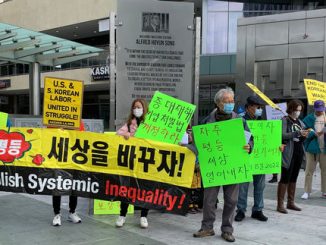
Los Angeles rally backs South Korean workers’ struggle

Photos: Insook Lee

Peter Kim

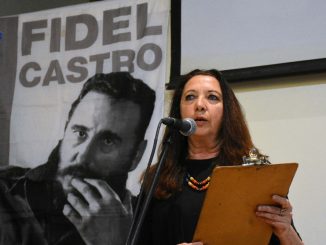
In Los Angeles Jan. 8, progressive Korean American groups and allies rallied in solidarity with the Korean Confederation of Trade Unions (KCTU) and against the U.S. military occupation of South Korea. The Harriet Tubman Center for Social Justice and the Socialist Unity Party were among the participating organizations. The following remarks were made by Korean American activist Peter Kim at the rally,

The KCTU, the largest trade union organization in South Korea, is organizing a major demonstration in Seoul on Jan. 15 under the slogan, “Let’s overthrow inequality through general unity with the people!” 

We are gathered here today as we did last October to support the Korean Confederation of Trade Unions’ unstoppable general strike. We are here again to endorse and support the Jan. 15 nationwide people’s rally hosted by the KCTU. 

The term of office of the Moon Jae In regime in South Korea is ending soon. Despite public opposition, this is the regime that just pardoned former President Park Geun Hye, allowing her  to receive security after his term ends. 

When he became president, Moon Jae In said he would create an era of zero temporary workers, but the numbers of temporary workers have increased while he’s been in office. During his campaign he promised to raise the minimum wage to $8.30, but after five years it’s still only $7.60. With inflation, even $10 isn’t enough. Hard-working Koreans are suffering with low wages, long work hours and dangerous working conditions. They deserve better!

The chaebol [corporate monopolies] who committed these crimes are free and workers who gather to protest are arrested for violating COVID-19 prevention laws. The chaebol’s in-house fund is about $100 billion, but many workers and some young people end up wandering the streets due to low wages, soaring housing prices and unemployment.

There are too many broken promises from the Moon Jae In government. Using COVID-19 prevention as an excuse to lockdown the country, he ended up putting small businesses out of business and blocking the workers’ right to protest and assemble, causing many to lose not only their jobs but their livelihood.  

Moon Jae In also talked about the peace process with North Korea, but did nothing to move those talks forward. Instead he spent an astronomical amount of money to import U.S. military weapons and support the U.S. military bases in Korea. He has not kept to his word in the last five years.

Sadly, there is no better option in the upcoming 2022 presidential election. Nobody talks about the workers and the welfare of the country, only about tax cuts for the wealthy and corporations.

Korean workers have had the highest suicide rate in the world for the past 16 years. The national birth rate is the lowest among 198 countries. The OECD ranks Korea second in the world in temporary workers, fourth in inequality and fifth in the youth unemployment rate. This is the reality of the world’s 10th largest economy. 

For all of these reasons, workers and young people, we must unite and fight. Nothing will change if we don’t stand up to the systematic inequality in South Korea. Let’s organize for the struggling workers and create change. Let’s unite with the KCTU’s rally on Jan. 15, 2022.

Strugglelalucha256


Alicia Jrapko, présenté! (in English)


Dear comrades and friends,

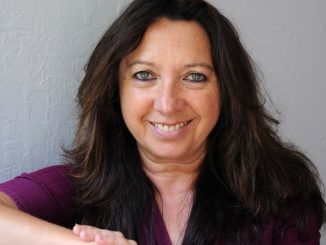
With deep sorrow and on behalf of her family, we announce that our dear colleague, sister and friend Alicia Jrapko passed away last evening after fighting a cruel illness for more than two years. In spite of the hard treatment, she never stopped working as much as she could. Alicia regretted not being able to continue contributing, loving and living with the energy that always characterized her.

Alicia was a great Argentine revolutionary, the daughter of workers who at a very young age took up the struggles of a generation that dreamed of building an Argentina with social justice for the people. Alicia once said in an interview: “In Latin America a great admiration was forged for Cuba, for Fidel, Raul, Che and so many other revolutionaries. In Argentina we wanted the same thing, but it was not achieved and a great part of my generation lost their best children.”

Alicia was born on January 1, 1953 in Merlo, Buenos Aires province, grew up and was educated in Córdoba, where she studied journalism. Argentina’s military dictatorship imposed in 1976 unleashed a fierce repression against all popular militants. Thirty thousand were detained-disappeared, among them many of Alicia’s classmates. She was unable to finish her degree, and with the clothes she was wearing, in the same year she had to go into exile.

Each of Alicia’s three children bear the middle names of her disappeared comrades: Gabriela Emma, Eileen Mabel and Juan Alberto.

For several years she lived in exile in Mexico, then settled in the United States, the most difficult country and at the same time the most necessary to support the causes of Latin America and fight against imperialism … it was difficult for her to understand the aggression, the lies and the attacks against Cuba by the media and the government.

Alicia became committed to the struggles of U.S. workers and starting in the early 1990s to Cuba solidarity work through IFCO-Pastors for Peace, where she worked closely with Rev. Lucius Walker as his West Coast coordinator and helped organize and recruit African American and Latino students to attend the Latin American School of Medicine (ELAM) for free to become doctors in their communities. Her solidarity work brought her closer to Cuba every day; she became a spokesperson for many caravans of Pastors traveling thousands of miles through the U.S. to counter the lies of the U.S. government against the revolutionary island while collecting humanitarian aid as a symbol of solidarity with the Cuban people. “We knew that the humanitarian aid we were taking to Cuba was symbolic, but we wanted to show that the U.S. government could not block solidarity between peoples. And we wanted to show that Cuba was not alone. The experience of traveling to Cuba on Pastors for Peace caravans changed my life forever and brought me closer to Cuba and its people.”

In 2000 Alicia was in the forefront of the battle for the return of Elian Gonzalez to his father in Cuba but her pivotal work can be found in the struggle to free the Cuban 5 political prisoners, unjustly incarcerated for monitoring the activity of terrorists in the U.S. against Cuba. Alicia assumed with determination and incomparable courage the leadership of the International Committee for the Freedom of the Cuban Five in the United States, and managed to get trade unionists, religious leaders, congressional representatives, jurists, intellectuals, actors and artists to join the campaign for the release of Cuban anti-terrorist fighters Gerardo Hernandez Nordelo, Ramon Labañino Salazar, Antonio Guerrero Rodriguez, Fernando Gonzalez Llort and Rene Gonzalez Sehwerert.

From 2002 until his release in 2014, regardless of the risks and the enormous distances, together with her partner in struggle and dreams, Bill Hackwell, she visited Gerardo Hernandez more than a hundred times in two maximum security federal penitentiaries, and was the constant and affectionate supporter of family visits.

Alicia’s enormous work and political commitment transcended before the Cuban people who conferred her several distinctions, among them the Felix Elmuza Medal awarded by the Union of Journalists of Cuba, the Shield of the city of Holguin and the Medal of Friendship awarded by the Council of State of the Republic of Cuba through the Cuban Institute of Friendship with the Peoples (ICAP), for her immense work during the long years of struggle for the freedom of the Five.

Pages would not be enough to describe the enormous work that this courageous woman carried out with extraordinary modesty, simplicity, dignity and fidelity, with all her energies placed at the service of human betterment throughout her precious life.

Alicia’s work focused on Latin America including the defense of the Bolivarian Revolution of Venezuela and she was also a visible presence in the antiwar movement to end the U.S. wars in Afghanistan and Iraq.

Since 2011 Alicia has been a co-chair of the National Network on Cuba (NNOC). She was the coordinator of the International Committee for Peace, Justice and Dignity for the Peoples in the U.S., and founder and co-editor of Resumen Latinoamericano in English. She created the U.S. chapter of the Network in Defense of Humanity and was a member of its General Secretariat. In her last project, despite being ill, Alicia was the co-chair of the Nobel Committee for Cuba’s Henry Reeve medical brigade, in one more effort in her tireless fight against the criminal blockade of Cuba.

Her name, Alicia, is the essence of truth. That truth was carried as a banner by our dear Ali throughout her life, the truth of the people against injustice, the truth, honesty, dignity and modesty of true revolutionaries, capable of giving their all, without any other personal ambition or motive. Alicia’s style of leadership pulled people to her and the struggle, always with her big smile and sincerity, earning her the respect of all.

She honored us with her friendship and affection, with her enormous courage. And she leaves us all in this infinite sadness, but she also leaves us with her example of how to live a life of struggle, nobility, dignity and hope.

All our love goes to Gabriela, Eileen and Juanito, her beloved children, her life partner Bill Hackwell, her six grandchildren, the youngest Che Simón, born this Jan. 5, whom she could not see or hold in her arms, but was able to listen to an audio of his cry for the future with a big smile; to her dear brother in Argentina, family, friends and colleagues in the United States.

We will never forget you, soul mate, dearest sister and mother.

Hasta Siempre Ali Querida!
You will always be present!
Until Victory Always!

Gerardo Hernández Nordelo and Graciela Ramírez Cruz

January 12, 2022 from Havana

Source: Resumen Latinoamericano

Strugglelalucha256


Alicia Jrapko, présenté! (en español)

Con profundo dolor y en nombre de su familia, comunicamos que nuestra querida compañera, hermana y amiga Alicia Jrapko, partió este 11 de enero en horas de la noche, tras luchar contra una cruel enfermedad por más de dos años. A pesar del duro tratamiento nunca dejó de trabajar en todo cuanto podía. Si algo lamentaba Alicia era no poder seguir aportando, amando y viviendo con la energía que la caracterizó siempre.

Alicia fue una gran revolucionaria argentina, hija de trabajadores que desde muy joven asumió las luchas de una generación que soñaba construir una Argentina con justicia social para el pueblo. Dijo Alicia en una entrevista…»en América Latina se forjó una gran admiración por Cuba, por Fidel, Raúl, el Che y tantas otras y otros revolucionarios. En Argentina queríamos lo mismo, pero no se logró y gran parte de mi generación perdió a sus mejores hijos». 

Alicia nació el 1ro de enero 1953 en Merlo, provincia Buenos Aires, creció y se educó en Córdoba, donde estudió periodismo. La dictadura militar de Argentina impuesta en 1976 desató una represión feroz hacia todos los militantes populares. Treinta mil fueron detenidos-desaparecidos, entre ellos muchos compañeros de clase de Alicia. No pudo terminar la carrera, y con la ropa que vestía, en el mismo año ’76 tuvo que exiliarse.

Cada uno de los tres hijos de Alicia lleva el segundo nombre de sus compañeros desaparecidos: Gabriela Emma, Eileen Mabel y Juan Alberto.

Durante varios años vivió exiliada en México, luego se radicó en Estados Unidos, el país más difícil y a la vez el más necesario para apoyar las causas de América Latina y luchar contra el imperialismo…era difícil  entender la agresión, las mentiras y los ataques contra Cuba por parte de los medios y el gobierno.

Alicia se comprometió con las luchas de los trabajadores estadounidenses y a principios de los años ’90 con el trabajo solidario con Cuba a través de IFCO–Pastores por La Paz, donde colaboró  estrechamente con el Reverendo Lucius Walker como su coordinadora de la costa Oeste, ayudó a organizar y promover  las becas para que los estudiantes afroamericanos y latinos pudieran asistir a la Escuela Latinoamericana de Medicina (ELAM) de forma gratuita para convertirse en médicos en sus comunidades. Su labor solidaria la acercaba cada día más a Cuba; se convirtió en vocera de muchas caravanas de Pastores que recorrieron miles de kilómetros a través de Estados Unidos para contrarrestar las mentiras del gobierno estadounidense contra la isla, mientras recolectaba ayuda humanitaria como símbolo de solidaridad con el pueblo cubano. «Sabíamos que la ayuda humanitaria que llevábamos a Cuba era simbólica, pero queríamos mostrar que el gobierno de EEUU no podía bloquear la solidaridad entre los pueblos. Y queríamos mostrar que Cuba no estaba sola. La experiencia de viajar a Cuba en las caravanas de Pastores por la Paz cambió mi vida para siempre y me acercó más a Cuba y su pueblo» dijo en una entrevista.

En el año 2000 Alicia estuvo al frente de la batalla por el regreso de Elián González junto su padre en Cuba, pero su trabajo fundamental se encuentra en la lucha por la liberación de los Cinco Patriotas cubanos, injustamente encarcelados por monitorear la actividad de los terroristas en los Estados Unidos contra Cuba.  

Alicia asumió con decisión e inigualable  valentía la dirección del Comité Internacional por la Libertad de los Cinco en Estados Unidos, y logró que sindicalistas, líderes religiosos, congresistas, juristas, intelectuales, actores y artistas se sumarán a la campaña por la liberación de los antiterroristas cubanos Gerardo Hernández Nordelo, Ramón Labañino Salazar, Antonio Guerrero Rodríguez,  Fernando González Llort y René González Sehwerert.

Desde el año 2002 hasta su libertad en 2014, sin importar los riesgos y las enormes distancias, junto a su compañero de lucha y de sueños, Bill Hackwell, visitó más de cien veces a Gerardo Hernández en dos prisiones federales de máxima seguridad, y fue el constante y afectivo apoyo de las visitas familiares. 

El enorme trabajo y compromiso político de Alicia trascendió ante el pueblo cubano que le confirió varias distinciones, entre ellas la Medalla «Félix Elmuza» que otorga la Unión de Periodistas de Cuba, el Escudo de la ciudad de Holguín y la Medalla de la Amistad otorgada por el Consejo de Estado de la República de Cuba a través del Instituto Cubano de Amistad con los Pueblos -ICAP-, por su inmensa labor durante los largos años de lucha por la libertad de los Cinco.

Alicia apoyó fuertemente la Revolución Bolivariana de Venezuela, el legado de Hugo Chávez y al presidente Nicolás Maduro.

No alcanzarían las páginas para describir el enorme trabajo que esta valiente mujer realizó con extraordinaria modestia, sencillez, dignidad y fidelidad, con todas sus energías puestas al servicio del mejoramiento humano a lo largo de su preciosa vida.

Desde 2011 Alicia ha sido la copresidenta de la Red Nacional sobre Cuba (NNOC). Fue coordinadora del Comité Internacional Paz, Justicia y Dignidad de los Pueblos en Estados Unidos y fundadora y coeditora de Resumen Latinoamericano en inglés. Creó el capítulo estadounidense de la Red en Defensa de la Humanidad y fue miembro de su Secretaría General. En su último proyecto, a pesar de estar enferma, Alicia fue copresidenta del Comité Nobel de la Brigada Médica Cubana Henry Reeve, como un esfuerzo más en su incansable lucha contra el criminal bloqueo a Cuba.

Su nombre, Alicia, significa verdad. Esa verdad la llevó como bandera nuestra querida Ali durante toda su vida, la verdad del pueblo contra la injusticia, la verdad, la honestidad, la dignidad y la modestia de los verdaderos revolucionarios, capaces de darlo todo, sin otra ambición o motivo personal. El estilo de liderazgo de Alicia atraía a la gente hacia ella y las luchas que lideraba, siempre con su gran sonrisa y sinceridad, ganándose el respeto de todos.

Nos honró con su amistad y cariño, con su enorme valentía. Y nos deja a todos en esta tristeza infinita, pero con su ejemplo de vida, de lucha, de nobleza, dignidad y esperanza.

Llegue todo nuestro cariño a Gabriela, Eileen y Juanito sus amados hijos, a su entrañable compañero de vida Bill Hackwell, sus seis  nietos, el más pequeño Che Simón, nacido este 5 de enero, a quien no pudo ver ni tomar en sus brazos, pero del que escuchó un audio de su grito por el futuro con una gran sonrisa; a su querido hermano en Argentina, familia, amigos y compañeros en Estados Unidos.

Jamás te olvidaremos compañera del alma, hermana más hermana y más querida. 

Hasta Siempre Ali Querida!
Siempre estarás Presente!
Hasta la Victoria Siempre!

Gerardo Hernández Nordelo y Graciela Ramírez Cruz

Fuente: Cuba en Resumen

Strugglelalucha256


‘Hey, hey, USA! How many bombs did you drop today?’

The Pentagon has finally published its first Airpower Summary since President Biden took office nearly a year ago. These monthly reports have been published since 2007 to document the number of bombs and missiles dropped by U.S.-led air forces in Afghanistan, Iraq and Syria since 2004. But President Trump stopped publishing them after February 2020, shrouding continued U.S. bombing in secrecy.

Over the past 20 years, as documented in the table below, U.S. and allied air forces have dropped over 337,000 bombs and missiles on other countries. That is an average of 46 strikes per day for 20 years. This endless bombardment has not only been deadly and devastating for its victims but is broadly recognized as seriously undermining international peace and security and diminishing America’s standing in the world.

The U.S. government and political establishment have been remarkably successful at keeping the American public in the dark about the horrific consequences of these long-term campaigns of mass destruction, allowing them to maintain the illusion of U.S. militarism as a force for good in the world in their domestic political rhetoric.

Now, even in the face of the Taliban takeover in Afghanistan, they are doubling down on their success at selling this counterfactual narrative to the American public to reignite their old Cold War with Russia and China, dramatically and predictably increasing the risk of nuclear war.

The new Airpower Summary data reveal that the United States has dropped another 3,246 bombs and missiles on Afghanistan, Iraq and Syria (2,068 under Trump and 1,178 under Biden) since February 2020.

The good news is that U.S. bombing of those 3 countries has significantly decreased from the over 12,000 bombs and missiles it dropped on them in 2019. In fact, since the withdrawal of U.S. occupation forces from Afghanistan in August, the U.S. military has officially conducted no air strikes there, and only dropped 13 bombs or missiles on Iraq and Syria – although this does not preclude additional unreported strikes by forces under CIA command or control.

Presidents Trump and Biden both deserve credit for recognizing that endless bombing and occupation could not deliver victory in Afghanistan. The speed with which the U.S.-installed government fell to the Taliban once the U.S. withdrawal was under way confirmed how 20 years of hostile military occupation, aerial bombardment and support for corrupt governments ultimately served only to drive the war-weary people of Afghanistan back to Taliban rule.

Biden’s callous decision to follow 20 years of colonial occupation and aerial bombardment in Afghanistan with the same kind of brutal economic siege warfare the United States has inflicted on Cuba, Iran, North Korea and Venezuela can only further discredit America in the eyes of the world.

There has been no accountability for these 20 years of senseless destruction. Even with the publication of Airpower Summaries, the ugly reality of U.S. bombing wars and the mass casualties they inflict remain largely hidden from the American people.

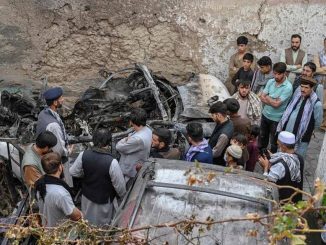
How many of the 3,246 attacks documented in the Airpower Summary since February 2020 were you aware of before reading this article? You probably heard about the drone strike that killed 10 Afghan civilians in Kabul in August 2021. But what about the other 3,245 bombs and missiles? Whom did they kill or maim, and whose homes did they destroy?

The December 2021 New York Times exposé of the consequences of U.S. airstrikes, the result of a five-year investigation, was stunning not only for the high civilian casualties and military lies it exposed, but also because it revealed just how little investigative reporting the U.S. media have done on these two decades of war.

In America’s industrialized, remote-control air wars, even the U.S. military personnel most directly and intimately involved are shielded from human contact with the people whose lives they are destroying, while for most of the American public, it is as if these hundreds of thousands of deadly explosions never even happened.

The lack of public awareness of U.S. airstrikes is not the result of a lack of concern for the mass destruction our government commits in our names. In the rare cases we find out about, like the murderous drone strike in Kabul in August, the public wants to know what happened and strongly supports U.S. accountability for civilian deaths.

So public ignorance of 99% of U.S. air strikes and their consequences is not the result of public apathy, but of deliberate decisions by the U.S. military, politicians of both parties and corporate media to keep the public in the dark. The largely unremarked 21-month-long suppression of monthly Airpower Summaries is only the latest example of this.

Now that the new Airpower Summary has filled in the previously hidden figures for 2020-21, here is the most complete data available on 20 years of deadly and destructive U.S. and allied air strikes.

Numbers of bombs and missiles dropped on other countries by the United States and its allies since 2001:

Iraq (& Syria*)       Afghanistan    Yemen Other Countries**
2001             214         17,500
2002             252           6,500           1
2003       29,200
2004       285               86         1 (Pk)
2005       404         176         3 (Pk)
2006       310           2,644     7,002 (Le,Pk)
2007           1,708           5,198         9 (Pk,S)
2008           1,075           5,215           40 (Pk,S)
2009       126           4,184         3     5,554 (Pk,Pl)
2010             8           5,126         2         128 (Pk)
2011               4           5,411           13     7,763 (Li,Pk,S)
2012           4,083           41           54 (Li, Pk,S)
2013           2,758           22           32 (Li,Pk,S)
2014         6,292*           2,365           20      5,058 (Li,Pl,Pk,S)
2015       28,696*         947   14,191           28 (Li,Pk,S)
2016       30,743*           1,337   14,549         529 (Li,Pk,S)
2017       39,577*           4,361   15,969         301 (Li,Pk,S)
2018         8,713*           7,362     9,746           84 (Li,Pk,S)
2019         4,729*           7,423     3,045           65 (Li,S)
2020         1,188*           1,631     7,622           54 (S)
2021             554*               801     4,428      1,512 (Pl,S)
Total     154, 078*         85,108   69,652     28,217


Grand Total = 337,055 bombs and missiles.

**Other Countries: Lebanon, Libya, Pakistan, Palestine, Somalia.

These figures are based on U.S. Airpower Summaries for Afghanistan, Iraq, and Syria; the Bureau of Investigative Journalism’s count of drone strikes in Pakistan, Somalia and Yemen; the Yemen Data Project‘s count of bombs and missiles dropped on Yemen (only through September 2021); the New America Foundation’s database of foreign air strikes in Libya; and other sources.

There are several categories of air strikes that are not included in this table, meaning that the true numbers of weapons unleashed are certainly higher. These include:

Helicopter strikes: Military Times published an article in February 2017 titled, “The U.S. military’s stats on deadly air strikes are wrong. Thousands have gone unreported.” The largest pool of air strikes not included in U.S. Airpower Summaries are strikes by attack helicopters. The U.S. Army told the authors its helicopters had conducted 456 otherwise unreported air strikes in Afghanistan in 2016. The authors explained that the non-reporting of helicopter strikes has been consistent throughout the post-9/11 wars, and they still did not know how many missiles were fired in those 456 attacks in Afghanistan in the one year they investigated.

AC-130 gunships: The U.S. military did not destroy the Doctors Without Borders hospital in Kunduz, Afghanistan, in 2015 with bombs or missiles, but with a Lockheed-Boeing AC-130 gunship. These machines of mass destruction, usually manned by U.S. Air Force special operations forces, are designed to circle a target on the ground, pouring howitzer shells and cannon fire into it until it is completely destroyed. The U.S. has used AC-130s in Afghanistan, Iraq, Libya, Somalia, and Syria.

Strafing runs: U.S. Airpower Summaries for 2004-2007 included a note that their tally of “strikes with munitions dropped… does not include 20mm and 30mm cannon or rockets.” But the 30mm cannons on A-10 Warthogs and other ground attack planes are powerful weapons, originally designed to destroy Soviet tanks. A-10s can fire 65 depleted uranium shells per second to blanket an area with deadly and indiscriminate fire. But that does not appear to count as a “weapons release” in U.S. Airpower Summaries.

Counter-insurgency” and “counter-terrorism” operations in other parts of the world: The United States formed a military coalition with 11 West African countries in 2005, and has built a drone base in Niger, but we have not found any systematic accounting of U.S. and allied air strikes in that region, or in the Philippines, Latin America or elsewhere.

The failure of the U.S. government, politicians and corporate media to honestly inform and educate the American public about the systematic mass destruction wreaked by our country’s armed forces has allowed this carnage to continue largely unremarked and unchecked for 20 years.

It has also left us precariously vulnerable to the revival of an anachronistic, Manichean Cold War narrative that risks even greater catastrophe. In this topsy-turvy, “through the looking glass” narrative, the country actually bombing cities to rubble and waging wars that kill millions of people, presents itself as a well-intentioned force for good in the world. Then it paints countries like China, Russia and Iran, which have understandably strengthened their defenses to deter the United States from attacking them, as threats to the American people and to world peace.

The high-level talks beginning on January 10th in Geneva between the United States and Russia are a critical opportunity, maybe even a last chance, to rein in the escalation of the current Cold War before this breakdown in East-West relations becomes irreversible or devolves into a military conflict.

If we are to emerge from this morass of militarism and avoid the risk of an apocalyptic war with Russia or China, the U.S. public must challenge the counterfactual Cold War narrative that U.S. military and civilian leaders are peddling to justify their ever-increasing investments in nuclear weapons and the U.S. war machine.

Medea Benjamin is cofounder of CODEPINK for Peace, and author of several books, including Inside Iran: The Real History and Politics of the Islamic Republic of Iran

Nicolas J. S. Davies is an independent journalist, a researcher with CODEPINK and the author of Blood on Our Hands: The American Invasion and Destruction of Iraq.


Strugglelalucha256


Elecciones en la India: el discurso de odio de la derecha se desata

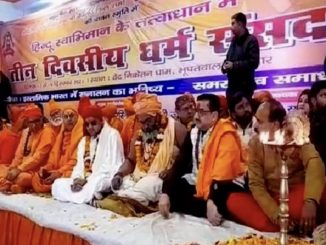
Un extraño acontecimiento se desarrolló en el norte de la India, entre el 17 y el 19 de diciembre de 2021. Se trató de un “parlamento religioso” (Dharma Sansad) alrededor del tema “El futuro del Sanatan Dharma en la India islámica: problemas y soluciones”. El evento se realizó en Haridwar, una ciudad del estado de Uttarakhand. Los ponentes – vestidos con túnicas color azafrán, que es lo que normalmente usan los monjes hindúes – subieron al escenario durante el Dharma Sansad y hablaron con un tono sorprendentemente peligroso: incendiario y provocador. Sadhvi Annapurna, secretaria general de Hindu Mahasabha, una organización de derecha nacionalista en la India, fue la más directa en exponer la agenda de odio contra la comunidad musulmana que definió el tono del evento. “Nada es posible sin armas”, dijo. “Si quieren eliminar su población, entonces hay que estar dispuestos a matarlos”.

A quiénes se refería con “su” y “ellos” durante el discurso quedó claro para todas las personas presentes y para todas aquellas que vieron el video, que circuló ampliamente en las redes sociales y en los canales de televisión india. Sadhvi Annapurna se refería a los 204 millones de musulmanes que viven en este país. “Incluso si cien de nosotros estamos dispuestos a matar 20 lakh (cien mil) de ellos [2 millones], habremos ganado y estaremos listos para ir a la cárcel”, dijo.

Un grupo de funcionarios públicos envió una carta al ministro jefe de Uttarakhand, Pushkar Singh Dhami, “condenando la respuesta de su Gobierno” al Dharma Sansad. A pesar de los llamados realizados por algunos sectores de la sociedad – incluyendo un grupo de ex-funcionario públicos – para que se investigue y arreste a los organizadores y oradores del Dharma Sansad por promulgar estos provocativos discursos de odio, la policía de Uttarakhand no ha tomado ninguna “acción seria” contra quienes intentaron incitar la violencia a través del evento. Uttarakhand es gobernado por el Partido Bharatiya Janata (BJP), cuyo líder, Narendra Modi, es el primer ministro de la India.

Mientras tanto, Dhami no ha hecho ninguna declaración en contra del evento, a pesar de que las fotografías que lo muestran inclinándose ante uno de los oradores del cónclave parecen sugerir un vínculo cercano con las personas involucradas en la organización del mismo. El orador que aparece en la fotografía, Swami Prabodhananda Giri, es el líder del Hindu Raksha Sena, una organización de derecha con sede en Uttarakhand. Durante el encuentro, Swami dijo que “todos los hindúes deben tomar las armas, y tendremos que llevar a cabo esta campaña de limpieza”. Está claro que la asociación entre “armas” y “limpieza” hace referencia al tipo de limpieza étnica o religiosa que hemos presenciado en varios períodos de la historia, incluyendo el holocausto durante la Segunda Guerra Mundial.

Elecciones y odio

Entre febrero y marzo de 2022, tres estados claves del norte de la India tendrán elecciones. Uno de estos estados es Uttarakhand. Los otros dos – Uttar Pradesh y Punjab – son clave para la suerte del BJP, que tendrá que probar su popularidad después de que Modi se vio obligado a derogar, el 19 de noviembre de 2021, las tres leyes agrícolas. El malestar de los agricultores en ambos territorios (Punjab y Uttar Pradesh) dio lugar a una campaña de protestas que se prologó durante todo un año, y que afectó la reputación del BJP hasta el punto de abrir la posibilidad de dibujar un nuevo mapa electoral en ambos estados. Uttar Pradesh (que tiene una población aproximada 200 millones de habitantes) es el estado más poblado de la India, y los resultados que el BJP obtenga allí serán determinantes sobre la autoridad del Gobierno de Modi en Delhi, la capital del país y sede del poder gubernamental. Una derrota en Uttar Pradesh, o incluso, una mayoría disminuida, le daría a la oposición la confianza para desafiar el enfoque de Modi en la definición de las políticas nacionales y para contrarrestar la ideología de derecha propagada por el BJP.

Actualmente, el BJP domina la asamblea estadal de Uttar Pradesh (obtuvieron 312 de las 403 escaños en las elecciones asamblearias del 2017). El ambiente de Uttar Pradesh sigue siendo tenso para las minorías (alrededor del 19% de la población del estado son musulmanes), en gran medida porque una gran parte de las organizaciones hindúes de derecha – muchas de ellas presentes en el cónclave religioso – han alimentado, por generaciones, el odio contra la minoría musulmana. Como parte de su arsenal para la captación de votos, el BJP ha desarrollado la estrategia para provocar la violencia religiosa, polarizar a la población y asegurar que el voto mayoritario hindú se agrupe bajo su bandera. Con esta técnica, el BJP triunfó en las elecciones generales del 2014: justo antes de que se realizaran, entre agosto y septiembre del 2013, los funcionarios locales del partido idearon una atrocidad en la ciudad de Muzaffarnagar, que resultó en la muerte de más de 60 personas y el desplazamiento de miles. En el 2014, después de esta ola de violencia, el líder del BJP – ahora ministro del Interior de la India (responsable de la ley y el orden del país) – Amit Shah, declaró ante un multitud congregada en Shamli, en el oeste de Uttar Pradesh, que las elecciones generales eran una cuestión de honor, y que sería “una elección para vengarse del insulto” y “para darles una lección a aquellos que han cometido injusticias”.

En noviembre de 2021, el Partido Samajwadi y el Rashtriya Lok Dal (Partido Nacional del Pueblo) formaron una alianza para las elecciones legislativas de Uttar Pradesh. El Partido Samajwadi había gobernado el estado desde el 2012 hasta el 2017, bajo el liderazgo del ex ministro jefe Akhilesh Yadav. Por su parte, el Partido Rashtriya Lok Dal, aporta peso en los estados occidentales de Uttar Pradesh, donde la protesta de los agricultores tuvo un gran impacto. Esta combinación amenaza la agenda divisoria de BJP. Es probable que se realicen más eventos como el Dharma Sansad, centrados en la difusión y el fortalecimiento del odio religioso en Uttar Pradesh, para polarizar al electorado en beneficio del BJP.

Las cloacas del odio

El cónclave religioso celebrado en diciembre del 2021 sugirió que había una amenaza para los hindúes en la “India Islámica”. Este es un tema que se remonta al siglo XIX, cuando los líderes de la derecha hindú empezaron a decir que el hinduismo estaba siendo amenazado, entre otras cosas, por el aumento de la tasa de natalidad de los musulmanes. Más allá de los hechos, esta idea, enconada en las cloacas del pensamiento de la derecha, sigue encontrando adeptos en algunas corrientes dentro del BJP, como Shah, quién describió a las minorías musulmanas de Uttar Pradesh como la gente “que ha cometido injusticias”. Referirse a la India como “islámica” forma parte de una exagerada paranoia, una fiesta del odio que se traduce en violencia y en la consolidación del poder político del BJP.

En lugar de enfrentarse a un arresto por su discurso de odio, los hombres y mujeres que hablaron en la asamblea presentaron una denuncia ante la policía en contra de “maulanas o clérigos” y “el Corán, los maulvis [eruditos Islámicos] de Haridwar y otros musulmanes no identificados”. A Sadhvi Annapurna, quien llamó al asesinato de musulmanes, se le puede escuchar en un video publicado en Twitter el 28 de diciembre de 2021, diciéndole a un oficial de policía que “nos demuestre que no es parcial”. Yati Narsinghanand, quien organizó el cónclave religioso, interviene para decirle que el policía es “parcial y está de nuestro lado”. Tras el cónclave religioso de Haridwar, veintiún “monjes hindúes” que participaron en el cónclave, formaron un comité para celebrar más reuniones de este tipo y “convertir la India en un ‘Rashtra [estado] hindú’”. “Ustedes [los hindúes en la India] solo pueden luchar contra ellos con armas”, dijeron los monjes, sin necesidad de detallar a quienes se referían al decir “ellos”.

La democracia en la India está corroída por el ácido legado de la derecha hindú, que se nutre de la intimidación y el falso orgullo como combustible para su éxito. Las protestas de los campesinos y campesinas ofrecieron una salida alternativa. Los dos caminos se medirán en las elecciones legislativas previstas para principios del 2022.

Este artículo fue producido para Globetrotter.

Vijay Prashad es un historiador, editor y periodista indio. Es miembro de la redacción y corresponsal en jefe de Globetrotter. Es editor en jefe de LeftWord Books y director del Instituto Tricontinental de Investigación Social. También es miembro senior no-residente del Instituto Chongyang de Estudios Financieros de la Universidad Renmin de China. Ha escrito más de 20 libros, entre ellos The Darker Nations y The Poorer Nations. Su último libro es Washington Bullets, con una introducción de Evo Morales Ayma.

Strugglelalucha256


Stop winter evictions!


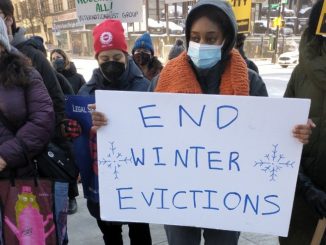
Jan. 8 – A hundred people marched today in New York City in sub-freezing temperatures to stop evictions. Landlords across New York State want to kick 250,000 families out of their homes.

People gathered at Brooklyn’s housing court at 141 Livingston St. Tenants find little justice there. Officials are often just rubber stamps for the landlords.

“Housing is a human right, fight, fight, fight!” was a favorite chant. Speakers pointed out the impossibility of finding affordable housing in the capital of capitalism. Over half of the tenants in New York City pay half of their income for rent. 

The current moratorium on evictions ends on Jan. 15. Landlords want to use Dr. Martin Luther King’s birthday to start throwing families’ furniture on the street.

New York Gov. Kathy Hochul doesn’t want to extend the moratorium. It was only because millions of people were in the street demanding Black Lives Matter that there was any ban on evictions during the pandemic. 

Marchers demanded the moratorium be extended until June 30.

After a short rally, people marched to 26 Court St., home of some of the landlords’ favorite law firms. People then went over the Brooklyn Bridge with their colorful banners to Manhattan’s housing court.

Among the organizations that came out today were the Crown Heights Tenant Union, Democratic Socialists of America, the Party for Socialism and Liberation and the Socialist Unity Party.

The CHTU is joining other groups in calling for a “march on billionaires’ row” on Jan. 12 at 6 p.m. at 57th Street and Broadway in Manhattan.

Kicking people out of their homes in the winter can be a death sentence. Every attempted eviction has to be stopped.  

Strugglelalucha256


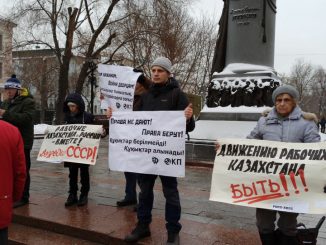
Why Kazakhstan exploded

What is happening now in Kazakhstan, a popular uprising or another “color revolution”? At the moment, users of Ukrainian social networks are actively discussing this issue. 

Despite all the differences, we are very similar in our social, economic and political systems – Ukraine, Kazakhstan, Georgia, Armenia, Russia, Belarus. After all, we all came out of one overcoat of the former USSR. That is why we rightly compare the crisis processes in our countries.

All “Maidans” – that is, large-scale protests that have taken place in our countries – had different triggers, but they were always due to the same underlying social reasons. So many active people would not go out to protest merely for cookies.

The first Kazakh workers’ Maidan took place in 2011 in the city of Zhanaozen, which is the epicenter of today’s explosion. This also had social reasons.

There are deep contradictions between the capital that has merged with state power, on the one hand, and the mass of social groups exploited by it, on the other. These contradictions are the foundation of Maidans in all our countries.

With all the Maidans, there is a problem that arises objectively – whether anyone wants it or not – and it is that members of the ruling class use the situation to fulfill their own needs. 

Maidans turn into color revolutions when the result is a change of the president’s name without changing the conditions that gave rise to the protests. That is, without changing the bankrupt social system of capitalism.

The result of these inter-elite chess moves is the strengthening of the omnipotence of national and transnational capital, the strengthening of the authoritarian regime (only with another figurehead), the suppression of civil liberties, more IMF bondage, and the final loss of independence for the country.

Ukraine after 2014 is a striking and sad example of this development.

However, in reality, another result is possible, and that is for the Maidan to change not only the president and the government, but eventually the social system itself via the overthrow of capitalism. Only thus will the root causes of social protest be removed.

It all depends on who is able to shape the agenda of the protest movement.

In Ukraine in 2014, or in Belarus in 2020, the agenda was shaped by the local nationalist and neoliberal bourgeoisie, far-right and Western-dependent “grant eaters.” And now in Kazakhstan, the pro-Western opposition is talking about two ways that protests can go:

“The country can go along two paths: revolution (topple and put everyone in jail) or urgent reforms – political and economic,” it states in social networks.

Surely, Kazakh grant-eaters want the latter path out of the dilemma: “The second legitimate path requires the dissolution of parliament, the dissolution of the ruling Nur Otan party, the deprivation of all immunities of [former president] Nazarbayev and his family members, rapid political reforms by presidential decrees, registration of opposition parties and the organization of parliamentary elections on a 50/50 basis. Then we need to carry out a constitutional reform.”

In fact, this plan offers the Kazakhs a redistribution of power without any social change. This is what happened during the events in Ukraine.

The way things will really go in Kazakhstan depends on whether the workers of Zhanaozen and other Kazakh cities, shot down in 2011, can unite. Will they be able to create a left-wing political entity and develop their own social program, avoiding the influence of the right-wing “opposition”? This is very important, but, as we understand, it is very difficult.

However, there is no other way out. Capitalist exploitation and “market reforms” are the real causes of the Kazakh Maidan. And the movement’s goal should be to eliminate these factors, not the redistribution of power among financial and political groups.

Everything that is happening in Kazakhstan today has direct analogs in Ukraine and other post-Soviet countries. And since social problems in Ukraine have not disappeared, but only intensified during the post-Maidan regime, we are also facing new popular uprisings.

Like it or not, the Maidan will objectively arise – because neither the parliamentary way nor elections can solve social contradictions.

The main thing is that it must be a social Maidan – a social revolution, which cannot be confused with its political imitations in the interests of the imperialists and oligarchs.

We cannot go on living as we do today. But we don’t need market reforms, we need social change.

Translated by Greg Butterfield

Source: Liva.com.ua

Strugglelalucha256


Socialist Movement of Kazakhstan calls for international solidarity

In a statement about the large-scale mobilizations and protests in the former Soviet republic, the Socialist Movement of Kazakhstan calls for international solidarity with the demonstrators and demands the withdrawal of troops from the cities, the resignation of all Nazarbayev officials, the release of all political prisoners and detainees, the legalization of the Communist Party and trade unions, as well as the nationalization of Kazakhstan’s entire extractive and large-scale industry.

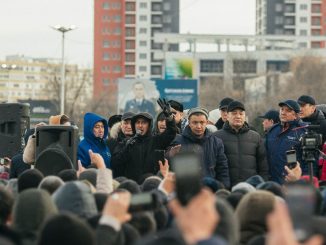
Jan. 6 – In Kazakhstan, there is now a real popular uprising. From the very beginning the protests were of a social and class nature, since the doubling of the price of liquefied gas on the exchange was just the last straw in an overflowing cup of patience. After all, the demonstrations began precisely in Zhanaozen at the initiative of the oil workers, which became a kind of political headquarters of the entire protest movement.

And the dynamics of this movement is indicative, since it began as a social protest, it then began to expand, and labor collectives used rallies to put forward their own demands for a 100% increase in wages, cancellation of optimization results, improvement of working conditions and freedom of trade union activity. As a result, on Jan. 3, the entire Mangistau region was engulfed in a general strike, which spread to the neighboring Atyrau region.

It is noteworthy that already on Jan. 4, Tengizchevroil oil workers went on strike, where the participation of American companies reaches 75%. It was there that last December 40,000 workers were laid off and a new series of layoffs was planned. They were subsequently supported during the day by the oil workers of Aktobe and West Kazakhstan and Kyzylorda regions.

Moreover, in the evening of the same day, strikes of miners from the ArcelorMittal Temirtau company began in the Karaganda region and copper smelters and miners from the Kazakhmys corporation, which can already be regarded as a general strike in the entire mining industry of the country. And here they also put forward demands for higher wages, lowering the retirement age, the right to their own trade unions and strikes.

At the same time, indefinite rallies on Tuesday began in Atyrau, Uralsk, Aktyubinsk, Kyzyl-Orda, Taraz, Taldykorgan, Turkestan, Shymkent, Ekibastuz, in the cities of the Almaty region and in Almaty itself, where the occupation of streets began on the night of Jan. 4-5 in an open clash of demonstrators with the police, as a result of which the city akimat (city hall) was temporarily seized. This gave rise to President Kassym-Zhomart Tokayev declaring a state of emergency.

It should be noted that these mobilizations in Almaty were attended mainly by unemployed youth and internal migrants living in the suburbs of the metropolis and working in temporary or low-paid jobs. And attempts to calm them down with promises by reducing the gas price to 50 tenge, separately for the Mangistau region and Almaty, have not satisfied anyone.

The decision of Kassym-Zhomart Tokayev to dismiss the government, and then removing former President Nursultan Nazarbayev from the post of chairman of the Security Council, also did not stop the protests, since on Jan. 5, mass protest rallies began in those regional centers of Northern and Eastern Kazakhstan, where they had not previously existed – in Petropavlovsk, Pavlodar, Ust-Kamenogorsk, Semipalatinsk. At the same time, attempts were made to storm the buildings of regional akimats (provincial governments) in Aktobe, Taldykorgan, Shymkent and Almaty.

In Zhanaozen itself, at their indefinite rally, workers formulated new demands – the resignation of the incumbent president and all Nazarbayev officials, the restoration of the 1993 Constitution and the associated freedoms to create parties, trade unions, release political prisoners and end repression. A council of aksakals (elders) was immediately created, which became an informal authority.

Thus, the demands and slogans that are now used in different cities and regions were broadcast to the entire movement, and the struggle received political content. Attempts are also being made on the ground to create committees and councils to coordinate the struggle.

At the same time, troops were pulled together in Almaty, Aktau and Zhanaozen, and if everything went peacefully in the Mangistau region and the soldiers refused to disperse the protesters, then shootings began in the southern capital, and on the night of Jan. 5-6, special forces were introduced, which began cleanup of the airport and neighborhoods captured by the rebels. According to various sources, there are already dozens of demonstrators killed.

In this situation, there is a danger of violent suppression of all protests and strikes, and here it is necessary to completely paralyze the country with a general strike. Therefore, it is urgent to form unified action committees on a territorial and production basis in order to provide organized resistance to military and police terror.

In this regard, the support of the entire international workers’ and communist movement and leftist associations is also necessary in order to organize a large-scale campaign around the world.

The Socialist Movement of Kazakhstan demands:

An immediate end to hostilities against our people and the withdrawal of troops from the cities!

Immediate resignation of all Nazarbayev officials, including President Tokayev!

Release of all political prisoners and detainees!

Ensuring the right for workers to create their own trade unions, political parties, to hold strikes and meetings!

Legalization of the activities of the banned Communist Party of Kazakhstan and the Socialist Movement of Kazakhstan!

We call on all the workers and laboring people of the country to implement in practice the demand of the executed oil workers of Zhanaozen – to nationalize, under the control of labor collectives, the entire extractive and large-scale industry of the country!

Translation by In Defense of Communism

Strugglelalucha256


New York City Student Walkout for COVID Safety

NYC Student Walkout for COVID Safety

Tuesday, January 11 – 11:52 a.m.

NYC citywide student walkout demanding real #COVID19 safety measures now! Follow nycstudentwalkout2022 on IG or join Facebook group for more information.

On Facebook

Strugglelalucha256


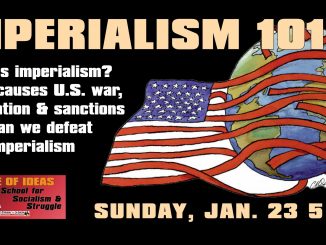
Imperialism 101: online class, Jan. 23

SUNDAY, JANUARY 23, 2022 AT 6 PM – 7:30 PM EST
Imperialism 101 – Class
Online event

Imperialism 101
This class will explore:
What is U.S. imperialism? What is the definition of imperialism?
What causes war, occupation & sanctions?
How can we stop imperialism and much more…
Readings and preparation include:
“Imperialism, the Highest Stage of Capitalism” by Lenin
https://www.marxists.org/archive/lenin/works/1916/imp-hsc/
If you are not able to read all 10 chapters, please read chapter X & VII
“Expanding Empire, The global war drive of big business and the forces that will stop it”
by Vince Copeland
https://struggle-la-lucha.org/imper…/expanding-empire/
If you are not able to read the entire pamphlet, please read chapters 1 and 12
If you would like to listen to “Imperialism, the Highest Stage of Capitalism”
Here is a youtube link https://www.youtube.com/playlist…
Strugglelalucha256
https://www.struggle-la-lucha.org/2022/page/81/