Shireen Abu Akleh was a truth teller

Palestine will not be silenced

Israeli police attacked the funeral procession – nearly forcing pallbearers to drop Abu Akleh’s coffin.

The Palestinian journalist Shireen Abu Akleh was deliberately targeted by an Israeli sniper and assassinated on May 11. She was murdered in the morning daylight while wearing a vest that was clearly marked PRESS on the front and on her back.

To the apartheid regime occupying Palestine, her camera was more dangerous than a gun.

For 25 years Abu Akleh told the world about Palestine. “I chose journalism to be close to people,” said Shireen Abu Akleh. “It might not be easy to change the reality, but at least I could bring their voice to the world.” 

The Al Jazeera broadcaster reported how racist Israeli settlers shout in Hebrew “Mavet le-Aravim.” (“Death to the Arabs.”) She showed the demolition of Palestinian homes and the shooting of Palestinian children.

For telling the truth, Shireen Abu Akleh was beloved throughout the Arab world and beyond. And for being a truth teller she was murdered.

More than 50 other Palestinian journalists have been killed. The Israeli military spokesperson Ran Kochav justified these killings by saying “They’re armed with cameras, if you’ll permit me to say so.” 

The capitalist media covers-up these murders. The first headlines about Abu Akleh’s death in The New York Times referred to her as simply being slain, not assassinated.

The actress Susan Sarandon tweeted the truth: “Shireen Abu Akleh was EXECUTED with a shot to the head.” 

Shireen Abu Akleh held U.S. citizenship. Where was the congressional resolution condemning her assassination after the U.S. has delivered over $140 billion into the Zionist state?

In contrast, the governments of South Africa and Namibia denounced this foul murder. So did the Zimbabwe Union of Journalists.

Africans remember how Israel supported the original apartheid regime in South Africa and even supplied those neo-Nazis with nuclear weapons. 

Attacking her funeral

The Zionist state couldn’t even let Palestinians bury Shireen Abu Akleh in peace. The whole world saw on May 13 how Israeli police in riot gear attacked the pallbearers with horses and batons in Al-Quds (Jerusalem), the capital of Palestine.

At one point the casket almost dropped to the ground. One of the carriers managed to hold it with one hand while warding off police clubs with the other.

Palestinians belong to different faiths. Shireen Abu Akleh was a Christian.

Some Israeli soldiers asked Palestinians in the funeral procession whether they were Muslim or Christian. If they answered “Muslim” they would be kicked out. 

Tear gas and stun grenades were used against mourners. Cops beat and kicked the mourners while seizing Palestinian flags.

That’s how every colonial regime acts. In 1948, Law No. 53 was passed in Puerto Rico that made it illegal to display or even own a Puerto Rican flag. “La Ley de la Mordaza” was repealed in 1957.

Israeli police claim Palestinians carrying their own flag is “nationalist incitement.” Real “incitement” is the Israeli Brigadier-General (Reserve) Zvika Fogel confirming that army snipers are ordered to shoot at Palestinian children.

Fogel told Ron Nesiel on the Israeli public radio network Kan in 2018 that “it is not the whim of one or the other sniper who identifies the small body of a child now and decides he’ll shoot. Someone marks the target for him very well and tells him exactly why one has to shoot and what the threat is from that individual.”

Someone in the Israeli military establishment also marked the target of Shireen Abu Akleh and ordered the sniper to shoot her in the head.

The truth will not be silenced

It’s not just in the U.S. client state of Israel that truth tellers are assassinated. Between 2000 and 2016, $10 billion in U.S. aid was sent to Colombia.

The upshot was that tens of thousands of people were killed. Among them were 53 Colombian journalists slain between 1992 and 2022.

Within the United States itself ― all of it stolen from Indigenous peoples ― journalists have been attacked and killed.

Los Angeles Times columnist and KMEX-TV news director Ruben Salazar was killed on Aug. 29, 1970, during the National Chicano Moratorium anti-war march in East Los Angeles. Cops had attacked the peaceful protest of over 20,000 people.

Salazar was killed by a tear gas canister fired by a Los Angeles County Sheriff’s deputy.

Many people believe that Salazar was deliberately targeted for exposing the racism and brutality of the police and sheriff departments. In the days before his death, Ruben Salazar felt that he was being followed by police.

The wealthy and powerful wanted to silence the radio journalist Mumia Abu-Jamal forever. The former Black Panther Party member was framed for killing a Philadelphia police officer and was sentenced to death.

Although the death sentence was eventually overturned, Mumia Abu-Jamal has been in prison since 1981.

Ramsey Orta, a member of Copwatch in New York City, videoed the killing of Eric Garner by police officer Daniel Pantaleo on July 17, 2014. Garner was choked to death while repeatedly saying “I can’t breathe.”

For revealing the truth about Eric Garner’s cruel death to the world, Ramsey Orta was railroaded to jail and spent four years in prison.

The U.S. Government is now trying to extradite Wikileaks founder Julian Assange for exposing Pentagon war crimes in Afghanistan and Iraq. Assange is in ill health and could be sentenced to many years in jail.

Hands off Julian Assange and all the truth tellers.

Strugglelalucha256


Harlem, NYC: Malcolm X Lives! March for Respect for Malcolm X! May 19


Malcolm X Lives! March for Respect for Malcolm X!

Thursday, May 19, 2022,
12 Noon: Assemble for March,
1 pm: March on 125th Street.

Black Power March and Demand that all businesses on 125th Street have a “Commercial Moment of Silence” and close from 1 – 4 pm. Shut ’em Down!

Strugglelalucha256


Malcolm X Day Celebration 2022 in San Diego

Strugglelalucha256


Boston May 24: May Day Brigade report

Strugglelalucha256


Victory Day and the struggle for abortion rights today

Presentation at the international webinar “Marxists Speak Out: Victory Day, Against Nazism and Imperialism, Yesterday and Today” on May 14.

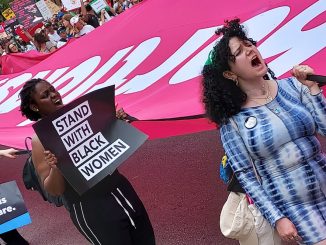
I’ve just come from a march of many thousands here in New York to defend the right to abortion. As you probably know, a draft ruling by the U.S. Supreme Court was leaked earlier this month, which would reverse the right to abortion granted in the Roe vs. Wade case almost 50 years ago. 

If the decision goes through, the legal precedent will also endanger many other hard-won civil rights, including same-sex marriage, the right to access contraception, protection from so-called sodomy laws used to criminalize queer people, even interracial marriage. It truly is an attack on the whole working class.

The vicious ruling class attack on reproductive rights made me think about the essential role of women and other oppressed-gender people in our movements and in the Soviet victory over fascism in World War II. We know the names of heros like the Red Army sniper Lyudmila Pavlichenko, air fighter Lidya Litvyak and saboteur Zoya Kosmodemyanskaya. But Soviet women also held down the homefront, kept the factories running, and waged guerrilla warfare when their cities and villages were occupied by the Nazis. 

On May 9, 2016, I had the great fortune to attend the Victory Day march in Lugansk, capital of the Lugansk People’s Republic. It was one of the most moving experiences of my life as a revolutionary. The people of the city poured into the streets to honor not only their ancestors who fought fascism decades before, but also those who fought and died to stop Ukraine’s attack on the city in 2014-15. And women were at the center of this mobilization. They were the organizers and leaders, as they are in so many of our organizations, movements, unions and communities.

In this spirit, the Socialist Unity Party is seeking ways to connect the struggle against the U.S./NATO proxy war in Ukraine with the emerging mass movement to fight for abortion rights and other struggles of the working class here at home. There is enormous and growing anger and distrust of the Democratic Party, which poses as the friend of workers and oppressed communities to get elected, while fundamentally serving the interests of the capitalist class just like the Republican Party.

In recent weeks, we have seen the spectacle of Democrats in Congress voting unanimously for an additional $40 billion for the proxy war in Ukraine, while at the same time failing in a rushed vote to codify abortion rights into law, despite having control of both the House and Senate. At the same time, every member of the Senate, Democrat and Republican, voted to add extra security for the Supreme Court justices who are poised to strip a basic human right from more than half the population.

The imperialist regime of the U.S. wants to mandate forced pregnancy and birth at a time when the cost of food and rent is skyrocketing, there is a frightening shortage of infant formula, and the public health measures of the pandemic have been repealed. And the money that could be used to mitigate some of these life-and-death crises is being spent on weapons and aid to prolong a war on the other side of the world.

The capitalists, in their insatiable drive for profits, can’t stop themselves from pushing too far. They are making the contradictions of their system so glaring that it gives us, their enemies, an opportunity to educate and organize the many, many workers whose lives are on the line  – especially the most downtrodden, including Black and Brown people, women, trans people and immigrants. 

As we mark the 77th Victory Day, our great task is to help our class make the connections between the struggle against imperialist war abroad and the war on workers at home.

Strugglelalucha256


Brooklyn middle school students walk out for abortion rights

Across the U.S., Bans Off Our Bodies student walkouts took place May 12 to protest the Supreme Court’s attack on abortion rights, including in Richmond, Virginia; Brookfield, Connecticut; Austin, Texas; Louisville, Kentucky; Urbandale, Iowa; and Stevens Point, Wisconsin.

Students at several New York City public schools participated. Struggle-La Lucha spoke with Dru, a seventh grader at Arts & Letters 305 United in Brooklyn, who joined a walkout by middle-school students and documented the event with videos. She talked about how the students organized the action, and how the school administration worked to sabotage it.

After the draft Supreme Court decision to overturn Roe vs. Wade leaked May 3, “People I talked to were upset about it,” Dru told SLL. “Some kids in my class were the ones planning the walkout. They gave out small hand-written leaflets announcing it. 

“Before the walkout the co-principal said she was all for it. Most of the teachers said they were in full support. They sent out permission slips to leave the school grounds, but that was about it.”

On May 12, she said, “During second period, the majority of the class got up and went downstairs. We passed the other co-principal, and there was a sign taped to the door next to him that said: ‘By participating in this walkout you are participating in a civil disturbance. Keep in mind that there could be severe consequences for doing this.’ He didn’t say anything, he just watched.

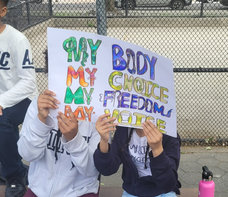
“After a few minutes there was a large crowd of more than 100 people in the schoolyard. People held signs they made. We crowded around a bench where the organizers gave talks with a megaphone.”

Handmade signs held by the multinational crowd read, “Free and safe abortions for all,” “Our bodies, our choice,” “Abortion is a personal decision, not a political debate” and “Access to abortion is a human right.” 

One powerful sign said, “Texas won’t make a 12-year-old wear a mask to school but will force a woman to have a baby?”

Dru continued: “After a few minutes we said we were going to march around the neighborhood so people would hear our message, since standing around in the schoolyard wasn’t really a walkout. Then some school staff members locked the gate. We were like, ‘What?’ So we turned around and went to the entrance to the public park next door, and they locked that too!

“A group of kids rushed to the last open gate and held it open so everyone could flood out. We walked down the sidewalk chanting and carrying our signs. 

“When we got to the next block the assistant principal and another staff member said if we didn’t go back we’d be in trouble. Even people with parental permission were told we had to go back,” she said. “Enough people were scared that we all went back to the schoolyard together. 

“People got back up on the bench and continued to speak out. At no point did the cops appear, but all the gates were locked and school staff were guarding every gate. The person standing by the gate we’d escaped from apparently had the list of people with parental permission, but they never made an announcement or told us anything.

“One of my parents talked to the school office, and was told that they’d let us go after informing us we’d be marked absent. But that never happened. 

“Everyone in the crowd was chanting. One of my friends said we should start circling in the schoolyard. After we’d been outside for about an hour some people started to give up and went back inside. The school staff were advising people to go back inside, and they were also telling people the [citywide students’] protest at Union Square was happening later than it really was. ‘You guys can’t stay out here that long.’ I was determined to stay as long as there were people out there.

“When there was only a small group left in the schoolyard, after they had been trying to discourage us and run out our time, they finally said, ‘’We can’t legally stop those of you with parental permission.’

“They could have let us march in the neighborhood and come with us to make sure we were being safe. The people who went to Union Square went without any adults, even though before they said school staff would accompany the walkout.”

Dru concluded: “The next day during the community meeting the co-principal said: ‘During the walkout yesterday a lot of you were concerned about getting in trouble because of that sign I had. But you won’t be getting in trouble from us. This was an inspiring experience. Protests are meant to be uncomfortable.’

“The kids who organized for the walkout were so excited. And it was kind of a slap in the face to them how the school treated it. They did everything they could to defuse the walkout. And afterward they said all kinds of sweet things about how inspiring it was. I was really angry.”

Dru’s parent Greg told SLL: “I was in constant contact with Dru by text during the walkout. I spoke to the school office. I’ve watched all of Dru’s videos. Everything backs up her version of events, not the spin that school officials put on it.

“It was a rotten way to treat these students who wanted to speak out for their rights that are under attack. In my opinion, this conduct is deeply at odds with the progressive, diverse, community-oriented values this school administration claims to uphold.

“I’m very proud of the students. They did everything they could and left egg on the faces of the school administration and the higher-ups in Mayor Eric Adam’s administration who were calling the shots. Their ‘jailbreak’ from the schoolyard to the street was especially courageous and inspiring. 

“I think next time, student organizers and concerned parents will know better than to trust the school officials’ promises and will plan accordingly.” 

Strugglelalucha256


Denver students march on Colorado Capitol in defense of reproductive rights

Hundreds of Denver-area middle and high school students took to the streets on May 12 to resist the ongoing warfare against a woman’s right to choose and reproductive rights generally.

“Hey-hey! Ho-ho! These sexist laws have got to go!” and “My body! My choice!” chants rang through the air as Denver youth and their parents marched on the Colorado state capitol as part of a larger national student walkout in defense of reproductive rights and women’s liberation. A recently-leaked draft opinion outlines plans for the Supreme Court to strike down the historic case regarding the right to an abortion.

The march was multinational in nature and led by Black and Brown student leaders. The students marched around the building for hours during an unseasonably warm day.

A 15-year-old woman from East High School in Denver did not mince words: “We’re tired of these old white men deciding the future of our country when they’ll be dead in 10 years.” Another speaker, a Denver native attending Florida A&M University, testified to the horrors she has witnessed while attending college. Republican Gov. Ron DeSantis recently signed HB5, anti-abortion legislation, as well as the repressive HB1557 “Don’t Say Gay” bill.

Student organizers noted that this would not be the last action planned in the city. 

Strugglelalucha256


Cuba: ‘One limited step in the right direction’

Declaration of the Ministry of Foreign Affairs of the Republic of Cuba.

Havana, May 16, 2022 — Today, the government of the United States announced several measures, which are positive but of a very limited scope, regarding Cuba associated to the granting of visas, regular migration, flights to Cuban provinces, remittances and adjustments to the regulations governing transactions with the non-state sector.

Taking into account the nature of such measures, it would be possible to identify some of the promises made by President Biden during the electoral campaign of 2020 to alleviate the inhumane decisions adopted by President Trump’s administration, which tightened the blockade to unprecedented levels and increased the “maximum pressure” policy applied ever since against our country.

These announcements in no way modify the blockade or the main measures of economic siege adopted by Trump, such as the lists of Cuban entities subject to additional coercive measures; nor do they eliminate travelling restrictions for US citizens.

They do not reverse either the arbitrary and fraudulent inclusion of Cuba in the State Department list of countries that allegedly sponsor terrorism, one of the main causes for the difficulties Cuba comes up against in its commercial and financial transactions in many parts of the world.

However, this is a limited step in the right direction, a response to the denunciations made by the Cuban people and government. It is also a response to the claims made by the US society and the Cubans residing in that country.  This has been a demand by the Community of Latin American and Caribbean States and virtually all members of the United Nations, expressed in the overwhelming vote against the blockade. These are just demands which have been ignored by the government of the United States at a very high cost for our people.

Since 2019, the blockade has been tightened to the extreme, taking advantage, in an opportunistic way, of the context of the pandemic, the international crisis and the consequent economic depression.  It would be no exaggeration to affirm that the consequences of this siege could be described as devastating.  The increase in migration is an evidence of that.

In taking these steps, the State Department uses an openly hostile language, accompanied by traditional slanders and new fallacies that have become fashionable in the last few months, which show that neither the goals pursued by the US policy against Cuba nor its main instruments have changed

Understanding the true dimension of this announcement would require waiting until the implementing regulations are published.

The Government of Cuba reiterates its willingness to establish a respectful dialogue, on an equal footing, with the government of the United States, based on the UN Charter, without any interference in the internal affairs of States and with full respect for independence and sovereignty.

(Cubaminrex)

Strugglelalucha256


Beyond abortion, a struggle to win our future

Havana, Cuba — When you have touched a woman you have struck a rock, says a South African proverb. It continues, you have dislodged a boulder, you will be crushed. The U.S. Supreme Court justices who penned the recently leaked draft majority opinion abolishing voluntary legal pregnancy termination, should take heed.

Although the current debate centers on the issue of the women’s right to make decisions over their own bodies, in fact much more is at the root. Today’s political flashpoint holds within it the urgent need to overturn patriarchal gender norms, class oppression and the capitalist economic system that perpetuates them. The fight is really for life for the majority, not just for the few. 

This is not political jargon. The combat between the past and the future can be seen in real time when Cuba’s proposed Families Code and 2022 National Program for the Advancement of Women is compared with the hateful onslaught faced by women in the United States where the Equal Rights Amendment is still blocked.

In the United States, rights that were thought to have been won, at least in part, are now being slashed, eroded or reversed like the right to legal, safe abortion, or like universal voting rights. It must be noted that the U.S. is still the only industrialized country without a national health plan, so payment for medical procedures even where legal may not be covered by private insurance and require out of pocket payment. A poll published by CNBC.com reported that “66% of Americans fear they won’t be able to afford health care” in 2021

All Cubans can afford health care

On the other hand, no Cuban need fear they won’t be able to afford health care in any year. Despite the undeniable fact that the U.S. economic, commercial, financial and media war against revolutionary socialist Cuba hurts every aspect of daily Cuban life, all health care from organ transplants to abortion is the right of every Cuban who needs it. Not Obama Care, not Medicare for All – free, universal, community-based preventive health care. 

Revolutionary Cuba leaves no stone unturned to provide these rights even hampered by the laser-focused, intensified U.S. blockade. Somehow, through working together with solidarity, they do it: Witness the herculean COVID-19 vaccine development, now expanding to protect the six-month to two-year age group.

The right to health care and debate about abortion were settled in Cuba long before the recent  green bandana advances in Argentina, Colombia and Chile. Nonetheless, the Cuban people, too, are in the midst of debating rights – but not the rights for capitalists and landlords to exploit and steal or Big Pharma extortion for medicines. The groundbreaking 1975 Family Code that codified gender equality in the home and in society is being updated, modernized, and strengthened with more equality and inclusion, more protection, not less. Significantly, even the title has been changed from Family Code to Families Code.

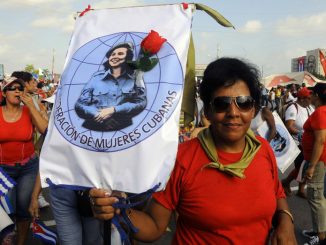
As presented by Federation of Cuban Women leader Teresa Amarelle Boué, Secretary General of the Federation of Cuban Women, at the March 2022 U.S.-Cuba Normalization Conference in New York City, the proposed revisions include the rights of children and seniors, as well as expanding benefits important to and sought by women workers such as in-workplace childcare. Even with resources severely stunted by the U.S. economic warfare, the code proposes to boost income 50% for working women with three or more children under 18. Six thousand one hundred and eleven of these women and their children already received a new home free of charge, fully resolving their housing needs. Even more could be done without the U.S. blockade, she said. Community laundries are a new win-win proposal that provides new jobs while alleviating some household labor.

Child poverty across the U.S.

Contrast this with the U.S. where a “right to life” banner is cynically used to restrict women’s reproductive autonomy. In the U.S., right to life is purported to begin at conception, but stops before birth, sending Black maternity and infant death rates to scandalous heights in the richest country on the globe. In 2020, 16% of children under 18 years of age, 11.6 million, live in poverty. Students graduate from university with unpayable student loans. Tickets to concerts and sporting events are out of reach for most. The right to health care, education, housing, sports and culture and a dignified life with the possibility of developing each human’s potential are all constitutionally guaranteed in Cuba. 

Gender reassignment has notably been free in Cuba as part of medical care. Now free fertility assistance including surrogacy under certain conditions is included in the proposed Families Code, something unthinkably unaffordable to many in the U.S. who are unable to have children.

The Families Code provides legal rights for the various family formations that actually exist in Cuba today – officially married, or committed relationships without formality, same-sex relationships, grandparents or other close relatives raising children and more. Rights are expanded, not restricted so each family choice and need is respected. Amarelle explained the improvements this way: 

“This is a code of opportunities and alternatives, of adding and multiplying, that recognizes and guarantees rights for those who didn’t have them. In no way does it affect or limit the rights already recognized for others.

“It does not establish molds nor does it require anyone to choose a family model that is not the one desired by each family.

“It is a broad and comprehensive code, revolutionary and modern.” (transcript of simultaneous translation by Martin Koppel, https://youtu.be/wJJfDeVi3gI)

Cuba expands rights of children

The rights of children are expanded. The term “patria potestar” or parental authority was replaced with parental responsibility meaning physically and psychologically capable to guarantee and protect the rights, well-being and the happiness of the daughters and sons, provide participation, to listen to them, protect  them, bring them love, foster their growth and independence in an atmosphere of affection.

The discussions are not pro-forma to check off some abstract requirement, but take into consideration the comments, additions, suggestions and proposals gathered through multiple opportunities in 78,000 assemblies. As of the March conference, the version under discussion is the 24th draft. After approval by the National Assembly the final product of the consultations will then be voted on by the people in a national referendum, where as a result of the consultation processes, voters actually understand what they are voting on.

The secret weapon of socialist Cuba

Equality and development of the potential of each human being is the secret weapon of socialist Cuba. The current U.S. efforts to push women back into some past family form conflicts with development of technology and our globalized world. 

This equality was fundamental in the revolutionary process itself, recognized and promoted by the historic leader of the 1959 Cuban revolution, Fidel Castro Ruz. Women clandestine leaders like Celia Sanchez, Heidi Santamaria, Melba Hernandez and Vilma Espin also joined Fidel and the July 26 Movement in the Sierra Maestra. 

Fidel also supported the formation of a battalion of women combatants, the Marianas, named after Mariana Grajales, mother of five sons including Antonio Maceo who fought and died for an end to slavery and Cuban independence from Spain. Weapons were scarce, but Fidel prioritized arming the Marianas who were regarded as the best fighters. After the victory over the U.S.-backed Batista dictatorship Fidel and Vilma Espin founded the Federation of Cuban Women to erase the legacy of colonialism through education and job opportunities. Tradition’s chains were severed when thousands of young women joined Cuba’s historic Literacy Campaign teaching the country to read and write in a year. The success of this process is evident today where women scientists and technicians are integral leaders in the development and production of Cuba’s five COVID-19 vaccines. 

The following statistics were presented by the FMC delegation to the Commission on the Status of Women (CSW66): 

Women: 67.4% of workers in education, more than 70% of judges and attorneys general, 62% of doctors and 64.2% of those working in international collaboration in countries around the world. Participation in decision-making is increasing. As of the end of 2021, women held 51.6% of State and Government positions including 52.3% of the State Council, 52.7% of Municipal People’s Power Assemblies, 53.22% of parliamentary representatives, 54.35% of the Municipal Assembly presidents and vice-presidents.

So what are we fighting for? The Supreme Court has forced the question. Let’s answer it. Cuba represents our future.

Strugglelalucha256


Fact-finding trip to Donbass: A front-line shelter in Rubizhne

Part One: Fact-finding trip to Donbass: A front-line shelter in Rubizhne

Part Two: Ukraine and Russia without the lens of Facebook & corporate media

Part Three: ‘Bitter Street’ in Lugansk – a battle line drawn with Nazi elements after 2014

I had just left the Lugansk People’s Republic, making my way to an interview in Moscow, when I saw a May 11 CNN story claiming Russia had targeted civilians in the Ukrainian city of Odessa. This was after the bombing of a hotel and shopping center there. When such structures are bombed, one assumes that they were filled with civilians.

Odessa was also the location of a massacre that took place after the 2014 coup, funded for years prior by the United States. The fascist element that was part of that coup burned the Odessa House of Trade Unions on May 2, 2014, killing progressives, socialists, trade unionists and anti-fascists.

My friend and guide during the Lugansk portion of my trip was Alexey Albu, who was  inside that burning building and one of the few who escaped. At the time, Alexey was an elected member of the Odessa Regional Council. He was a former member of the Central Committee of the Communist Party of Ukraine and at that time the local coordinator of Union Borotba (Struggle). He and others were working on solving the contradictions created in society by the coup in a peaceful way through the still-existing legislative processes.  

However, by May 2, time had run out. The fascists who praised Nazi collaborators and pushed ultra-nationalism against the Russian population turned even more violent against any opposition. Political repression and jailings were on the rise by the coup government, and six days after the massacre, Alexey found out he was to be arrested. He and his family then fled to Crimea where they felt safe. He later went to Lugansk to continue his political work, but had to separate from his family for four years to do so.

As he is from Odessa and still has many connections there, I wanted to ask Alexey about the bombing on May 11. Alexey responded: “Yes, Russia attacked the luxury hotel Grande Pettine, because there were foreign mercenaries operating there. And the big shopping and entertainment center Riviera was attacked because they made it into a warehouse for NATO weapons.

“It’s also important to know that Russia used high-precision missiles, so as not to cause harm to civilians. And it is very interesting that CNN did not pay attention when more than 40 civilians were drowned in blood and burned in fire in the Trade Union building on the second of May 2014,” said Alexey.

Challenging U.S. narrative

The Russian intervention in Ukraine began Feb. 24 at the request of the Donetsk and Lugansk People’s Republics (DPR and LPR). About a month later, unlikely sources – analysts and advisers working for the Pentagon — became whistleblowers in an exposé published by Newsweek, “Putin’s Holding Back.” 

The authors, many of whom were military officers, had to remain anonymous in order to be as truthful as possible, since they were still working as advisers. The article challenged the official narrative that Russian President Putin was targeting civilians.

Regarding a similar earlier accusation by the corporate media about a Russian bombing, said to have targeted “peacekeeping facilities” (as if belonging to the U.N.), one of the analysts responded: “And the so-called peacekeeper training ground [in Yavoriv] was hit because it was the place where the ‘international legion’ [Ukrainian military unit, training international mercenaries] was to have trained.”

This quote from one of the advisers sums up their motivation for becoming whistleblowers: “I’m frustrated by the current narrative — that Russia is intentionally targeting civilians, that it is demolishing cities, and that Putin doesn’t care. Such a distorted view stands in the way of finding an end before true disaster hits or the war spreads to the rest of Europe,” said this Pentagon adviser and U.S. Air Force officer.

It’s interesting that CNN reported that only one person died and five were hospitalized in the May 11 bombing. In a shopping center and hotel filled with people, as they implied, many more likely would have died.

One of the ways to determine whether someone is telling the truth when you have no access to events far away, under media whiteouts and the jailing of journalists, is to either catch the liar at other lies to bring their credibility into question, or find a way to get access to the location of the events. 

We did both.

Fact-finding mission

On April 27, I began a trip to the LPR in the Donbass region as part of a fact-finding mission organized by Struggle-La Lucha newspaper in the U.S. to gather eyewitness observations and testimony of Lugansk residents, some of whom I found were living in shelters near the front lines of the war. The loud blasts are a constant reminder for them of the artillery of the Ukrainian military, targeting apartment buildings nearby and hopefully continuing to miss them.

This trip would not have been possible if not for our friends from Borotba, who we’ve been collaborating with for eight years. Borotba was founded in 2011 and in the process of becoming a political party, but the Maidan coup interrupted that process.

While passing through Russia on the way to Lugansk, I spoke to progressive, socialist and communist organizations at the Moscow May Day celebrations and a commemoration of the Odessa Massacre on May 2.

I also interviewed visiting journalists from Belarus who were covering the May 9 Victory Day parade, commemorating the defeat of Nazi Germany and honoring the 27 million Soviet people who died fighting fascism – a fact which everyone should consider as context in today’s vilification of Russia. Soviet Russia, along with the rest of the USSR, was essential in order to defeat Nazi Germany in World War II. 

Although Russia is no longer socialist, that doesn’t change the fact that the parents and grandparents of most of the people in the country sacrificed for that victory. That deep understanding of the dangers of fascism did not go away with the counterrevolution. Nor did the targeting of this region by U.S. imperialism end.

The U.S. government says that the current Russian intervention was an uninvited “invasion,” that the justification of self-defense and concern over the growth of fascist forces in the Ukrainian government and military is just a smokescreen designed to facilitate the takeover of that country. They claim the Russian military is targeting civilians and the Ukrainian military is not. 

The Biden administration also says that it would be better for all of the people in the region if the Russian military withdrew its troops, with no acknowledgment of the eight-year Ukrainian war against the people of the Donbass region.

Surprisingly, a significant portion of organizations here in the U.S. that consider themselves anti-imperialist and socialist agree with the assessment pushed by the U.S. State Department.

The celebration of victory against the Nazis, by the way, is illegal in Ukraine. President Zelensky will not allow it. I know, the irony is unbelievable, but the fact remains – celebrating Victory Day in Kiev and anywhere controlled by the Ukrainian regime is illegal. 

In spite of Zelensky’s recent announcement giving lip service to the day for cover, the fact is that there was a curfew in place that day to discourage it. While in Lugansk, I asked someone what would happen if I were to have a sign celebrating Victory Day in Kiev. The answer was that in five minutes I would no longer be carrying that sign, and probably would be taken to prison.

But perhaps that’s just a quirky policy meant for public safety? Let’s dig deeper.

Rubizhne: Life on the front line

“Don’t step there!” a soldier from the LPR warned me as my foot was about to step into the grass, away from the established path of the soldier walking in front of me. 

This trek began in the morning, hitching a ride with the Lugansk People’s Militia to an area in the north of Lugansk, close to the front line of war against the Ukrainian military, where the LPR with the help of Russian soldiers recently liberated a residential area in Rubizhne. This city in Lugansk was previously occupied by Kiev forces.

Here there was a shelter in an abandoned apartment complex. Unexploded armaments and even mines from the Ukrainian military littered the area, the soldier said. 

Of course, I obliged and changed my path. I also immediately understood why no children were running around the grounds or using the playground. Instead, they mostly seemed to stay in the shelter or sometimes came out to play soccer in a small patch of land directly in front of it, under the watchful eye of a young LPR soldier.

At that moment my parental feelings kicked in and all I wanted to do was play with them, comfort them. But I had work to do.

This was once a lively apartment complex with a school and a beautiful playground. But now it looked like the backdrop to a “Walking Dead” episode.

Borotba’s Alexey Albu accompanied me and provided translation. The video clips linked here include some of these conversations and contain more footage from this portion of the trip.

We spoke with the woman in charge of the shelter, Larisa. She reluctantly took the position of caretaker for the shelter, voted in by the residents who trusted her. It definitely seemed like the right choice, because she keeps it in the best order that can be expected in these times. With all the work and responsibilities, she still manages to share compassion with those in need of comfort – war makes apparent the devils, but also the angels.

Basic foodstuffs and supplies – grains, water, and diapers – were neatly stored away. Getting food is especially a challenge for people who have nowhere else to go. Some residents who had alternative dwellings and were not disabled left Rubizhne, but the area is still not safe for travel. Many stayed to remain under the protection of the soldiers of both the LPR and Russia. 

Russia provides humanitarian aid

Humanitarian aid arrives frequently in Rubizhne, delivered by Russian soldiers. (In the short time I was at the border entering Lugansk from Russia, I saw 10 large trucks full of humanitarian aid entering the LPR.)

While we were at the shelter, two shipments of aid were delivered in a van, which we helped bring into the shelter. The box I was carrying almost broke open, with utensils and napkins barely making it to the bench where other items, especially diapers, were being placed.

Larisa explained that fuel, which is now hard to come by, had been used as their primary source for electricity, refrigeration and water (running the generator and water pump). So the aid is essential in order that people do not starve or die of thirst.

“Because of the war, they had problems getting assistance to the shelter,” Alexey explained. The trade unions in charge of delivering food in Lugansk were not able to, due to the area becoming a war zone, meaning they had to hand over that task to the military. 

Despite the danger and the fact that the Ukrainian military still controlled the area, the Russian and Lugansk soldiers, at great risk to their own lives, were able to get some aid to the residents of the shelter even before the area was liberated.

Recalling this moment, and the effect it had on her own child, brought Larisa to tears. She needed a minute to recover. 

“Ukrainian soldiers did not help at all,” she said when she returned. “That is unacceptable. No one from the Ukrainian side asked us, visited us. I had supported Ukraine, but after I saw how they left these people I no longer supported them.”

Accompanying us was a journalist from an Italian media organization. He asked why people stayed here at the shelter, and if they were allowed to leave. Although Larisa made the facility as comfortable as possible, the conditions were hard and the constant thunder of bombings was heard during our entire time there. 

Alexey explained that the roads here, although dangerous now, were even more dangerous during Ukrainian control, so leaving was not a safe option then. It became more possible after the area came under Russian control. “We tell people it is not safe, but if they want to leave, of course they can. No one will stop them,” explained Larisa.

Another issue Larisa wanted to address was the propaganda that has spread throughout Ukrainian society saying that the Russian soldiers rape and kill the people living in areas they’ve taken control of. She wanted to make it clear that this was not true.

“No, everything was very good, relations were very good and polite with the Russian soldiers. Even when we ask for some special foods like coffee or tea, they give it to us.”

Soldiers and civilians

To get a feel for the character of the relationship between the residents and the Russian and LPR soldiers, here’s one encounter that stuck with me. When we visited the school in the complex, which is now a shelter, I saw a woman reprimanding one of the soldiers for having the humanitarian aid truck remain too long at the entrance. 

Alexey said she was complaining that if they had to evacuate the school quickly, the truck would be in the way. The soldier politely nodded and agreed to move it soon, as if she was in charge. From her tone it seemed like that to me, and it definitely didn’t reflect a repressive relationship – not for the residents anyway.

Both in the village of Krymskoye and here in Rubizhne, folks talked about living underground, in their basements, to avoid being hit by bombs. In this shelter we walked down the stairs into a dark hall where we had to use the light from our phones to navigate, leading to the basement. Everyone slept with cots on the concrete floors, with just a few feet of space between each other, to have some semblance of privacy and illusion of personal space. Paint chips were peeling from the green concrete walls. Most of those spaces contained many members of a family.

We interviewed a woman who looked like she was in her 80s. She was alone in her space. Unlike the majority in Lugansk, she spoke Ukrainian. She was bundled in layers of clothing, although the weather was nice around noon, in the 60s°F (18°C). At night temperatures drop into the 40s°F (7°C) this time of year. Given the situation with no heat and her age, the layers made sense.

With a handkerchief hiding her tears, she spoke to us. “I have no relatives, I have no family,” she cried. Right away the caregiver of the shelter answered her: “Don’t worry, don’t worry – we are your family now.” Alexey, knowing Ukrainian, was able to translate her words for us. 

“Soldiers shot into my home and burned all my things. Everything that I own is right here,” she said, pointing to the bed she sleeps on. I could see nothing but blankets and pillows. Her age and situation makes leaving an even worse prospect.

After we were done, I tried to give her a hug, forgetting that we were required to wear bulletproof flak jackets and helmets the entire day. I accidentally head-bumped this 80-year-old woman. I panicked, thinking I’d hurt her, but it didn’t affect her a bit. Our compassion and willingness to listen to her story, however, did affect her. 

If only the compassion for the images, sometimes real, sometimes manufactured, used to promote support for U.S. war escalation against people in Lugansk and Donetsk, would extend to actual people like this woman, with the added compassion to at least listen to their stories!

Can’t eat Biden’s weapons

We then heard from a family of three – a mother, son and grandson. The son and grandson were both adults. The mother and son were disabled and therefore unable to find any employment in this environment, let alone travel. 

They, like many others, were dependent on the humanitarian aid given by Russia. They can’t eat Biden’s high-tech weaponry sent to the Kiev regime. So they remain here. 

They shared a similar story of having to leave a building that was being shot at. Although they said they couldn’t say for sure who was shooting at them, they were sure the shells were coming from where the Ukrainian military brigades were stationed.

I then asked them if they felt safe here in the shelter. They all said they did and that they didn’t know what they would do without this place. 

I also wanted to know how they felt about the Russian soldiers being at the shelter. Both Russian and Lugansk People’s Republic troops are present in this location, with the greatest number being LPR soldiers. But I wanted to specifically know how they felt about the Russian troops. So I asked them: “If the Russian soldiers left this shelter, how would that affect you?” The son and grandson answered immediately that they would not feel safe, and the mother nodded agreement.

The last interview we did in that basement was more detailed, regarding the circumstances of a family of four (five if you count the big gray cat held protectively by the teenage daughter).

The grandmother spoke to us about how they came to be there. She said that although this family was Russian, their neighbors were Ukrainian. When the Ukrainian soldiers came to their area, they told those soldiers that they didn’t have to worry because there were no Russian troops there. About a half hour later, the Ukrainian tanks came and began shooting into the houses.

“The dogs were very frightened and my neighbors were running out of burning houses,” said the grandmother. “They were shouting, ‘What are you doing, why are you shooting at us? We are Ukrainians.’ When they asked that, the soldiers just laughed and turned their faces away from the burning houses.”

She said: “I had to see who exactly was doing this, so I went outside and found some soldiers standing around and asked them, ‘Why are you shooting at my neighbors’ houses?’ No one answered me. But about 20 minutes later another Ukrainian tank came and shot directly into my house.”

When asked by another journalist how she felt about this situation, she recalled the hardship for her children and grandchildren after the 2014 coup. “They [the Ukrainian government] did not like that we used our native language [Russian]. So all schools, all kindergartens, changed their program to Ukrainian. But they are children who learned their language in homes that speak Russian. So we continued to teach our children in Russian. 

“My granddaughter and great-granddaughter both pleaded with me: ‘Please, I want to change schools because I don’t understand.’ But we couldn’t do anything about it. And with exact sciences like mathematics they had bigger difficulties because they couldn’t understand what was written.

“This shows how the Nazis feel about us and why they killed us and harmed our homes and organized shellings against us – they don’t consider us as their people.”

The Italian journalist asked: “So they were not locals, these were western Ukrainians?”

“Yes,” she replied, “I think they were western Ukrainians.”

This is just a small reflection of the Ukrainian nationalist tendencies that grew out of the 2014 regime change and inspired the Donbass regions of Lugansk and Donetsk to become independent republics. Ukraine, instead of honoring Victory Day on May 9, now honors Nazi collaborators — like the notorious Stephan Bandera — with statues and street names.

Under Ukrainian bombs

It happened while we were there! Another apartment nearby got bombed by Ukrainian artillery while we were interviewing the families down in the shelter basement. 

Another irony hit me (like the bomb attempted to do): my tax dollars were a portion of the billions spent on weapons like the one that just targeted the area where I and the people I was interviewing stood. Thanks for that, President Biden and all the Republicans and Democrats on board with escalating this proxy war against Russia. 

Fortunately, that apartment building close to us was already abandoned, unlike the demolished homes of the 350 people who were using and had used this shelter.

The bombing is so constant that it almost fades away in the background. But reminders like the shelling of the nearby apartment bring them, and the fear, back up to the conscious mind.

The constant threat of bombings also makes cooking a challenge. Right outside the shelter are two areas for cooking. Since there are no gas stoves due to lack of fuel, the cooking has to be done outside in self-made fire pits – and as illustrated by the recent bombing, it has to be done fast so as not to be outside too long. 

“We cook bread and a very tasty dessert specific to Lugansk here,” said Larisa. I asked her if she and the others who cook outside get worried about their safety. “Yes, of course we are afraid, but we need to cook because everyone needs to eat something.”

Today we find ourselves once again being sold a war by the U.S. government, this time against Russia. And – as in all U.S. imperialist wars – the corporate media follow along, dutifully reporting and publishing every video and “news story” they become aware of, with sources unknown at best and dubious at worst. 

These hidden parts are the other side of that story, the more truthful side.

Next: School’s out for now; take a tour of the after-effects of two opposing camps separated by ideology; and more voices from Lugansk, in the once Ukrainian-occupied village of Krymskoye.

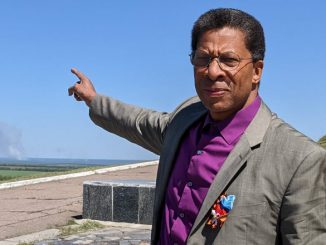
John Parker is the Socialist Unity Party candidate for U.S. Senate in California on the Peace and Freedom Party ticket and a member of the Black Alliance for Peace. 

Strugglelalucha256
https://www.struggle-la-lucha.org/2022/page/50/