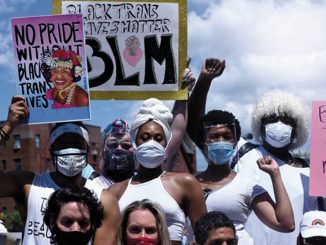


The Socialist Unity Party/Partido de Socialismo Unido and Struggle-La Lucha newspaper salute the lesbian, gay, bisexual, transgender, queer and two-spirit community as we mark the 53rd anniversary of the heroic Stonewall Rebellion. The spirit of fightback exhibited at Stonewall is needed today as much as ever.
First of all, we offer our solidarity to the Black community of Buffalo, New York, where a white supremacist massacred 10 African American people on May 14. And we extend our hand to the Latinx community of Uvalde, Texas, where the grief from the tragic May 24 school shooting is compounded by Gov. Greg Abbott’s attempt to exploit it for his anti-immigrant crusade.
As we enter Pride Month 2022, the United States is in the grip of a “trans panic.” Like the “gay panics” that have come before, this is an attempt to divide workers and oppressed people at a time when the capitalist system is in crisis.
The anti-trans campaign is fueled by the rich and powerful, who are desperate to keep us divided by scapegoating the most vulnerable, by convincing those lacking in class consciousness that transgender, non-binary and gender-nonconforming people are the root of their problems – not the profit system that exploits us all.
Among them are “enlightened” oligarchs and companies like Elon Musk and Netflix, Jeff Bezos and Starbucks. They fear the movement of workers to unionize and communities to hold their empires accountable. Queer people play an important role in these struggles.
Trans panic = more violence
State legislatures across the country have taken up more than 300 anti-LGBTQ2S bills so far this year, most of them targeting trans people and especially trans children and youth.
Bodily autonomy, at the heart of trans people’s ability to live under this system, is at stake, as courts and legislatures seek to turn back the clock to reinforce patriarchal capitalist norms that treat the bodies of women, children, people of color and LGBTQ2S people as the property of rich white cis men.
When Texas Gov. Abbott failed to get a law passed to criminalize gender-affirming care for trans kids, he issued an executive order to open criminal investigations against parents, healthcare providers, teachers and anyone else who supports trans youth. Alabama Gov. Kay Ivey signed a law to forcibly out and detransition trans children.
In Florida, the “Don’t Say Gay” law championed by Gov. Rick DeSantis bans discussion of LGBTQ2S existence in state classrooms. Other states have banned trans youth from participating in sports or using school restrooms. Teachers may be forced to report trans students to their parents or are allowed to misgender and deadname them.
This has led to increased threats and violence against trans people across the U.S., from public transit to social media. In 2021, at least 57 transgender or gender non-conforming people were fatally shot or killed by other violent means, and 2022 is already on track to top that horrific number. The great majority of victims of deadly violence are trans women of color.
Measures attacking gender-affirming care directly contradict the recommendations of medical experts. A recent University of Washington study found that trans youth who got gender-affirming treatment experienced a 60% drop in depression risk and a 73% drop in suicidal thoughts, on average. Access to gender-affirming care saves trans youth’s lives.
Amidst this crisis, the Supreme Court lobbed another bombshell: the majority’s plan to overturn the historic Roe V. Wade decision protecting the right to abortion, and to do it in a way that opens the door to similar attacks on contraception, same-sex marriage, protection from so-called sodomy laws and other rights won through decades of hard struggle.
Why now? The ultra-right politicians and behind them, many of the biggest banks and corporations, are using the attack on trans rights and reproductive rights to fuel the growth of a neo-fascist movement. It aims to protect private property and profits by crushing the rights of all workers. They are willing to sacrifice the lives of trans children, migrants and refugees, pregnant people, or anyone who makes a convenient target.
The only way fascist movements have ever been defeated is by people uniting and fighting back. It is not enough to rely on elections or hope that friendly politicians will save us. They won’t. The Democratic Party is tied by a million threads to the same capitalist class that demands these anti-people measures. Joe Biden and Nancy Pelosi will continue to say inoffensive things beside the railroad tracks while doing nothing to stop the onrushing train.
Fight like Sylvia Rivera and Marsha P. Johnson
How can we fight back? There are many recent examples of unity and struggle – especially by students and youth.
Across North America, from Salt Lake City, Utah, to Des Moines, Iowa, to Newfoundland and Labrador, students have walked out in large numbers to protest laws and repressive measures targeting trans people.
We urgently need a mass national protest like the 1987 March on Washington for Lesbian and Gay Rights, held amidst the AIDS crisis when the Reagan administration was targeting gay men, or the 1993 March on Washington for Lesbian, Gay and Bi Equal Rights and Liberation of more than one million people.
But simply coming out in large numbers is not enough. We must learn from the example of the 2011 Wisconsin State Capitol takeover by the labor movement and community allies. The occupation to resist anti-union legislation energized workers coast-to-coast, many of whom traveled to Madison or raised money to support the protesters.
While the occupation didn’t win in the short term, it laid the groundwork for the wave of teacher strikes that swept the country in 2018-2019 and today’s upsurge in organizing at Amazon, Starbucks and other anti-union behemoths.
Imagine the power of LGBTQ2S people and allies from the reproductive rights struggle, Black Lives Matter movement, immigrants and labor, occupying the capitol in Texas, Florida or another state targeting trans lives!
We must also recognize that reactionary U.S. wars and sanctions around the world fuel anti-LGBTQ2S attacks at home.
Every bomb Congress sends to Ukraine, Israel and Saudi Arabia for U.S. proxy wars explodes here, as Dr. Martin Luther King Jr. said during the Vietnam War. The more desperately needed resources are siphoned off for the expansion of the U.S. empire abroad, the more the system scapegoats us to ensure workers remain divided and powerless.
Our community cannot effectively fight the anti-trans, anti-people offensive at home while supporting U.S. aggression abroad. When people struggling against U.S. domination around the world win, our movements for rights are strengthened. When we extend our solidarity to those resisting U.S. imperialism, we open up the opportunity for greater understanding and participation by LGBTQ2S people everywhere.
Let’s embrace the legacy of ACT UP, Queer Nation and those who fought militantly against the “gay panic” of the 1980s. Let’s imbue our movement with the spirit of unity that fueled the Stonewall Rebellion – an uprising led by the most oppressed Black and Brown, working-class, revolutionary trans and queer youth.
Resist capitalism’s trans panic strategy! Fight for socialism – a system that puts people’s needs first!

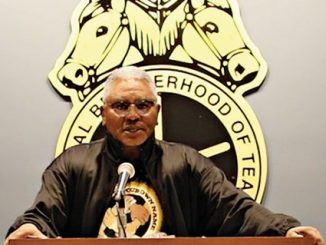
Clarence Thomas — labor organizer, retired member of International Longshore and Warehouse Union (ILWU) Local 10, leader of the Million Worker March Movement and author of the recently released “Mobilizing in our Own Name: Million Worker March” — spoke at Teamsters Joint Council 16 in New York City on May 14. Following are excerpts from his presentation.
Let me first say that I am glad to be here, on this part of a whirlwind book-signing tour. The Teamsters’ meeting is special and I’m going to get right into the reason why.
The Teamsters and Longshore Workers represent two of the strongest industrial unions in the nation, if not the world. We also share a radical rank-and-file militancy at the point of production.
Rise of industrial unionism
In May 1934, longshoremen on the West Coast and Teamsters in the Midwest took part in important struggles in the history of the U.S. labor movement: the 1934 Minneapolis Teamsters Strike and the West Coast Maritime Strike led by longshoremen in San Francisco.
Local leaders associated with the Communist League of America led the Minneapolis Teamsters Strike. The strike paved the way for the organization of over-the-road drivers and the Teamsters union.
Bloody Friday is the name of the event which occurred in Minneapolis, Minnesota, on July 20, 1934, when police shot at truck drivers who were flying pickets, injuring 67 picketers and killing strikers John Belor and Henry Ness. An investigation determined, “Police took direct aim at the pickets and fired to kill.”
When solidarity strikes protested the shooting, the governor declared martial law and deployed 4,000 troops. On July 24, over 100,000 people lined the streets of the route of the funeral procession for Henry Ness.
The strike was pivotal to Minneapolis’ strong union tradition and is seen as a critical moment for the Teamsters and the labor movement.
This outcome led to the enactment of legislation acknowledging the right of workers to organize.
July 5, 1934, marked a turning point in the West Coast waterfront strike. One of the demands was to end the shape-up, where each morning longshore workers would gather in front of the ferry landing in San Francisco to beg for jobs and to pay bribes to get a day’s work.
The union demanded the right to a worker-controlled hiring hall to end the shape-up and a six-hour workday so that work could be shared on the West Coast with their union brothers during the Great Depression.
On July 5, employers tried to open the San Francisco port with scab trucks escorted by the police at Pier 38. The police tear-gassed unarmed strikers. At least 100 strikers and their supporters were injured.
Howard Sperry, a longshoreman and a World War I veteran, and Nick Bordoise, a union cook and strike supporter, were both shot in the back and killed by plainclothes police officers outside the union headquarters. This date is known as Bloody Thursday. Teamsters had Bloody Friday; longshore workers had Bloody Thursday.
The following day, thousands of strikers’ families and sympathizers, including Teamsters, took part in a funeral procession down Market Street in San Francisco, stretching more than a mile and a half.
The city was paralyzed by a general strike. Six workers were shot or beaten to death on the West Coast by police or company goons during the strike, which lasted for 99 days.
These terrible events galvanized public support. Following Bloody Thursday, similar incidents up and down the coasts created a wave of rank-and-file unrest that conservative American Federation of Labor leaders were unable to stop.
This gives you some idea as to why our two respective unions are so strong. Brothers and sisters: this is our history and it is a hidden history.
The 1934 West Coast waterfront strike led by the Communist Party USA and Toledo Auto Workers strike led by the American Workers Party were catalysts for the rise of industrial unionism in the 1930s, much of which was organized by the Congress of Industrial Organizations.
International Workers’ Day
One of the things I want to talk about is International Workers’ Day — known as May Day — which the Million Worker March Movement pledged to reclaim.
As an African American, I know quite well what the enslavement of African Americans has meant to me, my family and many generations of African Americans who lived on these shores. We have been denied our names, our history, our culture, our traditions and our freedom.
Many people think May Day is a communist holiday. Yes, it is. It is an official holiday in socialist countries. But it started here in the U.S.
We don’t grow up understanding the importance of labor solidarity, or that whether a person is Black, white, Latino, trans or straight, we are all working people. If you are unemployed, you still are a worker. That’s a common bond.
The history of the labor movement is hidden because we didn’t learn how we got the eight-hour workday.
In 1886, workers in Chicago who manufactured the McCormick reapers were in the forefront of the struggle for the eight-hour workday. Children and women worked under inhuman conditions, while they and the men worked 12, 14, 16 hours a day.
Workers all over the world stood to attention when four men were framed up for throwing dynamite at the police department in 1886 and martyred by a kangaroo court.
There is a common thread that runs through labor history. That it is the role of police who represent the bosses, the state and the privileged.
We must understand that history — and the role of the police department. Whenever we have a picket, when there is a labor beef, and the police come out, they aren’t in solidarity with us. They come out on the side of the bosses. That’s their job.
There is a reason why the government and big business did not want the working class to celebrate May Day. They gave us Labor Day. That has no connection to our struggle.
The reason why the Teamsters are who they are is because of the militant history that we share.
Class interests – theirs and ours
We are working-class people whose interests are separate from those of the Democratic Party and the Republican Party. Their interests are not the same as ours and I can prove it.
Most people in this country would like to have national health care. Do we have it? No. Most working people in this country would like to have a living wage. A living wage today would really be calculated somewhere between $25 and $30 an hour.
The bosses want to make it appear as if there is something criminal about a worker making six figures, but they applaud the likes of Jeff Bezos and Bill Gates. They say the Teamsters and the Longshore Workers make too much money because they figure that we should be making the same wages as they pay people in Walmart.
The Democratic and Republican parties are funded in the interests of the rich. If they had their way, there wouldn’t be any unions.
We did not get the eight-hour work day, pensions and vacations because the bosses loved us. We got that because people fought and died for that. There’s nothing wrong with us standing up for our own class interests.
We don’t have a labor party in this country. They have them in other countries. Have you ever thought about why? Because they want us to believe that our interests are synonymous with the Republican and Democratic parties.
Let’s look at that. People in other countries don’t have to pay for their children to go to college, because they believe that a nation that does not invest in the youth doesn’t have a future. A country that really serves everybody would not be one with tremendous examples of income inequality.
Why do we have homelessness and poverty? We must be very clear as working people that we have our own class interest and that is what led to the Million Worker March.
To learn more about the formation of the MWM, read Clarence Thomas’ entire presentation online or listen to his speech, go to MillionWorkerMarch.com. Struggle-La Lucha will be publishing more from his book tour.
From transcription by Gloria Verdieu.

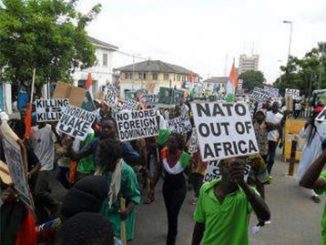
Anxiety about the expansion of the North Atlantic Treaty Organization (NATO) toward the Russian border is one of the causes of the current war in Ukraine. But this is not the only attempt at expansion by NATO, a treaty organization created in 1949 by the United States to project its military and political power over Europe. In 2001, NATO conducted an “out of area” military operation in Afghanistan, which lasted 20 years, and in 2011, NATO—at the urging of France—bombed Libya and overthrew its government. NATO military operations in Afghanistan and Libya were the prelude to discussions of a “Global NATO,” a project to use the NATO military alliance beyond its own charter obligations from the South China Sea to the Caribbean Sea.
NATO’s war in Libya was its first major military operation in Africa, but it was not the first European military footprint on the continent. After centuries of European colonial wars in Africa, new states emerged in the aftermath of World War II to assert their sovereignty. Many of these states—from Ghana to Tanzania—refused to allow the European military forces to reenter the continent, which is why these European powers had to resort to assassinations and military coups to anoint pro-Western governments in the region. This allowed for the creation of Western military bases in Africa and gave Western firms freedom to exploit the continent’s natural resources.
Early NATO operations stayed at the edge of Africa, with the Mediterranean Sea being the major frontline. NATO set up the Allied Forces Southern Europe (AFSOUTH) in Naples in 1951, and then the Allied Forces Mediterranean (AFMED) in Malta in 1952. Western governments established these military formations to garrison the Mediterranean Sea against the Soviet navy and to create platforms from where they could militarily intervene in the African continent. After the Six-Day War in 1967, NATO’s Defense Planning Committee, which was dissolved in 2010, created the Naval On-Call Force Mediterranean (NOCFORMED) to put pressure on pro-Soviet states—such as Egypt—and to defend the monarchies of northern Africa (NATO was unable to prevent the anti-imperialist coup of 1969 that overthrew the monarchy in Libya and brought Colonel Muammar Gaddafi to power; Gaddafi’s government ejected U.S. military bases from the country soon thereafter).
Conversations at NATO headquarters about “out of area” operations took place with increasing frequency after NATO joined the U.S. war on Afghanistan. A senior official at NATO told me in 2003 that the United States had “developed an appetite to use NATO” in its attempt to project power against possible adversaries. Two years later, in 2005, in Addis Ababa, Ethiopia, NATO began to cooperate closely with the African Union (AU). The AU, which was formed in 2002, and was the “successor” to the Organization of African Unity, struggled to build an independent security structure. The lack of a viable military force meant that the AU often turned to the West for assistance, and asked NATO to help with logistics and airlift support for its peacekeeping mission in Sudan.
Alongside NATO, the U.S. operated its military capacity through the United States European Command (EUCOM), which oversaw the country’s operations in Africa from 1952 to 2007. Thereafter, General James Jones, head of EUCOM from 2003 to 2006, formed the U.S. Africa Command (AFRICOM) in 2008, which was headquartered in Stuttgart, Germany, because none of the 54 African nations were willing to give it a home. NATO began to operate on the African continent through AFRICOM.
Libya and NATO’s Framework for Africa
NATO’s war on Libya changed the dynamics of the relationship between the African countries and the West. The African Union was wary of Western military intervention in the region. On 10 March, 2011, the AU’s Peace and Security Council set up the High-Level ad hoc Committee on Libya. The members of this committee included then-AU Chairperson Dr. Jean Ping and the heads of state of five African nations—former President of Mauritania Mohamed Ould Abdel Aziz, Republic of Congo’s President Denis Sassou Nguesso, Mali’s former President Amadou Toumani Touré, former President of South Africa Jacob Zuma and Uganda’s President Yoweri Museveni—who were supposed to fly into Tripoli, Libya, and negotiate between the two sides of the Libyan civil war soon after the committee’s formation. The United Nations Security Council, however, prevented this mission from entering the country.
At a meeting between the High-Level ad hoc Committee on Libya and the United Nations in June 2011, Uganda’s Permanent Representative to the United Nations during that time, Dr. Ruhakana Rugunda, said, “It is unwise for certain players to be intoxicated with technological superiority and begin to think they alone can alter the course of human history toward freedom for the whole of mankind. Certainly, no constellation of states should think that they can recreate hegemony over Africa.” But this is precisely what the NATO states began to imagine.
Chaos in Libya set in motion a series of catastrophic conflicts in Mali, southern Algeria and parts of Niger. The French military intervention in Mali in 2013 was followed by the creation of the G5 Sahel, a political platform of the five Sahel states—Burkina Faso, Chad, Mali, Mauritania and Niger—and a military alliance between them. In May 2014, NATO opened a liaison office at the AU headquarters in Addis Ababa. At NATO’s Wales Summit in September 2014, the alliance partners considered the problems in the Sahel that entered the alliance’s Readiness Action Plan, which served as “[the] driver of NATO’s military adaptation to the changed and evolving security environment.” In December 2014, NATO foreign ministers reviewed the plan’s implementation, and focused on the “threats emanating from our southern neighborhood, the Middle East, and North Africa” and established a framework to meet the threats and challenges being faced by the South, according to a report by the former President of the NATO Parliamentary Assembly, Michael R. Turner. Two years later, at NATO’s Warsaw Summit in 2016, NATO leaders decided to increase their cooperation with the African Union. They “[welcomed] the robust military commitment of Allies in the Sahel-Sahara region.” To deepen this commitment, NATO set up an African Standby Force and began the process of training officers in African military forces.
Meanwhile, the recent decision to eject the French military is rooted in a general sensibility growing in the continent against Western military aggression. No wonder then that many of the larger African countries refused to follow Washington’s position on the war on Ukraine, with half the countries either abstaining or voting against the UN resolution to condemn Russia (this includes countries such as Algeria, South Africa, Angola and Ethiopia). It is telling that South Africa’s President Cyril Ramaphosa said that his country “is committed to advancing the human rights and fundamental freedoms not only of our own people but for the peoples of Palestine, Western Sahara, Afghanistan, Syria and across Africa and the world.”
The ignominy of Western—and NATO’s—follies, including arms deals with Morocco to deliver Western Sahara to the kingdom and diplomatic backing for Israel as it continues its apartheid treatment of Palestinians, bring into sharp contrast Western outrage at the events taking place in Ukraine. Evidence of this hypocrisy serves as a warning while reading the benevolent language used by the West when it comes to NATO’s expansion into Africa.
This article was produced by Globetrotter. Vijay Prashad is an Indian historian, editor and journalist. He is a writing fellow and chief correspondent at Globetrotter. He is an editor of LeftWord Books and the director of Tricontinental: Institute for Social Research. He is a senior non-resident fellow at Chongyang Institute for Financial Studies, Renmin University of China. He has written more than 20 books, including The Darker Nations and The Poorer Nations. His latest book is Washington Bullets, with an introduction by Evo Morales Ayma.

As the U.S. and the G7 (comprising Canada, France, Germany, Italy, Japan, the United Kingdom, and the United States) insist that cutting off food exports from Ukraine poses the biggest threat to world food security, rather than admitting the far more powerful negative effect of Western sanctions against Russia, their propaganda does immense damage to the world’s understanding and capability of avoiding a looming global food disaster.
The G7 and the approaching food disaster
Looking at the world food supply situation, many experts see an imminent threat of “human catastrophe,” as World Bank President David Malpass put it. Andrew Bailey, the governor of the Bank of England, characterized his outlook on global food supply problems as “apocalyptic” when discussing increasing food prices. This rise has led to the unfolding of two issues simultaneously: creating the threat of hunger and famine in parts of the Global South, and hitting living standards in every country across the globe.
Even before rapid price rises surrounding the Ukraine war, more than 800 million people were suffering from chronic food insecurity—around 10 percent of the world’s population. U.S. Treasury Secretary Janet Yellen cited this fact while speaking to the participants of an April 2022 event, “Tackling Food Insecurity: The Challenge and Call to Action,” whose participants included the heads of international financial institutions such as the World Bank’s Malpass. Yellen also noted, “Early estimates suggest that at least 10 million more people could be pushed into poverty in Sub-Saharan Africa due to higher food prices alone.” The World Food Program (WFP) plans “to feed a record 140 million people this year,” and it reports that “at least 44 million people in 38 countries are teetering on the edge of famine,” an increase from 27 million in 2019.
In countries facing other problems, like climate change, food price increases have been catastrophic. For example, in Lebanon, “the cost of a basic food basket—the minimum food needs per family per month—[rose]… by 351 percent” in 2021 compared to 2020, according to the WFP.
In the Global North, famine is not a threat, but the populations of these countries face a sharp squeeze on their living standards as the global food crisis also raises the prices people in wealthy countries have to pay and budget for. In the United States, for example, the combination of high inflation and economic slowdown led to a 3.4 percent reduction in real average weekly earnings in the last year, as per data provided by the U.S. Bureau of Labor Statistics.
Fake Analysis by the G7 About the Reasons for the Food Crisis
Faced with this rapidly rising threat of the deepening food crisis, the G7 foreign ministers met from May 12 to May 14 to finally focus their attention on this pressing matter. They issued a statement on May 13 expressing “deep concern” about the growing food insecurity, while pointing out the next day that “the world is now facing a worsening state of food insecurity and malnutrition… at a time when 43 million people were already one step away from famine.”
But the G7 falsely claimed that the reason for this food crisis was primarily due to “Russia blocking the exit routes for Ukraine’s grain.” According to Canada’s foreign minister, Mélanie Joly: “We need to make sure that these cereals are sent to the world. If not, millions of people will be facing famine.”
Sanctions and the global food crisis
This G7 statement deliberately misrepresented the present global food crisis. Instead of attempting to solve this crisis, the U.S. and the rest of the G7 used this opportunity to further their propaganda on the Ukraine war.
Certainly, Ukraine’s export restrictions make the global food problem worse. But it is not the main cause of the deteriorating situation. A much more powerful cause is Western sanctions imposed on Russia’s exports.
The first reason for this is that Russia is a far bigger exporter of essential food items and other products in comparison to Ukraine. Russia is the world’s largest wheat exporter, accounting for almost three times as much of world exports as Ukraine, 18 percent compared to 7 percent.
Second, and even more important, is the situation with fertilizers. Russia is the world’s largest fertilizer exporter, and Belarus, which is also facing Western sanctions, is also a major supplier—together they account for more than 20 percent of the global supply. Fertilizer prices were already rising before the Ukraine war due to high fuel prices—fertilizer production relies heavily on natural gas—but sanctions by the West, which prevent Russia from exporting fertilizers, have made the situation worse.
David Laborde, a senior research fellow at the International Food Policy Research Institute, pointed out that “the biggest threat the food system is facing is the disruption of the fertilizer trade.” This is because, he said: “Wheat will impact a few countries. The fertilizer issue can impact every farmer everywhere in the world, and cause declines in the production of all food, not just wheat.”
The threat to global fertilizer supply illustrates how energy products are an essential input into virtually all economic sectors. As Russia is one of the world’s largest exporters not only of food but also of energy, sanctions against the country have a knock-on inflationary effect across the entire world economy.
Response in the Global South
This world food supply situation worsened further after the G7 meeting when on May 14, India, the world’s second-largest wheat producer, announced that it was halting wheat exports due to crop losses caused by an intense heat wave. Already in April Indonesia had announced that it was ending palm oil exports—Indonesia accounts for 60 percent of the world supply.
India’s halt of wheat exports will be a further severe blow to countries in the Global South, where its exports are mostly focused. In 2021-2022, India exported 7 million metric tons of wheat, primarily to Asian Global South countries such as Sri Lanka, Indonesia, Yemen, Nepal, Malaysia, the Philippines, and Bangladesh. But India had earlier set a target of expanding wheat exports to 10 million tons in 2022-2023, including supplying 3 million tons of wheat to Egypt for the first time.
Ending sanctions to prevent Worsening of the Food Crisis
The unfolding situation makes clear that António Guterres’ words were indeed accurate—the world food crisis cannot be solved without both Ukraine’s exports and Russia’s exports of food and fertilizer. Without the latter, humanity does indeed face a “catastrophe”—billions of people will have to lower their living standards, and hundreds of millions of people in the Global South will face great hardship like hunger or worse. Almost every Global South country rightly refused to support the unilateral U.S. sanctions against Russia. This refusal needs to be extended to the whole world to prevent further devastation.
John Ross is a senior fellow at Chongyang Institute for Financial Studies, Renmin University of China. He is also a member of the international No Cold War campaign organizing committee. His writing on the Chinese and U.S. economies and geopolitics has been published widely online, and he is the author of two books published in China, Don’t Misunderstand China’s Economy and The Great Chess Game. His most recent book is China’s Great Road: Lessons for Marxist Theory and Socialist Practices (1804 Books, 2021). He was previously director of economic policy for the mayor of London.
This article was produced by Globetrotter.
The probable victory of the progressive candidate Gustavo Petro in the Colombian presidential elections, taking place this Sunday, arouses great hopes there, in our region and in other corners of the planet. Polls show him winning, although not quite with half and the plus one of the valid votes needed to declare him the winner in the first round. So, unless there is a surprise, Petro would have to fight in a second round on June 19 with whoever comes in second, a place occupied until a few days ago by the pro-Uribe Fico Gutiérrez in the polls, which now show him in a technical tie with Rodolfo Hernández. Hernandez could snatch votes from Petro, a probable scenario to force a second round in which Uribism and all the right-wing currents would throw themselves at the neck of the progressive slate together with the hegemonic media. Petro, a former guerrilla and former mayor of Bogota is the standard bearer of the very broad coalition Historic Pact (PH) together with the prominent Afro-Colombian activist, feminist and environmentalist Francia Marquez who is running with him, in the difficult task of reaching the Nariño Palace.
The system always erects enormous obstacles to alternative candidates in any country. How complicated it will be in Colombia, a country ruled by an entrenched oligarchy for two centuries, which the United States considers its property. On March 28, after the legislative and primary elections, in which the PH obtained the largest number of seats, although not the majority in both chambers, General Laura Richardson, head of the Southern Command (SC) met with General Luis Navarro, Commander General of the Armed Forces to ask him about the possible deactivation of the seven US military bases in Colombian territory, in the event Petro wins. Navarro replied that both the legislators and the armed forces would oppose such a move, which earned the military chief a press release from the SC stating that Colombia “is an unconditional security partner of Washington”.
Petro has publicly claimed that there is a conspiracy to stage a coup or cancel the election rather than accept his triumph. He and Marquez, who have been the target of attacks in the past, have received death threats and in Colombia’s peculiar democracy they must appear at rallies protected by armored shields in this last week leading up to the elections
Colombia: towards a progressive government?
Four leftist or progressive presidential candidates have been assassinated in Colombia since 1980. Not to mention the murder in 1948 of Jorge Eliécer Gaytán, candidate of the Liberal Party, but with definite popular national roots and vocation, which ushered in the period known as La Violencia.
In the Andean country, where rivers of blood have flowed since the famous massacre of the banana plantations (1928), according to the Special Jurisdiction for Peace, created by the peace agreements in 2016, there had been between 2002 and 2008 alone 6400 people killed by the repressive practice of “false positives”, consisting of the murder by the army of innocent citizens presented as guerrillas. If we take the data issued by the prestigious INDEPAZ, in 2022, 78 social leaders and human rights defenders have been murdered, as well as 21 FARC combatants who signed the peace agreement, a tragedy that took off shortly after the election of the current president Iván Duque, a puppet of the neo-fascist former president Álvaro Uribe, a staunch enemy of the peace accords. It is also worth highlighting the repressive viciousness of the Colombian security forces during the great popular rebellions of 2019-2020 and 2021, the 70 percent rejection of Duque in the polls and the collapse of Uribism. A rekindled phenomena, which, like Petro’s rise, are closely related to the awareness created by the non-compliance with the peace agreements, also sparked popular protests in the streets at the same time there was increased sufferings imposed on the many by neoliberal policies.
Petro insists on full compliance with the peace accords. The need for agrarian reform to provide land to rural families and boost food production, but without expropriation; he promotes a tax reform to tax the 4000 largest fortunes in the country and combat tax evasion to finance health and education. It also proposes a new unified pension system supported mainly by the State, the renegotiation of free trade agreements and 50/50 parity positions in the government between men and women, as well as the recognition of the rights of minorities and sexual diversity. Petro and Marquez have been promoting the gradual transition from fossil to sustainable energy.
Ideally, Petro-Márquez could win in the first round because to ensure victory in the second round they will have to weave alliances with spaces outside the popular camp and negotiate away aspects of their program. But, in one way or the other, their victory would be an important step forward for Colombia and our America.
Source: Telesur, translation Resumen Latinoamericano – English
“ALBA-TCP REJECTS EXCLUSIONS AND THE DISCRIMINATORY TREATMENT IN THE SO-CALLED SUMMIT OF THE AMERICAS IN LOS ANGELES”
Havana, May 27, 2022 – The Heads of State and Government and the Heads of Delegations of the countries of the Bolivarian Alliance for the Peoples of Our America – Peoples’ Trade Treaty (ALBA-TCP), gathered in Havana, Cuba, on May 27, 2022, at its 21st Summit:

Has there ever been a more corrupt Congress? Democrats and Republicans alike.
On May 19, the U.S. Congress approved an additional $40 billion in “aid” to Ukraine, added to the roughly $14 billion of Ukraine war funds approved in March. That’s $54 billion total.
President Joe Biden promoted the escalation of military spending, grinning as he stood at the podium, with a banner behind him declaring “Standing With Ukraine.”
The Democrats unanimously approved the billions. None suggested that the funds should go to housing, food, healthcare, transportation, COVID relief or some other failing part of the U.S. economy.
To put some perspective on this, $54 billion is more than Russia’s defense budget for the whole year 2021, which was $43 billion.
Officially, the U.S. military budget is $782 billion for 2022. The $54-billion Ukraine “aid” equals 7% of this year’s official military budget.
The New York Times says that it’s more money than the U.S. has given in any kind of aid to any country in the last decade. “It is roughly two times the amount given in 2011 to Afghanistan, the largest U.S. foreign aid recipient until now,” the May 20 Times reported.
The Times adds that it is 1% of this year’s projected federal budget. The “Ukraine aid” is more than many of the individual packages in Biden’s “Build Back Better” plan that the Democrats couldn’t approve, including Medicare hearing aid benefits, and roughly equal to the “Build Back Better” public housing funds.
‘Financing total war’
“The sums of money being contemplated in Washington are enormous,” Adam Tooze wrote in the Guardian shortly before final approval. “It will mean that we are financing nothing less than a total war.”
On April 25, at a meeting with more than 40 NATO and non-NATO defense officials in Germany, U.S. Secretary of War Lloyd Austin said in so many words that the NATO military operation is not about “defending Ukraine” but is a proxy war against Russia, with Ukraine as the battlefield.
“A weakened Russia” is the goal, Austin said.
Leon Panetta — White House chief of staff under Bill Clinton, CIA director and secretary of defense under Barack Obama — explained that the conflict in Ukraine is a NATO “proxy war” against Russia. Biden himself declared the goal is regime change in Moscow, saying Putin “cannot remain in power.”
The Ukraine aid package, by the way, should rightfully be called a payoff to the U.S. military-industrial complex. For example, $9 billion of the $40 billion package goes directly to U.S. capitalist corporations that produce weapons, designated as “replenishment of U.S. weapons stock” in the bill.
About $6 billion goes to a Department of Defense slush fund that the Pentagon will decide how to spend. And $4 billion is for Ukraine to spend buying new military equipment from U.S. weapons producers.
Another $3.9 billion is for sending an additional 10,500 U.S. troops to Europe. Hard to find anything that’s actual aid to the people in Ukraine.
Written by Lockheed Martin
In fact, the whole Ukraine aid package was written by the U.S. military-industrial complex. Business Insider reported on May 23: “One of the largest defense contractors in the nation donated to nearly 150 members of Congress as they debated Ukraine military aid.”
On May 3, President Joe Biden went to Lockheed Martin’s Pike County Operations facility in Troy, Alabama, and did a photo op at the Javelin missile production facility.
Military contractors have been the primary beneficiaries of the Ukraine war aid approved by Congress.
Lockheed Martin is the top war (military-industrial) contractor in the U.S., followed by Raytheon, General Dynamics, Boeing and Northrop Grumman.
The top member of Congress in charge of the military budget, Democrat Adam Smith from Washington state, is also the top recipient of money from the weapons makers.
The fact is, any semblance of Congress being representative of people and not money has been mostly abandoned. The Supreme Court’s 2010 Citizens United decision “reversed century-old campaign finance restrictions and enabled corporations and other outside groups to spend unlimited funds on elections,” according to the Brennan Center for Justice.
In the New Yorker, legal analyst Jeffrey Toobin concludes that the Citizens United decision “let rich people buy candidates.”
In 2016, in a case involving the open corruption of former Virginia Gov. Bob McDonnell, the Supreme Court in a unanimous ruling made it difficult to impossible to prosecute political corruption. Some have characterized it as approving the purchase of sitting politicians.
On May 16 of this year, the Supreme Court removed the only restrictions left on the rich donating to (purchasing) politicians after they had been elected.
The military-industrial complex apparently owns Congress and it is writing the agenda.
Around 7.5 million people live in the Lao People’s Democratic Republic as compared to 8.8 million people residing in New York City. While 756 people in Laos have died from COVID-19, 40,365 New Yorkers died from it ― 53 times as many.
How does Laos do it? More bombs fell on Laos than any other country in history.
Two million tons of cluster bombs were dropped on the Asian country by the United States military from 1964 to 1973. That’s more bombs than were dropped by all sides during World War II.
What did Laotians do to the U.S. to deserve such terror? At least 50,000 people died from the bombing. Another 20,000 have died or been injured from the initially unexploded munitions in the 49 years since the war.
The not-so-secret weapon that Laos uses against disease is socialism. Encouraging people to organize themselves is a requirement to build a socialist society.
Trade unions, women’s associations and youth groups work with the communist party to carry out COVID-19 testing and vaccinations.
Over 1,100 years ago the Iranian scientist Ibn Sina ― also known as Abu Ali Sina or Avicenna ― advocated isolating sick people to stop the spread of disease. Although this was centuries before the invention of microscopes, the Muslim scholar thought that small organisms were responsible for infections.
In the socialist People’s Republic of China, entire cities with populations of millions were shut down to stop COVID. But nobody starved. Unarmed police in Wuhan delivered meals to residents.
Socialist Cuba developed five different vaccines against the coronavirus. Before its 1959 revolution Cuba wasn’t able to manufacture aspirin.
Volunteers in the Socialist Republic of Vietnam carried out massive testing and tracing to hold back the virus. People are being mobilized in the Democratic People’s Republic of Korea to fight the latest variant of COVID-19.
These five socialist countries have a total population of 1.55 billion people. That’s almost a fifth of the human race. Yet they account for little more than one percent of the 6.3 million people who have been counted as dying of COVID-19.
People before profits
Before their 1949 socialist revolution, Chinese people lived to be on average just 36 years old. By 2022, life expectancy had more than doubled to reach 77.3 years.
China was plagued by diseases before liberation. The parasitic disease schistosomiasis infected over 12 million people and threatened many more.
Millions of volunteers waded into rivers to root out fresh water snails that harbored the parasite. (See “Away With All Pests”, by Dr. Joshua Horn, published by Monthly Review Press.)
Capitalists dread such mass mobilizations. Trump wanted to send troops to shoot people who were demanding Black Lives Matter.
Slave masters prohibited funerals of enslaved Africans. The plantation owners feared that people would discuss how to rise up.
Centuries before capitalism, a Roman governor called Pliny the Younger wrote to Emperor Trajan. Pliny asked if he could allow the formation of a volunteer fire fighting company.
Even though fires in wooden buildings were frequent, Trajan prohibited such activity because the volunteers would talk politics.
Racist cops often don’t even allow Black and Brown youth to gather on street corners. In contrast, socialism requires peoples’ power – which includes youth getting together, whether to discuss world politics or play basketball.
The wealthy and powerful thought it was awful to shut down parts of the capitalist economy to stop the spread of COVID-19. To them profits are more precious than life.
Typical of their class was California lawyer Scott McMillan. Referring to the elderly, he tweeted: “The fundamental problem is whether we are going to tank the entire economy to save 2.5 percent of the population which is (1) generally expensive to maintain, and (2) not productive.”
Seniors and disabled people are considered roadkill by banksters and billionaires. The rich don’t care that one out of 35 people aged 85 years or older in the United States has died of COVID-19.
In socialist countries both older folk and youth are treasured. Cuba is proud that more than 2,000 of its people are over 100 years old.
Remarkable success in combating COVID-19 was also carried out by people’s governments of Nicaragua, Venezuela and Zimbabwe. This is despite these countries suffering from vicious economic sanctions imposed by the U.S. and European Union. Wall Street continues to economically blockade Cuba and People’s Korea.
Capitalism is unwilling and unable to fight pandemics. We need socialism to do that. Always remember what Laos was able to accomplish despite the mass murder conducted by the U.S.
1