Afghan resistance ends U.S. occupation

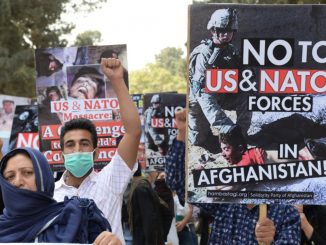
Members of the Solidarity Party of Afghanistan protest against the U.S.-led invasion of Afghanistan ahead of its 16th anniversary in Kabul on Oct. 6, 2017.

The long and brutal U.S. imperialist war in Afghanistan is coming to a chaotic, inglorious end. For 20 years, the people of Afghanistan resisted the U.S. occupation and today the puppet government and its phony army has completely collapsed and practically disappeared. 

The Kabul airport is packed with up to 6,000 U.S. officials and expats, Afghan people who collaborated with the occupation, and presumably some of the thousands of mercenaries that the U.S. hired while privatizing the war. 

The Taliban, which claimed the victory, has announced that it will allow safe passage for those departing the country until Aug. 31. U.S. aircraft have begun ferrying people out. U.S. journalists are fretting that it’s not enough time, lecturing the Taliban to respect human rights and hypocritically predicting all manner of brutality.

The Biden White House announced in the spring that the remaining 2,500-to-3,500 U.S. troops would be withdrawn (no mention at the time of the some 6,000 so-called NATO troops or the thousands of mercenaries the big media call “contractors”). 

As the withdrawal began, Biden kept sending more troops — 6,000 as of August 19 — to the airport. Presidents Obama and Trump had each announced a withdrawal. They both delayed and went along with an over-optimistic Pentagon fabrication of the prospects for an imperialistic victory.

Collapse of the puppet army, government

As the drawdown of troops began last week, by August 14, the Taliban had 21 of 34 provincial capitals under their control. Only three of the bigger cities — Kabul, Jalalabad and Mazar-i-Sharif — were not yet in Taliban hands. When they ultimately took control of Kabul, the U.S. media feigned shock at the speed of the Taliban’s return to Kabul.  

But an Aug. 15 article in the Washington Post revealed that in the ruling circles of imperialism, they were aware that they had a “morale problem.” Afghan government soldiers could not be relied on to fight the Taliban on behalf of U.S. imperialism. 

More than a year ago, Taliban representatives began offering amnesty-for-surrender deals to Afghan puppet government troops, officers, and village officials throughout the country. Repeatedly, Afghan government troops were handing over U.S.-provided weapons and equipment – no shots fired. The Taliban let the soldiers trained and armed by the U.S. simply walk away. 

The transition happened first in rural villages, then districts, then provincial capitals. In April of this year, when Biden announced that the withdrawal deadline was being sped up from Sept. 11 to Aug. 31, the pace of the surrenders quickened. 

Then, on Aug. 15, a few days after Afghan President Ghani gave a speech brimming with confidence about his government’s prospects for fending off any Taliban assault, reports surfaced that he had fled the country. Video of Taliban figures sitting at his desk in the presidential palace appeared. There had been no resistance by the Afghan military. 

This year-long process of surrender by Afghan troops couldn’t have been investigated in so much detail by the Washington Post in the last couple of days. Imperialists and savvy journalists have known that a pro-imperialist government could not survive on its own. The choice was between continuing an unpopular war and occupation (getting little in return), or ending it.

For twenty years, the imperialist U.S. military installed successive puppet governments, headed by U.S. cronies such as CIA asset Hamid Karzai, or Columbia University educated Ghani (who, ironically, wrote a book titled “Fixing Failed States.”) None of them had anything to offer that could improve the lives of impoverished people, rebuild infrastructure, or provide health care, education or housing. None of them had a base of support among the Afghan people.

A long history of Afghan resistance

There is a long history of Afghan independence and determination. In the middle of the 19th century, the Afghan people annihilated the formidable private army of the British East India Company and held off imperialist domination. 

The example of the 1917 revolution lifting the impoverished Central Asian nations formerly oppressed by the Czars of Russia influenced neighboring Afghanistan. Between 1921 and 1929 the two countries signed a Friendship Treaty and embarked on projects to help develop Afghanistan with power generation, water resources, transportation and communications. The projects were later abandoned with a government change. 

Even during the four decades of the last King of Afghanistan who was overthrown in 1973, there was a respectful relationship between the USSR and Afghanistan. The 1978 Saur Revolution that brought socialist leaders to power was an expression of growing sentiment among youth and students in Kabul and other cities for socialism. 

The People’s Democratic Party of Afghanistan (PDPA) took over with support from a substantial part of the Afghan military. Immediately they worked to eliminate the crushing debt agricultural workers owed to feudal landlords, build up womens’ rights and workers’ rights, along with other progressive initiatives. 

The CIA’s Operation Cyclone cut their progress short. The spy agency recruited among the most reactionary fundamentalists from the region to build the mercenary mujahedeen army to overthrow the April Revolution. Later, in the 1990s, the Taliban emerged from among the mujahedeen forces that dominated Afghanistan. 

From the time that the CIA launched Operation Cyclone in 1979, until the current retreat of U.S., NATO, and mercenary troops, the U.S. imperialists have been trying to impose a pro-imperialist government on an anti-imperialist population. 

The U.S. war leaves in its wake cities crowded with internal refugees — families who lost homes or fled the warfare to save their lives. Officially, nearly 71,334 Afghan civilians and nearly 70,000 Afghan police and military were killed directly by the war. About 7,500 U.S. soldiers, NATO troops and mercenaries died. More than 50,000 Taliban were killed. Nearly 500 journalists and aid workers perished.

U.S. banks, military contractors made a fortune

Military contractors and big U.S. banks, though, made a fortune during the war. In the past, taxing the rich to pay for war expenditures wasn’t out of the question. An Aug. 17 Associated Press article noted that U.S. President Harry Truman temporarily raised top tax rates by 92% and President Lyndon Johnson by 77% to pay for the horrors of the U.S. wars against the Korean people and the Vietnamese people. 

Today’s billionaires are bigger and more privileged than ever. Lawmakers no longer even hint that U.S. corporations should pay for the wars that bolster the fortunes of the capitalists as a class. Instead, the U.S. has debt-financed the $2 trillion used for the mayhem and murder in Afghanistan. 

Taxes on the rich have been practically eliminated. The U.S. Treasury will be paying the banks for the war on Afghanistan at least until 2050. With interest added, the Treasury will have shelled out some $6.5 trillion in costs. This amount doesn’t even include a portion of the $2 trillion the U.S. has committed to pay in health care, disability or burial costs for the millions of veterans that were hoodwinked into taking part in the dirty imperialist wars against Iraq or Afghanistan. 

The U.S. war on Afghanistan was another tragic setback for humanity. The task for anti-imperialist organizers — especially in the United States — is to make it the last.

Strugglelalucha256


Israel’s nukes are U.S. approved

While the U.S. corporate media has falsely accused Iran of developing nuclear weapons, it’s been largely silent about Israel’s nuke arsenal. This cover-up has continued despite widespread acknowledgement elsewhere of the Zionist state’s H-bomb stash. 

Back in 1986, London’s Sunday Times published the front page story “Revealed: Israel’s Nuclear Secrets.” The article estimated that Israel had between 100 and 200 nuclear weapons.

It was based on information from the former Israeli nuclear technician Mordechai Vanunu. In retaliation, Vanunu was kidnapped from Britain by Israeli agents and sentenced to 18 years in prison after a secret trial.

The U.S. State Department — which claims to defend human rights — said nothing about the abduction of this courageous whistleblower, who spent 11 years in solitary confinement for telling the truth.

The media even ignored U.S. organizations like the Center for Arms Control and Non-Proliferation, which estimates that Israel has 90 nuclear weapons. Or the Federation of American Scientists, which quotes “U.S. Intelligence Community” estimates that the apartheid state occupying Palestine had between 75 and 130 nukes. 

So it was surprising that the New York Times on Aug. 11 ran an essay by Peter Beinart discussing Israel’s nuclear arsenal. 

Beinart is no radical. As editor of the Atlantic magazine he supported the 2003 invasion of Iraq. More recently he’s become critical of U.S. foreign policy and was detained briefly in Israel.

It’s a sign of how much more isolated Israel and its U.S. backers have become that Beinart wrote the piece and the New York Times published it.

A much bigger question is why the military-industrial-complex has tolerated Israel’s nuclear arsenal that’s over a third the size of either the British or French inventory. 

Nuclear bonding over colonial wars

Doesn’t the Pentagon demand a monopoly of violence? That was the theme of its 1992 “Defense Planning Guidance,” parts of which were leaked to the New York Times and Washington Post. 

Written after the Soviet Union’s overthrow, it sought to prevent the rise of any other military power, even among its supposed capitalist allies.

U.S. capitalists wouldn’t let Germany — the strongest European economic power — start building nuclear weapons. The German working class, which includes millions of immigrants, would rise up to stop it.

British scientists played an important role in the Manhattan Project which built the atom bombs that incinerated Hiroshima and Nagasaki in 1945. The British mission was led by the Nobel Prize winning physicist James Chadwick, who discovered the neutron.

Prime Minister Winston Churchill agreed to this sharing of information with the understanding that Britain would get atom bombs too. The Pentagon double-crossed Britain, which had to develop its own nuclear program. It wasn’t until 1952 that Britain became the third nuclear power, after the United States and the Soviet Union.

Wall Street didn’t want France to have nukes, either. France detonated its first bomb in 1960 in southern Algeria, then a French colony.

The French nuclear program was carried out in collaboration with Israel, which played somewhat the same role that British scientists did in the U.S. Manhattan Project.

France was then the Zionist State’s closest ally. In its 1967 blitzkrieg invasion of Egypt, Jordan and Syria, Israeli pilots flew French Mirage jets, not U.S. Phantoms, which were then bombing Vietnam and Laos.

Israel joined the British and French colonial slave masters invading Egypt in 1956. They did so after Egyptian leader Gamal Abdel Nasser nationalized the Suez Canal, which had been built in the 1860s by French colonialists with slave labor. Taking over the canal was one of great victories against colonialism.

The Zionist state supported France’s war of extermination against the Algerian people who were fighting for independence. At least a million Algerians were killed with 40,000 tortured to death.

One of the torturers was Jean-Marie Le Pen, the founder of France’s fascist National Front, now renamed the National Rally. This war criminal is just as anti-Jewish as he is anti-Arab and anti-Muslim.

Targeting the Soviet Union

France’s explosion of its atomic bomb in the Sahara was a war crime against all Africans. Hundreds of Africans must have died from the fallout.

The French capitalists’ dirty war against Algeria was the political reason for Israel getting help to build the bomb. But France was defeated by the Algerian people. Afterwards French banksters had less use for the Zionist state.

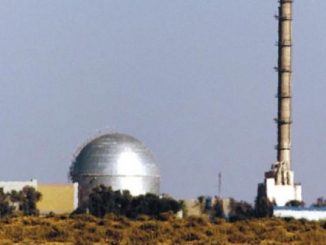
The U.S. government wasn’t initially in favor of Israel making nukes. President John F. Kennedy sent inspectors to Israel’s Dimona reactor. But the Zionist regime was able to continue with its nuclear program.

It was President Richard Nixon who started the big cash pipeline to Israel. At least $140 billion has been spent to prop up apartheid rule over Palestine. Every cent of it was stolen from poor and working people.

Nixon did this even though he can be heard on tape repeatedly attacking Black and Jewish people. This included a conversation with the late Rev. Billy Graham, who also made bigoted remarks against Jews. The evangelist’s son Rev. Franklin Graham is a leading hate monger against Muslims. 

Big Oil doesn’t allow Israel to have dozens of atom bombs so it can bomb Rockefeller’s oil wells in the Arab/Persian Gulf. Israel’s nukes were to be launched at the Soviet Union.

This is something that’s often overlooked in discussing the Zionist state. Israel’s nukes can be used against Iran and are a threat to many other countries.

The most sinister example is the Zionists helping its fellow apartheid regime in South Africa to develop nuclear weapons. This was revealed in the 1979 “Vela Incident,” which was the explosion of a nuclear bomb in the southern Indian Ocean.

At the time, South Africa was fighting a war with newly independent Angola and its Cuban allies. Sections of the South African apartheid military wanted to drop a nuclear bomb on Luanda, Angola’s capital.

For the Pentagon brass, the first phase of Israel’s 1982 invasion of Lebanon was a proxy war against the Warsaw Pact. The Pact was the response of the Soviet Union and the European socialist countries to NATO.

By having Israel shoot down more than 80 Syrian planes using U.S. technology, the Pentagon was saying that they could do the same over East Germany.

Supreme cynicism

Israel’s nukes were viewed as a replacement for the U.S. Jupiter nuclear missiles in Turkey that were removed in 1963 by President Kennedy following the Cuban missile crisis. However, there are also 50 nuclear weapons currently stored in Turkey at the U.S. Air Force base in Incirlik. 

The Pentagon’s green light for Israel’s nukes came as the Soviet Union was able to match the United Stated in developing multiple independently targetable reentry vehicles. Several of these MIRV nuclear weapons are fitted on a single missile and can be aimed at different targets.

MIRV missiles greatly sped up the arm race. The Pentagon hoped it would be the knockout threat that would force the Soviet Union to surrender. They were astounded that the socialist state could make them as well.

To military planners in U.S. think tanks, Israel’s nukes could be used to launch a “limited” nuclear war against the Soviets. Such an attack would kill millions of people, including many Jewish Soviet citizens, and devastate the Soviet Union.

Yet it would be suicidal for the Soviets to respond with an all-out attack on Israel’s master, the United States. Instead the Soviet military would be forced to attack Israel.

It’s hard to equal this cynicism. Six million people were killed by Hitler during the Jewish and Roma holocaust. A few decades later more than six million Arab and Jewish people in occupied Palestine could be killed in a nuclear exchange.

This scenario isn’t far-fetched. The whistleblower Daniel Ellsberg revealed Pentagon plans in 1961 to launch a nuclear first strike. It would kill 600 million people in the Soviet Union, the People’s Republic of China and other socialist countries.

This writer helped organize a 1969 demonstration in Milwaukee against the visit of then Israeli Prime Minister Golda Meir who grew up there. She denied that the Palestinian people even existed.

The protest was called by Youth Against War and Fascism at the newly opened Performing Arts Center. It’s now named after the late Zionist fundraiser Ben Marcus who refused to hire Black waitresses at his local Big Boy restaurant chain.

Communist leader and union organizer Al Stergar called upon Meir “to come home to Milwaukee and leave Arab people in peace.” Israel’s current prime minister was born in San Francisco. Stergar called Israel a deathtrap for Arab and Jewish people.

All of occupied Palestine is still a deathtrap. Israel’s nukes must be destroyed. Palestine will be free, from the river to the sea!

Strugglelalucha256


Estado de violencia en Puerto Rico

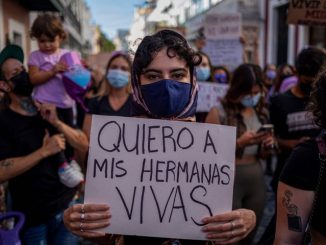
Hace unos días despertamos con la cruel noticia de que un padre había torturado y matado a su niñito de ocho años en medio de una disputa legal con la madre. Pero desgraciadamente, este no es un crimen aislado. La ola de actos sumamente violentos y desgarradores que rompen la fibra familiar y social, va en aumento.

Violencia de género, golpizas y matanzas entre padres, hijos, hermanos,  ya son noticias diarias. Y si a esto le sumamos los robos, las matanzas a plena hora del día producto del trasiego de drogas y peleas entre grupos mafiosos que inundan el país, donde muchas veces mueren personas inocentes, lo que sale a relucir es un país sumido en una ola de terror donde ninguna agencia del gobierno actúa en defensa del pueblo.

Esto es lo que produce la violencia del estado colonial que se va percolando más intensamente hacia la población en general.

Es el mensaje de un gobierno y una Junta de Control Fiscal impuesta por el Congreso de EUA diciendo que el pueblo no importa, que la educación de nuestros niños no importa, que la seguridad y la salud de nuestra gente no importa. Y por eso recorta

servicios básicos del pueblo, y privatiza la energía otorgando contratos multimillonarios a mafias extranjeras que maltratan a nuestros trabajadores sin ofrecer tan siquiera un servicio adecuado.

Desde  Puerto Rico para RADIO CLARIN de Colombia, les habló Berta Joubert-Ceci

Strugglelalucha256


NYC/NJ activists picket Port of New York to block Israeli-operated cargo ship

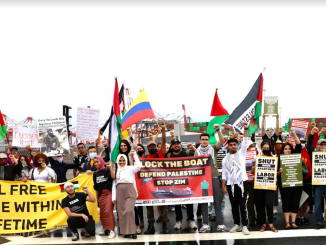
Elizabeth, New Jersey – Sunday, July 25 at 6am, about 100 pro-Palestine community activists in the New York metropolitan area picketed Israeli shipping giant ZIM in an attempt to block their cargo ship, Zim Qingdao, from unloading its cargo in the Port of New York/New Jersey at the Maher Terminal in Elizabeth, NJ. Zim Integrated Shipping Services Ltd (ZIM) is Israel’s largest cargo shipping company, often dealing in Israeli manufactured military technology, armaments and logistics equipment.

The event was organized byBlock the Boat NY/NJ, the local affiliate of an international  coalition of labor and human rights organizations fighting for  justice in Palestine, led by the Arab Resource and Organizing Center in Oakland, CA.

“We are sending a message that profiteering from Israeli apartheid and the ongoing violence against the Palestinian people will not be welcome in New York, New Jersey, or anywhere on the East Coast,” said Nerdeen Kiswani, Chair of Within Our Lifetime-United for Palestine. “Our communities are taking a stand against the ethnic cleansing, evictions, and bombings that Palestinians face every day.”

Chanting “STAND UP, SHUT IT DOWN , TURN THAT BOAT RIGHT BACK AROUND”, “INJURY TO ONE, INJURY TO ALL! TEAR DOWN ISRAEL’S APARTHEID WALL!” “Move Boat, Get Out the Way”, and “WHEN PEOPLE ARE OCCUPIED, RESISTANCE IS JUSTIFIED!” picketers held colorful signs and banners as the dockworkers drove past them to begin their shift. A few honked in solidarity and many popped out their cameras to take video of the lively and spirited picket line.

The Zim Qingdao had docked shortly before the picketers arrived. In an attempt to avoid the protest, Zim had tried to hide their approach by removing the ship from the Maher Terminal’s shipping schedule. Although police blocked demonstrators from gaining access to the employee entrance, Zim was well aware of our presence. Zim refused to comment when asked by a reporter from the local National Public Radio station, which covered the event.

Actions like this one  against ZIM are a response to a call from labor unions in Palestine urging workers and communities worldwide to refuse dealings with Israeli companies. The international #BlocktheBoat has received over 150 endorsements from labor unions, faith, and community organizations worldwide, including the Congress of South African Trade Unions (COSATU), the largest federation of trade unions in South Africa, representing 1.8 million people. Recent escalations of Israeli violence against Palestinians in Gaza, Jerusalem, and the West Bank have prompted thousands of demonstrations in cities across the world.

This mobilization follows months of successful actions on the North American West Coast which prevented the unloading of ZIM-operated vessels in Oakland, Seattle, and Prince Rupert. Over 8,000 people worldwide have signed up to answer the call to action at port cities around the world, as part of the BDS movement.

In Oakland, the ZIM-operated Volans’ was forced to disembark with its cargo in tow after being blocked from unloading for several weeks by a community picket. The same Volans ship eventually landed in Prince Rupert, BC. After a public call to action, First Nation, Arab, and allied community members organized a picket to successfully block the ship from unloading for 5 days. In Seattle, Falastiniyat, a Palestinian feminist collective organized community pickets at Seattle’s port, successfully blocking ZIM San Diego ship from being unloaded for 4 days before a police crackdown forced the unloading of the vessel. Meanwhile solidarity actions were held in Los Angeles, Vancouver, New York/New Jersey, Houston, Detroit, Italy, and South Africa.

The San Francisco-based Arab Resource and Organizing Center first called on communities to block ZIM-operated ships in the U.S. in 2014, with the first successful #BlockTheBoat action. Organizers have claimed the disruption of ZIM’s operations as a major victory for the international Boycott, Divestment, & Sanctions (BDS) movement, which works to put pressure on businesses profiting from Israeli apartheid.

The BDS movement has gained national prominence as a flashpoint in US politics as right-wing legislatures attempt to criminalize the boycott movement. Several BDS campaigns globally, including #BlockTheBoat, have seen numerous successes over the past year, driven by plummeting public support for Israel in the wake of human rights abuses and ethnic cleansing of Palestinians.

“Across the US, workers and social justice movements are standing to show their support for the Palestinian struggle for freedom, and that there will be a high price for all companies who do business that profits the apartheid state of Israel,” saidLara Kiswani, Executive Director of AROC

Block the Boat NY/NJ Coalition member organizations and endorsers include AROC: Arab Resource & Organizing Center, New York 4 Palestine, Al-Awda: The Palestine Right to Return Coalition, Within Our Lifetime: United for Palestine, Labor for Palestine, Samidoun Palestinian Prisoner Solidarity Network, American Muslims for Palestine – New Jersey, the ANSWERCoalition , Peoples Organization for Progress, Northern New Jersey Jewish Voice for Peace, Jews for Palestinian Right of Return, Jewish Voice for Peace-NYC, NYC Democratic Socialists of America, the NJ Green Party, CUNY4 Palestine, and Central NJ JVP.

Source: Fighting Words

Strugglelalucha256


Boston rally to stop Line 3, Aug. 25

WEDNESDAY, AUGUST 25, 2021 AT 6 PM EDT – 7:30 PM EDT
Boston Rally to Stop Line 3
507 Jamaicaway, Jamaica Plain, MA 02130

Join us at Jamaica Pond at 6pm to rally in solidarity with the Indigenous-led movement against the construction of the Line 3 tar sands pipeline. We will be holding a rally and vigil to honor the wild rice, treaties, and ways of life that are being trampled by corporate greed. We will call on the Biden administration, our so-called “climate president,” to end its hypocrisy and use its power to #StopLine3.

This event is part of nationwide day of action that includes events in Chicago, New York City, Washington D.C., and St. Paul!

Directions: We will be gathering near the Jamaica Pond Boathouse, 507 Jamaicaway, Jamaica Plain, MA 02130.

Cover Photo from @Giniw Collective

Some background:

Construction of Enbridge Corporation’s Line 3 pipeline is in violation of official treaties from 1837, 1854, and 1855 — an illegal invasion and occupation of Anishinaabe land. The pipeline will inevitably contaminate wild rice beds, an important food that is sacred to the Anishinaabe people. The workers who construct the pipeline — living in man camps — solicit sex from minors and contribute to the epidemic of Missing and Murdered Indigenous Relatives, Women, and Two Spirit people.

Indigenous leaders and water protectors have been brutalized by local police, hired by Enbridge, as they have tried to enforce treaty rights and resist construction. Nonviolent demonstrations have been met with rubber bullets, tear gas, non-lethal pain weapons, and much more. This is but a continuation of repressive settler-colonial policy on behalf of the government of the so-called United States against Indigenous people.

Environmentally, the pipeline is a disaster. Enbridge pipelines have spilled over 800 times in 15 years, and the 300,000 people who live downstream of the Mississippi River are at risk. The Line 3 pipeline has already generated 28 frac-outs, where drilling fluid pollutes the rivers. The pipeline’s completion will double Minnesota’s carbon emissions, the equivalent of 50 coal-fired power plants. Tar sands oil, which it will carry, is not the future of energy infrastructure, but a desperate last-ditch effort by a corrupt, entrenched industry whose profit-seeking hurtles the planet and people towards disaster.

Find out more here: https://linktr.ee/stopline3

Strugglelalucha256


Unemployed Workers Union and workers’ power in the pandemic crisis

Struggle-La Lucha questioned Sharon Black, an organizer with the Unemployed Workers Union in Baltimore. Following are her answers.

How did the Unemployed Workers Union get started?

You could say the initial effort began at the United Workers Assembly on May 1, 2021. While the Amazon workers’ struggle was highlighted, Steven Ceci, an unemployed hospitality worker, spoke on his struggle to get benefits and invited people to connect around organizing the unemployed.

In the beginning it was primarily unemployed workers from the People’s Power Assembly who called several protests at the unemployment office in Baltimore. The group was small, but as the crisis grew, it became apparent that we needed a union of the unemployed, underpaid and ultimately low-wage workers also. 

Not just a committee but an actual union. At this point the UWU stands on its own as an organization. I’m sure that some people initially thought we’d lost our minds.

We organized weekly “Unemployed & Workers Rights Clinics.” Because of COVID-19, we set up tables outside our office. On our first day, workers had shown up before we could even set up. People filled out grievances and we mailed them to the Labor Department Secretary and to the governor. 

In the midst of what was already a major crisis, Gov. Larry Hogan announced that he was halting the federal pandemic payments early. 

What about your lawsuit, how did that start?

The UWU lawsuit was one of the earliest lawsuits nationally. We did it as an organizing tool. Workers needed something that could buoy them.

In the beginning, we were alone. I don’t want to go into all of the backstory, but we were told that it was impossible, and at the start, we filed the lawsuit without any support either financially or politically. 

As organizers, we never saw the courts as the be-all and end-all. With thousands of unemployed workers spread across the state (sometimes isolated), the lawsuit garnered a lot of attention for our campaign, helping to push the struggle forward.

What stage is the struggle in for the Unemployed Workers Union now?

We’re overwhelmed. Our phones never stop ringing and we can’t keep up. Building an ark in a storm is difficult and it takes some ability to see the bigger picture to keep going. We could easily become impatient with ourselves and the things we’re lacking.

We won this incredible victory in stopping the governor from halting the weekly pandemic benefits early. Over 300,000 workers will continue with the CARES Act money. Governor Hogan tweeted that he would never change his mind but he was forced to back down.

But there has been no rest or even a chance to allow this victory to sink in because over 20,000 unemployed workers still have not received their benefits because of a designed-to-fail unemployment system.  

The second phase of this struggle, both in terms of the lawsuit and in the street, is in full swing. The challenge is getting people more deeply involved and to see that power comes from collective action. At our last Workers Assembly we talked about the George Floyd case and what it took to get Derek Chauvin convicted.

What is your general perspective around unemployment and the UWU?

Our goal is to organize a union of unemployed and low-wage workers. There is no rule that you have to have dues, or a paid staff. Not because we are opposed to either, but it doesn’t suit our present situation. We define our union based on the slogan “an injury to one, is an injury to all.” 

The UWU might even look toward getting membership in the AFL-CIO. It’s an interesting question that could challenge the narrow conception of what it means to be a worker.

We see the union as part of the broader workers’ struggle. There’s a connection between unemployment and low-wage and unorganized workers. 

Part of the initial attack, the propaganda about workers not wanting to work, getting too much in pandemic benefits — was aimed at dividing workers. It was a lie that served to make the unemployed feel isolated and bad, but its real aim was to lower wages for everyone. 

There’s been a major displacement of workers, one that I believe will be long-term. Some of this is obvious in terms of hospitality workers and in other areas of work. Certainly many smaller businesses have been wiped out. But how work is done, the way that technology for profit is utilized, is again reshaping and intensifying exploitation. 

It has also been a period of resistance to what you could call a war against workers. The efforts of the Amazon workers in Bessemer, Alabama, to unionize —  which is far from over — is one example as are countless smaller but inspiring strikes.

But the defining struggle that has shaped this past year has been the Black Lives Matter movement; even the New York Times was forced to document its incredible breadth. This struggle against racism is a workers’ struggle and has helped to shape what is taking place at almost every workplace. 

What is your long-term political perspective?

Unemployment is a permanent feature of capitalism. There’s never been full employment, at least in the United States, regardless of what cycle capitalism is in. Karl Marx explained it best: capitalists rely on a “surplus” of workers to keep workers competing with one another; this keeps wages and benefits low to extract maximum value from labor, increasing profits.

There’s also the cyclical aspect of capitalism, the boom and bust of overproduction where the economy contracts. Massive unemployment is one of the main features. 

This is important because it shows that organizing the unemployed is critical and will remain so in the future.

What are some of the issues pertinent to unemployed workers?

The unemployment benefit system is broken and in crisis, if you even want to call it compensation. There’s no uniform system, rather it varies vastly in different states. In Mississippi, the highest benefits are $235 a week. You also have states like Alabama, Florida and North Carolina that have horrifically short periods of assistance, from 12 to14 weeks. 

The false excuse is that the cost of living varies in different areas, but the real driving force is the lack of a strong labor movement and the history of “Jim Crow” racism and segregation, the latter being historically most important. 

Even before the pandemic, most workers would tell you they had to jump through hoops, that they were lucky to even collect benefits.

When I mention the “war on workers,” one of the factors silently driving this present crisis has been the attack on public-sector workers. 

Before and during the pandemic, state governments were automating the system and getting rid of the workers who service benefits. Certainly, the installation of the Beacon system has been a major feature of the crisis in Maryland. 

There is a major probability that unemployment insurance reserves will be depleted if another major wave in the pandemic hits or another capitalist downturn takes place. Unemployment insurance is under-funded.

We saw this in September 2020, when states had to apply for federal loans. California, Illinois, Massachusetts, New York and Texas borrowed billions. The U.S.Treasury Department had listed 20 states that had applied for loans.

In addition, unemployment insurance is not adequate. It doesn’t solve people’s needs, including protection from eviction, foreclosures, repossessions and providing all of the other necessities. 

This raises a number of questions. 

The pandemic has proved that the money is there. The billionaires and trillionaires have made record profits, the pandemic being a bonanza for them. They’re awash in money, including uncirculated capital moldering in banks. The bloated Pentagon death machine hasn’t lost a dime from their $700+ billion budget. 

Every human being can and should be guaranteed an income. Dr. King’s demand for a national guaranteed “Jobs or income now” — something that he advanced during the Poor People’s Campaign — has to be raised with more vigor.

The magnitude of the crisis that is actually unfolding now — something that will ripen more — calls for different solutions and organization. Ideas that might have been considered pie-in-the-sky, are necessities. Like a shorter work week. A reorganization of work itself. 

Questions about capitalism as a mode of production — is the system viable under these conditions? The fact that capitalism creates the crisis, but cannot solve it, raises the issue of socialism.

Is there anything else you wanted to add?

Getting back to the nitty-gritty. What has been so rewarding about the UWU is watching workers develop solidarity, consciousness and bringing workers together who have never been in struggle. Workers who never thought that they would be betrayed by the system have found themselves abruptly and cruelly left to fend for themselves.

Organizing the UWU is part of the antidote, not the only one, to the Jan. 6 coup attempt by a band of neo-Nazi and racist extremists. Of course, it was not workers who for the most part led that attempt. It was wealthy business owners, large and small, and especially those from inside the state, i.e. the Pentagon, military, and police, that conspired. But they depend on white workers, especially those who have bought into racism, or who are neglected and confused, to stay on the sidelines or in some cases act as cannon fodder. 

The UWU has been a force to unite, organize workers in their own self-interest and pull people away from that kind of answer.

Strugglelalucha256


Washington spent more than $2 trillion on a war that it knew could not be won

On August 15, the Taliban arrived in Kabul. The Taliban’s leadership entered the presidential palace, which Afghan President Ashraf Ghani had vacated when he fled into exile abroad hours before. The country’s borders shut down and Kabul’s main international airport lay silent, except for the cries of those Afghans who had worked for the U.S. and NATO; they knew that their lives would now be at serious risk. The Taliban’s leadership, meanwhile, tried to reassure the public of a “peaceful transition” by saying in several statements that they would not seek retribution, but would go after corruption and lawlessness.

The Taliban’s entry in Kabul is a eefeat for the United States

In recent years, the United States has failed to accomplish any of the objectives of its wars. The U.S. entered Afghanistan with horrendous bombing and a lawless campaign of extraordinary rendition in October 2001 with the objective of ejecting the Taliban from the country; now, 20 years later, the Taliban is back. In 2003, two years after the U.S. unleashed a war in Afghanistan, it opened an illegal war against Iraq, which ultimately resulted in an unconditional withdrawal of the United States in 2011 after the refusal by the Iraqi parliament to allow U.S. troops extralegal protections. As the U.S. withdrew from Iraq, it opened a terrible war against Libya in 2011, which resulted in the creation of chaos in the region.

Not one of these wars—Afghanistan, Iraq, Libya—resulted in the creation of a pro-U.S. government. Each of these wars created needless suffering for the civilian populations. Millions of people had their lives disrupted, while hundreds of thousands of people lost their lives in these senseless wars. What faith in humanity can now be expected from a young person in Jalalabad or in Sirte? Will they now turn inward, fearing that any possibility of change has been seized from them by the barbaric wars inflicted upon them and other residents of their countries?

There is no question that the United States continues to have the world’s largest military and that by using its base structure and its aerial and naval power, the U.S. can strike any country at any time. But what is the point of bombing a country if that violence attains no political ends? The U.S. used its advanced drones to assassinate the Taliban leaders, but for each leader that it killed, another half a dozen have emerged. Besides, the men in charge of the Taliban now—including the co-founder of the Taliban and head of its political commission, Mullah Abdul Ghani Baradar—were there from the start; it would never have been possible to decapitate the entire Taliban leadership. More than $2 trillion has been spent by the United States on a war that it knew could not be won.

Corruption was the Trojan Horse

In early statements, Mullah Baradar said that his government will focus its attention on the endemic corruption in Afghanistan. Meanwhile, stories spread across Kabul about ministers of Ashraf Ghani’s government attempting to leave the country in cars filled with dollar bills, which was supposed to be the money that was provided by the U.S. to Afghanistan for aid and infrastructure. The drain of wealth from the aid given to the country has been significant. In a 2016 report by the U.S. government’s Special Inspector General for Afghanistan Reconstruction (SIGAR) relating to the “Lessons Learned from the U.S. Experience with Corruption in Afghanistan,” the investigators write, “Corruption significantly undermined the U.S. mission in Afghanistan by damaging the legitimacy of the Afghan government, strengthening popular support for the insurgency, and channeling material resources to insurgent groups.” SIGAR created a “gallery of greed,” which listed U.S. contractors who siphoned aid money and pocketed it through fraud. More than $2 trillion has been spent on the U.S. occupation of Afghanistan, but it went neither to provide relief nor to build the country’s infrastructure. The money fattened the rich in the United States, Pakistan, and Afghanistan.

Corruption at the very top of the government depleted morale below. The U.S. pinned its hopes on the training of 300,000 soldiers of the Afghan National Army (ANA), spending $88 billion on this pursuit. In 2019, a purge of “ghost soldiers” in the rolls—soldiers who did not exist—led to the loss of 42,000 troops; it is likely that the number might have been higher. Morale in the ANA has plunged over the past few years, with defections from the army to other forces escalating. Defense of the provincial capitals was also weak, with Kabul falling to the Taliban almost without a fight.

To this end, the recently appointed defense minister to the Ghani government, General Bismillah Mohammadi, commented on Twitter about the governments that have been in power in Afghanistan since late 2001, “They tied our hands behind our backs and sold the homeland. Damn the rich man [Ghani] and his people.” This captures the popular mood in Afghanistan right now.

Afghanistan and its neighbors

Hours after taking power, a spokesperson for the Taliban’s political office, Dr. M. Naeem, said that all embassies will be protected, while another spokesperson for the Taliban, Zabihullah Mujahid, said that all former government officials did not need to fear for their lives. These are reassuring messages for now.

It has also been reassuring that the Taliban has said that it is not averse to a government of national unity, although there should be no doubt that such a government would be a rubber stamp for the Taliban’s own political agenda. So far, the Taliban has not articulated a plan for Afghanistan, which is something that the country has needed for at least a generation.

On July 28, Taliban leader Mullah Baradar met with Chinese Foreign Minister Wang Yi in Tianjin, China. The outlines of the discussion have not been fully revealed, but what is known is that the Chinese extracted a promise from the Taliban not to allow attacks on China from Afghanistan and not to allow attacks on the Belt and Road Initiative (BRI) infrastructure in Central Asia. In return, China would continue its BRI investments in the region, including in Pakistan, which is a key Taliban supporter.

Whether or not the Taliban will be able to control extremist groups is not clear, but what is abundantly clear—in the absence of any credible Afghan opposition to the Taliban—is that the regional powers will have to exert their influence on Kabul to ameliorate the harsh program of the Taliban and its history of support for extremist groups. For instance, the Shanghai Cooperation Organization (set up in 2001) revived in 2017 its Afghanistan Contact Group, which held a meeting in Dushanbe in July 2021, and called for a national unity government.

At that meeting, India’s External Affairs Minister Dr. S. Jaishankar laid out a three-point plan, which achieved near consensus among the fractious neighbors:

“1. An independent, neutral, unified, peaceful, democratic and prosperous nation.

“2. Ceasing violence and terrorist attacks against civilians and state representatives, settle conflict through political dialogue, and respect interests of all ethnic groups, and

“3. Ensure that neighbors are not threatened by terrorism, separatism and extremism.”

That’s the most that can be expected at this moment. The plan promises peace, which is a great advance from what the people of Afghanistan have experienced over the past decades. But what kind of peace? This “peace” does not include the rights of women and children to a world of possibilities. During 20 years of the U.S. occupation, that “peace” was not in evidence either. This peace has no real political power behind it, but there are social movements beneath the surface that might emerge to put such a definition of “peace” on the table. Hope lies there.

This article was produced by Globetrotter. Vijay Prashad is an Indian historian, editor and journalist. He is a writing fellow and chief correspondent at Globetrotter. He is the chief editor of LeftWord Books and the director of Tricontinental: Institute for Social Research. He is a senior non-resident fellow at Chongyang Institute for Financial Studies, Renmin University of China. He has written more than 20 books, including The Darker Nations and The Poorer Nations. His latest book is Washington Bullets, with an introduction by Evo Morales Ayma.

Strugglelalucha256


Haiti needs aid not intervention!

Stop the deportations!

Over 1,400 people were killed by the 7.2 magnitude earthquake that struck Haiti Aug. 14. Thousands more may have died. At least 30,000 families were made homeless.

This misery was compounded by Tropical Storm Grace that struck the country shortly afterwards. The tragedy comes 11 years after the Jan. 12, 2010, earthquake that killed over 220,000 people in Port-au-Prince, Haiti’s capital.

People around the world want to help Haiti. Yet the Biden administration deported two planeloads of Haitians in the week before the earthquake.

Justice demands that deportations of Haitians be stopped. Temporary Protected Status (TPS) of Haitians must be made permanent.

The earthquake and storm comes in the wake of the July 7 assassination of Haiti’s President Jovenel Moïse. The murder involved mercenaries from Colombia and may have been planned from within the United States.

Haiti needs aid but it doesn’t need or want foreign intervention. The United States invaded Haiti in 1915 and occupied the country until 1934.

Thousands of Haitians were killed, including resistance leader Charlemagne Péralte. The U.S. Marine who assassinated Péralte was given the congressional medal of honor.

The 2004-2017 UN intervention in Haiti resulted in over 10,000 Haitians dying from 
cholera. This occupation followed the overthrow of Haiti’s democratically elected President Jean-Bertrand Aristide by U.S. President George W. Bush and the CIA.

The world capitalist class have never forgiven the Haitian people for conducting the only slave revolution in history. Every slave master in the United States feared enslaved Africans rising up in another “another Haiti.”

It was Haiti that gave crucial aid to the “Liberator of America,” Simón Bolívar.

Two hundred thirty years of revenge followed. The restored Bourbon monarchy in France actually demanded reparations for the slave masters! Haiti was forced to pay this blood money until 1947.

Haiti deserves aid and reparations, not another U.S. or UN military  intervention. Genuine aid is being given to earthquake survivors by medical workers from socialist Cuba.

Haitians in the United States are also collecting aid. Please contact the Family Action Network Movement in Miami at info@fanm.org or call 305-756-8050 if you can help.

Reparations for Haiti!

Strugglelalucha256


The relative decline of U.S. imperialism

The swift collapse of Afghanistan puppet government when U.S. troops withdrew from the war with the Taliban and left the country after 20 years has been likened to the fall of Saigon at the end of the 30-year ‘American’ war against the Vietnamese people.  The scenes of Afghans trying to get onto U.S. planes at the airport to escape seem startlingly familiar to those of us who can remember the last days of Saigon.

But is this a superficial similarity?  After all, America’s occupation of Vietnam was way more costly as a share of U.S. national output and in terms of the lives of American soldiers than the attempt at ‘regime’ change in Afghanistan.  The Vietnam disaster led to the U.S. government running deficits for the first time since WW2.  But even more important, it meant a diversion of investment into arms rather than productive sectors at a time when the profitability of capital had already begun to fall, the Golden Age of investment and profitability having peaked in the mid-1960s.

Indeed, by the end of the 1960s, it was clear that the U.S. could never win in Vietnam, just as it was clear at least a decade ago (if not from the very beginning) that it could not win in Afghanistan.  But the ruling elite continued under Nixon and Kissinger to prosecute the war for several more years, spreading it into neighbouring countries like Laos and Cambodia.

But by the official end of the war in Vietnam, the economic consequences of this 30-year ‘intervention’ exposed an important turning point – the end of Pax Americana and the outright hegemonic position of American imperialism in the world economy.  From then on, we can talk about the relative decline (relative to other imperialist powers) of the U.S., with the rise of the European countries, Japan, East Asia and more recently China.  Despite the collapse of the Soviet Union in the late 1980s and early 1990s, the end of the ‘cold war’ did not reverse or even curb that relative decline.  The U.S. no longer can rule the world on its own and, even with the help of a ‘coalition of the willing’, it cannot dictate a ‘world order’.

Economically, it all started before the fall of Saigon.  As the profitability of U.S. capital started to fall from the mid-1960s, U.S. industry began to lose its competitive advantage in manufacturing and even in various services to rising Franco-German capital and Japan.  This eventually meant that the economic world order after WW2, which had established the economic hegemony of the U.S. economy and its currency, the dollar, started to crumble.

Indeed, it is 50 years to the month when officials of President Nixon’s administration met secretly at Camp David to decide on the fate of the international monetary system. For the previous 25 years, the U.S. dollar had been fixed to the price of gold ($35/oz) by international agreement.  Anybody holding a dollar could convert into a fixed amount of gold from U.S. reserves.  But in August 1971, President Nixon took to national television to announce he had asked Treasury Secretary John Connally to “suspend temporarily the convertibility of the dollar into gold or other reserve assets.”

It was the end of the so-called Bretton Woods agreement, so painfully negotiated by the Allied powers, namely the U.S. and the UK, over the heads of all the other countries in the world.  Conceived, along with the IMF, the World Bank and the UN, the agreement established a framework that committed all to fixed exchange rates for their currencies and fixed in terms of the U.S. dollar.  The U.S. in turn would fix the value of the dollar in terms of gold.  No country could change their rates without IMF agreement.

But with Nixon’s announcement, the fixed exchange rate regime was ended; it was the U.S. that had abandoned it and, with it, the whole post-war Keynesian-style international currency regime.  It was no accident that the ending of the Bretton Woods system also coincided with the ending of Keynesian macro management of the U.S. and other economies through the manipulation of government spending and taxation.  The post-war economic boom based on high profitability, relatively full employment and productive investment was over. Now there was a decline in the profitability of capital and investment growth, which eventually culminated in the first post-war international slump of 1974-5; and alongside this was the relative decline of American industry and exports compared to competitors.  The U.S. was no longer exporting more manufacturing goods to Europe, Latin America or Asia than it was importing commodities like oil from the Middle East and manufacturing from Germany and Japan.  It was starting to run trade deficits.  The dollar was thus seriously overvalued.  If U.S. capital, particularly manufacturing was to compete, the dollar fix to gold must be ended and the currency allowed to depreciate.

As early as 1959, Belgian-American economist Robert Triffin had predicted that the U.S. could not go on running trade deficits with other countries and export capital to invest abroad and maintain a strong dollar: “if the United States continued to run deficits, its foreign liabilities would come to exceed by far its ability to convert dollars into gold on demand and would bring about a “gold and dollar crisis.”

And that is what happened.  Under the dollar-gold standard, imbalances in trade and capital flows had to be settled by transfers of gold bullion. Up until 1953, as war reconstruction took place, the U.S. had actually gained gold of 12 million troy ounces, while Europe and Japan had lost 35 million troy oz (in order to finance their recovery). But after that, the U.S. started to leak gold to Europe and Japan.  By end-1965, the latter surpassed the former for the first time in the post-war period in terms of gold volumes held in reserve.  As a result, Europe and Japan began to pile up huge dollar reserves that they could use to buy U.S. assets.  The global economy has begun to reverse against the U.S..

The dollar reserves in Europe and Japan were now so large that if those countries bought gold with their dollars under the gold standard, they could exhaust U.S. gold stocks in an instant.  Private financial outflows (outbound investment) from the U.S. averaged roughly 1.2% of GDP throughout the 1960s—long term investment overseas through FDI or portfolio outflows. This served to finance net exports of U.S. investment goods and a current account surplus, shown as negative here as an offsetting withdrawal of dollars.  Netting these, about 0.4% of U.S. GDP in surplus outward investment was made available every year during the 1960s from the U.S.. This surplus was available for current account deficit countries in Europe and Japan to liquidate U.S. gold, replenishing their diminished reserve positive, or accumulate other financial claims on the U.S.—as shown on the right side.

But throughout the 1960s, the U.S. current account surplus was gradually eroded until, in the early 1970s, the current account was registering a deficit. The U.S. began to leak dollars globally not only through outward investment but also through an excess of spending and imports as domestic manufacturers lost ground.

U.S. current account balance to GDP (%), 1976-2020

The U.S. became reliant for the first time since the 1890s on external finance for the purposes of spending at home and abroad.  So U.S. external accounts were driven less by real goods and services and more by global demand for U.S. financial assets and the liquidity they provided.  By the 1980s, the U.S. was building up net external liabilities, rising to 70% of GDP by 2020.

U.S. net international investment position as % of U.S. GDP

If a country’s current account is permanently in deficit and it depends increasingly on foreign funds, its currency is vulnerable to sharp depreciation.  This is the experience of just about every country in the world, from Argentina to Turkey to Zambia, and even the UK.

However, it is not the same for the U.S. because what is left from the Bretton Woods regime is that the U.S. is still the main reserve currency internationally.  Roughly 90% of global foreign exchange transactions involve a dollar leg; approximately 40% of global trade outside the U.S. is invoiced and settled in dollars; and almost 60% of U.S. dollar banknotes circulate internationally as a global store of value and medium of exchange.  Over 60% of global foreign exchange reserves held by foreign central banks and monetary authorities remain denominated in dollars. These ratios have not changed.

Export surplus countries like the European Union, Japan, China, Russia and Middle East oil states pile up surpluses in dollars (mainly) and they buy or hold assets abroad in dollars.  And only the U.S. treasury can ‘print’ dollars, gaining a profit from what is called ‘seignorage’ as a result. So, despite the relative economic decline of U.S. imperialism, the U.S. dollar remains supreme.

This reserve currency role encouraged U.S. Treasury Secretary John Connally, when he announced the end of the dollar-gold standard in 1971 to tell EU finance ministers “the dollar is our currency, but it is your problem.”  Indeed, one of the reasons for the European Union, led by Franco-German capital, to decide to establish a single currency union in the 1990s was to try and break the dollar hegemony of international trade and finance.  That aim has had only limited success, with the euro’s share of international reserves stable at about 20% (and nearly all of this due to intra-EU transactions).

International competitors such as Russia and China routinely call for a new international financial order and work aggressively to displace the dollar as the apex of the current regime. The addition of the renminbi in 2016 to the basket of currencies that composes the IMF’s special drawing rights represented an important global acknowledgment of the increasing international use of the Chinese currency.  And there is talk of rival countries launching digital currencies to compete with the dollar.  But although the dollar-euro share of reserves has declined in favour of the yen and renminbi from 86% in 2014 to 82% now, alternative currencies still have a long way to go to displace the dollar.

Having said that, the underlying relative decline in U.S. manufacturing and even services competitiveness with first Europe, then Japan and East Asia and now China, has gradually worn away the strength of the U.S. dollar against other currencies as the supply of dollars outstrips demand internationally.  Since Nixon’s momentous announcement, the U.S. dollar has declined in value by 20% – maybe a good barometer of the relative decline of the U.S. economy (but an underestimate because of the reserve currency factor).

The dollar’s decline has not been in a straight line.  In global slumps, the dollar strengthens.  That’s because as the international reserve currency, in a slump, investors look to hold cash rather than invest productively or speculate in financial assets and the safe-haven then is the dollar.

That’s especially the case if U.S. interest rates on dollar cash are high compared to other currencies.  To break the inflationary spiral at the end of the 1970s, the then Federal Reserve Chair Paul Volcker deliberately hiked interest rates (adding to the depth of the economic slump of 1980-2).  In the slump, investors rushed into high-yielding dollars. Bankers loved it, but not U.S. manufacturers and exporters, as well as countries with large U.S. dollar debts.  The slump was bad enough, but Volcker’s action was squeezing the world economy to death.

Finally, in 1985, at a meeting at the Plaza Hotel, New York of central bankers and finance ministers in the then big 5 economies, it was agreed to sell the dollar and buy other currencies to depreciate the dollar.  The Plaza accord was another milestone in the relative decline of U.S. imperialism, as it could no longer impose its domestic monetary policy on other countries and eventually had to relent and allow the dollar to fall.  Nevertheless, the dollar continues to dominate and remains the currency to hold in a slump, as we saw in dot.com bust and slump of 2001 and in the emerging market commodity slump and euro debt crisis of 2011-14.

The relative decline of the dollar will continue.  The Afghanistan debacle is not a tipping point – the dollar actually strengthened on the news of Kabul’s collapse as investors rushed into ‘safe-haven’ dollars.  But the monetary explosion and the fiscal stimulus being applied by the U.S. authorities to revive the U.S. economy after the pandemic slump is not going to do the trick.  After the ‘sugar rush’ of Bidenomics, the profitability of U.S. capital will resume its decline and investment and production will be weak.  And if U.S. inflation does not subside as well, then the dollar will come under more pressure.  To distort a quote by Leon Trotsky, ‘the dollar may not be interested in the world economy, but the world is certainly interested in the dollar.’

Source: Michael Roberts Blog


Strugglelalucha256


Bronx / Brooklyn, NYC: Rally to Amend and Extend the Eviction Moratorium

Wednesday, August 18 – 10:30 a.m. – Grand Concourse, Bronx

Thursday, August 19 – 9:00 a.m. – Cadman Plaza, Brooklyn

Strugglelalucha256
https://www.struggle-la-lucha.org/2021/08/page/2/