Moonanum James: ‘The Thanksgiving myth celebrates genocide’

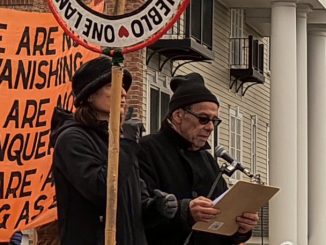
Moonanum James, co-leader of United American Indians of New England. SLL photo: Greg Butterfield

Talk given at the 50th National Day of Mourning in Plymouth, Mass., on Nov. 28, 2019.

Once again on the fourth Thursday in November, United American Indians of New England and those who support us are gathered on this hill to observe a National Day of Mourning. Today marks the 50th time we have come here, in all kinds of weather, to mourn our ancestors and speak the truth about our history.

Those who started National Day of Mourning could not have envisioned that generations would still be here, year after year, carrying on this tradition. Many of the elders who stood on this hill and organized the first Day of Mourning are no longer with us, but we feel their spirits guiding us today. We are thinking today of so many, including Shirley Mills, a beautiful person who passed into the spirit world this fall. We mourn her loss here today.

Fifty Thanksgivings ago, my father, an Aquinnah Wampanoag named Wamsutta Frank James, was invited to address a gathering celebrating the 350th anniversary of the arrival of the Pilgrims. When asked by the organizers to provide an advance copy of the speech he planned to deliver, Wamsutta agreed. When they saw his speech, the planners told him he could speak only if he were willing to offer false praise of the Pilgrims.

According to the organizers of the event, “The theme of the celebration is brotherhood and anything inflammatory would be out of place.” The organizers even offered to write a speech for him, one which would better fit with their settler-colonialist narrative. He refused to have words put into his mouth, and National Day of Mourning came into being as a result of that refusal. Instead of speaking at the banquet, he and a group of allies from throughout the Americas gathered here, on this hill, and observed the first National Day of Mourning in 1970.

A tradition of struggle

That first year, my father never did get a chance to deliver his speech on this hill — although some who don’t actually know our history say he did. Maybe 100 or 200 Native people and allies gathered, depending on which person is giving their recollection of the day. Indigenous peoples from this region and members of the Boston Indian Center organized and were joined by others, including some famous members of the American Indian Movement. They spoke out about the Pilgrim invasion and issues throughout Indian Country, marched around Plymouth, boarded the Mayflower II replica, and even buried Plymouth Rock in sand — a tradition I am proud to say we continued well into the 1990s.

In the 1970s, UAINE demanded the return of Wampanoag artifacts, including bones, that were being held by the gravedigger settlers at the Pilgrim Society Museum. At the fourth National Day of Mourning, the bones were returned to my father and given a proper burial. In 1972, the police followed us around with police dogs, and a young woman, Judy Mendes, who had a U.S. flag draped around her shoulders, was attacked and arrested.

Over the years, we repeatedly disrupted the Pilgrim Progress parade, a tradition we continued until 1996. The following year, in 1997, we were blocked on Leyden Street and arrested without warning when we simply tried to march. The resulting defense of the Plymouth 25 led to the National Day of Mourning plaque you see here on Cole’s Hill, and the Metacomet plaque we will visit when we march.

Consistently, our organization has not collaborated with the Pilgrims or their institutions, whether museums or the Mayflower Society or the Plymouth 400. We have our own story to tell, in our own way. Consistently, we have sought to present issues that Indigenous people are facing internationally, not just here, because we are indeed all related.

Pilgrim myth vs. Indigenous truth

So, what really happened at the first Thanksgiving — or what some of us call the first “thanks-taking?” According to popular myth, the Pilgrims, seeking religious freedom, landed on Plymouth Rock. The Indians welcomed them with open arms, and then conveniently faded into the background and everyone lived happily ever after. The end.

Here is the truth:

First, the Pilgrims are glorified and mythologized because the circumstances of the first permanent English colony in North America, Jamestown, were too ugly to hold up as an effective national myth. There are efforts now to teach schoolchildren about the African slaves kept at Jamestown. But no curriculum seems to want to teach the kids about settler cannibalism. Pilgrims and Indians are a much more marketable story.

Second, the Pilgrims came here as part of a commercial venture. They didn’t need religious freedom — they already had that back in the Netherlands. The Mayflower Compact was merely a group of white men who wanted to ensure they would get a return on their investment.

When they arrived — on outer Cape Cod, by the way, not on that pebble down the hill — one of the first things the Pilgrims did was to rob the Wampanoag graves at Corn Hill and steal as much of their winter provisions of corn and beans as they were able to carry. The writings of the colonists themselves describe these actions taking place.

The next part of the mythology is true: Some Wampanoag ancestors did welcome the Pilgrims and save them from starvation. And what did we get in return for this kindness? Genocide, the theft of our lands, slavery, starvation and never-ending repression.

The first ‘thanks-taking’

It is also important to remember that the first official Thanksgiving did not take place in 1621 when the Pilgrims had a harvest-time meal provided largely by the Wampanoag. Instead it was officially proclaimed by Gov. Winthrop of the Massachusetts Bay Colony in 1637 to celebrate the massacre of over 700 Pequot men, women and children on the banks of the Mystic River in Connecticut.

William Bradford of the Plymouth colony wrote of this event: “Those that escaped the fire were slain with the sword; some hewed to pieces, others run through with their rapiers … they thus destroyed about 400 at the time. It was a fearful sight to see them thus frying in the fire … horrible was the stink and scent thereof, but the victory seemed a sweet sacrifice, and they gave the prayers thereof to God, who had wrought so wonderfully for them.”

And yet the history books call us the savages.

So why does any of this matter? It is simple: When people perpetuate the myth of Thanksgiving, they are not only erasing our genocide, but also celebrating it.

But we did not simply fade into the background as the Thanksgiving myth says. We have survived and thrived. We have persevered. The very fact that you are here is proof that we did not vanish. Our very presence frees this land from the lies of the history books and the mythmakers. We will remember and honor all of our ancestors in the struggle who went before us. We will speak truth to power as we have been doing since the first Day of Mourning in 1970.

That first Day of Mourning in 1970 was a powerful demonstration of Native unity. It has continued for 50 years as a powerful demonstration of Indigenous unity and of the unity of all people who speak truth to power.

Capitalist crimes in Indian Country

Sadly, many of the conditions that prevailed in Indian Country in 1970 still prevail today. In 1970, our average life expectancy was just 44 years. Today, it is up, but for Native men, it is still six years below that of white people. Native women’s death rate has increased 20 percent over the past 15 years. In 1970, the average Native yearly income was $4,347. In 2019, 20 percent of Native people still earn under $5,000. In 1970, our suicide and infant mortality rates were the highest in the country. This has not changed.

We all know that racism is alive and well. All of us are struggling under the oppression of a capitalist system which forces people to make a bitter choice between healing and eating. We will continue to gather on this hill until corporations and the U.S. military stop polluting the Earth. Until we dismantle the brutal apparatus of mass incarceration.

We will not stop until the oppression of our Two-Spirit siblings is a thing of the past. When the homeless have homes. When children are no longer taken from their parents and locked in cages. When the Palestinians reclaim the homeland and the autonomy Israel has denied them for the past 70 years. When no person goes hungry or is left to die because they have little or no access to quality health care. When insulin is free. When union-busting is a thing of the past. Until then, the struggle will continue.

In 1970, we demanded an end to the Bureau of Indian Affairs. It is still a demand today. Native nations should not need federal oversight to govern ourselves or take control of our own lands.

I hope you will stand with the Mashpee Wampanoag and support pending legislation that would give Mashpee the right to petition for land to be taken into trust. And please tell your congresspeople that this legislation should also be applied to Aquinnah and other tribes that were federally recognized after 1934.

As we did in 1970, we mourn the loss of millions of our ancestors and the devastation of the land, water and air.

We condemn all acts of violence and terrorism perpetrated by all governments and organizations against innocent people worldwide. Since the invasion of Columbus and the rest of the Europeans, Native people have been virtually nonstop victims of terrorism. From the colonial period to the 21st century, this has entailed torture, massacres, systematic military occupations and the forced removals of Indigenous peoples from their ancestral homelands.

Let us not forget that this country was founded on the ideology of white supremacy, the widespread practice of African slavery, and a policy of genocide and land theft. Let us not forget that under the pipelines, skyscrapers, mines and oil rigs, lie the interred bones, sacred objects and villages of our Native ancestors.

On our program will be only Indigenous speakers. This is one day when we speak for ourselves, without non-Native people, so-called “experts,” intervening to interpret and speak for us.

Today, on liberated territory, we will correct the history of a country that continues to glorify butchers such as Christopher Columbus, that makes slave-owning presidents such as Washington and Jefferson into god-like figures, and even carves their faces into the sacred Black Hills of the Lakota.

In 1970, very few people would have given any thought to the fact that the Indigenous people of this hemisphere do not look upon the arrival of the European invaders as a reason to give thanks. Today, many thousands stand with us in spirit as we commemorate the 50th National Day of Mourning.

In the spirit of Crazy Horse, in the spirit of Metacom, in the spirit of Geronimo. Above all, to all the people who fight and struggle for real justice.

We are not vanishing. We are not conquered. We are as strong as ever.

Strugglelalucha256


Cheryl LaBash: Lo que Fidel significa hoy para mí

Discurso de Cheryl LaBash en un panel organizado por la Embajada de Cuba en los Estados Unidos como un homenaje a la vida de Fidel Castro. LaBash es copresidenta de la Red Nacional sobre Cuba.

Me siento muy honrada de estar hoy en este panel. No tengo una historia personal profunda como la que hemos escuchado en los últimos dos años sobre el trabajo en conjunto con el líder histórico de Cuba, Fidel Castro, cuya vida, trabajo y ejemplo recordamos hoy aquí. Realmente he sido la joven en la fila de atrás, que aunque ahora ya no es joven y a menudo ya no está en la fila de atrás, todavía trata de absorber lecciones de la revolución cubana, de entender el mundo y actuar para cambiarlo.

Mi trabajo de solidaridad con Cuba se interrumpió cuando comencé un nuevo trabajo en la década de 1990. Inspeccionar la construcción de carreteras de Detroit me requirió trabajar horas extras de abril a noviembre, desde el amanecer hasta el anochecer, y también los fines de semana. Pero cuando supe que Fidel vendría a la Iglesia Riverside [en Nueva York] el 8 de septiembre del 2000, tenía que ir.

La gente que me conoce no se sorprenderá. En vez de ir a trabajar ese viernes por la mañana, me monté en mi auto y conduje por 10 horas a la ciudad de Nueva York. Luego conduciendo alrededor del bajo Manhattan con la esperanza de encontrar un lugar de estacionamiento gratuito para luego montarme en el metro hasta Harlem. La cantidad de personas que ya intentaba entrar era abrumadora, pero yo fui una de los miles de afortunados que entraron a la iglesia. Mi asiento estaba en lo alto del palco para escuchar hablar a Fidel.

Cuando Fidel nos dejó físicamente hace tres años, incluso en los Estados Unidos pudimos ver la caravana que devolvió sus cenizas a Santiago de Cuba. La transmisión en vivo de la televisión por Internet desde Cuba nos mostró las asambleas en La Habana y Santiago. Nunca olvidaré oír al presidente nicaragüense Daniel Ortega preguntar ¿dónde está Fidel? Y la multitud callada y enlutada respondió "aquí" comenzando una consigna que se convirtió en un rugido: ‘Yo soy Fidel’.

No podía imaginar esa tecnología que me permitiera ver una transmisión en vivo desde Cuba cuando viajé allí por primera vez en 1985. En ese entonces, los discursos y entrevistas de Fidel explicaban que la deuda externa era una carga impagable para los países en desarrollo. Entonces parecía un tema muy extraño en la vida diaria en los Estados Unidos.

Pero hoy se ha vuelto algo muy cercano — no es sólo la deuda externa del FMI, la deuda extrae la vida misma de los trabajadores y las familias, la deuda estudiantil, la deuda de tarjetas de crédito, la deuda hipotecaria, los prestamistas de día de pago — todas impagables. Desde Puerto Rico hasta Detroit, hemos aprendido que nuestra deuda es muy parecida a lo que Fidel exponía.

Más interesante para mí en 1985 fue el sistema de salud de Cuba que demostró que era posible reducir la mortalidad infantil con pocos recursos pero con la máxima voluntad. Detroit era una noticia principal en ese tiempo.

Escandalosamente, en Detroit, una ciudad donde casi el 90 por ciento de la gente era afrodescendiente, los bebés morían a un ritmo de más del doble de las estadísticas nacionales de Estados Unidos. En 1990, un asombroso 23 por cada 1000 nacimientos y en 2017 aún un 15.5. Ahora la mortalidad materna para las mujeres negras también está aumentando.

¿Es un milagro que la mortalidad infantil en una Cuba en desarrollo y bloqueada sea de solo 4 por cada 1000 nacidos vivos? No, es la voluntad de Cuba de dar prioridad a los seres humanos, en Cuba y en todas partes a través del internacionalismo y un sistema económico que lo hace posible.

Fue allí, en la Iglesia Riverside, donde Fidel explicó cómo surgió la escuela de medicina latinoamericana y las becas para estudiantes estadounidenses. ELAM, el acrónimo en español de Escuela Latinoamericana de Medicina, había sido fundada ni siquiera un año antes de que Fidel hablara esa noche. Señaló que había un ‘tercer mundo’ dentro de los EUA sin médicos.

Veinte años han pasado desde que la ELAM fuera fundada el 15 de noviembre de 1999. En esos 20 años, 29.749 nuevos médicos de 115 países se han graduado, incluidos 182 de los Estados Unidos. De los 466 médicos que se graduaron el verano pasado de 82 países, 10 eran de los EUA. [ir a ifconews.org/medicalschool] Los estudiantes estadounidenses de ELAM se ofrecieron como voluntarios y fueron a servir a Haití después del enorme terremoto de enero de 2010. Una graduada estadounidense recaudó sus propios fondos y se ofreció como voluntaria para luchar contra el brote del ébola en el África occidental.

ELAM es sólo una parte del internacionalismo de Cuba que abarca medicina, alfabetización, deporte, cultura y mucho más. La Brigada Médica de Emergencia Henry Reeve se movilizó para salvar vidas cinco años después de Riverside, cuando el huracán Katrina azotó Nueva Orleans. Bloqueados por el gobierno de Estados Unidos, se fueron a las laderas del Himalaya después del terremoto de Pakistán. La herramienta de alfabetización ‘Yo sí puedo’ desarrollada por los cubanos en Haití también fue explicada por Fidel en Riverside.

Lo que Fidel significa hoy para mí.

Se está llevando a cabo una campaña ideológica contra Cuba. Su objetivo es poner en duda los ideales de Cuba tratando de reflejar los crímenes de explotación, racismo y trata de personas del capitalismo sobre Cuba. Es lo que Fidel llamó una Batalla de Ideas.

Esta campaña propagandística se centra en desacreditar los mismos puntos mencionados en el discurso de Fidel en la Iglesia Riverside — el internacionalismo médico de Cuba, que Cuba no tortura y desaparece a la gente, que Cuba realmente practica la igualdad de derechos para todos, independientemente de la identidad de género o color de piel, y que hay democracia para que todos participen en las elecciones y en la dirección de su país.

Está calculado y es intencional, un arma para justificar el verdadero bloqueo genocida. Es una campaña de propaganda para crear dudas, incertidumbre y dividir a las millones de personas que han llegado a conocer Cuba, su pueblo, su socialismo a través de visitar Cuba y experimentarlo por sí mismos.

Esta campaña regurgita las mismas mentiras que impregnaron la cultura popular estadounidense sobre Cuba después de la revolución, [pero] se ve refutada por el movimiento solidario, especialmente en las comunidades negras cada vez que las delegaciones y líderes cubanos llegaban a las Naciones Unidas en Nueva York.

Esas mentiras no pueden ser reinsertadas en la mente de las personas que han viajado a Cuba, que han estudiado en Cuba, que han observado que Cuba no tiene inversiones extranjeras, ni bases ni concesiones extractivas en ninguna parte. O en
el movimiento de justicia climática que sabe que Fidel habló en Riverside sobre el peligro de la extinción masiva debido al cambio climático. Pero las mentiras pueden empujar a Cuba a la parte inferior de la lista de preocupaciones. Es por eso que en los Estados Unidos debemos actuar en todos los sectores y plataformas para #unblockCuba (#DesbloquearCuba).

Hay herramientas poderosas en la batalla de ideas, no sólo habladas o escritas, sino en hechos. ¿Por qué otra cosa los Estados Unidos restringirían las visas para que los profesionales médicos hablaran en conferencias; para que los académicos
cubanos participen en LASA?

Las becas de la Escuela Latinoamericana de Medicina, el desarrollo de medicamentos para mejorar la vida humana, por ejemplo, eliminando el horror de la amputación de las extremidades debido a las úlceras diabéticas que son costosas y rentables. ¿Hay una familia de clase trabajadora cuyo pariente o amigo no tenga diabetes y tema una amputación? Las mismas ciudades donde se han recortado los servicios humanos para pagar el servicio de la deuda a los bancos y donde los dólares de los impuestos [del pueblo] van dirigidos a alimentar al ejército y a la policía, están mirando hacia Cuba.

Los médicos cubanos vinieron a Chicago para ayudar a mejorar los resultados maternos e infantiles. Detroit está investigando la colaboración en salud. Y este mes Nueva Orleans firmó un memorando de entendimiento con Cuba.

Para mí, y humildemente sugeriría para nosotros en los Estados Unidos, participar en la batalla de las ideas es el mensaje importante para hoy.

Pero, ¿por qué Cuba? El ejemplo de Fidel, la revolución cubana y las generaciones que se criaron para ser como el Che, son el poderoso antídoto contra la cultura deshumanizadora, divisiva y de consumo impulsada por el capitalismo y sus medios de comunicación de masas.

Es un legado de Fidel con el que todos podemos construir el mejor mundo que es posible y necesario.

Fuente: MinRex – Ministerio de Relaciones Exteriores, República de Cuba

Strugglelalucha256


20 years of fighting for the homeless in NYC

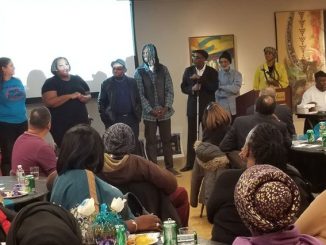
New York — Picture the Homeless celebrated the 20th anniversary of their organization in the Harlem State Office Building on Nov. 25. Leaders of PTH called for a renewed commitment to their work of fighting for the homeless at a time when housing opportunities in the major cities are rapidly deteriorating.

Talks by members of the PTH board recounted personal experiences among a diverse group of all ages, many of whom had gone without housing. They recounted the solidarity of a couple of homeless founders who had recognized the desperate need to organize. Other members told stories of how the support they received enabled them to become active in building PTH. They chose the name “Picture the Homeless” because mainstream culture attempts to drive people who are struggling to survive into oblivion. They want to be seen and heard demanding: “Housing is a human right!”

An exhibit at one side of the crowded hall not only recounted PTH’s history but also explained their strategy on a variety of issues such as police abuse and the large number of vacant properties in New York City that the city could allow people to rehabilitate and live in.

PTH wages a battle for the homeless to speak in their own name and to be able to play a role in determining a solution to the myriad problems they suffer. Echoing the grim experience of being undermined by the administrators of social services, who are supposed to serve them, they repeated, “If you are not at the table, you’ll be on the menu.”

Picture the Homeless asks for help in strengthening the voices of those without housing.

Strugglelalucha256


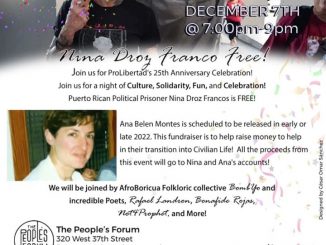
NYC Dec. 7: ProLiberatad 25th anniversary celebration

Strugglelalucha256


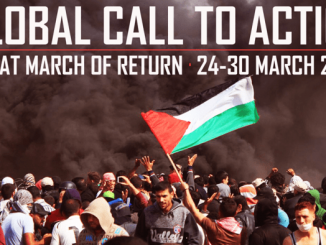
24-30 March 2020, worldwide: International week of action to support the Great March of Return and Breaking the Siege

Join Palestinians in the besieged Gaza Strip in a global mobilization on the second anniversary of the Great Return March to demand the right of return for Palestinian refugees and an end to Israel’s siege of Gaza.

On March 30, 2018, tens of thousands of Palestinians in the besieged Gaza Strip launched the Great March of Return and Breaking the Siege.

Israel’s violent repression of it exacted a gruesome toll, with its occupation forces’ live ammunition, tear gas and rubber-coated steel bullets massacring 214 Palestinians participating in unarmed demonstrations and wounding 18,764 more.

But the demands of the Great Return March – an end to Israel’s brutal closure of the Gaza Strip and the right of return for millions of Palestinian refugees ethnically cleansed from their homes – remain no less critical nearly two years later.

Seven years after the United Nations first warned that the conditions imposed by Israel’s siege would render Gaza unlivable by 2020, its crises of electricity, water, employment, and food security have already reached the breaking point.

This isolation of the Gaza Strip is part of Israel’s strategy to displace the Palestinian people, fragment our society, and liquidate our national movement.

Its plan, which started with the ethnic cleansing of 720,000 Palestinians in 1948, continues today with the use of walls, checkpoints, and roads to divide Palestinian neighborhoods and communities; the demolitions of Palestinian homes and institutions in Jerusalem, the West Bank, and 1948-occupied Palestine; the seizure of Palestinian land for Israeli settlements; the targeting of Palestinian leaders for political detention; and the exclusion of Palestinian refugees from their occupied homeland with lethal force.

Yet Palestinians have never paused our legitimate struggles for return, self-determination, and national liberation, from the armed Resistance, to general strikes, to Boycott, Divestment, and Sanctions (BDS) campaigns, to the Great Return March.

Since 2018, Palestinian refugees have persevered against unbelievable odds, braving Israeli occupation fire and risking injury and death to demand our right to return to the homes from which Israeli occupation forces drove us at gunpoint.

As the second anniversary of the Great Return March on 30 March – Palestinian Land Day – nears, we call on its supporters worldwide to join an international week of action to support its demands between 24-30 March 2020.

  1. Have an activity to support the next Freedom Flotilla, which will sail in 2020 to challenge Israel’s blockade of the Gaza Strip.
  2. Build a Boycott, Divestment, and Sanctions campaign against a target complicit in Israel’s violations of Palestinian rights and international law.
  3. Hold a screening of a documentary on Israel’s crimes against Palestinian refugees and the Gaza Strip and their struggle for liberation.
  4. Rally in solidarity with the Great Return March in a public area.
  5. Host a speaker on the Great Return March and its demands.
  6. Target political officials in your country to demand they publicly oppose Israel’s crimes against Palestinians and impose meaningful sanctions for them.

In all your efforts, we ask that you visibly support the Great March of Return and Breaking the Siege and our just demands.

Please send announcements of your events, as well as pictures, videos, and reports from them, to samidoun@samidoun.net, or message them to Samidoun Palestinian Prisoner Solidarity Network on Facebook.

On this, the International Day of Solidarity with the Palestinian People, we call on the world, its people and movements to escalate their support for Palestine and our century-long struggle for national liberation.

Higher National Commission
Great March of Return and Breaking the Siege
Gaza, Palestine
29 November 2019

Strugglelalucha256
https://www.struggle-la-lucha.org/2019/12/page/5/