Los Angeles Dec. 11: Vigil For Carlos Gregorio Hernandez Vazquez

Wednesday, December 11, 2019 at 6:00 PM – 8:00 PM PST

Placita Olvera Downtown Los Angeles
421 E Commercial St # 485, Los Angeles, California 90012

Join us on Wednesday December 11th at 6pm at Placita Olvera as we remember those that have died while in immigration custody.

Carlos Gregorio Hernandez Vasquez, a 16-year-old Guatemalan migrant, was seriously ill when immigration agents put him in a small South Texas holding cell with another sick boy on the afternoon of May 19.

A few hours earlier, a nurse practitioner at the Border Patrol’s dangerously overcrowded processing center in McAllen had diagnosed him with the flu and measured his fever at 103 degrees. She said that he should be checked again in two hours and taken to the emergency room if his condition worsened.

None of that happened. Worried that Carlos might infect other migrants in the teeming McAllen facility, officials moved him to a cell for quarantine at a Border Patrol station in nearby Weslaco.

By the next morning, he was dead.

Strugglelalucha256


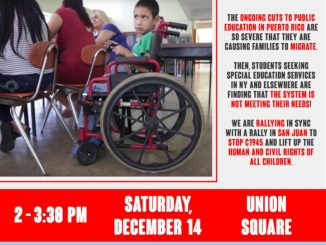
New York Dec. 14: Rally for Special Education rights from N.Y. to Puerto Rico

Saturday, December 14, 2019 at 2:00 PM – 3:30 PM EST

14th Street Union Square area

Hosted by PIST NYC

Stop violations of the civil rights of students with disabilities under federal law and UN declarations.

Reverse the cuts imposed on schools in Puerto Rico by the unelected board of bankers.

Make school bus routes shorter, safer and more eco-friendly. EPP now!

Note: Our parent community includes Bronx-based Bomba y Plena musicians who will play at the rally.

Strugglelalucha256


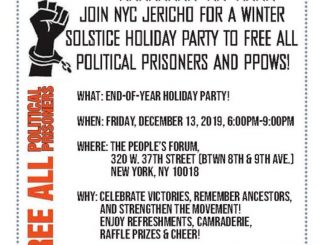
New York Dec. 13: Jericho Movement Holiday Party to Free Political Prisoners

Friday, December 13

6:00 – 9:00 pm
People’s Forum, 320 W. 37th St., Manhattan
Join NYC Jericho for a Winter Solstice Holiday Party to Free All Political Prisoners and PPOWS!
Celebrate victories, remember ancestors, and strengthen the movement!
Enjoy refreshments, camaraderie, raffle prizes & cheer!
Contact: NYCJericho@gmail.com
Strugglelalucha256


Hundreds gather in Chicago to refound Alliance Against Racist and Political Repression

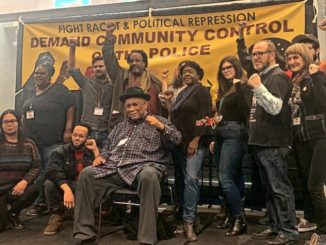
Around 1,200 people packed the Jacqueline Vaughn Auditorium and the lobby of the Chicago Teachers Union hall the night of Nov. 22.

They were unionists, community organizers, students, former prisoners and police-torture survivors, kinfolk of those wrongfully incarcerated or murdered by police, Black Lives Matter activists, migrant rights activists and representatives of freedom struggles around the globe.

They came from Chicago itself and from over 100 other cities and towns in 28 states. They were there to open the three-day refounding conference of the National Alliance Against Racist and Political Repression, a coalition first formed in the early 1970s.

Standing beneath a banner saying “Fight Racist and Political Repression, Demand Community Control of the Police,” CTU Vice President Stacy Davis Gates greeted the crowd. The CTU just won a new contract after a militant 11-day strike, its second in seven years.

Davis Gates told how the CTU had changed its constitution in 2010 to make “our charge the fight for justice and the humanity of the children before us in our classrooms.” She welcomed the audience to a “house built by Black women who believed in the humanity of Black, Brown and poor children.”

Wide range of speakers

The speakers that night and throughout the weekend reflected the range of communities affected by state terror. Many had suffered personally and terribly at the hands of the state apparatus. All of them brought the crowd to its feet with chants and standing ovations.

Xicano activist and former political prisoner Carlos Montes, a cofounder of the Brown Berets, spoke of the fight against police terror and state repression in the Southwest in historic context and today. Bernadette Ellorin, North America vice chair of the International League of Peoples Struggle and spokesperson of BAYAN USA, linked the struggle against racism and repression in the U.S. to the fight against U.S. imperialism around the globe.

Amanda Shackelford spoke of the case of her son, Gerald Reed, one of many people tortured by the Chicago Police Department into signing false confessions. Reed has been in prison for 28 years. His conviction was overturned last year but he has not been released. “When I speak, I am not only speaking for my son,” Shackelford said. “I am speaking for the men who don’t have a family anymore.”

Deported Palestinian community organizer Rasmea Odeh spoke by video from Jordan. Odeh is also a torture victim, imprisoned for 10 years after being tortured and sexually assaulted into signing a false confession by the U.S.-funded Israeli occupation forces. Jess Sundin of the Minnesota Antiwar Committee described the FBI raids on her home and those of other anti-war activists in 2010 and their victorious resistance to a state grand jury.

Former Black Liberation Army prisoner Masai Elehosi spoke of the struggle to free Jamil Al-Amin (f.k.a. H. Rap Brown) and other political prisoners, and Edwin Cortes, who served 19 years for fighting for Puerto Rican independence. Rosemary Cade spoke of her son Antonio Porter, tortured by the Chicago Police Department, wrongfully convicted and sentenced to 74 years. Toshira Garraway spoke of her fiancé, Justin Tiegin, beaten to death by St. Paul police and his body left in a dumpster. Kimberly Handy-Jones, whose son was murdered by St. Paul police in 2017, spoke. Also addressing the assemblage were Dorothy Holmes, whose son Ronald Johnson was murdered by Chicago police in 2014, and La Tanya Jenifor-Sublett, who was arrested and tortured by Chicago cops at the age of 19 and spent 21 years in jail for a crime she didn’t commit. And many, many more.

Pastor Emma Lozano, founder of Centro Sin Fronteras, addressed a panel opposing police cooperation with federal agencies to oppress our communities. Her brother, Rudy Lozano, was assassinated in 1983. Sheridan Murphy, former director of the Florida American Indian Movement, spoke of the struggle to free Leonard Peltier.

Frank Chapman: ‘Taking struggle to a new level’

The guiding spirit of the conference was Frank Chapman, field organizer and educational director of the Chicago Alliance Against Racist and Political Repression. Chapman was wrongfully convicted of armed robbery and murder in 1961 and sentenced to life and 50 years in a Missouri state prison. In 1973, the original NAARPR took up his case. He was freed in 1976 after 14 years behind bars and in 1983 was elected the alliance’s executive director. He is the author of a newly published book, “The Damned Don’t Cry: Pages From the Life of a Black Prisoner and Organizer.”

“We did not call you to this refounding conference to celebrate or commemorate what we did 40 years ago,” Chapman told the crowd. “We called you here to join us in rededicating ourselves to defend the inalienable democratic right of our people, oppressed people and workers, to rise up and overthrow their oppression in this present moment of history. We called you here to join us in consolidating and uniting all the pockets of resistance to police tyranny everywhere it exists in the United States of North America and to inscribe on our banners community control of the police. We called you here to join us in renewing and taking to a new level and to new heights the struggle to free political prisoners and the wrongfully convicted.

“We called you here because we share the vision of many of you to abolish the police and prisons and see it as part of the larger vision, changing and abolishing governments that enslave and oppress us. Ending racist and political repression is our central task in this moment in history. There can be no better world in birth without the carrying out of this task. This conference provides a historic opportunity for our movement to come together in a broad united front based on the inalienable right of the oppressed and the working class to organize and fight for radical systemic change. We are not fighting for some abstract ‘we the people’ democracy. We are fighting for a democracy that recognizes our right to rebel and overthrow the powers that be.”

Angela Davis: ‘For the abolition of prisons’

The keynote talk of the first evening was given by famed activist Angela Davis, a leader of the original NAARPR, whose struggle against her political frame-up in the 1970s won support around the world.

Recounting 20th-century battles against racist and political frame-ups from the Martinsville Seven to the Wilmington 10, Davis said, “We have to continue to get people out of jails and call for decarceration, but we must also make explicit calls for the abolition of the prisons entirely. On our work against racist police violence, we must call for community control of the police as opposed to police review commissions.”

The 17 talks of the opening night rally may be seen and heard at tinyurl.com/NAARPRrefounding

Over 800 registered delegates attended workshops and panels. Topics included “How to Build for Community Control of Police,” “It is Our Duty to Fight for our Freedom: The Fight to Free Political Prisoners and the Wrongfully Incarcerated,” “The Fight Against Racist and Anti-LGBTQ Violence,” and “Families to the Front: Families as Leaders in the Fight Against Police Murder and Unjust Incarceration.”

The success of the conference reflected ongoing community struggles around the country. The largest number of participants came from the Chicago area but large groups came from California, Florida, Indiana, Texas, Minnesota, Missouri, Utah and Wisconsin.

Justice for those murdered, wrongfully incarcerated by police

In particular it reflected the hard work of the Chicago Alliance Against Racist and Political Repression, which has fought for years to win justice for those murdered or wrongfully incarcerated by the police. It is leading the movement for a Civilian Police Accountability Council in Chicago and led the successful fight to convict Chicago cop Jason Van Dyke for the murder of 17-year-old Laquan McDonald in 2014.

Among the many organizations represented were the the Anti-Police Terror Project from Oakland, the Arab American Action Network of Chicago, the Centro Community Service Organization in Los Angeles, Centro Sin Fronteras, Chicago Boricua Resistance, the Chicago Torture Justice Center, the Committee to Stop FBI Repression, the Freedom Road Socialist Organization, the Innocent Demand Justice Committee, the International Committee to Free Leonard Peltier, the International League of People’s Struggle, the Jacksonville Community Action Committee, Justice for Brian Quinones and Justice for Cordale Handy from Minneapolis, the Lynne Stewart Organization, the New Abolitionist Movement, the North Texas Action Committee, the Tallahassee Community Action Committee, the Twin City Coalition 4 Justice for Lamar, Southsiders Organized for Unity and Liberation (SOUL), many chapters of Students for a Democratic Society and the U.S. Palestinian Community Network. Members of the Coalition of Black Trade Unionists came from St. Louis. Several union locals from around the country were also represented. Members of Struggle-La Lucha attended from Baltimore and New York City.

The final session of the conference, on Nov. 23, resolved that “this conference re-establishes the National Alliance and a renewed Black-led, Left-led, multiracial, multinational movement to stop police crimes, mass incarceration and to end racist and political repression.” The full text of the resolution, photos and other material from the conference may be found at NAARPR.org

The assembled delegates elected Frank Chapman as executive director.  A continuations committee will map out the next steps of the alliance in the immediate future.

Strugglelalucha256


South Florida police murder UPS Teamster hostage in shootout

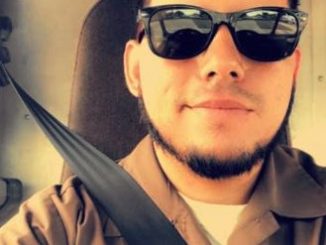
Miami, FL — The busy holiday season for UPS Teamsters took a deadly turn on December 5 in South Florida. Miramar police shot and killed UPS driver Frank Ordonez while firing dozens of times into the side of a UPS truck he had been taken hostage in. They also killed a civilian who was nearby.

After committing a failed robbery at a jewelry store in Miami suburb Coral Gables, the two burglars carjacked a UPS truck and took the driver hostage. They led police on a chase 20 miles north to Miramar. Upon getting stuck in traffic, police immediately began using cars filled with civilians who were waiting at a traffic light as human shields. They fired blindly into the truck with automatic rifles and killed not only the burglars, but the hostage and a motorist who happened to be on the scene.

Miramar resident Conor Munro said, “I watched the whole episode unfold live. That intersection is one of the busiest in the area, and the police turned it into a war zone. Instantly hundreds of cops were on the scene, firing easily 50 times. It’s no surprise they killed an innocent woman just sitting in her car. The killers need to be charged. Not only that, there needs to be a way we can stop this from happening again. Endless police militarization will only lead to more deaths like these. We need community control of the police now.”

Teamsters locals across the country released statements expressing their condolences for the driver and his young family. Meanwhile, UPS released a statement thanking law enforcement for their work without acknowledging the murder, implicitly taking the side of the police over Ordonez, his family, and the safety of UPS workers everywhere.

Source: FightBack! News

Strugglelalucha256


Free the Move 9, Mumia Abu Jamal, Leonard Peltier and All Political Prisoners

[su_row][su_column size=”1/2″ center=”no” class=””][embeddoc url=”https://struggle-la-lucha.org/wp-content/uploads/2019/12/SanDiego_Mumia_leaflet.pdf” download=”all” viewer=”google”][/su_column] [su_column size=”1/2″ center=”no” class=””][embeddoc url=”https://struggle-la-lucha.org/wp-content/uploads/2019/12/LosAngeles_Mumia_MOVE.pdf” download=”all” viewer=”google”][/su_column][/su_row]

2 Forums: San Diego and Los Angeles

San Diego — Welcome freedom fighter Pam Africa and recently released MOVE women, Janine Africa and Janet Africa, to Southern California. They are going to visit San Diego and Los Angeles.

Join us for this rare opportunity to hear firsthand from Janine Africa and Janet Africa, two members of the MOVE 9, incarcerated for over 40 years. Also, hear from Pam Africa, longtime leader of the International Concerned Family and Friends of Mumia Abu-Jamal.

The MOVE 9 members were jailed after a siege by police in 1978. In a second attack in 1985, police air-dropped two bombs on their Philadelphia headquarters, killing six adults and five children, and burning down an entire city residential block. Two MOVE members died in prison, two were released in 2018, and three were released in 2019 after forty years. Two more remain imprisoned.

Famed political prisoner, former Black Panther and journalist, Mumia Abu-Jamal, has made the case of the MOVE 9 his mission, even as his own life was in peril while on death row. Mumia’s death sentence was overturned and he was moved from death row, but the racists running the prison-industrial complex have since tried to murder him through medical neglect. It is through determined struggle carried out by the activists in International Concerned Family and Friends of Mumia Abu-Jamal, with Pam Africa in the forefront, that gains have been made in the cases of the MOVE 9 and Mumia Abu-Jamal.

Pam, Janine and Janet will be featured speakers at a “Free Political Prisoners” forum  in San Diego on Saturday, Dec. 14, at the Malcolm X Library and Performing Arts Center, and in Los Angeles on Sunday, Dec. 15, at the Harriet Tubman Center for Social Justice.

The MOVE members will share with the community their experiences before, during and after release, and the continuing fight to free the two remaining MOVE 9 members: Delbert Africa and Chuck Africa.

Pam Africa will give an update on Mumia Abu-Jamal and the ongoing struggle to free all political prisoners.

In San Diego, Zola Fish, from the Leonard Peltier Defense Committee, will give an update on the campaign to Free Leonard Peltier.

In Los Angeles, dancer Jessica Monea will perform West African Dance.

Both forums will emphasize the importance and necessity of supporting existing and former political prisoners like Janine Africa and Janet Africa. They have traveled all the way from Philadelphia on their first visit to the West Coast.

Let us show these sisters some love by helping them to recover some of their expenses and to ease some of the hardships as they adjust to life and struggle out on the streets along with us.

No one will be turned away for lack of funds.

Strugglelalucha256


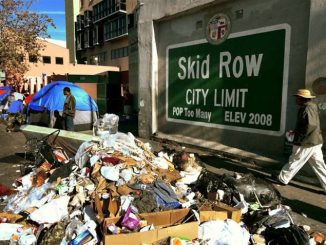
Homeless in Los Angeles tops 59,000

The population of homeless people in Los Angeles County has exploded to 59,000 in recent years. A report by California Healthline and Kaiser Health News in April 2019 revealed that more than 3,600 homeless people have died on the streets of Los Angeles in four years; 4 out of 5 were men, but with the number of women who have died doubling in that time.

Over the holiday, local television news has been full of stories about charitable organizations serving hot meals. The staff of service organizations with limited budgets hustled on their outreach to try to get people off the streets and into shelters when lower temperatures, wind and rain hit. They may have made a small dent in the problem, but those extra efforts are not everyday occurrences and now, as in many areas of the U.S., three-quarters of the county’s homeless will resume “sleeping rough” — on sidewalks or in tents.

Until recent years, Los Angeles’ homeless population has been concentrated in the famed 50-block Skid Row neighborhood and in South L.A.  Due to spiking rent costs and consistently low wages, the rapid swelling of homelessness has generated tent cities in many neighborhoods, town and city alike — far from shelters and other services.

California has the largest homeless population in the U.S., particularly Southern California. An April 2019 Point-In-Time count for San Diego County showed 8,000 homeless, with more than 5,000 living on the streets. San Diego has the highest rate of formerly homeless people ending up homeless again. The same survey showed a 40 percent increase in the homeless population in Orange County, the densely populated area between the cities of Los Angeles and San Diego.

Of the homeless population in L.A. County, 19 percent are disabled. Nearly 18,000 are students in Los Angeles public schools. About 15 percent are women with children. African American homelessness, already disproportionately high, increased by 22 percent over the last two years. According to L.A. County, 35 percent of the homeless population are Latinx, but they caution that as immigrant bashing and deportations have ratcheted up, the pervasive fear of going near any government office likely means that that number is a significant undercount. Both of these high percentages are associated with early release from California’s racist prison system due to overcrowding. Of the 160,000 people in prison in this state, two-thirds are African American and Latinx. To a terrible extent, release from prison ends up being a pipeline to homelessness.

A September 2018 NPR report said that in Los Angeles, 8 percent of homeless people surveyed are working, and among adults with children, 27 percent have jobs. Nearly 5,000 in San Diego reported having jobs. Most have been evicted because they just can’t afford the rent.

In 2016, Los Angeles voted for and passed a bond measure to target homelessness and raised $1.2 billion for the construction of housing to attack homelessness. That’s the largest amount of money to target homelessness in the country so far, yet the plan is a massive failure.

Bonds are rarely paid off by cities. Because of the interest, they enrich the bankers and other investors and are a drain on a city budget that usually lasts for many decades past the use of the funds.  An article on laist.com explains some of the failures of Prop HHH, as the measure was named.

The initial goal was to build 10,000 units of supportive housing — meaning reserved strictly for homeless people. Of the 10,000, so far two units are expected to be finished by the end of 2019. Initial estimates put the cost at up to $414,000 per unit to build. Now the median cost is $531,000, and one large building that’s been contracted will cost $700,000 per unit.

In the meantime, Los Angeles has paid $5.2 million in interest. Interest, consulting fees and permitting, projected over the life of the plan, will use 35 percent to 40 percent of this staggering amount of money. Because the costs are so high, the goal of 10,000 units has been revised downward to 7,640, and instead of 100 percent of the units being supportive housing — there will only be 5,873 units of supportive housing. In a bow to L.A.’s real estate developers, the rest will be so-called affordable housing and manager units.

Karl Marx explained that the “reserve army of labor” is permanent in a capitalist economy. It maintains a level of vulnerability of the working class. The higher the number of unemployed, homeless or imprisoned, the lower are wages and the higher are capitalist profits.

Along with the massive warehousing of people of color in prisons, the lack of action to tackle the homeless crisis is driven by an irresistible trend of the capitalist economy.  Democratic Mayor Eric Garcetti’s administration felt the pressure of the crisis, but Los Angeles’ powerful landlords, big banks and other capitalists wield the real power.

What appears to be bureaucratic speed bumps is likely fueled by their desire to continue making a fortune. Even when reforms like Prop HHH are successful, they are just barely enough to earn class peace. Homeless people are isolated. But every reform is worth fighting for. A united, determined and militant struggle against homelessness, racism and poverty can end the billionaires’ stranglehold on society once and for all.

Strugglelalucha256


Cyber Monday Baltimore Protest at BWI 2 Amazon Warehouse for Workers Rights

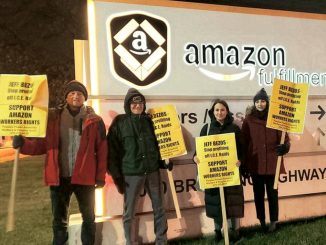
Baltimore, Dec. 2 — It was an unbearably cold Cyber Monday night at the BWI 2 Amazon Warehouse at the 6 p.m. shift change, when the Peoples Power Assembly held an informational picket at the Amazon gate. The PPA is setting up a “Workers & Peoples Union.”

The protest gave support to workers’ rights and the protests taking place in Europe. The action also targeted Amazon CEO Jeff Bezos’ refusal to stop investing in technology used by U.S. Immigration and Customs Enforcement to detain and target immigrants.

Steven Ceci, a picket participant and former worker at the adjacent Amazon warehouse, pointed out that several police cars parked across from the protest and Amazon security–euphemistically called “ambassadors” by the company bosses–placed themselves between those picketing and warehouse workers in an obvious effort to block interaction between the two groups.  Any protest participant who wandered past the gate was quickly stopped by security.

Sharon Black is a former Amazon warehouse worker.


Strugglelalucha256


From Plymouth to Bolivia, Indigenous people resist

50th National Day of Mourning: ‘Capitalism is not going to save us’

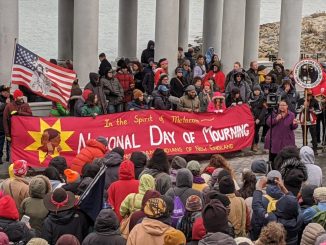
Plymouth, Mass., Nov. 28 — On the fourth Thursday of November, for the 50th year on the U.S. “Thanksgiving” holiday, Indigenous people and their supporters gathered on Cole’s Hill to remember the brutal reality behind white nationalist mythology — and the heroic history of Native resistance.

In lashing wind and cold rain, an estimated 1,500 people gathered at the call of the United American Indians of New England (UAINE). They came from not only from Baltimore, Boston, Maine and New York, but from as far away as Louisiana, Manitoba, Mexico and Mauna Kea in Hawai’i. This reporter traveled on a bus organized by the Haitian community from Brooklyn, N.Y., for the 12th consecutive year.

Together, Indigenous and Black, Latinx and Asian, Arab and white, they respectfully observed the opening ceremony, listened to speakers representing many Native Nations and then marched in solidarity through the streets of Plymouth.

Moonanum James of the Aquinnah Wampanoag tribe, co-leader of UAINE, recounted how his father, Wamsutta Frank James, was invited to speak at an event celebrating the 350th anniversary of the Pilgrims’ arrival in 1970. When the elder James refused to censor the truth about the invasion and its genocidal consequences for Native peoples, he was banned from speaking. This led to the first National Day of Mourning.

“Those who started National Day of Mourning could not have envisioned that generations would still be here, year after year, carrying on this tradition,” said Moonanum James. “Many of the elders who stood on this hill and organized the first Day of Mourning are no longer with us, but we feel their spirits guiding us today.”

James explained that the Pilgrims’ arrival in 1620 was a capitalist venture, not a bid for religious freedom, as typically depicted. “It is also important to remember that the first official Thanksgiving did not take place in 1621, when the Pilgrims had a harvest-time meal provided largely by the Wampanoag,” he said. “Instead it was officially proclaimed by Gov. Winthrop of the Massachusetts Bay Colony in 1637 to celebrate the massacre of over 700 Pequot men, women and children on the banks of the Mystic River in Connecticut.

“So why does any of this matter?” he asked. “It’s simple: When people perpetuate the myth of Thanksgiving, they are not only erasing our genocide, but also celebrating it.

“In 1970, very few people would have given any thought to the fact that the Indigenous people of this hemisphere do not look upon the arrival of the European invaders as a reason to give thanks. Today,” James concluded, “many thousands stand with us in spirit as we commemorate the 50th National Day of Mourning.”

Elevating MMIWG2S

Banners on the speakers’ platform and scattered throughout the crowd reflected a plethora of people’s struggles embraced by UAINE and Indigenous communities: “Homophobia is not Native to these shores,” “Defend Mother Earth” and “Free Leonard Peltier.” Wampanoag elder Bert Water read a message from political prisoner Leonard Peltier, imprisoned on frame-up charges for over 40 years. Sign language interpretation was provided for all the presentations.

Displayed prominently near the stage, a banner proclaimed: “Contra el golpe, en solidaridad con Bolivia. #ElMundoEsConEvo.” Many speakers condemned the U.S.-backed coup against Bolivian President Evo Morales and the subsequent massacres of Indigenous protesters.

Another common theme was expressed in the banner that read: “No borders in the Indigenous struggle.” From the platform to the crowd, people shared their outrage at the U.S. government’s detention and deportation of migrants, many of them of Indigenous backgrounds, and the separation of families, which echoed the horrific experience of many Native children forcibly sent to boarding schools that sought to strip them of their identities.

A striking red banner proclaimed “No more stolen sisters,” addressing the epidemic of missing and murdered Indigenous women, girls and two-spirit people (MMIWG2S) in the U.S. and Canada.

“Trump announced on Monday that the federal government is creating a task force on missing and murdered Indigenous women,” said UAINE co-leader Mahtowin Munro. “Having extensively followed the many pitfalls of Canada’s MMIW task force, I do not believe that this task force will enact real change. This task force will be grossly underfunded. The families and tribes of the missing and murdered may not be sufficiently involved and centered in the process so that they can get answers about what happened to their loved ones.”

As Munro spoke, an empty red dress whipped in the harsh winds nearby, offering a poignant symbol. “Unfortunately, the many underlying reasons for why MMIWG2S is a crisis will not be addressed.

“Attacking the Earth and attacking Indigenous women are intertwined,” she said. “The man camps and the resulting impact on Indigenous women is one of the many reasons why Indigenous people are fighting pipelines and mines and fracking.”

Fighting mega-dams

The theme of pervasive capitalist attacks on the planet, Indigenous sovereignty and people’s lives was echoed by many speakers.

Several Indigenous activists attended from the North American Megadam Resistance Alliance in Canada. They are touring the northeast U.S. to build support against electricity-generating “mega-dam” projects that are destroying Native lands and livelihoods.

“I have witnessed islands disappear, lands disappear. I have witnessed our lands get really, really dirty,” said Carlton Richards of the Pimicikamak Cree Nation in Manitoba, Canada. “Our children cannot swim in our waters. We cannot drink from our waters.”

Ayeta Aronson, a member of the Houma Nation along the Louisiana Gulf Coast, reported on numerous challenges facing her people, including the Bayou Bridge Pipeline, “which is the tail end of the same pipeline that Standing Rock brought attention to, the Dakota Access Pipeline. That pipeline goes through a lot of communities of color.

“And now, another pipeline is being planned to cut through the already fragile swamps. LNG wants to put a 283-mile, across 14 parishes, natural gas pipeline in through the wetlands that help break hurricane destruction,” Aronson said.

“The fact is that the land is changing. The climate is changing. We cannot replace what has already been lost. But we can, and do, try to preserve what is left, whether it be the land, our culture and traditions, or even just the memories of what was. We bring this knowledge forward with us, into the future.”

‘Don’t give up’

Led by a massive banner proclaiming “National Day of Mourning,” the crowd marched from Cole’s Hill through the main tourist area of Plymouth, before converging on the waterfront at the Plymouth Rock monument — another myth that everyone knows, but that has no connection to historical reality since the Pilgrims didn’t land there.

En route, marchers passed the church that for many years hosted a community social following the Day of Mourning activities, but which was recently bought by the Mayflower Society in preparation for the 400th anniversary of the Pilgrims’ arrival in 2020.

UAINE organizers explained that the Mayflower Society is heading a huge promotional effort to bring tourists to Plymouth and, more importantly, to shore up the white-supermacist “thanksgiving” mythology. The call was put out to protest next spring, when a Mayflower replica will arrive in Boston Harbor to kick off these warped “festivities.”

Instead, this year marchers boarded buses and cars and rode about two miles to a church on the town’s outskirts that agreed to let UAINE use its facilities. Hundreds of people were able to have a hearty meal and fellowship with their siblings in the struggle before heading back home.

As I boarded the bus for the long ride back to Brooklyn, these words from UAINE’s Mahtowin Munro stuck with me:

“Hoping that capitalism will get kinder is not going to save us. The Green New Deal is not enough to save us. Only by listening to Indigenous people and dismantling the capitalist system which allowed climate collapse to happen in the first place will we be able to save the planet.

“I don’t want anyone who hears this to give up,” Munro concluded. “We can fight for climate justice. We can end settler colonialism. We can reclaim our lands. We are not vanishing. We are not conquered. We are as strong as ever.”

Support the UAINE 2019-2020 fundraising campaign: gf.me/u/vumxka

SLL photos: Miranda Etel and Greg Butterfield


Video by Sunny Singh: 50th National Day of Mourning (Full Speeches)

Strugglelalucha256


‘Attacks on the Earth and Indigenous women are intertwined’

Talk given at the 50th National Day of Mourning in Plymouth, Mass., on Nov. 28, 2019.

Before we start, let’s take a moment to think about those who are no longer with us: Shirley Mills and many others. Our ancestors are beside us, holding us up today.

My name is Mahtowin Munro and I am the co-leader of United American Indians of New England. Greetings to all of you who have traveled to the 50th National Day of Mourning! Some of you had to get up in the middle of the night to travel here. Take a look around at this amazing crowd!

We acknowledge the many struggles that you have carried with you today, from the many efforts to stop pipelines and protect the water to the ongoing work to free Puerto Rico from U.S. colonialism, to the attempted desecration of Mauna Kea by scientists who lack respect for Indigenous sacred places, to occupied Palestine. Our speakers today will reflect some, but certainly not all, of the struggles that Indigenous peoples are leading and involved in.

Defending tribal sovereignty is certainly as much an issue today as it was at the original National Day of Mourning in 1970. Native nations continue to have their sovereignty and land rights denied and infringed upon, regardless of whether the tribal nations have treaties or not, and regardless of whether they have federal recognition or not.

Both of the federally recognized tribes in this state, the Mashpee and Aquinnah Wampanoag, have had their tribal sovereignty restricted and have been denied the use of their own lands by settler governments. The U.S. government also continues to deny federal recognition to other tribes in the region, such as the Massachusett and Nipmuc, among others. Nevertheless, Indigenous tribes in this area continue to strengthen cultures and political sovereignty with or without federal recognition.

While writing this speech, I could not help reflecting on all of the terrible things happening to Indigenous peoples in the world today. In Bolivia, the Indigenous President Evo Morales was forced to leave the country as a result of a U.S.-backed coup. As a result, Indigenous people there are dying at the hands of a fascist, CIA-installed government. Meanwhile, Indigenous people in Brazil have been under nonstop attack for defending the Amazon rainforest from destructive industries such as mining and logging. Some have been shot by the police, while others have been gunned down by hired assassins or private security forces.

Whether it’s Australia or Honduras, Chile or Nova Scotia, Indigenous people continue to defend and protect their lands. It’s really important for those of us who live here in the U.S. to show our solidarity with others in struggle and to bring public awareness to all Indigenous struggles and all acts of violence against Indigenous peoples, not just the ones occurring in North America. We are all united in our fight against settler-colonialism, and we must remember that what happens to one of us happens to all of us.

Children, families under attack

You know, as a mom, I always pay the most attention to the status of Indigenous children. Despite immense family and tribal efforts to improve educational outcomes and nurture our children, our children and youth are endangered in many ways. The residential school days may be over, but the Indian Child Welfare Act, which prevents our children from being stolen by non-Native people, is under attack and may end up going to the Supreme Court.

If the Indian Child Welfare Act is repealed, we could return to the grim time when Native children by the thousands were taken from their homes to be adopted by white families. Already, thousands of our kids are being put into foster care. This is one reason why we say the genocide of Indigenous peoples is ongoing, not something that happened in the past.

And at the U.S.-Mexico border, things have grown even worse this past year. More than 70,000 children were detained and caged by the U.S. government this year alone. The U.S. leads the world in child prisoners.

Many of us who are Native to this country have been outraged by the treatment of our relatives from Mexico, Central America and South America. It is devastating to see their families torn apart just as our families have been splintered as a result of cruel government policies. Everyone must remember that no one is illegal on stolen land, and we join migrant communities in saying that “We didn’t cross the border! The border crossed us!”

But the immigrant nation that is the U.S. has a short memory and is in denial of its own historical facts. This government is descended from the invaders who forcibly took our lands and resources from us, and then denied us the use of our languages and cultures. One again, we ask the question: Who is the illegal alien, Pilgrim?

In the various discussions of so-called “illegal immigrants,” the settlers laud their own achievements, claiming that “America is a nation of immigrants,” while ignoring the centuries of murder and violence perpetrated against African and Native people by these same immigrants. Surely the deaths of tens of millions of Native and African people at the hands of marauding, malicious European invaders should be worth bearing in mind.

Wearing red to honor MMIWG2S

Murders continue today. Looking around right now, you will see that some people are wearing red to honor Missing and Murdered Indigenous Women, Girls and Two Spirits (MMIWG2S), and we will have a red dress at the front of our march.

In Canada, Indigenous women are murdered at a rate seven times higher than non-Indigenous women. In the United States, 84 percent of Alaska Native and Native American women have experienced some form of violence in their lifetime, ranging from psychological to sexual and physical violence, most often perpetrated by non-Native men.

In Latin America, femicide — the murder of women because of their gender — is rampant, and the vast majority of cases go unpunished. Indigenous women are most at risk for this violence.

Underlying factors of poverty, racism, marginalization from justice and government services, legacies of colonial violence, and hypersexualized images of Native women in the media have made Indigenous women frequent targets. This crisis has largely been ignored and undercounted. Indigenous women are often not even included in statistics, even in regions with large Indigenous populations.

Trump announced on Monday of this week that the federal government is creating a task force on Missing and Murdered Indigenous Women. Having extensively followed the many pitfalls of Canada’s similar task force, I do not believe that this task force will enact real change. This task force will be grossly underfunded. The families and tribes of the missing and murdered may not be sufficiently involved and centered in the process so that they can get answers about what happened to their loved ones.

Unfortunately, the many underlying reasons for why MMIWG2S is a crisis will not be addressed. Will tribal legal sovereignty and jurisdiction be respected? Will racist settler attitudes toward Indigenous women change? Will there be an end to pipelines such as the Keystone XL and man camps?

Attacking the Earth and attacking Indigenous women are intertwined. The man camps and the resulting impact on Indigenous women is one of the many reasons why Indigenous people are fighting pipelines and mines and fracking.

End capitalism to fight climate collapse

We come together at a time when people are terrified about climate collapse and the future and there is so much suffering already. I read this week that 60 percent of the world’s animal population has been wiped out since 1970.

I want to say that individual actions are not going to save us when corporations and the U.S. military account for 70 percent of the world’s pollution. Promoting a narrative of individual responsibility is not going to save us. Recycling and REDD and carbon offsets are not going to save us.

Hoping that capitalism will get kinder is not going to save us. The Green New Deal is not enough to save us. Only by listening to Indigenous people and dismantling the capitalist system, which allowed climate collapse to happen in the first place, will we be able to save the planet.

Indigenous peoples have always been caretakers of the land, water and the life therein, despite intense efforts of settler governments to stop us from doing so. For generations, Indigenous peoples have been warning about climate change.

It is not too late to achieve some climate justice on this planet, but Indigenous voices must be acknowledged and centered.

One of the many ways that people are working to center Indigenous voices is through education and legislation. Here in Massachusetts, we have an MA Indigenous Agenda that is supporting five bills: a bill to ban the use of Native mascots in public schools, a bill to redesign the racist state flag and seal, legislation to celebrate Indigenous Peoples Day instead of Columbus Day, an education bill and a bill to protect Native heritage. There’s a lot you can do to help us get those bills out of committee. Please go to MAIndigenousAgenda.org for more information.

I end with a proposal, a starting place for the decolonization of our lands and a way to address climate collapse:

First, ensure that no projects can go through any Indigenous nation’s land without free, prior and informed consent.

Second, take all of the land that is currently being mismanaged by all settler governments, such as the National Parks or the Amazon rainforest, and let Indigenous nations manage that land. That would mean the restoration of millions of acres of our lands to us. It would also mean the end of desecration of our sacred sites, such as the Black Hills or Mauna Kea.

Third, cancel the leases, the pipelines, the mining and corporate contracts and start over.

Finally, since we all live here on this planet together, and since it is the only planet we have, we need to support and listen to Indigenous peoples all over the world who are on the frontlines of dealing with climate change.

I don’t want anyone who hears this to give up. We can fight for climate justice. We can end settler colonialism. We can reclaim our lands. We are not vanishing. We are not conquered. We are as strong as ever.

Strugglelalucha256
https://www.struggle-la-lucha.org/2019/12/page/4/