Southern African Development Community calls for solidarity on ending illegal sanctions on Zimbabwe

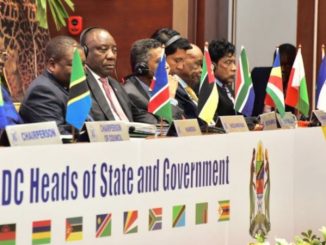
On Aug. 18, the 39th Southern African Development Community (SADC) Summit of the Heads of State and Government held in Dar Es Salaam, Tanzania, declared Oct. 25, 2019 to be a Day of Solidarity to Lift the Illegal Sanctions Imposed on Zimbabwe. The 16 member states of SADC have resolved to conduct actions in their countries to vigorously work toward this objective.

The SADC Secretariat is reaching out to the African Union chairperson, Egyptian President Abdel Fatthah el-Sisi, to push the anti-sanctions issue for support by the AU and for it to be discussed at the 74th United Nations General Assembly in September 2019.  As Executive Director Dr. Stergomena Lawrence Tax stated at the summit, “The embargo is militating against economic growth in both Zimbabwe and the region.”

Omowale Clay, spokesman of the December 12th International Secretariat, based in New York, said, “We are clear that this powerful show of solidarity and action by SADC helps to expose the lie that sanctions on Zimbabwe only targeted individuals rather than their real purpose to crash their economy in the hopes of fostering ‘regime change.’”

“These sanctions have challenged the economic growth of Zimbabwe by cutting off its foreign trade, and as a result, created a shortage of foreign currency, which compromises the government’s ability to acquire life sustaining necessities such as medicines, water purification equipment, heavy industrial equipment, fuel and many other necessities – sanctions kill!

 “After the fight for independence from the British (Rhodesian) colonizers in 1980, over 80 percent of the arable land was still held by settlers who were less than 5 percent of the population. In 1998, Zimbabwe enacted its land reform program and the land was finally returned to indigenous Zimbabweans who fought and died for it. The ZDERA [the Zimbabwe Democracy and Economic Recovery Act] sanctions implemented by the U.S. violate international laws protecting national sovereignty. ZDERA falsely states that the small, landlocked nation of Zimbabwe is a ‘threat to the national security of the United States.’ The U.S. sanctions must end now. It is a matter of life and death.

“This bold and united action by SADC on October 25th will help mobilize Africa and the Pan-African community against the criminal intent of sanctions — a Western weapon against the self-determination of developing countries — and further expose Western efforts at re-colonization,” Clay concluded.

Incoming SADC chair, Tanzanian President Dr. John Magufuli, stated in his closing remarks to the summit, “We are all aware, this brotherly and sisterly country has been on sanctions for a long time. These sanctions have not only affected the people of Zimbabwe and their government but our entire region.”

On Saturday, Sept. 21, 2019, the December 12th Movement will lead a March and Rally to End the Sanctions in Zimbabwe at the 74th Session of the General Assembly of the United Nations in Dag Hammarskjold Plaza on 47th Street and First Avenue, New York City.

All 193 member states of the U.N. are represented in this unique forum to discuss and work together on international issues covered by the U.N. Charter, such as development, peace and security, international law, etc. 

For more information please call the December 12th Movement at (718) 398-1766 or D12M.com.

Strugglelalucha256


Venceremos Brigade — 50 years of solidarity

The 50th Venceremos Brigade to Cuba departed from Bayamo, capital of Granma Province, Aug. 8, on a sunny, warm, humid morning. Thus began the final week of the three-week celebration of the first International Solidarity Brigade with the Cuban Revolution half a century ago. 

Already behind us is the official celebration on July 30 in the tree shaded courtyard at the Institute for Friendship with the Peoples. New and veteran brigadistas heard from Leslie Cagan, an early brigade founder; ICAP president and Cuban 5 hero Fernando González Llort; and reunited with old friends and comrades. 

Behind us are the two weeks of working and learning at the rural Julio Antonio Mella International Camp. There, we picked the green beans that we ate for dinner, maintained the campgrounds and drank coconut water from coconuts opened with machetes. Behind us is our visit to the city of Camagüey.

Next, in Santiago, the African roots of the Cuban revolution, nation and culture are further explored. In Guantánamo, we will see and learn up close the damage done by the illegal U.S. occupation of the naval base straddling the entrance to the large bay.

In 1969, hundreds of youth from the U.S. anti-imperialist, anti-Vietnam war and Black Liberation struggles overcame the U.S. blockade. The brigades at that time traveled via Canada or Mexico, sometimes on converted cattle ships, to work alongside Cuban women and men.

This year, 2019, the brigade recognized—as Cuban President Miguel Díaz-Canel affirmed recently—that everyone who travels to Cuba today is breaking the blockade. So all 160 brigadistas departed and returned using the direct U.S.-Cuba flights from U.S. airports.

Veterans of the early brigades remembered their inspiration from international delegations, cutting cane with Vietnamese and Korean comrades, learning about the fight against apartheid in South Africa. 

In addition to cutting cane, earlier brigades worked in citrus orchards and the construction of housing, schools and the Pan American games facilities. VB50 was welcomed into the Cuban homes constructed by earlier brigades, invited by the Committees to Defend the Revolution to share an evening of dance and song. 

The 50th Brigade maintained the Julio Antonio Mella International Camp, picked green beans, pulled vines off lime trees and cut grass with machetes. Visits to cooperative gardens educated us about Cuba’s remarkable ecologically sustainable practices, including bee keeping.

Remarkable journey

This 50th Anniversary Brigade program was a once-in-a-lifetime journey through Cuban history, traversing the country from the western provinces of Pinar del Río to the far eastern Guantánamo — the site of the territory illegally occupied by the U.S. Naval base and the torture chamber prison.

More than through distance, the 50th Venceremos Brigade reached back through centuries to the resistance of Indigenous people all but exterminated and the rebellions of Africans brought against their will to slave in mines and on sugar plantations.

In El Cobre—where VB50 shared the morning with a Committee to Defend the Revolution—a monument to the Cimarrón, or Memorial to the Rebellious Slave, reaches to the sky from a hilltop. The same noted Cuban artist who designed the stunning statue of Antonio Maceo at Santiago’s Revolution Square, Alberto Lescay, crafted this monument. He personally welcomed the brigadistas to his gallery for music and discussion. The powerful rebellion of Africans enslaved to mine copper here forced the Spanish Crown in 1831 to grant them freedom. 

In honor and recognition of Cuba’s African roots, Cuba’s military aid to Angola that broke the back of white supremacist apartheid in South Africa, was named Operation Carlotta, for the martyred woman leader of the 1843 Triunvirato Rebellion in Matanzas.

Of special note was the visit to La Demajagua, the former plantation of Carlos Manuel de Céspedes, where, on Oct. 10, 1868, the plantation owner declared the enslaved African workers were free. Together they would be strong enough to free all of Cuba from Spanish colonialism — beginning the 10 Years’ War, which ultimately led to Cuban independence. This, in fact, is viewed as the beginning of the united struggle that culminated on Jan. 1, 1959. 

How different from the U.S., where, in nearly 250 years since the U.S. Declaration of Independence, there has been no accounting for the original suppression of Indigenous people and accumulation of capital from the free labor of enslaved Africans. And no uniting of all to fight for the benefit of all, a foundation for real equity.

Céspedes’ Mambi army

In Bayamo, VB50’s welcome in Céspedes Square included the recitation of important historical facts. The first declaration in Bayamo, in December 1868, following its liberation from Spain, ended slavery, reinforcing Céspedes’ appeal at La Demajagua. When the Spanish army retook the town, they found only ashes. The people of Bayamo demonstrated their revolutionary spirit, desire for independence and self-determination by burning their city to the ground rather than be subjugated again.

This is something that U.S. imperialism needs to bear in mind as it attempts to suffocate both Cuba and Venezuela. It is no accident that the Cuban national anthem after 1959 remained La Bayamesa. The lyrics and author are memorialized in Bayamo’s central square.

Revolutionary Santiago 

The cradle of the independence wars against Spain is the eastern Cuban provinces of formerly Oriente (now Granma), Santiago, Guantánamo, La Tunas and Holguín. But Santiago is also where the July 26, 1953, attack on the Moncada Barracks began the march to the Jan. 1, 1959, victory of independence.

A visit to the mangrove swamp, where the overloaded yacht Granma disembarked Fidel and some 80 other fighters, makes the physical hurdles recounted in books a reality previously unimaginable. Without machetes, carrying supplies and weapons, how did they make their way through the tangle of roots, branches and razor grass, brigadistas wondered?

A concrete paved road winds up the mountain to the national park entrance for a trek to Fidel’s mountain command post, the Comandancia de la Plata, and the tallest point in Cuba, Turquino.The concrete road was not there in 1956, more than doubling the length on foot or by donkey to the Comandancia. 

As we switched out of our tour buses into smaller vans for the trip to the trail head, we received a special treat, a performance of the Rebel Quintet — a musical family who played and sang for the revolution. All, except for one who died recently and was replaced by a grandson, still wear their olive green uniforms and play their songs for the revolution.

The Moncada Barracks itself still bears the bullet holes from 1953. Now, in addition to a museum, it is a school where two thousand students study. The Latin American School of Medicine, where young doctors study, including some from underserved U.S. communities, is also a transformed military base.

Guantánamo is more than the prison

A fact emphasized to us more than once during our visit to Guantánamo province and its provincial capital, Guantánamo city: Guantánamo is more than a prison and more than the U.S. naval base. From two vantage points in Cuban territory we viewed the U.S. base. In Caimanera, a small Cuban town near the base, we watched All Guantánamo is Ours, a short video featuring the words of Caimanera residents, historians and students who describe the current and historic damage suffered by Guantánamo residents from the U.S. occupation of their territory.

We prepared to leave Cuba on Fidel Castro’s 93rd birthday. We remembered Fidel with workers at a pharmaceutical plant where we collectively unveiled portraits of Cuban heroes and martyrs in the main hallway. We placed flowers at the huge granite rock that holds Fidel’s ashes, but isn’t large enough to represent the vision and example that another socialist world is possible, is winnable. We have work to do. 

Join us at the international anti-imperialist conference, Nov. 1-3 in Havana, Cuba. 

And mark these dates: Nov. 6, when the United Nations General Assembly votes to condemn the U.S. blockade; March 2020, the National Conference in New York City to Normalize Relations with Cuba; and the 15th May Day Brigade and 51st Venceremos Brigade.

Let’s go to Cuba. Let’s end the U.S. blockade. ¡Sí, se puede!

Strugglelalucha256


Situación de las mujeres en EUA


Informe de Liz Toledo al comité directivo mundial de la FDIM/WIDF (Federación Democrática Internacional de Mujeres / Women’s International Democratic Federation)

Saludos camaradas y amigas, traigo solidaridad y amor de las Mujeres en Lucha y del Partido de Socialismo Unido en Estados Unidos.

“La situación y la condición de las mujeres trabajadoras en el capitalista EEUU continúa siendo miserable y de explotación. Aunque el 46,9% de la fuerza laboral total son mujeres, nos mantenemos en los trabajos peor pagados como el servicio de comida, oficinas, fábricas y asistencia médica. En el 2019, las mujeres todavía ganan 79 centavos por cada dólar que ganan los hombres.

“Sin embargo, mujeres trabajadoras recientemente dirigieron las luchas sindicales más dinámicas, incluyendo las revueltas de maestras/os desde West Virginia hasta Los Ángeles. En este caso, las maestras, a veces sin ayuda de los sindicados tradicionales, dirigieron paros y rehusaron volver al trabajo hasta que ganaran.

“Trabajadoras de comida rápida en la cadena de McDonald, retaron el acoso y abuso sexual recurrente, conduciendo un paro de un día en 10 ciudades diferentes. La mayoría de las trabajadoras está mal pagadas, y en su mayoría son negras, latinas e inmigrantes.

“Mujeres migrantes de África oriental jugaron un papel fundamental en el paro del 15 de julio de trabajadores del depósito de Amazon en el centro de distribución en Shakopee, Minnesota.

“Hibaq Mohamed, una de las líderes del paro en Amazon Prime Day, fue una de las mujeres que enfrentó patronos, policía y guardas de seguridad para facilitar una huelga contra los niveles de producción agotadores. Ella tiene solo 26 años,” reporta la ex trabajadora de Amazon, Sharon Black.

“Muchas de nuestras hermanas todavía enfrentan opresión y a menudo son marginadas por sus familias y comunidades. ¡La depresión, el abuso de sustancias y la pobreza siguen siendo la norma para las lesbianas latinas! Las latinas enfrentamos el racismo en Estados Unidos y como lesbianas enfrentamos múltiples opresiones. Continuamos luchando, defendiendo y protegiendo a nuestras hermanas en todas partes,” informa Celenia T., una activista lesbiana latina.

“Mientras que el capitalismo decae, hay menos empleos bien remunerados que nunca disponibles para las mujeres jóvenes, especialmente las mujeres y las personas cuir de color e inmigrantes. La extrema falta de oportunidades económicas ha dejado a muchas mujeres jóvenes subempleadas o desempleadas e incapaces de acceder a las necesidades básicas, incluida la atención médica y la educación.

“La administración Trump ha reducido los derechos de aborto y el acceso a anticonceptivos. Multitudes de mujeres jóvenes y personas cuir se encuentran endeudadas por financiar su educación, incluso cuando los títulos universitarios se devalúan cada vez más.

“Hay una epidemia de violencia sexual y violencia de género contra mujeres jóvenes y personas cuir que continúa creciendo. Las personas transgénero, las mujeres negras y marrones, las mujeres migrantes y las mujeres indígenas son asesinadas y desaparecen todos los días.”

“Las enfermedades mentales y los traumas son comunes, y la atención médica no está disponible, por lo que las mujeres jóvenes y las personas cuir tienen aún más dificultades para ser productivas bajo el capitalismo. Estos obstáculos afectan esproporcionadamente a las mujeres de color, a las mujeres y niñas indígenas y a los jóvenes LGBTQ2S.”

“Como socialistas, es nuestra obligación luchar. Estamos educando a las masas de mujeres jóvenes y personas cuir sobre la causa de su opresión, que no son los hombres de clase trabajadora, sino el sistema capitalista que les roba a las trabajadoras jóvenes, y a todos los trabajadores y personas oprimidas, sus derechos básicos y oportunidades.”

“Deseamos difundir una visión colectiva de una sociedad en la que las mujeres y las niñas jóvenes estén empoderadas y tienen las herramientas para lograr la liberación total del patriarcado, todas las formas de violencia de género y sexual y la explotación capitalista. Ahora es el momento para que las mujeres jóvenes, las niñas y las personas LGBTQ2S de la clase trabajadora se unan en la lucha,” dice Miranda de Mujeres en Lucha y Juventud Contra la Guerra y el Racismo.

La condición de la mujer en Estados Unidos sigue siendo una lucha. Las mujeres han estado y continúan estando en la primera línea de las luchas por la liberación de todas las personas. Somos trabajadoras sindicales que luchan para aumentar el salario mínimo a $15 y por la igualdad salarial. Estamos en el movimiento de Derechos Em/Migrantes exigiendo que terminen las separaciones familiares y abolir la policía de ICE (Inmigración y Control de Aduanas).

Mientras que en El Paso, Texas, y Dayton, Ohio, las comunidades enterraron a sus muertos por tiroteos racistas, el gobierno de los Estados Unidos arrestó a 800 trabajadores en sus trabajos en las fábricas de procesamiento de pollo de Mississippi. Sus hijos se quedaron sin sus padres en su primer día de escuela, pero los propietarios multimillonarios racistas que explotan a estos trabajadores no fueron arrestados para contratar trabajadores indocumentados.

Estamos en las calles exigiendo el fin del encarcelamiento masivo y abolir el sistema policial opresivo que solo sirve a los ricos y poderosos que continúan matando a jóvenes negros y marrones a voluntad y con impunidad.

Estamos entre los luchadores por la liberación LGBTQ2S. Stonewall 50 se celebró el pasado 30 de junio en la ciudad de Nueva York, cuando delegados de todo el mundo vinieron a celebrar el 50 aniversario del nacimiento del movimiento LGBTQ2S moderno.

Organizamos y luchamos para poner fin a la violencia sexual y doméstica de cualquier tipo dirigida a mujeres y niñas. Somos antibélicas y antiimperialistas. Incluso con la bota del imperialismo estadounidense en nuestros cuellos, seguimos defendiendo a Venezuela, Puerto Rico, Irán, Siria, Irak, Zimbabue, Palestina, Cuba y la República Popular Democrática de Corea contra la agresión estadounidense. ¡Fin a las guerras imperialistas! ¡Viva la clase obrera internacional!

Traducción de M.E. Duno

Strugglelalucha256


Tlaib and Omar: A watershed moment in the struggle against imperialism and racism

On Aug. 17, 2019, Rep. Rashida Tlaib stood in front of a crowd in her hometown of Detroit. The event was technically a public Shabbat called by the progressive Jewish community. However, a diverse and multinational crowd attended to show their support for the representative. 

The most powerful aspect about Representative Tlaib’s appearance was that she shouldn’t have been there at all. She should have been visiting her grandmother, Muftiya, who lives in a small village in the occupied territory of the West Bank. 

Since 1967, the apartheid state of Israel has violently and illegaly occupied the entirety of the West Bank. For the past fifty-plus years, Palestinians in the West Bank have lived and struggled under the oppressive yoke of U.S. imperialism in the form of Israeli racism. Muftiya is one of such brave Palestinians. 

So, why was Representative Tlaib not in the West Bank?

Tlaib had originally planned to visit her grandmother after she completed a diplomatic mission to the region with her fellow progressive representative, Ilhan Omar. In recent weeks, both representatives have been under a vicious attack from the right for their alleged “anti-semitic” positions. As we have previously written, these attacks are no more than a smokescreen to silence critiques of Israel’s racist and genocidal policies. 

Conspicuously enough, these same voices crying anti-Semitism at Omar and Tlaib were silent when a private prison correctional officer drove a truck through a crowd of Jewish people demonstrating against U.S. Immigration and Customs Enforcement concentration camps. 

As the right-wing war of words against Omar and Tlaib reached a fever pitch, the fascist leader of Israel, Benjamin Netanyahu, announced both representatives would be barred from entering Israel. Significantly, the Israeli government made this decision at the urging of the United States’ own demagogue, President Donald J. Trump.

After a public outcry against the decision, Israel rescinded its decision to bar Tlaib, but only under the condition that she not express support for the Boycott, Divest and Sanction movement — colloquially known as “BDS.” The BDS movement has been a crucial force in bringing attention to Israeli apartheid. 

Much to her credit, the representative rejected this insulting condition, stating, “Visiting my grandmother under these oppressive conditions meant to humiliate me would break my grandmother’s heart.” This statement is indicative of an important political moment for the progressive struggle in this country and around the globe. Representative Tlaib’s statement was an expression of nothing less than international working-class solidarity, and not just with her grandmother, but with all people suffering under U.S. imperialism and, in particular, Israeli apartheid.

This development is a groundbreaking one in terms of the political discourse in the U.S. The rise of two Muslim progressive representatives who are willing to take on the issue of Israel and Palestine in an honest and material way is unprecedented.

That is not to say that the Democratic Party transformed overnight into an anti-imperialist force. It is just to say that the contributions of Omar and Tlaib in the movement against U.S. imperailism and Israeli apartheid should not be ignored. Ultimately, their existence and rise to influence must be called what it is: a victory gained through the struggle of the working class against the wealthy at home and abroad. 

Leon Koufax is a Jewish communist from Baltimore who participated in the Embassy Protection Collective’s defense of the Venezuelan Embassy in Washington, D.C.

Strugglelalucha256


New York City: Save the Fulton Houses! Hands off public housing!

New York City Mayor Bill de Blasio wants to demolish two of the buildings in the Fulton Houses in the Chelsea section of Manhattan, a public housing project, and replace them with a luxury building built by a developer.

The real estate firm will be able to rent 70 percent of the apartments at market rates. The current median rent in Chelsea is nearly $3,500 per month. De Blasio claims the remaining 30 percent of the units will be “affordable.”

Fulton residents don’t believe him. They think that this “public-private” partnership, which is part of the federal government’s Rental Assistance Demonstration (RAD), is a scam to push them out.

Poor and working people have been driven out of Chelsea since the 1970s. In an Aug. 19 action, demonstrators marched in front of the old Nabisco cookie factory on Ninth Avenue, now Google’s New York headquarters, including a $2 billion food court, the upscale Chelsea Market. Among the slogans that protesters chanted were “Housing is a human right!” and “The people united will never be defeated!” 

Residents from the Fulton Houses were joined by other public housing residents as well as people from the nearby Penn South development. Supporters also came from the Metropolitan Council on Housing, the Justice Center in El Barrio, the Party for Socialism and Liberation and Struggle-La Lucha newspaper. 

Strugglelalucha256


The rich need us. We don’t need them.

Mark Hanna was a high school classmate of the world’s first billionaire, John D. Rockefeller, and became a pretty big capitalist himself. The Cleveland Central Labor Union’s secretary wrote in 1896 that Hanna wrecked the Seamen’s Union on the Great Lakes, smashed the Cleveland streetcar workers’ union and helped destroy the miners’ union in Pennsylvania.

That same year, this millionaire union buster, as Rockefeller’s political manager, put William McKinley in the White House. McKinley invaded Cuba, Guam, Puerto Rico and the Philippines to form Wall Street’s first overseas colonial empire along with Hawai’i. Capitalists had already spent centuries committing genocide against Indigenous nations.

Yet Hanna believed his employees working 10-hour and 12-hour workdays should be grateful to him as their “work-giver.”

The rich think that they’re doing you a favor by paying low wages. Unfortunately, some workers feel that way too.

Unemployment can make people grateful for any job. Even during capitalist “prosperity” millions of workers are unemployed.

In July, 14.6 percent of Black workers 24 years old and younger were jobless, and 11.3 percent of Latinx youth were jobless. Unemployment rates for Indigenous youth are even worse.

None of the official unemployment rates count the 2.2 million poor people in jail. They’re part of the working class. too.    

An alternative or supplement to low-wage jobs in New York and some other states is to join the army of people collecting cans and bottles for a nickel each.

Before the first of the month, you can see elderly people carry huge bags of bottles to supermarkets. The deposit money helps pay their rent.

Pennsylvania capitalists are so vicious that they’ve blocked a bottle and can deposit law from being passed. They don’t want poor people to get any money.

Keep them as “peasants”

Capitalist decay has destroyed millions of manufacturing jobs, but capitalists still need workers. The Walton family’s $155 billion fortune comes from 1.5 million workers in U.S. Walmart being paid poverty wages. Another 700,000 Walmart workers are exploited in other countries.

The Bloomberg Billionaires Index claims that Jeff Bezos’ $113 billion is “self-made.”  That’s a lie. Every cent of Bezos’ wealth comes from the 650,000 worked-to-death employees in Amazon warehouses.

The rich and the rest of us would starve without undocumented workers in the farm fields. Members of the Du Pont dynasty are not picking crops or working in the poultry and meat packing plants.

Trump and the other wealthy parasites hate Asian, Black, Indigenous and Latinx workers, but they can’t live without them. White workers are also despised by all the Trumps.

Over 40 years ago, New York City embarked on a policy of “planned shrinkage.” That was the term coined by Mayor Abe Beame’s head of Housing and Development, Roger Starr.

“Stop the Puerto Ricans and the rural Blacks from living in the city,” said Starr in 1976. “Our urban system is based on the theory of taking the peasant and turning him into an industrial worker. Now there are no industrial jobs. Why not keep him a peasant?” (“The Long Default: New York City and the Urban Fiscal Crisis,” by William K. Tabb)  

Beame was forced to fire Starr, but this racist was soon hired by the New York Times, where he spent 15 years writing editorials. 

Starr talked about New York City shrinking to maybe 5 million people. Yet despite losing almost 900,000 manufacturing jobs in the last 60 years, Gotham’s population has increased to 8.6 million from around 7.3 million in the mid-1970s. How so?

Manhattan’s garment district, which once employed 200,000 workers, is gone. But “somebody” needs to work in the office buildings, stores, warehouses, schools and hospitals.

“Somebody” has to push hand trucks, stock shelves and mop the floors. “Somebody” has to be nannies and clean the toilets. 

An army of construction workers — many of them immigrants — is needed to build the luxury apartments with unaffordable rents. Wouldn’t the workers prefer to build housing that they and other working people could move into?

Eugene Debs — a pioneering U.S. socialist who led the 1894 railroad workers’ strike — wrote that “We can run the mills without them, but they cannot run them without us.” Poor and working people produce all the values in capitalist society.

Despite the U.S. blockade, Cuban people are living much better since their factory owners, plantation owners and landlords fled to Miami. We need a socialist revolution just to keep capitalism from cooking the earth.

To paraphrase a slogan from the LGBTQ2S movement: Workers need capitalists like fish need bicycles.


Strugglelalucha256


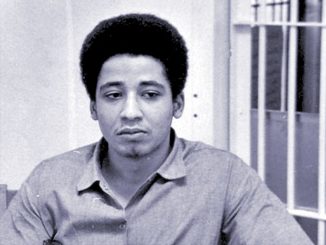
George Jackson killed Aug. 21, 1971

George Jackson was killed by prison guards on August 21, 1971.

At age 18, Jackson was convicted on dubious evidence of a gas station robbery of $70. Based on prior arrests, Jackson was sentenced to between one year and life in prison and shipped off to California’s notorious San Quentin prison. He was never released from prison for the rest of his life.

During his first years at San Quentin State Prison, Jackson became involved in revolutionary activity.

In 1966, Jackson met and befriended W.L. Nolen who introduced him to Marxist ideology. In speaking of his ideological transformation, Jackson remarked “I met Marx, Lenin, Trotsky, Engels, and Mao when I entered prison and they redeemed me.”

Jackson was appointed “field marshal” by the Oakland chapter of the Black Panther Party.

On January 13, 1970, Nolen and two other Black prisoners were attacked by the “Aryan Brotherhood” and then killed by a corrections officer at Soledad prison. Three days after the killings were ruled justifiable homicide, a guard named John V. Mills was killed. Despite a lack of evidence, Jackson and two other prisoners — Fleeta Drumgo and John Wesley Clutchette — were charged.

Together, the three became known as the “Soledad Brothers.”

On August 21, 1971, Jackson was shot and killed by guards at San Quentin Prison.

Following is an excerpt from George Jackson’s “Soledad Brother: The Prison Letters of George Jackson“:

We must accept the spirit of the true internationalism called for by Comrade Che Guevara. … We need allies, we have a powerful enemy who cannot be defeated without an allied effort! The enemy at present is the capitalist system and its supporters. Our prime interest is to destroy them. Anyone else with this same interest must be embraced, we must work with, beside, through, over, under anyone, regardless of his or her external physical features, whose aim is the same as ours in this. Capitalism must be destroyed, and after it is destroyed, if we find we still have problems, we’ll work them out. That is the nature of life, struggle, permanent revolution; that is the situation we were born into. There are other peoples on this earth. In denying their existence and turning inward in our misery and accepting any form of racism we are taking on the characteristic of our enemy. We are resigning ourselves to defeat. For in forming a conspiracy aimed at the destruction of the system that holds us all in the throes of a desperate insecurity we must have coordinating elements connecting us and our moves to the moves of the other colonies, the African colonies, those in Asia and Latin Amerika, in Appalachia and the south-western bean fields.

We must establish a true internationalism with other anticolonial peoples. Then we will be on the road of the true revolutionary. Only then can we expect to seize the power that is rightfully ours, the power to control the circumstances of our day-to-day lives.

The fascist must expand to live. Consequently, he had pushed his frontiers to the farthest lands and peoples. This is an aspect of his being, an ungovernable compulsion. This perverted mechanical monster suffers from a disease that forces him to build ugly things and destroy beauty wherever he finds it.

We must fall on our enemies, the enemies of all righteousness, with a ruthless relentless will to win! History sweeps on, we must not let it escape our influence this time!!!!”


Strugglelalucha256


Maryland Says ICE and camps have got to go

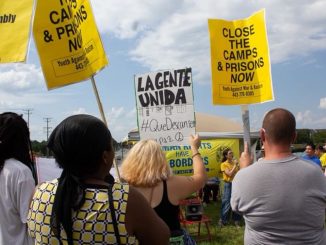
On two consecutive weekends, Maryland residents came out to say “No!” to another U.S. Immigration and Customs Enforcement (ICE) detention center. 

Members of Youth Against War and Racism, the Baltimore Peoples Power Assembly, Migrante and many others held a news conference to announce the newly formed ICE Out Of Baltimore Campaign. They initiated the campaign after an article appeared in the Baltimore Sun papers revealing that ICE has advertised on a federal contracts forum seeking locations to build a detention center in Maryland that would house 600 to 800 men and women in the Baltimore metropolitan area. 

There are currently three listed ICE detention centers already in the state of Maryland, located inside the Howard County Detention Center, in Frederick, Md., and on the eastern shore in Worcester County. 

The Aug. 4 news conference was held on the grounds of the Howard County Detention Center in Jessup. Over a hundred people braved temperatures in the high 90s and represented folks from all over the central portion of the state, encompassing Baltimore city and county, Carroll, Howard and Prince George’s counties, as well as the Washington, D.C., suburbs of Takoma Park in Montgomery County. The Howard County Detention Center houses approximately 149 people in the section reserved for ICE detainees. 

Speakers at the press conference represented a well-rounded group of area activists from Youth Against War and Racism, the Peoples Power Assembly, Friends of Latin America, Migrante Youth, the Green Party, the Baltimore Poor People’s Campaign, Struggle-La Lucha newspaper, and the Brown/Black Alliance for Liberation, among others. 

Leslie Salgado of Friends of Latin America presented an excellent statement outlining the years of U.S. foreign policy that have created the conditions that are now resulting in a tremendous influx of migrant refugees seeking to escape from the economic and political terror of some Latin American countries.

Echoing similar sentiments, a representative of Migrante Youth of Washington, D.C., gave an extremely moving account of Filipinos who have come to the U.S. to flee repression of the Duterte dictatorship, only to end up being exploited and trafficked in substandard jobs in the hotel industry.

Linking the struggles between ICE detention camps and prisons in the U.S., Marilyn Barnes and her lawyer, Alec Summerfield of the Prisoners Solidarity Committee, spoke of the Truth and Justice for Mariyn Barnes campaign. They are fighting a battle against the Harford County Maryland Sheriff’s Department to get the truth about her son’s death while in their custody. 

The death of this African-American man in his early twenties has been labled a suicide. The family disputes this since Barnes was due to be released in the morning. The Sheriff’s Department has put up every roadblock and the Maryland State Medical Examiners Office will not release the autopsy report to the family.

The second activity was held a week later on Aug 11, again at the Howard County Detention Center. The rally called by Jews United For Justice numbered over 250 people. Both Jewish and non-Jewish participants came together in one strong voice demanding the portion of the detention center used by ICE be shut down.

The talks were interspersed with songs, prayers, and readings in Hebrew and English, as well as chants in Spanish. The organizers targeted the newly elected Howard County executive, Calvin Ball, the first African-American person elected to this position, demanding he show ICE the door. ICE is paying Howard County over $144,000 a year to house the detainees. 

Amid chants of “Shut down ICE!” and “Every deportation is family separation!” nearly 30 of those in attendance sat down to block the driveway that leads to the part of the building that houses ICE detainees. The Howard County Police, however, decided not to arrest any of them.

At both the press conference and the rally, speakers addressed the plight of those caught up in the regulations of the DACA (Deferred Action for Childhood Arrivals) and TPS (Temporary Protected Status) programs ended by Trump’s executive order. Individual cases were raised, one of a cook at a local restaurant who was taken into ICE custody even though he has all his legal documents. Another youth spoke of his mother being taken into custody by ICE, in addition to how the new DACA regulations affect him and his brother differently with regards to potential deportations. Both adults are awaiting hearings at the Baltimore ICE Regional Office.

Strugglelalucha256


Call a new “Solidarity Day” against racism and bigotry!

To AFL-CIO President Richard Trumka,
Call a new “Solidarity Day” against racism and bigotry!
Defend migrants and refugees!

Over 130 years ago, the Wall Street wheeler-dealer Jay Gould declared he could “hire one-half of the working class to shoot the other half.” In 1886, Gould broke strikes on the old elevated lines in Manhattan and the Missouri Pacific railroad, now part of the Union Pacific.

The present serial bigot and sexual predator in the White House has the same desire as Gould did. Trump wants working and poor people to turn on each other and destroy everything that workers won, from social security to health safety regulations and much more.

Three days after the targeted killings of Mexican people by a white supremacist in El Paso, Texas, goaded on by Trump declaring “Stop the invasion,” nearly 700 poultry workers were jailed by U.S. Immigration and Customs Enforcement (ICE) in Mississippi. Their children were left alone, not knowing if they’d ever see their parents again. 

Many of the workers jailed in these raids were members of the United Food and Commercial Workers union. It’s not accidental that the Latinx workers had won a $3.75 million civil rights lawsuit a year before.

Retaliation via ICE raids also occurred at plants in Salem, Ohio, and Morristown, Tenn., following work-related complaints made by workers to authorities. 

ICE has became one of the biggest union busters. It forced immigrant workers to quit at a FreshDirect warehouse in Long Island City, N.Y., less than two weeks before union recognition votes were to be held in December 2007. The attempt to unionize was smashed. 

We need a new Solidarity Day

Based on a campaign from union locals, the AFL-CIO called for a March on Washington, D.C., on Sept. 18, 1981, to defend PATCO, the unionized air controller workers whom Reagan fired. Close to a half million workers participated.

Just as racism, sexism against women and homophobia divide poor and working people, so too, racism and bigotry promote prejudice against immigrants. Just as no child is illegitimate, no human being is illegal.

What should be illegal is Trump putting migrant children in cages and refugees in concentration camps.

The labor movement has been under attack for more than 40 years. Automation and plant closings have cut union membership wholesale. Deregulation by the capitalist government did the same to airline unions and the Teamsters.

AFL-CIO President Richard Trumka’s own United Mine Workers has less than 40,000 members. It once had 600,000. It was the miners that built the mighty CIO during the 1930s.

But the labor movement is like an uncoiled spring with vast amounts of potential energy. Millions of workers want union protection, pay and benefits. Teachers in West Virginia and around the country have been leading the way; and Mississippi poultry workers have been standing up. 

Corporate CEOs and their tool, Donald Trump, want to smash any organizing drive. Now is the time to organize a major show of workers’ solidarity against Trump’s offensive. We urge the AFL-CIO to call a national march, whether at the border, in Mississippi or in Washington, to say “No!” to Trump and racism.

We remember the wonderful union song and battle cry first popularized by coal miners in Harlan County: “Which side are you on!” We ask the officials of the AFL-CIO, President Richard Trumka and all of the other unions, that question: “Which side are you on?” The time to fight and defend migrants and refugees is now! An injury to one is an injury to all.

Strugglelalucha256


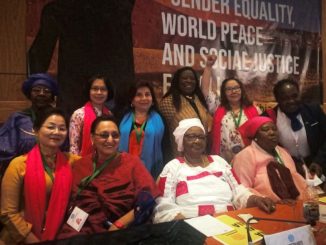
History of the Women’s International

It is not accidental that very little is known in the U.S. about the Women’s International Democratic Federation, which was born to fight against the same imperialism that the U.S. leads. On Dec. 1, 1945, right after World War II, women from 41 countries met in France to create the WIDF (FDIM in Spanish). Many of these women had suffered directly from the bloody effects of the war and many had struggled against fascism.

Yolanda Ferrer Gómez, general secretary of the Cuban Women’s Federation, gave a moving statement on the organization’s history in 2007 at the 14th Congress in Caracas, Venezuela: 

“They were widows, mothers who had lost their children, former prisoners from Nazi concentration camps, combatants who fought alongside men in the battlefields, members of the resistance and clandestine movements, guerrillas, workers who secured the rearguard and supplied the front, fighters all of them in uniform or civilian clothes.”

She continued: “With them, women who had fought in other latitudes against fascism also united, Spanish exiles, members from national organizations from the Americas and Asia, African women, from Arab countries, from Indigenous communities, all in solidarity.”

They pledged: “To defend the economic, political, legal and social rights of women; to fight so that the indispensable conditions for the harmonic and happy development of our children and future generations are built; struggle tirelessly so that all forms of fascism are forever annihilated and establish worldwide a true democracy; fight without rest to assure a lasting peace in the world.”

The WIDF was also enriched by the membership of socialist women from the revolutions that later developed in Cuba and Vietnam. The federation has played a key role in support of national liberation, such as in Angola, and against apartheid in South Africa. It has worked in international forums trying to give a more militant direction and has given voice to those under the yoke of imperialism, from Palestinians to Iraqis.

The WIDF was especially hard-hit during the 1990s, when the disintegration of the USSR and the Eastern and Central European socialist countries meant that material support and great theoretical and practical contributions so instrumental for the functioning of the federation suddenly stopped.

Crucial role of Cuba

Vilma Espín — one of four WIDF vice presidents, a combatant in the Cuban Revolution, a member of the Central Committee and the Political Bureau of the Cuban Communist Party and president of the Cuban Women’s Federation — played a decisive role in the enormous task of ensuring the survival and development of the WIDF. Thanks to Cuban action, the federation not only survived but thrived as a space of struggle and promotion of women.

During the WIDF’s 13th Congress held in Beirut, Lebanon, in 2002, Marcia Campos from Brazil was elected president. This was the first time a woman from Latin America held that post. She had founded the Confederation of Brazilian Women and is a member of the Central Committee and the National Secretariat of the October 8th Revolutionary Movement in Brazil.

The 14th Congress was held in Venezuela to show solidarity with the Bolivarian Revolution. But a new phenomenon occurred. The fighting revolutionary masses who are transforming this region also came to the congress. Many of the organizations present were not yet affiliates of the WIDF, but infused the congress with their combative energy. Wanting to affiliate and move forward the federation, many representatives spoke at the regional work session of the Americas.

There were Indigenous women from the Bolivian Bartolina Sisa Peasant Union, Peruvian Indigenous parliamentarians, young women from Puerto Rico and Colombian women urging a humanitarian exchange of prisoners. Prominent was the participation of Venezuelan women who, as the hosts, worked tirelessly to assure the smooth development of the congress and in their presentations highlighted the important role and advances of women under the Bolivarian Revolution.

The overall experience was tremendous: meeting and sharing with revolutionary women from all over the world, listening to their countries’ struggles, and most importantly, experiencing the overwhelming solidarity among all the attendees and their great respect, admiration and gratitude for Cuban President Fidel Castro and Venezuelan President Hugo Chávez.

Where else could you hear women from the Sahara thanking Chávez for his support of their cause in international forums? The congress gave the opportunity to interview many women from different struggles who offered their progressive views on crucial current events: the women’s role in Angola’s MPLA, South Africa after apartheid, Zimbabwe’s land distribution, the political view of the Democratic People’s Republic of Korea, the struggle against Plan Colombia and so much more.

The WIDF congress is not simply a “women’s issue.” As one participant said, “Everything and every struggle is of concern to women; we are half the world and give birth to the other half.” It was a Congress of Women in Struggle.

Strugglelalucha256
https://www.struggle-la-lucha.org/2019/08/page/2/