‘The message for ICE is to get out of our city!’

Opposition to 1850 Fugitive Slave Act shows the way

Oberlin and wellington freedom fighters

May 8, Worcester, Mass. – Ferreria de Oliveira, a migrant from Brazil, screamed for help. Her two daughters, one of whom was carrying her own newborn baby, tried to reach their mother. They were shoved out of the way, with the new mother forced face down onto the pavement and arrested by the ICE agents and Worcester city cops.

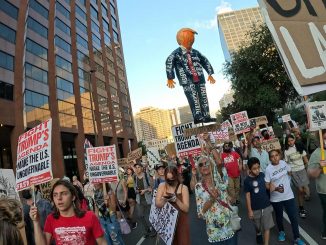
A community hotline, “Massachusetts 50501”, notified residents that ICE was on the scene.  A crowd gathered in the working-class city of Worcester, Massachusetts, and surrounded the ICE agents and city cops. They chanted “Where is the warrant?”, objecting to these gestapo thugs ignoring the migrant woman’s right to due process.

A spokesman for ICE arrogantly told the press that they didn’t need a warrant, that Oliveira had been arrested before by local police. However, a media search for criminal arrest and court records did not show her name at all.

The city’s cops are forbidden to arrest people for their citizenship status. Massachusetts law forbids police assisting ICE agents detaining people in the state. They were sent to the scene supposedly  “to preserve the peace and prevent anyone from being injured.”

Yet the Worcester cops did violate that law by attacking the crowd surrounding masked ICE thugs seizing the migrant mother and arresting her teenage daughter as well as Ashley Spring, a Worcester School Committee candidate.  When Spring tried to prevent the juvenile from being arrested, she also was arrested:

“The community gathered,” Spring said on Eureka Street while in handcuffs. “We found out that (ICE) didn’t have a warrant. They didn’t have not just a judicial warrant. They didn’t have a warrant at all. They wouldn’t present it.

“The community decided that these women were free to go, and the women decided to go and exercise their right to leave. At that point, the police continued to try to brutalize them, to rip the baby out of the mother’s arms, 4-week-old baby, and the community tried to intervene and help them.”

The next day hundreds of protesters packed a local YMCA to protest these arrests by both ICE and the city police: “We know that ICE, we know that the federal government, is descending upon communities of color,” Worcester City Councilor Khrystian King said.

“’The message for ICE is to get out of our city,’ Worcester City Councilor Etel Haxhiaj said to applause from residents.

And on May 11 a thousand people rallied on Worcester’s Common. “This issue is very clear. We want ICE to stop acting unconstitutionally. The way that they are taking people reminds all of us of the Gestapo or the KKK,” said Rebecca Winter, an organizer with Massachusetts 50501.

Miller declares war on our rights.

On May 9, the day after the ICE attacks in Worcester, Stephen Miller, Trump’s deputy chief of staff and chief snarling-dog advisor who orchestrated President Trump’s crackdown on immigration, announced that the White House was considering defying numerous court decisions, including some by the Supreme Court, by suspending immigrants’ right to habeas corpus:

“The Constitution is clear,” he told reporters outside the White House, arguing that the right, known as a writ of habeas corpus, “could be suspended in time of invasion.”

“That’s an option we’re actively looking at,” he said, adding, “A lot of it depends on whether the courts do the right thing or not.”

Miller’s timing was not random. He made this statement to intimidate the growing militant resistance to ICE by saying that Trump has the right to not only arrest and deport migrants, but also to arrest anyone who gets in their way, including the heroic people of Worcester.

This would nullify every state and local government that prohibits police from assisting ICE’s illegal arrests and deportations.

The Miller-Trump proclamation echoes the enslaver-controlled federal government before the Civil War, who repressed those who defied the slave catchers sent to the North empowered by the 1850 Fugitive Slave Act.

The Jerry Rescue, the Boston Vigilance Committee and the Oberlin-Wellington Rescue

William Henry, who called himself “Jerry”, escaped from slavery in Missouri in 1843 and made his way to Syracuse, New York, where he found work as a cooper, a maker of wooden barrels.

In 1850, the U.S. Congress, under the control of the South’s enslavers, passed the infamous Fugitive Slave Act. It required that all escaped slaves, upon capture, be returned to the slave-owner and that officials and citizens of free states had to cooperate.

In effect, this act nullified all the northern states’ laws against slavery and turned every cop and judge into slave catchers. Anyone who opposed this could be arrested and jailed.

In 1851, five U.S.  Marshals went to Jerry’s workplace and arrested him, preparing to return him to his Missouri owner.  At the same time, an anti-slavery convention was set to open in Syracuse.

On October 1, the day after Jerry’s arrest, a large crowd gathered outside the jail where he was being held.  At a signal, they all broke in and freed Jerry. He was then guided to Canada and freedom.

When the convention opened a few days later, Reverend Samual May spoke:

But when the people saw a man dragged through the streets, chained and held down in a cart by four or six others who were upon him; treated as if he were the worst of felons; and learnt that it was only because he had assumed to be what God made him to be, a man, and not a slave—when this came to be known throughout the streets, there was a mighty throbbing of the public heart; an all but unanimous up rising against the outrage. There was no concert of action except that to which a common humanity impelled the people. Indignation flashed from every eye. Abhorrence of the Fugitive Slave Bill poured in burning words from every tongue. The very stones cried out.

In Boston, the abolitionist Vigilance Committee conducted the same kind of militant actions, rescuing George Latimer, who had escaped from Virginia. After his rescue from jail, he was also guided to Canada. The committee also freed the couple Ellen and William Craft, who were able then to travel to England.

John Price was a young man who had escaped his Kentucky slave owner in 1856 and was able to reach the town of Oberlin in Ohio. Lured by a false promise of work in 1858, Price traveled out of Oberlin to the town of Wellington, some 8 miles away. There he was arrested by slave catchers and federal marshals, who prepared to catch a train back to Kentucky.

When the Oberlin townspeople heard about Price’s kidnapping, they sprang into action:

White and black Oberlinians hurried the eight miles to Wellington in wagons, buggies, carriages, and some even on foot to rescue Price from slavery. When John H. Scott went to his neighbor, Mrs. Oliver P. Ryder, to borrow a horse she told him, “If necessary, spare not the life of my beast, but rescue the boy.”

When the southbound train arrived, the situation grew urgent and the crowd began to force their way into the hotel. In the confusion that followed, Price escaped with the help of men who had been trying to negotiate with the captors. Energized by the success of the rescue, Oberlin residents paraded back from Wellington, “shouting, singing, rejoicing in the glad results.”

Although his final destination is unknown, it is believed that Price was able to make his way to Canada.

However, thirty-five of his rescuers were arrested and put on trial, 23 from Oberlin and 12 from Wellington. Two of the defendants sold 5,000 copies of their newspaper “The Rescuer” from inside the Cleveland jail.

On May 24, 1859, thousands of people crowded into Cleveland’s Public Square to support the Rescuers. Court costs continued to mount, and the legal tangle intensified when the Rescuers’ supporters arranged for the arrest of the slave catchers on kidnapping charges in Lorain County.

A deal was finally negotiated and the Rescuers were released on July 6, 1859, eighty-three days after being imprisoned.

The people will win!

The response by the Democratic Party leadership to the Trump-Miller fascist onslaught against undocumented workers has been criminally pathetic. Even when a Wisconsin judge and the mayor of Newark are arrested at ICE’s behest,  they have caved at every turn and failed to lead any mass resistance.

This contrasts sharply with the heroic defiance shown by the people of Worcester. Just as the defiers of the Fugitive Slave Act would lead to John Brown’s raid on Harpers Ferry and then the Civil War, this growing militant campaign for basic solidarity with our migrant sisters and brothers is bound to awaken a massive militant class struggle.

Strugglelalucha256


The failure of tariffs in a declining empire

Manufacturing

Speaking to Congress after 100 days in office, President Donald Trump claimed that the new tariffs on imports are about reindustrialization, “making America rich again and making America great again,” he said.

Every declining empire built upon exploitation and conquest has clung to the dream of reviving the former glory and splendor of its golden age of robbery and oppression in one final, desperate attempt.

Executive orders and oligarchic rule

To impose the tariffs, the Trump administration has turned to oligarchic rule, the authoritarianism of the billionaires. Tariffs are a form of taxation that the Constitution explicitly reserves for Congress. Usurping the authority of Congress by invoking emergency executive powers to impose tariffs is part of Trump’s mode of autocratic governance, including defiance of judicial rulings and aggressive actions against immigrants and political opponents. 

Why do Trump and his gang of billionaire oligarchs think that tariffs are necessary to encourage “reindustrialization”? 

The decay of the profit motive

The root cause is the decay of capitalism’s core engine — the profit motive. At one time, the profit motive was the driver of economic development; now it has become an obstacle. Monopolies stifle competition, and filling shareholders’ pockets takes priority over expanded production, so unstable financial speculation now dwarfs productive industry. 

Profit maximization has driven globalization. Banks and monopoly corporations often move production to countries with low wages to increase profit margins.

The monopolistic dominance that once secured U.S. global supremacy is now paralyzing its capacity to compete. Even the capitalist class acknowledges that the profit-driven system cannot generate reindustrialization on its own, revealing a fundamental flaw in the capitalist system.

Tariffs: An admission of failure

The goal of reindustrialization through tariffs is not a solution but an admission of failure. It reveals that capitalism can no longer be fixed through its own mechanisms. 

The reality is that capitalism’s decline is irreversible. No amount of government intervention by Trump (or anyone else) can resuscitate a mode of production that prioritizes the extraction of profit over renewal, over developing and building what’s needed.

Capitalism’s fixation on profits has undermined its productive foundations.

What real reindustrialization would require

To “Make America Great Again,” to reindustrialize and develop what’s needed, would require policies and actions that are exactly the opposite of what Trump is doing. 

Reindustrialization would require an expanding workforce, not Trump’s anti-immigrant purge.

Reindustrialization requires skilled workers. The Reagan administration made substantial cuts in federal education spending, laying the groundwork for the neoliberal reforms of the Clinton administration, whose privatization mandates and emphasis on market-based solutions accelerated the erosion of the public education system.

The reindustrialization campaign pushed by the Biden administration led to Taiwan-based TSMC, the world’s largest contract chipmaker, announcing in April 2024 that it would establish manufacturing facilities in Arizona. While there was a great deal of publicity when it was announced, the project remains in development with no certainty when production will begin. 

The company has had difficulty finding skilled local workers, leading to delays in the project’s timeline. To mitigate the skilled labor shortage, TSMC has brought in over 1,000 experienced workers from Taiwan to assist with the installation. Approximately 50% of the current workforce setting up the Arizona facility are Taiwanese workers. 

The company has instituted a local educational program in reading and math for the tech skills required. The Arizona Academic Standards Assessment, or AASA, results show that only 40% of the students in the public school system passed the reading (English Language Arts) test, only 32% passed the basic math test.

The alternative: Production for need, not profit

Reindustrializing and building what’s needed would require a system driven by production based on needs, not on profit — socialism.

Strugglelalucha256


From Freddie Gray to free Palestine: activists link struggles against state violence and oppression

Jace Carter addressed the Baltimore Hands Off Our Students Protest & March that gathered at Penn Station, April 27, 2025. Over a hundred students from many of the area campuses attended.

Good afternoon, sisters, brothers and siblings. My name is Jace, and I’m with the People’s Power Assembly, an organization that has been fighting against racist police terror and for the rights of poor, working-class people since the murder of Trayvon Martin in 2012. 

We were also on the frontlines after Freddie Gray’s murder by the Zionist-trained BPD during the Baltimore Uprising in 2015. And on this, the 10th anniversary of Freddie Gray’s murder, and today in particular (April 27) being the day of his funeral, I stand here today to say it’s still: All night, all day, justice for Freddie Gray!

All night, all day, justice for Freddie Gray!

All night, all day, we will fight for Freddie Gray!

I am also, unfortunately, a recent graduate of Loyola University Maryland, a liberal institution that is very anti-worker and very deep in the pockets of the capitalists. Shame! In November of 2023, the People’s Power Assembly marched across the Evergreen Quad in solidarity with the students who had newly formed the Students for Justice in Palestine (SJP) chapter at Loyola. The administration had the audacity to call Loyola Police on this demonstration to break it up, calling it an “unauthorized gathering,” claiming that we “didn’t have the proper permits and approvals,” and whatnot. 

After this demonstration, the administration threatened leaders within this SJP chapter with expulsion if they did not immediately disband the chapter. Shame!

I am deeply ashamed to have been part of an institution that prides itself on how many community partnerships it claims to have, and also claims that its student body doesn’t live in that infamous “bubble” that was mentioned earlier. The people I went to this shameful institution with called our York Road neighbors, and I quote, “dirty, homeless druggies,” and are deathly afraid to walk York Road at any time of day out of “fear.” Call it what it is, it’s outright racism!

I was also part of a social justice organization on campus as a work-study student my senior year, where I actively witnessed my best friend and roommate, who also worked there, get her wages repeatedly stolen by her supervisor. I ended up resigning my position in disgrace because when I tried to call this shameful shit out, I was considered crazy. 

I say all this to say that as blood brothers, sisters and siblings in the struggle, especially to my fellow student organizers and activists, I continue to stand in solidarity with you all, fighting against your oppressive institutions, and we will continue to fight like hell to make our demands fully enacted! 

And one last thing that I want to say (this is a very short speech) is that Mahmoud Khalil should be home today with his wife and newborn son, and not sitting in an ICE detention facility 1,400 miles away in Louisiana! 

Free Palestine! Long live the student intifada! Till victory!

Strugglelalucha256


Fascism is capitalism in crisis: Socialist author urges revolutionary readiness at LA book talk

Version 1.0.0

On May 3, the Struggle for Socialism Party Los Angeles branch discussed the new book, “Against fascism: reclaiming populism’s legacy for today’s class struggle, compiled by Louisiana socialist Gregory Williams. Following is the opening presentation for the class series. 

BUY NOW  |  FREE PDF

John Parker: This is a time when the attacks of fascism are so clear, so blatant. We work with a group called the Community Self-Defense Coalition, doing daily patrols. Over 60 organizations are part of it. If you see ICE, there’s a number you can call to bring the patrol out.

This work helps empower the community to fight back and chase out these ICE forces when they try to kidnap folks. You know, let folks know you’ve got to have a signed warrant before you can go in.

I was on patrol yesterday, and I guess I’m making the point about why that’s so important for this class. Often people think about the issues, and what can be done about them, and they just think, “It’s a damn shame they’re doing this to these people.” But when you see it happening to you and your neighbors, and your children — all the time so blatantly — you don’t have a choice. You’ve got to get involved. 

But to understand how to get involved, you’ve got to know what the situation is. What is it that’s causing this? What’s fundamentally creating this problem?

How can we get ahead of it? If we understand what’s going on, we can try to get ahead of it. Gregory Williams analyzed a lot of the stuff in the class struggle, from a Marxist point of view, on what’s going on now with Trump. This book is going to give us a heads up and the tools to be able to fight back. We’re so glad to have the author here today.

Gregory Williams: Thanks, John. What you said dovetails into what I’m planning to say. Thank you for having me here.

We’ve published this new book through Struggle – La Lucha, the magazine we put together through the Struggle for Socialism Party. Since this is class one, I’ll give an overview of the book, or try. It’s challenging because it’s a compilation dealing with people’s struggles in multiple periods. It’s going from the late 19th century all the way to now, or the beginning of this year, and Trump’s second term. 

But when we look at these periods, side by side, common themes emerge. And they’re things our movement needs to understand in the fight against capitalism and fascism. So even though the book goes into a lot of history, it’s really about strategizing in our current moment.

From the back cover summary:

“Fascist movements are on the rise worldwide, attacking working-class and oppressed people. The authors of this collection argue that capitalism’s inherent dynamics are the cause, as with fascism in the 20th century. Fascism is the capitalist class’s response to a system in crisis.

“They use racism and misogyny, transphobia and homophobia to try to beat back the diverse working class while amassing more wealth for themselves. But the workers beat back fascism before, and we can do it again.

“Workers have the power to eliminate the root cause of fascism by transforming society with socialist revolution, and this book is about getting us there. All the pieces in the book come from fighters in the revolutionary struggle, and most have already been published in Struggle – La Lucha.

“Topics include populism, a progressive farmer’s movement of the 1890s; the contemporary trans struggle; the Silicon Valley MAGA connection; the legacy of the Jena Six; the abortion rights movement in the South; the real motives of right-wing governors; and the fight against KKK leader David Duke.” 

Analyzing our moment

I want to talk about one of the book’s themes, and that’s the question of how we analyze a given political period in terms of the stage of the class struggle, the balance of forces, whether the period overall is more progressive or reactionary, because that affects how we organize.

I’ll focus on the David Duke section just for some examples because it offers some keys for how to read the book, and for strategizing in our political moment. 

The section consists of three pieces written by Marxist leader Sam Marcy on Duke’s 1991 gubernatorial campaign in Louisiana.

I’ll paraphrase the introduction I wrote in that section. In his “Perspectives on the Duke Campaign,” Marcy explains what was truly new about Duke’s campaign. He argued that even if the racism was the same old, same old espoused by segregationist politicians George Wallace and Lester Maddox in the Civil Rights era, Duke was more dangerous because the 1960s and ‘70s were a very different period politically from the early 1990s.

Marcy says:

“In the 1960s, when both Maddox and Wallace were trying to become national figures, their type of all-out, segregationist racism was basically defensive: They were trying to hold onto white supremacy as it had existed for a century; they were trying to retain the status quo of racism. At that time, there was an upward, progressive movement throughout the whole country. …

“In contrast to the present, it was a progressive era. …

“The Duke movement is not just a defensive attempt to halt the progress of Civil Rights. It is a wholesale offensive to undo and reverse the historic gains made by the Black and other progressive forces. 

“The Duke campaign comes in the midst of an anti-labor offensive. Gains made by the workers have been crumbling; the capitalist recession and the attacks on the living standards of the workers have brought frustration and anger. The labor movement has been forced into concession after concession.

“Strike breaking and scab herding are on the order of the day.

“The situation is ripe for a fascist demagogue to prey upon these frustrations, especially among the middle class who are losing their moorings to the bourgeoisie.”

In 2025, most of the progressive gains of the past centuries have already been reversed. We’re in a deeply reactionary period, with economic conditions rapidly deteriorating and staggering inequality being the order of the day. The situation now is truly ripe for fascist demagogues, as Marcy said of 1991.

(And speaking of the segregationists of the ‘60s, things are so bad now that the courts are overturning school district desegregation orders. It’s already happening in one Louisiana school district,  and it could be the first of many. That’s how reactionary it is. They’re overturning school desegregation, which was never fully completed anyway.)

So, that’s the introduction to the Duke section. What strikes me is how precise Marcy is in his analysis of his present moment. That was also a major feature in Vladimir Lenin’s thinking, as the leader of the Bolshevik socialist revolution, closely analyzing the historical moment, looking at many aspects of it — political, economic, cultural, etc. According to Lenin’s thinking, this kind of analysis — when developed collectively by a revolutionary party that’s based in the masses — that is what can allow the working class and the oppressed people to effectively organize, to overthrow the ruling class. And this has been tested in many revolutions beyond the USSR, especially in the Global South. 

In 1991, Sam Marcy understood that the political situation had changed drastically since the high tide of struggle in the ‘60s and ‘70s. After the economic crisis of the ‘70s, the global capitalist system was restructured in many ways. Nixon nixed the international gold standard. In the U.S., there was more automation. Factories and industrial jobs were sent overseas, always in search of cheaper labor. 

Unions were increasingly under attack when they had actually been making gains up until the mid-70s. Privatization was on the rise. Real wages declined while the cost of living rose. The working class was squeezed. The social safety net was cut. Everywhere, the capitalist class was on the offensive.

As the capital of capitalism, the U.S. is exemplary, but these things were happening in all the imperialist countries to greater and lesser degrees. But in the U.S., particularly, the military budget grew year after year, taking on an outsized role in the economy, sucking up resources from meeting human needs. And unlike during World War II, the oversized role of war spending tended to depress the economy, not to stimulate it.

(This is almost never discussed in the bourgeois media, but military spending is inflationary. It’s never discussed that the billions they’ve been giving to Israel and Ukraine and so on have been a major factor in the inflation of the past few years.) 

So, all that was just a description of what was happening in the imperialist countries themselves, especially in the U.S. But at the same time, around 1991, in much of the socialist camp, namely the USSR and Eastern Europe, imperialist-backed counterrevolutions were underway. Everything that the working class and the oppressed people had built in those countries was being dismantled and sold off to the highest bidders. Life expectancy plummeted in the formerly socialist countries. 

In the Global South, in the colonized and formerly colonized world, the imperialists installed brutal dictatorships, which were fascism 2.0. As in many Latin American countries, they destroyed unions and attacked anyone who stood in the way of squeezing the people to the max to extract profits for capitalists in the imperialist countries.

So, when Marcy analyzed Duke’s campaign in 1991, he wasn’t just thinking about what was happening in the state of Louisiana, even though there was a major crisis happening there. He was thinking about this whole context.

This was a reactionary period, characterized by reversals for people’s struggles. And although the capitalists were on the offensive everywhere, the capitalist system itself was increasingly decaying, more plagued by contradictions, as with the outsized role of the military in the U.S. economy, distorting the economy as a whole and dragging it down, all these contradictions getting worse and worse. All of this is why Marcy identified Duke as such a threat. He wasn’t just any old racist in any old time, this was a serious fascist threat.

In that period, Marcy thought a demagogic fascist figure shifting the blame of the capitalist crisis onto oppressed peoples was very dangerous. And all these trends are even more acute now. If we look at the writings from that time, the main takeaway for me is that things have gotten much worse. 

We know these contradictions are driving resurgent fascism. But what can we do in such a period? The most reactionary sections of the ruling class have the upper hand. Trump and Musk are tearing up any part of the capitalist government that might actually help people, while bolstering the repressive state. 

Trump’s tariff war is fueling fears of recession, and any worker knows the economy is already bad. We’re not going from a good economy to a bad economy, we’re going from bad to worse. 

People know things are bad, and they increasingly have a sense that it’s going to take people in the streets to turn things around. And the courts, Congress, and Democratic Party won’t save us.

Militarism fuels fascism

During the past month, millions of people have protested all over the U.S. On April 5, tens of thousands came out for Palestine and immigrants in Washington, D.C., marching on ICE headquarters. 

Millions also came out for the Hands Off and 50501 protests. And that is an encouraging sign that people are coming out, but we know movements controlled by the Democratic Party can’t win the fight.

(And here’s an aside for when we go into the history of the populist movement of the 1890s. A big part of the story of  how their movement was derailed is that it ultimately was taken over by the Democratic Party. I don’t know if that was the very first time that happened in the history of the country, but it was an early one, and that’s sort of been the pattern ever since. This isn’t talked about enough in the book.)

Back to the Hands Off protests. People are rightly angered by the cuts to Medicaid and Social Security, etc., but the protest organizers included “hands off NATO” in their list of demands. Comrade John Parker wrote an article about the 50501 rallies, saying:

“NATO and U.S. wars are never about democracy or freedom. They are about maintaining global dominance, fascism, poverty, and the subjugation of our international working class – starting with the Global South, Black and Brown, Palestinian, and anyone getting in the way of U.S. imperialism and its IMF and World Bank.

“We must be wary of progressives who sidestep these issues, especially those who avoid discussing Palestine, minimize police brutality, or demonize countries like Iran, Cuba, China, Venezuela, Nicaragua, the DPRK, and Russia. Of course, no state is without contradictions — but we must focus on the largest contradiction of all: the unchecked violence of U.S. imperialism.”

That violence he’s talking about is a driver of fascism, not least of all because it’s fundamentally racist. The genocide happening in Gaza is absolutely racist, just like what the Nazis did. This is one place where we as revolutionaries can intervene. We have to be the ones to expose the role of militarism because the liberal groups won’t do it.

For example, people have been protesting at Tesla dealerships, and I think that’s a good thing, and shows the right instinct that billionaires need to be hit in the pocketbook, especially with strikes, but less attention is paid to Musk’s military contracts.

 Gary Wilson, one of the editors of Struggle – La Lucha, recently wrote

“SpaceX has established near-monopoly status in orbital launch capabilities, accounting for approximately 90% of mass launched into orbit in 2024. This dominant position makes the company indispensable for military and intelligence satellite deployment.” 

SpaceX CEO Gwen Shotwell recently claimed that the company has $22 billion in government contracts altogether. I don’t know if that’s the real total because some of these things are classified.

The book talks a good bit about Silicon Valley and how these tech capitalists are funding and promoting fascism, just like industrialists and bankers who bankrolled Hitler. And I’d like people reading the book to think about how Silicon Valley is fundamentally integrated into the military-industrial complex and fuels this kind of politics, and think about how tech is integrated into surveillance, policing, deportation, imprisonment.

A big part of what Trump’s doing right now is about militarism. He’s making an unprecedented increase in the military budget — $1 trillion. 

This is the working class’s money, and he wants to give even more of it to people like Musk. And that’s part of the whole tariff thing because tariffs are a regressive tax on working-class people, while he’s cutting taxes for billionaires.

Anti-racist class unity needed

Another major theme in the book is class unity, class-conscious unity against racism, as Comrade Lallan Schoenstein put it in the interview she did for the Jena Six section. But it’s also class unity against the attacks on trans people and immigrants. 

Take the sections on populism in this book. The book argues that Trump and Vance aren’t populists, as the media likes to claim. They call anybody who makes any kind of appeal to the masses, they call that populism, and there’s a history of that, and there’s a reason why it’s done, but it’s not true. Populism, like I said before, was a left-wing historical movement. What Trump and Vance represent is fascism. 

When the populist movement was at its height in the 1890s, it was mainly based among farmers, who were also linked up with industrial laborers. They were coming up against big capitalist monopolies emerging in banking and industry, the Rockefellers, Standard Oil, JP Morgan. They were also up against the rich planters in the South in the post-Reconstruction period. And in order to stand any kind of chance, they needed class unity across racial lines. They needed Black and white unity. 

Unfortunately, the populist movement never solved that problem, but they did make important strides, and the book goes into this a lot. They attempted alliances, which were very progressive for the day, but to a large extent, everywhere they failed it was because they didn’t have that unity. It was primarily due to the racism of white people in the movement. It wasn’t that the Black farmers wanted to have separate organizations, especially in the beginning. In a lot of cases they weren’t allowed to be in the white organizations. And to some extent, they overcame that, but ultimately it didn’t go far enough. And that’s part of the reason they failed.

Some of the lessons for us come from the fact that, like our movement, the period in which the populists were operating was overall reactionary. It was during the rise of Jim Crow, which was the result of the counterrevolution against Reconstruction.

Reconstruction had been one of the most progressive eras in the country. One of the only times that there was a real specter of democracy. Both Black people and poor white farmers in the South made strides during the Reconstruction period after chattel slavery was ended. Reconstruction consolidated political and economic gains stemming from the heroic defeat of slavery.

But after Reconstruction was defeated, much of that process was reversed. I argue that the Klan terrorism of this period was fascist in character. Fascism didn’t just originate in Europe. U.S. racism in that period — not to mention the whole history of colonization — you can’t really understand fascism without looking at colonialism. But particularly in this post-Reconstruction period, Klan terrorism was a precursor of fascism.

So, parts of the book focus on the way rich people in the South, especially, whipped up racist hysteria using the mass media of their day. They used newspaper articles and cartoons, similar to how social media disinformation is disseminated now, often with rich funders. This is one of the patterns I talk about when comparing these periods.

Just like today, the scapegoating and bigotry are all about keeping the people disunited so they can’t fight our real enemies, the rich. And this picture of a Klan rally [in PowerPoint] isn’t from the 19th Century. It’s from the 20s in New York, but I thought that was a really good one because you see exactly where the “America first” slogan came from. You could put this right into 2025, “one God, one country, one flag” — it’s all the same stuff.


Organize and study for upsurges ahead

Finally, I want to say that a book like this can’t tell us what we should do in our moment. It can’t give us a blueprint. Even with the writings of great revolutionary figures, we don’t get a blueprint. That has to be figured out through the movement itself. But the book does try to document some flashpoints of current struggles. 

When I was going back and editing, it was interesting to see these snapshots of our recent past — of demonstrations we’ve done, marches we’ve been at, because, often with the social media news cycles, as soon as things happen, they’re sort of forgotten. And everything is just so ahistorical. Even the recent past. This was on display after Oct. 7. They started every news segment with “the war started by Hamas on Oct. 7,” without mentioning the history of colonization. Everything is given without a context.

I hope the book can help spark political discussion, both about history and present-day strategy. Right now, they’re trying to erase history in every conceivable way. In general, if we can have more collective study in the movement, that would be good. These kinds of discussion groups are important. It’s a way for us to build our collective consciousness. That’s essential for us to win against the fascist enemy.

It’s especially exciting to talk about the book with you all, because the Harriet Tubman Center is part of the Los Angeles Community Self-Defense Coalition, as John already said, along with 60 other organizations, initiated by Unión del Barrio. With community patrols, they’re making it harder for ICE to operate. They’re actually obstructing these fascist attacks at the street level where it’s happening. This is the kind of organizing that really strikes at the fascists.

And there’s a section in the book that talks about something that happened back in February, when the residents of historically Black Lincoln Heights, Ohio, drove out neo-Nazis who were having a rally there. Then they formed armed community patrols to protect their community throughout the neighborhoods. This is another example of the type of practical work, and we need to combine our collective study with that type of practical work, like what you all are already doing. And if we do that, we’ll be able to ride the waves that are coming.

Another theme from the book is that we don’t know exactly when there’s going to be a people’s upsurge. (This comes out in the interview with Larry Hales, talking about the Jena  Six). But we know it’s coming, we know that it has to come as conditions get worse. Something’s going to spark it off.

We don’t know when the exact moment will be or how it’s going to happen, but when we’re studying, when we’re building the community infrastructure ahead of time, then we can actually take that on. And I hope that the work ya’ll are doing gains more visibility. It’s really a great example for people throughout the movement to learn from. I wish it were in the book.

Strugglelalucha256


Republicans want to kill all trans people — and many Democrats would let them

What Can History Teach Us About Resisting Queer Genocide?

“Never forget conservatives want to kill you and liberals want you to die quietly.”

Note from Mady Castigan: This article was written by writer and journalist David Forbes (Bluesky), but I fully endorse and embrace the use of the term “genocide” to describe the current situation in a journalistic context. We encourage other journalists and outlets to consider using the term as well in order to properly convey the gravity of our times both to your readers and to the historical record.

Strugglelalucha256


New Orleans nurses and immigrant workers stand together

Nurses at New Orleans’ University Medical Center went on strike on May 1. After voting to unionize in December 2023, they’ve been in contract negotiations since March 2024 and went on strike in October 2024 and again this February.

Here’s an April 29 statement from nurse Terry Mogilles posted to nolanursesunited on Instagram: 

“I’m a registered nurse at University Medical Center in New Orleans, Louisiana, and a proud member of National Nurses United. I am joined here today by some of my colleagues from UMC and a group of strong, fighting nurses from all over the country. On May 1, we will begin our third strike to win a strong contract for our nurses that protects our patients and our community. We want corporate health care to know: When you take on one of us, you take on all of us!”

Nola nurses 2

The nurses were joined on the picket line by the immigrant worker organization Unión Migrante, which led the May Day march later in the evening. In their Facebook livestream at the picket line, Unión Migrante said: 

“We are here in solidarity with the nurses and patients of LCMC, where most of our immigrant community turns to for health care.

“Let’s say it clear to the greedy men in charge of the hospital. Human lives matter more than money! Nurses’ working conditions are our healing conditions as patients. It is disgusting that LCMC treats its employees and patients as disposable – we deserve better!

“They deserve a collective agreement with a sustainable patient ratio for each nurse. They deserve decent salaries, as we all deserve. Bills and rent aren’t going down. They deserve union representation and a job with respect.

“This May 1, we remember to stand on the shoulders of people who fought and died for a weekend, an eight-hour workday, health insurance, and much more. So we say, together with the nurses, one more day, one more day stronger! Towards victory always!”


Strugglelalucha256


Tariffs are a step toward military mobilization

The Trump administration’s April 2 “emergency” executive order reveals that military readiness and defense industrial capability — not merely economic protectionism — are the primary objectives. The administration has explicitly positioned these policies as necessary to rebuild U.S. manufacturing capacity for war.

The April 2 executive order states:

“Large and persistent annual U.S. goods trade deficits have led to the hollowing out of our manufacturing base; inhibited our ability to scale advanced domestic manufacturing capacity; undermined critical supply chains; and rendered our defense-industrial base dependent on foreign adversaries.”

Billionaire hedge fund (Bridgewater Associates) manager Ray Dalio says that tariffs prepare the economy for war.

Tariffs “can reduce both current account and capital account imbalances,” Dalio writes. “Which in plain English means reducing the dependencies on foreign production and foreign capital which is especially valued in times of global geopolitical conflicts/wars.”

Dalio thinks: “The United States and China are now in a trade war, a technology war, a geopolitical influence war, and a capital/economic war, and they are now dangerously close to a military war.”

The ‘Arsenal of Democracy’

Peter Navarro, White House Senior Counselor for Trade and Manufacturing and author of the Project 2025 chapter on trade, says that military expansion is the goal, to build an “Arsenal of Democracy,” the term Franklin D. Roosevelt used to describe the United States’ role as a major supplier of weaponry, supplies, and other military aid to Allied countries during World War II.

On Fox News, Navarro said:

“The bigger picture here is restoring the American manufacturing base. We don’t have that. We’re an assembly… you remember… something called the Arsenal of Democracy back in World War II? That was how we beat the Japanese and the Germans with our military might. When [U.S. General George] Patton [and the U.S. Army] went to Berlin [in 1945] it was with trucks, jeeps and tanks that were made in the auto plants of the Midwest [of the U.S.] and right now the only thing that looks like the Midwest [did] back then is Mexico. You go across the diaspora [sic] of cities in Mexico, there’s … 50 football field size assembly plants that are down there [and that] make the engines for here. We can’t do that. The Germans and the Japanese, the South Koreans and the Mexicans have taken our manufacturing capabilities so we’ve got to get that back. […] If we don’t have a solid auto industry, when we have problems in the world, we’re going to be speaking some other language.”

Strategically, U.S. military planners worry about inadequate civilian industrial capacity, which limits the country’s ability to convert civilian industries for wartime production quickly. Immediately concerning is the widespread consensus that current military production levels are insufficient and slow to expand, hampered by skilled labor shortages and a weak industrial base.

In November 2024, Admiral Samuel Paparo, head of the U.S. Indo-Pacific Command, told Military.com that supplying significant military aid to Ukraine and Israel had compromised the U.S.’s readiness to respond to potential crises in the Indo-Pacific region, particularly regarding Taiwan. Paparo said that the Ukraine and Gaza interventions are depleting critical ammunition stockpiles and emphasized the urgent need to replenish supplies beyond current levels.

Upon confirmation in January 2025, Secretary of Defense Pete Hegseth vowed to rebuild military capabilities by revitalizing the defense industrial base, streamlining procurement, achieving fiscal accountability, and rapidly deploying emerging technologies. 

Globalized manufacturing

Trump’s extreme tariff strategy, which targets all foreign nations, won’t be able to bolster isolated military-related industries, given the realities of modern production. The production of complex goods now depends on a globalized division of labor, with scales of specialization and technological intricacy surpassing the capacity of any single country, including the largest economies. Such production demands immense societal resources, a requirement fundamentally incompatible with the profit-driven, market-centric framework of U.S. imperialism.  

Globalized manufacturing is not merely about outsourcing to exploit low-wage markets in the Global South. It also relies on a division of labor among wealthy imperialist states, each leveraging distinct industrial and technological specialties. This system serves as a mechanism to contain China, which faces not isolated adversaries like the U.S., Japan, or Europe, but a coalition of imperialist powers united by their shared structural dominance in the global economy. These states collectively benefit from exploiting China and other countries in the Global South.  

Should the global trade order fracture, the U.S. would still need to sustain alliances with key imperialist and subordinated states in the Global South to preserve an international (if no longer fully global) division of labor — a structure that defined the first Cold War. Before 1991, imperialist economies thrived without access to Chinese labor, Eastern European manufacturing, or Russian resources. Today, agreements like the United States-Mexico-Canada Agreement (USMCA) ensure U.S. imperialism retains control over regional pools of low-wage labor and natural resources.  

No imperialist state, including the U.S., can sustain capitalism in isolation. Their wealth and capital accumulation depend critically on extracting value from the Global South through unequal trade relations, securing super-profits that far exceed average returns. Even non-market activities, such as war production, rely on efficiencies derived from globalized supply chains and labor hierarchies. Ultimately, imperialist dominance is meaningless without mechanisms to exploit that power — a reality inseparable from capitalism’s drive for profit.

Strugglelalucha256


The Billionaire-Military Complex

Military spending surges while domestic programs face the DOGE axe

In case you didn’t notice, the only thing on Trump’s budget so far is military expansion.

On April 7, Trump announced plans for a $1 trillion defense budget next year, a massive increase.

“We’re going to be approving a budget, and I’m proud to say, actually, the biggest one we’ve ever done for the military,” he said. “$1 trillion. Nobody has seen anything like it.” 

At the same time, severe cuts (DOGE) ravage domestic government programs. 

The timing of this announcement speaks volumes. As working people grapple with reduced public services and slashed social programs, with tens of thousands of civil service jobs cut and other job losses, as well as cuts in health care and education, the Pentagon secures yet another windfall. This is not just a budget reallocation but a declaration of who truly holds the reins of power — the billionaires like Elon Musk and the military-industrial complex. Maybe we should call it the billionaire-military complex.

And Trump thinks that his tariff war on the world will pay for the military expansion. Trump’s top economic adviser, Stephen Miran, said that the administration is using tariffs to pressure foreign nations to finance U.S. military and financial dominance.

Miran laid out the Trump administration’s strategy in a speech on April 7 at the Hudson Institute. The White House later published an official transcript of his remarks.

Miran said that the Trump administration seeks to strengthen U.S. global power, demanding that allies and rivals alike pay for the “benefit” of global U.S. military and financial dominance.

He suggested several ways other countries could pay, including:

– Accepting U.S. tariffs on their exports without retaliating, allowing tariff revenue to help finance the U.S. military.

– Buying more U.S.-made goods, specifically including military equipment (while cutting back on trade with China).

– Investing in and building factories in the U.S.

– Making direct financial contributions (“simply write checks”) to the U.S. Treasury (bonds).

Miran said: “Our military and financial dominance cannot be taken for granted; and the Trump Administration is determined to preserve them.” He also affirmed the goal of ensuring “dollar dominance can continue for decades, in perpetuity.”

Military-industrial complex in Silicon Valley

The U.S. military-industrial complex is centered in Silicon Valley. 

A report by Roberto González published in April 2024 by the Costs of War Project, has the details:

“Although much of the Pentagon’s $886 billion budget is spent on conventional weapon systems and goes to well-established defense giants such as Lockheed Martin, RTX, Northrop Grumman, General Dynamics, Boeing, and BAE Systems, a new political economy is emerging, driven by the imperatives of big tech companies, venture capital, and private equity firms. As Defense Department officials have sought to adopt AI-enabled systems and secure cloud computing services, they have awarded large, multi-billion-dollar contracts to Microsoft, Amazon, Google, and Oracle. …

“Booming demand for AI-enabled military technologies and cloud computing services is being driven by several developments. Perhaps most importantly, the easy availability of massive amounts of digital data collected from satellites, drones, surveillance cameras, smartphones, social media posts, email messages, and other sources has motivated Pentagon planners to find new ways of analyzing the information.”

The United States military has shifted toward AI and “data-driven” warfare. A new revolving door is placing senior Pentagon officials in executive positions or as advisers to big tech companies.

González of the Costs of War Project says:

“Over the past two years, global events have further fueled the Pentagon’s demand for Silicon Valley technologies, including the deployment of drones and AI-enabled weapon systems in Ukraine and Gaza, and fears of a global AI arms race against China.”

The Costs of War Project report “refutes the popular misperception that China is poised to surpass the U.S. in a global ‘AI arms race’ that will determine the future of geopolitics and global economic dominance. It does this by showing how the arms race narrative has been propagated by Pentagon officials and tech leaders who stand to benefit from increased sales of high-tech weapons, surveillance, and logistics systems enabled by AI. These myths and misperceptions risk diverting taxpayer funds towards research and development (R&D) projects that meet military needs, rather than civilian needs.”

Strugglelalucha256


The ‘fare ain’t fair’ in New York City

Transit fares have gone up 58 times since 1948

April 21 — The Fare Ain’t Fair campaign held a news conference this morning across from City Hall in lower Manhattan, demanding a rollback in subway and bus fares. Initiated by the December 12th Movement, the campaign advocates a big expansion of the Metropolitan Transit Authority’s “fair fares” program.

The campaign estimates four million New Yorkers would benefit if the program were expanded to include those living below 400% of the miserably low federal poverty limit. It would certainly help one-out-of-three New York City residents who are paying at least half their income on rent. 

Speakers pointed out that the current $2.90 fare is 58 times what it was in 1948, when it was a nickel. Nobody’s wages have risen like that. The fare is scheduled to go up to $3 in August.

People can’t afford the fare, and many are jumping the subway turnstiles out of necessity. Police have flooded the subways hunting for poor people to jail.

Last year, cops shot Darrell Mickles for allegedly skipping the fare and shot two other people as well at the Sutter Avenue station. Over 88% of those arrested for non-payment are Black or Latinx.

The real crime is the Metropolitan Transit Authority paying $2.8 billion every year in tax-free interest to the banks and other bondholders. That’s four times what the MTA claims it’s losing to folks’ self-help at the fare box or turnstile.

As the Fare Ain’t Fair campaign stated, “it’s time the MTA starts TAXING Wall Street rather than BORROWING from them and putting us in more debt. It’s time THEY PAY THE FARE!” 

After the news conference, people testified at a City Council hearing. To get in touch with the Fare Ain’t Fair Campaign, contact fareaintfair@protonmail.com.

Strugglelalucha256


Free them all: protest outside ICE prison in Jena, Louisiana

People traveled from across the Deep South on Tuesday to take part in a protest at an ICE prison in Jena, Louisiana. On any given day, as many as 2,000 people are caged at the LaSalle Detention Facility, one of nine for-profit immigrant prisons across the state. The majority of the people in detention have never been charged with a crime; most are forced to spend months in detention, and some, even years.

Jena2

Protesters from New Orleans, Baton Rouge, Lafayette, Shreveport, and beyond spoke out against the persecution of immigrants and demanded the release of student activist Mahmoud Khalil, who is being targeted by the Trump administration for speaking out against the U.S. / Israeli genocide in Palestine.

Jena3

The Trump administration is trying to use ICE as a Gestapo-like force to crush any organizing against U.S. wars-for-profit, for workers’ rights, etc. They have been targeting our immigrant brothers and sisters, but their intention is to intimidate and repress any and all efforts to resist the U.S. billionaires’ agenda of war and austerity. Any efforts to defend and expand the labor and civil rights and social programs we’ve fought so hard to win must also be aimed at the abolition of ICE and the legalization of immigrants whose labor the billionaires exploit for super-profits. None of us is free if one of us is chained.

Marches, rallies, and actions to inspire courage among the people are all part of the fight against fascism. We will build our strength that much more by bringing the movement into our workplaces and working-class communities. The struggle for Palestinian freedom is part of the struggle for food on our table, is the struggle to liberate humanity from the clutches of the war and prison profiteers in control of the U.S. government.

Workers Voice Socialist Movement is based in New Orleans, Louisiana.

Strugglelalucha256
https://www.struggle-la-lucha.org/in-the-u-s/page/12/