Trump and Musk ‘close’ USAID

2 5 Usaid

Havana, Feb. 4 — The “gibberish” was formed in Washington. The couple of the moment, Donald Trump and Elon Musk, closed USAID — the United States Agency for International Development, — one of the arms that mask US interventionism in the world, one of the claws of the CIA and other intelligence services to obtain information about other countries and influence their internal and external policies, a tentacle of the State Department to foment dissidence that leads to “regime change” when it is provided, in short: a driving force behind US positions on the world stage.

Musk, the tsar of governmental efficiency at the head of the department created especially for the purpose of bringing order to the administrative institutions of the State and even probably privatizing it, had for days been criticizing the agency on his powerful networks and, although it may seem unheard of to you, he went so far as to describe it as “a radical left-wing psychological political operation”, which is impossible to prove and very difficult to believe even for the most naive earthling, but that is of no importance for the absolute power enthroned in the White House.

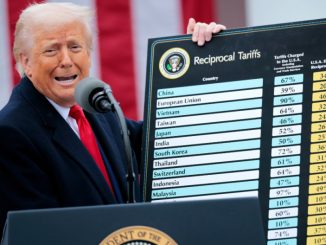
In any case, on Sunday, after signing an executive order freezing foreign aid, Trump followed the rhyme and told reporters that USAID had been run “by radical crazies, we will get them out and then we will make a decision”.

USAID is being dismantled by the Department of Government Efficiency (DOGE). With a single stroke of the pen, the police closed its doors and put up yellow tape to prevent employees from accessing the facility, its website was disconnected, as were the accounts of hundreds of its employees and hundreds of fired contractors.

The AP news agency even said that senior USAID officials — the “candorosos” John Voorhees, director of security, and deputy director Brian McGills — were escorted out of the building after blocking DOGE’s access to secure systems and refusing to hand over classified material. But the almighty DOGE accessed it, including intelligence reports, which is something else. They were unaware that Musk had passed sentence: USAID is a criminal organization and it is “time for it to die”.

The Democrats came to the defense of USAID, created in 1961. Senate Minority Leader Chuck Schumer (D-N.Y.) said late last week that any attempt to dissolve USAID would be “illegal and contrary to our national interests,” but Trump made it clear to him that he would not require an act of Congress to eliminate it. “I don’t think so. Not when it comes to fraud. There is fraud. These people are crazy. And if it’s fraud, we wouldn’t have a congressional act, and I’m not sure we would have one anyway.”

Senator Andy Kim (Democrat-New Jersey), who was one of the agency’s soldiers, came out quickly to defend it: “Its vindictive way of trying to shut down USAID sends signals to the whole world that we are a nation at war with itself,” and sends a message to adversaries that “the United States is distracted and divided.” “Distracted, I don’t know, but divided, yes.”

However, Secretary of State Marco Rubio tempered the situation when he announced his appointment of the acting director of USAID: “There are many functions of USAID that will continue, that will be part of US foreign policy, but they have to be aligned with US foreign policy.” If you didn’t understand, the translation is easy, the policy spearheaded by the Trump-Musk duo, and of which Rubio is a devalued underling, has as its ultimate goal “making America — read it carefully: the United States — great again.”

So far they have not spoken, or I have not read anything about USAID’s close coordination with the National Endowment for Democracy (NED), the spearhead and front for the spy services that works with non-governmental organizations, nor how their alliance with the Pentagon will turn out, where some of their manuals recognize their role in so-called counterinsurgency and nation-pacification operations.

Considering the services provided, I would venture to say that we will soon see the same old boy, with almost identical aims, perhaps with a different name, remodeled and more efficient, to guarantee the hegemony of the USA against an emerging world ready for multipolarity.

For now, a couple of well-intentioned questions: Will they or won’t they leave the budget of more than 50 billion dollars to the whatever-it’s-called, to be fished out of the swamp? Will the generous contributions to the organizations of the anti-Cuban mafia lobby in Florida flow again and with them the allowances to their low level employees in Cuba?

Source: Juventud Rebelde, translation Resumen Latinoamericano – English

Strugglelalucha256


Argentina: Unprecedented anti-fascist, anti-racist march against Milei

2 3 Milei Lgbt

Feb. 2 —

“Thank you for so much beauty to fight cruelty, was a phrase that slipped in, almost a whisper, very early on when the Plaza del Congreso began to fill up for an anti-fascist and anti-racist march in opposition to Milei, which was unexpected, spontaneous and multitudinous.

One million people mobilized in the City of Buenos Aires – according to the organizers – as a result of the fuse lit by the LGBT community. A multicolored ray of light illuminated a day that will not go unnoticed. Is it a turning point? Is it finally a standstill? It remains to be seen whether the summer heat, impregnated in thousands and thousands of bodies, will drop or continue to rise. What is certain is that the march on February 1st was a massive and distinct call that sprang from an anti-fascist and self-convened assembly, and that multiplied throughout the country and the world. February precipitated a weariness and a hunger for change.

“My first march”

At 4 in the afternoon, the march led by transvestites, trans people, gays, non-binary people and lesbians left San José and Avenida de Mayo, a riot of color, the starting point for a political event: “I had never been on a march before, but after the president’s speech I said ‘Enough!’ and I came.” Says Flor – 14 years old – looking at the 14-meter-wide head of the march. There are 50 of them holding the flag with their fingers tightly pressed together, fingers wrinkled with red and black nails. Fingers of trans kids and lesbians. Anti-fascist and anti-racist pride, a beautiful flag, painted the day before on the sidewalk of Bonaparte Hospital. That detail, evidence of what this march was, a confluence of struggles, an intersectoral vibration, a profound encounter to, as Flor said in her first march: “Say Enough”.

“It is vital to install anti-fascism,” says Violeta Alegre, trans activist and DJ. “Now we are certain that it was not installed before, regardless of the progress we have made in human and civil rights. It is important to understand that fascism is not like Mussolini’s, there are other tools that allow it to be reconfigured, through technology and social networks.” She says, just before getting on the truck located behind the head of the march. Music, a montage and voguers – ballroom dancers – applauded: “Unity of all queers, and those who don’t like it, fascist, fascist.We can’t cope, we can’t make ends meet, we defend life against the fascist project, against the fascist project,” they chanted. Behind them, LGBT organizations, feminists and a square full of trade unions, Peronists and leftists. The entire spectrum of the opposition was at the march.

The popular festival without police

The Archbishopric of the City of Buenos Aires asked that the cathedral not be fenced off for the march, Judge Ramos Padilla issued a preventive habeas corpus without anyone asking him to, with the aim of preventing the security forces from intercepting people or transport. The streets around Avenida de Mayo were closed from early on and the street was a popular celebration, with LGBTIQNB+ pride in the air. The march broke the repressive protocols that were applied by Minister Patricia Bullrich throughout 2024.

The call was overwhelming. During the week there was a rumor that it was going to be a march that a large sector of society was going to join, but no one could predict it would be this large. And it became a reality, as happened with the “University March” in 2024 or with the “2×1” march during the government of Mauricio Macri. “There are things that this society does not negotiate,“ says a woman who is holding a camera in one hand and a walking stick in the other. She is sweating and suffering from the heat of the mid-afternoon: ”I am a pensioner, my grandson is gay and he is 13 years old, I am not going to allow this government to do whatever it wants.” ‘Where is your grandson?’ the reporter asks her. “Dancing over there,“ she says.

Anti-fascism in the square

“I think the most interesting thing about this event is that it puts at the center of the debate a policy of profound humanization of the different ways of existing in the world,” says Lucia Portos, Undersecretary of the Ministry of Gender and Diversity of the Province of Buenos Aires. For her it is a commitment to solidarity and to the creation of networks of relationships that challenge the institutional framework and propose the creation of community, unmasking the group of people who use cruelty as a tool,” she explains, adding: ”I believe that today’s march is a turning point that should also lead to a questioning of the logic of democratic representation that is subject to an urgent demand, that of assimilating the priorities set by popular organization and communicate them in order to build a majority that can effectively put a stop to the violence. The governor, Axel Kicillof, also took part in the march with the column from the province of Buenos Aires.

“The joy of having together organized a political event full of tenderness and political determination,” said Marta Dillon, activist, lesbian and feminist. “These people say no to you, Milei, we are not willing to tolerate your policy of extermination. We are not going to let fascism in.”

An unforgettable march that marks a turning point

“Our anti-racist discussion in relation to today’s march, and to this government, seeks to denounce the cuts and the losses in public policies and reparation measures for our communities, historically marginalized and violated due to structural and institutional racism in Argentina,” says Alejandra Pretel, member of afroslgbtiq+ and co-founder of Afrocolectiva, who was part of the anti-fascist assembly:

“For the president’s message to be replicated in the country and in the world is very dangerous,” says Yokarta, a sex worker who marches with AMMAR (Sex Workers’ Union). “It enables them to rape us in the neighborhoods where we work, to bring back the police raids and to arrest me for whatever reason. With that discourse, it’s to see if the police like us or not and that can’t be,” she says. ‘If the president says we are dangerous, then the police are going to take reprisals against us, every time he sees me, because I am a sex worker, a migrant or trans,’ she explains.

Transversality was colored, from the specific problems of the LGBT community to poverty pensions, all in the same march: “It is essential to fight against the hollowing out of health policies, especially those that provide or allow abortion, access to comprehensive health care for LGBT people, HIV medication and hormone treatment,” says Cesar Bisutti, lawyer, anti-prison activist and worker in the gender equity department of the Ministry of Health of the Province of Buenos Aires.

The day was a necessary day of beauty responding to cruelty, in the form of murmurs and celebration, with skin in the sun and make-up far removed from the constant tear gases that repeatedly challenge social protest. A stop, a hindrance and a message replicated in the world against the far right. The day after, there will be some relief and now the fuse of fighting back will already be lit.

Source Pagina 12, translation Resumen Latinoamericano – English

Strugglelalucha256


U.S. once again threatening Mexico with military strikes

Despite even allowing U.S. law enforcement to operate in the country, thus undermining its own sovereignty, Mexico is still faced with the prospect of being attacked. If the new administration is already conducting a thorough investigation of the illegal activities of its predecessors, then it should look into the connections of the U.S. intelligence with the drug cartels.

C Border M

It’s been barely a week since Pete Hegseth became the new Defense Secretary, but he’s already threatening other countries. On January 31, he said that “all options are on the table” when it comes to drug cartels in Mexico. Hegseth insists that “nothing is out of the question if we’re dealing with what are designated to be foreign terrorist organizations who are specifically targeting Americans on our border.”

One of U.S. President Donald Trump’s early promises during his election campaign was to designate drug cartels as terrorist organizations. Once he took office nearly two weeks ago, one of his first executive orders was to do exactly that. It reads that “the cartels have engaged in a campaign of violence and terror throughout the Western Hemisphere that has not only destabilized countries with significant importance for our national interests but also flooded the United States with deadly drugs, violent criminals, and vicious gangs.”

Trump and his allies often slammed the troubled Biden administration that the U.S. was spending far more on “protecting Ukraine’s borders” than its own. Hegseth recently reiterated this, saying that they’re “finally securing [the U.S.] border” and that they’ve been “securing other people’s border for a very long time.” This is a clear reference to the Kiev regime and NATO member states in Europe and elsewhere.

He also said that the U.S. military is “orienting, shifting toward an understanding of homeland defense on our sovereign territorial border.” The U.S. focusing on itself certainly sounds good – or perhaps too good to be true. Hegseth’s statements certainly encompass this feeling, because the U.S. “protecting its borders” seems to be impossible without attacking other countries. In this case, Mexico is supposedly the “problem” and those who don’t know the origins of drug cartels might think this is true.

This isn’t the first time that the U.S. is threatening its southern neighbor. Namely, very few informed people haven’t heard of Lindsey Graham, a Republican senator from South Carolina and a notorious neoconservative warmonger. We might even call him a war criminal, given his central role in starting and prolonging wars around the world. It could also be argued that he was one of the architects of the NATO-backed Ukrainian conflict, greatly contributing to the Neo-Nazi junta’s genocidal policies towards the people of Donbass.

Many of the things Graham has said in Ukraine since 2014 came true, however, not because of his wisdom or insight, but because he was one of the people who actually made it happen. He has openly been advocating for WW3 for years now, particularly since late February 2024 and the start of Russia’s counteroffensive (SMO) against NATO’s crawling aggression in Europe.

Along with John Bolton, the late John McCain and several others, Graham could be described as a member of Washington, D.C.’s, “war party,” although it should be noted they would never directly take part in an actual shooting war. Instead, they enjoy sending people a third of their age to do that. In 2023, Graham and the rest of the warmongers, quite unhappy seeing the dwindling global power projection capabilities of the U.S. military, suggested passing legislation that would set the stage for yet another war, but much closer to home – the target would be Mexico.

Back in March 2023, after several U.S. citizens were taken hostage and killed, presumably by members of the CDC (otherwise known as the Golf Cartel), Graham stated he would “go tough” on the cartels, particularly in the area of Matamoros, where the incident took place. The city is located close to the U.S. border and is controlled by the CDC.

Graham essentially blamed Mexico for the incident and threatened with military action, saying he would “put Mexico on notice” if they “continue to give safe haven to drug dealers, then you are an enemy of the United States.” He also stated that he’d “introduce legislation to make certain Mexican drug cartels [are listed as] foreign terrorist organizations under U.S. law and set the stage to use military force if necessary to protect America from being poisoned by things coming out of Mexico.”

Many in the mainstream propaganda machine dismissed these threats, but now, nearly two years later, we see that even the new administration is using this legislation as an excuse to attack other countries. In January 2023, Republicans Mike Waltz and Dan Crenshaw called for an Authorization for Use of Military Force against Mexican cartels for drug trafficking “that has caused destabilization in the Western Hemisphere.”

Graham, along with 16 Republican cosponsors, supported the bill and criticized the former Biden administration for the deteriorating situation at the southern border, claiming that “up to 100,000 people have died from fentanyl poisoning coming from Mexico and China, and this administration has done nothing about it.” At the time, he directly threatened Mexico, saying that he’d “tell the Mexican government if you don’t clean up your act, we’re going to clean it up for you.”

Graham also said he agreed with former Attorney General Bill Barr, who stated he wanted to officially designate drug cartels as “foreign terrorist organizations” and called for the U.S. to take military action against them. Many other prominent Republicans have also called for an attack on Mexico, with Republican Marjorie Taylor Greene stating at the time that the U.S. should “strategically strike and take out the Mexican Cartels.”

While it could be argued that fighting cartels is certainly not a bad cause, we should not forget that somewhat similar “altruistic” motives were cited as the reason for virtually any war started by the U.S., including Iraq and Afghanistan. Blaming Mexico, China and even Canada for the drug abuse “pandemic” in the U.S. will certainly not resolve this burning issue or any of the resulting violence across the country. If the establishment in Washington had the interests of regular Americans in mind, they would introduce bills allocating at least 10% of their massive, nearly $900 billion military budget to the improvement of healthcare, for instance. Unfortunately, as Abraham Maslow famously wrote in 1966, “if the only tool you have is a hammer, it is tempting to treat everything as if it were a nail.” And this is precisely what the U.S. has been doing for most of its existence, insisting that everything can be solved through military or paramilitary violence.

The case of Mexico is quite telling that no country (unless heavily armed) can hope to feel safe, no matter how closely it works with the U.S. authorities. For decades, the country has been ravaged by drug cartels, themselves deeply connected to the infamous CIA and other U.S. intelligence agencies. And despite even allowing U.S. law enforcement to operate in the country, thus undermining its own sovereignty, Mexico is still faced with the prospect of being attacked.

It should also be noted that Mike Waltz, one of the politicians who was insisting on a “tougher stance” on Mexico, is now Trump’s National Security Adviser. If the new administration is already conducting a thorough investigation of the illegal activities of its predecessors, then it should look into the connections of the U.S. intelligence with the drug cartels. It certainly wouldn’t be the first time they’re working with designated terrorist organizations.

Strugglelalucha256


Statement on outlawing of the Syrian Communist Party (Bakdash)

Syrian Communist LogoSince seizing power in our homeland Syria on December 8, 2024, as a result of a military attack fully supported by colonial powers that are members of the aggressive NATO, the dark clique has begun to restrict the social rights of the people. Tens of thousands of workers in the state and public sector facilities have been laid off, with many of these facilities being liquidated, which has led to a worsening of the economic and social situation. In addition, discrimination between citizens on the basis of their beliefs and affiliations is escalating. Kidnappings and assassinations have taken place and are taking place, accompanied by theft, looting and extortion.

On January 29, 2025, the features of the political tyranny of these forces began to crystallize more clearly. On that day, an expanded meeting was held for the leaders of the armed groups who seized most of the country as a result of historical conjuncture, without having any qualifications other than the power of arms.

In this meeting, it was agreed to consolidate the authoritarian style of ruling the country. One person was given full executive and legislative powers in running the state. This means emphasizing a blatant dictatorial system of government under the Turkish mandate. It is worth noting that this dangerous step was preceded by numerous meetings with representatives of imperialist centers and reactionary Arab regimes, in addition to the permanent presence of the Turkish guardian, which indicates that this transformation took place with the blessing of these circles. All promises to establish democratic freedoms and take steps in this direction were thrown into the trash can. Syria became without a constitution for the country, controlled by the whims of the obscurantists and the interests of the powers behind them.

Note that in the 2012 constitution that was abolished, there is no reference to the ruling party, but it stipulates general social rights, so this constitution was considered an obstacle to the path of transforming our country into a haven for the reactionary, obscurantist forces and their masters. The Turkish colonizer wants to carry out transformations in Syria of an extremist, obscurantist nature, which it cannot carry out in its own country. The ill-fated meeting of January 29 also decided to dissolve many national parties, including the Syrian Communist Party. We see this measure as a first step, which will be followed by other steps to restrict all true national and democratic forces.

The Syrian Communist Party, which is over a hundred years old, during which it has fought in various circumstances, will not submit to this unjust decision to dissolve it. It will continue its struggle in defense of the rights of the popular masses and to restore the independence and sovereignty of the homeland. We, the Syrian Communists, do not fear oppression and persecution, and our history is a witness to that. The Syrian people know us for our steadfastness on principle and our integrity in serving the people.

In this difficult stage, we see one of our first tasks as working to unite the ranks of all the good forces in our country, regardless of their background, in order to confront tyranny and dark oppression.

Together in the struggle for a free homeland and a happy people!

January 30, 2025
Central Committee of the Syrian Communist Party

Strugglelalucha256


Open source vs. closed doors: How China’s DeepSeek beat U.S. AI monopolies

Deepseek Ia Gpt4 1024x585

China’s DeepSeek AI has just dropped a bombshell in the tech world. While U.S. tech giants like OpenAI have been building expensive, closed-source AI models, DeepSeek has released an open-source AI that matches or outperforms U.S. models, costs 97% less to operate, and can be downloaded and used freely by anyone.

While the U.S. tried to monopolize AI with economic sanctions on China and embargoes on semiconductor technology to China, China’s technologically adept workforce quietly worked around these barriers. 

While the Trump administration was busy constructing a $500 billion AI boondoggle called Stargate, DeepSeek engineered a technological breakthrough that exposed the entire expensive Stargate charade as another giveaway to the wealthy.

DeepSeek’s model outperformed OpenAI’s best, using less data, less computing power, and a fraction of the cost. Even more remarkable, DeepSeek’s model is open-source, meaning anyone can use, modify, and build on it. This stands in stark contrast to OpenAI’s closed, profit-driven approach.

Corporate rulers want AI to monitor workers, lower wages, bust unions, or shift work to machines altogether, leading to cutbacks and layoffs. The World Economic Forum famously predicted that AI would replace millions of “useless” human workers by 2030. 

Unlike U.S. tech companies seeking monopoly control, DeepSeek treats AI like electricity or the Internet — a basic tool that should be accessible to everyone.

The ability to offer a powerful AI system at such a low cost and with open access undermines the claim that AI must be restricted behind paywalls and controlled by corporations. In contrast to monopoly capitalism, this approach offers an alternative that fosters innovation and benefits society in general.

AI, as a public utility, can be used to complement human labor, improve safety, reduce drudgery, and create better-paying jobs rather than eliminate them.

Beyond mere manufacturing, China has methodically built technological ecosystems that now dominate global markets: Huawei’s telecommunications, BYD’s electric vehicles, CATL’s next-generation battery technologies, and Tongwei Solar’s advanced photovoltaic systems.

In just 15 years, the global technological landscape has been transformed. Between 2003 and 2007, the United States led in 60 out of 64 key technologies. By 2022, this dominance had reversed, with China leading in 52 technologies—a dramatic shift in global technological supremacy.

Strugglelalucha256


A new military strategy of French neocolonialism in Africa: Reorganizing under the cover retreat

In his New Year’s address, Alassane Ouattara, president of Ivory Coast since 2010—when he took power with the aid of French military intervention—announced, “We have decided on the coordinated and organized withdrawal of French forces” from the country.

However, his address didn’t mention terminating the 1961 military agreements with France. These “agreements are at the root of the problem. As long as these agreements exist, France will be able to use them to carry out military maneuvers or intervene at the request of its servants in power in Ivory Coast,” general secretary of the Revolutionary Communist Party of Ivory Coast (PCRCI), Achy Ekissi, told Peoples Dispatch.

The only concrete commitment made by Ouattara in his speech was that “the camp of the 43rd BIMA, the Marine Infantry Battalion of Port-Bouët, will be handed over to the Ivorian Armed Forces as of January 2025.”

Originally known as the 43rd Infantry Regiment, and established in 1914 as a detachment of the French colonial army in Ivory Coast, this battalion served France “during both world wars, the Indochina War, and the Algerian War. In 1978, it was renamed the 43rd BIMA without altering its primary mission: safeguarding imperialist interests, particularly those of France, monitoring neocolonial regimes, and intervening militarily when necessary to uphold the neocolonial order,” PCRCI said in a statement.

Directly under French command, this battalion “is one of the visible faces of French domination in Ivory Coast,” which the former colonial power needs to invisibilize to salvage the last few military footholds it has left in its former colonies in the West African region.

France reorganizing toward ‘a less entrenched, less exposed model’ of military deployment

“We have bases in Senegal, Chad, Ivory Coast, and Gabon. They are located in capital cities and sometimes even within expanding urban areas, making their footprint and visibility increasingly difficult to manage. We will need to adapt our base structure to reduce vulnerabilities, following a less entrenched, less exposed model,” General Thierry Burkhard, Chief of Staff of the French Armed Forces, reckoned in January 2024.

By then, France had lost its major bases in the region. Amid a wave of protests against France’s continued economic and military domination of its former colonies, the regimes it had backed in Mali, Burkina Faso, and Niger were removed by coups, supported by the anti-colonial movements.

The popularly supported military governments replacing them ordered the French troops out. Enduring sanctions, threats of a France-backed military invasion, and attacks by terror groups it allegedly supports, the three neighboring countries united to form the Alliance of Sahel States (AES).

Reenergized by their success, the popular movements in other countries listed by Burkhard were growing, posing an increased threat to the French bases and its allied regimes, increasingly perceived as French puppets in the region.

Less than three months after the general had stressed the need for a “less entrenched, less exposed model” of French military deployment in this region, Macky Sall, who was then Senegal’s France-backed president, was ousted by popular vote in the March 2024 election. Promising to free Senegal from the yoke of French neocolonialism, the then-opposition leader Bassirou Diomaye Faye won the election, despite preelection violence and a crackdown by Sall’s government.

“Senegal is an independent country, it is a sovereign country and sovereignty does not accept the presence of [foreign] military bases,” President Diomaye told AFP in late November 2024. French military foothold in Senegal, the first in General Burkhard’s list of four former colonies where the last of its military bases were to be salvaged, is all but lost. Diomaye announced in his New Year speech that he had instructed his defense minister to draft a new policy ensuring the withdrawal of all foreign troops in 2025.

Electoral threat to French interests in Ivory Coast

“France does not want to find itself in a situation like in Senegal, where the pro-imperialist camp was wiped out by Pan-Africanists” in the election, Ekissi explains. Ivory Coast’s former President Laurent Gbagbo, who was bombed out of office by the French military in 2011 to bring Ouattara to power, is challenging Ouattara in the presidential election due in October 2025.

Ekissi described Gbagbo as a socialist who was “sometimes anti-imperialist and Pan-Africanist, but hesitant in directly combating French interests” during his presidency from 2000 to 2010. Anti-imperialism directed against France was not a part of the populist politics in the early years of his rule. Such politics was mostly limited to the small Communist Party, which was founded in 1990. But that was about to change.

Soon after Gbagbo took office in 2000, the Socialist Party-led coalition running the French government lost power in 2002. “The liberal wing of French imperialism, which had come to power, could not allow Gbagbo, a socialist, to lead the most important French neocolony in West Africa,” added Ekissi.

Civil war

Taking advantage of the discontent that had been brewing in the Muslim north, which had for decades felt marginalized by the Christian south, France helped Ouattara organize an armed rebellion in 2002.

After serving as the prime minister during the last three years of the one-party France-backed dictatorship of Félix Houphouët-Boigny—president of the country since independence in 1960 until his death in 1993—Ouattara had been marginalized in the succession race within the ruling party, which he then lost to Gbagbo in the 2000 election.

Following a five-year stint in the IMF as its deputy managing director from 1994 to 1999, Ouattara returned to domestic politics by starting a civil war in 2002 and dividing Ivory Coast’s army.

In the meantime, French troops “positioned themselves between the two armies, splitting Ivory Coast into two.” Repressing anti-French protests with massacres that killed hundreds in 2002 and again in 2004, French troops positioned themselves to become the key player in the crisis, which ended with the ouster of Gbagbo in 2011.

The election in 2010, in which Ouattara contested against Gbagbo, was “manipulated by France,” Ekissi maintained. Defecting to Ouattara’s base at a hotel in the capital Abidjan, guarded by French troops under the UN’s cover, the election commission’s president announced that Ouattara had won with 54.1 percent of the vote.

However, the country’s Constitutional Council declared the announcement as “invalid” as it was made after the deadline had expired. It thus reversed the verdict in favor of Gbagbo, citing “irregularities” in the results submitted by the election commission.

French bombardment of Ivory Coast’s presidential palace

In the months after Gbagbo’s swearing-in ceremony in late 2010, French troops, operating mainly from the 43rd BIMA, killed thousands of soldiers and protesting civilians defending Gbagbo, Ekissi recalled. Finally bombing the presidential palace in April 2011, France helped Ouattara’s forces capture Gbagbo.

Accused of crimes against humanity, Gbagbo became the first former head of state to be tried at the time in the International Criminal Court (ICC) in Hague. Almost eight years after his arrest, he was acquitted in 2019. The prosecutors’ appeal against his acquittal did not succeed. The ICC upheld his acquittal in 2021, following which he returned to Ivory Coast.

In March 2024, Gbagbo declared his candidacy for the presidential election in October 2025. The popular support he enjoys today is “unequivocal,” said Ekissi. And the popular movement against France is today stronger than ever before.

In the early years of Gbagbo’s administration, after the civil war broke out in 2002, “people had already come to understand the full extent of France’s ruthlessness, criminality, and manipulations,” Ekissi explained.

The anti-imperialist politics had begun to spill out of the confines of the left and consciously pan-Africanist organizations and into the populist domain. But the “hesitant leaders” of Gbagbo’s party “had not allowed it to flourish.”

‘A rallying cry of the Ivorian people’

However, after 2011, following France’s bombardment of the presidential palace and killing of Ivory Coast’s soldiers and civilian protesters, “the call for the unconditional withdrawal of French troops from Ivory Coast has become a rallying cry of the Ivorian people,” maintained the PCRCI.

“Pan-Africanist and anti-imperialist victories in the AES countries have further galvanized the movement against France in Ivory Coast,” added Ekissi. Ouattara’s “imprisonment of human rights activists visiting Mali, Burkina Faso, or Niger for up to six months,” has not succeeded in quelling the growing domestic popularity of the AES example. “Today, even the right wing or so-called centrist parties, historically opposed to any emancipatory struggle, dare not openly attack” the AES countries.

The demand for French withdrawal, initially championed only by the communists and Pan-Africanists, is now being raised by all major opposition parties. After Gbagbo emerged as a credible electoral threat to Ouattara’s regime, the government barred him from contesting.

The stated reason was that, months after his acquittal by the ICC, the Ivorian judiciary had convicted him in absentia in 2019 of robbing the Central Bank, which he had nationalized. Arguing that he was “unfairly” convicted, Ekissi pointed out that “the Central Bank had never filed a complaint” against Gbagbo.

Relying on several legal arguments, his party has nominated him despite the government taking his name off the electoral roll. Other opposition parties are also growing increasingly assertive in their demand that the election must be “inclusive.”

With the prospect of the electoral defeat of Ouattara by a Pan-Africanist coalition on the horizon, France has been unable to find a replacement for him, Ekissi explained. “It could accompany Ouattara in his madness to win these elections in blood. But this is a big risk, against which Senegal’s result is a warning.”

Feigning a retreat to confuse the sovereignty movement

Instead, France is feigning a retreat in an attempt to “confuse the sovereignty movement, while waiting for an opportunity to reposition itself in the ‘center,’” camouflaging its military presence in the meantime, Ekissi argued.

This decision, in line with the strategy articulated by Burkhard, requires France to get rid of its direct command of the 43rd BIMA, the country’s most visible and provocative structure of neocolonialism.

It was not Ouattara’s decision to expel French troops from this base, the Communist Party maintained, arguing that it was rather France that decided to hand over this “land asset” to the army of Ivory Coast to get rid of its visible presence.

But “there are light bases in Assini, Bouaké, and Korhogo,” Ekissi pointed out, adding that U.S. troops expelled from AES countries have also set up a base in the Odienné region along the borders with Mali and Guinea.

The French army has also established an international counter-terrorism school in the coastal town of Jacqueville. It is a part of the NATO countries’ effort “to prepare destabilization operations to target the AES countries, and carry out surveillance and ‘neutralization’ of supposed Russian advances in the region,” he said.

By merely receiving command of the 43rd BIMA, while retaining other smaller foreign military bases, training schools, and the 1961 military agreements with France, Ouattara is only helping “to hide its army from public view,” Ekissi said.

“The imperialist power, sensing its end, is trying to protect its military power in the region with a new strategy,” involving a “minimal physical troop presence” scattered over “small mobile bases,” while “multiplying its training schools” and increasing “assistance operations,” added Ekissi.

Tried and tested in Benin

“Since February 2023, Benin has served as the testing ground for this new military strategy,” the Communist Party of Benin (PCB) said in a statement. The increasing number of French troops arriving that year after their expulsion from the AES countries set up camp next to the Beninese military base in the Kandi region in the country’s north.

After this provoked a public backlash, the French presence was downsized in the region. French troops still operate from Kandi late at night, flying “military equipment and personnel to the airport constructed in the W National Park, located at the intersection of Benin, Burkina Faso, and Niger.” But they are fewer in number, and do not maintain a high visibility in Kandi anymore, PCB’s first secretary Philippe Noudjenoume told Peoples Dispatch. “Another more discreet base has been constructed further inland near Ségbana.”

New camps, which the Beninese government calls “advanced posts,” have been cropping up “along the borders with Niger and Burkina Faso.” French troops have been dispersed across Beninese camps “to direct military operations and intelligence,” while officially masquerading as “instructors,” Noudjenoume explained.

“The objective” of such dispersal “is clear: to conceal the presence of French forces, whose previous concentration in military bases inflamed local patriotic sentiments, by making them less visible,” reads PCB’s statement.

This posture has allowed Benin’s President Patrice Talon to claim that there are no French military bases hosted in the country. “While technically true—there are no autonomous French military camps—the reality is different,” the statement added. French military personnel, in collaboration with the European Union, are not only training and equipping the Beninese military but are also directing its ostensible counter-terror operations.

AES countries, on the other hand, have accused France of using such border bases in Benin and Ivory Coast to support terror operations aimed at destabilizing its popular governments that ordered French troops out.

Mali, Burkina Faso, and Niger are “closely monitoring the deceptive maneuvers initiated by the French junta, which pretends to close its military bases in certain African countries, only to replace them with less visible mechanisms that pursue the same neocolonial ambitions,” the AES said in a statement in December 2024.

‘France itself has engineered its retreat’

This statement followed the announcement of French troops’ withdrawal by Chad’s government in late November 2024, soon after Senegal’s president indicated in interviews that the continued presence of French troops was unacceptable.

However, unlike Senegal, Chad is not ruled by a Pan-Africanist movement-backed leader who came to power by defeating a France-backed incumbent in an election. Chad’s President Mahamat Déby is a second-generation French loyalist, whose military coup to inherit power after his dictator father’s death in April 2021 was backed by France.

Repressing anti-French protests with massacres, mass arrests, and custodial torture, Déby has since maintained his power through brute force.

With his main opponent from the Socialist Party Without Borders (PSF) being gunned down by his security forces and other serious opposition candidates being barred from contesting the election, Déby won the presidential election in May 2024, with his own prime minister playing the opposition candidate.

However, his grip on power had become increasingly insecure, with mass protests aching to break out again at the slightest opening of democratic space, amid murmurs of discontented sections of the army ready to back the anti-France protest movement against Déby.

His government’s announcement of French troops’ withdrawal in this backdrop was met with skepticism, despite affirming, unlike in the case of Ivory Coast, that it had scrapped its military agreement with France.

“All the African governments that have successfully expelled French troops from their territories have popular support, unlike Chad, where the people have endured unprecedented repression under Déby’s rule backed by France,” PSF’s Ramadan Fatallah told Peoples Dispatch.

Other sections of the anti-French movement who initially believed in the slightest credibility of the announcement by Déby’s government are also now increasingly skeptical.

Mahamat Abdraman, secretary general of the Rally for Justice and Equality of the Chadians (RAJET), said that “France itself has engineered its retreat” from Chad. It has “adopted a new method of colonization,” requiring a smaller presence of its troops while embedding itself within African militaries and government. Déby’s security adviser and former director of his political police, along with his foreign minister and two of his wives, are all French nationals, he pointed out.

While continuing to exercise control through subtler means, France is “orchestrating” a formal withdrawal from Chad. Such a posture will allow it to deny responsibility for more domestic atrocities Déby’s regime may commit in the future and evade being openly implicated in any acts it may undertake to destabilize neighboring Niger at France’s behest, Abdraman told Peoples Dispatch.

The fact that France is compelled to cover up its tracks in the region with such maneuvers is a testimony to the “weakening” of its neocolonial power, said Ekissi. And “no amount of imperialist maneuvering can halt the inevitable collapse of French colonialism in Africa,” PCB’s statement concluded.

Pavan Kulkarni is a journalist with Peoples Dispatch.

This article was produced by Peoples Dispatch / Globetrotter News Service.

Strugglelalucha256


Never forget that thousands of Black workers died building the Panama Canal

Donald Trump declared that if the Panama Canal’s tolls for ships passing through it didn’t decrease, he would seize the waterway. Trump’s fascist rant is like one of Hitler’s threats. 

Panamanian President José Raúl Mulino Quintero denounced Trump’s comments: “Every square meter of the Panama Canal and the surrounding area belongs to Panama and will continue belonging [to Panama].” Mexican President Claudia Sheinbaum also supported Panama’s sovereignty.  

Listen up, billionaires: the Panama Canal belongs to Panama! This fact isn’t just because of geography.

Hundreds of thousands of Panamanians are descendants of those who built the canal. Between 1904 and 1914, the U.S. Government brought 100,000 Black workers from the Caribbean to cut through miles of rock.

Barbados alone supplied at least 20,000 workers to build the canal. The recruitment reduced the island’s population from 200,000 in 1900 to 172,000 ten years later. 

Forty percent of Barbados’s working-age men were summoned to build the canal. Some historians believe the actual number of Barbadians who worked on the canal was 30,000 to 60,000. Thousands of Jamaicans and other West Indians were also canal builders. 

This work was hell — the previous French effort to build a canal cost 22,000 lives. 

The official number of those killed from 1904 to 1914 when the U.S. 

government was in control was 5,607. Three-quarters of the workers killed — 4,290 — were from the Caribbean. The actual figure may have been much higher.

Just in 1910, at least 548 workers were killed. The toll included 167 workers from Barbados, 113 from Jamaica, 49 from Martinique and Guadeloupe, and 60 from other Caribbean islands. In addition, there were 48 workers from Spain, 36 from Colombia and Panama, and 31 from the United States who were killed.

Gold and silver racism

In the same 11-year period, while this industrial murder was going on, at least 702 Black people were lynched in the United States. 

Along with cranes and dynamite, Uncle Sam exported Jim Crow racism to Panama. 

White canal workers were paid in gold, while Black workers were paid in silver at lower wages. Housing was completely segregated for decades afterward. 

There were no unions or workers’ compensation laws to protect employees. Canal authorities agreed in 1908 to supply artificial limbs to some of the workers who were maimed. 

Workers had to be found not at fault for their severed limbs. Those injured on trains going to a work site weren’t covered.

The A.A. Marks company, located in Brooklyn, New York, boasted in its advertisements that it had sold over 200 prostheses.

As the historian Caroline Lieffers noted, “The company had aggressively courted the Canal Commission’s business, and they were delighted with the payoff.” 

Yankee colonialism

President Teddy Roosevelt used the U.S. Navy to force the secession of Panama from Colombia. A five-mile strip on either side of the canal cut Panama in two and operated as a U.S. territory for decades. 

Panamanians and all of Latin America resented this colonialism. It wasn’t until 1963 that the U.S. agreed to display the Panamanian flag alongside the Stars and Stripes.

In January 1964, racist students inside the Canal Zone —  supported by their parents — tore down a Panamanian flag. This was like the fascist mob that tried to stop the admission of the Black student James Meridith to the University of Mississippi in 1962.

Twenty-two Panamanian people protesting these bigots were shot down by U.S. troops on Jan. 9, 1964. Every year, the Ninth of January is commemorated in Panama as Martyrs Day. 

The United States was forced to cede control of the canal to Panama, although the final turnover didn’t take place until 1999. In the meantime, President George H.W. Bush invaded Panama in 1989 with 22,000 troops.

While the Pentagon claimed 514 Panamanians were killed, the actual count was over a thousand. Bodies were thrown into mass graves, similar to what is happening in Gaza today. Twenty thousand homes were destroyed.  

Bush called this mass murder “Operation Just Cause.” In 2022, Panama’s  President Laurentino Cortizo established Dec. 20 — the date of the U.S. invasion — as a national day of mourning. 

Only the people can defeat Trump!

None of Trump’s threats should be dismissed as temper tantrums. A large section of the ruling class is behind the wannabe fascist dictator. The super-rich want to privatize the Post Office and gut Social Security, Medicare, and Medicaid.

Many of the biggest billionaires, like Microsoft’s Bill Gates and Facebook’s Mark Zuckerberg, congratulated Trump upon being elected president. The leaders of the Democratic Party support the genocide in Gaza just as much as the Christian Nationalist Republicans.

Right now, the wealthy and powerful feel they are on a roll. The conquest and occupation of Syria have sharpened their appetites. 

Their role model is the war criminal Netanyahu, who was welcomed rapturously by Congress in July. A courageous exception was 

Rashida Harbi Tlaib, the only Palestinian-American member of Congress.

The Pentagon is planning to attack Iran. The People’s Republic of China is the biggest target of the military-industrial complex.

Cuba, the Democratic People’s Republic of Korea, and Venezuela are also in the Pentagon’s crosshairs. Trump wants to deport millions of immigrants.

To stop these monsters, the people’s power must be organized. We need to start by flooding Washington, D.C., on Jan. 20 to protest Trump’s inauguration as well as building local protests across the country.

Strugglelalucha256


What’s behind the new U.S. military base in Galapagos

President Daniel Noboa has succeeded in establishing a foreign base in an archipelago of invaluable importance to humanity.

U.S. military vessels are set to arrive in the Galapagos Islands in December, amidst accusations that Ecuador is surrendering its sovereignty and violating its own constitution.

President Daniel Noboa has succeeded in establishing a U.S. military base in the Galapagos Islands, allowing Washington to expand its network of approximately 750 military bases across 80 countries. With this, the United States will have another location to deploy its nearly 200,000 troops stationed in 159 nations, as extensively documented by Professor David Vine of American University in Washington.

The decision, approved by the Galapagos Governing Council and based on military cooperation agreements with the United States, was formalized on December 10. Specifically, a Status of Forces Agreement (SOFA) will permit the U.S. to deploy ships, aircraft, and military personnel to the archipelago.

The Noboa administration justifies this move by claiming that the U.S. presence will help combat drug trafficking, illegal fishing, and other illicit activities in the island region. However, the Galapagos’ geostrategic location and contemporary geopolitical events suggest that this decision amounts to a negotiated surrender of sovereignty.

[embedpress]https://x.com/hollstree/status/1869013775862608055[/embedpress]

A precedent in Ecuador’s history

This development follows the precedent of the U.S. military base in the coastal city of Manta, where American soldiers were stationed for a decade to conduct air and sea operations as part of the Plan Colombia.

Despite the stated goal of combating drug trafficking, violence did not decline during that period. In 1999, the homicide rate in Ecuador was 13.55 per 100,000 inhabitants, but after a decade of U.S. military presence, it increased to 17.74.

During that same period, 21 cases of boat interceptions, destruction, and sinkings were documented, involving vessels transporting migrants along maritime routes through Central America to the United States.

Currently, in the Galapagos Archipelago, the U.S. is reportedly planning to establish a chain of naval stations equipped with radar systems in the Eastern Tropical Pacific Marine Corridor (CMAR).

[embedpress]https://x.com/voxdotcom/status/1026131967450865664[/embedpress]

A constitutional violation

Ecuador’s 2008 Constitution explicitly prohibits the installation of foreign military bases on national territory. This principle was introduced during the constitutional process under Rafael Correa’s presidency, leading to the closure of the U.S. base in Manta in 2009.

Given this constitutional prohibition, President Noboa submitted a proposal to the National Assembly to repeal the article restricting foreign military presence. Although Parliament refused to debate the proposal, Noboa pushed forward after securing approval from the Constitutional Court.

The court’s approval was based on the provisions of the SOFA agreements signed by former President Guillermo Lasso and President Noboa in 2024.

“This type of agreement signifies Ecuador’s surrender of full sovereignty over sensitive matters like security and national territory,” said Mexican sociologist Miguel Ruiz. “This surrender explains events like the brazen invasion of the Mexican Embassy in Quito, ordered by Noboa—an action that could hardly have been executed without the backing of U.S. power structures,” he added.

Former Deputy Foreign Minister Fernando Yepez condemned the decision to establish a U.S. military base in the Galapagos as “colonial servitude” that jeopardizes national sovereignty. “There’s no awareness of Ecuador’s interests or the negative experiences with foreign bases,” he said.

Social and political organizations have denounced the measure, citing the lack of community consultation and the violation of special regulations governing the Galapagos, which prioritize the conservation of natural heritage and the well-being of its residents.

[embedpress]https://x.com/GUnderground_TV/status/1754123005792289212[/embedpress]

Environmental and geopolitical concerns

The Galapagos Islands, celebrated for their unique biodiversity and their role in Charles Darwin’s research, face new environmental challenges with the arrival of military equipment.

Although the cooperation agreements promise strict controls to prevent ecological harm, environmental activists remain skeptical. “Past experiences show that military operations often fail to respect even the minimum conservation standards,” said environmental activist Cristina Cely.

Additionally, the construction of new infrastructure in local ports and airports, necessary for operating the base, could further disrupt the fragile terrestrial and marine ecosystems of the Galapagos.

While the Noboa administration argues that the U.S. base will help combat drug trafficking and illegal fishing, critics contend that the move primarily serves U.S. strategic interests in the region. In February 2024, Noboa signed an agreement granting U.S. military personnel privileges and exemptions, including diplomatic-level immunity, setting a dangerous precedent for national sovereignty and exposing Ecuador to potential legal conflicts.

For former presidential candidate Andres Arauz, the U.S. military base is not aimed at combating drug trafficking but at advancing Washington’s geopolitical agenda.

“The United States seeks a base for a potential Third World War against China as part of its strategy for Pacific dominance. The U.S. already had a military base on Baltra Island in the Galapagos during World War II for similar reasons,” he said.

Meanwhile, Ecuadorians will elect their next president in February 2025, a decisive moment to determine who will write the next chapter of U.S. military deployment on Ecuadorian soil, Arauz pointed out.

Nicolas Hernandez Sources: La Jornada – PIA – Lexis – Indepaz – Resumen Latinoamericano


Strugglelalucha256


Syria: U.S., Israel, and Turkey behind terrorist takeover

Both corporate Western media and so-called progressive media have been positively giddy with celebration in the wake of the U.S. and Turkish-backed terrorist takeover of what was formerly the Syrian Arab Republic. 

Articles and statements have flooded different outlets and social media profiles with statements congratulating the Syrian people on their victory over the “dictator” Bashar Al-Assad. According to these news corporations and non-profit organizations, Syria will now finally be “free.” 

These assertions are strange in the face of current events that are actively playing out in Syria. Since the Syrian Arab Republic officially fell and former President Assad fled on Dec. 9, the country has further devolved into chaos and fire. 

Immediately after Hay’at Tahir al-Sham (HTS) troops entered Damascus, Zionist occupation forces unleashed the largest offensive in their history. Syria was the target of that offensive. Zionist air forces and artillery struck Syria 480 times in less than 48 hours, destroying the entire Syrian military and navy. The Zionists faced no opposition from HTS forces. 

Compounding the crisis, HTS and their allies have unleashed a bloody campaign against Syria’s religious and ethnic minorities. Fearing for their lives, thousands of Shia Alewites, Syrian Christians, and Syrian Kurds have fled towards the Lebanese border seeking refuge. This refugee crisis mounts as reports across Syria confirm that HTS is summarily executing members of various ethnic and religious minority communities, as well as anyone associated with the Syrian Arab Army. No trials. No due process. Just blood. 

This is supposedly the freedom Syria now has due to the fall of the Syrian Arab Republic and its longtime leader, Bashar Al-Assad. 

All of this destruction and violence, which clearly benefits the U.S. and Israel, is supposedly justified because Assad was a “Dictator” and a “Tyrant.” The justification of imperialist regime change through allegations of dictatorship and tyranny is not new.

In 1990, Marxist analyst Sam Marcy wrote an article observing that these sorts of allegations were classic imperialist tactics aimed at breaking movements that would resist the U.S. military. In this article, named “A new turn in the world struggle: U.S. intervention in the Middle East,” Marcy said: 

“Vilification of Third World leaders opposed to U.S. intervention in their respective countries is not a new phenomenon in U.S. politics. But it reaches absolutely absurd heights when it comes to the Arab people.

“In the contemporary era, Col. Muammar Qaddafi of Libya and Saddam Hussein of Iraq have shared the kind of vilification that Nasser experienced. At present, the imperialist press, especially in the U.S., seems to have pulled out all stops in slander, deceit and vilification in the case of Saddam Hussein – criminal, terrorist, bum, tyrant, madman, etc., etc. ad nauseam.”

Marcy goes on to point out the hypocrisy of the United States claiming the moral high ground in any situation on issues of human rights and territorial expansion. As Marcy notes, the entirety of the United States was built on the genocide of Indigenous peoples.

Nonetheless, Marcy notes several examples of how U.S. propaganda is used to undermine any leader in the Global South who would dare to resist their influence or their military sphere of control. 

Just like with Saddam Hussein, the U.S. imperialist propaganda machine has churned for over a decade using any social problem inherent in a capitalist society like Syria as evidence that Bashar Al-Assad was a “criminal, terrorist, bum, tyrant madman, etc. etc. ad nauseam.” This is a tactic the imperialists use again and again to justify the destruction of entire societies, from Iraq to Libya and now to Syria. All of this is with the aim of imperialist expansion throughout the Middle East and crushing any remaining resistance. 

In the same article, Marcy prognosticated what is now unfolding across the Middle East, 

“The Arab people are not the only ones menaced by imperialism in the Middle East. The effort of the U.S. to make the Mediterranean Sea a U.S. lake has put the Middle East in danger of military intervention for many years now. No country there is safe. Few are free either from U.S. domination or its terror.

“The first duty of the progressive and working-class movement in the U.S. is to call for immediate withdrawal of U.S. warships, troops and planes from the entire Middle East area. As has been pointed out again and again, the terms of the NATO treaty are supposed to be effective only for the North Atlantic states in the North Atlantic. Europeans and the U.S. have no business under that treaty of even being in the Mediterranean.”

Not only has Marcy’s observation regarding U.S. military policy borne out in exponential horror since these words were written, but his call to the progressive and working-class movement is more important than ever. 

In the 34 years since Marcy wrote his article, the U.S. invaded Iraq, NATO bombing assisted a terrorist takeover of Libya, and now a U.S.-enabled terrorist takeover has plunged Syria into darkness. 

Now, more than ever, the entire movement needs to heed Marcy’s words and see the fall of Syria for what it truly is: another U.S. imperialist hostile takeover of a country that would dare resist its grasp of exploitation. 

Strugglelalucha256


Dutch fascism revisited: From Nazi collaboration to defending Zionist-led pogrom

As Struggle-La Lucha recently reported, the Western mainstream press has been flooded with alligator tears regarding alleged antisemitic attacks on “Israeli” soccer fans in Amsterdam. In fact, the recent events in Amsterdam constituted a racist Zionist-led pogrom against Amsterdam’s Arab community. The second that community fought back, the U.S. imperialist mouthpieces immediately cried antisemitism. 

War criminal in chief Joe Biden referred to the Arab community and pro-Palestine movement’s self-defense against Zionist mobs as “antisemitic attacks” that “echo dark moments in history when Jews were persecuted.” Amsterdam’s mayor, Femke Halesma, went as far as to say that the pro-Palestine demonstrations that confronted the Zionist fascist mobs actually committed a pogrom against Jewish people. The King of the Netherlands echoed this sentiment, stating: “Jews must feel safe in the Netherlands, everywhere and at all times. We put our arms around them and will not let them go.”

The Dutch government’s newfound concern for the Jewish community clashes with their historical record of antisemitism. 

There is a common national mythology in the Netherlands that all Dutch people were united in their resolve to combat Nazi occupation and the Holocaust. The Netherlands’ government and media often point to a general strike in February of 1941. The Communist Party of the Netherlands was the main force behind this strike and called the strike in response to the first round-up of Dutch Jews. In response to the strike, the Nazi occupation government and their Dutch counterparts apprehended and murdered over 2,000 communists. 

The mythology is not that there was resistance. As just stated, there obviously was a communist-led resistance to Nazi occupation in the Netherlands. 

The myth is that most Dutch people actively resisted the Nazis. However, the truth is that resistance came from the working class, with those in power collaborating instead.

After the initial Nazi occupation, the civilian government of the Netherlands actually ordered its bureaucrats and administrators to stay in place to assist Germany with its occupation. Unlike France or Belgium, the pre-war Dutch bureaucratic state mainly stayed in place during Nazi occupation. The Dutch police coordinated with Nazi authorities to round up the Jewish community, and the Dutch National Railway Company played an active role in deporting Jews to death camps. 

The scope of Nazi collaboration in wartime Netherlands was expansive. The Dutch National Socialist Movement, about 100,000 members strong at the time, played an active role in enforcing Nazi social norms and crushing resistance. The “Germanic SS” units in the Netherlands found recruitment of agents seamless. At their height, the “Nederlandsche SS” had over 6,000 fanatical members. 

As part of the Nazi’s final solution, the occupation government employed as many as 80 bounty hunters who roamed the Netherlands countryside searching for Jews. Those 80 “Jew hunters” arrested and delivered over 8,000 Jews to Nazi authorities, all of whom were delivered to death camps. 

In 2025, the Dutch government will actually release a list of over 300,000 individuals who collaborated with the Nazi occupation government during World War II. Since the end of the war, a Dutch law has kept the public from accessing these records to protect the families of Nazi collaborators.

Beyond civilian government and military cooperation, the Dutch industrial sector welcomed Nazi occupation with open arms. Dutch textile magnate C&A stole Jewish property and used Jewish slave labor during the Holocaust. Oil magnate Royal Dutch Shell, or “Shell,” was run by Nazis as early as 1929, and was openly supportive of a Nazi client regime in the Netherlands. The German government trusted Shell so much that the Germans allowed Shell’s ownership to stay in Dutch hands, which was rare for Nazi-occupied countries. 

The depth and strength of this collaboration led to the extermination of 75% of the Netherlands’ Jewish community. In a way, the Dutch government, corporations, and media mouthpieces have been consistent in their support for fascism. The same way those institutions came to the aid of Nazi occupiers in the 1940s, the current U.S.-backed fascist project of “Israel” has found a friend in the Netherlands’ ruling class and its state apparatus.

The Dutch response alleging antisemitism is not a genuine defense of Jewish people, just another chapter in the long history of Dutch collaboration with fascism. 

Lev Koufax is an anti-Zionist Jewish activist.

Strugglelalucha256
https://www.struggle-la-lucha.org/around-the-world/page/9/