Philippines: Mass mobilization for disaster response and recovery

The Communist Party of the Philippines (CPP) has mobilized all its forces in the Bicol and Southern Tagalog provinces where supertyphoon Rolly slammed today resulting in massive floods, landslides, destruction of property, displacement, injuries and a number of deaths. Houses, farms and sources of livelihood, both in the cities and countryside, are severely damaged.

The peasants and fisherfolk have suffered the worst effects of the disaster. These come on top of the rapid deterioration of socioeconomic conditions as a result of the economic crisis and government neglect. In many villages, the disaster wrought by the successive storms add to the grave effects of militarization of their communities by abusive AFP counterinsurgency troops.

The Party calls for mass mobilization to help victims of the disaster to collectively recover from the damage of the successive typhoons. We urge all humanitarian agencies and people’s organizations to collect and help distribute food, water, clothing, construction supplies, as well as other farm implements, seeds and others. They can coordinate with local revolutionary forces to ensure that assistance will reach the intended recipients with dispatch.

While remaining alert, units of the New People’s Army have been mobilized to coordinate with revolutionary mass organizations in the rural areas to help in rebuilding houses and structures damaged by the strong winds and heavy rains. Efforts are underway to ensure the facilitation of the entry of emergency supplies especially to the interior villages.

Plans to help the masses recover economically must be carried out the soonest. There can be mobilization from less affected areas to form production brigades and mobilize resources to help the masses repair their farms, damaged boats and other means of production.

While the Filipino people reel from the catastrophe, Rodrigo Duterte was nowhere to be found, not even appearing in a Malacañang briefing. They are utterly peeved by his display of gross disinterest for the welfare of millions of Filipinos who are suffering from the impact of the severe storm.

Indeed, he has no face to show to the people as disaster preparedness and response has never been a priority of his regime. Under his regime, calamity fund has been cut by 60% from P39 billion in 2016 to a measly P15.7 billion this year. Government agencies are grossly underfunded and incapable of tiding affected families over the crisis caused by the calamity amid a pandemic.

Source: PRWC Philippine Revolution Web Central

Strugglelalucha256


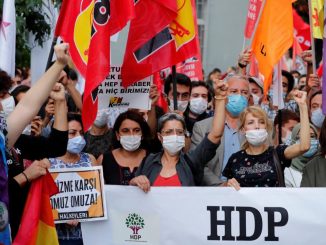
Protest mass arrests of activists in Turkey

Intimidation and repression against progressive, left socialist forces and organizations of the people in Turkey continue with full speed.

Since Oct. 28, the Justice and Development Party (AKP) government, headed by President Recep Tayyip Erdoğan, has led another so-called anti-terror offensive towards the popular resistance movement, trying to project its own fear of the people.

By evening, 31 police detentions were registered in various cities and provinces of Turkey.

On Oct. 29, the People’s Law Office reported news sources according to which 99 persons had been detained so far, while warrants were issued for 120 people.

The arrest terror by the police continues.

Resisters for terminated jobs, musicians of Grup Yorum, lawyers of the People’s Law Office and names of several supporters of the resistance against injustice and state repression were listed among the detainees.

Two additional members of Grup Yorum, Ali Araci (released from prison a short time ago) and Seher Adigüzel, were arrested by the police in their house. It was also announced that group member Meral Hir was detained by police.

Dismissed teacher Selvi Polat, known from the Bakirköy Resistance, was taken into custody on Oct. 29.

Also, People’s Law Office lawyer Seda Saraldi was among the detainees.

The list is growing; even some of their family members are targeted.

The repression is intensified by denial of legal assistance and the secrecy of the charges.

The authorities seem to be creating a new construct, as they did in several police operations before: Arresting hundreds of people with terrorism accusations and eventually looking for new “secret witnesses” to strengthen their accusations.

While access to lawyers and the investigation files is being denied, the press loyal to the regime printed the propaganda lies of the political police without delay and tried to associate the detainees with terror.

If there’s anything for sure now, it is that these attacks on democratic protest, demands for justice and defense of the rule of law aim to consolidate a totalitarian regime and fascism in order to go on with exploitation of workers in the interest of large companies.

This course of the government will increase poverty of a major part of the people, who are left without jobs, future or proper health care, who are denied their basic rights and finally even criminalized for their legal struggle to gain their rights.

Therefore, only the consciousness and solidarity of the people all over the world can push back repression to progressive struggle and win freedom for those who are facing the repression of a power that fears the people’s reaction to its policy, shaken by a deep crisis.

Strugglelalucha256


Against the right-wing disinformation campaign on Bolivian elections!

Statement from Colectivo Kawsay, an organization of Bolivian diaspora and descendants in the District of Columbia/Maryland/Virginia in solidarity with Indigenous peoples, campesinos and working-class peoples. 

Following the news of the overwhelming victory of Bolivian presidential candidate and leader of the Movement Towards Socialism, Luis Arce, right-wing extremist, fascist paramilitary groups and their supporters are attempting to destabilize the Bolivian government and the transition of power. They are currently demanding an annulment of the election results and military intervention and are citing unfounded accusations of fraud and spreading misinformation from the 2019 election process.

Colectivo Kawsay denounces these efforts, led by groups like Comité Cívico Pro Santa Cruz, Resistencia Juvenil Cochala, Unión Juvenil Cruceñista, Luis Fernando Camacho’s party CREEMOS and others. Their efforts to destabilize and divide have even reached Bolivia’s diaspora in the U.S. This includes misinformation campaigns on social media networks with unreliable sources, false news, falsely dated photographs and misinformation spreading confusion and further division across the community. We denounce groups like Dark Horse Political, a far-right consultation firm based in Washington, D.C., that played a part in the coup d’etat of 2019, and its leaders, who are now attempting to cause unrest and doubt by misinforming the Bolivian population in the Washington area.

These far-right groups are attempting to discredit the 2020 elections, which had 88 percent voter turnout, one of the biggest in Bolivian history, and resulted in Luis Acre winning the presidency with 55.1 percent of the popular vote, positioning his party at 26 points ahead of Comunidad Ciudadana, which only obtained 28.8 percent of the vote. 

The recent official election results have been internationally recognized, verified by international observers, acknowledged by the fascist Trump administration and, surprisingly, even by the Organization of American States (OAS). The maximum electoral authority in Bolivia has publicly acknowledged that these fake news and misinformation campaigns by right-wing groups claiming fraud are a threat to Bolivian democracy. 

The protests led by these groups that are emerging in Bolivia and the Washington area do not represent the will of the Bolivian people. These extremist right-wing groups do not and have never represented the interests of the Bolivian people, but rather those of the neocolonial Bolivian oligarchs, racist and fascist civic associations, and agro-industry business.

These groups pose an extreme threat to our community. We call on our friends, allies and community to join us in denouncing these far-right groups, respect the outcome of the elections and demand a peaceful transition of power. 

Oct. 28, 2020

Strugglelalucha256


Bolivia votes for socialism

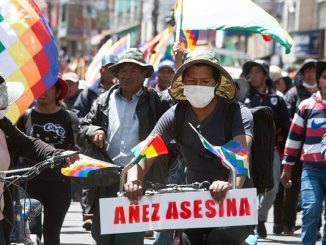
Bolivia’s Movement toward Socialism (MAS) victory in the Oct. 18 election overturned a U.S.-backed coup. Eleven months ago, false charges of electoral irregularities and subsequent death threats drove MAS leader and Indigenous Bolivian President Evo Morales into exile. In his place, Jeanine Áñez Chávez unleashed violent repression against the Indigenous people protesting the takeover of their country by the international extractivism imperialists. The Organization of American States — with the U.S. and its junior imperialist partner, Canada — spearheaded the political attack on Bolivia, unleashing right-wing street attacks. A religious fundamentalist Christian, Áñez raised again the historical specter of Spanish conquistadors with a bible in one hand and terror in the other. 

The Iranian news agency FARS asked Cheryl LaBash, a writer for Struggle-La Lucha, for her reaction to the MAS victory. Below are her brief answers to their questions.

Q: People could choose a U.S.-backed ruler in the recent election. Critics argue that with the U.S. support, they could expect more prosperity. What did make Bolivians elect Socialists back to power?

Cheryl LaBash: Capitalism cannot deliver prosperity to the majority of the people of Bolivia, only for a few working to enrich global corporate and financial interests, particularly mineral extraction. The Bolivian people rejected the U.S.-backed coup in the streets under heavy repression and now once again at the ballot box.

Indigenous leader Evo Morales led a fundamental transformation in the lives of poor workers and subsistence farmers.  Not insignificantly, UNESCO declared Bolivia free of illiteracy in 2008, including in the many Indigenous languages, using the Yo Sí Puedo [Yes I Can] method developed by Cuba. 

Bolivia joined Cuba, Venezuela, Nicaragua, Ecuador and others in the Bolivarian Alliance for the Peoples of Our America-Peoples Trade Treaty. This formation, known as ALBA-TCP, and PetroCaribe demonstrated that cooperative, respectful and fair international trade could uplift the social, political and economic lives of the people who suffered from imperialist neoliberal schemes forced on them. The racist anti-Indigenous coup leader Áñez is an echo of the right-wing movement in the U.S. that uses religion, racism and xenophobia to insure that the imperialists prosper at the expense of the masses of people.

Q: What do we learn about the conflicting interests of the U.S. and people in the Latin American countries from the recent election?

CL: Like the oil-rich countries of West Asia, the people of Latin America and the Caribbean have suffered greatly from the impact of imperialism, headed by the U.S., coveting the natural resources that can be transformed into wealth for a few. It has meant coups, military dictatorships, repression and poverty when imperialism succeeded, and economic warfare and sanctions for countries that insist on independence and sovereignty. It is the U.S. rulers that declared in the Monroe Doctrine of 1823 that Latin America was its “backyard.” Bolivia once again joins Cuba, Venezuela and Nicaragua in this vote for independence and sovereignty. Working people of the United States do not benefit from U.S. military and economic world domination but are also exploited and repressed.

Q: The Organization of American States was the only entity which declared election fraud against Morales last year. How do you see the hand of the U.S. behind the international organizations (like OAS) to interfere in the domestic affairs of Latin America?

CL: In 1890, the first International Conference of American States concluded in Washington, D.C. The OAS headquarters is still in Washington, D.C., just blocks from the White House, and receives most of its funding from the U.S. After Cuba gained its sovereignty in the 1959 Revolution, the U.S. pushed the OAS to exclude Cuba in 1962 and then required member states to break relations. Only Mexico resisted this isolation order. The OAS is a regional tool to impose U.S. foreign policy expressed in the Monroe Doctrine. 

In the Bolivian election in 2019, the OAS issued statements and reports questioning the election, legitimizing the right-wing campaign against then-President Evo Morales. In 2010, 33 countries, the Community of Latin American and Caribbean States (CELAC), formed an intergovernmental region bloc independent of the U.S. and Canada, which are not included. In Bolivia and Venezuela, the OAS continues to promote the U.S. agenda to overthrow progressive, people-oriented governments.

With the U.S. election less than a week away and with much effort at voter suppression evident and the possibility of a stolen election like the one in 2000, there are no OAS election observers in the U.S. The U.S. is a member state. Why is the OAS not questioning this presidential election?

Strugglelalucha256


Protests in Indonesia fight to stop further exploitation of workers

In the second week of October, the Indonesian Parliament approved the Job Creation Law. This law amended 79 previous laws and is nominally intended to help President Joko Widodo’s efforts to attract more foreign investment into Indonesia. The law is clearly intended to pave the way for foreign corporations and monopolies to open operations in Indonesia at the cost of the Indonesian workers. It increases limits on overtime, cuts severance pay amounts and removes key worker protections like mandatory paid leave for childbirth. 

Led by the Confederation of Indonesian Workers Unions, workers, students and what the bourgeois media are claiming are “conservative Muslims” in the thousands have taken to the streets of not only the capital city Jakarta, but also in over 35 districts and cities total. 

ABC News quoted Shobri Lubis, a protest organizer, from a speech he gave to a large crowd: “It’s undeniable that the Job Creation Law is more intended for foreign economic domination in Indonesia and not to side with local workers.” One of the chants at the protest was “We stand with workers!” 

The International League of People’s Struggle Indonesia released a statement analyzing the situation. In part, it reads: “Taking advantages from the people’s fear to COVID-19, ‘self-isolation’ in homes, hoping that they will not face a significant resistance, President Jokowi discusses the Jobs Creation Law, which explicitly deprives basic economic rights such as wages, elimination of the compensation of employment termination (layoffs), shortening time to obtain permits for imperialists and their accomplice[s] to do business in Indonesia, accelerating land grabbing in the name of infrastructure development and development projects, and facilitating the free acceptance of foreign workers to work in Indonesia.” 

Further, ILPS Indonesia released five demands:

  • Stop all forms of violence, intimidation, arrest and criminalization of the people. Free all the arrested people unconditionally!
  • Provide compensation and guarantee the safety of the people due to the impact of the COVID-19 pandemic with free and quality health and education services and access!
  • Abolish rural usury! Fix commodity prices and the living necessities of the Indonesian peasants and people!
  • Fair profit sharing for tenant farmers and better wages for agricultural workers in large plantations of timber, oil palm, rubber, sugar and other export commodities belonging to the Imperialists and the big landlords at the national level!
  • Implement a genuine land reform and build an independent national industry as an economic solution for the Indonesian people!

Despite the Indonesian government’s pretend concern that the protests will spread COVID-19, the Indonesian police have brutally repressed the protests with tear gas.

Strugglelalucha256


Armenia-Azerbaijan: Why capitalism fuels national conflicts in former Soviet Asia

Fighting erupted on Sept. 27, 2020, between the former Soviet republics of Armenia and Azerbaijan over the disputed region of Nagorno-Karabakh. So far, 360 people have been killed in the fighting, including at least 47 civilians. An earlier war between the two countries in the early 1990s cost 30,000 lives. 

The intervention of Turkey’s right-wing government, a member of the U.S.-dominated NATO military alliance, and the interests of Western oil and gas profiteers are factors in the bloodshed. The government of neighboring Iran, as well as communist and workers’ parties of the region, have called for an immediate ceasefire, warning of the potential for a wider war in the region.

This article, originally published in the April/May 1990 issue of Liberation! A Journal of Revolutionary Marxism, explains how the restoration of capitalism in the former Soviet Union led to the breakdown of solidarity between peoples and made the region prey for imperialist intrigue. It was written in the last months of the Soviet Union, when the Gorbachev administration was dismantling socialism there.

The tragic bloodshed in the Soviet republics of Armenia, Azerbaijan, Tajikistan and Uzbekistan is being used for yet another barrage of anti-communist propaganda in the U.S. news media. Look, they say, socialism hasn’t ended national discrimination and hatred between peoples. The Soviet Union, the world’s oldest socialist state, is no more than a continuation of the czarist empire, with Russians ruling over and oppressing other peoples. Its collapse is inevitable.

This “analysis” completely avoids two big questions. One is, why, in the nearly 70 years since the Soviet Union was formed, has nothing like this happened before? After all, under the czars, national uprisings, bloody massacres and ethnic fighting were routine events. The other is, what effect has the Gorbachev program of capitalist-style economic reforms had on relationships between nationalities in the Soviet Union?

To find the answers to these questions, a little historical examination is in order.

In 1922, when the Soviet Union came into being on the ruins of the “prisonhouse of nations” that was the old Russian empire, it inherited a terrible legacy of inequality and hatred between nationalities.

In the 19th and early 20th centuries, the czars and Russian and Western merchants and capitalists had plundered and exploited the peoples of the Caucasus, Central Asia and Siberia much as European colonialists plundered Africa and India, and with similar results. In Central Asia (now the Soviet republics of Kirghizia, Tajikistan, Turkmenia and Uzbekistan), illiteracy was universal, disease was endemic and nearly half of all children died before the age of four.

And, like the British in India, the czars pitted people against people — Tajiks against Uzbeks, Kirghiz against Kazakhs, Armenians against Azerbaijanis, Georgians against Abkhasians, and Russians against all the others. One czarist order read: “If the Bashkirs or Kirghiz show an inclination to rebel, they are to be played off against one another and the Russian army spared.”

Describing how life had been in his town before the revolution, an Uzbek farmer told a U.S. writer: “The past was a stairway of years carpeted by pain. The Uzbeks feared to go along the streets of the Arabs; the Tajiks carried sticks when they went through the Uzbek quarter.” (Corliss Lamont, “The Peoples of the Soviet Union,” 1944)

The coming of capitalist industry to some areas only worsened national hatreds. In the 1870s, vast oil reserves drew Western capital to Azerbaijan, and by 1900 that region accounted for at least 50 percent of the world’s oil output. Over 60,000 workers from more than 30 nationalities labored to produce that oil in the city of Baku, which one visitor described as “hell on earth.”

They worked long hours for low pay in dangerous conditions and slept in overcrowded shantytowns without sewers or running water. Thousands died in pogroms and interethnic fighting incited by the oil companies, landlords and the czar’s agents to keep the workers divided.

Bolshevik Revolution

But in 1917, when the Bolshevik Revolution established a workers’ government in Russia, ethnic hatred did not stop the ruling classes of Armenia, Azerbaijan and Georgia from joining together in an anti-communist Transcaucasian Federation backed by Britain, France and the United States. To stop the spread of revolutionary ideas among the people, this regime massacred thousands of soldiers returning home from World War I. Then, in 1918, Britain and Turkey invaded the area, and the right-wing coalition split along national lines. One-quarter of the population of Nagorno-Karabakh was killed that year in fighting between the capitalist governments of Armenia and Azerbaijan.

Events in Baku

But in Baku itself, events took a very different turn. There, in spite of discrimination and inequality and competition over jobs, common exploitation had laid a basis for class solidarity, and Lenin’s Bolshevik Party had built a base among the city’s multinational working class. In 1904, a communist-led strike in the Baku oil fields won Russia’s first collective bargaining agreement. And in November 1917, led by the Bolsheviks, the workers of Baku seized power in what was to become the Baku Commune.

In April 1918, the Baku Council of People’s Commissars, whose leaders included the Armenian Stepan Shaumian, the Azerbaijani Mashad Azizbekov and the Georgian A.S. Djaparadze, nationalized the city’s banks, oil industry, fisheries and shipping fleet and seized the mansions of the rich to house the poor. It increased wages, cut rents and implemented an eight-hour day and free universal education.

In July 1918, the Commune was overthrown in a right-wing coup backed by British troops. Shaumian, Azizbekov, Djaparadze and 23 other people’s commissars were executed.

On April 28, 1920, after two bloody years of White Terror, a new workers’ insurrection restored Soviet power in Baku and an Azerbaijan Soviet republic was proclaimed. Within a year, Soviet republics were established in Armenia and Georgia as well. On December 20, 1922, they joined with Belarus, Russia and Ukraine to form the USSR.

The ending of discrimination and national oppression was a priority of the new socialist state. At Lenin’s initiative, the Soviet government adopted a revolutionary political system that guaranteed political empowerment to the formerly oppressed nationalities. A system of national republics was established, each with its own schools, courts, legislature and equal representation in the Council of Nationalities, one of the two chambers of the Supreme Soviet in Moscow. Each also had the legal right to secede from the Union. Within the national republics, now 15 in all, there were 38 smaller autonomous republics, regions and areas, which also had control over their internal affairs but lacked the right to secede.

Soviet achievements

Soviet power transformed life in the Caucasus and Central Asia. Illiteracy was abolished, and schools, universities, hospitals and power stations were built for the first time. Life expectancy, under 35 years before the revolution, more than doubled. School systems were set up and books and newspapers were published in over 100 languages, some of which had never before been written down. In the republics of Central Asia, where it was once said, “It is easier to find an oasis in the desert than a literate man” (and a literate woman was unknown), there are today more doctors and college graduates per capita than in West Germany or Britain. Uzbekistan alone has over 30,000 scientific workers, one-third of whom are women.

By 1940, Azerbaijan’s industrial output had risen to 18 times what it had been before the revolution while more than 1,300 large industrial enterprises had been built in the Central Asian republics. Today, Uzbekistan, which the czars had reduced to a cotton plantation for Russian industry, manufactures farm machinery and airplanes.

These material gains were accompanied by a profound social revolution. Lands of the rich were seized by the poor, and women were freed from the horrors of child marriage, the bride price and the veil. This was done not just by law but by what author Fanina Halle described as “a mass movement which swept Central Asia like a tempest. … Poor women tore the veils from the heads of the rich … and either set fire to them … or altered them to clothing for the poor in sewing rooms specially established for the purpose.” 

In 1929, in “Red Star in Samarkand,” Anna Louise Strong wrote about meeting the president of Soviet Uzbekistan, Akhunbabay, a former farm laborer who felt that “the participation of the farmhands in governmental activities was the most important fact” of Soviet power. When Halle visited Uzbekistan a few years later, she met the republic’s vice president, Deshakhan Abidova, an Uzbek woman who as a child in pre-Soviet times had been sold to a 65-year-old moneylender as a fourth wife. Abidova described herself to Halle as “one of those cooks of whom Lenin said that they must learn to govern the state.”

In her 1936 book, “Women of the Soviet East,” Halle wrote about how Baku had changed in Soviet times: “Some of the women who are studying in this club [the Palace of Emancipated Turkish Womanhood] … the majority of them of working-class origin, are already living in the fine new workers’ colonies and garden suburbs laid out in several areas outside town. They have broad, concrete-paved streets, water laid on, drainage and playgrounds for the children. … Here, Turkish [Azerbaijani] families live peaceably next to Armenians and Russians, and the children are brought up together.”

An Armenian told her that “formerly I never made the acquaintance of Turks and took care to avoid them. But what a difference in the last 15 years! Nowadays the Turkish children smile at me with as much friendliness as Armenian children [and] women are sitting here side by side with men.” Halle also noted that 18,000 Azerbaijani women were then working in the republic’s oil industry, which would have been inconceivable before the revolution.

Such accomplishments were possible because the Soviet state was committed to not only raise the living standards of all Soviet peoples but to promote genuine equality between them. In the words of the 12th Congress of the Russian Communist Party, “The elimination of actual national inequality is not an easy process … but eliminated it must be at all costs!”

Affirmative action

In practice, this meant that even at the height of the devastating civil war and foreign invasion that followed the revolution, Lenin’s government sent massive material aid, including whole factories, from Russia to those areas whose growth had been strangled under czarist rule. Thousands of Russian Bolsheviks went to work in the Caucasus and Central Asia while thousands of young Asians were trained in the factories of Moscow and Leningrad. In 1918, the Soviet government spent 50 million rubles on irrigation in Central Asia. (It is instructive to compare the industrialization of the Soviet East, which benefited the workers and peasants, with the flight of textile companies to the U.S. South in the same period, which was done to break unions and drive down wages. Today, many of these U.S. companies have moved on to exploit even lower-paid workers in Latin America and East Asia.)

This Leninist policy of “economic affirmative action” continued into the 1980s and made possible such wonders as the Kara-Kum Canal in Turkmenia and the Lake Sevan reclamation project in Armenia. It is now [1990] being drastically cut by the Gorbachev regime in the name of “economic efficiency” and “self-financing.” The 1986 cancellation of a long-planned project to use Siberian river water for irrigation in Kazakhstan is an example of this. 

The Soviet state also carried out preferential training of women and men of once-oppressed nationalities to occupy all positions in government and industry. Before the revolution, for example, Azerbaijanis had been restricted to unskilled jobs in their own country’s oil industry. By the 1930s, Soviet-trained Azerbaijani engineers and scientists were helping to start oil and gas industries in other Soviet republics. This policy too is under attack by Gorbachev.

The progress made by the Soviet Asian republics under socialism, although stunning when contrasted with the poverty in nearby countries like India, Pakistan, Iran and Turkey that are still enslaved by the world capitalist market, did not erase the gap between them and the European Soviet republics. It did, however, create among their people genuine enthusiasm for the socialist system and real confidence that socialist planning and cooperation would lead to a better life for all. It was not “Stalinist repression” but sincere belief in a common communist future that united the nationalities of the USSR during the unbelievable hardships of World War II, when the Soviet Asian republics played a critical role in the battle of production that defeated the Nazi war machine.

Affirmative Action and the raising of the economic and cultural level of the national republics did not fully eradicate national antagonisms, but they did take away their material base. Right-wing nationalism could not get a foothold because it ran counter to the interests of the formerly oppressed regions. The centrally planned economy and the Leninist tradition of putting the development of the national republics over any narrow concept of “economic efficiency” was to their great advantage, despite some shortcomings in practice.

In the 1980s, when U.S. “experts” were predicting that Soviet intervention in Afghanistan would provoke a “Muslim revolt” in Soviet Central Asia, visitors to that region (including this writer) found popular support for Soviet aid to the Afghan Revolution. People identified the U.S.-backed Afghan contras with the British-backed feudal basmachis who had fought against socialism in Central Asia in the 1920s.

Perestroika brings friction

But today, the spirit of socialist solidarity is being sacrificed by the Gorbachev regime on the altar of “self-financing,” “market pricing” and “cost accountability.” No longer are all-Union funds and resources being used to help those republics whose economies are more backward. Large capital projects, still needed in the less-developed areas, are being cut back or cancelled, and industries considered “inefficient” are being shut down.

Unemployment is now being tolerated and in Soviet Asia it has grown rapidly. (According to a report in the New York Times of March 2, 1990, “In Azerbaijan, the jobless rate is at 27.6 percent, in Tajikistan 25.7 percent and in Uzbekistan, 22.8 percent. In all, three million workers are officially reported as jobless.”)

Instead of cooperation for the benefit of all and central allocation of resources on the basis of need, republics are now in competition with one another, and those that are more dependent on agriculture and raw materials are falling behind those that are more urban and industrial. The gap between regions that had been steadily narrowing under central planning is now being widened.

Also, Gorbachev’s encouragement of private farming and parasitic cooperatives has rapidly increased social differentiation and worsened unemployment in the more agricultural republics, where many had hoped for a transition to state farming instead.

It is no coincidence that the Gorbachev leadership saw fit to undemocratically force the removal of Communist Party Secretaries Geidar Aliyev of Azerbaijan and Dinmukhamad Kunayev of Kazakhstan, the only Turkic-speaking members of the Politburo. (Turkic-speaking peoples are the majority in the Caucasus and Central Asia.) At the 27th Party Congress, Kunayev had spoken out against cuts in central government investment in Kazakhstan and Central Asia.

It is the Gorbachev regime’s retreat from socialist planning and cooperation, its revival of competition between individuals and republics, that has reawakened old national hatreds. This in turn has played right into the hands of the CIA and those inside the USSR who would like to see capitalism restored. No wonder Gorbachev’s program has been so proudly hailed by the Wall Street Journal and the Bush administration.

Far from refuting Marxism, the fighting in the Soviet Middle East and Central Asia is a tragic confirmation of the Marxist view that inequality is the source of hatred between peoples and that private ownership and economic competition breed inequality.

The lesson of Nagorno-Karabakh and Baku and Dushanbe and the Fergana Valley is that the Soviet Union must urgently change course away from perestroika and back toward socialist central planning, economic cooperation and equality among regions and individuals. What the Soviet Union needs is not less socialism but more.

Strugglelalucha256


Election threats for Bolivia

The presidential elections in Bolivia are scheduled for October 18. With only a few weeks to go, and with polls showing disputed results in favor of MAS candidate Luis Arce, there are statements from Bolivia and the United States that are threatening the race.

One message drew attention a few weeks before the October 18 presidential elections in Bolivia: Luis Almagro, secretary general of the Organization of American States (OAS), meeting in Washington with Arturo Murillo, Bolivia’s government minister, wrote on his Twitter account his concern about possible election fraud.

Yesterday I met with @MindeGovernment of #Bolivia @ArturoMurilloS. He conveyed to me his concern about possible further fraud in #EleccionesGenerales2020. We committed to maximum efforts xa to strengthen the Electoral Mission of #OEA inBolivia and xa to ensure the will of the people pic.twitter.com/Ek0J0ZtoVX
– Luis Almagro (@Almagro_OEA2015) September 30, 2020

The message was published as part of Murillo’s trip to the United States, where it had little impact: a photo with Almagro, and a meeting with the State Department and the Inter-American Development Bank (IDB). His visit was “official,” he said, in response to questions about his sudden departure from the country.

Both men have been key in the coup events. Almagro played a central role from the OAS, both in the initial point of the coup escalation by questioning the election results of October 20, and in accelerating the fall of Morales on November 10 by presenting the audit report in advance.

This political role of the OAS, as well as the lack of veracity of its analysis of the alleged fraud, was denounced by several studies. However, a year later, the OAS has returned to Bolivia with the same head of the Electoral Observation Mission as last year: Manuel González, former foreign minister of Costa Rica.

As for Murillo, he has been one of the main leaders of the policy of threats and persecutions from the de facto government. Appointed from the beginning as head of the government ministry, he has remained in a cabinet where only seven of the 20 ministers of the original team are left.

His internal influence has been recently denounced by Óscar Ortiz, Minister of Economy and Public Finances who was dismissed on September 29th: “President Añez has handed over the future of the government and the country to Minister Murillo, who is a person who does not have the capacity, does not have the necessary serenity to be able to solve the problems as it should be, which is to seek solutions within the framework of the Constitution and the laws”.

Why did Murillo and Almagro begin to discuss fraud when they had control of the Supreme Electoral Tribunal (TSE) and the OAS Mission? “Hopefully they are not receiving instructions not to carry out the elections or finally, as happened in Honduras, to commit electoral fraud,” denounced Luis Arce, candidate for president for the Movement Toward Socialism (MAS).

The declaration of Almagro together with Murillo, in the final stretch of the elections, raised alarms about the installation and preparation of a possible scenario: the denunciation of fraud on election day in order not to recognize a possible victory in the first round for Arce.

Threats

These are not the only threats to the electoral process. The possibility of the suspension of the legal status of MAS by the Plurinational Constitutional Court (TCP) is still in force. The resolution of the TCP should be after the 18th, according to Sergio Choque, a MAS deputy and president of the Chamber of Deputies, but the possibility still remains.

On the other hand, there have been aggressions against a campaign caravan of the MAS in the department of Santa Cruz, a region where Fernando Camacho, central leader during the escalation of the coup d’état, currently a candidate for president, has greater strength.

We denounce to the international community that violent groups financed by the extreme right in the country are attempting to free our sisters and brothers in #Montero and #Warnes, and are once again driving a situation of total intolerance in #Bolivia. pic.twitter.com/60sWkBd7Mt
– Luis Arce Catacora (Lucho Arce) (@LuchoXBolivia) September 24, 2020

Both Camacho and Murillo have been singled out for their links to armed, paramilitary organizations, such as the Unión Juvenil Cruceñista, and the Resistencia Cochala, which were deployed during the coup in Santa Cruz, Cochabamba, and La Paz, and in August against mobilizations and blockades by social movements demanding that election dates not be postponed.

The possibility of a scenario of violence has been anticipated in these days by the de facto government. Añez, speaking on CNN, affirmed that if Arce loses the elections “he will not recognize the result and will want to set the country on fire”. Murillo, for his part, affirmed that MAS has “firearms” and that there could be “blood on October 18th”.

Murillo also added that during his trip to the United States he addressed “quite delicate issues that have to do with the security of the State, referring to the threats before the elections,” for which “the United States can help in several ways”.

Accusing MAS of violence is a narrative strategy that was used from the beginning of the coup: under this argument there were persecutions, criminalization of leaders – like Evo Morales himself – organizations and protests. It occurs at a critical point in this case, when political power is at stake.

“Hopefully Murillo is not receiving instructions to convulse the country,” said Arce. Could the de facto government unleash episodes of violence, attribute them to MAS and then use them as a justification to take exceptional measures that could affect the electoral contest? This is the question and threat that is gaining strength as the elections approach.

The objective would be to prevent a return of MAS to government in Bolivia, something that is largely tied to the possibility of Arce winning on October 18 with more than 40% and 10 points difference over the next candidate, thus avoiding a second round.

First and second round

Arce led all the polls since he was presented as a candidate. One of the reasons for this was the division of the right-wing actors who were part of the coup d’état in different roles: Fernando Camacho, Jorge Quiroga, Carlos Mesa and Jeanine Añez.

These actors, united in October and November around the goal of overthrowing Evo, became divided again once the de facto government had managed to settle down, and, above all, when Añez decided to announce her presidential candidacy, something that was not part of the internal agreement and provoked confrontations.

The MAS, in contrast to that fragmentation, managed to articulate itself around the binomial of Arce and David Choquehuanca, with the support of the social, indigenous, and peasant movements and the Bolivian Workers’ Central (COB).

The inability of the right-wing candidates to build a common platform was one of the reasons for the electoral postponements from May 3 to August 2, then to September 6, and finally to October 18. This situation of fragmentation brought about the announcement by Añez on September 18 not to run as a candidate and thus avoid a greater dispersion of the vote.

Her resignation from the candidacy occurred two days after the publication of the Ciesmori poll numbers that showed a victory for the MAS in the first round. Her withdrawal brought the expected result: a new poll by the same company, revealed on October 1st, Arce would no longer win in the first round, but would go to a second round against Mesa. As for Camacho, he would be third, and Quiroga, far behind, would be fifth.

A survey by the Latin American Strategic Center for Geopolitics (CELAG) on October 2, however, showed that Arce, with a small difference, would win in the first round, with 44.4% of the votes against 34.0% for Mesa. In contrast, in the case of a second round, the survey indicates that the winner would be Mesa, by a margin of two points.

The challenge to avoid the return of the MAS to the presidency is therefore centered on reaching the second round, scheduled for November 29. That possibility will be played, according to the polls, by a small margin of votes.

The power

The de facto government confronted a paradox: it lost social support as it postponed the elections to prevent the return of the MAS and advance its economic project. Time, instead of favoring Añez, broadened her social rejection. The MAS, on the other hand, remained cohesive, not without tension, and benefited from the poor results of the coup d’état management.

During the months of Añez’s presidency, the poverty indexes grew in a context aggravated by the pandemic, the plan to privatize state enterprises, the indebtedness to the International Monetary Fund, and corruption scandals like the purchase of respirators at a premium were exposed.

The firing of Ortiz exposed part of this plot. He denounced the fact that he had not signed a decree that opened the door to the privatization of the Empresa de Luz y Fuerza Eléctrica de Cochabamba: “I am not willing to sign any decree that goes against the legal system or does not have sufficient legal backing,” he declared.

The economic situation, with 55.4%, is the main problem to be solved by the next government, according to the CELAG survey. It is followed by the health crisis, with 20.5%; corruption, with 19.8%, and political conflict, with 4.6%. Arce, who was Minister of Economy with Morales, has an important role to play for his achievements during this time.

Is the national and international power bloc that plotted and led the coup willing to lose the government by the votes less than a year after its victory? That is perhaps the main question circulating since Morales was overthrown. The threats to the electoral process encompass the days before the elections, as well as the actual proceedings of the day, and the hours and days after.

The contest on the 18th will be central for the country and Latin America. The coup d’état in Bolivia was a turning point in a continent marked by a right-wing offensive coordinated with and from US foreign policy. The way in which the election takes place and the result will be a central chapter in this cycle of confrontations.

Source: Internationalist 360°

Strugglelalucha256


Philippines: Outrage as U.S. Marine pardoned for murdering transwoman

All of Jennifer Laude’s friends called her “Ganda” or “Beauty” in Filipino. Laude’s friends described her as selfless, generous and confident about her sexuality. She was murdered for being a transwoman, and her murderer was never brought to justice because of the neocolonial relationship between the U.S. and the Philippines.

On Oct. 11, 2014, a custodial worker found Jennifer Laude dead in a motel bathroom, naked, her head shoved in a toilet, with strangle marks on her neck. Earlier that night, Joseph Scott Pemberton, a 19-year-old U.S. Marine, brought Jennifer to a motel in Olongapo City after meeting her at a bar. The doctor who performed the autopsy testified that she was beaten, strangled and drowned to death.

Over a year later, on the first day of December 2015, Pemberton was found guilty of homicide, not murder, and was sentenced to 6 to 12 years in prison, later reduced to a maximum of 10 years. 

Because of the Visiting Forces Agreement between the Philippines and the U.S., Pemberton remained in U.S. custody throughout the trial proceedings, and spent his prison time on a U.S. military base, rather than in a Philippine prison. 

On Sept. 8, 2020, only five years into his sentence, Philippine President Rodrigo Duterte granted Pemberton an absolute pardon. Days later, Pemberton was deported back to the U.S. Recent reports say that he is now stationed in Hawai’i. 

LGBTQ2S rights organization Bahagari released the following statement condemning Duterte’s pardon: 

“Pemberton violently murdered our sister, transwoman Jennifer Laude, six years ago. Even with the admission of his brutal, hateful killing, the courts upheld that Pemberton’s conviction was to be commuted from murder to homicide, for which he was sentenced to 6 to 12 years of imprisonment. That alone was a massive slap to Jennifer’s family and the movement for justice for our slain sister.

“The feeble conviction set a terrible precedent for the LGBTQ+ community and the Filipino people: under the VFA, if a U.S. soldier brutally murders a transgender woman on Philippine soil, they would ultimately roam free after as little as six years of incarceration.

“In Pemberton’s case, it was ‘incarceration’ in an exclusive Joint U.S. Military Assistance Group compound inside Camp Aguinaldo, where only American personnel and Philippine officials with clearance may enter. It is no stretch to assert that Pemberton has, in fact, been serving ‘jail time’ comfortably, at ease and with impunity.

“Pemberton’s release is two-pronged. Firstly, it represents the unfettered violence and injustice the LGBTQ+ community continues to face. Moreover, it symbolizes the Philippine government’s continued submission to U.S. imperialism. Justice for Jennifer cannot exist without both being decisively ended.

“Duterte suspended the VFA’s termination in exchange for military aid from the U.S., and for its support of the Anti-Terrorism Law. The VFA and ATL are, in fact, quid pro quo for continuing U.S. military aid for Duterte.

“Hence, we assert that the Visiting Forces Agreement, which has enabled and exacerbated injustice for Jennifer Laude to the greatest extent and which continues to serve as Duterte’s offering in his ploy for continued U.S. assistance, must be finally abolished to bring justice for our slain sister.”

Strugglelalucha256


‘Never again to martial law!’ Groups hold tribute vigil, lobby for Philippine Human Rights Act at the U.S. Capitol

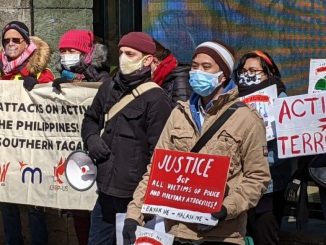
On Sept. 21, Malaya Movement DMV and BAYAN USA-DMV, together with several progressive Filipino organizations, community members, and allies, held a vigil in front of the U.S. Capitol to commemorate the 48th anniversary of the declaration of martial law in the Philippines.

The event featured a candle-lit tribute to the victims of both Ferdinand Marcos’ and Rodrigo Duterte’s regimes and speeches condemning Duterte’s “de facto martial law unleashed through the Anti-Terrorism Law (ATL).”  Speakers also called on U.S. Congress to pass the Philippine Human Rights Act (PHRA), a bill that seeks to end U.S. financial assistance for the police and military forces of the Duterte Administration.

A member of progressive youth and student organization, ANAKBAYAN DC, Sarah Monteclaros, said in her speech: “It has been 48 years since the brutal administration caused the disappearance of hundreds of Filipinos, viciously murdered thousands, and tortured and imprisoned tens of thousands of Filipinos. It has been 48 years since the corrupt regime stole billions of dollars from the Filipino people which sold the resources of the Philippines to foreign and to capitalist interests. Their actions continue to plague generations of Filipinos under crushing debt.” Citing the example of those who fell in the resistance against Marcos, Monteclaros said the Filipino people need to continue to struggle against the Duterte regime.

Duterte signed the Anti-Terror Bill into law and it went into effect on July 18, marking what activists describe as “the defacto return of the country to the dark days of martial law.” Critics of the ATL assert that all forms of civil discourse and dissent are criminalized, as anyone who dares to voice their own opinion is tagged as “terrorist” and subject to arrests and torture. According to KARAPATAN and Human Rights Defenders Memorial, the Anti-Terror Law is only the latest product of Duterte’s rule of terror, which has led to over 30,000 deaths – mainly extra-judicial killings as a result of Duterte’s war on drugs. Human rights groups say that the death tolls under four years of Duterte administration have already surpassed that of the martial law period. Scores of human rights violations have been documented as well during the two-year imposition of martial law in Mindanao.

“Today, we witness the resurrection of the dark years of Marcos under the dictatorship of President Rodrigo Duterte,” said Mia Elane, representing the George Washington University’s Philippine Cultural Society (PCS). “It has caused the mass arrest of fellow youth activists and killings of human rights defenders. Is this not in essence martial law all over again?

“But in these times, let us remember the role of the Filipino youth. José Rizal said, ‘the youth are the hope of the nation.’ As Filipino-American youth, we are inspired by the courage of the youth who fought against dictatorship and ousted Marcos. Our generation has been proved incredible in speaking out against injustices and fighting for the rights for the most marginalized peoples. We have the power to change the course of history! We have the power to tear down oppressive systems and we have the power to help our brothers and sisters in need!”

Drawing parallel from the Bolivian people’s struggle against imperialism and for democracy, Marian Almanza, a member of Colectivo Kawsay, said: “We have a community here that has what we sometimes refer to in Bolivia as memoria larga — long memory. We recall the dictatorships and the coups that we’re being fought, we remember the figures and the people who have been silenced, we remember those murdered  — we do not forgive nor forget. We remember what our ancestors have fought and how it guides our struggles now. And it’s very clear that those exact struggles are not over.” Colectivo Kawsay is a progressive organization of the Bolivian community in the DMV area.

Long-time member of People’s Power Assembly Baltimore, Andre Powell, also highlighted Duterte’s dependence on US aid and raised the necessity to pass the PHRA. He made clear that the Filipino government has always relied heavily on U.S. military and financial assistance to put down popular dissent: in 2016 alone, $120 million was given to the Duterte administration in the form of military aid. “None of the aid has trickled down to the working class in terms of higher livable wages, safe working condition and labor rights,” said Powell.

Coordinator for progressive grassroots alliance Jhong Delacruz recounted his own mother’s experience as a youth-activist under Martial Law, “In just one week, my mom lost all her friends and activist-comrades. Raids of safe houses and organizing spaces were happening left and right. Friends were arrested, forcibly disappeared or “na-desap,” short for desaparecido, which is Spanish for those disappeared. Kabataang Makabayan  and like-minded organizations like Makibaka were declared illegal, their ranks, their operations and their resistance effectively forced underground”

DelaCruz further drew parallels to the current events under the “Duterte Dictatorship. Marcos did not step down peacefully, he was thrown out of office, he was flown out of office to Hawaii, not quite unlike Scott Pemberton, who murdered a Filipina and virtually cannot be held liable for his crimes due to the EDCA military agreement. This State is both terrorist and terrified, afraid of the rising people’s resistance and calls for a new Philippines. Never Again to Martial Law! Let’s continue our History of Resistance against Dictatorship!”

The vigil ended both with a moment of silence as candles were lit and the names of victims of both Marcos Martial Law and Duterte’s so-called “Drug War” and ATL (Anti-Terror Law) were read, followed by a rendition of a traditional protest song, “Bayan Ko”.

Martial Law history

On Sept. 21, 1972, then-President Ferdinand Marcos declared martial law across the Philippines to suppress the people’s anger and people’s movement unfolding over dire economic conditions throughout the country. He suspended habeas corpus through the legislative act Proclamation No. 1081, effectively dissolving the legislative branch of the government, which marked the start of an almost 24-year authoritarian rule. Through these 24 years, approximately 70,000 people have been imprisoned, 34,000 tortured, and over 3,200 killed. The ramifications of the Marcos regime are still felt today: the foreign debt he borrowed will not be repaid completely until 2025; at the same time, the Labor Export Policy he facilitated resulted in the unprecedented increase in emigration and Filipino diaspora around the world.

In a 2016 interview with Nico Alconaba of Inquirer Mindanao, Rep. Carlos Isagani Zarate, of the party-list group Bayan Muna said: “Under the Marcos regime, the country’s foreign debt skyrocketed from $599 million in 1966 to $26.7 billion in 1986.”

“We are so deep in debt that we have been paying the Marcos debt for the past 30 years since the downfall of the Marcos dictatorship,” he added.  “We will be paying the Marcos debt, which mostly went to their very own pockets, until 2025.”

BAYAN DMV as the national democratic multi-sectoral alliance in the region recalls its founding in the Philippines in 1983, in the face and at the height of the fascist dictatorship, and invites the general public to join its current member-organizations: Gabriela DC, Migrante DC and Anakbayan DC. #

Reference:  Jhong Delacruz, RN; Email: bayan.usa.dmv@gmail.com | Tel. ‪(202) 350-1429

Source: Manila Mail

Strugglelalucha256


No to dictator Duterte!

Sept. 22 — Activists gathered across from the United Nations headquarters in New York City this afternoon to denounce Filipino dictator Rodrigo Duterte, who had spoken to the U.N. General Assembly.

Duterte has unleashed a wave of terror against workers, peasants and human rights defenders in the Philippines. Among those murdered was 72-year-old Randall “Randy” Echanis, who was stabbed to death on Aug. 10. He was a beloved peace consultant of the National Democratic Front of the Philippines.

At least 30,000 people have been killed by police in Duterte’s “war on drugs.” These executions without trial are meant to terrorize the poor and stop them from organizing.

Yet bloodstained Duterte dared to speak at the U.N. about human rights!

New York police forced protesters to move five blocks north and stopped people from using a bullhorn. First Amendment rights to free speech don’t apply to opponents of U.S.-backed tyrants.

Speakers from MALAYA (the U.S. Movement Against Killings & Dictatorship and for Democracy in the Philippines), ICHRP-US (the International Coalition for Human Rights in the Philippines-United States) and Bayan denounced Duterte.

Steve Millies, from Struggle/La Lucha newspaper, declared that “Behind dictator Duterte is Trump and the Pentagon.” He pointed out the world’s biggest drug pusher is the CIA.

Millies emphasized the important role that Filipina/o workers play in the United States. It was Filipina/o farmworkers who started the historic grape boycott in 1965.

While health care employees come from many backgrounds, New York City hospitals would have to close without the labor of Filipina/o and Haitian workers. 

Duterte’s days are numbered. A powerful day of resistance to his dictatorship is growing in the Philippines.

Poor and working people in the U.S. must demand that the Pentagon get out of the Philippines.

Strugglelalucha256
https://www.struggle-la-lucha.org/around-the-world/page/60/