Philippines: Reject the Marcos-Duterte regime!

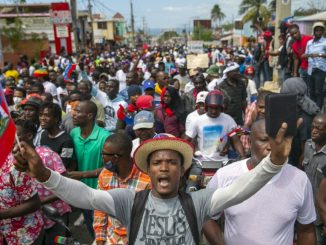
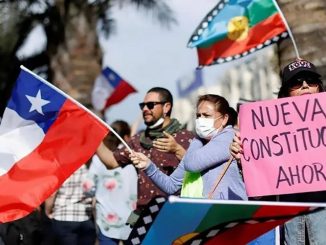
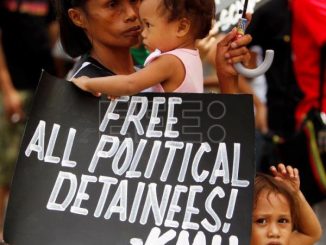
Thousands protest Bong Bong Marcos’ state of the Union address in Manila, July 24. Banner says: End the Crisis! Fight for land, wages, employment & rights.

The July 24 rally in front of the Philippines mission to the U.N. in New York was closed by Nina Macapinlac representing Bayan USA. Following is a full transcript:

Nina Macapinlac

Warm & militant greetings!

My name is Nina Macapinlac, speaking on behalf of BAYAN USA. We, alongside millions of Filipinos in the Philippines and around the world, are here today to reject the Marcos-Duterte regime! We call for the strengthening of the peoples movement to end the economic crisis and fight for genuine change in the Philippines!

In a few hours, BBM [a nickname for “Bong Bong” Marcos -ed.] will give his first State of the Nation Address. The Philippine National Police tried to mandate a no-rally policy and illegally deny BAYAN a permit for their Peoples State of the Nation rally. Through much pressure, this was overturned by the city mayor and BAYAN will be able to hold its Peoples State of the Nation Address rally. This is a small but major victory. While 22k cops are getting ready to protect Bong Bong Marcos so that he can spout lies, the mass movement asserted and will continue to assert our rights in order to tell the truth on what is really happening in the Philippines!

So while kasamas take Commonwealth Avenue in Quezon City, we are also out here in the streets of New York City! In Chicago, in California, in Hawaii, in Texas! In Hong Kong, UK, Australia and more. We are part of an international movement! Filipinos everywhere and the international community are marching in step to demand genuine democracy in the Philippines and push forward the Peoples Agenda!

This year is the 50th anniversary of martial law under Marcos Sr. and the Marcos family is back in Malacañang Palace. Let that sink in. It has been half a century since martial law enabled a dictatorship and that dictator’s son is back in power. Upsetting, painful, ironic. There are so many words that can be used to describe how this political moment feels.

But let us remember that we are not helpless in a time loop. There are material reasons as to how we got to this moment. The Marcos family’s decades-long disinformation campaign was made possible by the alliances they forged with other political dynasties and reactionaries, enabled by a rotten political system that treats government as a business.

To top it off, Marcos Junior is coming to New York City in September for the U.N. General Assembly — the same time as the martial law anniversary. He is coming despite a $353 million contempt order because the State Department & Biden think it’s okay to let him enter the country because they need the Philippines to uphold U.S. geopolitical interests in Asia to isolate China. Sara Duterte is also tagging along to talk about education, to come here to talk to the international community on what it means to have a good education system for their people.

Will we let Marcos & Duterte have a good time here in New York City? No!

Will we allow Biden to legitimize these fascists to the international community?

Will we give Marcos & Duterte all hell when they get here? Yes!

As someone said, well actually it was Ate Carolina, we are wearing white today because we cannot mourn forever. We must move on and fight for genuine democracy for Inang Bayan.

So let us do that by ramping up our campaign against Marcos-Duterte! Let us build up to September, to the week of September 13 when the U.N. General Assembly is meeting, culminating on September 21st, the 50th anniversary of martial law! Let us make sure that Marcos knows he is not welcome in the Northeast! Repeat after me –

MARCOS OUT OF NYC!
DUTERTE OUT OF NYC!
FASCISTS ARE NOT WELCOME HERE!

So comrades, let us draw strength and inspiration from each other, from the masses, from our siblings who are fighting fascism and imperialist crisis around the world. From El Salvador to Puerto Rico to Sri Lanka to Palestine, we are not alone in this struggle as Filipino people!

Let us lean on each other for community and solidarity! Let us organize tirelessly and build fighting mass organizations! And let us build our mass movements until the Philippines is free and all our people are free!

Manila, July 24.

Strugglelalucha256


Panamanian trade unions condemn violent repression of protesters

The struggle continues in Panama as the government of Laurentino Cortizo has resorted to violent repression in an attempt to quell mass protests against his government policies. While the organizations behind the protests have called on the government to engage in dialogue and address their list of demands, so far the government has refused to do this.

On Tuesday, July 19, the representatives of various popular movements and social organizations that have been mobilizing across Panama since July 1 arrived in the city of Penonomé to participate in the single negotiation table, mediated by the Catholic Church, with the national government to find a solution to the growing economic and social crisis in the country. However, they suspended the negotiation process before it began after the right-wing government of President Laurentino Cortizo unleashed violent repression against protesters in the Veraguas province, condemning that “with repression, the people in struggle cannot have dialogue.”

The leaders of the People United for Life Alliance from the capital Panama City, the National Alliance for the Rights of the Organized People (ANADEPO) from Veraguas, and the Indigenous organizations from the Ngäbe Buglé region, the three organizers of the ongoing national strike, as well as archbishop José Domingo Ulloa strongly rejected that just when the negotiations were supposed to begin, the president ordered security forces to repress social protests in the Santiago de Veraguas city.

Today July 20, the organizers of the strike expect to restart the negotiation process and have called on the government to suspend all repressive measures. Organizers also announced the opening of humanitarian corridors which were agreed upon through dialogue with agricultural producers to allow the circulation of food products and fuel to communities across the country.

No dialogue with repression

About half an hour before the dialogue process was set to begin, the anti-riot units brutally repressed protesters who had been organizing blockades of the Inter-American highway as part of the national mobilizations against the increase in cost of living. The security officials forcibly cleared the highway, using tear gas, pepper spray and pellets to disperse the crowd. In the incident, scores of protesters were injured. Additionally, at least seven were arrested.

Nevertheless, within hours following the repression, protesters returned to block the road. In the evening, a large number of people arrived in Santiago to support the closure of the Inter-American highway and joined the blockade.

In solidarity with the repressed protesters in Veraguas, the National Coordinator of Indigenous Peoples of Panama (COONAPIP) called for an indefinite closure of the Inter-American highway on various points, starting Wednesday morning, when the negotiations will resume.

Saúl Méndez, general secretary of the Single Union of Construction Workers (SUNTRACS), denounced the act of violence as an attempt to break the social movement, and called on the people to remain calm and united. “We understand that the brutal repression against the people in Santiago is a provocation to break the popular movement from uniting and reaching a concrete agreement. So, I encourage all the social fighters who are in the street anywhere in the country to maintain sanity, keep calm and be intelligent. The government will have to respond to our most urgent needs,” he told local media.

The social movements and organizations that are part of the People United for Life Alliance have drafted a list of 32 demands that address the rampant inflation and rising inequality in the country. The demands include reduction and freeze of price of fuel and basic commodities, a general increase in salaries and pensions, freezing the price of medicine and resolving the lack of supply, greater budget for public education and healthcare sectors, better working conditions in the education and health sectors, repairing of schools, hospitals, roads, and other public infrastructure, measures to combat corruption, rejecting the four bilateral US-Panama military bases, policies to support the Indigenous communities and ensure the respect of their autonomy, withdrawal of the austerity measures such as 10% reduction of the state workforce and a voluntary retirement program for public sector employees, among others.

Source: Peoples Dispatch

Strugglelalucha256


The assassination of Shinzo Abe and Japan’s military expansion

The assassination of Shinzo Abe, the former prime minister of Japan, on July 8 maybe stirred some memories of the period of government by assassination in Europe in the 1920s and 1930s. It was a time when a pandemic and a severe capitalist depression led to a reign of terror from ruling class reactionary groups – the rise of fascism.

Shinzo Abe was described by Donald Trump adviser Steven Bannon as “Trump before Trump.”

Abe had some similarities to Trump. He was a right-wing “Make Japan Great Again” nationalist who stirred up racism to rouse his supporters.

Abe was allied with anti-Korean and other racist groups. He drummed up anti-Korean sentiment against both the Korean residents of Japan and the people of South and North Korea, former colonies of Japan. He appointed Eriko Yamatani, a politician closely associated with the ultra-nationalist, extremist anti-Korean group Zaitokukai, to be the head of the National Public Safety Commission that oversees the National Police Agency.

Abe was a “special adviser” in the Nippon Kaigi, Japan’s largest ultra-conservative, far-right non-governmental organization and lobby. Nippon Kaigi, the Asia Times reports, is “comparable to movements in the Southern U.S. which, to this day, glorify the Confederacy.”

A war criminal

Abe was for many years at the head of Japan’s ruling party, the Liberal Democratic Party. The LDP was founded in 1955 by Abe’s grandfather Nobusuke Kishi. It was funded by the CIA.

China has a museum in the city where the Japanese occupation of China began in 1931 that showcases the atrocities committed by the invading forces, including the “Rape of Nanking,” a massacre of more than 300,000 people. The museum describes Nobusuke Kishi, Abe’s grandfather, who was a top official of the Japanese occupation regime, as a “Class-A war criminal.”

Even while out of power, Abe was “advising” the LDP’s plan for a new Imperial Constitution for Japan. U.S. General Douglas MacArthur, the supreme commander of the occupying forces, shaped the writing of Japan’s postwar constitution. This is generally known as a U.S.-dictated constitution, one that ultra-nationalists like Abe have long sought to tear up.

Occupied by U.S. military

Japan has been occupied and dominated by the United States since 1945. Japan has the highest number of U.S. military bases in the world at 120, followed by Germany with 119, and then South Korea with 73. The U.S. occupation forces in Japan exceed 55,000 troops.

Some 75% of all U.S. armed forces and military bases in Japan are on the island of Okinawa, Japan’s only remaining colony. The Kadena Air Base in Okinawa is the largest U.S. Air Force base in the Asia-Pacific Region. A strong and popular anti-base movement in Okinawa regularly stages mass protests against the U.S. military occupation.

The assassination of Abe comes at a time when Japan’s economy is in crisis. For example, the Japan Times reported June 30, “Japan’s worst factory output slump in two years heaps pressure on the economy.”

Japan’s economy is contracting. Japan is the third-largest economy in the world, yet its Gross Domestic Product (GDP) per capita is almost the lowest of the Group of Seven (G7) imperialist countries – the U.S., Germany, Britain, France, Canada and Italy (with the lowest GDP per capita). Japan’s poverty rate is the second-highest among the G7, behind Italy.

Income inequality in Japan accelerated during Abe’s rule. Abenomics, as it was known, meant austerity and cutbacks for the working class while huge monetary “stimulus” support boosted stocks and corporate profits. Wages have not gone up since 2012, with household income falling an average of 3.5%, while the top 10% saw big increases.

Japan’s current prime minister, banker Fumio Kishida, took office in October 2021 on a promise to revive Japan’s economy with what he calls “new capitalism,” which is popularly believed to be a rejection of Abenomics.

Doubling military spending

Kishida’s “new capitalism” will mean a doubling of military spending and increased military involvement in the Indo-Pacific region, according to the policy guidelines adopted on June 7. The guidelines call for doubling Tokyo’s military spending “within five years.” If that happens, Japan would be the third-largest military spender in the world, surpassed only by the U.S. and China.

Kishida announced the planned military expansion at the opening of the G7 summit on June 27 in Germany, just after drills with the U.S. and Australia leading up to the massive Rim of the Pacific Exercise (RIMPAC) war exercises in early July. Kishida denounced China and North Korea in order to justify future Japanese aggression in the Asia-Pacific region.

Next was the NATO summit in Madrid. Kishida, the first Japanese leader to attend a NATO summit, said that Japan would work with the NATO military alliance to “realize a free and open Indo-Pacific.”

The U.S. announced at the NATO summit the formation of a new “coordination mechanism” in the Pacific in preparation for war. The so-called “Partners in the Blue Pacific” are the U.S., Australia, New Zealand, Britain and Japan – an imperialist front.

Economics drives politics. And military spending and expansion are frequently touted as economic stimuli that will turn around a capitalist crisis, even though it never does.

Shinzo Abe’s alleged assassin, Tetsuya Yamagami, reportedly told police that he targeted the former prime minister because of Abe’s affiliation with the Unification Church, a religious cult rooted in anti-communism. Abe’s war-criminal grandfather Nobusuke Kishi was one of the founders of the Unification Church. The church had bankrupted the family of the alleged assassin.

That could be the end of the story.

While Abe was a militarist and proponent of Japan’s military expansion, he had said that Japan would be a partner to NATO, not a member, which would put the Japanese military under direct U.S. military command. He considered NATO a diversion from a focus on North Korea and China, which were the primary targets throughout his career.

Strugglelalucha256


Exporting blood and Benjamins: U.S. capitalism is the real Dracula

Malcolm X declared, “you show me a capitalist, I’ll show you a bloodsucker.” U.S. capitalists are the biggest bloodsuckers on the planet.

In 2017, human blood and plasma were the tenth largest U.S. export items, with sales of $28.6 billion. That’s half the value of car exports. Human blood easily outranked the sales of corn and soybeans abroad. 

Most countries ban the selling of blood just as it’s illegal to sell one of your kidneys. (Although there’s an underground market for body parts in the U.S.)

It’s poor people who are compelled to sell their blood plasma. Another occupation of the oppressed in some states is collecting bottles and cans for deposit money.

Jacqueline Watson’s imprisoned son needed money to make phone calls. Phone companies ripping-off prisoners and their families is big business.

She took a 40-minute bus ride to a plasma center in North Philadelphia. Watson sold her blood for $30 so her son could talk to his family.

In 15 states, including Texas, New York and Illinois, it costs prisoners at least $6 for a 15 -minute-long in-state phone call. In some states children have to pay almost $1 per minute to talk to an incarcerated parent.

In 2019 there were 805 plasma centers in the United States. Forty-three of these blood sucking enterprises were located near the Mexican border.

Border Patrol pigs lock-up Mexican and other immigrant children in cages. But Mexicans can use a B1/B2 visa to sell their blood in the U.S.

In many cases they do so to buy food. This is what colonialism looks like. In 1848 the U.S. government stole half of Mexico to expand slavery.

People can sell their plasma twice a week or 104 times a year. For some people this has resulted in being exhausted and having weakened immune systems.

That’s particularly dangerous during the COVID-19 pandemic.

Lubricating the drug trade

An even bigger U.S. export is its paper money. In 2018 the U.S. exported $65.3 billion of its own currency, overwhelmingly in $100 bills. 

That’s larger than the Gross Domestic Product of Tanzania, an African country with a population of 60 million people. 

The hundreds of billions in $100 bills are not being used to play Monopoly or some other board game. Big corporations don’t keep huge amounts of cash.

Neither do most workers in the United States, even the millions who don’t have bank accounts. The 40% of U.S. people who can’t afford a $400 emergency expense don’t keep stacks of $100 bills. 

It’s organized crime ― especially the trillion dollar drug trade ― that need $100 bills with slave-owner Ben Franklin’s picture on them. Working with the drug cartels are the big banks.

Wachovia Bank ― now part of Wells Fargo ― laundered hundreds of billions in drug money through its branches in Mexico. The $110 million fine that Wells Fargo paid in 2010 was less than two percent of its profits that year.

At the same time Wells Fargo and the rest of the banksters foreclosed nearly 7 million homes between 2007 and 2014. That’s over 25 million people thrown into the street.

Half of U.S. exports in 1860 were the cotton picked by enslaved Africans. This supplied capitalism’s biggest industry at the time, the cotton textile factories in Europe and the U.S..

Today the U.S. exports over $90 billion in human blood products and cash for the drug cartels. No wonder Karl Marx wrote that “capital comes dripping from head to foot, from every pore, with blood and dirt.”

Strugglelalucha256


Ecuador: An agreement reached and a crisis that continues

July 7 — On Thursday afternoon the Indigenous uprising in Ecuador ended. The trucks loaded with people began to leave Quito in caravans and under applause to their respective communities. They did it after 18 days of a national strike in which participated the different Indigenous organizations of the country, transporters, popular neighborhoods, all those who came out to protest against the government of Guillermo Lasso.

There were almost three weeks of roadblocks in the different provinces, mobilizations in the capital, daily repression, a balance of five protesters killed, a country in crisis.

The agreement between the Indigenous movement, in particular the Confederation of Indigenous Nationalities of Ecuador (CONAIE), and the government took several days to reach. The starting point was Monday, when the parties sat down after two weeks of protests, with the presence of the different branches of government. The government decided the following day not to return to the meeting, not to recognize the main leader Leonidas Iza, and thus to redouble a tension at the limit, crossed by the death of a military officer on Monday morning during a repression in Sucumbios, Amazon region.

On Wednesday, the possibility of the mediation of the Episcopal Conference appeared, which acted as the theater of the meeting on Thursday in the capital. Finally, an agreement was reached after midday. The main point highlighted in the agreement, the 15 cents reduction in gasoline and diesel, left at first the impression of little after 18 days of mobilization, a look that, however, did not seem predominant in the face of an atmosphere of victory.

It was not the only point achieved thanks to one of the longest and most massive displays of force of the Ecuadorian Indigenous movement, against a president with little social legitimacy, but with the support of the sectors of power.

The arm wrestling

Lasso’s government implemented several joint strategies in the face of the uprising that came after a year of his mandate and more than 80% of disapproval. On the one hand, a policy of direct confrontation with Iza, who was arrested at the beginning of the strike, released, and now has an open court case. This attack against the main leader was combined with a discourse to accuse him of being at the head of a coup attempt, and therefore justify a state of exception with militarization and daily and nightly repressive actions, as on Tuesday night, in the popular town of San Miguel de Común, in Quito.

The government sought to show itself in a position of strength in the face of its first major political crisis. That position adopted showed the support of different sectors of power, economic, police, military and political, particularly in one of its most difficult moments: the vote within the National Assembly (NA) to achieve the presidential dismissal promoted by Correismo, something that did not happen for lack of 12 votes.

The calculation of Lasso, the red circle, the factors of power, was that the Indigenous movement could not sustain the strike indefinitely and, consequently, would end up accepting a lower negotiation than the one originally proposed.

CONAIE began the strike with an agenda of ten points which included the reduction of the price of gasoline and diesel; economic relief for 4 million families with moratorium and renegotiation of debts; fair prices for agricultural products; moratorium on the expansion of the extractive mining and oil frontier; respect for the 21 Indigenous collective rights; and a halt to privatizations, among others. An agenda of sectoral demands and at the same time of economic model, with the flag of Ecuador having a central place in the mobilizations. Thus, the Indigenous movement put itself at the head of a national demand through its uprising.

The Conaie leadership’s calculation was, perhaps, that the government would give in before 18 days, as an effect of the crisis unleashed, the economic impacts, and the internal tensions. A re edition of the October 2019 uprising and its dialogue table, but now with real guarantees for the implementation of the agreements. However, the government showed support to be able to prolong the conflict, and the negotiation took place in a framework of attrition due to the days elapsed. What was signed was an expression of this correlation of forces, a crystallization point in a crisis that has been going on since before Lasso’s government and has no end in sight.

The crisis does not end

The national strike achieved several objectives: to double the budget for bilingual education; to strengthen price controls against speculation; to declare an emergency in the health sector; the end of decree 95 of oil policy, subsidy in inputs for small producers, among others.

There will be 90 days to carry out the agreements. How much of what has been agreed will be implemented? Some answers are yet to be seen within a crisis that closed one of its chapters on Thursday and remains latent.

The 2022 strike can be seen as a continuity of the 2019 uprising: massive protests against neoliberal policies and right-wing governments with centrally repressive responses. Lasso’s victory in 2021 meant a deepening of the model reinstalled by former president Lenin Moreno and, therefore, of its consequences and responses to them.

In both cases the Indigenous movement was at the forefront of the protests. Between 2019 and 2022 its presidency changed, now under the leadership of Iza, who became the main political target of the government, which initiated a process of judicialization of the protest. The movement is in turn heterogeneous, as was seen in the difference between the Conaie and its political instrument, Pachakutik. While the former led the uprising, the latter adopted a policy of backing the government in the NA. Many Indigenous congressmen were pressured in their communities to vote against Lasso in the impeachment process that finally did not reach the necessary majority, although it did achieve a simple majority.

The country is now in a moment of post-confrontational tranquility. It is uncertain to know when there will be new protests, surely led by the Indigenous movement that once again showed a capacity for national and massive mobilization, social legitimacy, and a leadership installed at national level in the figure of Iza.

In February 2023 regional elections will take place, which will show the force map at the polls for the government and its allies, Correism, and the Indigenous movement.

Source: Alai, translation, Resumen Latinoamericano – English

Strugglelalucha256


Solidarity with Ecuador strike in Washington, D.C.

Ecuadorians and supporters demonstrated solidarity with the ongoing national strike at the Ecuadorian Embassy in Washington, D.C., on June 26. A banner in Spanish read, “No to poverty, unemployment, violence, Lasso” — referring to current president Guillermo Lasso who is facing impeachment.

Strugglelalucha256


The United States extends its military reach into Zambia

On April 26, 2022, the United States Africa Command (AFRICOM) announced that they had set up an office in the U.S. Embassy in Lusaka, Zambia. According to AFRICOM Brigadier General Peter Bailey, Deputy Director for Strategy, Engagement and Programs, the Office of Security Cooperation would be based in the U.S. Embassy building. Social media in Zambia buzzed with rumors about the creation of a U.S. military base in the country. Defense Minister Ambrose Lufuma released a statement to say that “Zambia has no intention whatsoever of establishing or hosting any military bases on Zambian soil.” “Over our dead bodies” will the United States have a military base in Zambia, said Dr. Fred M’membe, the president of the Socialist Party of Zambia.

Brigadier General Bailey of AFRICOM had met with Zambia’s President Hakainde Hichilema during his visit to Lusaka. Hichilema’s government faces serious economic challenges despite the fact that Zambia has one of the richest resources of raw materials in the world. When Zambia’s total public debt grew to nearly $27 billion (with an external debt of approximately $14.5 billion), it returned to the International Monetary Fund (IMF) in December 2021 for financial assistance, resulting in an IMF-induced spiral of debt.

Two months after Hichilema met with the AFRICOM team, he hosted IMF Deputy Managing Director Antoinette M. Sayeh in June, who thanked President Hichilema for his commitment to the IMF “reform plans.” These plans include a general austerity package that will not only cause the Zambian population to be in the grip of poverty but will also prevent the Zambian government from exercising its sovereignty.

Puppet regime

Dr. M’membe, president of the Socialist Party, has emerged as a major voice against the United States military presence in his country. Defense Minister Lufuma’s claim that the United States is not building a base in Zambia elicits a chuckle from M’membe. “I think there is an element of ignorance on his part,” M’membe told me. “This is sheer naivety. He [Lufuma] does not understand that practically there is no difference between a U.S. military base and an AFRICOM office. It’s just a matter of semantics to conceal their real intentions.”

The real intentions, M’membe told me, are for the United States to use Zambia’s location “to monitor, to control, and to quickly reach the other countries in the region.” Zambia and its neighbor, the Democratic Republic of the Congo, he said, “possess not less than 70 percent of the world’s cobalt reserves. There are huge copper reserves and other minerals needed for modern technologies [in both these countries].” Partly, M’membe said, “this is what has heightened interest in Zambia.” Zambia is operating as a “puppet regime,” M’membe said, a government that is de jure independent but de facto “completely dependent on an outside power and subject to its orders,” M’membe added, while referring to the U.S. interference in the functioning of the Zambian government. Despite his campaign promises in 2021, President Hichilema has followed the same IMF-dependent policies as his unpopular predecessor Edgar Lungu. However, in terms of a U.S. base, even Lungu had resisted the U.S. pressure to allow this kind of office to come up on Zambian soil.

After news broke out about the establishment of the office, former Zambian Permanent Representative to the African Union, Emmanuel Mwamba, rushed to see Hichilema and caution him not to make this deal. Ambassador Mwamba said that other former presidents of Zambia—Lungu (2015-2021), Michael Sata (2011-2014), Rupiah Banda (2008-2011) and Levy Mwanawasa (2002-2008)—had also refused to allow AFRICOM to enter the country since its creation in 2007.

Is this a base or an office?

Zambia’s Defense Minister Lufuma argues that the “office” set up in Lusaka is to assist the Zambian forces in the United Nations Multidimensional Stabilization Mission in the Central African Republic (MINUSCA). Since 2014, the United States has provided around 136 million kwacha ($8 million) to assist the Zambian military. Lufuma said that this office will merely continue that work. In fact, Zambia is not even one of the top five troop contributing countries to MINUSCA (these include Bangladesh, Cameroon, Egypt, Pakistan and Rwanda). Lufuma’s reason, therefore, seems like a fig leaf.

Neither Zambia nor the United States military has made public the agreement signed in April. The failure to release the text has led to a great deal of speculation, which is natural. Meanwhile, in Ghana, where a defense cooperation agreement was signed between the two countries in May 2018, the United States had initially said that it was merely creating a warehouse and an office for its military, which then turned out to mean that the United States military was taking charge of one of the three airport terminals at Accra airport and has since used it as its base of operations in West Africa. “From the experience of Ghana, we know what it is,” M’membe told me, while speaking about the American plan to make an office in the U.S. Embassy in Zambia. “It is not [very] different from a base. It will slowly but surely grow into a full-scale base.”

From the first whiff that the United States might create an AFRICOM base on the continent, opposition grew swiftly. It was led by former South African President Thabo Mbeki and his Defense Minister at that time, Mosiuoa Lekota, both of whom lobbied the African Union and the Southern African Development Community to reject any U.S. base on the continent. Over the past five years, however, the appetite for full-scale rejection of bases has withered despite an African Union resolution against allowing the establishment of such bases in 2016. The U.S. military has 29 known military bases in 15 of the African countries.

Not only have 15 African countries ignored their own regional body’s advice when it comes to allowing foreign countries to establish military bases there, but the African Union (AU) has itself allowed the United States to create a military attaché’s office inside the AU building in Addis Ababa. “The AU that resisted AFRICOM in 2007,” M’membe told me, “is not the AU of today.”

This article was produced by Globetrotter. Vijay Prashad is an Indian historian, editor and journalist. He is a writing fellow and chief correspondent at Globetrotter. He is an editor of LeftWord Books and the director of Tricontinental: Institute for Social Research. He is a senior non-resident fellow at Chongyang Institute for Financial Studies, Renmin University of China. He has written more than 20 books, including The Darker Nations and The Poorer Nations. His latest books are Struggle Makes Us Human: Learning from Movements for Socialism and (with Noam Chomsky) The Withdrawal: Iraq, Libya, Afghanistan, and the Fragility of U.S. Power.

Strugglelalucha256


In solidarity with the Ecuadorian people, for the reestablishment of democracy in Ecuador

Declaration of the Network of Intellectuals and Artists in Defense of Humanity on June 24, 2022

The Ecuadorian people, with the indigenous and peasant movement at the forefront, have taken to the streets to express their resistance to the adverse impacts of the extreme neoliberal policies implemented by the government of banker Guillermo Lasso.  The peaceful nationwide mobilization is demanding from the government response to critical aspects that affect the people in their daily lives, such as the lack of employment and labor rights, a moratorium and renegotiation of personal and family debts, fair prices for peasant production, control of basic prices and an end to speculation, fuel prices, respect for collective rights, no privatization of strategic sectors and public patrimony, funds for healthcare, limits to mining and oil extraction, education for all and effective security and protection policies.

The government has responded with an aggressive intervention of the police, the army and with the declaration of a state of emergency in several provinces, which has resulted in five people dead, more than a hundred injured and other violations of human and constitutional rights. Moreover, in the face of the perseverance of the popular mobilization, Lasso has threatened even greater repression and the use of lethal ammunition. This, in the context of a state of emergency, prohibits the most basic constitutional rights, such as the right to assembly, association, free transit and even freedom of expression.

The Network of Intellectuals and Artists in Defense of Humanity expresses its support for the Ecuadorian people, their agenda of basic demands and their constitutional right to resistance. At the same time, it urges the government of the president, Guillermo Lasso, to:

  • Repeal the state of exception, demilitarize the country and reestablish democratic institutionality.
  • Respect the human and political rights of citizens, as well ending intimidating, racist and discriminatory actions contrary to the Ecuadorian Constitution.
  • To analyze and give a prompt response to the ten-point agenda presented by the indigenous, peasants, women, students and other organizations, which includes essential aspects for the life of the citizenry, which are framed along the lines of basic human rights.

Mr. Lasso and his government should base their actions on the constitutional framework and respect the initiatives that are expressed in the other functions of the State, as is the case of the National Assembly, where proposals are being put forward to find a way out of the serious internal commotion that the country is experiencing, including ways to resolve the situation with votes and not with bullets.

The Network of Intellectuals and Artists in Defense of Humanity reiterates its solidarity with the Ecuadorian people, with the indigenous peoples and nationalities, with the popular, peasant, youth and women’s movements, in the hope of overcoming soon all forms of authoritarianism and retaking, through constitutional means, the management of their own destiny.

Our America, June 24, 2022

Source: Resumen

Strugglelalucha256


Petro’s historic victory in Colombia tilts Latin America more leftward

June 21 — This Sunday, Colombia made history. For the first time, a leftist candidate will become president of this Latin America nation that yearns for a definitive regime change. Gustavo Petro, the former rebel fighter who has promised a profound social and economic reform in that country, is the Colombian people’s best option at this point in time to get them out of the poverty and violence that has shaken them for decades.

With 99.5 percent of the votes accounted, Gustavo Petro held an unassailable lead of over three points, some 700,000 votes ahead of his rival, Colombia’s “Donald Trump” Rodolfo Hernandez.

Another historic moment of the election is the rise of 40-year-old environmental, social and feminist activist Francia Marquez, who will soon be Colombia’s first black female vice-president.

“The great challenge that all Colombians have is reconciliation. The time has come to build peace, which implies social justice,” said Marquez, who was the target of numerous death threats during the campaign.

“Today is a celebration for the people. Let’s celebrate our first popular victory,” Petro, the candidate of the leftist Colombia Humana party, wrote on Twitter.

Quickly after Petro’s words, the billionaire Hernandez acknowledged his defeat by saying on his twitter account. “I hope Gustavo Petro will be faithful to his talk against corruption.”

This victory may be the light in the dark for those who take the brunt of the widespread poverty, rising violence, and many other deep-rooted social issues. Once the result is made official, Petro will succeed the unpopular Ivan Duque who like his mentor Alvaro Uribe, benefited by the enormous drug trade in Colombia and his pit dog like relationship to Washington. Both of them encouraged and allowed attacks on Venezuela that originated in their country and have allowed for nine US military bases on their soil to menace the region. It remains to be seen how Petro will handle all that.

It also remains to be seen how he will be able to get progressive legislation passed in a congress where he has little support and the representatives of the oligarchy are predominate. Petro is not a socialist and he made it clear in his victory speech by saying he was going to fix the country’s problems with capitalism. That gesture from the former M-19 guerilla was an olive branch to calm not just the local oligarchy but more importantly the financial centers of the North.

None of these looming problems can take away from Petro’s openness to engage in closer regional relationships with Latin American countries reflecting this revived trend of the region, but centuries of dependence, colonialism and meddling from the north cannot be swept away in four years, and that will be another of Petro’s major challenges.

 The People’s Choice

What really got Petro and Marques elected was their campaign promises to bring peace, stability and prosperity to those that have none. Colombia is sick and tired of the death squads connected to Duque and Uribe that murdered hundreds of union leaders, activists and community leaders, they are tired of the corruption, they are tired of the wrenching poverty that went on and on. They were the refreshing candidates of hope promising ambitious reforms in pensions, taxes, healthcare, and agriculture, as well as changes in Colombia’s fight against drug cartels and other armed groups.

“As of today, Colombia is changing, a real change that orients us toward one of our objectives: the politics of love, understanding, and dialogue,” Petro said from the Colombian capital, Bogota.

The victory of Petro, a former senator and former mayor of Bogota, marked a drastic change in presidential politics in a country that has long marginalized the left-wing for any links they had to the long-standing armed struggle. None of that mattered because this new president could not possibly be worse than what the Colombian people had to endure over the last 4 years under Duque.  In his first words, he said that, he will advocate unity and respect.

“Expect no political persecution or legal persecution from my government. There will only be respect and dialogue”, the politician said and added that he will listen not only to those who have taken up arms but also to “that silent majority of farmers, Indigenous people, women, and youth who suffer the consequences of violence with greater force.”

All Eyes on Latin America

Today, all eyes are on Latin America as the peoples of the region remove the ultra-right from power. This was the case in Chile, with the triumph of Gabriel Boric; Bolivia, with Lucho Arce; Argentina, with Alberto Fernandez, and now Colombia.

Up next is the election in Brazil, the largest country in Latin America, where former President Luiz Inácio Lula da Silva leads the polls to unseat the ultra right wing President Jair Bolsonaro next October.

According to experts, a Lula victory would mean that all the region’s largest countries, including Mexico and Argentina, are led by leftist presidents. Little by little, justice is appearing for our peoples of Latin America.

Source: Resumen Latinoamericano – English

Strugglelalucha256


The wide role Brazil’s military has played in the destruction of the Amazon


In the Brazilian Amazon, as deforestation reaches record levels and rivers are increasingly polluted, the illegal gold mining contributing to these problems continues largely unabated. The response of the government has been to increase military action to curb environmental crimes in Brazil. Far from achieving this purpose, however, the military intervention has only led to tragedies in the region, directly or indirectly.

A source from the Brazilian Amazon wrote to us at Revista Opera two years ago to warn us about something strange that was going on there: illegally mined gold was being sold at the same price as legally mined gold. “If the nugget is a big one,” said the source, “they give the miner extra [money].” There was no investigation based on this information since it would have required great resources and risks, neither of which we could afford. It was just another fascinating story that was buried in the green hell (Inferno Verde) or El Dorado—terms often used to describe the immensity of the Amazon rainforest.

In August 2021, a study by the Federal University of Minas Gerais (UFMG) in partnership with the Brazilian Federal Public Ministry (MPF) showed that in two years—2019 and 2020—28 percent of all gold that was both produced by and sold in Brazil appeared to have been mined illegally. Perhaps such a large influx of gold for some exceptional reason had an effect on the price paid out for mining it at a given time, or perhaps the information provided was fabricated by the source, we thought.

The study further stated that of the gold produced in the Amazon, 44 percent was found to be “irregular” or illegal, revealing how the activity continued unchecked in the region.

The Amazon has been a multifaceted obsession of Brazil’s military for some time now. During the military dictatorship, which began in 1964, the motto regarding the policy to be followed in the Amazon was “integrate not to surrender.” Later on, the motto conformed to the view that the forest was a site for a possible insurrection. In the ’80s and ’90s, Brazil’s generals would focus their attention on the incursion of Colombian left-wing guerrillas and on the trafficking of drugs and weapons. For them, the integration of the Amazon was a part of what the country’s military institutes now call a “national project.”

Media attention has focused on deforestation during the tenure of the government under Brazilian President Jair Bolsonaro. Despite the press coverage of the dark skies that were witnessed by Brazil’s major cities during the daytime in August 2019, as the smoke from the wildfires enveloped the cities, revealing the extent of deforestation in the Amazon, one fact remained hidden: the militarization of the Amazon.

During Bolsonaro’s rule, three military Law and Order Assurance Operations (GLOs) for reducing deforestation in the Amazon have been enacted: Operation Verde Brasil, which ran from August to October 2019; Operation Verde Brasil 2, between May 2020 and April 2021; and Operation Samaúma, between June and August 2021. The decrees of the operations provided Brazil’s Armed Forces with powers to take “preventive and repressive actions against environmental crimes,” and for “surveying and fighting fires.” In total, out of the 41 months that have elapsed since Bolsonaro’s government came to power, the Amazon has been under military control for almost 17 of them.

In addition, in February 2020, the National Council of the Legal Amazon was also reestablished, with its presidency being transferred from the Ministry of the Environment to the vice presidency. The council is now chaired by Army General and Brazilian Vice President Hamilton Mourão and is composed of 16 ministries (seven of which were being directed by army officials at the time the decree established the council). The general purpose of the council is to coordinate and integrate the action of the ministries on the issues related to the Amazon, “strengthen the state’s presence in the Legal Amazon” and “coordinate actions for the prevention, inspection and repression of illicit acts.” In addition, the council is responsible for establishing special subcommittees and inviting “specialists and representatives of public or private, national or international bodies or entities to participate in the meetings.”

Despite this mandate of the council, governors, representatives of the Brazilian Institute of Environment and Renewable Natural Resources (Ibama), the National Indian Foundation (Funai)—two governmental organizations working for the protection of the environment and the traditional populations of the Amazon—Indigenous peoples, and traditional communities weren’t invited to be part of it, and 19 military officials were appointed to the thematic committees of the body—whose composition is decided by vice president Mourão—in addition to four delegates from Brazil’s Federal Police.

An article by journalist Marta Salomon in Piauí magazine in October 2020 stated how there was a “Military Buildup With Money From the Amazon” during Operation Verde Brasil 2: renovations in barracks that included painting walls, replacing floors, doors, coatings and roofs were part of the operating expenses—in addition to the secret expenses in the contracts of the Army Intelligence Center with private companies. As spending on preservation of the forest by the Ministry of the Environment fell, investments in GLO military missions in the Amazon grew by 178 percent: in 2021, 37 percent of the total spending to stop deforestation was allocated to military actions.

Another government measure involving the military (or military measure involving the government) was the “intervention” in Funai, Brazil’s official agency that is responsible for protecting and promoting Indigenous rights. An article by Daniel Giovanaz in February 2021 revealed that “[o]f the 24 regional coordinations of the National Indian Foundation (Funai) in the Legal Amazon, 14 [were] led by the military.” One of these coordinators was Jussielson Golçalves Silva, an inactive navy soldier arrested in March this year for brokering the leasing of Indigenous lands to cattle ranchers in Ribeirão Cascalheira, Mato Grosso. Another article by Marta Salomon in October 2021 mentioned the case of Army Captain Raimundo Pereira dos Santos Neto, regional coordinator of Funai in Pará state, who had sent a letter to the organization informing them that a “collaborator,” Antônio Júlio Martins de Oliveira, had built a shed on the banks of the Iriri River under the pretext of serving the Kayapó Indigenous people of the region. The collaborator was an illegal miner, and the Funai shed was being used for his illegal activities, according to Salomon’s article.

As reported before, the three GLO operations that constituted the direct military intervention over the Amazon for a year and a half cost R$550 million—almost six times the budget allocated to Ibama for environmental inspection, licensing and biodiversity management in 2020—and failed to curb deforestation in the Amazon, according to Folha de S. Paulo. Brazil’s government said that the operations “attest to intransigence in the defense of our territory.” Vice President General Mourão, president of the Amazon Council, declared that the results of Operation Samaúma were “extremely positive,” despite data showing that during the GLO operations, deforestation continued to increase. In April this year, the vice president said that the data on deforestation in the Amazon rainforest for the month—when military operations were no longer active—were “terrible, horrible.” This raises questions about the contradictions in the statements made by Mourão during and after the GLO operations and the end-results of the military intervention in the Amazon; with the situation going from “extremely positive” in August 2021 during Operation Samaúma to “terrible, horrible” a few months later, once the operation ended.

The killings of indigenist Bruno Pereira and English journalist Dom Phillips, who disappeared on June 5 in Vale do Javari, Amazonas state, certainly has nothing to do, directly, with the military intervention in the Amazon, despite the delay in beginning the search operation by the armed forces and the scandal over the notes that the Amazônia Military Command (CMA) issued, saying it was “awaiting command from the upper echelons.” Indirectly, however, the title of an article written by Phillips in 2018 explains the role played by the military intervention in their killings clearly: “Tribes in Deep Water: Gold, Guns and the Amazon’s Last Frontier.”

This article was produced by Globetrotter in partnership with Revista OperaPedro Marin is the editor-in-chief and founder of Revista Opera. Previously, he was a correspondent in Venezuela for Revista Opera and a columnist and international correspondent in Brazil for a German publication. He is the author of Golpe é Guerrateses para enterrar 2016, on the impeachment of Brazil’s President Dilma Rousseff, and coauthor of Carta no CoturnoA volta do Partido Fardado no Brasil, on the role of the military in Brazilian politics.

Strugglelalucha256
https://www.struggle-la-lucha.org/around-the-world/page/42/