
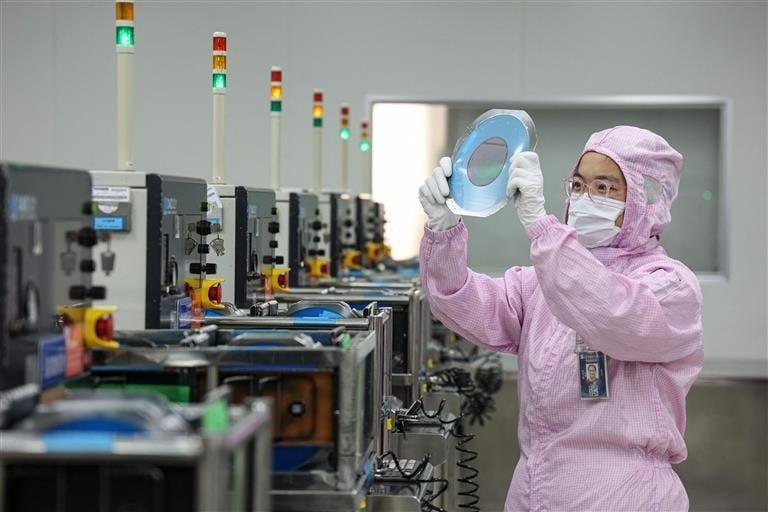
The United States tried to stop China from making advanced chips and developing artificial intelligence. China broke the blockade on two fronts. Under a socialist plan, its engineers and skilled production workers built a domestic chip industry. Its researchers took the lead in AI models, including DeepSeek, that anyone in the world can download and use free. Now the United States government is moving to block the models themselves.
The blockade is a weapon in a class war. United States monopolies draw enormous profits from their control of the most advanced chips and AI technology. China’s market reforms had left it open to that weapon. Its tech companies bought their chips from Nvidia, and its chipmakers bought their machines abroad. The blockade struck at that dependence. China answered with socialist planning, which brings together workers, engineers, factories and research institutions to develop technology the monopolies cannot keep for themselves.
The fight has divided the United States monopolies. In July and August 2026, Nvidia chief executive Jensen Huang led the corporate opposition to sanctions and trade bans on the Chinese companies that make these models. That fight forced the Trump administration to retreat, for the time being. On Nov. 12, Huang resigned.
China built its own chips
The blockade failed first in hardware. The United States government banned the sale of the most advanced chips to China. China’s engineers, technicians and skilled production workers set out to make their own, and the government backed them with a plan. Chip self-reliance became a goal of the five-year plan. The government put tens of billions of dollars into chip plants, chipmaking machinery and design.
Today workers at Huawei and other Chinese companies turn out chips that do the work the bans were meant to stop. A few years ago Nvidia had China’s market for data-center AI chips almost to itself. In the first half of 2026 its share was down to about a third, the market research firm IDC reported. Huawei was close behind, at the head of a field of Chinese chipmakers.
The blockade still exacts a price. Only one company in the world, ASML of the Netherlands, builds the machines that make the most advanced chips. The Dutch government, under pressure from the United States, bars ASML from selling them to China.
So Chinese chipmakers make their best chips on older machines, running each layer through many extra steps. That takes more work and more money, and fewer of the chips come out working. In 2024 the Financial Times reported that SMIC, China’s largest chipmaker, was charging up to half again as much for comparable chips as TSMC, the company in China’s Taiwan province that makes most of the world’s advanced chips.
Of the Ascend 910C AI chips SMIC makes for Huawei, only about one in five came out working in 2024. By February 2025 engineers had doubled that to nearly two in five, the Financial Times reported. The industry standard is about three in five.
Chinese scientists and engineers are working to break that hold. In a laboratory in Shenzhen, a team that included recent university graduates and engineers who once worked at ASML built an early test version of the machine China is barred from buying. They finished it in early 2025. It fills nearly a factory floor. It produces the extreme ultraviolet light the machine depends on, but it has not yet made a working chip, and the team is still struggling to get the precision optics it needs. The government’s goal is to produce working chips on the machine by 2028, Reuters reported. People close to the project think 2030 is more realistic.
In Shanghai, engineering teams from several Chinese chip-equipment makers were brought together in a state-owned company, Aishengna, set up in 2023. By July 2026 they had begun building Chinese-designed versions of the older machines that China’s chipmakers still buy from ASML, Reuters reported. The machines need more testing and trail ASML’s. About five are due at Chinese chipmakers this year and about 20 in 2027.
The plan trained these workers. In December 2020 the government made chip science and engineering a discipline of its own, with its own doctoral degrees. The next year Tsinghua, Peking and other universities opened schools to train chip engineers.
China builds its own chips, whatever the cost, because of socialist planning. A plan produces for society’s needs. It can set a goal for the whole country, carry costs like these and hold to it for years, because what counts is the benefit to society, not whether it brings any investor a quick return. Socialist planning develops the scientific and technical knowledge of the working class and puts it to use for society. Under the monopolies, that knowledge becomes the private property of the owners.
The market road led to dependence
Chinese tech companies bought Nvidia’s chips because it was the quickest and cheapest option, and Nvidia had the market almost to itself. The blockade showed what that dependence was worth.
The companies would have gone on buying. In September 2025 China’s internet regulator told Alibaba, ByteDance and other tech companies to stop buying the chip Nvidia had designed for the Chinese market and to cancel their orders. Several had planned to buy tens of thousands. They stopped at once, the Financial Times reported. A month earlier the government had directed publicly owned data centers to get more than half their chips from Chinese makers. For each company, buying from Nvidia was the profitable choice. The plan overruled it.
The market side of China’s economy, opened up by the reforms, also shows what capital does with the technology when it is left in charge. Investors poured money into Chinese AI and chip companies. So many companies crowded into chips, memory and robotics that prices and profits fell. Then, with profits falling, share prices sky-high and new United States restrictions threatened, the speculation broke. In less than four months from its July 1, 2026, peak, the STAR 50, a stock index of 50 leading Chinese technology companies on the Shanghai exchange, lost more than two-fifths of its value, about $480 billion. In July the state-owned funds known as the “national team” spent about $9 billion of government money buying shares to hold the market up, and the slide went on.
When chips are made for profit, cheaper chips mean lower profits, and the speculation built on those profits collapses. When chips are made by plan, to raise the technology of the whole country, cheaper chips are a gain for society.
The United States has used this weapon before. For decades it and its allies barred the sale of advanced technology to the Soviet Union, and the Soviet Union fell behind in computers. Its leaders answered in the 1980s by turning to the market. The market reforms broke up the plan, and the Soviet Union collapsed. China, hit with the same weapon, answered by strengthening the plan.
China took the open field
The blockade failed a second time in the AI programs themselves. An AI model is the working core of a chatbot like ChatGPT. Engineers build it by running enormous amounts of text through thousands of chips for weeks or months, which is why the chips matter. What comes out is one very large file. Whoever has that file can run the chatbot.
The biggest United States AI companies, OpenAI, Anthropic and Google, keep their most powerful models locked up. People can use them only through the company, on the company’s terms.
An open model is one whose makers publish that file. Anyone can download it, run it on their own computers and change it.
Cut off from Nvidia’s most advanced chips, Chinese researchers have been learning to do more with less. DeepSeek, a lab in the city of Hangzhou, had a team of about 150 researchers and engineers, most of them recent graduates and doctoral students. It had about 2,000 Nvidia chips of a slower kind. Nvidia designed that chip for sale in China, holding its speed below the limit the 2022 export rules set. The Commerce Department banned it anyway in 2023.
DeepSeek’s engineers changed how their model divides its work among the chips, cut the memory it needs and sped up its calculations, their technical report shows. They did it on those slower Nvidia chips, not Chinese ones.
DeepSeek released the model it built that way in December 2024, and a more powerful one built on it on Jan. 20, 2025. A week later Nvidia’s stock market value fell by about a sixth in a single day.
Then the Chinese labs gave their models away. Developers anywhere in the world can download them and run them without paying a United States company each time they do.
An open model can be put to work at once. Within three weeks of the January release, the Shenzhen city government had installed DeepSeek’s model on its own computers and opened it to every city agency. Shenzhen’s Longgang district ran it on Huawei’s Chinese-made chips.
The ground the plan laid
The Chinese labs are mostly private companies, but they work on ground the plan laid. In July 2017, more than seven years before DeepSeek’s breakthrough, the State Council, China’s national cabinet, issued a plan to build China’s AI research and industry through 2030.
It called for training a generation of AI researchers in China’s public universities. DeepSeek’s team studied there. Tuition is a small fraction of what students in the United States go into debt to pay. In 2018, 35 universities were approved to teach AI as an undergraduate major. By 2026, more than 600 did. The researchers were in place before the labs needed them.
Once DeepSeek showed what open models could do, the plan made the open path national policy. The State Council’s AI Plus plan of August 2025 called for building up the open development of AI and urged universities to give academic credit for work on it. The 15th Five-Year Plan, adopted in March 2026, backs it by name.
The United States monopolies hold their most powerful models as private property. They do not release them, so a government or a company can use those models only on the owner’s terms, and the owner charges for every use. The open models some of them release are not their best.
China’s plan measures AI by how widely it is put to work, and a model anyone can download serves that goal. The AI Plus plan aims to bring new AI devices and programs into near-universal use by 2030.
Who gives the orders
China’s AI labs compete hard with one another, and they built on AI research shared around the world, including Google’s and Meta’s. What decides the direction is who holds power.
The Communist Party holds state power, and with it the land, the banks, the power grid, the railways, energy, steel and the other industries that the rest of the economy depends on. That separates China from Japan and South Korea, where governments also backed industry but capitalists held state power.
The owners of China’s private labs are capitalists, and the struggle between the plan and capitalist relations inside China is not over.
The United States government also pays for the research. The internet and much of the science behind AI came out of government laboratories and government-funded universities. Then it was all handed to private companies, which own the results. After that the companies give the orders. When Nvidia’s chief executive led the fight against a ban on Chinese models in July 2026, the Trump administration backed off.
In China the orders run the other way. The government that told Alibaba and ByteDance to stop buying Nvidia’s chips had already overruled Jack Ma. When his Ant Group set out to turn its hold on people’s payment and credit records into a private financial empire, the government halted its stock offering in November 2020 and moved its credit-scoring business into a company where state-owned firms hold nearly half the shares.
China now leads the open field. Chinese open models passed United States models in downloads in the summer of 2025, and by March 2026 they were far ahead. Qwen, a line of open models made by the Chinese tech company Alibaba, was downloaded more than 3 billion times in six months this year, Bloomberg reported. That is about five times as many downloads as Google’s and Meta’s open models put together.
By May 2026, Chinese open models were handling most of the traffic on the largest service that lets users choose among competing AI models. Meta, whose Llama models led the open field two years ago, now keeps its most powerful models closed. The open model it released on Oct. 15, 2026, which it calls the best ever made in the United States, still trails the leading Chinese model on a test of writing computer code in Meta’s own comparison.
Public infrastructure or private profit
The plan treats computing power as public infrastructure, like a publicly owned utility. In 2022 the government began building a national computing network of eight hubs and 10 data-center clusters, moving computing work to energy-rich western provinces. By March 2026, more than four-fifths of China’s AI computing capacity was in the eight national hubs, People’s Daily reported.
China’s three publicly owned telecommunications companies, China Mobile, China Telecom and China Unicom, are among the biggest builders and operators of the network. A university, a factory or a small lab can buy computing time from it without building a data center of its own. New data centers that get government money are directed to use Chinese-made AI chips.
The plan also places the hubs near wind and solar power. In Zhongwei, in the Ningxia region of northwestern China, a solar farm opened in May 2026 to power a computing park directly.
In the United States, four corporations, Amazon, Microsoft, Google and Meta, were expected to spend about $650 billion on data centers and AI this year. Each decides for itself what to build and how to make money from it, and households served by the same power companies are made to help pay for the power. A study at the Massachusetts Institute of Technology found that data centers raised home electricity rates in the markets they entered. In Virginia, residential customers were assigned nearly half the cost of a power line built to serve a data center, Reuters reported.
The damage goes beyond the electric bill. To power its supercomputers in and around Memphis, Elon Musk’s xAI ran dozens of methane gas turbines without air pollution permits. Turbines like these pour out smog-forming nitrogen oxides and formaldehyde, and Reuters found the pollution falls hardest on Black communities. From Memphis to Northern Virginia, people living beside data centers put up with the fumes and the constant noise.
Communities across the United States are organizing to oppose the construction of new data centers. In Boxtown, a Memphis neighborhood founded by freed slaves, residents who defeated an oil pipeline in 2021 are fighting the turbines, and the NAACP has sued xAI.
The same corporations turn AI on the workers. Employers cited AI in more than 120,000 announced job cuts in the first 10 months of 2026, more than twice as many as in all of 2025, the outplacement firm Challenger, Gray & Christmas reported. Technology companies cut the most.
AI could shorten the working day and take over dangerous and repetitive work. Under capitalist ownership, the bosses use it to cut jobs instead. The workers produce more, while the monopolies take the gains.
Nvidia’s answer
Huang knew where things stood. In Beijing in July 2025, he called DeepSeek, Qwen and Moonshot’s Kimi “the best open reasoning models in the world today.” He also had a business reason to care. Open models still run on chips, he argued, and a world of companies and governments running their own models buys more chips than a handful of closed AI firms renting out theirs.
Nvidia had been releasing its own open models, called Nemotron, since June 2024. In December 2025 it launched a new generation, Nemotron 3, meant as a United States alternative that would run on Nvidia chips. Nvidia’s open-model push was a bid by one company to win back for the United States monopolies the ground China had taken with a national plan.
Pax Silica
A Chinese model that any country can download free breaks the United States monopoly on the software. But running it still takes chips, electricity, servers and communications lines. Having lost control of the models, the United States government is trying, through Pax Silica, to control everything the models run on.
The State Department launched Pax Silica in December 2025. It is a coalition to build a supply chain for AI with China shut out. Governments join by United States invitation. By Oct. 23, 2026, when Paraguay joined, 24 countries and the European Union had signed on with the United States. They run from Japan, Britain and Israel to the Gulf monarchies that rule with United States backing and six Latin American governments.
The State Department also lists Taiwan, a province of China, as a participant. Nvidia designs its chips but owns no factories. TSMC makes them in Taiwan, along with nearly all of the world’s most advanced chips.
The chip industry of Taiwan is already being used against the rest of China. TSMC stopped making chips for Huawei in 2020. In 2024, on Commerce Department orders, it stopped making its most advanced AI chips for customers on the mainland. Pax Silica writes that arrangement into a formal coalition.
Pax Silica covers chips, minerals, energy and factories. A White House export program, set up by executive order, sells the rest: a full package of United States hardware, data centers, rented computing and AI models. The aim is to lock foreign customers into United States systems.
China’s plan got there first. China makes its own chips. Its power grid is publicly owned. Its government has built a national computing network.
The chip war moves on to the models
The United States government has also gone after the models themselves. That fight came to a head in July 2026. On July 16, Moonshot, a Chinese AI lab based in Beijing, launched a model called Kimi K3 and promised to publish it for anyone to download, which it did on July 27. It is the largest open model ever built. It took first place on Arena’s ranking for front-end code, the code that builds what people see on websites and apps, ahead of Anthropic’s newest model. For developers who use the model on Moonshot’s computers, Moonshot charged less than a third of Anthropic’s price for the same amount of output.
On July 22, White House science adviser Michael Kratsios accused Moonshot of two things. He said it had built Kimi K3 by feeding Anthropic’s model huge numbers of questions and training its own model on the answers. He also said Moonshot had used Nvidia’s most advanced chips, which are banned from sale to China, by getting servers with those chips in Thailand. He offered no public evidence. Moonshot had not yet made the model available to download, so no one outside the company could examine it. Moonshot denied it, saying the gains came from changes it made to the model’s design. Anthropic’s model had been out only 15 days when Kimi K3 launched, too little time, researchers pointed out, to copy it into a model this large. Even OpenAI’s head of strategic futures, Dean Ball, said copying could not explain how good Kimi K3 is.
The possible measures, Kratsios said, include sanctions and putting companies on export-control lists. Officials were reported to be weighing an outright ban on Chinese open models.
Huang answered on July 24 with his first post ever on X. He shared an open letter signed by 25 companies, among them Microsoft, Meta, IBM, Palantir and Hugging Face, the main platform where developers share open models. The letter warned the government against the sanctions and bans it was weighing, calling them “premature restrictions” on open models.
Anthropic stayed off it, and OpenAI signed only after it was out. Both have pressed for restrictions on Chinese models, citing national security. Days after Kimi K3 came out, Ball wrote that a world dominated by open models leads to “full AI communism.”
A model can be copied without limit at almost no cost. Moonshot charges for running Kimi K3 on its own computers, but anyone can download the model and run it on theirs, so it can charge only for the computing. The closed-model companies can charge a monopoly price only as long as their models are fenced off as private property. The technology itself pushes toward common use.
The pushback worked, for the time being. By early August, after an outcry led by Nvidia, Microsoft, Google and Meta, the administration had backed off sanctions and trade bans on the Chinese model makers “for now,” The New York Times reported. A Commerce Department draft aimed at Chinese open models was stopped inside the government. The administration turned instead to selling United States AI abroad.
Huang’s side was no friend of China. It wanted China kept as a customer, dependent on United States chips. The White House wants open models too, as long as they are made in the United States and run on United States chips. The two sides differ only on how to hold China back.
In July the White House accused Moonshot of copying and showed no evidence. In November an accusation with no evidence was made against Huang. The New York Times reported that he had had an affair with Alice Huang, who is not related to him, an executive at Megaspeed, a data-center company in Singapore. The Times said she had been recruited by Chinese intelligence, but it gave no source for that claim. Attorney General Todd Blanche said the Justice Department had reached no conclusion about who she is or whether her company smuggled chips to China. Huang resigned on Nov. 12. The spy story took out the man who had led the fight against a ban, and no one has had to prove it.
Four days later the blockade tightened. On Nov. 16, 2026, the Commerce Department issued a rule requiring a license to send advanced AI chips to any data center, anywhere in the world, that supplies large amounts of computing power to companies based in China. It also put license requirements on data centers in Singapore, Malaysia, Indonesia, Thailand and Brazil. Megaspeed is based in Singapore, and Thailand is where Kratsios said Moonshot had used banned Nvidia chips. It was the first change in the export rules since the spy story broke, Fortune reported. The government is moving to control everything the models run on.
On the United States side, monopolies fight over whose profits the government will protect. On China’s side, the plan has held its course.
The United States tried to stop China from building the tools of AI. Socialist planning broke that blockade. Now the United States government wants to keep Chinese AI models out of the rest of the world, after they have already been downloaded billions of times. China has opened the technology to the world. The next blockade would wall in the United States itself.
Join the Struggle-La Lucha Telegram channel