
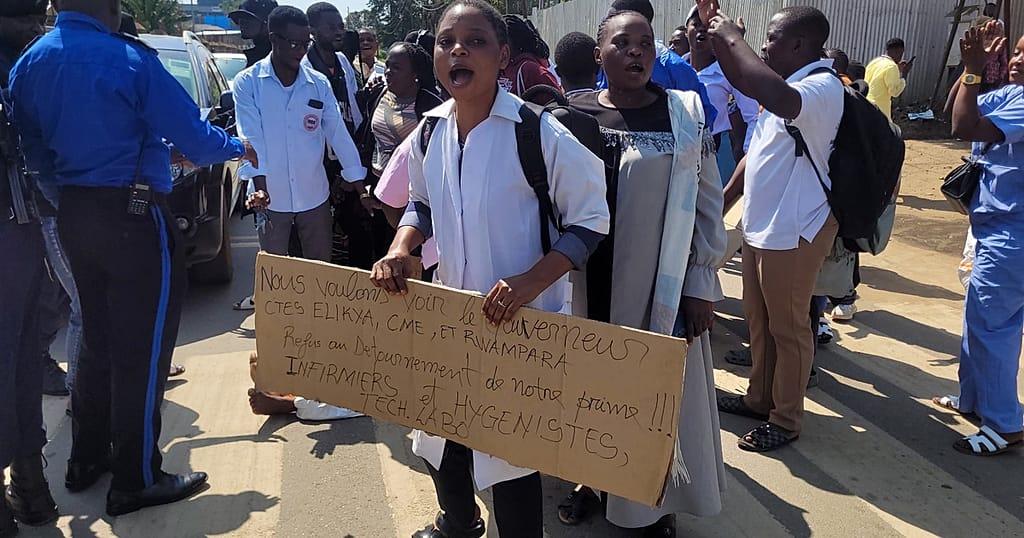
The United States government has a detailed plan for the Democratic Republic of the Congo. It covers Congo’s copper and cobalt, and the mineral rights the United States says it is getting. For the Ebola epidemic that has killed more than 5,000 people in Congo’s northeast since May, it has no plan. The health workers fighting that epidemic have not been paid for months, and they have started to strike.
On Oct. 29, workers at the Ebola treatment center in Tchomia, in Congo’s Ituri province, stopped work. They are owed four months of wages. They had given the Congolese government a 72-hour ultimatum, and it expired with no answer. Five confirmed Ebola patients and 10 suspected cases were in the center when they walked out.
“We are tired of requesting our salaries,” one of the strikers, Moise Mugenyi, told the Associated Press. “Today, being able to feed our families has become a real problem.”
Ituri is in Congo’s far northeast, on the border with Uganda. Tchomia is one of several places there where Ebola response workers have stopped work. In the Nia-Nia health zone, the teams that trace cases, inform communities and control infection began an unlimited strike on Oct. 22. They have not been paid since August. They had sent a written request on Oct. 2, issued an ultimatum on Oct. 5 and struck for two days on Oct. 10 and 11. They suspended that strike after a meeting with the African Union’s disease control agency and the World Health Organization, and nothing changed. In Rwampara, outside the provincial capital of Bunia, response workers counted 77 days without pay. They charged that the payrolls were padded with fictitious names and demanded a joint commission to check them. Treatment center workers in Rwampara had already struck over unpaid wages in July.
The acting head of the Ebola response in Ituri, Dr. Justin Mukonkole, told the strikers to be patient while the government responds.
International donors have given nearly $1 billion to the United Nations agencies, international charities and aid groups running the Ebola response in eastern Congo, the head of the African Union’s disease control agency, Jean Kaseya, told reporters in mid-October. Only about one dollar in five has been accounted for.
The second-deadliest Ebola outbreak on record
Congo’s health ministry declared the outbreak on May 15. Ten days later, more than 230 deaths had been reported. By Oct. 31, Congo had reported 10,351 confirmed cases and 5,026 deaths, according to the Associated Press. The disease has spread from three health zones in May to 67, across eight provinces. Nearly half of the people confirmed to have it have died. It is the fastest-growing and deadliest Ebola outbreak in Congo’s history, and the second-deadliest ever recorded, after West Africa’s in 2014–2016.
The virus is the Bundibugyo strain of Ebola. No vaccine or treatment for it has been approved. The first trial vaccinations began in Ituri only in late October.
A genetic study by Congolese and international scientists, released in October, estimates that the outbreak emerged in late February. The first suspected case the World Health Organization identified was a health worker who fell ill on April 24, three weeks before the outbreak was declared, and died at a medical center in Bunia.
The Trump administration had shut down the disease-detection programs in Ituri before the outbreak began. On its outbreak page, updated Oct. 30, the Centers for Disease Control and Prevention says the risk to the American public remains low.
The mineral rights
On June 27, 2025, Congo and Rwanda signed a peace agreement in Washington, D.C. Secretary of State Marco Rubio presided. The agreement committed the two countries to economic cooperation on critical minerals.
President Donald Trump said what the United States got out of it at a White House press conference that day. “We’re getting, for the United States, a lot of the mineral rights from the Congo,” he said.
The fighting in eastern Congo, where the Rwandan-backed M23 armed group holds territory, has not stopped. The agreements over Congo’s minerals kept moving. On Dec. 4, 2025, the United States and Congo signed a separate Strategic Partnership Agreement governing mineral investment.
Congo produces about three-quarters of the world’s cobalt. Congo is also the second-largest producer of copper.
The mines keep producing
Congo’s big copper and cobalt mines are in Lualaba province, in the far south. The epidemic began in the gold-mining area around Mongbwalu in Ituri and has spread across the north and east.
When the outbreak was declared, investors wanted to know one thing: would it touch the mines? In May, a research unit of the Fitch credit rating agency told them it would not. Copper and cobalt mining was unlikely to be seriously affected. Even mines inside the outbreak zone, including the Kibali gold mine in Haut-Uélé province and the Bisie tin mine in North Kivu, were expected to keep producing.
The epidemic caused one problem for the minerals program. In July, Reuters reported that Ebola was disrupting travel and delaying meetings on the minerals partnership.
The United States government has signed agreements for Congo’s copper and cobalt while the fighting goes on in the east. It shut down disease detection in Ituri before the outbreak began. The people fighting the outbreak are Congolese health workers, and they have gone up to four months without pay. In Tchomia, Nia-Nia and Rwampara, they are on strike for their wages.
Join the Struggle-La Lucha Telegram channel