
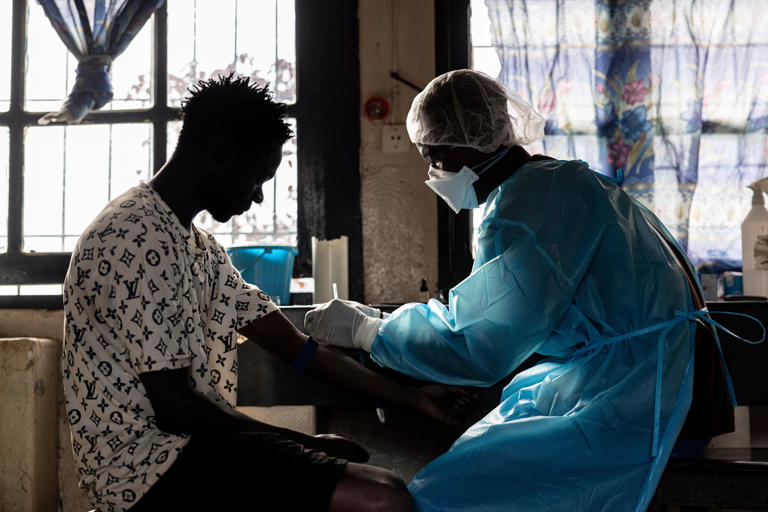
On April 30, health workers in Bunia tested patient samples for Ebola. The result came back negative. But the test could not detect Bundibugyo — a rare and highly fatal Ebola species with no approved vaccine or treatment. The false negative gave the virus two more weeks to spread through mining communities and displacement camps.
It was the kind of failure that looks like a technical glitch. It wasn’t. It was the result of what five centuries of colonial violence and imperialist plunder had left behind — and left out. The virus exposed a capitalist decision: some lives are protected by laboratories, vaccines and treatment. Others are left with nothing.
What plunder destroyed
When Portuguese ships reached the Congo River in 1483, they did not find an empty land. They found the Kingdom of Kongo — a centralized, sophisticated state with law, diplomacy and government across much of Central Africa. Portugal came with ships, guns and priests. Behind them came slave traders. What followed was seizure and plunder.
Over the next four centuries, the transatlantic slave trade ravaged Kongolese society and tore the Kingdom of Kongo apart. The Portuguese, and later the Dutch, British and others, organized the violence. People were kidnapped. Families were shattered. Villages were emptied. Fields went untilled. The kingdom’s political order was weakened until it could no longer defend its people.
Central Africa became the single largest source of enslaved people transported to the Americas. Scholars estimate that between 5 million and 6 million people were taken from the Congo-Angola region alone over the course of the trade.
The form of plunder changed. The target remained the same: labor, land and wealth.
Belgium’s King Leopold II held the Congo as his personal property from 1885 until 1908. Under his rubber extraction regime, Congolese workers who failed to meet quotas had their hands and sometimes feet cut off. Villages that resisted were burned. Forced labor, starvation, disease and murder killed an estimated 5 million to 10 million people. Some historians rank it among the largest colonial massacres in recorded history. When Belgium took formal colonial control, it continued to extract copper, diamonds, uranium and rubber for decades while investing little in fundamental welfare. Belgian colonial policy built almost no public education system. Education was dominated by missionary schools, which trained Congolese people for manual and agricultural labor while restricting “book learning” to basic literacy and math.
The Congo won formal independence on June 30, 1960. Belgian colonial rule had produced only about 30 Congolese university graduates in the entire country. Patrice Lumumba, the country’s first elected prime minister, called for control over Congo’s own resources and for a united Africa free from colonial domination. Washington saw that program as a threat. The U.S. feared that Soviet support for anti-colonial movements and independent African development could help Congo break out of Western control.
Katanga held roughly 60 percent of the world’s cobalt supply — a strategic mineral essential for jet engine turbines and aerospace rocket nozzles — alongside vast deposits of industrial diamonds and the uranium that had fueled the Manhattan Project.
Cobalt. Uranium. Diamonds. Lumumba was a threat to all of it. On Jan. 17, 1961, he was murdered. The CIA, operating on authorization from the Eisenhower administration, plotted his assassination. Belgium and the mining company Union Minière played their own roles. Mobutu seized total power in a U.S.-backed coup in 1965.
Washington then backed three decades of Mobutu Sese Seko’s dictatorship. Mobutu looted the treasury and channeled the wealth to Western banks, crushed political opposition and drove public health into ruin. When armed resistance threatened the mineral pipeline directly — as in 1978, when a rebellion in the Kolwezi mining hub sent global cobalt prices surging — France and Belgium sent paratroopers and the U.S. provided transport planes to crush it.
When the Soviet Union collapsed in 1991, Mobutu’s usefulness to Washington ended. The U.S. cut off financial support. The regime fractured, and Mobutu fell in 1997. The wars that followed were not caused by “ancient hatreds” or local chaos. They were wars for minerals, driven by imperialist mining interests and enforced through proxy forces, cross-border interventions and armed groups tied to the mineral trade. They have killed more than 6 million people, most of them from disease and starvation rather than combat. Eastern Congo was turned into a killing floor.
Cobalt goes into batteries and jet-engine superalloys. Uranium fuels reactors and nuclear weapons. Industrial diamonds cut rock, metal and semiconductor wafers. Coltan, cassiterite and wolframite become tantalum, tin and tungsten for electronics and military equipment. Gold provides corrosion-resistant plating for micro-connectors, SIM cards and processor bonding wires.
Tech monopolies — Apple, Nvidia, Google, Microsoft and Intel — depend on mineral supply chains that run through eastern Congo. So do the weapons manufacturers and the financial institutions that hold their stock. The minerals leave. The fighting, hunger and displacement stay behind. This is monopoly capital’s “innovation”: clean devices, cloud servers and weapons systems at one end; displacement, hunger and disease at the other.
Ebola spreads through what imperialism made
In Ituri Province today, armed groups and smuggling networks fight over gold routes. More than 100,000 people were newly displaced in Ituri in the months before the outbreak was confirmed. Nearly 1 million people have been displaced by conflict in Ituri in total. Seven million people are internally displaced across eastern DRC. Twenty-seven million face acute hunger.
In parts of North Kivu, people survive on just over six liters of water a day and share one latrine among more than 100 people. These are not conditions in which Ebola, cholera or measles can be contained. Cholera, measles, mpox, polio and drug-resistant infections are spreading through camps where vaccination, sanitation and primary care have collapsed.
That is how Ebola gets its opening. Displacement, land destruction, mining and military supply lines push people deeper into forest zones where Ebola can jump from animals to humans.
In late April, deaths began mounting around Mongbwalu, a mining area northwest of Bunia. At first, health workers did not recognize the outbreak as Bundibugyo Ebola. Cases later appeared in Bunia and Rwampara, where people had gone seeking care. By the time the disease was confirmed, funerals, family care and hospital exposure had already given the virus weeks to spread. When the WHO was alerted on May 5, officials were not yet calling it Ebola. They were reporting a “high-mortality outbreak of unknown illness.” An estimated 50 people were already dead.
Confirming the diagnosis required genomic sequencing at the Institut National de Recherche Biomédicale in Kinshasa — more than 1,000 miles from the outbreak zone, roughly the distance from Tulsa, Oklahoma, to Washington, D.C. Results came back May 14. The DRC and Uganda declared the outbreak May 15. WHO determined on May 17 that the outbreak constituted a public health emergency of international concern and announced it publicly the next day.
By then, the virus had been spreading for at least six weeks. Hundreds of suspected cases had appeared across three health zones. The outbreak had crossed into Uganda and reached Kampala, the capital. By May 25, it had passed 1,000 suspected and confirmed cases, with more than 230 deaths reported in the DRC and confirmed cases in Uganda.
By combined suspected and confirmed cases, this is now the third-largest Ebola outbreak in history. Former CDC Director Robert Redfield noted that Ebola outbreaks are normally caught at five to 10 cases. This one was not confirmed until past 100.
Ituri had no local sequencing capacity. Early detection takes laboratories, clinics, trained staff and supplies. Congo was denied them. The wealth that could have built them was looted instead.
Designed to fail
Bundibugyo Ebola has struck before: Uganda in 2007 and the DRC in 2012. Both outbreaks killed between 30% and 50% of those infected. The pharmaceutical industry had the technical capacity to develop a vaccine after either one. Merck and Johnson & Johnson saw no profitable market in saving Congolese and Ugandan lives, so no approved vaccine was made and no approved treatment developed.
Bundibugyo killed people in central Africa, not in countries where governments and insurers would pay monopoly prices. The existing Ebola vaccines and therapies target Zaire ebolavirus and are not approved for Bundibugyo. They should not be assumed to protect against it. Candidate vaccines are being fast-tracked, but WHO officials have said doses of the most promising vaccine may not be ready for six to nine months. The treatment gap is the pharmaceutical industry functioning as designed — organized around profit, patents and monopoly pricing, not human need.
The final nail
In previous Ebola outbreaks, U.S.-funded programs helped keep parts of Congo’s disease-surveillance system functioning. They supported local health workers, testing, training, handwashing stations and protective equipment. But this was not a public health system built for and controlled by the Congolese people. It was an emergency layer funded from Washington.
The Trump administration removed it.
U.S. foreign assistance to the DRC fell from $1.4 billion in 2024 to about $430 million in 2025, with only about $21 million allocated for fiscal 2026. The International Rescue Committee, which had operated USAID-funded surveillance programs in Ituri Province — the outbreak’s epicenter — was forced to scale back, eliminating surveillance operations, handwashing stations and distribution of protective equipment.
The STOP Spillover program, built specifically to catch deadly diseases in this region, was terminated. USAID itself was dismantled and its remaining programs folded into the State Department with a fraction of the staff.
Elon Musk boasted that USAID had been fed into a “wood chipper,” then later acknowledged that Ebola prevention had been among the programs canceled.
Community health workers with direct experience from previous outbreaks lost their positions when USAID programs shut down. Dr. Daniel Bausch, a former CDC medical officer, described where they went: “Now they’re driving a taxi in Kinshasa or selling fruit somewhere. So this cadre of reasonably trained people that you can employ just isn’t around.”
The CDC lost 3,400 positions — 25% of its workforce — and has no permanent director. The U.S. withdrew from and defunded the WHO. A gag order severed the CDC’s ties to its international counterparts.
“What we’ve lost is speed, which is the most important thing in an outbreak like this,” said Nicholas Enrich, former acting assistant administrator for global health at USAID.
Washington’s alibi
Secretary of State Marco Rubio told reporters on May 22 that the WHO was “a little late” in identifying the outbreak. WHO Director-General Tedros Adhanom Ghebreyesus rejected the claim the following day. The WHO had deployed a team to Ituri within days of the May 5 alert. That team’s initial tests came back negative because the diagnostics were built to detect Zaire ebolavirus, the Ebola species targeted by existing vaccines and treatments, not Bundibugyo. Confirmation required sending samples to Kinshasa. That delay came from the lack of local testing and sequencing capacity. In the same province, USAID-funded surveillance programs had just been cut. Washington’s alibi turns cause into accusation: first it helps produce the lack of capacity, then it blames others when that lack costs lives.
Rubio then pointed to a $23 million response package, with only $13 million for direct health aid, and a plan to open 50 clinics in the affected areas. Uganda’s health ministry said as of May 22 it had “not been engaged” by the U.S. on the treatment centers. The U.S. commitment during the 2014 Ebola outbreak exceeded $5.4 billion.
Still moving
The virus has reached Kampala, a capital city with an international airport. It has been detected in Goma, a crossroads city on the Rwanda border with major transit corridors. Cases have been reported across hundreds of miles. Transmission chains remain unaccounted for.
Aid groups on the ground say they lack basic supplies. Julienne Lusenge, president of Women’s Solidarity for Inclusive Peace and Development, which operates a small hospital near Bunia, described conditions: “We only have hand sanitiser and a few masks for the nurses.”
Dr. Herbert Luswata, a physician at Bwera Hospital in Kasese, Uganda, described conditions on May 21: “We are really very scared. We are not safe at all. The response is too slow and inadequate, not anywhere close to the standards that are required in a response for an epidemic like Ebola, which we know has a very high fatality rate. We are too exposed as health workers.”
The outbreak is moving through a region where the first defenses against disease were destroyed long before Bundibugyo was named. Health workers are treating patients without protective equipment. Communities are burying their dead without body bags. Yet the people holding the line are the same people imperialism has written off: nurses, doctors, burial teams, women’s organizations and community health workers fighting the outbreak with almost nothing.
The people of Congo and Uganda are paying the price for what was done to their countries. Not by nature — but by imperialist powers, banks, mining monopolies, drug companies and the capitalist governments that serve them.
Join the Struggle-La Lucha Telegram channel