
The Pentagon wants bases on Somalia’s Gulf of Aden coast to command the Bab el-Mandeb, the strait at the mouth of the Red Sea, and the shipping lane between the Suez Canal and Asia that runs through it. Its war on Iran and Yemen has made that control urgent. Every government and would-be government in Somalia is bidding to supply them, and the Pentagon is pitting them against one another: the more pieces Somalia breaks into, the more bidders it gets.
Somalis in the homeland and in the United States have fought back on three fronts. In the city of Las Anod, they drove out the army of the secessionist Somaliland administration. In the streets of Mogadishu, they marched against Israel’s recognition of that administration. In Minneapolis, the largest Somali community in the country has spent a year organizing against ICE. Rep. Ilhan Omar, the only Somali in Congress, has stood against ICE, the genocide in Gaza and the partition of Somalia, and the United States government she opposes has raided her home.
What the Pentagon wants
Somalia sits on the Horn of Africa, the point of the continent that juts toward Yemen and Arabia. Its northern coast runs along the Gulf of Aden. At the gulf’s western end is the Bab el-Mandeb. The Pentagon’s only permanent base in Africa, Camp Lemonnier, is near that strait in Djibouti, the small country on Somalia’s northwestern border. Whoever holds the shores of the strait and the gulf leading to it can close the route or keep it open. The Pentagon wants more of the African side.
Berbera, the main port on Somalia’s northern coast, lies about 160 miles across the water from Yemen. Since 2023, Yemen’s Ansar Allah has blockaded shipping tied to Israel in solidarity with Gaza, and the United States and Israel have bombed Yemen in return. Since July, the United States-backed Saudi monarchy has resumed the bombing war it waged from 2015 to 2022. In September, Ansar Allah took Yemen’s Red Sea coast up to the Bab el-Mandeb, putting the Yemeni shore of the strait in the hands of the force the Pentagon is fighting.
Satellite images analyzed by the French daily Le Monde show that since October 2025 the United Arab Emirates has been digging underground hangars for ammunition and fuel at Berbera’s airport, which has one of the longest runways in Africa. Le Monde’s sources said the Emirates is building on behalf of the United States and Israel, and that Israeli military personnel have already visited the site. Yemen’s Ansar Allah has warned that any Israeli presence in Somaliland will be a target.
Further east along Somalia’s coast, at the port of Bosaso in the Puntland region, the Pentagon has staged operations for years from an Emirati-run base. On Aug. 2, 2026, Maj. Gen. Claude Tudor, commander of United States special operations forces in Africa, signed an agreement to expand the United States’ own base there. Puntland’s statement said the base would serve “maritime security.” Analysts told Responsible Statecraft the real driver is the spread of the war on Iran into the Red Sea.
Who is helping
Berbera is held by Somaliland, a region in Somalia’s northwest that declared itself a separate country in 1991 and has its own government and army. It was a British colony until 1960, when it joined the former Italian colony to the south to form independent Somalia. No government recognized Somaliland as a country for 34 years. Then, on Dec. 26, 2025, Israel, the Pentagon’s forward base in West Asia, did.
Somaliland’s leaders have made plain what they are selling. In February, the minister of the presidency offered the United States exclusive rights to Somaliland’s minerals and said it was open to hosting United States bases. In August, President Abdirahman Mohamed Abdullahi said he would host bases for both the United States and Israel. The commander of the Pentagon’s Africa Command, AFRICOM, had already toured Berbera’s port and airport in November 2025. In Congress, Rep. Scott Perry and three Republican co-sponsors have introduced a bill to recognize Somaliland that declares Somalia’s claim to the region “invalid and without merit.” Sen. Ted Cruz has separately urged Trump to recognize Somaliland. The Trump administration has floated sending Palestinians expelled from Gaza there.
Bosaso is held by Puntland, a northeastern region that stays inside Somalia on paper while running its own affairs. Since late 2024, Puntland’s army has fought Islamic State fighters in the mountains behind Bosaso, and AFRICOM has been its air force. In 2025 the United States carried out 12 times as many airstrikes in Somalia as in 2024, and it has kept that pace this year. Puntland’s own commanders announce the strikes and thank their “U.S. partners.” Puntland signed the Bosaso base deal with the Pentagon without asking the federal government.
The federal government in Mogadishu is bidding too. It coordinates AFRICOM’s airstrikes, and in early 2025 it offered the Pentagon the ports of Berbera and Bosaso, neither of which it controls.
Standing behind all of them is the Emirati monarchy, a United States-backed regime. Dubai’s state port company, DP World, holds a 30-year concession and the controlling stake at Berbera. DP World’s subsidiary, P&O Ports, holds a 30-year concession at Bosaso. The Emirates runs the military base at Berbera’s airport, the one at Bosaso, and has armed Puntland’s coastal forces. Israeli officials told Axios the Emirates helped arrange Israel’s recognition of Somaliland. The ports are businesses as well as bases, and the Emirates is the go-between that connects the United States and Israel to the regional governments that hold the coast.
Las Anod drove Somaliland out
Somaliland claims every inch inside the borders of the old British protectorate. Its president has vowed to hold them “no matter how long it takes or what it requires.” The people of Las Anod, the main city of the Sool region at the eastern edge of that claim, had other ideas.
On Dec. 26, 2022, an opposition politician was assassinated in Las Anod, the latest in a string of killings. Students took to the streets against Somaliland’s rule. Somaliland’s forces fired into the crowds and killed dozens. The protests spread across Sool and into the neighboring Sanaag and Cayn regions, and by early January 2023 they had pushed Somaliland’s troops to the edge of the city.
The movement then built its own authority. Elders and town leaders met for weeks and on Feb. 6, 2023, issued the Las Anod Declaration: Sool, Sanaag and Cayn are part of Somalia, and a 33-member council would govern them until that was made good. Somaliland’s army attacked the city the same day and shelled it for months, hitting homes, hospitals, schools and water wells. The people did not give in. On Aug. 25, 2023, their fighters overran Somaliland’s main garrison and drove its army 60 miles west.
Somali Minnesotans stood with Las Anod. In February 2023, as the shells fell, about 200 of them rallied at the State Capitol in St. Paul. “We’ve never wanted to secede from the state of Somalia,” organizer AJ Awed of the Khaatumo Youth League said. In January 2024, Omar spoke out against Ethiopia’s deal to lease a stretch of Somaliland’s coast for a naval base, with recognition dangled in return, telling a Somali audience in Minneapolis that Somalia must stay one country. Somaliland’s deputy foreign minister posted a mistranslated clip, and Republicans led by House Majority Whip Tom Emmer demanded an ethics investigation and called for her deportation.
The new administration in the city of Las Anod won federal recognition in October 2023 and in July 2025 reconstituted itself as the North Eastern State of Somalia. It still claims the coastal parts of Sanaag that Somaliland and Puntland hold. Those two, rivals for decades, signed a security and cooperation accord in October 2025. Its stated aims are fighting armed Islamist groups, easing trade and calming Erigavo, the main town of Sanaag, which the new state claims. The Pentagon profits from the standoff: it can deal with Somaliland at Berbera and Puntland at Bosaso while both of them face the people of Las Anod. The Western press, when it notices Las Anod at all, calls the fighting a clan feud. What the people of Las Anod fought was a secession, a colonial border and an army that shelled them to accept both.
Mogadishu fills the streets
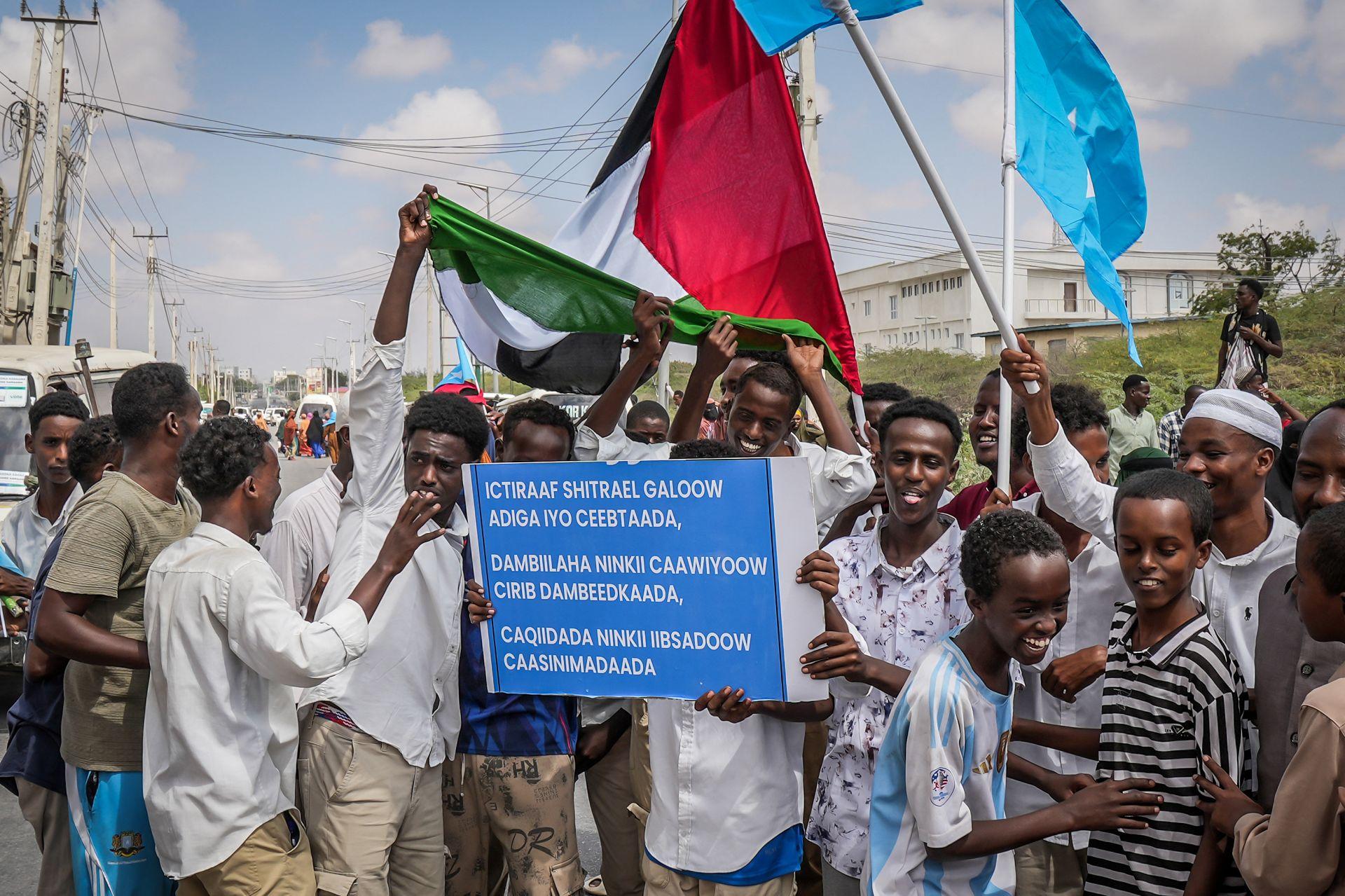
Israel’s recognition brought Somalis into the streets across the country. On Dec. 28, 2025, hundreds of young people marched with Palestinian flags in Borama, inside Somaliland itself. Somaliland’s police jailed them. On Dec. 30, tens of thousands marched in Mogadishu, Baidoa, Las Anod and other towns, Palestinian flags beside Somali ones. On Jan. 2, Somaliland’s police arrested a leading cleric in Hargeisa for preaching against ties with Israel. On Jan. 8, after Israel’s foreign minister visited Hargeisa, Mogadishu marched again. “We are protesting against the division of our country,” marcher Said Gedi told reporters. On Jan. 11, thousands of women organized by the Banadir Regional Women’s Organization shut down the roads into Mogadishu’s center.
On Jan. 12, the federal government annulled every agreement with the United Arab Emirates, port deals and security pacts included. Somaliland, Puntland and Jubaland in the far south all refused to recognize the annulment, and DP World said its operations at Berbera continued. The regional governments and the Emirati company held the ports. The federal government held a press release.
The federal government was never anti-imperialist. It broke with the Emirati monarchy over a direct attack on Somalia’s territory while staying tied to the Pentagon that stands behind that monarchy. It opposes partition as far as partition threatens its own claim to rule, and no further. The force against partition has come from Las Anod and from the streets.
Minneapolis
The Trump administration turned on Somalis in the United States in the same weeks. In early December 2025, Trump called Somalis “garbage” and launched Operation Metro Surge, flooding Minneapolis and St. Paul, home to the largest Somali community in the country, with federal immigration agents. In January it moved to end Temporary Protected Status for Somalis, in force since 1991.
Somalis in Minnesota answered. Days after Trump’s “garbage” remark, a hundred people packed a library meeting room in St. Cloud. “We’re here because we refuse to be silent,” Abdikadir Bashir of the Center for African Immigrants and Refugees Organization told them. In Minneapolis, Somali women organized to warn their neighbors whenever ICE appeared. On Jan. 23, 2026, the Twin Cities struck against the surge. Karmel Mall, the Somali shopping center in Minneapolis, shut its doors along with more than 700 other businesses, and tens of thousands marched downtown in temperatures around 10 below zero, with wind chills near 20 below. By February the surge had been forced out.
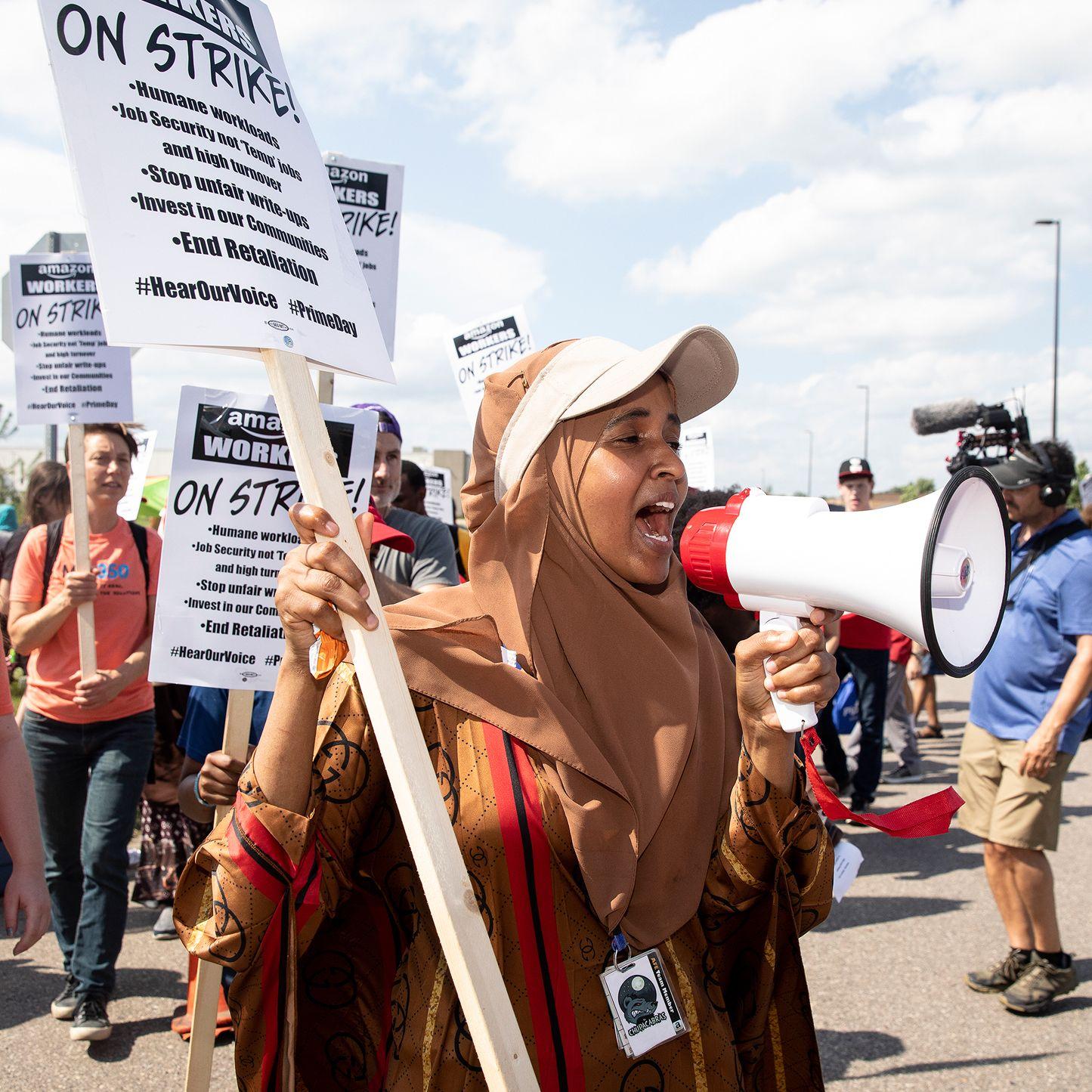
This is the same community whose workers took on Amazon. In 2018, East African workers at Amazon’s warehouse in Shakopee, a Minneapolis suburb, organized through the Awood Center. Awood is the Somali word for “power.” They forced the company to the table over work quotas and injuries, the first Amazon warehouse workers anywhere to do so, by the center’s account. Omar, newly elected, joined their rally that December. On Prime Day 2019, they walked off the job.
A community that can shut down Amazon and the Twin Cities is one the Trump administration could not break in the streets, so it came back through the courthouse. On Oct. 12, Homeland Security Investigations agents raided Omar’s Washington, D.C., home over immigration papers filed when she was a child, and officials have said openly that the aim is her citizenship. That night, Trump told a rally in Youngstown, Ohio, that Omar “comes in from a country without laws, without police, without military, where all they do is shoot each other.” Within days, a dozen grand jury subpoenas went out, most of them to her relatives. The same Republicans who demanded her deportation in 2024 for defending Somalia’s unity now have the machinery of immigration enforcement turned on her, her family and through them every Somali family in Minnesota.
One class, two fronts
The Pentagon’s bargaining on the Gulf of Aden and the ICE surge in Minneapolis are carried out by the same government for the same ruling class. Abroad, every division in Somalia gives the Pentagon greater control. A united Somalia could set terms for its coast or refuse the Pentagon’s bases altogether. A divided Somalia can only bid against itself, each piece needing the Pentagon’s air force or its recognition, and United States recognition of Somaliland would deepen every division. At home, an immigrant community kept in fear is a workforce easier to exploit and harder to organize, and the raid on Omar puts on notice every Somali in the United States who speaks against partition. In Las Anod, Somalis drove out Somaliland’s army and built their own authority. In Mogadishu, they filled the streets. In Minneapolis, they have organized against ICE and walked off the job at Amazon. That is what refusing partition and repression looks like.
Join the Struggle-La Lucha Telegram channel