
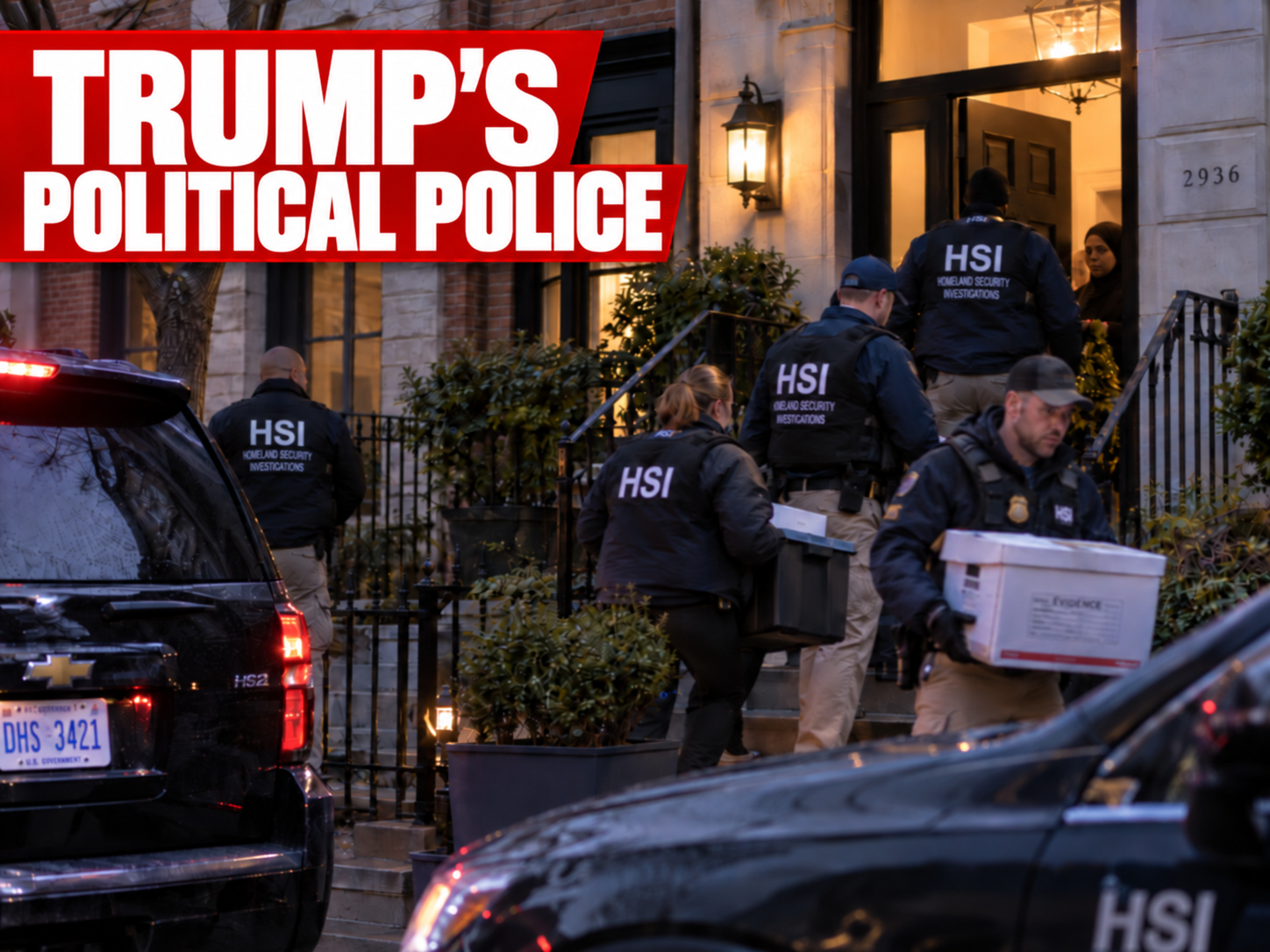
The federal agents who searched Rep. Ilhan Omar’s home on Oct. 12 belong to the same agency that is seizing fuel bound for Cuba. In early 2026, it put undercover agents inside Minnesota union halls and churches. On Oct. 8, it went door to door in northern Manhattan collecting video of an ICE shooting. Homeland Security Investigations (HSI), the armed investigative unit of Immigration and Customs Enforcement (ICE), with the power to spy, raid, seize and arrest, is the federal government’s political police at home and its blockade police against Cuba. On both fronts, it faces organized people fighting back.
HSI agents searched Omar’s Washington home before dawn on Oct. 12 and carried out boxes, 22 days before the Nov. 3 election. According to The New York Times, the investigation concerns immigration papers her late father filed when the family arrived as refugees in 1995.
Trump officials had targeted Omar for months. In March, Vice President JD Vance accused her of immigration fraud. In September, Homeland Security Secretary Markwayne Mullin warned that “something is going to happen.” Investigators have also seized Omar’s phone and issued more than a dozen grand jury subpoenas, including some to her relatives, the Associated Press reported Oct. 14. The Wall Street Journal reported Oct. 15 that the administration is trying to build a case to strip Omar of her citizenship and potentially deport her.
HSI has been building to this. On Aug. 6, a police officer in Richfield, Minnesota, found a woman watching Omar’s town hall from a Ford Explorer with plates registered to another vehicle. She said she was event security, then admitted she was an undercover HSI agent. The same HSI office had already gone after the movement that beat back Operation Metro Surge, when the Trump administration flooded the Twin Cities with federal immigration agents from December 2025 to February 2026. Federal agents killed Renee Good on Jan. 7 and Alex Pretti on Jan. 24.
On June 16, HSI’s top official in Minnesota, Michael McCarthy, stood beside the federal prosecutor for Minnesota, Daniel Rosen, to announce conspiracy charges against 15 anti-ICE activists over their resistance to the surge. One defense attorney, Bruce Nestor, described the defendants as “union members, workers, neighbors.” The prosecutor could not name a single agent injured by the conspiracy he alleged.
The 15 defendants have brought HSI’s methods into the light. Evidence the government had to turn over shows agents sat in meetings at churches, schools and union halls and got into encrypted Signal chats under programs named Operation Keyhole, Operation Puppet Master and Project Whipple Shield. HSI also used a PATRIOT Act tool to pull bank records without a warrant.
ICE is now preparing to make that spying permanent. Federal contracting documents posted Sept. 18 describe a $100 million program, called ERO ONE, that would station intelligence analysts with top secret clearances in more than two dozen cities, including New York, Miami and St. Paul, to work for ICE’s deportation officers. Their job would be to chart every relationship around a target: family, friends, the organizations they belong to, even the person they carpool with to work. They could draw on the tracking tools ICE already uses, including ImmigrationOS, an app built by Palantir to follow immigrants’ movements. Pointed at a union, that is a map of its members and organizers. Private contractors would do the work, and the contract could be awarded as soon as February.
HSI grew out of the old Customs Service. Its 7,100 agents have powers to inspect cargo, seize shipments and obtain bank records. After Trump returned to office in January 2025, HSI was redirected to put immigration enforcement first. In September 2025, Trump labeled “antifa” a domestic terrorist organization. No such organization exists. The label let him direct federal agencies to go after any left-wing network they chose.
HSI has also turned its investigators on voters. It ran state voter rolls through its databases, flagged tens of thousands of people as possible noncitizen voters and sent agents after them. From January 2025 to May 2026, ProPublica found, just 41 people were charged. The hunt’s purpose was to make naturalized citizens afraid to vote.
The Justice Department has now gone after the ballots themselves. On Oct. 13, acting Deputy Attorney General Trent McCotter gave California election officials 48 hours to review a Homeland Security list of supposed noncitizen voters. He demanded that their mail ballots be set aside unless officials could confirm their citizenship, including ballots already cast. The government is moving beyond investigating voters to trying to stop their votes from being counted, just three weeks before the Nov. 3 election.
The investigations reach different people, but the threat extends across immigrant communities. Federal agents can dig through decades-old records to intimidate people who vote, organize or hold political office.
In New York, HSI showed up after an ICE officer shot Oscar Belgal, 28, in the neck on Oct. 8 in Marble Hill, a Dominican working-class neighborhood at the northern tip of Manhattan. His 5-year-old son was in the back seat. Within an hour, neighbors filled the streets. While they marched, HSI agents went door to door asking for residents’ video. Neighbors followed the agents, telling residents not to open their doors without a warrant. Those who kept their doors shut kept their recordings out of ICE’s hands.
The Department of Homeland Security claimed its officers “immediately rendered aid,” but people on the block saw agents hold Belgal down on the asphalt as he bled. City police finally took him to the hospital.
ICE pulled him out of the hospital within hours. He is now held in solitary confinement at the Metropolitan Detention Center, a federal jail in Brooklyn, with the bullet still in his neck, the left side of his face numb and his hearing damaged, his lawyers at the Legal Aid Society said in an Oct. 14 court filing. Surgery to remove the bullet was set for Oct. 12. It never happened. Jail staff give him ibuprofen. His lawyers say ICE had no valid arrest warrant when its agents opened fire. On Oct. 13, protesters rallied outside the jail to demand his release.
In Florida and Texas, HSI enforces the blockade. On Oct. 7, it said it had seized 90 biodiesel shipments bound for Cuba, more than 600,000 gallons, at Port Everglades and Houston. Jose Figueroa, head of HSI’s Miami office, promised to “deny the Cuban government access to resources.” HSI says it is still investigating the people and companies in the United States who arranged the shipments.
Blockade police
The seizures are part of the latest escalation of a blockade the United States has kept on Cuba for six decades. On Jan. 29, 2026, Trump added penalties for any country supplying oil to Cuba. The only fuel allowed in is what private businesses buy in the United States, less than 3% of Cuba’s needs. The power plants, hospitals and water systems that keep the whole population alive get none. Power cuts that stop water pumping have left 3.5 million Cubans short of water, the United Nations reports.
The exemption for private businesses has a clear class purpose. Cuba’s 1959 revolution took sugar mills, refineries, utilities, banks and land out of the hands of corporations based in the United States and made them social property. The blockade is designed to cripple that economy and open the way for capitalists to take it back. Cuban electrical workers keep repairing the grid after blackouts, while solar parks built under the blockade now supply nearly 800 megawatts of power at midday.
Who gains
In June 2025, farm and hotel owners complained that ICE raids were taking away workers they needed. Trump halted raids at their workplaces, only to reverse himself within days. Meatpacking, construction, farming, warehouses and home care all depend heavily on immigrant labor. The bosses need these workers, but they also benefit when workers are afraid to stand up for themselves. Someone who risks arrest on the way to work, or an investigation into their citizenship, has much more to lose by reporting stolen wages, signing a union card or joining a picket line. That fear helps employers hold down wages and impose speedup. The whole workforce lives with the consequences.
The blockade seeks to restore the exploitation the Cuban Revolution abolished. Deportation deepens exploitation where it still rules. Both aim at workers’ ability to act for themselves.
The port seizures, the Omar search, the Minnesota spying and the Marble Hill canvass are separate operations with one base, one toolkit and one class function. The method is the same: find the lifeline and cut it. For Cuba it is fuel. For the movement against ICE it is money, meeting rooms, encrypted chats and the trust of neighbors. A union’s independence rests on meeting, raising money and planning action without the boss or the government in the room. That independence is one of the few ways the working class can exercise collective power. HSI put the government in the room, inside the organizations whose Jan. 23, 2026, general strike shut down much of the Twin Cities and helped force the surge out.
The same agency turns up against Cuba and the movement at home because both stand in the way of the same class, and the organized working class in the United States has a direct interest in both. Every gain a union wins depends on workers acting together, whatever their papers; the raids and citizenship investigations exist to keep them apart. The meetings, chats and bank accounts HSI penetrated are the means every union needs to strike. Cuba shows that workers can run their country’s wealth without capitalists; the blockade is aimed at making that example fail.
Some unions have already acted. Dozens of unions and labor councils have passed resolutions against the blockade, among them the California Federation of Labor, the Coalition of Black Trade Unionists and the Coalition of Labor Union Women. The International Longshore and Warehouse Union, whose members move cargo on the West Coast docks, pledged $10,000 at its 2024 convention for pacemakers for Cuba. In the Twin Cities, where HSI spied on the movement against the surge, transit workers in Amalgamated Transit Union Local 1005 and public workers in AFSCME Locals 2822 and 3800 have taken the same stand.
A labor movement that leaves Cuba or immigrant workers to face HSI alone leaves its own halls open to the same agency, the same tools and the same class.
Join the Struggle-La Lucha Telegram channel