
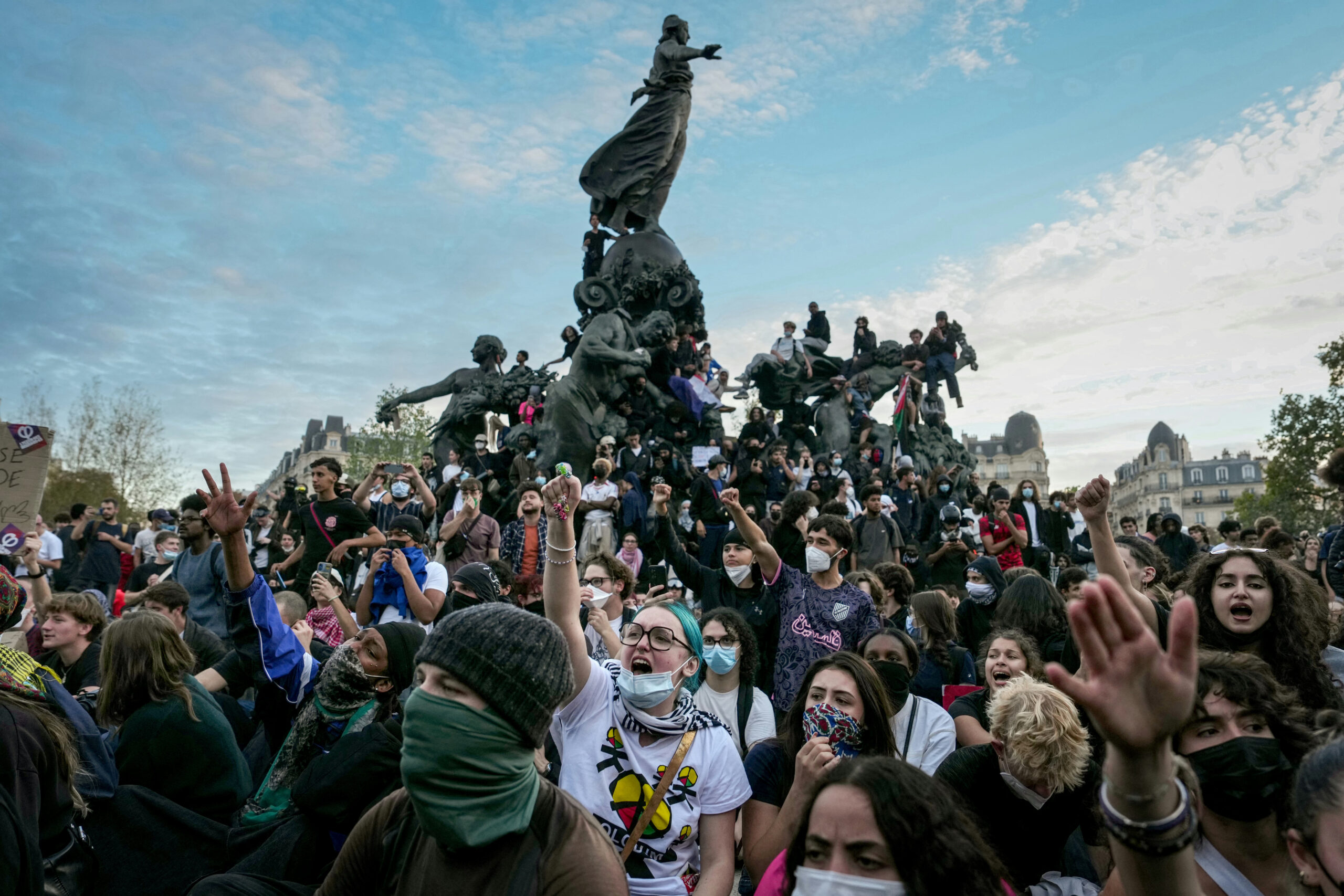
French high school students rose up against crumbling schools and ran straight into the bond market. The government in Paris says there is no money for teachers or classrooms. It is handing more to bankers and bondholders in interest than it spends on its schools, and the bondholders are demanding more. The fight in the streets of France is over whether a generation’s schools will be sacrificed to a worldwide debt crisis that capitalism created.
The revolt began Sept. 21, 2026, at Saint-Exupéry High School in Créteil, a working-class suburb of Paris, where students joined their striking teachers and tried to blockade the school. Within days, students were blockading schools where ceilings are collapsing, rats run through classrooms, and there are not enough chairs.
Black and Arab youth from the poorest suburbs led the way. By Oct. 5, more than half of France’s 3,700 high schools had been hit by blockades or walkouts. On Oct. 6, hundreds of thousands marched across the country, joined by university students, striking teachers and union members.
They demand more teachers, repaired buildings, equal funding for poor districts and an end to Parcoursup, the university admissions system that left 100,000 students without a place in July 2026.
Police against students
The government answered with police. More than 6,500 people have been arrested, most of them minors. On Oct. 5 in Lens, a police grenade blew off the hand of a 15-year-old. On Oct. 1 in Argenteuil, police shot a 16-year-old in the eye with a rubber bullet. On Sept. 28 in Saint-Ouen, a rubber bullet shattered the teeth and jaw of a 14-year-old. Only after that did the interior minister suspend the use of stun grenades. In the suburbs, the crackdown recalls 2023, when police killed 17-year-old Nahel Merzouk in Nanterre.
Government ministers blame France Unbowed (La France Insoumise), the main left opposition party, and right-wing politicians have called for banning it. Education Minister Édouard Geffray offers the students a “consultation platform” and no money.
The movement has already forced one retreat. On Oct. 1, Geffray dropped a plan to charge registration fees at some post-high school trade schools and preparatory classes.
Why there is no money
The French government cut 3,256 teaching positions in 2026. It has frozen teachers’ pay for years. By the education ministry’s own count, some 20 million class hours went untaught in the 2024–25 school year. In the middle of a summer of heat waves, it cut two-thirds of the fund for making school buildings safe in extreme heat.
Its 2027 budget raises school spending by less than inflation, cuts another 1,500 permanent teaching positions and freezes the housing aid that students depend on to pay rent. A French Senate report in early September called for ending free, open public universities.
The reason given is the debt. The French government owes more than the whole country produces in a year. Interest on that debt now runs to about 64 billion euros a year, more than the national schools budget, and it is rising. The interest rate the French government pays to borrow for 10 years has climbed to its highest level since 2002.
Who gets the money
Where did the debt come from? The bankers blame spending on schools and pensions. That is false. Governments ran up the debt bailing out the banks in 2008, keeping business afloat in 2020 and paying for wars and weapons year after year.
France signed the pledge that President Donald Trump demanded of the NATO governments in June 2025: to raise military and related spending to 5% of everything the country produces by 2035. France now spends about 2%. Its military budget for 2027 is set at double what it was in 2017. In August 2026, the government raised its military budget law for 2024–2030 from 413 billion euros to 436 billion.
A government bond is a claim on future taxes. The money lent to the government was spent long ago. The interest is paid out of taxes, and it goes to the banks, funds and wealthy families that hold the bonds. The bondholders are part of the same capitalist class that owns the factories, corporations and financial system.
Stock prices on Wall Street were still setting records on Oct. 6, the same day French students marched for classrooms without rats.
The Financial Times headlined its report “France between the bond market and the barricades.” The head of the International Monetary Fund, Kristalina Georgieva, said on Oct. 7 that governments face “very tough political choices” and pointed to France and Italy. The choices she means are cuts.
The French government borrows in euros, and the European Central Bank in Frankfurt, Germany, issues the euro. Paris cannot issue currency to pay its bondholders. The European Central Bank can buy French bonds to hold interest rates down, but its rules tie that help to meeting the European Union’s limits on deficits. Without that help, the bond market demands cuts. With it, the European Union and the European Central Bank demand them.
The same squeeze across Europe
France is one front. On Oct. 7, the interest rate on United States government debt stood at its highest since 2002, and British government debt reached its highest since 2007. Home mortgage rates in the United States hit their highest in three years, as the United States war on Iran kept oil above $100 a barrel.
The student protests are moving across borders too. Italian students occupied high schools in Turin and Rome on Oct. 5 under the slogan “Let’s do as in France.” Police and students clashed in Liège, Belgium. Greek students called nationwide school actions for Oct. 8.
Students and workers across Europe are running into the same squeeze: cuts to schools, wages and social services while governments protect the banks and bondholders.
Schools or bondholders
Prime Minister Sébastien Lecornu’s government has chosen to pay the bondholders. Giving the students what they demand would mean breaking with the austerity demanded by finance capital. Refusing them risks spreading the movement to the whole working class.
Civil servants, health workers and workers in energy and chemicals are already striking or preparing to. If that movement widens, workers can do more than swell the demonstrations. They can stop production, transport, energy and the daily operation of the government itself.
The students have called another national day of action for Oct. 8. The union confederations have called a strike for Nov. 5. Calls are circulating for a “yellow vest”-style movement beginning Oct. 17.
The bond is a claim on the future, and so is the students’ demand. The bondholders claim the taxes of the next 30 years. The youth of France claim teachers, classrooms and a place to study. The future of society lies in the development of these students, not in the bankers’ purses. The government is enforcing the bondholders’ claim against theirs. The students have shown they intend to win theirs. The decisive question is whether the working class brings its own power into the fight.
Join the Struggle-La Lucha Telegram channel