
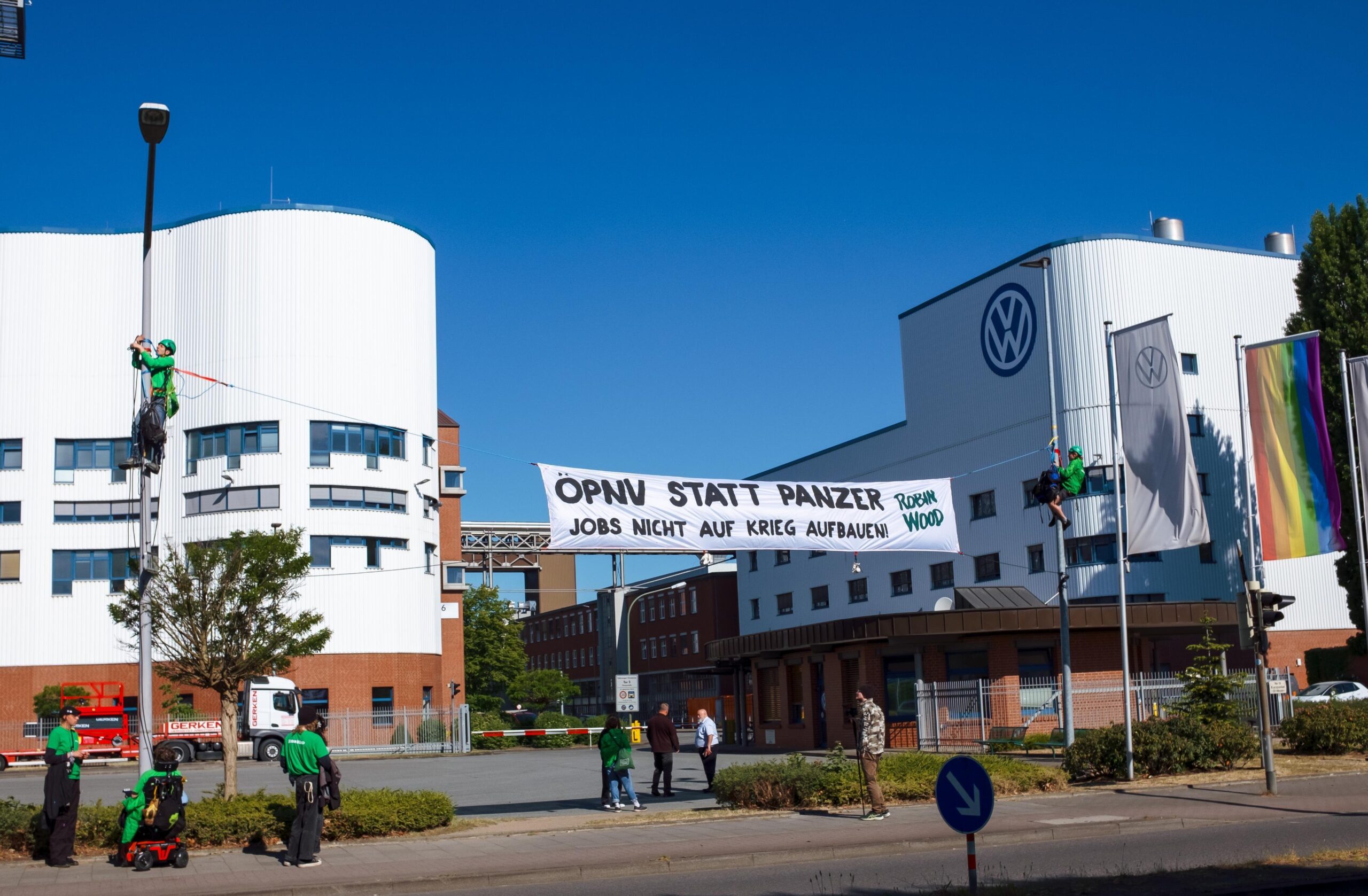
Volkswagen’s plant in Osnabrück, Germany, is running out of cars. Weapons production is moving in.
In a stark symbol of Germany’s shrinking civilian industrial base being retooled for war, Volkswagen agreed Sept. 7 to sell the historic factory to the German state of Lower Saxony and Israeli investment firm Aurelius Capital. Civilian car production will end in the summer of 2027.
In its place, Aurelius Capital and Lower Saxony plan to turn the factory into a military production hub. The first project would be with Rafael Advanced Defense Systems, Israel’s state-owned arms manufacturer.
About 1,800 people still work at Osnabrück. No new electric vehicles or civilian products are keeping the factory gates open for them. Government money and military orders are.
That is what Germany’s military buildup looks like inside the factory gate.
The Israeli investment firm Aurelius Capital would become the majority owner. Lower Saxony would take a minority share. Rafael Systems, Israel’s state-owned military systems company, would supply the weapons technology. The Volkswagen workers would supply the labor and manufacturing skill.
Volkswagen says the Rafael System project would be the first of several planned military projects at the factory. It has not named the companies that might take part in the others or what countries they are based in.
Volkswagen Chief Executive Oliver Blume calls this a new industrial future for Osnabrück. Lower Saxony Minister-President Olaf Lies says Germany’s changed “security situation” requires it.
The military buildup was already underway before the war on Iran. Trump demanded that NATO governments raise military and military-related spending to 5% of their economies. Germany backed the demand, and NATO adopted the 5% target in 2025. NATO is massively expanding its forces and weapons production against Russia while its members arm Ukraine for the continuing war against Russia. NATO governments pledged another 70 billion euros in military equipment, aid and training for Ukraine in 2026.
The European Union is pushing the same buildup. Its ReArm Europe program aims to mobilize up to 800 billion euros for increased military spending and weapons production.
The U.S. war on Iran has added another pressure. It has burned through missile interceptors far faster than they can be replaced. By September, the Congressional Budget Office estimated that the fighting had consumed between half and two-thirds of some U.S. missile-defense interceptor inventories and that rebuilding the stocks could take at least five years even with increased production.
Together, NATO spending, European rearmament and the war on Iran are creating a huge market for expanded weapons production. Osnabrück is one factory being pulled into that buildup.
Lower Saxony steps around Qatar
Volkswagen had already tried to bring the Israeli weapons manufacturer Rafael Systems into the Osnabrück plant.
That plan ran into opposition from Qatar’s sovereign wealth fund. Qatar controls 17% of Volkswagen’s voting rights and has seats on its supervisory board. Reuters reported in June that the fund was obstructing the proposed deal with Rafael Systems. In July, Bild reported that Qatar had blocked the partnership.
The new arrangement bypasses the Qatari roadblock, allowing Aurelius Capital and Lower Saxony to buy the Volkswagen plant instead. Once the factory is sold, Qatar’s political opposition to Volkswagen going into business with an Israeli arms company is effectively squelched.
Lower Saxony is on both sides of the deal. The state already owns part of Volkswagen. Now it plans to buy part of the Osnabrück plant too, helping turn it from car production to weapons production.
The government is stepping in to organize the restructuring.
Volkswagen targets 100,000 jobs
What is happening at Osnabrück is part of a much larger restructuring of Volkswagen worldwide.
On Sept. 3, VW’s supervisory board unanimously greenlit “Future Plan 2030” — a blueprint for mass layoffs across the company. Management is demanding roughly 50,000 additional job cuts worldwide, pushing the total number of jobs targeted for elimination to as many as 100,000.
The company says its European factories are able to produce about 500,000 more cars a year than it can sell profitably. As a result, entire industrial hubs in Emden, Zwickau, Hanover, and Neckarsulm are effectively on death watch, with no new civilian vehicles scheduled for production once current models phase out over the next decade.
Management blames weak demand, high costs and tariffs. These are different pressures — cars that cannot be sold at a profit, inflation that raises production costs, and tariffs that close markets — but they all land in the same place: Volkswagen cannot make enough profit producing cars.
The factory stands intact. The heavy machinery is ready. The skilled workers are on the line. The productive capacity exists.
Cars are useful products made by workers’ labor. Volkswagen is halting production because it cannot sell enough of them at a profit. Capitalism is based on production for profit for the bosses, not on producing what people need.
The conversion follows the profits. Car production is shrinking, while soaring government military spending has made weapons production far more profitable.
The government of Lower Saxony is becoming a co-owner, while the Rafael Systems project is aimed at winning German and other European military orders.
The factory has made this turn before
This is not the first time the Osnabrück site has been mobilized for war.
Wilhelm Karmann bought a coachbuilding business there in 1901. But during World War II, the Karmann plant transformed into a vital cog for the Nazi war machine, directly profiting from workers kidnapped from occupied territories and subjected to slave labor.
During World War II, Karmann produced military vehicles, aircraft cabins and fuel canisters for the Nazi war machine using thousands of forced laborers kidnapped from occupied countries.
Among them were hundreds of Soviet women. Raissa Schaldybina was just 17 when she was abducted from the Soviet Union in 1942 and dragged to Osnabrück. Karmann imprisoned her in a forced-labor camp and forced her to work 12-hour shifts building aircraft cabins.
Allied bombing flattened much of the factory, but the corporate entity survived. Karmann rebuilt after the war, tethered itself tightly to Volkswagen, and operated until its 2009 bankruptcy, when VW took over the Osnabrück plant.
Now, a grim history is echoing on the exact same industrial ground. Once again, civilian production is being scrapped. Once again, the factory is being retooled to fuel a massive German military buildup.
From Gaza to Osnabrück
Rafael Systems is the primary manufacturer behind Iron Dome and David’s Sling — air-defense networks that sustain Israel’s ability to wage war while carrying out the genocide in Gaza. These are fundamentally U.S.-Israeli weapons systems, subsidized by billions of dollars in Pentagon funding and partially built in the United States.
Now the U.S.-driven military buildup in Europe is creating a vast new market for weapons production.
At the exact moment Germany’s most vital civilian industries are contracting — with Volkswagen slashing jobs and cutting automotive capacity — arms manufacturers are expanding on the strength of rising military spending and major government orders.
Osnabrück is where these two economic shifts physically meet. Inside a single factory gate, the elimination of German auto jobs is now directly linked to military production with Rafael Systems.
Who decides what workers produce?
When the Rafael Systems plan first became public, anti-war activists and politicians from the Left Party opposed it. They argued that Volkswagen should remain a civilian manufacturer and should not cooperate with the weapons supplier to Israel’s genocide in Gaza.
Society does not lack for things that need to be produced. Germany requires housing, schools, rail networks, and public infrastructure.
Instead of meeting human needs, rising military spending is pulling government money and industrial capacity into weapons production as civilian auto production contracts.
Lower Saxony buys into the plant. Berlin creates the military market through rising arms spending. The existing factory provides the machinery. The workers provide the accumulated, generational skill. Rafael Systems provides the weapons technology. The arms business absorbs it all.
About 1,800 people currently work at Osnabrück. The plan is expected to keep about 1,200 employed. The rest are collateral damage in a much larger economic realignment.
Osnabrück could become the model for other Volkswagen plants. Factories that can no longer generate sufficient profit producing civilian goods are being turned toward military production, with government money helping finance the conversion and rising military spending creating demand for weapons.
The German government is reorganizing industry for war.
Join the Struggle-La Lucha Telegram channel