
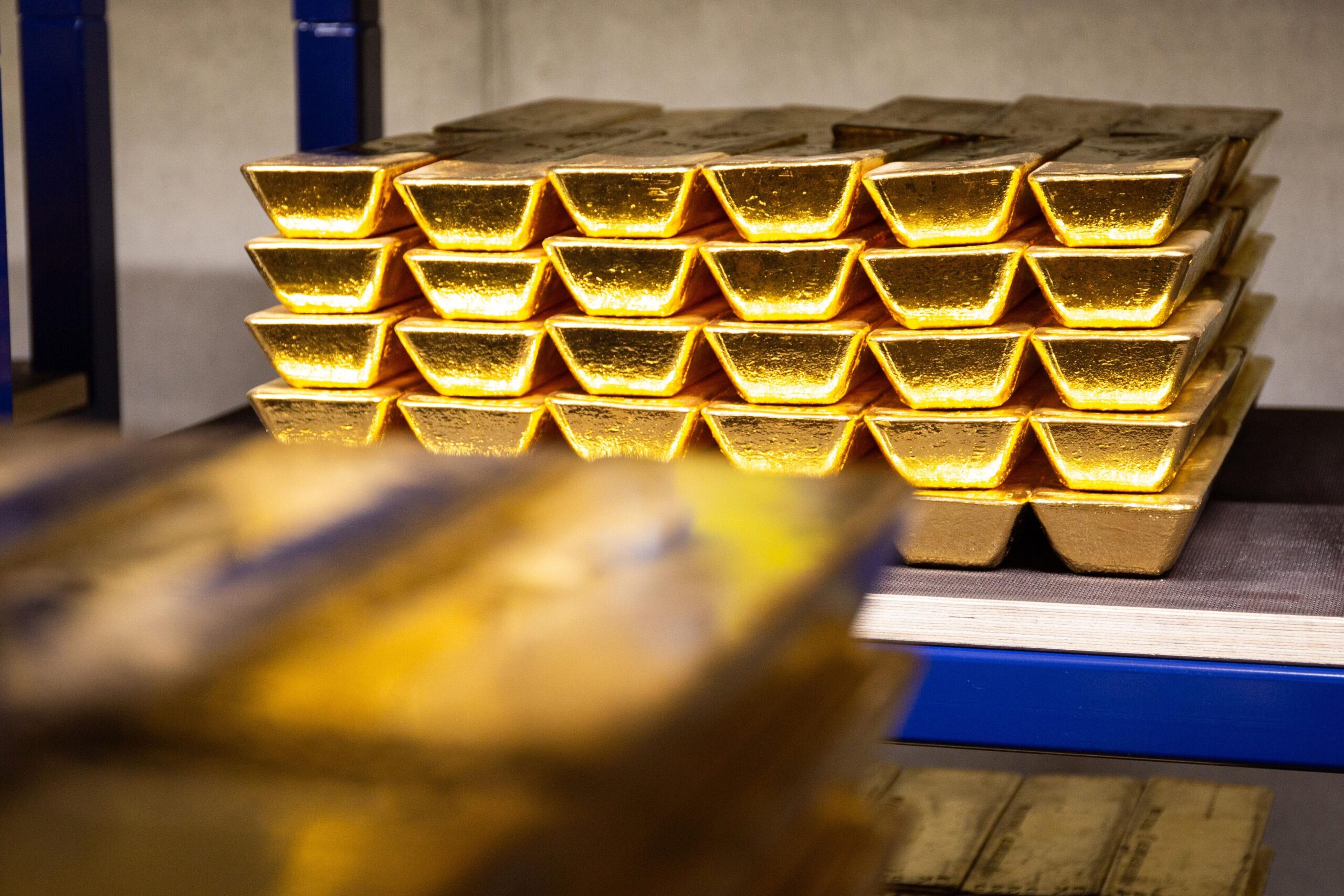
The Dutch National Bank announced Sept. 2 that it had shifted more than a quarter of the gold it held in New York and Ottawa to London between March and August 2026, mostly by selling bars in New York and buying gold in London.
The bank said it was preparing for a crisis. Gold in London can be reached and sold quickly. Gold in New York cannot.
That is the polite version. The blunt meaning is that the central bank of a NATO country does not want so much of its gold held in the United States in the event of a crisis.
The Dutch were not first. France did the same earlier this year, emptying its remaining gold out of New York. Germany still keeps more than a third of its gold in the New York Federal Reserve, and economists, politicians and the German taxpayers’ association have demanded that it be brought home. Emanuel Mönch, a former head of research at the Bundesbank, called it risky to leave so much there.
These are different moves, but they point the same way.
Central banks are backing away from the dollar and putting more of their reserves into gold. By the end of 2025, their gold was worth more than the U.S. government bonds they held. They still rely heavily on the dollar, but they no longer trust it.
The turn became much sharper after February 2022, when Washington and its allies blocked Russia from using about $300 billion of its central-bank reserves held abroad. But Russia was not alone. Britain has kept 34 tons of Venezuela’s gold, now worth about $4.4 billion, locked away at the Bank of England since 2018.
Every central bank in the world was shown something important. Dollars and government bonds held abroad are only yours as long as the governments controlling the financial system let you use them. Washington and its allies have shown they can freeze them when they choose.
Gold is different.
What the reserve managers rediscovered
Marxist economics writer Sam Williams has been making that argument on the Critique of Crisis Theory blog for more than 15 years.
His starting point is Marx’s theory of money.
Money did not begin because a government invented it. It grew out of commodity exchange. Different commodities served as money at different stages of history, but as trade developed, gold and silver took over that role.
Gold could do this because gold is itself a commodity. Human labor is required to mine it, refine it and bring it to market. It therefore has value of its own and can serve as the universal measure of the value of all other commodities.
Paper notes, coins made of cheap metal, and electronic entries can represent money in circulation. They do not abolish the money commodity they represent.
Modern Monetary Theory starts at the opposite end. Instead of money growing out of commodity exchange, it begins with the government imposing its money on society through taxation. Williams argues that this turns Marx upside down by making the government, rather than commodity production and exchange, the starting point of money.
The political purpose of Modern Monetary Theory is to justify the idea that the capitalist state can solve the problems capitalism creates. If money is the government’s creation, then it appears that the government can create enough purchasing power to meet social needs. MMT gives an economic theory to the argument that workers can join with sections of the capitalist class, elect the right government and use the existing state to make capitalism work in their interests.
That difference becomes very concrete when the dollar falls against gold.
The dollar measured by gold
Bourgeois economists, including the advocates of Modern Monetary Theory, begin with the dollar as money and treat gold as just another commodity whose price rises and falls in dollars. Williams begins with Marx’s opposite premise: gold is the money commodity, and the dollar is being measured against it.
The renewed demand for gold by central banks confirms the materialist basis of Marx’s argument. When confidence in paper currencies and government debt begins to weaken, they turn back to the commodity against which the dollar itself is being measured.
So when the financial pages say that the price of gold is rising, Williams says we should read the movement the other way around. Gold is not simply becoming more expensive. Each dollar is representing a smaller amount of gold. What appears as a rising gold price is also the falling gold value of the dollar.
The European Central Bank, which published the figures, says gold only surpassed U.S. government debt in reserves because gold prices rose. That is the same fact turned around. The dollar bought less gold, and so did the bonds that pay in dollars.
Before Franklin Roosevelt took office, a dollar represented about a twentieth of an ounce of gold. Under the postwar Bretton Woods system, it represented a thirty-fifth. Today it represents only a tiny fraction of that.
That is inflation. It takes more dollars to represent the same value, so the dollar prices of other commodities rise.
As U.S. economic power began to shrink relative to its rivals, Nixon ended the dollar’s convertibility into gold in August 1971. That ended the Bretton Woods system. It could not abolish gold as the money commodity.
But U.S. bourgeois economists defensively declared that gold had become just another commodity. Many left-leaning economists abandoned Marx’s materialist analysis of money and set out to prove that his theory had been overtaken by history.
The central banks now buying gold and moving it where they can reach it fastest are giving a different answer in practice.
Overproduction and the trap
Williams’s argument does not stop with the dollar.
Gold is itself produced under capitalism. When profits in gold mining are high, more money is invested in opening mines and expanding production. When profits fall, investment moves elsewhere. Like every other commodity, too much gold can be produced relative to other commodities, and then too little.
But gold has a special role because it is the money commodity.
Capitalist production constantly throws food, machinery, clothing and every other kind of commodity onto the market. These commodities contain surplus value — the source of profit — produced by workers. But the capitalist does not have that profit in hand until the commodities are sold for money.
Gold is different. It is itself a commodity produced by labor, but it is also the commodity that serves as money and measures the value of all the others.
The contradiction is between capitalism’s drive for profits by producing ever more commodities and the need to sell those commodities for money before the capitalist can get the profit.
Production races ahead. Credit allows the expansion to continue. Factories produce a glut of goods, debts pile up, and the commodities become harder to sell at a profit.
Capitalists who were eager to expand yesterday become afraid to part with their money today. Banks tighten credit and call in loans. Payments are demanded. Everyone wants money in hand.
Marx described the change in Capital. During periods of capitalist prosperity, the capitalist treats money as though it hardly matters because commodities can always be sold. Then crisis comes and suddenly capitalists and bankers want the one commodity that can settle every debt: money.
Under the gold standard, the scramble showed itself directly as a scramble for gold. Central banks raised interest rates to protect their reserves and draw gold toward themselves.
The U.S. ended the formal gold standard in 1971, but it did not end capitalism’s need to sell commodities for money or gold’s role as the money commodity.
The warning now appears in the exchange between gold and paper currency. Since 2022, central banks have been buying gold on a scale not seen for decades. They bought more than 1,100 tons a year from 2022 through 2024, about twice the average of the preceding decade. Purchases remained exceptionally high in 2025.
In Williams’s analysis, this is what puts the Federal Reserve in a trap.
It can keep creating dollars and make borrowing easier in an attempt to hold off recession. But as the dollar loses value in relation to gold, prices rise, and interest rates are pushed higher.
Or it can defend the dollar by raising interest rates and making loans harder to get. That means slowing production, bankruptcies, factory closings and unemployment.
The dollar price of gold has risen much faster in the last five years than it did in the five years before that. Ten years ago, gold sold for about $1,300 an ounce. Five years ago it was about $1,750. By November 2025, it had climbed above $4,000.
That month, Williams argued that this sharp rise — the other side of the dollar losing value in relation to gold — was a warning that another crisis of overproduction could not be postponed much longer.
Two months later, gold broke through $5,000 an ounce and briefly rose to nearly $5,600. It has come down since — about $4,400 in early September 2026 — but still stands far above where it was a year earlier.
The movement of gold and government debt since then is what that warning looks like inside the reserves of the capitalist states.
The war adds another pressure.
Washington is borrowing heavily while fighting its war against Iran. U.S. government debt has passed $40 trillion. The more Washington has to borrow, the more bonds it has to sell — and as buyers become less willing to hold them, they demand higher interest rates.
At the same time, every new financial sanction repeats the lesson of Russia’s frozen reserves. Financial sanctions are economic warfare — a modern form of blockade carried out through banks, currencies and access to trade. The U.S. Treasury is already using the dollar system this way against governments Washington targets.
In this analysis, militarism is not something separate from the monetary crisis. The enormous military machine has to be paid for. Increasingly, Washington pays for it by borrowing in a world where the governments and institutions that lend are asking harder questions about the debt they hold.
What the gold says
The Dutch central bank called gold an “anchor of trust” and the “ultimate reserve asset,” especially useful in an extreme crisis. Then it moved more of that gold to London, where it could get at it quickly.
In 2024, central banks around the world held more of their reserves in gold than in euros. By the end of 2025, the value of their gold had also risen above the value of the U.S. government bonds they held.
None of this means the dollar disappears tomorrow. The dollar remains the chief currency of world trade and finance, and U.S. government debt remains one of the world’s largest stores of financial wealth.
But the change in direction matters.
The people who manage the reserves of capitalist states are putting more wealth into gold — something the U.S. Treasury cannot print and that cannot be created by a bookkeeping entry.
That is why gold’s role as the money commodity is at the heart of Marx’s theory of money: unlike the dollar, gold is itself a commodity produced by labor.
A dollar is a paper note or an entry in a bank account representing value. Gold has value of its own because labor is required to produce it, and through centuries of commodity exchange it became the commodity accepted in exchange for all others.
When confidence in dollars weakens, banks and central banks turn to gold.
The bankers can move their gold to London. The crisis they are hedging against affects everyone else, with inflation, layoffs and the stripping away of health care. Their actions show what they think of the future of their own capitalist system: they no longer trust it.
Join the Struggle-La Lucha Telegram channel