
“The President cannot assert ownership over our culture or erase it.”
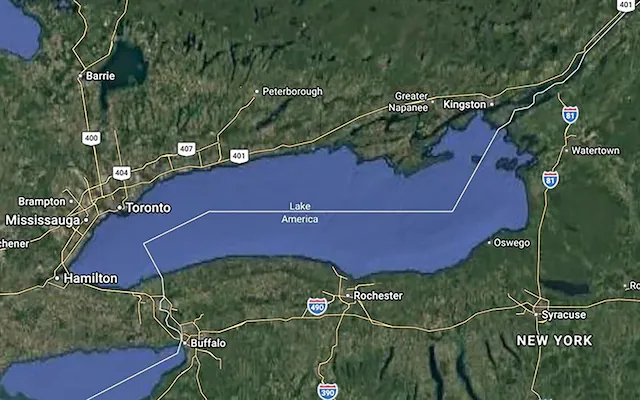
Seneca Nation President J. Conrad Seneca said that on Aug. 28, the day after Donald Trump signed an executive order renaming Lake Ontario “Lake America.” Seneca called for the order to be rescinded and for the name to remain as it stands, reflecting the Seneca people, the other Haudenosaunee nations and all the Indigenous peoples around the lake.
Long before the United States existed, Seneca said, and before settlers brought English to those lands, Seneca and Haudenosaunee ancestors traveled the lake and the waterways that fed it, including to conduct diplomacy among their nations. What Trump is doing now, he said, is the opposite of diplomacy.
The Seneca Nation has heard the United States make claims over its land before. The same government agreed in the 1794 Treaty of Canandaigua never to claim Seneca territory later broke that promise for the Kinzua Dam, seizing more than 10,000 acres and driving hundreds of Seneca people from their homes.
Now Trump is claiming the power to erase an Indigenous name from the map.
He signed the order on Aug. 27 in the Oval Office. It directs the Interior Department and the U.S. Board on Geographic Names to make the change within 30 days and strike references to Lake Ontario from the Geographic Names Information System, the federal database covering more than 2 million physical and cultural features. Every executive department and agency is ordered to use the new name on maps, contracts, documents and communications.
The U.S. Geological Survey began updating the database within hours. Google changed the label on its maps for U.S. users by Aug. 30. MapQuest publicly refused.
Ontario is itself an Indigenous name. In the Seneca language, the lake is sga:nyodai:yoh, beautiful lake. In Wendat it is rendered oniatarí:io or Ontari’io, translated variously as lake of shining waters or the lake is beautiful, the lake is big.
The name predates the United States, predates Canada and predates the arrival of the people who now propose to replace it. The Canadian province of Ontario took its name from the lake in 1867, not the other way around.
John Kane, a Mohawk living on the Seneca Nation’s Cattaraugus Territory and a syndicated radio host, told Buffalo Toronto Public Media that the order was a distraction thrown up by a president under pressure from the failures of his administration. He also said what most of the coverage would not: colonialism and racism cannot be separated, and this is a white man in the White House who believes he can drop “America” onto anything he wants.
The U.S. government already broke the treaty
The Treaty of Canandaigua was signed on Nov. 11, 1794, by 59 Haudenosaunee leaders and by Timothy Pickering, President George Washington’s sole agent. It set the Seneca Nation’s boundaries beginning on Lake Ontario.
Its language was explicit. The United States “will never claim the same, nor disturb the Seneka Nation … in the free use and enjoyment thereof: but it shall remain theirs, until they choose to sell the same to the people of the United States, who have the right to purchase.”
Seneca President J. Conrad Seneca also made a constitutional argument. Article 6 says treaties are the “supreme Law of the Land,” he wrote, and are to be honored as such. He called the order the latest in a long record of attempts to disregard what the United States’ agreed to with the Seneca and the other Haudenosaunee nations.
The U.S. government did not offer that guarantee out of friendship. George Washington sought to prevent the Haudenosaunee from joining the Native nations resisting U.S. expansion in the Ohio Territory, a combination the young United States had good reason to fear. The treaty reflected that balance of forces.
The U.S. government respected the agreement only as long as it felt compelled to.
In October 1956, the Army Corps of Engineers began surveying Seneca land along the Allegheny River for a dam presented to the Seneca Nation as flood control for Pittsburgh. Historian Laurence Hauptman, in “In the Shadow of Kinzua,” says that the project’s real motive was private hydroelectric development in Pennsylvania and state park and highway development in New York.
A federal judge ruled against them in early 1957. In United States v. 21,250 Acres of Land, the U.S. District Court for the Western District of New York held that the treaty “cannot rise above the power of Congress to legislate.” Federal agents could enter Seneca territory and eminent domain could proceed.
The decision rested on the doctrine that Congress could override treaties with Native nations whenever it chose. The judge cited Lone Wolf v. Hitchcock, the 1903 Supreme Court ruling that gave Congress the power to unilaterally break any Indian treaty. Lone Wolf in turn quoted earlier Supreme Court rulings that openly treated Indigenous peoples as conquered and dependent populations whose rights existed only so long as the U.S. government chose to recognize them.
On Sept. 16, 1966, the Corps flooded more than 10,000 acres of Seneca land. About 600 people were forced from the Allegany Reservation. The communities of Red House and Coldspring were burned out so people could not return. Burial grounds, hunting territory and fishing places disappeared beneath the reservoir and remain there today.
That is the record of the treaty now being invoked against Trump’s renaming.
The treaty said the United States could never claim the land. The Army Corps of Engineers trashed the agreement.
The same government that flooded Seneca territory in 1966 is now deleting an Indigenous name from a federal database in 2026. The methods are different. The claim of power is the same.
What the order actually claims
Bruce Blakeman, running against Gov. Kathy Hochul in November, told Syracuse media that Trump was joking and would not really change anything. On Aug. 30, Ontario Premier Doug Ford said on ABC that it was something out of “Saturday Night Live.”
But the order itself is not written as a joke.
It makes an economic, military and territorial case for the lake. It cites shipping, settlement, commerce and defense. It invokes Oswego and Sackets Harbor, the St. Lawrence Seaway, and Coast Guard operations that keep shipping lanes open through the winter.
It goes further. The order points to the deepest waters lying on the U.S. side and declares that “the United States claims most of the Lake’s volume.”
That sentence states the claim plainly. The White House is asserting ownership over a waterway roughly 190 miles long that the United States shares with Canada and that both settler states took from Indigenous peoples.
The order also came at a particular moment. Trade talks with Canada collapsed Aug. 21. On Aug. 22, the administration imposed 50% tariffs on some $20 billion in Canadian goods, including dairy, alcohol, cement and hockey equipment. Ottawa responded with tariffs on U.S. steel, dairy, appliances, agricultural equipment, pulp and paper, and electronics, with its measures set to take effect Sept. 8.
Most opposition from Democratic politicians has remained limited to that trade dispute. Rep. Debbie Dingell announced legislation to nullify the renaming while emphasizing Canada’s importance as a U.S. ally and economic partner. Hochul said New York will not use Trump’s name and argued that the White House should be repairing the trade relationship instead.
Their complaint is that the tariff war is hurting business.
The Seneca Nation is raising a more fundamental question: What gives Trump the right to claim the land and water in the first place?
Kane placed “Lake America” alongside Trump’s talk of annexing Canada as a 51st state, taking Greenland and declaring the Strait of Hormuz U.S. territory. The same administration waging war in West Asia has spent the summer drawing new lines around what it says belongs to the United States.
Maps have always accompanied conquest. Naming is part of that process because it turns power into something that looks permanent and natural.
The Seneca people answered Washington in 1794. They answered again when federal surveyors entered their territory in 1956 and when the water rose behind Kinzua Dam in 1966.
They are answering it now.
An executive order cannot make sga:nyodai:yoh into “Lake America.”
Join the Struggle-La Lucha Telegram channel