
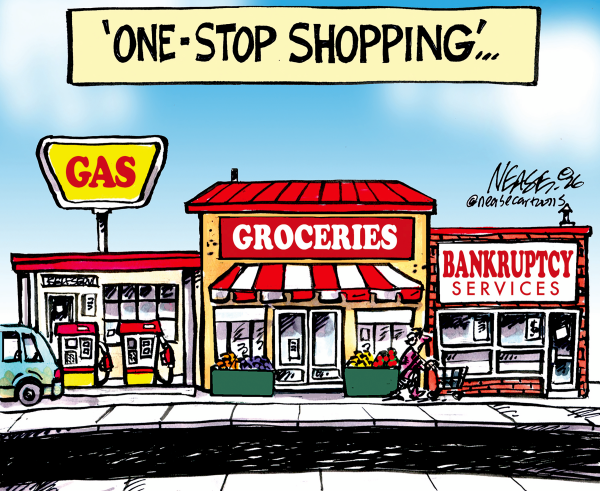
The U.S. war on Iran is hitting workers in the wallet — and pushing the capitalist economy toward a wider crisis.
Workers feel it first. Food prices are jumping. The war has driven transportation costs sharply higher. Since the war began, gasoline and diesel prices have risen about 40%. Diesel has climbed to about $5.60 a gallon. The price gap between crude oil and the diesel made from it has risen above $100 a barrel for the first time as the war disrupts refineries and fuel shipments. Diesel moves trucks, trains and farm machinery, so those higher costs spread through the price of food and other goods. Gasoline has reached $4.10 a gallon.
Mortgage rates are climbing too. The average 30-year mortgage has risen from 5.98% before the war to 6.65% today. Auto loan rates are also rising as long-term government interest rates climb. Credit card rates remain extremely high because they follow the Federal Reserve’s short-term rates.
Workers are going into debt just to live. U.S. households spent $160 billion through “buy now, pay later” loans last year, nearly twice as much as in 2023. Half of the people using them said they could not make ends meet otherwise. It is the old loan-shark business in digital form: advance workers money when their paychecks fall short, then collect fees and payments out of their future wages. Miss a payment, and borrowers can be hit with late fees, overdraft charges or debt collection. Lenders are now financing rent, electricity, health insurance and other necessities.
Behind the rising costs, a crisis is building in a market most workers never use: the market for U.S. government bonds.
War must be paid for, and the capitalist state pays for it by borrowing. Every bomb dropped, every carrier deployed, every missile fired is wealth destroyed. War production builds no housing, schools or factories making goods for workers. The weapons are used up as the military operations continue, while the government debt incurred to pay for them keeps growing. The government must keep paying interest on the bonds it sold to finance the war, sending money to banks, investment funds and wealthy bondholders year after year.
On Aug. 18, the interest rate on 30-year government bonds reached 5.337%, its highest in 19 years. The government is borrowing heavily just as war-driven inflation is making long-term promises to repay dollars less attractive. Bond buyers demand a higher return, bond prices fall and interest rates rise. Federal debt passed $40 trillion for the first time. The government is spending nearly $2 trillion a year more than it takes in.
On Aug. 19, Treasury Secretary Scott Bessent tried to force those rates down by announcing larger government bond financial manipulations. The 30-year rate fell below 5.2%, but by Aug. 20 it was climbing again. The big banks and investment funds that lend to the government want higher interest rates, and they are getting them.
This has produced growing talk of a U.S. “debt crisis.” The debt is real, but debt itself is not the crisis. It becomes explosive when the credit system can no longer postpone the deeper crisis developing in capitalist production.
Debt is not capital
A government bond is a loan to the government that promises regular interest payments and repayment of the loan after a set period of time. But the bond itself is not a factory, warehouse, railroad or machine. It does not produce commodities or generate profits by putting workers to work.
Marx called securities of this kind fictitious capital. They bring income to their owners, but what the owners hold is a claim on future payments, not productive capital.
Government bonds are not guaranteed to hold their value. Investors who bought 30-year bonds in 2020 and 2021, when interest rates were near zero, have seen their resale value fall by as much as half even though the government kept making every payment. A bond paying almost no interest is worth far less once new bonds pay more than 5%.
The federal debt has more than doubled since Donald Trump first entered the White House in 2017, driven by tax cuts for corporations and the rich, military spending, pandemic rescue measures and repeated efforts to prop up the capitalist economy.
The wars have added directly to the pile-up. An independent estimate puts the direct cost of the war on Iran at more than $103 billion in its first 120 days. In June, the White House asked Congress for $72 billion in war funding. U.S. military operations against Venezuela and in the Caribbean and eastern Pacific cost at least another $4.7 billion through March 31, according to Brown University’s Costs of War project.
The bill does not end when the missiles are fired. On Aug. 17, the Navy awarded Raytheon a seven-year, $22.9 billion contract to rebuild and greatly expand Tomahawk production. The weapons destroyed in war have to be produced all over again, adding still more military spending to a government already borrowing nearly $2 trillion a year.
The government bonds are fictitious capital, but the interest income they bring their owners is real. The government paid $963 billion in interest from October through July, the first 10 months of fiscal 2026. That is about $3.2 billion a day flowing to banks, investment funds, wealthy investors and foreign governments that lent money to the U.S. government by buying its bonds and Treasury notes. Every rise in interest rates increases that tribute.
Vietnam: when war broke the dollar
This has happened before.
The U.S. war on Vietnam was paid for largely through borrowing. War spending drove inflation higher, cutting the buying power of the dollar. The Bretton Woods system established after World War II had placed the U.S. dollar at the center of the international monetary system. Other currencies were tied to the dollar, while dollars held by foreign central banks could be exchanged for U.S. gold at the fixed price of $35 an ounce. As the dollar lost buying power, there was less and less reason to hold dollars when they could be traded for gold at that guaranteed price. Foreign governments increasingly did exactly that, draining U.S. gold reserves.
On Aug. 15, 1971, President Richard Nixon tore up the U.S. commitment to redeem dollars held by foreign governments for gold at $35 an ounce. The gold backing of the dollar under Bretton Woods was gone. Foreign governments holding dollars could no longer exchange them for U.S. gold and were forced to absorb the loss as the dollar’s value fell. Attempts to patch the system together failed, and by early 1973 Bretton Woods had collapsed.
The U.S. war on Iran is exposing the same fundamental weakness in the dollar system. Gold jumped more than 4% on Aug. 19 and has climbed above $4,500 an ounce.
Gold remains the money commodity behind the international monetary system — the real thing that paper money stands in for. The Federal Reserve can print more dollars. It cannot print gold, and it cannot print value.
There is no door to slam this time. In 1971, U.S. economic and military power was still strong enough to make the world economy accept dollars that could no longer be exchanged for gold. That power has eroded. China, once the largest foreign holder of U.S. government debt, has reduced its Treasury holdings to $633 billion, down more than 13% from a year earlier and the lowest since 2008. Washington can no longer simply dictate that the rest of the world accept its paper in place of gold. A loss of confidence in the dollar shakes the promise behind $40 trillion in U.S. government debt.
Washington pushes the crisis outward
Washington is pushing the costs of its war drive onto other imperialist powers and their workers — not only through the devaluation of the dollar, but by demanding that they rearm, borrow more and cut social spending.
The U.S. demands that European NATO governments and Japan rearm, much of it with U.S. weapons. U.S. arms corporations get the profits. European and Japanese governments take on more debt, while workers are made to pay through taxes, cuts in social spending and attacks on living standards. At the same time, long-term interest rates have climbed sharply in Germany, France, Britain and Japan as governments borrow more and the war drives up energy prices. Every imperialist power is financing the same war drive, and the bond crisis is spreading to every one of them.
When capitalists want cash
The market for government bonds has not broken down yet. But in March 2020 it did.
As the COVID crisis spread, banks, investment funds and corporations suddenly needed cash. They sold stocks, corporate bonds and finally U.S. government bonds themselves. So many bonds were thrown on the market that trading in some nearly stopped.
The panic revealed a law of capitalist crisis: when a crash comes, capitalists do not want investments — not even “safe” ones. They want money itself, and they will sell anything to get it.
The Federal Reserve stopped the panic by creating hundreds of billions of new dollars and using them to buy bonds, as it had after the 2008 crash.
But creating more dollars does not create more real value. If the quantity of dollars grows faster than the value they represent, the dollar loses value and prices rise. It does not build a factory, produce a commodity or create an ounce of new value. Each rescue also encourages banks and investment funds to gamble more freely and borrow more heavily, expecting the Fed to step in again when the next crisis hits.
The next rescue, if it comes, will come with a growing federal debt already above $40 trillion, a major war underway and the dollar rapidly losing ground against gold.
The AI boom and overproduction
The war machine is not the only borrower crowding in. Amazon, Alphabet, Meta and Oracle have borrowed about $223 billion by selling bonds this year to pour money into AI data centers, chips and power plants.
That is more than twice what they borrowed in all of 2025. AI-related borrowing now accounts for roughly 15% of U.S. investment-grade corporate bond sales. At the same time, several of these corporations have been laying off workers. Much of the new investment is going into data centers, chips and automated systems designed to do more work with fewer workers.
The federal government is borrowing to finance war, while the AI monopolies borrow enormous sums of their own. Together they are adding to the demand for money capital. When demand for money to borrow grows faster than the supply, interest rates rise. Higher rates swell the government’s interest bill, forcing it to borrow still more.
The AI boom also shows how capitalist expansion prepares its own bust.
Spending on data centers, chips and power plants raises sales and profits, encouraging still more spending and borrowing. But the spending cannot speed up forever. Once growth slows, sales fall short, profits shrink and lenders pull back. Facilities that seemed desperately needed can suddenly become excess capacity that cannot be used at a profit.
Railroads transformed capitalist production in the 19th century — even though one railroad boom after another ended in bankruptcies and financial panics. Capitalism can produce useful technology and, at the same time, produce far more capacity than it can profitably use.
During a boom, capitalists build factories, add machinery, pile up goods and borrow in expectation of future profits. Credit lets the boom run far beyond what cash alone would allow. But production is not planned to meet human need. Each capitalist produces for profit and competes for markets.
Sooner or later, goods, factories and debts pile up faster than the market can absorb them at a profit. Money gets tight. Interest rates rise. Loans get harder to find. What first looks like a shortage of money turns out to be something deeper: too many goods and too many factories to sell and run at a profit.
Factories close. Businesses go bankrupt. Workers lose their jobs. Machinery is idled, inventories are dumped at a loss, and factories and equipment lose value until conditions for profitable production are restored — and then the cycle starts over.
That is the capitalist crisis of overproduction.
Both roads lead to the workers
The Federal Reserve is caught between two pressures, and both of its options are attacks on the working class.
If it prints money on a large scale to push interest rates down, the exchange value of the dollar can weaken and commodity prices can rise. When wages fail to keep up, workers take a real wage cut — the squeeze they are already feeling at the gas pump and grocery store.
If it keeps money tight, businesses cut back, weaker companies fail and workers are thrown out of work. Mass unemployment then does its own work for capital, letting employers press down wages and speed up those still on the job.
Either road leads to the same place: restoring profits by driving up the exploitation of the working class. The Fed is not weighing burdens. It is choosing weapons. How far either weapon cuts will be decided by the resistance of the workers, not in the Fed’s boardroom.
No interest rate abolishes this contradiction. The Treasury can shuffle its debts. Central banks can increase bank reserves — the electronic funds that commercial banks hold at the central bank — and use them to buy bonds. They can rescue financial markets again. But none can abolish the contradictions of capitalist production, and none can make war produce anything but destruction.
The next crisis will not stay on Wall Street
The present fall in government bond prices does not mean that a general crisis has begun. But it contains the threat of one developing. In a panic, falling bond prices bring losses; losses create demands for cash; the scramble for cash forces still more bonds onto the market — until buyers disappear and the market itself breaks down.
When these contradictions can no longer be postponed through credit, they erupt in bankruptcies, unemployment and a sharp fall in production.
Capitalist crisis also changes the conditions of the class struggle. Factories close. Millions can be thrown out of work. Wages and living standards come under attack. Illusions about the permanence and stability of the system are shaken.
Again and again, capitalist crashes have produced great strikes, mass movements, rebellions and revolutionary struggles.
The coming crash will not remain on Wall Street. It will enter the workplaces and the streets as a new stage of the class struggle.
Join the Struggle-La Lucha Telegram channel