
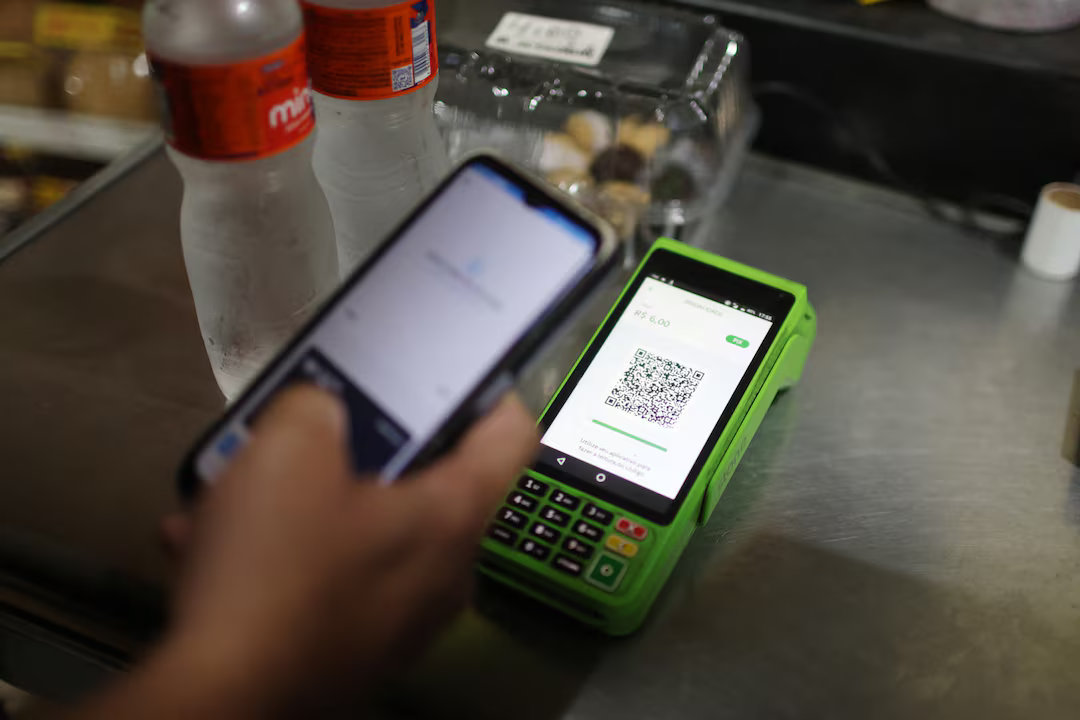
On July 15, 2026, Washington announced a new 25% tariff on Brazilian goods, taking effect July 22 — a punishment aimed at protecting U.S. payment monopolies. Pix, Brazil’s public instant-payment system, cuts Visa and Mastercard out of millions of transactions.
In July 2025, Trump imposed a 50% tariff on Brazilian goods in a failed attempt to stop the prosecution of former President Jair Bolsonaro, who was later sentenced to 27 years in prison for plotting a coup. When the U.S. Supreme Court struck down those tariffs in February 2026, Washington tried again. On June 1, it threatened a new 25% tariff unless Brazil made concessions, including changes that would protect U.S. payment companies from Pix. Talks continued until July 15, when Washington imposed the tariff.
On July 1, Flávio Bolsonaro — the jailed former president’s son and the right wing’s presidential candidate — asked Washington to delay the tariff until after Brazil’s October election. His proposal was to hold the threat in reserve while voters decided whether to install a government willing to keep Pix from linking to payment systems outside U.S. control. Washington imposed the tariff instead, using immediate economic pressure to weaken Lula and improve Flávio Bolsonaro’s chances of winning the presidency.
Three days before the deadline, The Economist saw “storm clouds” gathering over U.S. financial supremacy. Its July 12, 2026, report carried a warning: U.S. payments firms may be the first casualties. (“Storm clouds gather over America’s financial supremacy“)
Pix was built by Brazil’s central bank. It allows people and businesses to transfer money directly and almost instantly, usually without the fees charged by the two U.S. payment monopolies. Pix is free for individuals and now handles more than half of all financial transactions in Brazil. The central bank has logged 313 million Pix payments in a single day.
U.S. Trade Representative Jamieson Greer complained that the system unfairly disadvantages U.S. companies. The USTR’s formal finding is that Brazil’s central bank, as both regulator and operator of Pix, created mandates and fee caps that disadvantage U.S. electronic payment providers. In substance, Washington is complaining that the system is too cheap.
Brazilian President Luiz Inácio Lula da Silva answered: “Pix is a Brazilian achievement, and we will not give it up.”
Washington’s tariff protects Visa and Mastercard
Washington drops the “free market” when a public system undercuts U.S. monopolies. Washington is acting as the executive committee of monopoly capital, using state power to defend the tolls collected by Visa and Mastercard. The tariff shows how strongly monopoly capital now depends on financial tolls.
The tariff covers thousands of Brazilian products, including sugar, clothing and machinery. But Washington exempted coffee, beef, oil, rare earths and aircraft parts — goods U.S. corporations depend on or whose higher prices would hurt the U.S. market. The pattern exposes the class character of the tariff: protect U.S. supply chains while hitting Brazilian industries Washington believes can be used to force concessions. One of those concessions is protection for Visa and Mastercard against Pix.
Payment channels and world money
The conflict is real. But The Economist blurs two different questions: control over the machinery that transmits payments and control over the money in which debts are calculated and settled.
Visa and Mastercard route payment instructions and handle authorization, clearing and settlement between merchants’ banks and cardholders’ banks. SWIFT does the same work between banks across borders. These networks organize payments, but they do not create the value being transferred or decide what counts as money in world trade.
That is why a country can build its own network and still be chained to the U.S. dollar. A Brazilian company can skip Visa and still owe its debts in dollars. A Chinese bank can send a payment over a Chinese network while the contract it is paying was written in dollars. Even digital tokens that stand in for dollars can skip the card companies and the big international banks — and still spread the dollar’s reach, because every token is a claim on dollars.
New payment systems can weaken U.S. control over the pipes that money moves through. The U.S. dollar’s rule over the world market rests on more than the pipes.
That distinction is central to a Marxist analysis of money.
Under capitalism, businesses produce goods before they know whether anyone will buy them. A warehouse can be full, but until the goods are sold, the business has no money from them to pay wages, debts or the costs of producing more.
A payment network can send a message that a transaction has gone through. But the seller needs more than that message. The seller needs money that others will accept, that can pay debts and retain its purchasing power.
On the world market, those functions have been performed primarily through the U.S. dollar system.
World trade ultimately requires a form of world money. Karl Marx showed that gold functions as the money commodity under capitalism. Paper currencies, bank deposits and digital claims represent money, but their value is ultimately tested against gold and against one another.
The dollar’s power cannot be measured by counting card payments or SWIFT messages. It rests on a deeper foundation. Much of world trade is priced in dollars. Governments, banks and corporations borrow in dollars, and central banks hold dollars as reserves. When a financial crisis hits, borrowers scramble for dollars and depend on the Federal Reserve to supply them. Countries also use dollars to settle long-term trade deficits and surpluses.
Countries are building payment channels that go around Visa, Mastercard and SWIFT. The messengers can be replaced. The U.S. dollar is harder to escape. So the card companies and SWIFT will feel the squeeze first, long before the dollar loses its place in world trade and finance.
The tollbooth
After paying their operating costs, Visa and Mastercard retain more than half of their revenue as operating profit. That extraordinary profit comes from their monopoly control over the channels through which payments must pass. Swiping a card or scanning a phone creates no new value. The value has been produced elsewhere by workers in factories, farms, mines, warehouses, offices and transportation.
Visa and Mastercard control points through which already existing value must pass. Their monopoly position allows them to appropriate a portion of the surplus value produced throughout the economy.
They collect a toll as money moves from buyer to seller.
Pix threatens the tollbooth. It demonstrates that a public payment system can conduct enormous numbers of transactions without handing a cut to two U.S. corporations. Washington’s tariff is an attempt to compel Brazil to preserve a source of monopoly revenue for U.S. finance capital.
Brazil’s right wing and the October election
Brazil’s right wing shows what capitulation would look like. According to The Economist, Flávio Bolsonaro — the presidential candidate endorsed by Trump — has suggested preserving Pix for domestic use while promising not to connect it to cross-border systems that could challenge U.S. payment networks internationally.
That compromise would allow Brazil to keep some of Pix’s domestic advantages while leaving the international privileges of U.S. capital largely intact. That is the position of a section of the Brazilian capitalist class: lower payment costs at home, no confrontation with the U.S.-controlled financial system.
Flávio Bolsonaro’s ties to finance capital are direct. Leaked messages published in May 2026 show the senator negotiating some $24 million in financing from Daniel Vorcaro, the jailed former owner of Banco Master, with at least $10.6 million paid in six bank transfers in 2025. The money was ostensibly to finance a film about his father. Federal police are investigating whether the film served to camouflage the payments. Some $2 million landed in a Texas fund tied to a lawyer for the senator’s brother, Eduardo Bolsonaro, who spent months in Washington lobbying for U.S. sanctions and tariffs against Brazil.
The tariff also aims past Brazil at China. Trade between Brazil and China reached a record $171 billion in 2025, more than double Brazil’s $83 billion in trade with the United States. Washington’s economic pressure serves a larger goal: to install a government in Brasília that will pull the country out of China’s orbit and secure Brazilian resources for U.S. capital.
The pressure is backfiring. An Atlas/Bloomberg poll released July 1, 2026, put Lula nearly 10 points ahead of Flávio Bolsonaro in the first round, after the senator’s support fell when the Vorcaro audios leaked. A Quaest poll released July 15, 2026, showed Lula widening his lead in a runoff. Lula has laid the tariff threats at his opponent’s feet, and nearly half of Brazilian voters agree with him.
Flávio Bolsonaro’s own proposal makes the plan clear. On July 1, he asked Washington to delay the tariff until after Brazil’s October election. That would give him a chance to win the presidency and then offer Washington the concessions Lula had refused. A Bolsonaro victory could deliver at the ballot box what Washington could not win through negotiations.
Two kinds of independence
The Economist groups Brazil, China, India, Russia, Britain and the European Union together under the heading of “payments sovereignty.” A Marxist analysis has to distinguish between very different class forces.
For countries targeted by U.S. sanctions and financial blockades, independent payment systems make U.S. economic warfare harder. They give countries more ways to keep trade moving, buy necessary goods and protect their reserves when Washington tries to shut their economies down.
China’s construction of independent payment channels can also give other countries greater room to trade outside immediate U.S. control.
The efforts of Britain and the European Union have a different character. European finance capital is not seeking liberation from imperialism. It wants payment infrastructure that cannot be switched off by a rival imperialist power. The result is growing competition between capitalist financial centers.
The Economist reduces all these struggles to “fragmentation.” That word conceals the system being fragmented: a structure dominated by U.S. banks, U.S. corporations, the dollar and the U.S. state.
The dollar undermines itself
Washington itself is accelerating the process.
An international currency works best when capitalists believe it is universally available, politically predictable and safe to hold. The U.S. gains enormous power because the dollar performs this role. Yet the U.S. increasingly uses its control over the financial system to impose sanctions, block countries from making payments, freeze or seize their reserves and cut them off from international trade.
Each new sanction, seizure or financial blockade gives governments another reason to build payment systems beyond Washington’s control.
The United States therefore faces a contradiction. The more aggressively it uses the dollar system to impose sanctions and enforce its political and military aims, the more it undermines confidence in the dollar as a universally accepted currency.
The tariff over Pix makes that contradiction especially clear. It warns every government and central bank building an alternative: even a successful domestic payment system can become grounds for retaliation when it cuts into the income of U.S. monopoly capital.
Who pays and who owns
The Economist warns that separate national and regional payment systems could make international transactions slower and more expensive. It cites a report sponsored by SWIFT, the banking network whose position is threatened by those systems.
Separate networks can create real costs. But the report counts only the costs of moving away from U.S. control. It does not count the monopoly fees collected by Visa and Mastercard, the damage caused by U.S. sanctions, the reserves frozen or seized by Washington, or the trade stopped when countries are cut off from financial channels.
The existing system appears free and efficient because its costs are hidden inside practices so long established that they are treated as natural. Merchants pay monopoly fees and fold them into every price. Sanctioned countries lose access to trade and reserves. Workers face higher prices, shortages and lost jobs.
Payment monopolies are part of the growing power of finance capital. When capital has difficulty finding sufficiently profitable investment in production, it turns more heavily to interest, debt, fees and monopoly charges. These claims do not create new value. They draw on the surplus value already produced by workers.
Visa and Mastercard use their control of payment networks to collect fees from the banks and payment companies that depend on them.
Pix closes one of those channels. It can reduce monopoly fees, weaken U.S. financial control and give countries more room to resist sanctions and economic blockade. These are real gains in the struggle against imperialism.
But a different payment network does not necessarily mean a different class system. The central bank runs Pix, but the money still sits in private banks. The system lowered the toll without taking the banks out of private hands. The decisive question is who owns the banks, credit system and payment infrastructure, who controls the financial data and who receives the savings produced by the technology.
Workers produce the value. Capitalists control how it is invested, circulated and divided.
The fight over Pix shows both sides of the task: defend every gain that weakens imperialist monopoly, and fight to place the banks, credit and payment systems under social ownership and workers’ control.
Join the Struggle-La Lucha Telegram channel