
The Voting Rights Act was won to break the machinery that denied Black people political power — not only the right to cast a ballot, but the right to elect Black representatives and shape the government under which they live.
That right was not handed down by the courts. Black people and their allies were beaten, jailed, bombed, lynched and assassinated to win it. From Reconstruction to the Civil Rights Movement, the struggle for Black voting rights was a struggle against the same Southern ruling class that used poll taxes, literacy tests, terror and gerrymanders to keep Black people out of power.
Now that right is under direct attack again.
On April 29, the Supreme Court’s right-wing majority issued its ruling in Louisiana v. Callais, attacking what remained of Section 2 of the Voting Rights Act. That section was designed to stop states from diluting Black voting strength. It was one of the legal gains won by the Black freedom struggle.
The Voting Rights Act was not handed down by a liberal court. It was forced onto the national agenda by a mass movement and reaffirmed by Congress again and again, including a nearly unanimous reauthorization in 2006. The court is now attacking one of the most democratically won laws in U.S. history.
The court has turned that history upside down.
A law created to protect Black voting power is now being used to destroy a Black-majority congressional district in Louisiana. In the name of ending “racial gerrymandering,” the court has opened the door to the very thing the Voting Rights Act was passed to stop: the organized weakening of Black political representation in the South.
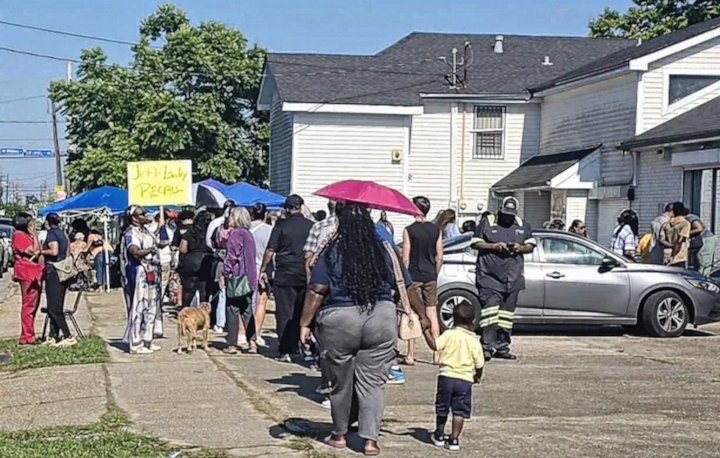
On April 29, the Supreme Court struck down Louisiana’s second majority-Black congressional district. The next day, Gov. Jeff Landry moved to suspend the May 16 U.S. House primaries. Early voting was set to begin May 2. Absentee ballots had already been mailed. More than 42,000 had already been returned. Those votes were thrown out. Then, on May 4, the Supreme Court rushed its own paperwork, bypassing the usual waiting period and clearing the way for Louisiana officials to redraw the map after voters had already cast ballots.
This was a political operation carried out through legal machinery.
The new map is designed to eliminate Black representation. It would take Louisiana’s two Black members of Congress — Rep. Cleo Fields of Baton Rouge and Rep. Troy Carter of New Orleans — and force them into the same district. One of them would be driven out without losing an election. Black voters would be packed into one district instead of having the power to elect representatives in two. The result would be one less Black-held seat in Congress from Louisiana.
Louisiana is not alone. After Callais, Republican-led states across the South moved to dismantle Black-majority congressional districts and drive Black representatives out of Congress. The ruling gave them the opening they were waiting for.
A sitting Black representative can be pushed out without losing an election. Black voters can have their power reduced without officials openly declaring, “We are taking away your rights.” The Supreme Court issues the ruling. The governor stops the election. The Legislature redraws the lines. The old disenfranchisement returns under the cover of constitutional law.
Black voters are told they still have the right to vote. Then the courts and legislatures redraw the districts so those votes cannot elect Black representatives. The ballot remains. The power behind the ballot is stripped away.
Courts and legislatures are being used to cut down Black political power before voters can act. The courts stand inside this attack. They are part of it. In Dred Scott, the Supreme Court backed slavery and declared that Black people had no rights the white ruling class was bound to respect. In Plessy v. Ferguson, it made Jim Crow segregation the law of the land. Today, in Louisiana v. Callais, the same court is using the language of “equal protection” to attack the voting rights and Black representation that generations fought, bled and died to win.
Now the courts are using the language of voting rights to restore the power of those who opposed them.
In Louisiana, the courts are defending the political order that benefits from cutting down Black voting power. Black representation gave oppressed communities a base from which to fight for food, housing, education, health care, jobs and public services. When Black people fought for voting rights, courts and laws bent under the pressure of mass struggle. Now those same institutions are being used to claw back what was won.
The attack in Louisiana belongs to the same ruling-class offensive that funds war, cuts social programs, backs police repression, sends ICE against immigrant workers and attacks liberation struggles abroad. The same ruling-class machinery that attacks Black voting power at home uses indictments, sanctions and military threats against liberation struggles abroad — especially those that challenge U.S. colonial and neocolonial domination. In each case, the political decision comes first. The legal cover follows.
That method was used against Venezuela before U.S. imperialism moved to remove Nicolás Maduro. Washington conjured a drug-trafficking case out of whole cloth, producing an indictment instead of evidence. The claims kept shifting because the political decision came first: remove Venezuela’s popularly elected president, a leader of the Bolivarian struggle against U.S.-backed oligarchy, oil domination and imperialist control.
Now the same machinery is being pointed at Cuba.
The Justice Department is threatening to indict 94-year-old Raúl Castro over the 1996 shootdown of planes tied to Brothers to the Rescue, a U.S.-created terrorist network that repeatedly violated Cuban airspace. Cuba had warned Washington about these provocations. The U.S. government knew what was happening and allowed it to continue.
Thirty years later, the incident is being pulled back into service.
Raúl Castro is being targeted as one of the historic leaders of the Cuban struggle that broke the island free from the U.S.-backed Batista dictatorship and U.S. neocolonial rule. The aim is to criminalize the revolution through one of its leaders, just as Washington criminalized Venezuela’s Bolivarian process through its attack on Maduro.
It is like arresting the head of a union in the middle of a strike and pretending the issue is one person, not the struggle itself.
The pattern is the same. In Louisiana, a court ruling and a redistricting map are used to eliminate Black voting power before voters can decide. In Venezuela and Cuba, indictments and old charges are used to attack liberation struggles that challenged U.S. domination.
In Louisiana, the target is Black representation. In Cuba, the target is the Cuban Revolution. In Venezuela, the target is the Bolivarian Revolution. In every case, courts, prosecutors and executive officials move before the people can settle the question through struggle, organization or elections.
The fight for Black voting rights and the fight against U.S. imperialism are two fronts of one struggle against the same ruling class.
The same courts, prosecutors, politicians, banks and military commands that serve capitalist rule abroad also attack voting rights at home. The same ruling class that cannot forgive Cuba for making a revolution 90 miles from Florida cannot tolerate Black political power in the South. The same law that protects counterrevolutionaries against Cuba is used to erase Black representation in Louisiana.
Legal defense matters. Elections matter. Every right must be defended. But Black voting rights were won by mass struggle — by marches, boycotts, organizing, sacrifice and rebellion against white supremacy. The courts moved only when the people moved.
The attack in Louisiana reaches beyond one district or one election. It is a warning. The ruling class is testing how far it can go in using courts and state governments to cancel voting power before voters can act. If it succeeds in Louisiana, the method will spread.
The defense of Black voting rights must become a mass issue for labor, oppressed communities, anti-war forces and everyone who understands that democracy for working and oppressed people has always been won from below.
From Baton Rouge to Havana, the law is being used as a weapon. The answer is not trust in the courts. The answer is mass struggle — in the unions, communities, campuses and streets — to defend Black voting rights, Black representation and every liberation struggle against U.S. imperialism.
Join the Struggle-La Lucha Telegram channel