
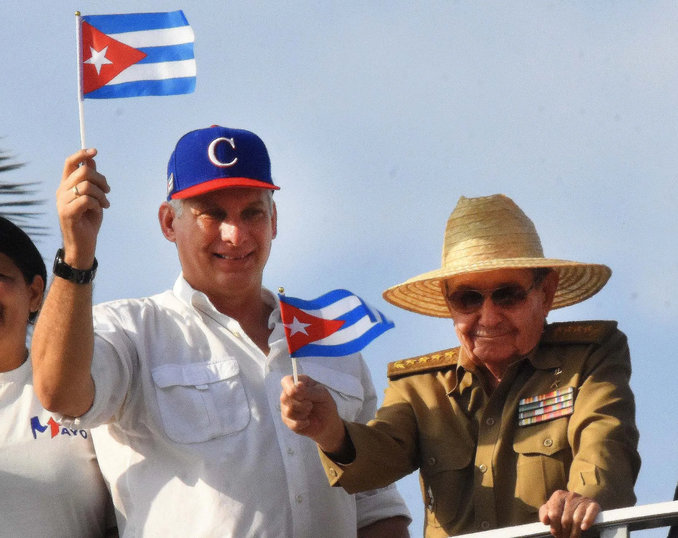
The Justice Department is moving to indict 94-year-old Raúl Castro, one of the historic leaders of the Cuban Revolution, over Cuba’s 1996 shootdown of two planes flown by Brothers to the Rescue — not a humanitarian group, but one arm of a U.S.-created anti-Cuba terrorist network rooted in the CIA’s war against the Cuban Revolution.
Raúl Castro was a commander in the revolutionary struggle that overthrew the U.S.-backed Batista dictatorship. He later served as Cuba’s defense minister and president. Washington is not just naming an individual. It is targeting a leader identified with the revolution itself.
That indictment threat sits alongside everything else Washington has deployed against Cuba in recent months: a fuel blockade that left the island with no diesel and no fuel oil reserves as of May 14, a visit from CIA Director John Ratcliffe carrying Trump’s ultimatum for “fundamental changes,” a $100 million aid offer conditioned on political concessions, and at least 25 U.S. military surveillance flights near Cuba’s coast since Feb. 4 — the same platforms used before the Jan. 3 kidnapping of Venezuelan President Nicolás Maduro.
This is how imperialism operates: the courts, the CIA, the Pentagon, the Treasury Department, Congress and the corporate media move as different arms of the same class state.
The administration has been open about the Venezuela frame. Ratcliffe urged the Cuban side to take a lesson from the Maduro operation. Senior officials want the option of running the same playbook against Havana.
That is why the Venezuela comparison matters. Nicolás Maduro was targeted not simply as a head of state, but as a leader of the Bolivarian Revolution. Raúl Castro is being targeted in the same way: as one of the historic leaders of the Cuban Revolution. It is like arresting the head of a union in the middle of a strike and pretending the issue is one person, not the struggle itself.
The possible indictment is part of that architecture — not as genuine legal cover, but as a propaganda point Washington can point to when everyone already knows what it is. Remember the Maine. The pretext doesn’t have to be credible. It just has to exist.
But to understand what the indictment would actually charge, you have to understand what Brothers to the Rescue actually was.
José Basulto and the CIA’s anti-Cuba network
Brothers to the Rescue was founded in Miami in 1991 by José Basulto. The group claimed to search for Cuban rafters in the Florida Straits as a humanitarian cover. Its few rescue flights soon gave way to political and provocative missions toward and into Cuban airspace, using the humanitarian image as cover for a role inside the wider anti-Cuba CIA operations. Basulto himself was no ordinary humanitarian worker. He was a CIA operative, a Bay of Pigs veteran, and a man with a long record in intelligence, communications, explosives, sabotage and subversion. He later acknowledged a CIA-sponsored commando mission into Cuba. In 1962, he carried out an armed attack in which he fired a 20mm cannon at a Cuban hotel.
Brothers to the Rescue operated inside a U.S.-run anti-Cuba network. Through the 1990s, that network planned and carried out bombings against Cuban tourism targets, assassination plots and paramilitary operations against the island. Alpha 66, Omega 7, Comandos F4, the Cuban American National Foundation, Independent and Democratic Cuba, and Brothers to the Rescue itself operated with impunity in the United States — with the knowledge and support of the FBI and CIA, according to Marjorie Cohn, former president of the National Lawyers Guild and Thomas Jefferson School of Law professor.
The 11th U.S. Circuit Court of Appeals later documented the record. Alpha 66 ran paramilitary camps, attacked Cuban hotels in 1992, 1994 and 1995, tried to smuggle hand grenades into Cuba, and sent members who were intercepted on their way to assassinate Fidel Castro in 1997. The Cuban American National Foundation planned to bomb a Havana nightclub. Comandos F4 was involved in a separate Castro assassination attempt.
This was not simply a Cuban American political current. It was a U.S.-based terror apparatus aimed at overthrowing the Cuban Revolution. Washington encouraged it, shielded it and, in key instances, directed it.
Luis Posada Carriles showed what that protection meant. Posada had been a CIA agent since 1961. He was the mastermind of the 1976 bombing of Cubana de Aviación Flight 455, which killed all 73 people aboard. He later admitted responsibility for a campaign of hotel bombings in Havana in the late 1990s that killed an Italian tourist and wounded dozens more.
In 2005, Posada surfaced in the United States after years moving through the U.S.-protected anti-Cuba network in Central America. He had been arrested in Panama in 2000 in a plot to assassinate Fidel Castro, then pardoned in 2004. Prosecutors later said he lied about how he entered the United States; testimony put him on a boat from Isla Mujeres, Mexico, to Florida, not on the land route he claimed. The FBI acknowledged that he posed a potential threat to national security. A federal judge dismissed the charges anyway. Posada died a free man in Miami in 2018.
Cuba had warned Washington about these operations. U.S. authorities did not stop them. Posada’s freedom was the answer.
The aircraft Brothers to the Rescue flew carried a history of their own. Cuba documented that the group used aircraft previously employed in U.S. wars and proxy wars, including Vietnam and El Salvador. They had been passed along from the U.S. Air Force with “USAF” markings not fully erased.
These were not innocent private aircraft. They came through the same U.S. military and CIA pipeline that armed the dirty wars in Central America. At least one plane used in Brothers to the Rescue operations had previously been flown by the CIA-backed Nicaraguan Contras.
Now that same matériel was being turned against Cuba from Florida. The civilian markings were the cover. The mission was provocation.
These were called “propaganda” flights. They were a terror tactic. The U.S. Army used the same method in Vietnam: send aircraft overhead and make the people below wonder whether this time the payload would be leaflets or bombs.
Over Havana, the message was not only the paper dropped from the plane. The message was the plane itself.
As Brothers to the Rescue took on a more open political role, its flights into and toward Cuban airspace became a campaign of provocation. In July 1995, one of its aircraft scattered anti-government propaganda over Havana. The following year, Cuba brought the record to the United Nations: 25 airspace violations in the 20 months before Feb. 24, 1996. Cuba repeatedly warned Washington that continued violations would be met with force.
Washington did not stop the flights.
The shootdown
On Feb. 24, 1996, three Brothers to the Rescue planes departed from the Miami area. Cuban Air Force MiGs intercepted two of them over Cuban coastal waters. Four men were killed: Carlos Costa, Mario de la Peña, Armando Alejandre Jr., and Pablo Morales. Basulto piloted the third aircraft and returned to Florida.
Cuba defended the action at the United Nations as a sovereign response to serial violations of its airspace and to the broader hostile operations — bombings, sabotage, propaganda flights — that U.S.-directed networks were running against the island from U.S. territory.
In a Feb. 13, 2026, letter to Trump, four Republican members of Congress asked the Justice Department to indict Raúl Castro. They claimed he personally approved the intercept order while serving as Cuba’s defense minister.
The political effect of the shootdown in 1996 was immediate and lasting. Congress passed the Helms-Burton Act within days — long-stalled legislation that conditioned the removal of U.S. sanctions on the fall of the Castro government and gave new rights to U.S. and Cuban American claimants to property seized after the 1959 revolution. President Bill Clinton, who had hoped to liberalize relations with Havana, signed it into law on March 12, 1996.
The Cuban Five and the legal inversion
The shootdown did not stay in the realm of diplomacy. It became a weapon in a U.S. courtroom.
Cuba had deployed agents to South Florida to monitor the most dangerous U.S.-backed organizations operating against the island — including Brothers to the Rescue. Those agents, the Cuban Five, were arrested by the FBI in 1998. Among them was Gerardo Hernández, the network’s coordinator. He was charged not only with espionage but with conspiracy to commit murder in connection with the 1996 shootdown.
The charge turned reality upside down. Cuba’s agents were monitoring groups that were planning and carrying out attacks against the island. That was the real context. The Miami trial pushed it aside.
The trial lasted seven months in a city saturated with anti-Cuba politics. A pretrial survey found that 49.7% of the local Cuban American population strongly favored direct U.S. military action to overthrow the Cuban government. During deliberations, jurors said they felt pressured. Some said their license plates had been filmed on the way to their cars.
In 2005, a three-judge panel of the 11th Circuit unanimously overturned the convictions. It found that seating an impartial jury in Miami was “an unreasonable probability because of pervasive community prejudice.” The full court reinstated the convictions the next year.
The Cuban Five were eventually freed in December 2014. The actual result of the proceedings: the people monitoring terrorist operations against Cuba ended up imprisoned for years. The architects of those operations — Posada among them — remained free.
Now Washington wants to use the same incident to indict Raúl Castro, Cuba’s defense minister at the time.
Psychological operation
Frank Mora, a former ambassador to the Organization of American States who now teaches at Florida International University, described the indictment threat as a psychological operation — aimed as much at Miami’s right-wing Cuban American political machine as at Havana. It signals to that layer that Trump is serious about ending revolutionary rule on the island.
William LeoGrande, a professor of government at American University, framed the broader strategy clearly: the administration is trying to force Cuba to capitulate at the bargaining table by building a credible enough threat that Havana blinks first.
“The Cubans are not good at backing down,” he said.
That is a historical understatement. The Cuban Revolution has withstood more than six decades of U.S. blockade, invasion, assassination plots, sabotage and economic warfare because the Cuban people have defended it. The Trump administration is deploying that entire toolkit simultaneously — fuel embargo, CIA ultimatum, Pentagon surveillance, Treasury sanctions, Justice Department indictment threat — and betting that the combination will produce what none of those measures produced separately.
The indictment of a 94-year-old man over a 30-year-old shootdown — one that followed 25 documented airspace violations by one arm of a U.S.-created anti-Cuba terrorist network — is not a neutral act of law enforcement. It is a propaganda point, chosen for the same reason Ratcliffe’s Havana visit was made public rather than kept secret: Washington is not looking for justice. It is manufacturing a pretext for aggression.
Cuba has seen this before. Washington may put Raúl Castro’s name on the indictment. But the target is the Cuban Revolution itself — because it remains proof, 90 miles from Florida, that U.S. imperialism can be resisted and survive.
Join the Struggle-La Lucha Telegram channel