
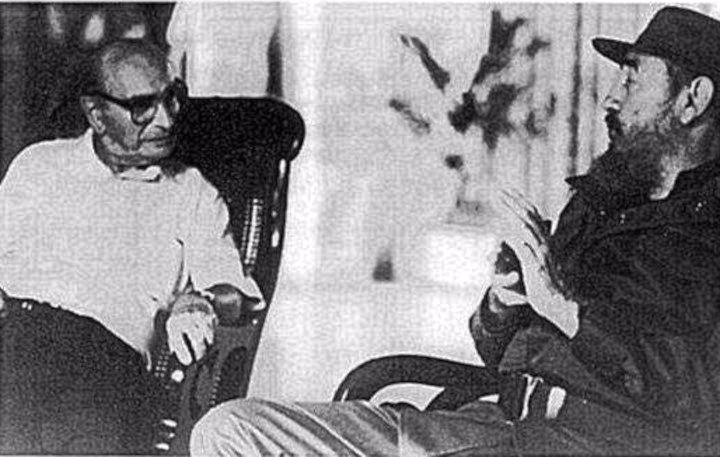
The Marxists Internet Archive has added 243 articles by Sam Marcy, expanding one of the most important collections of Marxist writing produced in the United States in the second half of the 20th century. The newly added articles, transcribed by Melinda Butterfield, span 1959 to 1996. The Sam Marcy Internet Archive now brings together these articles alongside books, pamphlets and biographical material.
For readers who know Marcy mainly through the major pamphlets — High Tech, Low Pay, Generals Over the White House, The Klan & the Government, Perestroika: A Marxist Critique, A Marxist Defense of the Los Angeles Rebellion, and others — the expanded archive shows something more: Marcy’s method in motion. It shows how he applied Marxist analysis week after week to wars, strikes, rebellions, elections, economic crises, socialist countries, national liberation struggles, and the changing composition of the working class.
The national question at the center
Central to Marcy’s work was the fight against racism and national oppression. He did not treat this as a separate question or a moral add-on to socialist politics. He treated it as a fundamental axis of the class struggle in the United States.
In “The Negro upsurge,” written in June 1959 as a letter to a comrade in the Deep South, Marcy argued that the Black liberation struggle was not simply a civil rights reform movement but a decisive revolutionary force. He looked back to Reconstruction and the Garvey movement as two moments when Black masses entered history on a vast scale — and when socialist and communist forces failed by not recognizing their revolutionary potential or making that struggle central to the fight for socialism.
That analysis runs through the archive like a spine. In July 1967, writing on the Newark Rebellion, Marcy hailed it as a “glorious answer to the master class.” In January 1970, he wrote on the government assassination of Black Panther leaders, linking the state’s violence to its long history of political murder. In November 1970, as the Black Panther Party-led Revolutionary People’s Constitutional Convention moved from the Philadelphia Plenary toward its planned Washington gathering, Marcy defended the Panthers against attacks from other left organizations that echoed the ruling-class campaign to isolate and vilify them. In September 1970, he wrote on U.S. responsibility for the genocidal assault on the Palestinian people.
The lesson running through these writings is clear: any Marxist analysis of the United States that does not put racism, national oppression and the Black struggle at the center is not a Marxist analysis of the United States.
Anti-war method
Marcy did not treat war as a mistake, a bad policy or a product of individual politicians. In “Anti-war strategy and the state as organized violence,” written in December 1967, he returned to Marx, Engels and Lenin to explain the capitalist state as an instrument of class domination — organized violence serving monopoly capital. The anti-war struggle, he argued, had to expose the state itself: the Pentagon, police, courts and prisons.
Generals Over the White House (1980) is the most sustained development of this analysis in the archive. Marcy’s view of militarism, he wrote, differed fundamentally from liberal anti-militarism, which treats the Pentagon as an aberration or a pressure group distorting otherwise reasonable state policy. For Marcy, the structure of capitalist society — the relationship between the basic classes — determines the politics of the capitalist state regardless of which governing group is in power. That policy is inevitably imperialist, and inevitably serves a military-industrial complex propelled in the direction of war. The generals are not over the White House despite the Constitution. They are there because of the class character of the state.
Marcy’s writing runs through five decades of U.S. war-making and world struggle. The early articles analyze the Cuban Revolution, China, the Soviet Union, the India-China border dispute and the emerging conflicts in the world communist movement as part of a new period in the global class struggle.
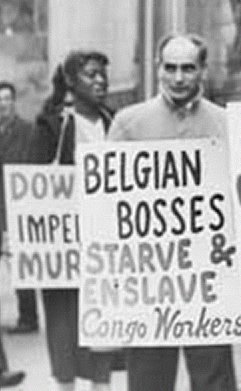
The 1960 articles take up the Congo Revolution and the UN’s role as an instrument of imperialist intervention. The 1968 articles on Czechoslovakia and the French general strike show Marcy grappling simultaneously with the crisis of the socialist states, the explosive energy of the Western working class and U.S. strategy toward both. On Czechoslovakia, what stood out was his insistence on judging events by their class character: he rejected the imperialist “democracy versus Moscow” frame and argued that the Dubček reforms were opening the door to capitalist restoration by weakening socialist property relations through market reforms and ties to Western capital. At the same time, he did not present the Soviet leadership as revolutionary; he distinguished between revisionism and full capitalist restoration, and argued that the long-term defense of socialist foundations could only come through the working class itself. In December 1969, he wrote on the historical and political significance of the My Lai massacre — not only as an atrocity story but as a window into the nature of imperialist war.
His 1991 writing on the Gulf War shows the analysis at full power: the political origins of the war, Congress’s abdication to the executive, the role of mass anti-war movement, and the deeper crisis of imperialist overextension. “War,” he quoted Clausewitz, “is simply the continuation of politics by other means.” The politics, Marcy insisted, was monopoly capitalism’s drive for profit and domination on a world scale.
Economic analysis
The same class framework anchors Marcy’s economic writing. In 1962, after a stock market collapse, he warned against treating financial shocks as market psychology. In 1979, he argued again that financial and credit crises are symptoms of the deeper contradiction between socialized production and capitalist appropriation. In “The dollar decline and the rise of the military,” he linked dollar instability to the monstrous growth of the U.S. military-industrial complex — corporate profit, state spending, inflation and war fused into one system.
High Tech, Low Pay, published in 1986, remains one of the archive’s most important works for today. Marcy saw that new technology under capitalism reorganized exploitation rather than relieving it. The scientific-technological revolution shifted the composition of the working class — expanding lower-paid service and clerical labor, drawing in more Black, Latine, Asian, Native, women and undocumented workers, and undermining older privileged layers. This was not a disappearance of the working class but its transformation. Marcy called for a classwide strategy: unions going beyond routine contract struggle to prepare new forms of combat, up to and including seizure and workers’ control of plants and industry.
The socialist countries
His writings on the socialist countries are another strength of the collection. He defended the USSR, Cuba, China, the DPRK and other workers’ states against imperialism without turning that defense into political passivity. In his 1991 writing on the collapse of the Soviet Union, he treated capitalist restoration as a world-historic defeat for the working class while tracing the internal class forces, national contradictions and imperialist pressures behind the crisis.
This is one of the archive’s greatest strengths: it shows Marcy thinking through defeats without surrendering to them. In 1993, he asked directly how revolutionaries should understand China after the Soviet collapse, warning against letting the State Department set the terms of analysis for the movement.
Marcy did not write as an academic observer of events. His Marxism was directed toward organization, intervention and preparation. The point was not simply to explain each crisis, but to identify the forces moving within it and the tasks facing revolutionaries. That is why so many of the articles still read as guides to action rather than historical commentary.
A working school
The Sam Marcy Internet Archive is more than a collection of historic articles. It is a working school in Marxist method — historical materialism applied to living events. The archive shows Marcy using the method Marx displayed in The Eighteenth Brumaire of Louis Bonaparte: looking past personalities and surface events to uncover the class forces, state forms and social contradictions driving history forward. It shows dialectical materialism not as a phrase, but as a method of scientific analysis: tracing contradictions, identifying class interests, and placing each struggle inside the larger movement of capitalist crisis and working-class resistance. War, racism, police repression, financial crisis, high technology, layoffs, sanctions and attacks on socialist countries are not separate issues. They are different fronts in the same global class struggle.
The archive is freely accessible at marxists.org.
Editor’s note: The Sam Marcy Internet Archive is maintained by the author.
Join the Struggle-La Lucha Telegram channel