
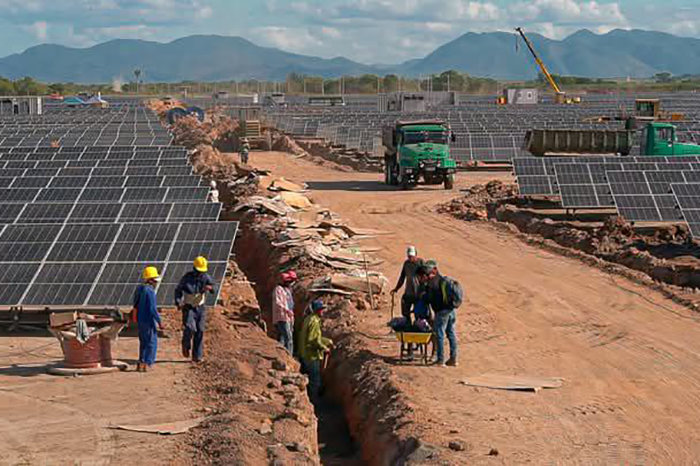
The Financial Times does not usually look to Cuba for lessons. But even the business press has had to notice what U.S. policy has produced: Washington’s oil blockade, tightened under conditions of widening war, has pushed the island deeper into a rapid solar buildout drawing on Chinese technology and Cuban state planning.
The blockade cut fuel supplies and drove blackouts that have lasted up to 20 hours a day. In response, China supplied a gigawatt of photovoltaic panels, 49 solar parks now connected to the national grid, and thousands of individual home kits, including systems for maternity wards, rural homes and emergency rooms. Solar’s share of Cuba’s electricity generation has tripled in roughly a year, rising from under 6% to more than 20%.
Félix Estrada Rodríguez, director of the National Load Dispatch Center of the Cuban Electric Union, reported that the country first crossed 800 megawatts of photovoltaic generation at midday on Feb. 10, then surpassed 900 megawatts the next day. By February, solar was covering 38% of generation during daylight hours.
China is also supplying batteries. According to The Economist, Cuba is importing them from Beijing at a frenzied pace, and battery storage is included in the next phase of the Mártires de Barbados II solar park already under construction. But storage is lagging behind panel deployment. Of the 55 solar parks planned for 2025, only four were equipped with battery systems. Peak demand in Cuba comes around 7 to 8 p.m., after sunset, and the gap between daytime solar generation and evening electricity use remains the central technical problem.
That problem sits inside a deeper one. Around 16% of all electricity generated is lost in the transmission system before it reaches consumers. Cuba’s thermoelectric plants, still the backbone of the grid, operate at an average of just 34% of capacity. On March 16, a boiler leak at the Antonio Guiteras plant in Matanzas, the island’s largest power station, brought down the grid from Camagüey to Pinar del Río within minutes. Experts estimate that restoring and modernizing the full system would cost $8 billion to $10 billion, a sum Cuba cannot raise on its own under blockade and one China is not expected to cover in full.
This is the real structure of the crisis. Cuba is not simply carrying out a normal energy transition. It is trying to reorganize basic survival under imperialist siege. The same blockade that cuts off fuel also blocks access to credit, spare parts and the long-term investment needed to rebuild the grid. Solar can ease part of the emergency. It cannot by itself overcome the accumulated damage imposed by decades of economic strangulation.
Cuban Energy Minister Vicente de la O Levy has said so directly. “This does not mean that blackouts will be completely eliminated,” he said. “This is a gradual, costly, investment-intensive process.”
The U.S. war on Iran sharpens that reality. Rising oil prices are putting pressure on governments everywhere, but Cuba is not just another country responding to market signals. It is a besieged socialist state being forced to reduce dependence on a fossil-fuel system dominated by hostile imperialist powers. As oil prices rise, more countries are turning to Chinese green technology. In Cuba, that opening is not mainly a market opportunity. It is a breach in the blockade’s attempt to isolate the revolution and wear it down through scarcity.
The blockade was meant to exhaust the Cuban Revolution by cutting it off from fuel, trade and the basic means of modern life. Instead, it has helped force an uneven but politically significant turn toward solar power, Chinese technology and planned adaptation. That has not solved the island’s energy crisis. The grid remains fragile, underfunded and vulnerable. But it has shown something Washington did not intend: Imperialist strangulation does not always produce surrender. Sometimes it produces new ways to resist, adapt and survive.
Join the Struggle-La Lucha Telegram channel