
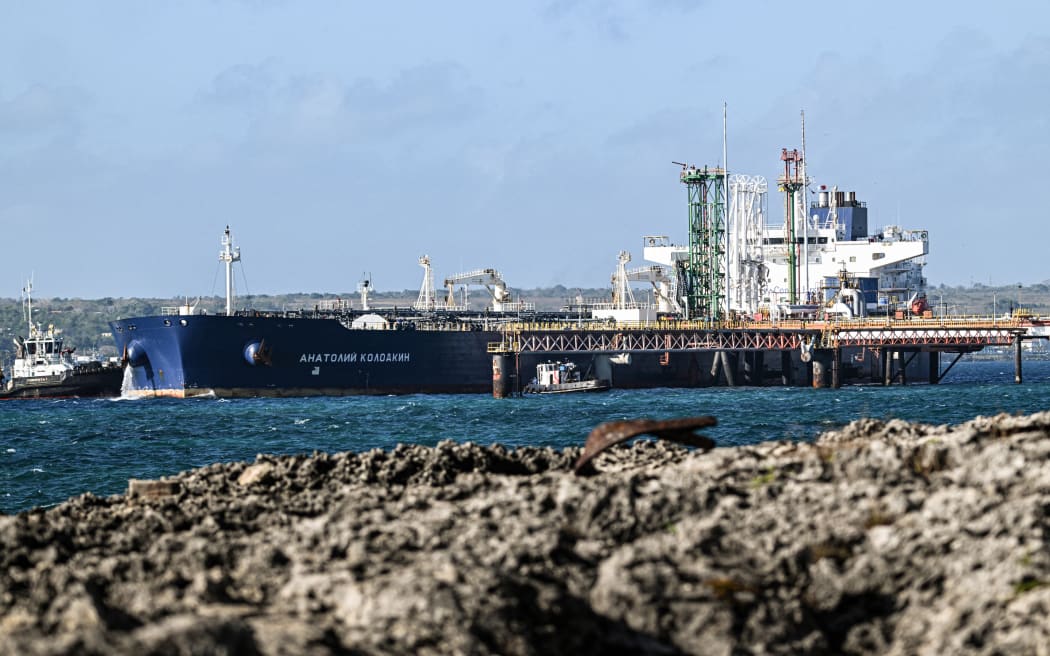
A Russian oil tanker carrying 730,000 barrels of crude oil docked at the Cuban port of Matanzas this week, delivering the largest fuel shipment to reach the island in months. Days earlier, 15,600 tons of rice donated by the Chinese government arrived in Havana — a concrete act of international solidarity with Cuba as the Trump administration tightens its blockade of the island.
The Anatoly Kolodkin departed the Russian port of Primorsk on March 8. A Russian Navy vessel escorted the tanker through the English Channel before it crossed the Atlantic. Russia’s Energy Ministry confirmed that the ship had docked and was unloading.
Despite the threats, the tanker was allowed to proceed. U.S. Coast Guard vessels were present in the region but received no orders to intercept it, the New York Times reported. Speaking to reporters aboard Air Force One on March 29, Trump claimed credit for the decision, saying he still expects Cuba to “fail soon.”
The deliveries came just days after Trump said in Miami on March 27 that Cuba was “next” following what he described as successful U.S. military operations in Venezuela and Iran. “Cuba’s next, by the way,” Trump said. “But pretend I didn’t say that.”
Cuba faces severe fuel shortages and recurring power cuts after Venezuelan oil shipments were cut off following the January U.S. operation that kidnapped President Nicolás Maduro and First Combatant Cilia Flores and imposed U.S. control over Venezuela’s oil exports. The resulting energy crisis has driven up fuel prices, slashed public transportation and threatened hospital operations across the country.
Chinese Ambassador to Cuba Hua Xin announced the arrival of the 15,600-ton rice shipment on March 28, calling it a concrete sign that “Cuba is not alone.” The following day, Chinese Foreign Ministry spokesperson Mao Ning paired that message with a direct political demand, urging Washington to immediately end its blockade and sanctions against Cuba, along with “any form of coercion or pressure.”
Cuban Foreign Minister Bruno Rodríguez condemned the blockade as a “brutal onslaught” on Cuba’s economic system. “For more than 67 years, the U.S. has imposed economic warfare against Cuba with the intention of harming the economy and denying access to markets and technology,” Rodríguez said in a March 29 statement.
Cuba has entered preliminary contacts with Washington, but President Miguel Díaz-Canel Bermúdez made clear they are exploratory, not negotiations. In an interview with Spanish political scientist Pablo Iglesias, he said the purpose is to determine whether any common agenda is possible — not to bargain over core principles. Sovereignty, independence and Cuba’s political system “are not up for discussion,” he said.
He placed the opening in historical context, noting that Cuba has sought dialogue with every U.S. administration from Kennedy to Obama, even as the blockade has tightened, particularly since 2019, when the activation of Title III of the Helms-Burton Act sharply cut off access to international finance and deepened the crisis still gripping the island today.
Cuba is preparing for the possibility that talks fail. Díaz-Canel described countrywide civilian-military drills now underway under Cuba’s “war of the entire people” defense doctrine. Every Cuban, he said, knows their role. The lesson of January — when 32 Cuban security personnel died defending Maduro against the U.S. raid that seized the Venezuelan president — was not lost on anyone. “They demonstrated what millions of Cubans are capable of when defending the island,” Díaz-Canel said.
“We don’t want war,” Díaz-Canel said. “But if that agreement doesn’t materialize, we are prepared. We would give our lives for the revolution.”
Join the Struggle-La Lucha Telegram channel