
Donald Trump stated the U.S. objective in Iran with unusual clarity. “My favorite thing,” he told the Financial Times on March 30, “is to take the oil in Iran.” He then compared Iran to Venezuela.
Venezuela is not just something Trump reached for. It shows the method: use force, then control the oil money.
In January, U.S. forces kidnapped Venezuelan President Nicolás Maduro and First Combatant Cilia Flores. The Trump administration said it intends to control Venezuela’s oil sales and revenue “indefinitely.”
Iran holds roughly 12% of the world’s oil and 17% of its natural gas. In 1953, the CIA overthrew Prime Minister Mohammad Mosaddegh and installed the Shah to keep that oil under Washington’s control. The 1979 revolution ended that arrangement. What Trump is proposing is not a departure from U.S. policy toward Iran. It is its clearest statement in decades.
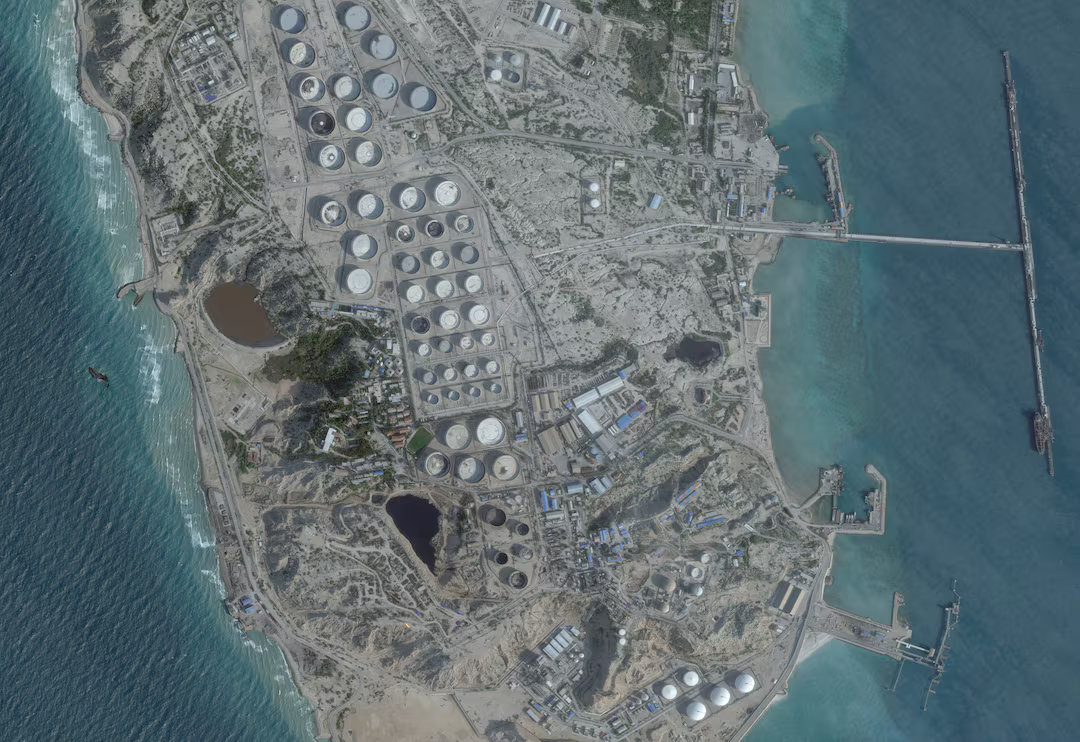
The target is Kharg Island in the Persian Gulf, about 15 miles off Iran’s southwestern coast. Between 15,000 and 20,000 people live there, most of them oil workers. Through its terminals pass approximately 90% of Iran’s crude oil exports — about 1.6 million barrels a day.
Trump expressed interest in the island decades before he became president. In a 1988 interview with The Guardian, he said: “I’d go in and take it.” He was a real estate and casino boss then, with no role in government. Now he commands the U.S. military.
On March 13, U.S. forces bombed more than 90 military targets on Kharg, hitting air defenses, a naval base and mine storage facilities. Oil infrastructure on the island was left intact — for now. That night, Trump boasted that the United States had “totally obliterated” Kharg’s military targets, said he had chosen not to destroy the oil facilities “for reasons of decency,” and threatened to reconsider if Iran, or anyone else, disrupted shipping through the Strait of Hormuz.
Trump framed interference with shipping through the Strait of Hormuz as the trigger for hitting Iran’s oil infrastructure. But that trigger was already in play. Iran had already been targeting vessels in the Strait, and Trump’s formula — interference by “Iran, or anyone else” — was broad enough to invoke whenever he chose. At a March 16 press conference, he dropped the decency framing entirely. The oil infrastructure had been spared, he said, “for the purposes of someday rebuilding that country.” “We didn’t want to do that,” he added, “but we will do that.”
More than 50,000 U.S. troops are now in the region. Marines, Army paratroopers, Rangers and Navy SEALs have all been sent into the Persian Gulf. These are forces built for raids, landings and occupation.
Trump, asked about Iranian defenses on the island, was dismissive. “I don’t think they have any defence. We could take it very easily.”
This war has already shown otherwise. Kharg lies well within artillery range of the Iranian mainland. Any amphibious force would have to transit the Strait of Hormuz and most of the Persian Gulf to reach it. Iran has already shown it can strike U.S. bases across West Asia with high accuracy. Nothing in this war suggests Kharg could be taken easily.
On March 30, Trump escalated again. On Truth Social, he threatened to “blow up and completely obliterate” Iran’s power plants, oil wells and Kharg Island — and “possibly” its desalination plants — if a peace deal was not reached “shortly” and the Strait of Hormuz was not “immediately open for business.”
But Trump’s confidence is not really about whether the plan would work. It comes from the imperialist claim that Washington gets to decide who controls the oil, the shipping lanes and the money they bring in.
The goal is the same as it was in 1953: to force Iran back under U.S. domination.
Join the Struggle-La Lucha Telegram channel