
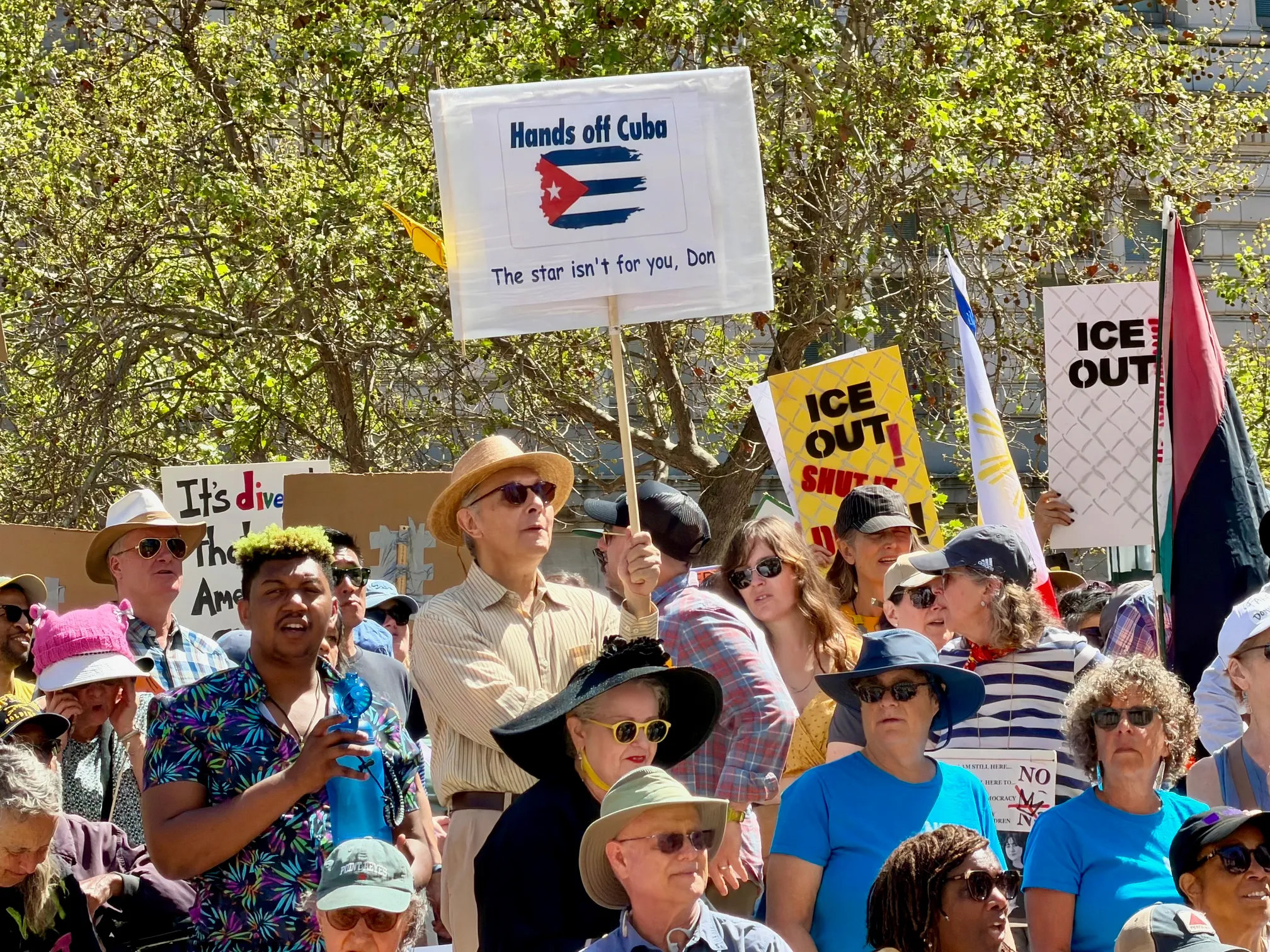
The organizers built the stage. The crowds brought the politics.
More than 8 million people filled the streets in over 3,000 cities and towns across the country on March 28 in the third round of “No Kings” protests — the biggest mobilization yet against the Trump administration and, by organizer count, the largest single-day protest in U.S. history.
The figures come from the 50501 Movement, the online organization that co-founded the No Kings campaign alongside Indivisible and MoveOn. Crowds surged in New York, Los Angeles, Chicago, Atlanta and Dallas.
“No Kings” was designed to contain the movement within Democratic Party politics and channel growing anger into the 2026 elections. But the crowds pushed past that framework.
Anti-war signs and chants were visible at nearly every protest, even as the official organizers downplayed or ignored the U.S. war on Iran in their public messaging. The official No Kings website listed grievances ranging from health care to corruption to billionaires, but did not name the Iran war. Organizers in multiple cities kept it off the program, and at rallies where speakers were vetted, antiwar voices were blocked. That was not an oversight. It reflected the leadership’s political dependence on a Democratic Party that refuses to break with the Iran war.
But the crowds did not follow that script. “No ICE, No Wars” was the most common chant of the day. The Iran war was on the signs, in the streets, and on the lips of millions of people whose opposition the official program had no room for.
That is the main contradiction in the movement right now. The infrastructure is tied to the Democratic Party, while the politics developing in the streets are moving beyond it. Indivisible and allied groups tried to channel enormous anger into voter registration drives and messaging for the 2026 midterms. Democratic officials at rallies offered no explanation of the deeper system behind the crisis and no path forward beyond the usual electoral routine. Meanwhile, Palestine solidarity contingents turned out by the thousands, from Seattle to New York.
The anti-war, pro-Palestine politics visible across the country on March 28 were not organized from the podium. They came from below — and they ran directly against the institutional commitments of the people who built the stage.
The Iran war was the foreign policy issue the crowds brought to March 28 over the objections of the organizers. But it is not the only front the Trump administration is fighting on.
Venezuelan President Nicolás Maduro and First Combatant Cilia Flores remain in U.S. custody, held in orange jumpsuits in a New York detention center after being seized in a military operation in January that killed over 150 people. The Trump administration is blocking Venezuelan funds to pay for their legal defense.
In Cuba, the blockade is tightening — daily power outages, fuel shortages and an armed infiltration attempt intercepted in February. Hundreds rallied in lower Manhattan on March 26, two days before No Kings 3, demanding Maduro and Flores be freed. That rally drew no coverage from the mainstream press and no acknowledgment from the No Kings leadership. The movement that outran its organizers on Palestine and Iran has the potential to make those connections too.
The most important announcement came at the end of the day. From the Minneapolis stage, No Kings organizers said the network would pivot toward a May Day general strike: no work, no school, no shopping on May 1.
That is a real step forward. The first three rounds of No Kings were protest mobilizations — impressive in size, but limited in leverage. A strike raises a different question. It brings the fight onto class ground. That is why the Minneapolis AFL-CIO general strike of Jan. 23 is being cited as the model.
Whether May 1 becomes something more depends on the same question raised on March 28: whether the movement the Democratic Party helped call into the streets is prepared to go further than the Democratic Party will. Eight million people in the streets suggests that question is no longer abstract.
Join the Struggle-La Lucha Telegram channel