
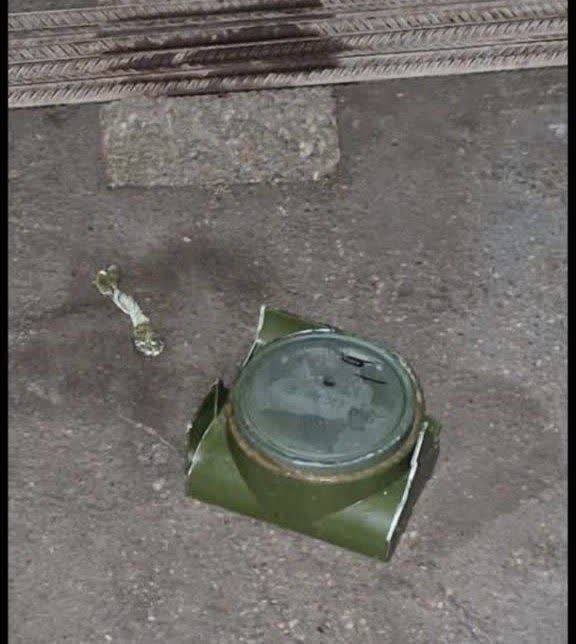
Multiple news organizations have confirmed that U.S.-made anti-tank landmines were scattered across residential areas outside Shiraz, in southern Iran. At least one civilian has been confirmed killed, and others were reportedly injured
The mines were identified by four independent weapons analysts as BLU-91/B scatterable anti-tank mines from the U.S. Gator mine system — the first confirmed U.S. combat use of such mines since the 1991 Gulf War.
U.S. Central Command has declined to confirm or deny the deployment. The evidence indicates this is the first confirmed U.S. mine use in combat in more than three decades.
What the images showed
Images and video of the devices first appeared in Iranian state media, which described them as “explosive packages slightly larger than tuna cans” dropped by aircraft over the southern suburbs of Shiraz. Multiple independent weapons analysts later identified them as BLU-91/B scatterable anti-tank landmines from the U.S. Gator mine system.
Dr. N.R. Jenzen-Jones of Armament Research Services said the images showed BLU-91/B mines dispensed from CBU-78/B or CBU-89/B air-delivered cargo bombs. He cited the square aeroballistic adaptors visible in the footage, a feature specific to the BLU-91/B and its companion anti-personnel variant, the BLU-92/B. Andro Mathewson, a former HALO Trust staffer, reached the same conclusion independently. Amael Kotlarski of Janes and multiple Washington Post sources described as munitions experts also corroborated the identification.
The U.S. is the only participant in the war known to possess the Gator system. Iran has no known path to these weapons, and the BLU-91/B was developed only after the 1979 revolution ended U.S. arms transfers to Iran. Public arms-transfer records also show no Gator transfers to Israel.
Civilians are being killed
At least one person has been confirmed killed: a 31-year-old father who picked up one of the mines from his driveway, not knowing what it was.
Iranian state media reported several additional deaths and injuries. These figures cannot be independently verified because of the internet shutdown Iran has maintained since Feb. 28.
The mines pose an ongoing and unpredictable threat to the civilian population. The BLU-91/B activates two minutes after deployment and carries a self-destruct mechanism set for four hours, 48 hours or 15 days. But the self-destruct can fail. After the 1991 Gulf War, a contractor hired by the Kuwaiti government found 205 Gator BLU-91 duds in a single sector of one battlefield. Years after the war, mines were still exploding from the heat with no triggering event.
The devices “resemble ready-made canned food,” according to Iranian authorities, who urged the public not to touch them. Ordinary contact with the devices or the ground around them could trigger an explosion.
Whatever military objective Washington claims, scattering these mines across a residential village violates the most basic rule of war: civilians cannot be treated as targets. A weapon scattered across a residential village cannot reliably distinguish between a military target and civilian life.
The Gator system typically deploys anti-tank and anti-personnel mines together, but the available images so far show only anti-tank mines. Whether anti-personnel variants were also used remains unconfirmed.
The U.S. used the same Gator mine tactic in the 1991 Gulf War. A later GAO review found no measurable military benefit, but it did find large numbers of unexploded duds left behind, killing and injuring civilians and U.S. troops for years. It failed then. It is killing civilians now.
A war crime, not a technicality
The United States has never signed the Ottawa Convention, the 1997 treaty banning anti-personnel landmines. Anti-tank mines like the BLU-91/B are not covered by that treaty, and Washington has long argued that such weapons remain lawful military tools.
But that technical distinction does not settle what happened outside Shiraz. The central legal question is whether the attack distinguished between military targets and civilians. A weapon scattered across a residential village does not do that. Used this way, the attack is indiscriminate.
That is the basis on which this attack should be understood: as a war crime.
A directive signed by Defense Secretary Pete Hegseth earlier this year authorized the use of such weapons. This attack outside Shiraz appears to be one such case. But no order from Washington can make it lawful to scatter landmines across a civilian village.
Join the Struggle-La Lucha Telegram channel