
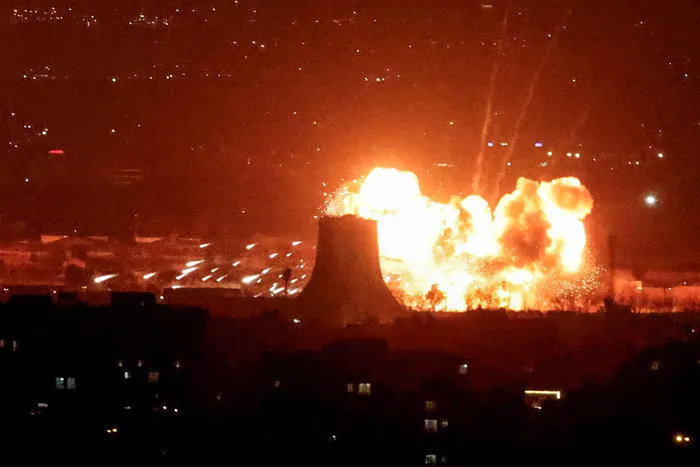
The war launched on Feb. 28 did not come out of nowhere.
It is the latest stage in more than 80 years of U.S. intervention in Iran — a continuous effort to control a country with some of the largest oil and gas reserves in the world.
That history begins during World War II.
In 1943, U.S., British and Soviet leaders met in Tehran to coordinate the defeat of Nazi Germany. Iran was officially independent, but it was under Allied military occupation and British imperial control over its oil. The three powers issued a declaration pledging to respect Iran’s sovereignty — even as London and Washington moved to secure Anglo-Iranian Oil Company assets and Persian Corridor infrastructure under long-term Western control.
After the war, Washington sealed that position in place.
In 1946, the United States drove Soviet forces out of northern Iran, consolidating Western control over the country. Iran became an early test case for U.S. global power.
The 1953 coup
The decisive step came in 1953.
Prime Minister Mohammad Mossadegh nationalized Iran’s oil industry, which had been controlled by British interests. The response was immediate. The CIA and British intelligence organized a coup to remove him and restore Mohammad Reza Pahlavi to the throne.
That coup reshaped Iran.
U.S. oil companies gained a major share of production. The Shah ruled as an autocrat. A secret police force enforced the system. Iran had become a neocolony — formally independent, but with its resources extracted, its politics controlled and its repressive state apparatus serving foreign capital. It was a reliable source of oil profits and a key U.S. outpost in West Asia.
For the next 25 years, that system held.
Iran as U.S. enforcer
Under the Nixon Doctrine, the United States turned Iran into its main regional enforcer. Washington dramatically escalated arms sales, supplying the Shah with tens of billions in advanced weapons. Oil revenues were funneled back through U.S. banks and into U.S. industry. Iran functioned as a proxy power, enforcing U.S. control in the Gulf.
Inside the country, the Shah’s secret police — SAVAK, built with CIA and Israeli intelligence assistance — ran a system of mass surveillance, arbitrary detention and torture. Amnesty International reported in 1976 that Iran held more political prisoners than almost any country in the world. The regime’s repressive apparatus was trained, equipped and backed by the United States.
By 1977, Iran ranked 17th among the world’s economies, with a GDP of roughly $80 billion and oil revenues of $20 billion a year. None of it reached the majority of Iranians. Some 68% of the population remained illiterate. Infant mortality ran at roughly 100 deaths per 1,000 live births — higher than in neighboring Iraq, whose economy was less than a quarter the size of Iran’s but whose state-led development delivered broader basic services to its people. The oil wealth flowed to the Pahlavi court and to the foreign capital it served. For workers and peasants, that ranked economy could not keep children alive or teach parents to read.
Revolution breaks the system
That system broke in 1979. Years of repression had built pressure across every class the Shah’s order excluded — workers, peasants pushed off the land, urban poor crowded into shantytowns, students and professionals with no political voice. The wealth was real. The deprivation was equally real. The contradiction had become intolerable.
Millions took to the streets. The uprisings were not spontaneous eruptions — they were the product of deep organization through mosques, neighborhood committees and underground political networks that SAVAK had failed to destroy. Wave after wave of demonstrations swept Tehran and cities across the country through 1978, each massacre met with larger crowds. On Black Friday — September 8, 1978 — government forces gunned down demonstrators in Tehran’s Jaleh Square. It did not stop the uprising. It accelerated it.
The Shah’s rule did not fall from street pressure alone. Oil workers walked off the job and shut down production — cutting off the revenues that financed the military, the secret police and the entire apparatus of U.S.-backed control. It was the working class, at the point of production, that brought the system to its knees. Millions had driven the Shah from power. Direct U.S. control over Iran was finished.
Washington responded immediately.
Sanctions and military threats
Carter froze Iranian assets and imposed sanctions in 1979.
When Iraq invaded Iran in 1980, Washington backed Saddam Hussein — providing intelligence, financing and diplomatic cover. The objective was to exploit and prolong the conflict, weakening both countries while U.S. and Western oil companies moved to reassert control over the region’s energy and politics.
That war lasted eight years and killed hundreds of thousands of Iranians and Iraqis.
In July 1988, as the war was ending, a U.S. warship shot down Iran Air Flight 655, killing all 290 people aboard. Washington called it a mistake. No one was held accountable.
Sanctions deepened through the 1990s. A 1996 law extended U.S. economic pressure beyond its own borders, targeting foreign companies doing business with Iran. Clinton administration officials drew up contingency plans for cruise-missile strikes and a potential full-scale invasion. Washington repeatedly warned that “all options are on the table.” Carrier groups, long-range bombers and missile-defense assets were deployed to the Persian Gulf to underline the threat. By the 21st century, the economic siege and the permanent military menace had become defining features of U.S. policy toward Iran.
The 21st century brought new tactics but the same objective.
Iran’s nuclear program is for civilian energy and economic development, which is its right under the Nuclear Non-Proliferation Treaty. In 2015, under intense Western pressure, Iran reached an agreement with the United States and five other powers — the Joint Comprehensive Plan of Action — limiting its nuclear program in exchange for sanctions relief. It was an unequal concession. Iran surrendered significant nuclear capacity. Washington partially lifted an economic siege it had no legal or moral right to impose.
It did not last. In 2018, the Trump administration withdrew from the agreement and reimposed sanctions under a campaign it called “maximum pressure.” Iran holds roughly 17% of the world’s natural gas reserves and 12% of its oil reserves — among the largest concentrations on earth. Those resources had been under Western control before 1979. The revolution took them back. Washington has never accepted that.
In January 2020, a U.S. drone strike assassinated General Qasem Soleimani at Baghdad International Airport. Iraqi Prime Minister Adil Abdul-Mahdi later told parliament that Soleimani had come to Baghdad on a diplomatic mission — carrying Iran’s response to a Saudi message as part of Iraq-mediated de-escalation talks between Tehran and Riyadh. Washington killed him anyway. The assassination was a direct act of war — carried out on Iraqi soil without congressional authorization or declaration of war, and in deliberate sabotage of a regional peace process.
Iran absorbed the blow and did not capitulate.
War returns openly
Washington escalated. In June 2025, Israel launched the Twelve-Day War — surprise airstrikes on Iran’s nuclear facilities at Natanz, Fordow and Isfahan, plus military bases and government infrastructure across the country. Israel functions as a forward military outpost for U.S. imperialism in West Asia. Its strikes were coordinated with Washington, not independent. When Israeli attacks could not fully destroy Iran’s most deeply buried sites, the United States stepped in directly. On June 22, Trump launched Operation Midnight Hammer — B-2 bombers and submarine-launched cruise missiles targeting the same facilities. A U.S.-brokered ceasefire ended the fighting June 24.
The nuclear pretext was three decades old by then. The United States — the only country ever to use nuclear weapons — and Israel, which maintains a large, undeclared nuclear arsenal, had recycled their belligerent demands to justify what was always a war for control — over Iran’s energy, its financial independence, its refusal to accept subordination to the U.S.-dominated order.
The sanctions, the assassinations, the proxy wars and the bombing campaigns all failed to restore the control Washington lost in 1979. The Feb. 28 assault is Washington’s answer to that failure — a war of imperialist plunder attempting to take back what the revolution took away.
Join the Struggle-La Lucha Telegram channel