
Following is Struggle – La Lucha’s submission to the United Nations Committee on the Elimination of Racial Discrimination on behalf of Cuba (CERD). Cuba is a signatory to both the International Convention on the Elimination of All Forms of Racial Discrimination (ICERD) of 1969 and the 2001 Durban Declaration and Programme of Action. This text concerns Cuba’s progress in eliminating racial oppression, and was submitted to the CERD on March 23 as part of Cuba’s periodic review as required by this UN convention.
Learning from Cuba’s 2022 Families Code
I traveled to Cuba twice as a reporter for Struggle-La Lucha magazine: first in May 2023 and again in July 2025. The 2023 trip was with the U.S. Friends Against Homophobia and Transphobia delegation, organized by Women in Struggle – Mujeres en Lucha. This delegation brought together LGBTQ+ activists from across the U.S. to learn about Cuba’s new Families Code, passed in September 2022 by popular referendum. The 2025 trip was a follow-up to learn about subsequent developments and for the Havana launch of the book “Love is the law: Cuba’s queer rights revolution,” a compilation of writings from our delegation.
The Families Code is a major overhaul to the country’s constitution regarding sexuality, gender, and family life. It is one of the world’s most progressive codes on families, and it passed with 66.85% in favor. This code greatly expands the rights of women, queer and trans people, and ultimately all Cubans.
The code was developed and adopted via a mass-democratic process that happened across the country, with debate everywhere from neighborhood assemblies to labor union halls. Cuba’s socialist revolution made this possible, at a time when capitalist governments like that of the U.S. are trying to erase queer and trans people and push back all gains made by working-class and oppressed people.
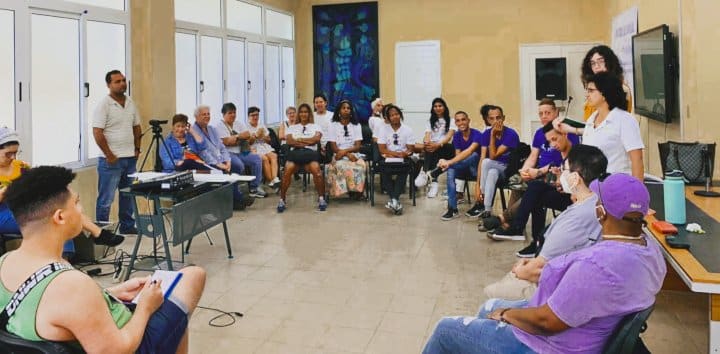
During this trip, we met with Cuban activists at the headquarters of the National Center for Sex Education (CENESEX) in Havana. These activists represent multiple LGBTQ+ organizations, including TransCuba, La Red HSH (the Network of Men Who Have Sex with Men), and the Network of Lesbian and Bisexual Women in Cuba. These are autonomous organizations of people from these communities that work closely with CENESEX, which is under the Ministry of Health.
We also met with delegates from the neighborhood assemblies who shared their experiences of debating and voting on the code at the local level. They shared rich accounts of how people’s consciousness was transformed through this process.
The activists we met with were diverse in their racial and ethnic make-up, reflecting the diversity of Cuban society. As a longtime organizer for LGBTQ+ rights in the U.S. state of Louisiana, I know that LGBTQ+ people do not simply face oppression on the basis of their gender identities and sexuality, and racist segregation present in society can be reproduced in LGBTQ+ organizations if there are not conscious strategies to overcome that. I was, therefore, impressed by these groups’ diverse make-up, which must reflect the steps that Cuba has taken to overcome racist oppression and discrimination.
It could be objected that these activist organizations are not representative of the level of integration typical of the broader LGBTQ+ community in Cuba. However, our delegation also interacted with the Havana LGBTQ+ community outside the activist context. We attended a drag show at one of Havana’s most popular queer bars. Many of us commented on how incredibly diverse the patrons were, not only in racial terms. In the U.S., it is not always the case that trans people, queer women, and queer men gather in the same spaces. In this bar, that was the case.
A legal advisor for CENESEX, Sonia Zaldivar, explained to us that this Families Code “was conceived and resulted from many years of fighting and the study of science. … By combining every type of knowledge – from the streets, from the academy, from other countries – [a Families Code was crafted] that stayed true to our conception of life. After 26-27 versions of the document, which changed with discussions across society, the Code went into effect with over 60% approval.”
While U.S. lawmakers are attempting to prevent discussion of LGBTQ+ life in schools, Cuba is ensuring that schools include lessons about sexual orientation and gender identity in the curriculum. The law affirms that parents have a responsibility to teach their children about these things and to respect their children’s identities.
Cuba has redefined marriage and the family structure to include all types of actually existing families, from those with LGBTQ+ parents to households led by grandparents. The patriarchal nuclear family does not capture the reality on the ground, and in Cuba, it is no longer privileged in the legal framework. The new Code even gives more rights to step-parents (including step-fathers or step-grandparents) who have dedicated themselves to the care of a child.
Color Cubano
This mass-democratic process resulting in the Families Code is typical of Cuba’s approach to politics, building up consensus from the street level. That means giving working-class people the chance to shape the direction of society, unlike in the United States, where access to the political arena depends upon access to millions of dollars. Cuba used this approach to develop its 2019 constitution as well as the 2022 Families Code.
While our delegation was focused on learning about the Families Code, we learned a great deal about the Cuban political system in general. This makes me confident that Cuba’s approach to ending racist oppression and discrimination is just as thorough-going.
In 2019, Cuba strengthened its institutional framework to overcome racial oppression with the National Program against Racism and Racial Discrimination, also known as “Color Cubano.” The purpose of Color Cubano – implemented at the highest levels of government – is to root out all vestiges of racism from pre-revolutionary society, which was shaped by European colonialism, genocide against Indigenous peoples like the Taíno, the enslavement of Africans, and decades of domination by U.S. imperialism.
Color Cubano calls for national action plans, anti-discrimination laws, education, and effective remedies for victims of discrimination. The program is managed by a National Commission composed of representatives from 18 state entities, 18 civil society organizations, and 12 research bodies. In October 2023, the Color Cubano Social Laboratory was inaugurated at the Quintín Banderas Cultural Center in Havana to support the program through research and monitoring. The initiative also includes the revision of school curricula to better highlight African history, culture, and the contributions of Afro-Cubans to the country’s development. All of this is in stark contrast to the efforts by the Trump administration in the U.S. to weaken laws against racial discrimination and restrict discussion of past and current oppression in the educational system.
Cuba is a signatory to the International Convention on the Elimination of All Forms of Racial Discrimination (ICERD) of 1969 and the 2001 Durban Declaration and Programme of Action. The goals of Color Cubano are completely in keeping with Cuba’s international commitments to eliminate racism.
Note on the 2019 constitution
It is noteworthy that Color Cubano was adopted in 2019, the same year that Cuba ratified its new constitution. The new Families Code is in many ways an outgrowth of the consultative process to draft the constitution.
The draft of this constitution was discussed and debated in about 133,000 people’s discussion meetings across the country between Aug. 13 and Nov. 15 of 2018. Over 9 million people participated in workplaces, neighborhoods, and more. Around 60% of the content was modified as a result of these discussions, demonstrating the democratic character of the process.
Consider that the U.S. Constitution was written 239 years ago – exclusively by white, male property owners. Because of who wrote it, it does not reflect the voices and experiences – much less the interests – of the diverse population of the U.S., except through a limited number of amendments resulting from major struggles. By contrast, Cuba has a constitution created by people alive today, reflecting the needs of the working class, women, LGBTQ+ people, and others who have been historically marginalized.
The mere fact of this constitution is a victory for oppressed people and enshrines anti-racism into law. Article 42 states:
“Discrimination motivated by race, color of the skin, sex, national origin, religious creeds, or any other offending human dignity, is proscribed and is penalized by the law. The institutions of the State educate everyone, from the earliest age, in the principle of the equality of human beings.”
Representation in Cuba’s parliament
Cuba’s seriousness about eliminating oppression is also demonstrated by the makeup of its parliament, the National Assembly of People’s Power. According to Cuba’s 2025 report to the ICERD:
“Of the 470 deputies, 55.74 per cent are women and 45.11 per cent are black or mulattos. About 20 per cent are between 18 and 35 years old. The average age of the deputies is 46 years, and 94.04 per cent are university graduates.”
Contrast this with the U.S. Congress. According to Pew Research Data from January 2025, the 119th Congress is the most racially and ethnically diverse in the country’s history. And yet:
“Just over a quarter (26%) of voting members in the U.S. Congress identify as a race or ethnicity other than non-Hispanic White.”
According to Pew Research Data from February 2025:
“Women make up 28% of voting members in the 119th Congress – on par with their share in the last Congress, but a considerable increase from where things stood even 10 years ago.”
That kind of progress is glacial by Cuban standards.
Cuba eliminating the structural basis of racial oppression
Like the U.S. South and Haiti, Cuba was part of a bigger Caribbean world dominated for centuries by slavery and the plantation system. Slave rebellions shook Cuba in the 1840s. One of the most famous insurrectionists was Carlota Lucumí, a Yoruba woman who led an uprising at the Triumvirato sugar mill. She is counted in the immortal ranks of revolutionaries like Haiti’s Toussaint L’Ouverture and Charles Deslondes, who led a slave rebellion in south Louisiana in 1811, inspired by the Haitian Revolution. But the “peculiar institution” of slavery was not abolished in Cuba until 1886, 21 years after the end of the U.S. Civil War.
Cuban revolutionaries won independence from Spain in 1898. With the Spanish out, Washington and Wall Street took over, turning the country into a sugar plantation neo-colony. Havana became a mob-run haven for foreign sex tourism.
Dictator Fulgencio Batista’s Cuba of the 1950s was a nightmare for the great majority; he was Washington’s hand-picked stooge. Countrywide, per capita income was half that of Mississippi, the poorest state in the U.S. The average Cuban was living on 312 pesos or $6 per week. Few rural areas had schools, and children often died early from infectious diseases. Most workers were employed on the huge farms and were out of work – suffering from malnutrition and other plights – during the off-season.
But between 1959 and 1963, Cuba’s revolutionary socialist government carried out land reform, breaking the cycle of rural poverty. They did what the radical Reconstructionists in the U.S. dreamed of doing. So, even though Cuba has a very similar history of colonial genocide against the Indigenous people and enslavement of Africans, its social reality today is starkly different from the U.S. South. Cuba is as multinational as the U.S. but is infinitely further along on the road to racial equality and is not riven by comparable levels of economic inequality.
Regime change would wipe out progress
Cuba’s economy has been strangled by the U.S. blockade since 1962. The purpose was always to immiserate the population to force regime change. The targets have always been civilians.
A declassified 1960 State Department Memorandum, “The Decline and Fall of Castro,” explains the doctrine plainly. In this document, Lester Mallory – then Deputy Assistant Secretary of State for Inter-American Affairs – said that the majority of Cubans supported the socialist government. (April 6, 1960, Foreign Relations of the United States, 1958–1960, Cuba, Volume VI, Document 499.) Therefore, the U.S. strategy must be “disenchantment and disaffection based on economic dissatisfaction and hardship.” He argued that Washington must work to deny “money and supplies to Cuba, to decrease monetary and real wages, to bring about hunger, desperation, and the overthrow of government.”
The intensity of the blockade has ebbed and flowed, but the objective has remained the same: destroy Cuba’s political system and make it into a neocolony of the U.S. In his second term, U.S. President Donald Trump has attempted to outright starve Cuba to bring about its collapse. Beginning in December of 2025, the U.S. has implemented an almost complete oil blockade, resulting in the collapse of the electrical system.
If Cuba becomes a failed state, the result will not be more democracy or better living conditions, but the opposite: unimaginable misery. Cuba might be overrun by narcotrafficking cartels, whose customers are primarily in the U.S. International financial institutions dominated by the U.S. would likely impose privatizations and austerity – the “shock therapy” that dramatically lowered life expectancies across the former Soviet Union and Eastern Bloc countries. Cuba’s health care and educational systems would be dismantled so that foreign capitalists could make money.
All of Cuba’s gains made since 1959 would be erased. The economic, social, and legal foundations for those gains would be wiped out, and that would include Cuba’s progress in the elimination of racial oppression and discrimination. The international community – including all relevant UN bodies – must vigorously oppose what the U.S. is doing. Trump must not be allowed to “take” Cuba.
Join the Struggle-La Lucha Telegram channel