
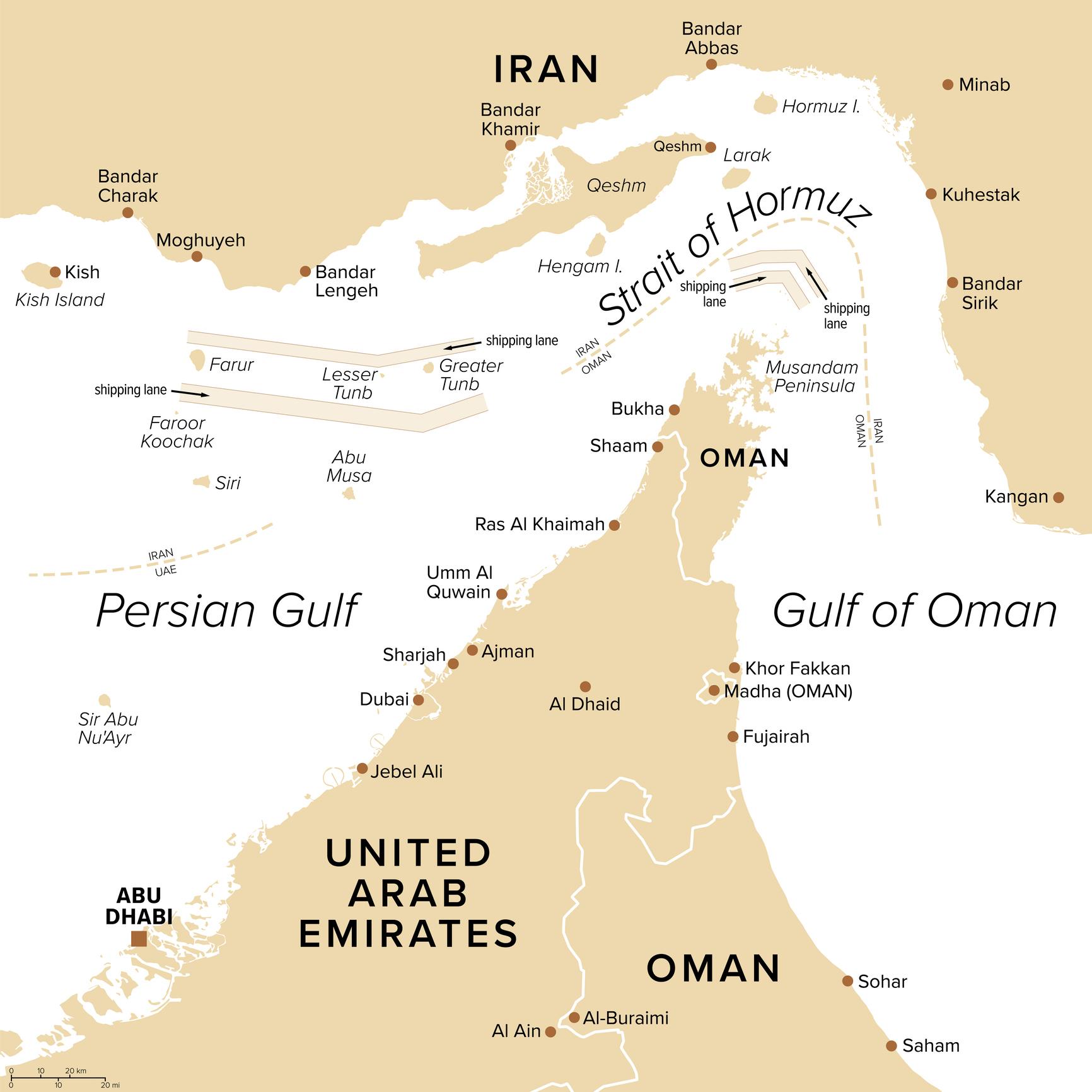
Reports emerging in early March suggest Iran may allow limited tanker passage through the Strait of Hormuz — on one condition: payment must be made in Chinese yuan.
The claim comes from an unnamed Iranian official speaking to CNN and has not been confirmed by Iranian state media. It may be a trial balloon. It may be a negotiating signal. But the discussion points to something deeper than tanker traffic or oil prices: the dollar sanctions system that Washington uses as a weapon of economic warfare.
Economic warfare is still warfare
The U.S. war on Iran did not begin on Feb. 28, 2026, when the bombs started falling. It has been waged for more than four decades through sanctions, financial blockades, and the systematic use of dollar power as a weapon.
Sanctions are economic warfare directed against workers. They fall first on the general population through inflation, shortages and collapsing public services. Food, medicine and fuel become more expensive. Banking channels close. Governments divert resources from social programs just to keep the economy functioning. The aim is simple: make life unbearable enough that populations turn on their governments — or that governments capitulate.
The instrument that makes this global enforcement possible is the dollar system. Most international payments pass through U.S. banks or dollar accounts, which allows the U.S. Treasury to threaten foreign banks with being cut off from the U.S. financial system if they do business with sanctioned countries.
Iran has lived under that war for over 40 years. Cuba has lived under it for more than 60 years and now faces fuel shortages and blackouts as the Trump regime tightens the strangling blockade on energy supplies. Venezuela has faced escalating financial siege since 2015, when sanctions cut the country off from credit markets and oil revenues that fund social programs. The Democratic People’s Republic of Korea, Syria and Zimbabwe. The U.S. now maintains sanctions programs affecting roughly one-third of the world’s population.
In March 2026, as oil prices topped $100, the U.S. quietly lifted sanctions on 128 million barrels of Russian oil to offset supply losses from its own war on Iran. The same sanctions architecture used to strangle Iran’s civilian economy for four decades, turned off when it suited Washington. No principle. No consistency. A weapon used when useful, set aside when not.
What dollar hegemony actually does
Since the collapse of the Bretton Woods gold system in 1971, the dollar has remained at the center of world finance through a dense web of financial markets, banking infrastructure and political power anchored in the United States.
Dollar dominance is not primarily about oil pricing. That framing overstates some things and misses others.
The real power lies in financial markets.
The dollar is the world’s reserve currency — the unit in which most international debt is issued and in which central banks hold much of their reserves — leaving those reserves vulnerable to seizure — and through which a large share of global financial transactions are settled, supported by the deepest and most liquid financial markets in the world.
Once the global financial system is built around a currency, the system reinforces itself. Banks use it, companies borrow in it, and governments hold their reserves in it. That makes it very difficult for another currency to replace it.
Switching away from it is difficult, and no single country or bloc has yet built financial markets deep enough to replace it. Even the euro, after more than 20 years, has made only limited progress.
This gives the U.S. government a weapon no other state can wield on the same scale. Because most international payments pass through banks connected to the U.S. dollar banking system, Washington can threaten to cut any country — or any bank that does business with it — off from global finance. That threat is credible. Banks in Europe, Asia and Latin America comply with U.S. sanctions not because their own laws require it, but because refusing could get them cut off from the U.S. banking system that moves much of the world’s money.
The result is that U.S. foreign policy can strangle economies from a desk in Washington. Workers in sanctioned countries pay through inflation, shortages and unemployment. Workers elsewhere pay through austerity imposed to satisfy dollar-denominated debts and IMF conditions.
The system functions as the financial infrastructure of modern imperialism.
What the yuan story actually means
By itself, the yuan payment story does not challenge dollar dominance. Oil may be invoiced in yuan, but the world price of oil is still set in dollar markets.
What the yuan payment story does represent is something narrower and more immediately significant: the construction of payment infrastructure that routes around the dollar system.
If Iran can require yuan payment for Strait passage, and if that becomes regular practice rather than a one-time workaround, it creates a way for Iran and its trading partners to settle payments without sending the money through U.S. banks. That plumbing can then be used more broadly — to settle other transactions, to extend credit, to build the kind of financial relationships that make sanctions progressively harder to enforce.
The mechanism already exists. China’s Cross-Border Interbank Payment System — CIPS — provides a payment channel that allows banks to settle transactions without routing the money through the U.S. banking system. A transaction settled through CIPS between a Chinese and Iranian bank never touches a U.S. correspondent bank, which is precisely where sanctions enforcement enters the picture. The dollar doesn’t move. A U.S. institution is never involved. The transaction happens entirely within China’s financial system. Iranian banks can then use the yuan they receive to pay for Chinese goods, machinery, or medicine — outside the reach of U.S. Treasury enforcement.
This is why Washington is alarmed. Not because the dollar is about to collapse, but because every expansion of dollar-independent payment infrastructure can reduce the reach of U.S. economic warfare. It means sanctioned countries can trade, import medicine, sell oil, and receive payment without touching a system the U.S. controls.
For Iran, after four decades of sanctions, that matters enormously. For Venezuela, Cuba, and every other country living under U.S. financial siege, the precedent matters too.
The war gave Iran the leverage
Iran’s geographic leverage over the Strait of Hormuz — a narrow waterway carrying roughly one-fifth of the world’s oil shipments — has always been a strategic fact. What changed is that the U.S. decision to launch a war of aggression against Iran gave Tehran an active reason to use that leverage, and a negotiating position strong enough to make conditions.
The U.S. ruling class calculated that military force could achieve what four decades of sanctions had not: the destruction of the Iranian government and the installation of a compliant replacement. Instead, they handed Iran a weapon.
The attempt to use military power to reinforce financial dominance may ultimately accelerate the pressures eroding both.
The stakes for workers
But the direction of travel matters. Every payment rail that bypasses the dollar system is a reduction in U.S. capacity to impose economic warfare. Every country that develops the ability to trade without routing payments through the U.S. dollar banking system is a country that can survive sanctions rather than be strangled by them.
Workers worldwide have a direct stake in that. The dollar system as a coercive instrument has produced decades of structural poverty and austerity across the Global South. Its erosion is not an abstraction. It is a concrete reduction in the tools available to the U.S. ruling class to discipline governments that step out of line — to punish countries that nationalize their oil, support their workers, or refuse to subordinate their economies to imperialist finance.
The consequences are visible in places like Cuba today, where tightening U.S. pressure on oil shipments has produced fuel shortages, long power outages, and disruptions to transportation, food distribution and medical services across the island.
The war on Iran is a war to preserve that system. For decades Washington has used sanctions, financial blockades and the power of the dollar to discipline countries that refuse to subordinate their economies to imperialist finance. Military force is the same strategy, stripped of pretense.
Iran’s yuan gambit does not overturn the system. But every payment channel that bypasses it weakens the reach of U.S. economic warfare and makes it harder to starve a country into submission.
For Iran, for Cuba, for Venezuela — and for every country living under the threat of sanctions — that matters.
At stake is U.S. capacity to use global finance as a weapon of war.
Join the Struggle-La Lucha Telegram channel